

Introductions to Goethe's Scientific Writings
GA 1
Translated by Steiner Online Library
4. On the Nature and Significance of Goethe's Writings on Organic Formation
[ 1 ] The great significance of Goethe's morphological works is to be found in the fact that in them the theoretical basis and the method of the study of organic natures is established, which is a scientific deed of the first rank.
[ 2 ] If one wishes to appreciate this in the right way, one must first of all bear in mind the great difference that exists between phenomena of inorganic and those of organic nature. A phenomenon of the former kind is, for example, the collision of two elastic spheres. If one ball is at rest and the other collides with it in a certain direction and with a certain speed, the latter will also have a certain direction of movement and a certain speed. If it is a question of comprehending such a phenomenon, this can only be achieved by transforming what is immediately available to the senses into concepts. We must succeed in this to the extent that nothing sensually real remains which we have not penetrated conceptually. We see one sphere arriving, bumping into the other, the latter moving on. We have conceived this phenomenon when we can determine the speed and direction of the latter from the mass, direction and velocity of the first and from the mass of the other; when we realize that under the given conditions this phenomenon must occur with necessity. But the latter means nothing else than: That which presents itself to our senses must appear as a necessary consequence of what we have to presuppose ideally. If the latter is the case, we can say that concept and appearance coincide. There is nothing in the concept that is not also in the phenomenon and nothing in the phenomenon that is not also in the concept. Now we have to look more closely at those relationships as a necessary consequence of which an appearance of inorganic nature occurs. Here the important circumstance arises that the sensually perceptible processes of inorganic nature are conditioned by relations which also belong to the world of the senses. In our case, mass, velocity and direction, i.e. definitely conditions of the sensory world, come into consideration. Nothing else appears as a condition of appearance. Only the directly sense-perceptible circumstances are interdependent. A conceptual grasp of such processes is therefore nothing other than a derivation of the sense-perceptible-real from the sense-perceptible-real. Spatio-temporal relationships, mass, weight or sensually perceptible forces such as light or heat are what cause phenomena that belong to the same series. A body is heated and thereby increases its volume; the first as well as the second belongs to the world of the senses, both the cause and the effect. In order to understand such processes, therefore, we do not need to leave the world of the senses. We only deduce one phenomenon from another within it. If, therefore, we wish to explain such a phenomenon, i.e. to penetrate it conceptually, we have no other elements to include in the concept than those which can also be perceived with our senses. We can look at everything we want to grasp. And this is the ceiling of perception (appearance) and concept. Nothing remains obscure to us in the processes because we know the relationships from which they follow. We have thus developed the essence of inorganic nature and at the same time shown the extent to which we can explain it from within itself without going beyond it. There has never been any doubt about this explainability since we first began to think about the nature of these things. One has not always gone through the above train of thought, from which the possibility of a congruence of concept and perception follows; but one has never hesitated to explain phenomena in the manner indicated from the nature of their own being. 64Some philosophers maintain that we can trace the phenomena of the sense world back to their original elements (forces), but that we can explain them just as little as the essence of life. On the other hand, it should be noted that these elements are simple, i.e. cannot be further composed of simpler elements. However, it is impossible to derive or explain them in their simplicity, not because our cognitive faculty is limited, but because they are based on themselves; they are present to us in their immediacy, they are self-contained, cannot be derived from anything else.
[ 3 ] The situation was different until Goethe with the phenomena of the organic world. In the organism, the conditions perceptible to the senses, e.g. shape, size, color, thermal conditions of an organ, do not appear conditioned by conditions of the same kind. It cannot be said of a plant, for example, that the size, shape, position, etc. of the root determine the sensually perceptible conditions of the leaf or flower. A body in which this were the case would not be an organism, but a machine. On the contrary, it must be admitted that all sensory relationships in a living being do not appear as a consequence of other sensory-perceptible relationships, as is the case with inorganic nature.65This is precisely the contrast between the organism and the machine. In the latter, everything is an interaction of parts. Nothing real exists in the machine itself except this interaction. The unified principle which governs the interaction of those parts is absent in the object itself and lies outside it in the mind of the designer as a plan. Only the most extreme short-sightedness can deny that this is precisely the difference between organism and mechanism, that the principle which brings about the interaction of the parts is only present outside (abstractly) in the latter, whereas in the former it gains real existence in the thing itself. Thus the sensually perceptible relations of the organism do not appear as a mere consequence of one another, but as dominated by that inner principle, as a consequence of such a principle which is no longer sensually perceptible. In this respect it is just as little perceptible to the senses as that plan in the mind of the constructor, which is also only there for the mind; indeed, it is essentially that plan, except that it has now moved into the interior of the being and no longer carries out its effects through the mediation of a third party - that constructor - but does so directly itself. Rather, all sensory qualities appear here as the consequence of something which is no longer sensually perceptible. They appear as the consequence of a higher unity hovering above the sensory processes. It is not the form of the root that determines the form of the stem, nor the form of the stem that determines the form of the leaf, etc., but all these forms are determined by something above them, which is not itself a sensory-perceptual form; they are there for each other, but not through each other. They are not interdependent, but are all conditioned by another. We cannot derive what we perceive sensually from sensually perceptible relationships, we must include elements in the concept of processes that do not belong to the world of the senses, we must go beyond the world of the senses. It is no longer enough to look at things, we must grasp the unity conceptually if we want to explain phenomena. This, however, leads to a distancing of perception and concept; they no longer seem to coincide; the concept hovers above the perception. It becomes difficult to see the connection between the two. Whereas in inorganic nature concept and reality were one, here they seem to diverge and actually belong to two different worlds. The view that presents itself directly to the senses does not seem to have its foundation, its essence, in itself. The object does not seem to be explainable by itself, because its concept is not derived from itself, but from something else. Because the object does not appear to be governed by the laws of the world of the senses, but is nevertheless there for the senses, appears to them, it is as if we were faced here with an insoluble contradiction in nature, as if there were a gulf between inorganic phenomena, which can be understood by themselves, and organic beings, in which an intervention in the laws of nature occurs, in which universally valid laws are suddenly broken through. This gulf was in fact until Goethe generally accepted in science; only he succeeded in speaking the solving word of the riddle. Before him, it was thought that only inorganic nature could be explained by itself; human cognition ceased with organic nature. The magnitude of Goethe's achievement is best appreciated when one considers that the great reformer of modern philosophy Kant not only shared this old error completely, but even sought to find a scientific justification for the fact that the human mind would never succeed in explaining organic formations. He did see the possibility of an intellect - an intellectus archetypus, an intuitive intellect - which would be able to see through the connection between concept and reality in organic beings just as it does in inorganic beings; but he denied the possibility of such an intellect in man himself. According to Kant, the human mind is supposed to have the property that it can only conceive of the unity, the concept of a thing as arising from the interaction of the parts - as an analytical general obtained through abstraction - but not in such a way that each individual part appears as the outflow of a certain concrete (synthetic) unity, a concept in intuitive form. Therefore it is also impossible for this understanding to explain organic nature, for this would have to be conceived as acting out of the whole into the parts. Kant says of this: "Our understanding therefore has the peculiarity for the power of judgment that knowledge is not determined by it, by the general, by the particular, and therefore the latter cannot be derived from the former.66Kant, Kritik der Urteilskraft; edition by Kehrbach, p. 294. Thus, in the case of organic formations, we would have to refrain from recognizing the necessary connection between the idea of the whole, which can only be thought, and what appears to our senses in space and time. According to Kant, we would have to limit ourselves to recognizing that such a connection exists; but the logical requirement of recognizing how the general thought, the idea, emerges from itself and reveals itself as a sensuous reality, this could not be fulfilled in the case of organisms. Rather, we would have to assume that concept and reality are here directly opposite each other and have been brought about by an influence outside the two in the same way as man builds some composite thing, e.g. a machine, according to an idea he has conceived. This denied the possibility of an explanation of the world of organisms, even seemingly proving its impossibility.
[ 4 ] This is how things stood when Goethe set out to cultivate the organic sciences. But he set about studying them after he had been prepared for them in the most appropriate way through repeated readings of the philosopher Spinoza.
[ 5 ] The first time Goethe approached Spinoza was in the spring of 1774. Goethe says of this first acquaintance with the philosopher in “Dichtung und Wahrheit”: 67III. “After I had looked around the world in vain for a means of educating my strange nature, I finally came across the ethicsof this man”. In the summer of the same year, Goethe met Friedrich Jacobi. The latter, who dealt with Spinoza in greater detail - as evidenced by his letters on Spinoza's teachings in 1785 - was entirely suited to introducing Goethe more deeply to the philosopher's nature. Spinoza was also much discussed at the time, for with Goethe "everything was still in its first effect and counter-effect, fermenting and boiling". 68Dichtung und Wahrheit, III. Teil, 14. Buch. Some time later, he found a book in his father's library whose author fought fiercely against Spinoza, even disfiguring him to the point of a complete grimace. This prompted Goethe to take another serious look at this profound thinker. In his writings he found answers to the deepest scientific questions that he was capable of raising at the time. In 1784, the poet read Spinoza with Frau von Stein. He wrote to his friend on November 19, 1784: "I am bringing Spinoza with me in Latin, where everything is much clearer ..." [WA 6, 392] The effect of this philosopher on Goethe was now immense. Goethe himself was always clear about this. In 1816 he wrote to Zelter: "Apart from Shakespeare and Spinoza I would not know that any other departed person has had such an effect on me (as Linné)" [WA 27, 219] He thus regarded Shakespeare and Spinoza as the two spirits who had the greatest influence on him. How this influence manifested itself in relation to the studies of organic education becomes clearest to us when we consider a word about Lavater from the "Italian Journey": Lavater also held the view, generally accepted at the time, that a living thing could only come into being through an influence not inherent in the nature of beings themselves, through a disturbance of the general laws of nature. Goethe wrote the following words about this: "The other day, in a tiresome apostolic-capuchin-like declamation by the Zurich prophet, I found the nonsensical words: Everything that has life lives through something outside itself. Or so it sounded. Now a heathen proselytizer can write that down, and the genius won't "pluck him by the sleeve" when revising it. 69Italian Journey, Oct. 5, 1787. Now this is spoken entirely in the spirit of Spinoza. Spinoza distinguishes between three types of knowledge. The first kind is that in which we remember things when we hear or read certain words and form certain ideas of these things, similar to those by which we visualize them. The second kind of cognition is that in which we form common concepts from sufficient ideas of the properties of things. The third kind of knowledge, however, is that in which we proceed from the sufficient conception of the real nature of some of God's attributes to the sufficient knowledge of the nature of things. Spinoza now calls this kind of knowledge scientia intuitiva, the conceiving knowledge. It was this latter, the highest kind of knowledge, that Goethe was striving for. Above all, we must be clear about what Spinoza wants to say: things are to be known in such a way that we recognize some attributes of God in their essence. Spinoza's God is the idea content of the world, the driving, all-supporting and all-sustaining principle. We can either imagine it as an independent being, existing separately from the finite beings, which has these finite things beside it, dominates them and brings them into interaction. Or else, one imagines this being as being absorbed into the finite things, so that it no longer exists above and beside them, but only in them. This view by no means denies that primordial principle, it fully recognizes it, only it regards it as poured into the world. The first view regards the finite world as a revelation of the Infinite, but this Infinite remains in its essence, it forgives itself nothing. It does not go out of itself, it remains what it was before its revelation. The second view also sees the finite world as a revelation of the infinite, only it assumes that this infinite in its revelation has gone completely out of itself, has put itself, its own being and life into its creation, so that it only exists in this. Since cognition is obviously an awareness of the essence of things, but this essence can only exist in the part that a finite being has of the primal principle of all things, cognition is called an awareness of that which is infinite in things. 70Some attributes of God in them. Now, as we have explained above, before Goethe it was assumed that inorganic nature could be explained by itself, that it bore its reason and its essence within itself, but not so in organic nature. Here one could not recognize that essence which reveals itself in the object in the latter itself. It was therefore assumed to be external to it. In short, organic nature was explained according to the first view, inorganic nature according to the second. As we have seen, Spinoza had proved the necessity of unified knowledge. He was too much of a philosopher to extend this theoretical demand to the special branches of organic science.* This was left to Goethe. Not only the above statement, but numerous others prove to us that he was firmly committed to the Spinozist view. In "Dichtung und Wahrheit": 71IV. "Nature works according to eternal, necessary, so divine laws that the deity itself could not change it. " And with regard to Jacobi's book published in 1811: "Von den göttlichen Dingen und ihrer Offenbarung" Goethe remarks: 72Tag- und Jahres-Hefte 1811. "How could I welcome the book of such a warmly beloved friend, in which I was to see the thesis carried out: nature conceals God. With my pure, deep, innate and practiced way of looking at things, which had taught me to see God in nature and nature in God without fail, so that this way of looking at things was the basis of my whole existence, did not such a strange, one-sided and limited statement have to distance me in spirit from the noblest man, whose heart I adored, forever?" Goethe was fully aware of the great step he was taking in science; he realized that by breaking down the barriers between inorganic and organic nature and consistently applying Spinoza's way of thinking, he was bringing about a significant change in science. We find this realization expressed in the essay Anschauende Urteilskraft Having found the Kantian justification of the inability of the human mind to explain an organism in the "Critique of Judgment" that we have mentioned above, he speaks out against it thus: "It is true that the author (Kant) seems here to point to a divine intellect, but if in the moral we are to elevate ourselves to an upper region through belief in God, virtue, and immortality, and approach the first being, it may well be the same case in the intellectual, that by beholding an ever-creating nature we make ourselves worthy of spiritual participation in its productions. If I had first unconsciously and from an inner drive restlessly pressed for that archetypal, typical thing, if I had even succeeded in building up a natural representation, nothing could now prevent me from courageously passing the adventure of reason, as the old man from Königsberg himself calls it." [Natw. Schr., 1st vol. p. 116.]
[ 6 ] The essence of a process of inorganic nature, or in other words: of a process belonging to the mere sense world, consists in the fact that it is caused and determined by another process also belonging only to the sense world. Let us now assume that the causative process consists of the elements m, c and r, 73mass, direction and velocity of a moving elastic sphere, and that the effected process consists of m', c' and r'; thus, for certain m, c, and r, m', c' and r' are always determined by those elements. If I now want to understand the process, I must represent the whole process, which is composed of cause and effect, in a common concept. But this concept is not such that it lies in the process itself and that it could determine the process. It now summarizes both processes in a common expression. It neither causes nor determines. Only the objects of the sense world determine themselves. The elements m, c and r are also perceptible elements for the external senses. The concept only appears there to serve the mind as a means of summarization, it expresses something that is not ideal, not conceptual, that is sensually real. And that something which it expresses is a sensuous object. Knowledge of inorganic nature is based on the possibility of grasping the external world through the senses and expressing their interaction through concepts. Kant saw the possibility of recognizing things in this way as the only one available to man. He called this thinking discursive; what we want to know is external perception; the concept, the summarizing unity, is merely a means. But if we wanted to know organic nature, we would not have to grasp the ideal moment, the conceptual, as one that expresses, means, borrows its content from another, but we would have to recognize the ideal as such; it would have to have its own content originating from itself, not from the spatio-temporal world of the senses. That unity, which our mind merely abstracts there, would have to be based on itself, it would have to form itself out of itself, it would have to be formed according to its own essence, not according to the influences of other objects. The comprehension of such an entity that forms itself out of itself, that reveals itself by its own power, should be denied to man. What is necessary for such a comprehension? A power of judgment that can also lend a thought a substance other than merely a substance received through the external senses, a power that can grasp not only the sensible, but also the purely ideal for itself, separated from the sensory world. One can now call a concept that is not taken from the sensory world by abstraction, but which has a content flowing from it and only from it, an intuitive concept and the cognition of it an intuitive one. What follows from this is clear: an organism can only be grasped in the intuitive concept. That it is granted to man to recognize in this way is shown by Goethe's deed.*
[ 7 ] In the inorganic world there is interaction between the parts of a series of phenomena, mutual interdependence of the members of the same series. This is not the case in the organic world. Here it is not one member of a being that determines the other, but the whole (the idea) determines each individual from itself, according to its own nature. This self-determining entity can be called, with Goethe, an entelechy. Entelechy is therefore the force that calls itself into existence out of itself. What comes into appearance also has a sensuous existence, but this is determined by that entelechical principle. This is also the source of the apparent contradiction. The organism determines itself out of itself, makes its properties according to a presupposed principle, and yet it is sensually real. It has thus arrived at its sensuous reality in a quite different way from the other objects of the sense world; it therefore seems to have come into being in a non-natural way. But it is also quite understandable that the organism in its outward appearance is just as exposed to the influences of the sense world as any other body. A stone falling from a roof can hit a living being as well as an inorganic body. The organism is connected with the external world through the intake of food etc.; all physical conditions of the external world have an effect on it. Of course, this can only take place insofar as the organism is an object of the sensory world, a spatio-temporal object. This object of the external world, the entelechical principle that has come into existence, is the external appearance of the organism. However, since it is not only subject to its own laws of formation, but also to the conditions of the external world, not only as it should be according to the nature of the entelechical principle that determines itself from within itself, but also as it is dependent on and influenced by others, it never appears completely appropriate to itself, as it were, never merely obeying its own nature. Then human reason enters and forms in the idea an organism that is not in accordance with the influences of the external world, but only in accordance with that principle. Every accidental influence, which has nothing to do with the organic as such, falls away completely. This idea, which corresponds purely to the organic in the organism, is now the idea of the primordial organism, the type of Goethe. From this we can also see the high justification of this type idea. It is not a mere concept of understanding, it is that which is truly organic in every organism, without which it would not be an organism. It is even more real than any individual real organism, because it manifests itself in every organism. It also expresses the essence of an organism more fully, more purely than any individual, particular organism. It is obtained in a substantially different way than the concept of an inorganic process. The latter is extracted, abstracted from reality, it is not effective in the latter; the idea of the organism, however, is active, effective as entelechy in the organism; in the form grasped by our reason it is only the essence of entelechy itself. It does not summarize experience; it affects that which is to be experienced. Goethe expresses this with the words: "Concept is sum, idea result of experience; to draw the latter, understanding is required, to grasp the latter, reason." (Proverbs in Prose [Natw. Schr., 4th vol., 2nd abb., p. 379]) This explains the kind of reality that belongs to Goethe's primeval organism (primeval plant or primeval animal). This Goethean method is obviously the only possible one for penetrating into the essence of the world of organisms.
[ 8 ] In the case of the inorganic, it is to be regarded as essential that the phenomenon in its multiplicity is not identical with the lawfulness that explains it, but merely points to the latter as something external to it. View - the material element of cognition - which is given to us through the external senses, and the concept - the formal - through which we recognize the view as necessary, stand opposite each other as two elements that objectively demand each other, but in such a way that the concept does not lie in the individual members of a series of appearances themselves, but in a relationship between them. This relationship, which summarizes the multiplicity into a unified whole, is grounded in the individual parts of the given, but as a whole (as a unity) it does not come to real, concrete appearance. Only the members of this relationship come to external existence - in the object. The unity, the concept, as such only appears in our understanding. It has the task of summarizing the multiplicity of appearances; it relates to the latter as a sum. We are dealing here with a duality, with the manifold thing that we look at and with the unity that we think. In organic nature, the parts of the manifold of a being are not in such an external relationship to one another. The unity comes to reality at the same time as the multiplicity, as identical with it in what is seen. The relationship between the individual members of a manifest entity (organism) has become a real one. It no longer comes to concrete appearance merely in our understanding, but in the object itself, in the latter of which it produces the multiplicity from itself. The concept does not merely have the role of a sum, of something summarizing, which has its object outside itself; it has become completely one with it. What we look at is no longer different from that by which we think what we look at; we look at the concept as an idea itself. This is why Goethe calls the faculty by which we comprehend organic nature anschauende Urteilskraft. The explaining - the formal of cognition, the concept - and the explained - the material, the contemplation - are identical. The idea through which we grasp the organic is thus essentially different from the concept through which we explain the inorganic; it does not merely summarize a given manifold - like a sum - but sets its own content out of itself. It is the result of the given (of experience), a concrete phenomenon. This is the reason why in inorganic natural science we speak of laws (laws of nature) and explain the facts through them, whereas in organic. Nature, on the other hand, we do this using types . The law is not one and the same with the manifoldness of the view that it dominates, it stands above it; in the type, however, the ideal and the real have become one, the manifold can only be explained as starting from a point of the whole that is identical with it.
[ 9 ] The significance of Goethe's research lies in the recognition of this relationship between the science of the inorganic and that of the organic. One is therefore mistaken if today the latter is often declared to be an anticipation of that monism which seeks to establish a unified view of nature encompassing both the organic and the inorganic by endeavoring to trace the former back to the same laws - the mechanical-physical categories and laws of nature - by which the latter is conditioned. We have seen how Goethe conceives of a monistic view. The way in which he explains the organic is essentially different from the way in which he proceeds with the inorganic. He wants the mechanical mode of explanation to be strictly rejected in the case of what is of a higher kind (see "Proverbs in Prose" [Natw. Schr., 4th vol., 2nd ed., p. 413]). He criticizes Kieser and Link for wanting to attribute organic phenomena to inorganic modes of action. (Ibid. 1st vol., pp. 198 and 206.)
[ 10 ] The reason for the indicated erroneous view of Goethe was the relationship in which he placed himself to Kant with regard to the possibility of a knowledge of organic nature. But when Kant asserts that our understanding is unable to explain organic nature, he certainly does not mean that it is based on mechanical laws and that he is only unable to grasp it as a consequence of mechanical-physical categories. According to Kant, the reason for this inability lies precisely in the fact that our understanding can only explain mechanical-physical things and that the essence of the organism is not of this nature. If it were, the intellect could very well comprehend it by means of the categories at its disposal. Goethe is not thinking of explaining the organic world despite Kant as a mechanism; rather, he claims that we are by no means deprived of the ability to recognize the higher kind of natural activity that constitutes the essence of the organic.
[ 11 ] When we consider what has been said above, we are immediately confronted with an essential difference between inorganic and organic nature. Because there any given process can cause another, which in turn can cause another and so on, the series of processes nowhere appears to be a closed one. Everything is in constant interaction, without a certain group of objects being able to close itself off from the influence of others. The inorganic series of actions have no beginning or end anywhere; the following is related to the preceding only by chance. If a stone falls to earth, its effect depends on the accidental form of the object on which it falls. The situation is different in an organism. Here unity is the first thing. The entelechy built upon itself contains a number of sensuous forms of organization, of which one must be the first, another the last; in which the one can only ever follow the other in a quite definite way, The ideal unity sets out of itself a series of sensuous organs in temporal succession and in spatial juxtaposition and separates itself in a quite definite way from the rest of nature. It sets its states out of itself. Therefore, they can only be understood in such a way that one follows the formation of successive states emerging from an ideal unity, i.e. an organic being can only be understood in its becoming, in its development. The inorganic body is closed, rigid, can only be aroused from the outside and is immobile on the inside. The organism is the restlessness within itself, constantly transforming, metamorphosing from within. The following sayings of Goethe refer to this: "Reason is dependent on what is becoming, understanding on what has become; the latter does not worry: what for? the latter does not ask: whence? -She delights in developing; he wishes to hold on to everything so that he can make use of it" ("Proverbs in Prose"; Natw. Schr., 4th vol., 2nd abb., p. 373) and "Reason has dominion only over the living; the created world, with which geognosy deals, is dead." [Ibid. p.373]
[ 12 ] The organism appears to us in nature in two main forms: as a plant and as an animal; in both in different ways. The plant differs from the animal in the lack of a real inner life. In the animal, the latter appears as sensation, voluntary movement, etc. The plant does not have such a mental principle. It is still completely absorbed in its exteriority, in its form. Inasmuch as this entelechical principle determines life from one point, as it were, it confronts us in the plant in such a way that all the individual organs are formed according to the same principle of form. Entelechy appears here as the formative power of the individual organs. The latter are all built according to one and the same type of formation, they appear as modifications of one basic organ, as repetitions of the same at different stages of development. That which makes the plant a plant, a certain formative power, is active in the same way in every organ. Each organ thus appears to be identical with all the others and also with the whole plant. Goethe expresses this as follows: "It has occurred to me that the true Proteus lies hidden in that organ of the plant which we usually refer to as a leaf, and that it can hide and reveal itself in all forms. Forwards and backwards the plant is always only a leaf, so inseparably united with the future germ that one cannot think of one without the other." 74Italian Journey, May 17, 1787. The plant thus appears to be composed, as it were, of nothing but individual plants, as a more complicated individual, which in turn consists of simpler ones. The formation of the plant thus progresses from stage to stage and forms organs; each organ is identical with every other, i.e. the same according to the principle of formation, but different in appearance. The inner unity of the plant expands, as it were, in breadth; it lives itself out in diversity, loses itself in it, so that it does not, as we shall see later in the animal, acquire a concrete existence endowed with a certain independence, which as a center of life confronts the diversity of organs and uses them as mediators with the outer world.
[ 13 ] The question now arises: How is this difference in the appearance of the plant organs, which are identical in their inner principle, brought about? How is it possible for the laws of formation, which all act according to one principle of design, to produce a leaflet on one occasion and a sepal on another? In the life of the plant, which is entirely external, the difference can also only be based on external, i.e. spatial moments. Goethe now sees alternating expansion and contraction as such. When the entelechical principle of plant life, which acts from a single point, comes into existence, it manifests itself as spatial; the formative forces act in space. They produce organs of a certain spatial form. Now these forces either concentrate, they strive together, as it were, into a single point; and this is the stage of contraction, or they spread out, unfold, they strive, as it were, to move away from each other: this is the stage of expansion. In the whole life of the plant, three expansions alternate with three contractions. Everything different that enters into the essentially identical formative forces of the plant comes from this alternating expansion and contraction. First, the whole plant rests on one point contracted in the seed (a). It now emerges from this and unfolds, expands in leaf formation (c). The forming forces repel each other more and more, which is why the lower leaves still appear rough and compact (cc'); the further upwards, the more ribbed and jagged they become. What was previously pressed together now moves apart (leaves d and e). What used to be in successive spaces (zz') now reappears in the formation of the keich (f)
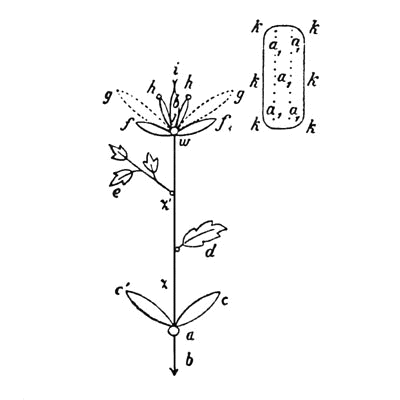
[ 14 ] at one point of the stem (w). The latter forms the second contraction. An unfolding, spreading occurs recently in the corolla. The petals (g) are finer and more delicate in comparison to the sepals; this can only be due to a lower intensity at one point, i.e. a greater extension of the formative forces. The next contraction occurs in the reproductive organs [stamens (h) and pistil (i)], whereupon a new expansion takes place in the fruit formation (k). In the seed (a) that emerges from the fruit, the entire essence of the plant is again condensed into a single point. 75The fruit is formed by the outgrowth of the lower part of the pistil (ovary 1); it represents a later stage of the pistil and can therefore only be drawn separately. The final expansion occurs during fruit formation. Plant life differentiates itself into a concluding organ, the actual fruit, and into the seed; in the former all moments of appearance are, as it were, united, it is mere appearance, it alienates itself from life, becomes a dead product. All the inner, essential moments of plant life are concentrated in the seed. A new plant emerges from it. It has become almost entirely ideal, its appearance is reduced to a minimum.
[ 15 ] The whole plant represents only an unfolding, a realization of what is potentially dormant in the bud or in the seed. Bud and seed only need the appropriate external influences to become perfect plant formations. The difference between bud and seed is only that the latter has the earth directly as the ground of its unfolding, whereas the former generally represents a plant formation on a plant itself. The seed represents a plant individual of a higher kind, or, if you like, a whole circle of plant formations. The plant begins, as it were, a new stage of its life with each bud formation, it regenerates itself, it concentrates its forces in order to unfold them anew. The formation of buds is therefore also an interruption of vegetation. Plant life can contract into a bud when the conditions of actual real life are lacking, in order to unfold anew when they occur. The interruption of vegetation in winter is based on this. Goethe says about this: 76Italian Journey, Dec. 2, 1786. "It is quite interesting to notice how a lively vegetation that is not interrupted by severe cold works; there are no buds here, and one first learns to understand what a bud is." So what lies hidden in the bud with us is open during the day there; it is therefore true plant life that lies in the latter; only the conditions for its unfolding are missing.
[ 16 ]The concept of alternating expansion and contraction in Goethe has now been particularly opposed, but all attacks on it are based on a misunderstanding. It is believed that these concepts could only be valid if a physical cause could be found for them, if one could prove a mode of action of the laws at work in the plant from which such expansion and contraction would follow. This only shows that one is taking the matter to the extreme instead of to the base. There is nothing to be presupposed which causes expansion or contraction; on the contrary, everything else is a consequence of the former; they bring about a progressive metamorphosis from stage to stage. One cannot conceive of the concept in its self-existent, intuitive form; one demands that it should be the result of an external process. Expansion and contraction can only be thought of as caused, not as effected. Goethe does not regard expansion and contraction as if they followed from the nature of the inorganic processes taking place in the plant, but he regards them as the way in which that inner entelechical principle shapes itself. He could therefore not regard them as a sum, as a summary of sensory processes and deduce them from such, but he had to derive them as a consequence of the inner unified principle itself.
[ 17 ] Plant life is sustained by metabolism. With regard to this, there is an essential difference between those organs that are closer to the root, i.e. the organ that takes up nourishment from the earth, and those that receive the nutrient that has already passed through other organs. The former appear to be directly dependent on their external inorganic environment, the latter on the organic parts preceding them. Each succeeding organ therefore receives nourishment prepared, as it were, for itself by the preceding organ. Nature progresses from seed to fruit in a sequence of stages, so that what follows appears as the result of what precedes. And Goethe calls this progression a progression on a spiritual ladder. Nothing more than what we have indicated lies in his words, "that an upper node, by arising from the preceding one and receiving the juices indirectly through it, must receive them more finely and more filtered, must also enjoy the influence of the leaves that has happened in the meantime, must develop itself more finely and supply its leaves and eyes with finer juices". All of these things become understandable if one attaches to them the meaning intended by Goethe.
[ 18 ] The ideas set out here are the elements inherent in the essence of the primordial plant, and indeed in a manner appropriate to the plant itself, not as they appear in a particular plant, where they are no longer original but appropriate to external conditions.
[ 19 ] Now, of course, something different occurs in animal life. Life does not lose itself here in externality, but separates itself, separates itself from corporeality and uses corporeal appearance only as its tool. It no longer expresses itself as a mere ability to shape an organism from within, but expresses itself in an organism as something that is still there outside the organism, as its dominating power. The animal appears as a self-contained world, a microcosm in a much higher sense than the plant. It has a center that every organ serves.
"So every mouth is skillful to grasp the food,
Which is due to the body, be it weak and toothless
Or mightily toothed jaws; in either case,
an appropriate organ provides nourishment for the other limbs
. Also every foot, the long one, the short one, moves completely
harmoniously to the sense of the animal and its need." 77"Metamorphosis of Animals"; cf. Natw. Schr., 1st vol., p. 344.
[ 20 ] In the plant, the whole plant is in each organ, but the principle of life does not exist anywhere as a specific center; the identity of the organs lies in their formation according to the same laws. In the animal, each organ appears as coming from that center, the center forms all organs according to its nature. The form of the animal is therefore the basis for its external existence. But it is determined from within. The way of life must therefore be based on these inner principles of formation. On the other hand, the inner formation is in itself unrestricted, free; it can submit to external influences within certain limits; but this formation is one determined by the inner nature of the type and not by mechanical influences from outside. Adaptation cannot therefore go so far as to make the organism appear merely as a product of the external world. Its formation is a limited one.
"No god extends these limits, nature honors them;
For only thus limited was perfection ever possible." 78Metamorphosis of Animals, op. cit. p.345.
[ 21 ] If every animal being only conformed to the principles inherent in the primordial animal, they would all be the same. However, the animal organism is divided into a number of organ systems, each of which can reach a certain degree of development. This now gives rise to a differentiated development. Although, in principle, equal to all the others, one system can push itself to the fore, can utilize the reserve of formative powers in the animal organism and withdraw it from the other organs. The animal thus appears particularly developed in the direction of that organ system. Another animal appears to be formed in a different direction. Herein lies the possibility of the differentiation of the primordial organism during its transition into appearance into genera and species.
[ 22 ] However, the real (actual) causes of differentiation are not yet given. Here they come into their own: adaptation, according to which the organism shapes itself according to the external conditions surrounding it, and the struggle for existence, which works towards ensuring that only those beings best adapted to the prevailing circumstances survive. However, adaptation and the struggle for existence could have no effect at all on the organism if the principle constituting the organism were not one that can take on the most diverse forms while always maintaining inner unity. The connection between the external formative forces and this principle is by no means to be understood as if the former had a determining effect on the latter in the same way as one inorganic being has on another. The external conditions are indeed the cause that the type develops in a certain form; but this form itself is not to be derived from the external conditions, but from the inner principle. In this explanation one will always have to look for the former, but the form itself is not to be regarded as its consequence. Goethe would have rejected the derivation of the forms of an organism from the surrounding external world through mere causality, just as he did with the teleological principle, according to which the form of an organ was traced back to an external purpose that it had to serve.
[ 23 ] In those organ systems of the animal in which the outward appearance of the structure is more important, e.g. in the bones, the law observed in plants also emerges again, as in the formation of the skull bones. Goethe's gift of recognizing the inner lawfulness in purely external forms is particularly evident here.
[ 24 ] The difference that Goethe's views establish between plant and animal could appear trivial in view of the fact that modern science has reasons to justifiably doubt a fixed boundary between plant and animal. However, Goethe was already aware of the impossibility of establishing such a boundary (see Natw. Schr., 1st vol., p. 11). Nevertheless, there are certain definitions of plant and animal. This is connected with his whole view of nature. He does not assume any constant, fixed in appearance at all; for in the latter everything fluctuates in constant motion. The ess of a thing to be captured in the concept, however, is not to be taken from fluctuating forms, but from certain medium stages on which it can be observed (see loc. cit., p. 8). It is quite natural for Goethe's view that certain definitions are established and yet these are not retained in the experience of certain transitional formations. Indeed, he sees the mobile life of nature precisely in this.
[ 25 ] With these ideas, Goethe laid the theoretical foundation for organic science. He found the essence of the organism. One can easily misjudge this if one demands that the type, that principle (entelechy) which forms itself out of itself, should itself be explained by something else. But this is an unfounded demand, because the type, held in intuitive form, explains itself. For anyone who has grasped the "self-forming" of the entelechical principle, this is the solution to the riddle of life. Any other solution is impossible because it is the essence of the thing itself. If Darwinism must presuppose a primordial organism, then Goethe can be said to have discovered the essence of that primordial organism. 79In modern natural science, a primordial organism is usually understood to be a primordial cell (primordial cytode), i.e. a simple being that stands at the lowest stage of organic development. Here one has in mind a quite definite, real, sensuously real being. When we speak of the primordial organism in Goethe's sense, it is not this that we have in mind, but that essence (entity), that formative, entelechical principle which causes that primordial cell to be an organism. This principle appears in the simplest organism as well as in the most perfect, only in different forms. It is the animality in the animal, that by which a being is an organism. Darwin presupposes it from the beginning; it is there, is introduced, and then he says of it that it reacts in this or that way to the influences of the external world. For him it is an indeterminate X; Goethe seeks to explain this indeterminate X. It is Goethe who broke with the mere juxtaposition of genera and species and undertook a regeneration of organic science according to the nature of the organism. Whereas pre-Goethean systematics needed as many different concepts (ideas) as there were externally different genera, between which there was no mediation, Goethe explained that all organisms are the same in idea, only different in appearance; and he explained why they are so. This created the philosophical basis for a scientific system of organisms. It was only a question of implementing it. It would have to be shown how all real organisms are only manifestations of an idea and how they manifest themselves in a particular case.
[ 26 ] The great deed which was thus done in science was also recognized in many ways by more deeply educated scholars. The younger d'Alton 80Goethes Naturwissenschaftliche Korrespondenz (1812-1832), ed. by F.Th. Bratranek, 1st vol, p. 28. writes to Goethe on 6 July 1827: "I would consider it the greatest reward if Your Excellency, to whom natural science owes not only a complete transformation in magnificent overviews and new views of botany, but even many excellent enrichments in the field of bone science, would recognize in these sheets an endeavour worthy of applause." Nees von Esenbeck 81Ebenda, 2nd vol., p. 19 f. on 24 June 1820: "In your paper, which you called an ˂attempt to explain the metamorphosis of plants˃, the plant was the first among us to talk about itself and in this beautiful humanization it also captivated me when I was still young." Finally, Voigt 82Ebenda, 2nd vol., p. 330 f. on June 6, 1831: "With lively participation and humble thanks I received the little book on metamorphosis, which, as such an early participant in this doctrine, now also incorporates me historically in the most binding way. It is strange that animal metamorphosis - I do not mean the old insect metamorphosis, but that which originates in the spinal column - has been more favorably received than vegetable metamorphosis. Apart from the plagiarisms and abuses, the reason for the silent recognition may be that less was thought to be at risk with it. For in the skeleton the isolated bones remain eternally the same, but in botany metamorphosis threatens to overturn the whole terminology and consequently the determination of the species, and the weak are afraid because they do not know where such a thing could lead." There is a full understanding of Goethe's ideas here. There is an awareness that a new way of looking at the individual must take hold; and only from this new view should the new systematics, the contemplation of the particular, emerge. The type, built upon itself, contains the possibility of assuming infinitely manifold forms when it enters into appearance; and these forms are the object of our sensuous contemplation, they are the genera and species of organisms living in space and time. By grasping this general idea, the type, our mind has grasped the whole kingdom of organisms in its unity. If it now looks at the formation of the type in each particular form of appearance, the latter becomes comprehensible to it; it appears to it as one of the stages, the metamorphoses, in which the type is realized. And to show these different stages should be the essence of the systematics to be founded by Goethe. In both the animal and plant kingdoms there is an ascending series of development; organisms are divided into perfect and imperfect ones. How is this possible? The ideal form, the type of organism, has the characteristic that it consists of spatio-temporal elements. It therefore also appeared to Goethe as a sensual-supersensible form. It contains spatio-temporal forms as an ideal view (intuitive). When it now appears, the truly (no longer intuitive) sensuous form may or may not fully correspond to the ideal form; the type may or may not come to its perfect development. The lower organisms are lower precisely because their form of appearance does not fully correspond to the organic type. The more external appearance and organic type coincide in a particular being, the more perfect it is. This is the objective reason for an ascending series of development. The demonstration of this relationship in every form of organism is the task of a systematic presentation. When establishing the type, the primordial organisms, however, no consideration can be given to this; it can only be a matter of finding a form that represents the most perfect expression of the type. Goethe's Urpflanze is intended to offer such a form.
[ 27 ] Goethe has been reproached for not taking the world of cryptogams into consideration when composing his type. We have already pointed out earlier that this can only have happened in a completely conscious manner, since he was also concerned with the study of these plants. But there is an objective reason for this. The cryptogams are precisely those plants in which the original plant is only expressed in a highly one-sided way; they represent the plant idea in a one-sided sensory form. They can be judged on the basis of the established idea, but this idea itself is only fully expressed in the phanerogams.
[ 28 ] What is to be said here, however, is that Goethe never accomplished this realization of his basic ideas, that he did not enter the realm of the particular enough. Therefore, all his works remain fragmentary. His intention to shed light here, too, is shown by his words in the "Italian Journey" (September 27, 1786) that with the help of his ideas it would be possible for him to "truly determine genders and species, which, as I think, has been done very arbitrarily up to now". He did not carry out this plan, nor did he particularly explain the connection between his general ideas and the world of the particular, with the reality of the individual forms. He himself saw this as a shortcoming in his fragments; he wrote to [F.J.] Soret von de Candolle on June 28, 1828: "It is also becoming increasingly clear to me how he views the intentions in which I am proceeding and which are expressed clearly enough in my short essay on metamorphosis, but whose reference to empirical botany, as I have long known, is not clear enough." [WA 44, 161] This is probably also the reason why Goethe's views were so misunderstood; for they were only misunderstood because they were not understood at all.
[ 29 ] In Goethe's terms, we also receive an ideal explanation for the fact found by Darwin and Haeckel that the developmental history of the individual represents a repetition of tribal history. For what Haeckel offers here cannot be taken for more than an unexplained fact. It is the fact* that every individual passes through all those stages of development in an abbreviated form which paleontology at the same time shows us as separate organic forms. Haeckel and his followers explain this by the law of heredity. But the latter is itself nothing more than an abbreviated expression for the fact stated. The explanation is that those forms as well as every individual are the manifestations of one and the same archetype, which in successive periods of time brings to fruition the creative powers lying within it according to possibility. Every higher individual is more perfect precisely because it is not hindered by the favorable influences of its environment from developing completely freely according to its inner nature. If, on the other hand, the individual is forced by various influences to remain at a lower level, then only some of his inner forces come to manifestation, and then that which in the more perfect individual is only a part of a whole is a whole in him. And in this way the higher organism appears in its development to be composed of the lower ones, or the lower ones also appear in their development as parts of the higher. We must therefore see in the development of a higher animal the development of all the lower ones (biogenetic law). Just as the physicist is not satisfied with merely stating and describing the facts, but searches for the laws of the same, i.e. for the concepts of phenomena, so it cannot be enough for him who wants to penetrate into the nature of organic beings if he merely states the facts of kinship, heredity, the struggle for existence, etc., but he wants to recognize the ideas underlying these things. We find this striving in Goethe. What Kepler's three laws are to the physicist, Goethe's typological ideas are to the organicist. Without them, the world is a mere labyrinth of facts. This has often been misunderstood. It is claimed that the concept of metamorphosis in Goethe's sense is a mere image that has basically only taken place in our minds through abstraction. It would have been unclear to Goethe that the concept of the transformation of leaves into flower organs only had a meaning if the latter, e.g. the stamens, were once real leaves. But this turns Goethe's views upside down. One sensory organ is made the first in principle and the other is derived from it in a sensory way. Goethe never meant it that way. For him, that which is first in time is by no means first in idea, in principle. It is not because the stamens were once true leaves that they are related to the latter today; no, it is because they are ideally related in their inner essence that they once appeared as true leaves. The sensual transformation is only a consequence of the ideal relationship and not vice versa. Today the empirical fact of the identity of all the lateral organs of the plant has been established, but why are they called identical? According to Schleiden, because they all develop on the axis in such a way that they are pushed out as lateral projections, in such a way that the lateral cell formation remains only on the original body and no new cells are formed on the first formed tip. This is a purely external relationship, and the idea of identity is regarded as the consequence of it. The situation is different again with Goethe. For him, the lateral organs are identical in their idea, their inner essence; therefore they also appear outwardly as identical formations. For him, the sensory relationship is a consequence of the inner, ideal relationship. Goethe's view differs from the materialist view in the questions it poses; the two do not contradict each other, they complement each other. Goethe's ideas form the basis of the latter. Goethe's ideas are not merely a poetic prophecy of later discoveries, but independent theoretical discoveries which have not yet been sufficiently appreciated and which natural science will continue to feed on for a long time to come. Even if the empirical facts he used have long since been overtaken by more detailed research, and in some cases even refuted, the ideas he put forward are once and for all fundamental to organic science, because they are independent of those empirical facts. Just as every newly discovered planet must orbit its fixed star according to Kepler's laws, so every process in organic nature must take place according to Goethe's ideas. Long before Kepler and Copernicus, the processes in the starry sky were observed. They were the first to find the laws. Long before Goethe, the organic kingdom of nature was observed; Goethe found its laws. Goethe is the Copernicus and Kepler of the organic world.
[ 30 ] The essence of Goethe's theory can also be understood in the following way. In addition to ordinary empirical mechanics, which only collects the facts, there is also rational mechanics, which deduces the a priori laws as necessary from the inner nature of the basic mechanical principles. As the former relates to the latter, so do Darwin's, Haeckel's, etc. theories to Goethe's rational organicism. This aspect of his theory was not immediately clear to Goethe from the outset. Later, however, he expressed it quite decisively. When he wrote to Heinr. Wilh. Ferd. Wackenroder on January 21, 1832: "Continue to acquaint me with everything that interests you; it follows on somewhere from my considerations" [WA 49,211], he only meant to say that he had found the basic principles of organic science, from which everything else must be derived. In earlier times, however, all this worked unconsciously in his mind and he treated the facts accordingly. 83Goethe often perceived this unconscious action as dullness. See K. J. Schröer, Faust von Goethe, 6th ed., Stuttgart 1926, vol. II, p. XXXIV ff. It only became tangible to him through that first scientific conversation with Schiller, which we report below. 84Natw. Schr., 1st vol., p. 108 ff. Schiller immediately recognized the ideal nature of Goethe's original plant and claimed that no reality could be appropriate to such a plant. This inspired Goethe to reflect on the relationship between what he called type and empirical reality. Here he encountered a problem that is one of the most important in human research: the problem of the connection between idea and reality, between thought and experience. This became increasingly clear to him: the individual empirical objects did not correspond perfectly to his type; no being in nature was identical with him. The content of the concept of type cannot therefore come from the world of the senses as such, although it is obtained from the same. It must therefore lie in the type itself; the idea of the primordial being could only be such an idea which, by virtue of a necessity lying within itself, develops a content from itself which then appears in another form - in the form of perception - in the world of appearances. In this respect, it is interesting to see how Goethe himself advocates the rights of experience and the strict separation of idea and object to empirical naturalists. In 1786, Sömmerring sent him a book in which he (Sömmerring) attempted to discover the seat of the soul. In a letter to Sömmerring on August 28, 1796, Goethe found that Sömmerring had interwoven too much metaphysics with his views; an idea about objects of experience has no justification if it goes beyond them, if it is not founded in the essence of the objects themselves. In the case of objects of experience, the idea is an organ for grasping as a necessary connection what would otherwise merely be perceived in blind juxtaposition and succession. But from the fact that the idea must not bring anything new to the object, it follows that the latter is itself, according to its own essence, an ideal, that empirical reality in general must have two sides: the one, according to which it is particular, individual, the other, according to which it is ideal-general.
[ 31 ] In his dealings with contemporary philosophers and his reading of their works, Goethe gained many a perspective in this respect. Schelling's work "On the World Soul" and his "[First] Outline of a System of Natural Philosophy" ([Goethe's] Annals of 1798-1799) as well as Steffen's "Fundamentals of Philosophical Natural Science" had a stimulating effect on him. Many things were also discussed with Hegel. These stimuli finally led to Kant, with whom Goethe had already dealt once before, inspired by Schiller, being taken up again. In 1817 (see Annalen) he considered Kant's historical influence on his ideas about nature and natural things. We owe the essays to this reflection on the core of science:
Happy event,
Contemplative power of judgment,
Consideration and surrender,
Educational instinct,
The undertaking is excused,
The intention is initiated,
The content is favored,
History of my botanical studies
Development of the essay on metamorphosis of plants
[ 32 ] All these essays express the idea, already indicated above, that every object has two sides: the one immediate to its appearance (form of appearance), the second containing its being. Thus Goethe arrives at the only satisfactory view of nature, which establishes the one truly objective method. If a theory regards the idea as something alien to the object itself, merely subjective, then it cannot claim to be truly objective if it only makes use of the idea at all. Goethe, however, can claim not to add anything to the objects that is not already in them.
[ 33 ] Goethe also pursued those branches of knowledge to which his ideas related in a detailed, factual way. In 1795 (see K. A. Böttiger, Literarische Zustände und Zeitgenossen etc. I. Bd., Leipzig 1838, p. 49) he heard Loder lecture on ligaments; he did not lose sight of anatomy and physiology at all during this time, which seems all the more important as he was writing his lectures on osteology at that time. In 1796, experiments were carried out to grow plants in the dark and under colored glasses. Later, the metamorphosis of insects was also observed.
[ 34 ] Another suggestion came from the philologist [F. A.] Wolf, who drew Goethe's attention to his namesake Wolff [WA 27, 209 f.], who had already expressed ideas in his "Theoria generationis" in 1759 that were similar to Goethe's ideas on the metamorphosis of plants. This prompted Goethe to study Wolff more closely, which he did in 1807 (see Annalen zu 1807 and Natw. Schr., 1st vol., p. 5); however, he later found that Wolff, for all his acumen, was not yet clear on the main points. He did not yet know the type as a nonsensical thing, developing its content merely out of inner necessity. He still regarded the plant as an external, mechanical connection of details.
[ 35 ] In 1807, Goethe's contact with numerous naturalist friends and the joy that he had found recognition and imitation of his endeavors among many kindred spirits gave him the idea of publishing the fragments of his scientific studies that had been withheld until then. He gradually abandoned the idea of writing a larger scientific work. However, the individual essays were not yet published in 1807. Interest in color theory pushed morphology into the background for some time. The first volume did not appear until 1817, and by 1824 two volumes had been published, the first in four volumes and the second in two. In addition to essays on Goethe's own views, we find reviews of important literary phenomena in the field of morphology as well as essays by other scholars, whose comments are always complementary to Goethe's explanation of nature.
[ 36 ] Goethe was prompted to engage more intensively with the natural sciences on two more occasions. In both cases it was important literary phenomena in the field of this science that were intimately connected with his own endeavors. The first time was prompted by the work of the botanist Martius on the spiral tendency, the second time by a scientific dispute in the French Academy of Sciences.
[ 37 ] Martius composed the plant form in its development from a spiral and a vertical tendency. The vertical tendency causes growth in the direction of the root and the stem; the spiral tendency causes propagation in the leaves, flowers, etc. Goethe saw in this idea only a development of the ideas he had already set down in his 1790 essay on metamorphosis that took more account of the spatial (vertical, spiral). With regard to the proof of this assertion, we refer to the notes to Goethe's essay "On the Spiral Tendency of Vegetation", 85Na-tw. Schr., 1st vol., pp.217ff. from which it emerges that Goethe presents nothing essentially new in it compared to his earlier ideas. We would like to address this especially to those who claim that here we can even perceive a regression on Goethe's part from his earlier clear views to the "deepest depths of mysticism".
[ 38 ] Still in his old age (1830–32), Goethe wrote two essays on the dispute between the two French turforscher Cuvier and Geoffroy Saint-Hilaire. In these essays we once again find the principles of Goethe's view of nature summarized in striking brevity.
[ 39 ] Cuvier was an empiricist in the spirit of the older naturalists. He sought a special term for each animal species. As many individual animal species as nature offers, he believed he had to include as many individual types in the conceptual structure of his system of organic nature. However, the individual types stood side by side in his system. What he did not take into account was the following. Our need for knowledge is not satisfied with the particular as such, as it directly confronts us in appearance. But since we confront a being of the sense world with no other intention than to recognize this very being, it cannot be assumed that the reason why we do not declare ourselves satisfied with the particular as such lies in our cognitive faculty. Rather, it must lie in the object itself. The essence of the particular itself is by no means exhausted in its particularity; in order to be understood, it pushes towards something that is not particular but general. This ideal-general is the actual being - the essence - of every particular existence. The latter has only one side of its existence in the particularity, while the second is the general - the type (see Goethe's "Proverbs in Prose"; Natw. Schr., 4th vol., 2nd dept., p. 374). This is how it is to be understood when we speak of the particular as a form of the general. Since the actual essence, the content of the particular is thus the ideal-general, it is impossible for the latter to be derived from the particular, to be abstracted from it. Since it cannot borrow its content from anywhere, it must give itself this content. The typical-general is therefore one in which content and form are identical. For this reason, however, it can only be grasped as a whole, independent of the individual. Science has the task of showing in each particular how the same, in its essence, subordinates itself to the ideal-general. In this way, the particular species of existence enter the stage of mutual determination and dependence. What can otherwise only be perceived as spatial-temporal juxtaposition and succession is seen in necessary cohesion. Cuvier, however, wanted nothing to do with the latter view. Instead, it was that of Geoffroy Saint-Hilaire. This is in fact the side from which Goethe was interested in this dispute. The matter was often distorted by the fact that the facts were seen in a completely different light through the spectacles of the most modern views than they would appear in if one approached them without bias. Geoffroy referred not only to his own research, but also to several German like-minded people, including Goethe.
[ 40 ] The interest Goethe took in this matter was extraordinary. He was delighted to find a comrade in Geoffroy Saint-Hilaire: "Now Geoffroy Saint-Hilaire is firmly on our side and with him all the important students and supporters of France. This event is of incredible value to me and I rightly rejoice at the final victory of a cause to which I have dedicated my life and which is also my own," he said to Eckermann on August 2, 1830. It is a peculiar phenomenon that Goethe's research in Germany was only well received by philosophers, but less so by natural scientists, whereas in France it was more popular with the latter. De Candolle paid the greatest attention to Goethe's theory of metamorphosis and generally treated botany in a way that was not far removed from Goethe's views. Goethe's "Metamorphosis" had also already been translated into French by [F. de] Gingins-Lassaraz. Under such circumstances, Goethe could well hope that a translation of his botanical writings into French, undertaken with his cooperation, would not fall on barren ground. Such a translation was delivered in 1831 by Friedrich Jakob Soret with Goethe's continued assistance. It contained the first "Versuch" from 1790 (cf. Natw. Schr., 1st vol., p. 17ff.); the history of Goethe's botanical studies (ibid. p. 61ff.) and the effect of his teachings on his contemporaries (ibid. p. 194ff.), as well as some information about de Candolle, in French with a German text opposite.