

Introductions to Goethe's Scientific Writings
GA 1
Translated by Steiner Online Library
9. Goethe's Theory of Knowledge
[ 1 ] We have already indicated in the previous chapter that Goethe's scientific world view does not exist as a complete whole, developed from a single principle. We are only dealing with individual manifestations from which we can see how this or that thought appears in the light of his way of thinking. This is the case in his scientific works, in the brief allusions to this or that concept, as he gives them in the "Proverbs in Prose", and in the letters to his friends. Finally, the artistic formulation of his world view, which also allows us to draw the most varied conclusions about his basic ideas, can be found in his poetry. But by admitting without reservation that Goethe's basic principles were never expressed by him as a coherent whole, we do not at the same time want to find the assertion justified that Goethe's world view does not spring from an ideal center that can be brought into a strictly scientific formulation.
[ 2 ] We must above all be clear about what we are dealing with here. What acted in Goethe's mind as the inner, driving principle in all his creations, permeating and animating them, could not push itself to the fore as such in its particularity. Precisely because it permeates everything for Goethe, it could not appear before his consciousness as a single thing at the same time. If the latter had been the case, then it would have had to appear before his mind as something closed off, at rest, instead of being, as was really the case, always active and active. It is incumbent upon the interpreter of Goethe to follow the manifold activities and revelations of this principle, its constant flow, in order then to draw it in ideal outlines as a complete whole. If we succeed in expressing the scientific content of this principle in a clear and definite manner and in developing it all-round in scientific consistency, then Goethe's exoteric explanations will only appear to us in their true light, because we will see them as developing from a common center.
[ 3 ] In this chapter, Goethe's epistemology will occupy us. As far as the task of this science is concerned, a confusion has unfortunately arisen since Kant, which we must briefly indicate here before moving on to Goethe's relationship to it.
[ 4 ] Kant believed that philosophy before him had gone astray because it sought knowledge of the essence of things without first asking itself how such knowledge was possible. He saw the fundamental evil of all philosophizing before him in the fact that one thought about the nature of the object to be cognized before one had examined the cognition itself with regard to its ability. He therefore made this latter examination the fundamental philosophical problem and thus inaugurated a new school of thought. Since then, philosophy based on Kant has devoted untold scientific energy to answering this question; and today more than ever, philosophical circles are trying to come closer to solving this problem. Epistemology, however, which in the present day has virtually become the scientific question of the day, should be nothing more than the detailed answer to the question: How is knowledge possible? Applied to Goethe, the question would then be: How did Goethe conceive of the possibility of knowledge?
[ 5 ] On closer inspection, however, it turns out that the answer to the question posed must not be placed at the top of the theory of knowledge. If I ask about the possibility of a thing, then I must first have investigated it. But what if the concept of knowledge that Kant and his followers have, and of which they ask whether it is possible or not, were itself to prove utterly untenable, if it could not stand up to penetrating criticism? If our process of cognition were something quite different from what Kant defined? Then the whole work would be null and void. Kant adopted the common concept of cognition and asked about its possibility. According to this concept, cognition should consist in a depiction of relations of being existing in themselves outside of consciousness. However, one will not be able to determine anything about the possibility of cognition as long as one has not answered the question of the what of cognition itself. This makes the question: What is cognition? is thus made the first question of epistemology. With regard to Goethe, it will therefore be our task to show what Goethe imagined knowledge to be.
[ 6 ] The formation of an individual judgment, the establishment of a fact or series of facts, which according to Kant could already be called cognition, is by no means cognition in Goethe's sense. Otherwise he would not have said of style that it rests on the deepest foundations of knowledge and thus stands in contrast to the simple imitation of nature, in which the artist turns to the objects of nature, imitates their forms and colors with fidelity and diligence in the most exact manner, and conscientiously never distances himself from them. This detachment from the world of the senses in its immediacy is characteristic of Goethe's view of real knowledge. The immediately given is the experience. In recognition, however, we create an image of what is immediately given, which essentially contains more than what the senses, which are the mediators of all experience, can provide. In order to recognize nature in the Goethean sense, we do not have to hold on to it in its actuality, but in the process of cognition it must reveal itself as something essentially higher than what it appears to be when we first encounter it. Mill's school assumes that all we can do with experience is merely summarize individual things into groups, which we then hold as abstract concepts. This is not true cognition. For those abstract concepts of Mill's have no other task than to summarize what presents itself to the senses with all the qualities of immediate experience. True cognition must admit that the immediate form of the sense-given world is not yet its essential form, but that this is only revealed to us in the process of cognition. Cognition must provide us with that which sense experience withholds from us, but which is nevertheless real. Mill's cognition is therefore not true cognition, because it is only a developed sensory experience. It leaves things as they are presented to the eyes and ears. We should not go beyond the realm of experience and lose ourselves in a fantasy, as the metaphysicians of older and newer times loved to do, but we should progress from the form of experience as it presents itself to us in what is given to the senses to one that satisfies our reason.
[ 7 ] We are now confronted with the question: How does what is directly experienced relate to the image of experience created in the process of cognition? Let us first answer this question quite independently and then show that the answer we give is a consequence of Goethe's worldview.
[ 8 ] First of all, the world presents itself to us as a multiplicity in space and time. We perceive spatially and temporally separate details: here this color, there that shape; now this sound, then that sound, etc. Let us first take an example from the inorganic world and distinguish exactly what we perceive with our senses from what the cognitive process delivers. We see a stone that flies against a glass plate, pierces it and then falls to earth after a certain time. We ask, what is given here in direct experience? A series of successive visual perceptions, starting from the places which the stone has successively occupied, a series of sound perceptions when the pane breaks, the flying away of the shards of glass, and so on. If one does not want to be mistaken, one must say: the immediate experience is given nothing more than this incoherent aggregate of perceptual acts.
[ 9 ] The same strict delimitation of what is directly perceived (sensory experience) can also be found in Volkelt's excellent work "Kant's Epistemology Analyzed According to Its Basic Principles" [Hamburg 1879], which is one of the best that modern philosophy has produced. However, it is quite impossible to understand why Volkelt understands the incoherent perceptual images as ideas and thus cuts off the path to possible objective knowledge from the outset. To conceive of immediate experience from the outset as a whole of ideas is decidedly a prejudice. When I have any object before me, I see its shape, its color, I perceive a certain hardness in it, and so on. Whether this aggregate of images given to my senses is something external to me, whether it is a mere figment of my imagination, I do not know from the outset. Just as little as I recognize from the outset - without thoughtful consideration - the warming of the stone as a consequence of the warming rays of the sun, so little do I know in what relation the world given to me stands to my imagination. Volkelt places at the head of the theory of knowledge the proposition: "that we have a multiplicity of such and such a variety of representations". It is true that we have a manifold; but how do we know that this manifold consists of ideas? Volkelt indeed does something very improper when he first asserts that we must hold fast to what is given to us in direct experience, and then makes the presupposition, which cannot be given, that the world of experience is the world of ideas. If we make such a presupposition as Volkelt's, then we are immediately forced to the above-mentioned false question in epistemology. If our perceptions are concepts, then all our knowledge is conceptual knowledge and the question arises: How is a correspondence between the concept and the object that we conceptualize possible?
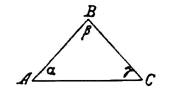
[ 10 ] But where has real science ever had anything to do with this question? Just look at mathematics! It has a structure in front of it that is created by the intersection of three straight lines: a triangle. The three angles ", p, y are in a constant relationship; together they form an elongated angle or two right angles 1800). This is a mathematical judgment. The angles t:, p, y are perceived. The above cognitive judgment arises on the basis of thoughtful consideration. It establishes a connection between three perceptual images. There is no question of reflecting on any object behind the idea of the triangle. And this is how all sciences do it. They weave threads from conceptual image to conceptual image, creating order in what is chaos to immediate perception; but nowhere does anything other than the given come into consideration. Truth is not the correspondence of an idea with its object, but the expression of a relationship between two perceived facts.
[ 11 ] We return to our example of the thrown stone. We connect the facial perceptions that emanate from the individual places where the stone is located. This connection gives a crooked line (throwing line); we obtain the law of the oblique throw; if we further consider the material nature of the glass, then take the flying stone as the cause, the breaking of the disk as the effect, etc., we have imbued the given with concepts in such a way that it becomes comprehensible to us. All this work, which summarizes the diversity of perception into a conceptual unit, takes place within our consciousness. The ideal connection of the perceptual images is not given by the senses, but is grasped by our mind absolutely independently. For a being endowed with mere sensory perception, all this work would simply not be there. For it, the external world would simply remain the incoherent chaos of perception that we have characterized as that which initially (directly) confronts us.
[ 12 ] So the place where the perceptual images appear in their ideal coherence, where the latter is held up against the former as their conceptual counter-image, is the human consciousness. Even if this conceptual (legal) connection is produced in consciousness according to its substantial nature, it does not follow from this that it is also only subjective according to its meaning. Rather, its content arises from objectivity just as much as its conceptual form arises from consciousness. It is the necessary objective supplement to the perceptual image. Precisely because the perceptual image is incomplete, unfinished in itself, we are forced to add the necessary supplement to it as sensory experience. If the directly given were sufficiently far-reaching in itself that a problem would not arise for us at every point of it, we would never need to go beyond it. But the perceptual images do not follow so from one another and from one another that we ourselves can regard them as mutual consequences of one another; rather, they follow from something else that is closed to sensory perception. Conceptual comprehension confronts them and also grasps that part of reality which remains closed to the senses. Cognition would be an utterly useless process if something complete were handed down to us in the experience of the senses. Any summarizing, ordering, grouping of sensory facts would have no objective value whatsoever. Cognition only makes sense if we do not accept the form given to the senses as a complete one, if it is a half-form that still contains something higher, but which is no longer perceptible to the senses. This is where the spirit enters. It perceives that which is higher. That is why thinking must not be understood as if it added something to the content of reality. It is no more and no less an organ of perception than the eye and the ear. Just as the latter perceives colors, the latter sounds, so does thinking perceive ideas. Idealism is therefore quite compatible with the principle of empirical research. The idea is not the content of subjective thinking, but the result of research. Reality confronts us when we confront it with open senses. It confronts us in a form that we cannot regard as its true form; we only attain the latter when we bring our thinking into flow. Recognizing means adding the perception of thought to the half-reality of sense experience, so that its image becomes complete.
[ 13 ] It all depends on how one conceives the relationship between idea and sensory reality. By the latter I want to understand here the totality of the views conveyed to man through the senses. The most widespread view is that the concept is merely a means belonging to consciousness through which it takes possession of the data of reality. The essence of reality lies in the appearance of things themselves, so that if we were really able to arrive at the primordial ground of things, we could only take possession of the conceptual image of it and by no means of itself. Two quite separate worlds are therefore presupposed. The objective outer world, which carries its essence, the reasons for its existence within itself, and the subjective-ideal inner world, which is supposed to be a conceptual image of the outer world. The latter is completely indifferent to the objective, it is not required by it, it is only there for the cognizing human being. The congruence of these two worlds would be the epistemological ideal of this basic view. I include in the latter not only the scientific direction of our time, but also the philosophy of Kant, Schopenhauer and the Neo-Kantians, and no less the last phase of Schelling's philosophy. All these schools of thought agree that they seek the essence of the world in a trans-subjective and must admit from their point of view that the subjective-ideal world, which for them is therefore also a mere imaginary world, means nothing for reality itself, but only something for human consciousness.
[ 14 ] I have already indicated that this view leads to the consequence of a complete congruence of concept (idea) and perception. What is found in the latter would have to be contained again in its conceptual counterpart, only in ideal form. In terms of content, the two worlds would have to coincide completely. The relations of spatio-temporal reality would have to be exactly repeated in the idea; only that instead of the perceived extension, shape, color, etc., the corresponding idea would have to be present. If, for example, I see a triangle, I would have to trace its outline, size, direction of its sides, etc. in my mind and make a conceptual photograph. I would have to do exactly the same with a second triangle and so with every object of the outer and inner sensory world. In this way, each thing would find itself exactly in my ideal picture of the world according to its location and its properties.
[ 15 ] We must now ask ourselves: Does this consequence correspond to the facts? Not at all. My concept of the triangle is a single one that encompasses all the individual triangles I look at; and no matter how often I present it, it always remains the same. My various ideas of the triangle are all identical with each other. I have only one concept of the triangle at all.
[ 16 ] In reality, every thing presents itself as a particular, fully determined "this", which is confronted by equally fully determined "thats" saturated with real reality. The concept confronts this multiplicity as a strict unity. In it there is no particularity, no parts, it does not multiply, is, infinitely often imagined, always the same.
[ 17 ] The question now arises: What is actually the bearer of this identity of the concept? It cannot indeed be its manifestation as a concept, for Berkeley was quite right in asserting that the one conception of the tree now has absolutely nothing to do with that of the same tree a minute later, if I keep my eyes closed between the two; nor do the different conceptions of one object in several individuals with each other. Identity can therefore only lie in the content of the idea, in its what. The meaningfulness, the content must guarantee the identity for me.
[ 18 ] However, this also removes the view that denies all independent content to the concept or idea. For this view believes that conceptual unity as such is without any content at all; it arises merely by the fact that certain determinations in the objects of experience are omitted, while what is common is singled out and incorporated into our intellect for the sake of a convenient summary of the multiplicity of objective reality according to the principle of embracing the whole of experience with the mind by means of as few general units as possible - that is, according to the principle of the smallest measure of force. Schopenhauer takes this standpoint alongside modern natural philosophy. In its harshest and therefore most one-sided consequence, however, it is represented in Richard Avenarius' pamphlet: "Philosophy as the thinking of the world according to the principle of the smallest measure of force. Prolegomena to a Critique of Pure Experience" [Leipzig 1876].
[ 19 ] This view, however, is merely based on a complete misjudgment not only of the content of the concept, but also of the view.
[ 20 ] In order to create clarity here, it is necessary to go back to the reason that contrasts the view as a particular with the concept as a general.
[ 21 ] We will have to ask ourselves: In what does the characteristic of the particular actually lie? Can it be defined conceptually? Can we say: This conceptual unity must break down into these or those vivid, particular manifolds? No, is the very definite answer. The concept itself does not know particularity at all. It must therefore lie in elements that are not accessible to the concept as such. But since we do not know an intermediate link between perception and concept - if we did not want to cite Kant's fantastic-mystical schemes, which today can only be regarded as dalliance - these elements must belong to perception itself. The ground of particularity cannot be derived from the concept, but must be sought within the concept itself. That which constitutes the particularity of an object cannot be comprehended, but only viewed. This is the reason why any philosophy that seeks to derive (deduce) the particularity of the entire visual reality from the concept itself must fail. This is also the classical error of Fichte, who wanted to deduce the whole world from consciousness.
[ 22 ] However, anyone who accuses ideal philosophy of this impossibility as a shortcoming and wants to dismiss it as such is in fact acting no more reasonably than the philosopher [W. T.] Krug, a successor of Kant, who demanded that the philosophy of identity deduce his pen for him.
[ 23 ] What really distinguishes the view essentially from the idea is precisely this element, which cannot be brought into concepts and which must be experienced. As a result, concept and perception stand opposite each other as essentially identical but different sides of the world. And since the latter demands the former, as we have shown, it proves that it has its essence not in its particularity but in its conceptual generality. This generality, however, must first be found in the subject according to appearance; for it can indeed be obtained by the subject on the object, but not from the latter.
[ 24 ] The concept cannot borrow its content from experience, for it does not absorb the characteristic of experience, the particularity, into itself. Everything that the latter constructs is alien to it. It must therefore give itself its own content.
[ 25 ] It is usually said that the object of experience is individual, is a living perception, whereas the concept is abstract, poor, meagre, empty in comparison to the substantive perception. But in what is the richness of the determinations sought here? In the number of them, which, given the infinity of space, can be infinitely great. For this reason, however, the concept is no less fully determined. The number from there is replaced by qualities. But just as number is not found in the concept, so the view lacks the dynamic-qualitative nature of the characters. The concept is just as individual, just as full of content as the view. The only difference is that in grasping the content of perception nothing is necessary but open senses, purely passive behavior towards the external world, while the ideal core of the world must arise in the spirit through its own spontaneous behavior if it is to come to light at all. It is an entirely irrelevant and idle expression to say that the concept is the enemy of living perception. It is its essence, the actual driving and active principle in it, adds its own to its content without abolishing the former - for as such it has nothing to do with it - and it should be the enemy of perception! It is its enemy only when a philosophy that misunderstands itself wants to spin the whole, rich content of the world of the senses out of the idea. For it then delivers an empty phrase scheme instead of living nature.
[ 26 ] Only in the way we have indicated can we arrive at a satisfactory explanation of what experiential knowledge actually is. The necessity of proceeding to conceptual knowledge would be absolutely unrealizable if the concept brought nothing new to sensory perception. Pure experiential knowledge should not take a step beyond the millions of details that are available to us in our perception. Pure experiential knowledge must consequently negate its own content. For why create once again in the concept what is already present in perception? According to these considerations, consistent positivism would simply have to cease all scientific work and rely on mere coincidences. By not doing so, it actually carries out what it theoretically denies. In general, both materialism and realism implicitly admit what we assert. Their approach is only justified from our point of view, while it is in the most flagrant contradiction with their own basic theoretical views.
[ 27 ] From our point of view, the necessity of scientific knowledge and the transcendence of experience is explained without contradiction. The world of the senses confronts us as the first and immediately given; it looks to us like an immense enigma, because we can never again find the driving, working force in it. This is where reason comes in and, with the ideal world, confronts the sense world with the principle entity that forms the solution to the riddle. As objective as the sense world is, so objective are these principles. That they do not appear to the senses, but only to reason, is indifferent to their content. If there were no thinking beings, these principles would never appear; but they would therefore be no less the essence of the phenomenal world.
[ 28 ] Thus we have contrasted the transcendental world view of Locke, Kant, the later Schelling, Schopenhauer, Volkelt, the Neo-Kantians and modern naturalists with a truly immanent one.
[ 29 ] The latter seek the world's ground in something alien to consciousness, something beyond, while immanent philosophy seeks it in that which appears to reason. The transcendental view of the world regards conceptual knowledge as an image of the world, the immanent view as its highest manifestation. The latter can therefore only provide a formal theory of knowledge that is based on the question: What is the relationship between thinking and being? The latter places the question at the top of its epistemology: What is cognition? The former starts from the prejudice of an essential difference between thinking and being, while the latter approaches the only certain thing, thinking, without prejudice and knows that it cannot find any being apart from thinking.
[ 30 ] If we summarize the results obtained on the basis of epistemological considerations, the following emerges: We have to start from the completely undetermined, immediate form of reality, from what is given to the senses before we bring our thinking into flow, from what is only seen, only heard, etc. It is important that we are aware of what the senses give us and what thinking gives us. The senses do not tell us that things stand in any relation to one another, such as that this is cause, that is effect. For the senses, all things are equally essential for the construction of the world. The thoughtless observation does not know that the seed is on a higher level of perfection than the grain of dust on the road. For the senses, both are equivalent beings if they look the same on the outside. At this level of observation, Napoleon is no more important in world history than Hinz or Kunz in the remote mountain village. This is as far as the epistemology of today has penetrated. But that it has by no means thought through these truths exhaustively is shown by the fact that almost all epistemologists make the mistake of immediately attributing the predicate that it is conception to this initially indeterminate and undetermined entity that we encounter at the first stage of our perception. This is a gross violation of the insight we have just gained. As little as we know, if we remain with the immediate conception of sense, that the falling stone is the cause of the depression in the place where it fell, so little do we know that it is imagination. Just as we can only arrive at this through manifold considerations, so we could also only come to the realization that the world given to us is mere imagination, even if it were correct, through reflection. The senses give me no information as to whether what they convey to me is real or merely imaginary. The world of the senses confronts us as if shot from a pistol. If we want to have it in its purity, we must refrain from attaching any characterizing predicate to it. We can only say one thing: it confronts us, it is given to us. This does not yet say anything about it itself. Only if we proceed in this way do we not block our way to an unbiased assessment of this given. If we attach a characteristic to it from the outset, this impartiality ceases. If we say, for example, that the given is a conception, then the whole of the following investigation can only be carried out under this presupposition. In this way we do not provide a theory of knowledge without presuppositions, but we answer the question: what is cognition? under the presupposition that what is given to the senses is conception. This is the fundamental error of Volkelt's theory of knowledge. At the beginning of it, he states in all rigor that epistemology must be without presuppositions. At the top, however, he places the proposition that we have a multiplicity of conceptions. Thus his theory of knowledge is only the answer to the question: how is knowledge possible on the condition that the given is a multiplicity of representations? For us the matter will be quite different. We take the given as it is: as a multiplicity of - something that will reveal itself to us if we allow ourselves to be pushed away from it. Thus we have the prospect of arriving at an objective knowledge, because we allow the object itself to speak. We can hope that the entity we are confronted with will reveal to us everything we need, if we do not make the free access of its manifestations to our judgment impossible through an inhibiting prejudice. For even if reality were to remain eternally mysterious to us, such a truth would only have value if it were gained by the hand of things. But the assertion that our consciousness is of such and such a nature would be completely meaningless, and therefore we cannot come to a clear understanding of the things of the world. Whether our mental powers are sufficient to grasp the nature of things is something we must test for ourselves. I can have the most perfect mental powers; if things do not reveal anything about themselves, my faculties are of no help to me. And conversely, I may know that my powers are small; whether they are nevertheless sufficient to recognize things, I do not yet know.
[ 31 ] What we have seen further is this: The immediately given leaves us unsatisfied in the characterized form. It confronts us like a demand, like a riddle to be solved. It says to us: I am there; but the way I meet you there, I am not in my true form. As we hear this voice from outside, as we become aware that we are confronted with a half-form, a being that conceals its better side from us, the activity of that organ announces itself within us through which we gain information about the other side of the real, through which we are able to complete the half-form into a whole. We become aware that we must supplement what we do not see, hear, etc., by thinking. Thinking is called upon to solve the riddle that perception presents us with.
[ 32 ] We only become clear about this relationship when we examine why we are unsatisfied by visual reality and satisfied by imagined reality. Visual reality confronts us as something finished. It is just there; we have done nothing to make it so. We therefore feel ourselves confronted with an alien being that we have not produced, indeed, in whose production we were not even present. We stand before something that has become. But we can only grasp that of which we know how it became so, how it came about; if we know where the threads are on which what appears before us hangs. It is different with our thinking. A thought-form does not appear to me without my participating in its creation; it only comes into the field of my perception in such a way that I myself lift it out of the dark abyss of imperceptibility. The thought does not appear to me as a finished entity, like sense perception, but I am aware that when I hold it in a completed form, I have brought it to this form myself. What is before me does not appear to me as the first, but as the last, as the conclusion of a process that is so interwoven with me that I have always stood within it. But this is what I must demand of a thing that enters the horizon of my perception in order to understand it. Nothing must remain obscure to me; nothing must appear as completed; I must pursue it myself to that stage where it has become a finished thing. That is why the immediate form of reality, which we usually call experience, urges us to a scientific treatment. When we bring our thinking into flow, we go back to the conditions of the given that first remained hidden to us; we work our way up from product to production, we arrive at the point where sense perception becomes transparent to us in the same way as thought. Our need for knowledge is thus satisfied. We can therefore only come to a scientific conclusion with a thing when we have (completely) penetrated what we have directly perceived with our thinking. A process of the world only appears to be completely penetrated by us when it is our own activity. A thought appears as the conclusion of a process within which we stand. But thinking is the only process in which we can place ourselves completely within, in which we can be absorbed. Therefore, to scientific observation, experienced reality must appear to emerge from the development of thought in the same way as a pure thought itself. To investigate the essence of a thing means to begin in the center of the world of thought and to work out of it until such a thought-formation appears before our souls that seems identical with the experienced thing. When we speak of the essence of a thing or of the world in general, we can therefore mean nothing other than the comprehension of reality as a thought, as an idea. In the idea we recognize that from which we must derive everything else: the principle of things. What the philosophers call the absolute, the eternal being, the ground of the world, what the religions call God, we call, on the basis of our epistemological discussions: the idea. Everything that does not appear immediately as an idea in the world is ultimately recognized as emerging from it. What superficial observation believes to be devoid of all share in the idea, deeper thinking derives from it. No other form of existence can satisfy us than that derived from the idea. Nothing must remain on the sidelines, everything must become part of the great whole that the idea encompasses. But it does not demand that we go beyond ourselves. It is the entity built upon itself, firmly grounded in itself. This is not because we have it directly present in our consciousness. It lies in itself. If it did not express its essence itself, then it would appear to us in the same way as the rest of reality: in need of explanation. This seems to contradict what we said above: the idea would appear to us in a satisfactory form because we actively participate in its creation. But this is not due to the organization of our consciousness. If the idea were not an entity built upon itself, we could not have such a consciousness at all. If something has the center from which it arises not within itself but outside itself, then when it confronts me I cannot declare myself satisfied with it, I must go beyond it, to that very center. Only when I encounter something that does not point beyond itself do I attain the consciousness: now you are standing within the center; here you can remain standing. My awareness that I am standing within a thing is only the consequence of the objective nature of this thing, that it brings its principle with it. By seizing the idea, we reach the core of the world. What we grasp here is that from which everything emerges. We become one with this principle; therefore the idea, which is the most objective, appears to us at the same time as the most subjective.
[ 33 ] The sensory reality is so mysterious to us precisely because we do not find its center in itself. It ceases to be so when we realize that it has the same centre as the world of thoughts that appears in us.
[ 34 ] This center can only be a unified one. It must be such that everything else points to it as its explanatory ground. If there were several centra of the world - several principia from which the world could be recognized - and if one area of reality pointed to this, another to that world principle, then as soon as we found ourselves in one area of reality, we would only be pointed to the one center. It would not even occur to us to ask about another. The one area would know nothing of the other. They would simply not be there for each other. It therefore makes no sense to speak of more than one world. The idea is therefore one and the same in all places in the world, in all consciousnesses. The fact that there are different consciousnesses and that each one represents the idea does not change the matter. The idea content of the world is built on itself, perfect in itself. We do not create it, we only seek to grasp it. Thinking does not produce it, but perceives it. It is not the producer, but the organ of perception. Just as different eyes see one and the same object, so different consciousnesses think one and the same thought content. The manifold consciousnesses think one and the same thing; they only approach the One from different sides. That is why it appears to them variously modified. This modification, however, is not a difference of objects, but only a perception from different angles. The difference in human views is just as explainable as the difference that a landscape shows to two observers in different places. If only one is at all able to penetrate to the world of ideas, one can be sure that in the end one has a world of ideas common to all men. The most that can then happen is that we grasp this world in a rather one-sided way, that we stand in a position where it appears to us in the most unfavorable light, etc.
[ 35 ] We are probably never confronted with a sensory world completely stripped of all thought content. At most in early childhood, when there is still no trace of thinking, we come close to a pure sensory perception. In ordinary life we have to do with an experience that is half and half saturated with thinking, which already appears more or less lifted from the darkness of seeing to the bright clarity of spiritual comprehension. The sciences work towards completely overcoming this darkness and leaving nothing in experience that is not permeated by thought. What task has epistemology fulfilled in relation to the other sciences? It has enlightened us about the purpose and task of all science. It has shown us the significance of the content of the individual sciences. Our epistemology is the science of the purpose of all other sciences. It has enlightened us to the fact that what is gained in the individual sciences is the objective ground of the existence of the world. The sciences arrive at a series of concepts; epistemology teaches us about the actual task of these concepts. With this characteristic result, our theory of knowledge, which is based on Goethe's way of thinking, differs from all other contemporary theories of knowledge. It does not merely want to establish a formal connection between thinking and being; it does not merely want to solve the epistemological problem logically, it wants to arrive at a positive result. It shows what the content of our thinking is; and it finds that this what is at the same time the objective content of the world. In this way, epistemology becomes the most meaningful science for man. It enlightens man about himself, it shows him his position in the world; it is thus a source of satisfaction for him. It tells him what he is called to do. In possession of its truths, man feels elevated; his scientific research gains a new illumination. Only now does he know that he is most directly connected with the core of world existence, that he reveals this core, which remains hidden from all other beings, that the world spirit appears in him, that it indwells him. He sees in himself the finisher of the world process, he sees that he is called to accomplish what the other forces of the world are unable to do, that he has to crown creation. If religion teaches us that God created man in his own image, our theory of knowledge teaches us that God only brought creation to a certain point. Then he allowed man to come into being and, by recognizing himself and looking around him, he sets himself the task of continuing to work, of completing what the elemental force had begun. Man immerses himself in the world and recognizes what can be further built on the ground that has been laid, he sees the suggestion that the primal spirit has made and carries out what has been suggested.
[ 36 ] So the theory of knowledge is at the same time the doctrine of the meaning and destiny of man; and it solves this task (of the "destiny of man") in a much more specific way than Fichte did at the turning point of the 18th and 19th centuries. Through the thought formation of this strong mind, one does not reach the full satisfaction that must come to us through a genuine theory of knowledge.
[ 37 ] We have the task towards all individual existence to process it so that it appears to flow from the idea, so that it completely evaporates as an individual and is absorbed in the idea into whose element we feel ourselves to be placed. Our mind has the task of training itself in such a way that it is able to see through all reality given to it in the way in which it appears from the idea. We must prove ourselves to be perpetual workers in the sense that we transform every object of experience so that it appears as part of our ideal world view. This brings us to the point where Goethe's way of looking at the world begins. We must apply what we have said in such a way that we imagine that the relationship between idea and reality we have described is a fact in Goethe's research; Goethe approaches things in the way we have justified. He himself sees his inner work as a living heuristic which, recognizing an unknown, sensed rule (the idea), seeks to find such a rule in the outer world and to introduce it into the outer world ("Proverbs in Prose", Natw. Schr., 4th vol., 2nd section, p. 374). When Goethe demands that man should instruct his organs ("Proverbs in Prose", ibid., p. 350), this also only has the meaning that man does not simply surrender to what his senses hand over to him, but that he gives his senses the direction that they show him things in the right light.