

Fundamentals of an Epistemology
of Goethe's worldview
with special consideration of Schiller
GA 2
Translated by Steiner Online Library
10. The Inner Nature of Thinking
[ 1 ] We are taking another step closer to thinking. So far we have only considered its position in relation to the rest of the world of experience. We have come to the conclusion that it occupies a very privileged position within it, that it plays a central role. We will refrain from this now. We shall confine ourselves here only to the internal nature of thought. We want to examine the self-inherent character of the world of thought in order to find out how one thought depends on the other ; how thoughts relate to each other. Only this will give us the means to gain insight into the question: What is knowledge at all? Or in other words: What does it mean to think about reality; what does it mean to want to come to terms with the world through thinking?
[ 2 ] We must keep ourselves free of any preconceived opinion. But it would be such an opinion if we wanted to presuppose that the concept (thought) is the image within our consciousness, through which we gain information about an object lying outside it. This and similar presuppositions are not discussed here. We take the thoughts as we find them. Whether they have a relation to anything else, and what kind of relation, is what we want to investigate. We must therefore not take it here as a starting point. The above-mentioned view of the relationship between concept and object is very common. The concept is often defined as the mental counter-image of an object lying outside the mind. Concepts are supposed to depict things, to give us a faithful photograph of them. When one speaks of thinking, one often thinks only of this presupposed relationship. One almost never seeks to wander through the realm of thought within one's own area in order to see what arises here.
[ 3 ] We want to examine this realm here as if there were nothing at all outside its boundaries, as if thought were all reality. We look away from the rest of the world for a while.
[ 4 ] The fact that this has been omitted in the epistemological attempts based on Kant has been disastrous for science. This omission has given the impetus to a direction in this science that is completely opposed to ours. By its very nature, this direction of science can never comprehend Goethe. It is in the truest sense of the word unGoethean to proceed from an assertion which one does not find in observation, but which one places in what is observed. But this is what happens when you place the view at the forefront of science: The indicated relationship exists between thought and reality, idea and world. One only acts in Goethe's sense if one immerses oneself in the nature of thinking itself and then observes what relationship arises when this thinking recognized according to its essence is brought into a relationship with experience.
[ 5 ] Goethe follows the path of experience in the strictest sense everywhere. He first takes the objects as they are, seeks to penetrate their nature with complete detachment from all subjective opinion; then he establishes the conditions under which the objects can interact and waits to see what results from this. Goethe seeks to give nature the opportunity to bring its laws to bear under particularly characteristic circumstances, which he brings about, to express its laws himself, as it were.
[ 6 ] How does our thinking appear to us when viewed by itself? It is a multitude of thoughts that are interwoven and organically connected in the most diverse ways. But this multiplicity, once we have penetrated it sufficiently on all sides, only constitutes a unity, a harmony. All the links relate to each other, they are there for each other; one modifies the other, restricts it and so on. As soon as our mind imagines two corresponding thoughts, it immediately realizes that they actually merge into one. It finds everywhere what belongs together in its realm of thought; this concept joins that, a third explains or supports a fourth, and so on. Thus, for example, we find in our consciousness the thought content "organism"; if we look through our imaginary world, we encounter a second one: "lawful development, growth". It immediately becomes clear that these two thought contents belong together, that they merely represent two sides of one and the same thing. But so it is with our whole system of thought. All individual thoughts are parts of a large whole that we call our conceptual world.
[ 7 ] If any individual thought appears in my consciousness, I do not rest until it has been harmonized with the rest of my thinking. Such a special concept, apart from the rest of my spiritual world, is completely intolerable to me. I am aware of the fact that there is an inner harmony of all thoughts, that the world of thought is a unified one. Therefore, any such separation is an unnaturalness, an untruth.
[ 8 ] Once we have come to the conclusion that our entire world of thought has the character of a perfect, inner harmony, then it will give us the satisfaction that our spirit longs for. Then we feel that we are in possession of the truth.
[ 9 ] Since we see truth in the consistent coherence of all the concepts at our disposal, the question arises: Yes, does thinking, apart from all vivid reality, from the sensory world of appearances, also have a content? Doesn't complete emptiness, a pure phantasm, remain when we think all sensory content has been eliminated?
[ 10 ] That the latter is the case is probably a widespread opinion, so that we must take a closer look at it. As we have already noted above, the whole conceptual system is often thought of only as a photograph of the external world. They maintain that our knowledge develops in the form of thought, but demand of a "strictly objective science" that it takes its content only from the outside. The outside world must provide the material that flows into our concepts.9J. H. von Kirchmann even says in his "Lehre vom Wissen [als Einleitung in das Studium philosophischer Werke]" (Leipzig 1873, 3rd improved edition) that cognition is an influx of the external world into our consciousness. Without it, these are empty schemas without any content. If the outside world were to disappear, concepts and ideas would no longer have any meaning, because they are there for their own sake. This view could be called the negation of the concept. For it then no longer has any meaning for objectivity. It is something added to the latter. The world would also exist in all its perfection if there were no concepts. For they add nothing new to it. They contain nothing that would not exist without them. They are only there because the cognizing subject wants to make use of them in order to have that which is already there elsewhere in a form appropriate to it. For it, they are only mediators of a content that is non-conceptual in nature. Thus the view put forward.
[ 11 ] If it were well-founded, one of the following three premises would have to be correct.
[ 12 ] 1. the conceptual world is in such a relationship to the external world that it only reproduces the entire content of the latter in a different form. Here the external world is understood to be the sense world. If this were the case, then one could truly not see what necessity there would be to rise above the sense world at all. One has already given the whole to and fro of cognition with the latter.
[ 13 ] 2. The conceptual world takes up only a part of the "appearance for the senses" as its content. Think of it like this. We make a series of observations. We encounter the most diverse objects. We notice that certain characteristics that we discover in an object have already been observed by us. Our eye scans a series of objects A, B, C, D etc. A would have the characteristics q a r; B: 1mb n; C: k h cg and D:p na v. In D we again encounter the characteristics a and p, which we have already encountered in A . We refer to these characteristics as essentials. A and D have the same essential characteristics, we call them similar. Thus we summarize A and D by holding their essential characteristics in thought. Here we have a way of thinking that does not quite coincide with the world of the senses, to which the superfluousness criticized above does not apply and which is nevertheless just as far removed from adding anything new to the world of the senses. On the other hand, it can be said above all that in order to recognize which properties are essential to a thing, a certain norm is necessary which makes it possible for us to distinguish the essential from the non-essential. This norm cannot lie in the object, because it contains the essential and the non-essential in an undivided unity. This norm must therefore be the inherent content of our thinking.
[ 14 ] However, this objection does not completely overturn the view. For one can say: This is just an unjustified assumption that this or that is more or less essential for a thing. That does not concern us either. It is merely that we find certain identical properties in several things, and we then call the latter similar. There is no question of these identical properties being essential. But this view presupposes something that is not true at all. There is nothing really common in two things of the same kind if we stop at sense experience. An example will make this clear. The simplest is the best, because it is the easiest to grasp. Let's look at the following two triangles.
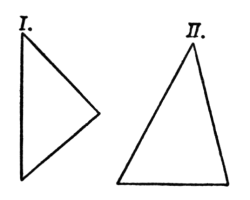
[ 15 ] What do they really have in common if you stop at sensory experience? Nothing at all. What they have in common, namely the law according to which they are formed and which causes them both to fall under the term "triangle", is only gained by us when we transcend sense experience. The term "triangle" encompasses all triangles. We do not arrive at it by merely observing all the individual triangles. This concept always remains the same, however often I may imagine it, while I will hardly succeed in looking at the same "triangle" twice. The fact that the single triangle is the fully determined "this" and no other has nothing to do with the concept. A certain triangle is this determined not by the fact that it corresponds to that concept, but by elements that lie entirely outside the concept: Length of sides, size of angles, position, etc. However, it is quite inadmissible to claim that the content of the concept "triangle" is borrowed from the objective world of the senses when one sees that its content is not contained in any sensory phenomenon at all.
[ 16 ] 3. There is now a third possibility. The concept could be the mediator for the apprehension of entities that are not perceptible to the senses, but which nevertheless have a character based on themselves. The latter would then be the non-conceptual content of the conceptual form of our thinking. Whoever assumes such entities existing beyond experience and grants us the possibility of knowledge of them must necessarily also see the interpreter of this knowledge in the concept.
[ 17 ] We will explain the inadequacy of this view in more detail. Here we only want to point out that it certainly does not speak against the content of the conceptual world. For if the objects that are thought about were beyond all experience and beyond thinking, then the latter would have to have all the more within itself the content on which it is based. It could not think about objects of which no trace could be found within the world of thought.
[ 18 ] In any case, it is clear that thought is not an empty vessel, but that it is full of content purely in itself and that its content does not coincide with that of another form of manifestation.