

Fundamentals of an Epistemology
of Goethe's worldview
with special consideration of Schiller
GA 2
Translated by Steiner Online Library
15. Inorganic Nature
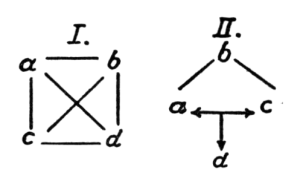
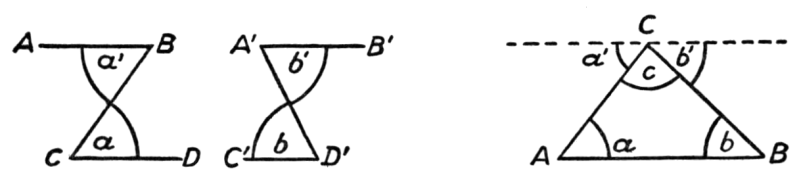
[ 1 ] The simplest kind of natural effect appears to us to be that in which a process is entirely the result of factors that are externally opposed to one another. Here an event or a relationship between two objects is not conditioned by a being that lives itself out in external manifestations, by an individuality that manifests its inner abilities and character in an external effect. They are caused solely by the fact that one thing exerts a certain influence on the other in its events, transmitting its own states to others. The states of one thing appear as a consequence of those of the other. The system of effects that take place in such a way that one fact is always the consequence of others like it is called inorganic nature.
[ 2 ] The course of a process or the characteristic of a relation depends here on external conditions; the facts have characteristics in themselves which are the result of those conditions. If the way in which these external factors come together changes, the consequence of their coexistence naturally also changes; the phenomenon brought about changes.
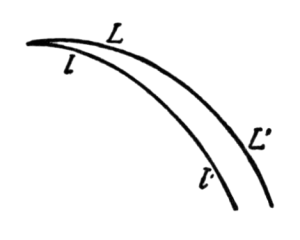
[ 3 ] What is this way of coexistence in inorganic nature, as it enters directly into the field of our observations? It has entirely the character that we characterized above as that of immediate experience. We are only dealing here with a special case of that "experience in general". What matters here are the connections between the sensory facts. But it is precisely these connections that appear unclear and opaque to us in experience. One fact a confronts us, but at the same time numerous others. If we allow our gaze to wander over the diversity offered here, we are completely unclear as to which of the other facts are more closely related to the a in question and which are more distantly related. There may be those without which the event cannot occur at all; and again there may be those which only modify it, without which it could well occur, only then it would have a different form under different circumstances.
[ 4 ] This also shows us the path that cognition must take in this field. If the combination of facts in direct experience is not sufficient for us, then we must proceed to another one that satisfies our need for explanation. We have to create conditions so that a process appears to us with transparent clarity as the necessary consequence of these conditions.
[ 5 ] We remember why thinking actually already contains its essence in direct experience. Because we are inside, not outside, the process that creates thought connections from the individual elements of thought. Thus we are not only given the completed process, the effectual, but also the working. And it depends on this that in any process of the outer world that confronts us we first see the driving forces that bring it from the center of the world whole to the periphery. The opacity and obscurity of a phenomenon or a relationship in the world of the senses can only be overcome if we can see quite clearly that they are the result of a determined constellation of facts. We must know that the process we now see arises through the interaction of this and that element of the sense world. Then the manner of this interaction must be completely penetrable to our understanding. The relation into which the facts are brought must be an ideal one, one that corresponds to our spirit. Things will naturally behave according to their nature in the relations into which they are brought by the mind.
[ 6 ] We can immediately see what is gained. If I look at random into the world of the senses, I see processes that are brought about by the interaction of so many factors that it is impossible for me to see directly what is actually behind this effect. I see a process and at the same time the facts \(a\), \(b\), \(c\) and \(d\). How am I supposed to know immediately which of these facts are more or less involved in the process? The matter becomes clear when I first examine which of the four facts are necessary for the process to occur at all. I find, for example, that \(a\) and \(c\) are absolutely necessary. Afterwards I find that without \(d\) the process occurs, but with considerable change, whereas I see that \(b\) has no essential meaning at all and could also be replaced by something else. In the foregoing, \(I\) shall symbolically represent the grouping of elements for mere sense perception, \(II\) that for the mind. The mind thus groups the facts of the inorganic world in such a way that it sees in an event or a relation the consequence of the relations of the facts. In this way the mind brings necessity into coincidence. Let us illustrate this with a few examples. If I have a triangle \(abc\) in front of me, I probably do not see at first glance that the sum of the three angles is always equal to an elongated one. This becomes immediately clear if I group the facts in the following way. From the figures below it is immediately clear that the angles are \(a'= a\); \(b'= b\). (\(AB\) and \(CD\) respectively \(A'B'\) and \(C'D'\) are parallel).
[ 7 ] If I now have a triangle in front of me and I draw a parallel straight line to the base line AB through the apex \(C\), I find, if I apply the above, with respect to the angles \(a' = a\); \(b' = b\). Now since \(c\) is equal to itself, all three triangular angles together are necessarily equal to an elongated angle. I have here explained a complicated relation of facts by reducing it to such simple facts by which, from the relation given to the mind, the corresponding relation necessarily follows from the nature of the given things.
[ 8 ] Another example is the following: I throw a stone in a horizontal direction. It describes a path that we have mapped in the line \(ll'\). If I look at the driving forces that come into consideration here, I find: 1. the impact force that I exert; 2. the force with which the earth attracts the stone; 3. the force of air resistance.
[ 9 ] On closer consideration, I find that the first two forces are the essential, those that cause the peculiarity of the orbit, while the third is secondary. If only the first two acted, the stone would describe the orbit \(LL'\). I find the latter if I disregard the third force altogether and relate only the first two. It is neither possible nor necessary to do this actually. I cannot eliminate all resistance. But I need only grasp the nature of the first two forces mentally, then bring them into the necessary relationship also only mentally; and the trajectory \(LL'\) results as that which would necessarily have to occur if only the two forces acted together.
[ 10 ] In this way, the mind resolves all phenomena of inorganic nature into those where the effect seems to it to emerge directly and necessarily from the agent.
[ 11 ] If we then add the third force to the law of motion of the stone as a result of the first two forces, we obtain the path ll'. Further conditions could complicate the matter even more. Every composite process of the sensory world appears as a fabric of those simple facts permeated by the spirit and can be dissolved into them.
[ 12 ] Now such a phenomenon, in which the character of the process follows directly from the nature of the factors under consideration in a transparently clear manner, we call an original phenomenon or a fundamental fact.
[ 13 ] This primordial phenomenon is identical with the objective law of nature. For it is not only expressed in it that a process has taken place under certain conditions, but that it had to take place. It has been realized that it had to take place given the nature of what was under consideration. Today, external empiricism is so generally demanded because it is believed that any assumption that goes beyond what is empirically given is groping around in uncertainty. We see that we can remain completely within the phenomena and still arrive at what is necessary. The inductive method, which is widely used today, can never do this. It essentially proceeds as follows. It sees a phenomenon that occurs in a certain way under given conditions. A second time it sees the same phenomenon occurring under similar conditions. From this it concludes that a general law exists according to which this event must occur, and pronounces this law as such. Such a method remains completely external to the phenomena. It does not penetrate into the depths. Its laws are generalizations of individual facts. It must always await confirmation of the rule from the individual facts. Our method knows that its laws are simply facts which have been torn out of the confusion of contingency and made necessary. We know that if the factors a and b are there, a certain effect must necessarily occur. We do not go beyond the phenomenal world. The content of science, as we think of it, is nothing more than objective events. Only the form of the compilation of facts has changed. But through this we have penetrated one step deeper into objectivity than experience makes possible. We arrange the facts in such a way that they act according to their own nature and only according to this nature and that this effect is not modified by this or that relationship.
[ 14 ] We attach the greatest importance to the fact that these statements can be justified wherever one looks into the actual operation of science. They are contradicted only by the erroneous views held about the scope and nature of scientific propositions. While many of our contemporaries conflict with their own theories when they enter the field of practical research, the harmony of all true research with our disputes could easily be demonstrated in each individual case.
[ 15 ] Our theory demands a certain form for every law of nature. It presupposes a connection of facts and states that if the same occurs somewhere in reality, a certain process must take place.
[ 16 ] Every law of nature therefore has the form: If this fact interacts with that, then this phenomenon arises ... It would be easy to prove that all laws of nature really have this form: If two bodies of unequal temperature adjoin each other, heat flows from the warmer to the colder until the temperature in both is the same. If a liquid is in two vessels that are in contact with each other, the level in both vessels will be the same. If a body stands between a light source and another body, it casts a shadow on the latter. What is not a mere description in mathematics, physics and mechanics must be an original phenomenon.
[ 17 ] All progress in science is based on the realization of primordial phenomena. If one succeeds in separating a process from its connections with others and explaining it purely as the result of certain elements of experience, one has penetrated one step deeper into the workings of the world.
[ 18 ] We have seen that the primordial phenomenon arises purely in thought when the factors under consideration are brought into connection in thought according to their nature. However, the necessary conditions can also be created artificially. This is done in scientific experiments. There we have the occurrence of certain facts under our control. Of course, we cannot disregard all secondary circumstances. But there is a way to get past the latter. One produces a phenomenon in various modifications. One allows one set of circumstances to take effect and another set of circumstances to take effect. Then one finds that a constant runs through all these modifications. One must retain the essential in all combinations. One finds that in all these individual experiences one factual element remains the same. This is higher experience in experience. It is fundamental fact or phenomenon.
[ 19 ] The experiment should assure us that nothing else influences a certain process than what we take into account. We put together certain conditions, the nature of which we know, and wait to see what happens as a result. There we have the objective phenomenon on the basis of subjective creation. We have an objective that is at the same time thoroughly subjective. The experiment is therefore the true mediator of subject and object in inorganic natural science.
[ 20 ] The seeds of the view we have developed here can be found in Goethe's correspondence with Schiller. Goethe's and Schiller's letters from the beginning of 1789 deal with this. They refer to this method as rational empiricism because it makes nothing but objective processes the content of science; these objective processes, however, are held together by a web of concepts (laws) that our mind discovers in them. The sensory processes in a context that can only be grasped by thinking, that is rational empiricism. If one holds these letters together with Goethe's essay: "The Experiment as Mediator of Subject and Object", one will see in the above theory the logical consequence of this.11It is interesting to note that Goethe wrote a second essay in which he further elaborated on the thoughts of the first essay on the experiment. We can reconstruct the essay from Schiller's letter of January 19, 1798. Goethe divides the methods of science into: common empiricism, which stops at the external phenomena given to the senses; rationalism, which builds systems of thought on insufficient observation, which, instead of grouping the facts according to their essence, first artificially works out the connections and then reads something into the world of facts from them in a fantastic way; then, finally, rational empiricism, which does not stop at common experience, but creates conditions under which experience reveals its essence. [Note 11 should now be supplemented to the effect that the essay I am hypothesizing here was actually found later in the Goethe and Schiller Archive and added to the Weimar Goethe edition]
[ 21 ] In inorganic nature, therefore, the general relationship that we have established between experience and science applies. Ordinary experience is only half of reality. Only this half is there for the senses. The other half is only there for our mental comprehension. The mind elevates the experience from an "appearance for the senses" to its own. We have shown how it is possible in this field to rise from the effected to the active. The latter is found by the spirit when it approaches the former.
[ 22 ] We only get scientific satisfaction from a view when it introduces us to a self-contained wholeness. But the world of the senses, as an inorganic world, does not present itself as complete at any of its points; nowhere does an individual whole appear. One process always points us to another on which it depends; this to a third and so on. Where is there a conclusion here? The sense world as inorganic does not achieve individuality. It is only complete in its universality. We must therefore strive, in order to have a whole, to understand the totality of the inorganic as a system. Such a system is the cosmos.
[ 23 ] The penetrating understanding of the cosmos is the goal and ideal of inorganic natural science. Any scientific endeavor that does not advance to this point is mere preparation; a part of the whole, not the whole itself.