

Myths and Legends
Occult Signs and Symbols
GA 101
26 December 1907, Cologne
Translated by Steiner Online Library
12. Man's Relationship to His Environment
[ 1 ] These lectures will discuss some of the occult signs and symbols in such a way that the meaning and significance of such symbols and signs resonate not only with the intellect, but also with the senses and the heart.
[ 2 ] You all know that in occultism and theosophy, a wide variety of symbols and signs are used, and you also know that a great deal of intellectual acuity and speculation is sometimes devoted to interpreting such signs and symbols. These lectures will now show us that much of this ingenuity and speculation is misplaced, and that, in general, speculation and ingenuity are not at all the faculties through which one approaches the true meaning of occult signs and symbols. For the occultist, signs and symbols are by no means limited to what is listed as such in common handbooks and writings; rather, we find occult signs and symbols most frequently precisely where we might least expect them: deep occult truths are hidden in myths and tales rooted in the people. The mistake usually made in interpreting such myths and legends is simply that too much intellectual acuity, too much speculation is applied there as well; one might almost say that a deeper meaning is sought in a manner that is far too intellectual, far too rational. Now, a series of four lectures cannot exhaust this topic, but can only treat it aphoristically. Nevertheless, what we discuss should be presented in such a way that we can form a mental image of the relationship between occult signs and symbols and the higher worlds, namely what is called the astral world and the devachanic or spiritual world.
[ 3 ] As you know, even in everyday language, people very often use certain figurative metaphors when they want to allude to something higher. For example, when one wants to use an image to represent knowledge or insight, one says “light” or even “the light of knowledge.” Behind these simple expressions of our language there is sometimes something extraordinarily profound. Those who use such expressions are often completely unaware of their origin and therefore often have no idea, for example, how the image of light relates to knowledge or insight. They regard it as a metaphor, just as poets use metaphors today. We would be completely mistaken if we were to think of only such a figurative meaning in occultism. The matters at hand are much, much deeper. What is called symbolic in today’s language, what is called figurative, or perhaps even described with the term allegory, is generally misleading. It is easy to assume that a sign has been chosen arbitrarily to represent something. In occultism, a sign is never chosen arbitrarily. When a sign is used in occultism to represent something, there is always a deeper connection.
[ 4 ] However, we will not be able to truly grasp this connection between occult signs and symbols and the higher worlds unless we consider, at least briefly, how human beings should relate to their environment from the perspective of occultism. Once occultism—or that fundamental aspect of occultism now proclaimed as theosophy—begins to fulfill its mission in the world in a deeper sense—and this is only the beginning— when the time comes that the various branches of our life and culture will be permeated by the truths and impulses of occultism, then the whole emotional and sensory life of human beings, their entire relationship to the environment, will change fundamentally. If we are to describe how modern human beings relate to the environment, we must say: For a number of centuries, human beings have increasingly developed a relationship to the environment that is very abstract, very intellectual, and materialistic. The person who walks through the fields today, whether in spring, summer, or autumn, generally sees what presents itself to the eyes, what the senses can take in, and what the intellect can combine from sensory perceptions. If a person has an aesthetic disposition, if they possess a poetic sensibility, they imbue their perceptions with feelings and emotions; they feel sadness and pain in one natural phenomenon and exaltation, joy, and delight in another.
[ 5 ] But even where, in modern human beings, dry, sober sensory perception gives way to poetic and artistic sensibility, this is really only a beginning to what occultism must now offer—not to reason, not to the intellect, not to the minds, but to the souls and the hearts. Only then will Theosophy become a significant factor in life—not merely by providing us with an intellectual summary of all manner of events on the physical, astral, and devachanic planes, but by becoming so deeply ingrained in our souls that our souls learn to perceive, feel, and will differently. We must, in particular, realize that through Theosophy and Occultism, what we already emphasized in our festive lecture yesterday will indeed come to pass more and more: Humanity will learn to see, in what is expressed in the external world as it presents itself to the senses—the physiognomy, the gestures, the facial expressions—the revelation of what lies behind things in terms of the soul and the spirit. We will also learn to see in what takes place outside in the sphere of the Earth—in the movements of the celestial bodies—an expression of the spiritual and the soul, just as we see, for example, an expression of something soulful in a person’s hand movements or gaze. And so we will learn, for example, to see in the clearing air an outward manifestation of the inner processes of spiritual beings that truly permeate the air, the water, and the earth.
[ 6 ] Let us try to create a mental image of how the nature around us appears when we rise to a conception of the soul and spirit that lives around us. Once we have opened ourselves to this idea, we must ask ourselves: What about the souls of the creatures living around us on the physical plane—the souls of animals, plants, and minerals? What is there in these three kingdoms of nature, apart from what presents itself physically to our senses? When we consider the animal kingdom, it differs quite significantly from the human being in spiritual and soul terms. What we have enclosed within the limits of a human being’s skin, we do not have in the same way in an individual animal. The individual animal can be compared to a single limb of a human being. We can compare all animals of the same form—for example, all lions, all tigers, all pike, all flies, and so on, everything in the animal kingdom that has the same form—to a limb of a human being, for instance, the fingers of the hand. If we take the ten fingers of a human being, we will not be tempted to ascribe a soul endowed with an “I” to each of the ten fingers. We know that all ten fingers belong to a single human being. We attribute the ego-soul to the individual human being. Just as we attribute the ego-soul to an individual human being, so we attribute an ego-soul to an entire animal species; whether you call it a group soul or a species soul is irrelevant. What matters is that we conceive of things as flowing into one another, as fluctuating. Thus, in the case of a group of animals of the same form, we must assume that the same thing underlies them as the individual human being: the I-soul. However, we must not seek this soul of the animal groups where we seek the I-soul of the human being. The place where this human ego-soul resides between birth and death is the physical plane. This does not mean that this ego-soul, in its nature and essence, belongs solely to the physical plane, but the human ego-soul lives on the physical plane. This is not the case with the group-egos of animals. For these group-I’s of animals, to which the individual animals of the same kind belong, the location of the individual animals is irrelevant; whether a lion is in Africa and another here in a menagerie makes no difference. The individual animals all belong to the same group-I, and the group-I is located on the astral plane. So if we want to find the I of a group of animals of the same kind, we must go clairvoyantly to the astral plane; and on the astral plane, the group-I of the animals in question is as distinct a personality as the human being here on the physical plane. If a person extends his ten fingers, and you erect a wall here, and the person extends his ten fingers through ten holes in the wall, then someone standing outside the wall sees only the ten fingers; if he wants to find the ego behind the ten fingers, he must go behind the wall. So you must imagine that in the individual lion we must see a member of the group ego of all lions. If you go to the astral plane, you will find there a lion-species individuality or personality of all lions, just as you find behind the wall the individuality of the ten fingers of the human being. The same applies to the other similarly shaped animal species. And when you “take a walk” on the astral plane, you will find the astral plane populated by these animal group-I’s, which you encounter there just as you encounter individual human beings here on the physical plane, except that these group-I’s extend into the separate animal individuals on the physical plane, just as you extend the ten individual fingers through the wall.
[ 7 ] There is, however, a vast difference between the nature, the inner character, of the group-I of animals, and what constitutes the character of the individual human being. This difference will seem very paradoxical to you, but it exists. For there is a peculiar fact: If one compares the intelligence and wisdom of the animal group-I’s on the astral plane with the intelligence and wisdom of human beings here on the physical plane, one will find that the animal group-I’s are considerably more intelligent. Everything they have to do happens with the greatest naturalness. In the course of evolution, human beings must first bring their ego to the level of wisdom that the animal group-egos on the astral plane already possess. However, these animal group-egos lack one thing that human beings here on the physical plane must develop throughout the entire course of Earth’s evolution. This specific element is nowhere to be found in the animal group-egos. This is the element of love, everything that is love—from the simplest form of blood kinship among related creatures, to the highest ideal love of a universal human brotherhood. This element is precisely what humanity is developing within the course of Earth’s evolution. Feelings, sensations, and impulses of will are also possessed by the animal group-egos. To develop love—that is precisely the mission of human beings here on Earth; this is what is lacking in animals. The fundamental element of the group-I of animals is wisdom, just as the fundamental element of the human I is love.
[ 8 ] If we now wish to understand how we ourselves should perceive the manifestations of these animal group-I’s within the nature that surrounds us, we need only remember that everything around us here is a manifestation of spiritual events and spiritual beings. Those who are not endowed with clairvoyant abilities cannot, of course, take those “walks” on the astral plane, through which they would encounter the population of animal group-I’s there just as they encounter physical human-I’s here on Earth. But even those who are not clairvoyant can perceive the effects, the actions of what the group-I’s do, here on the physical plane. They can observe how, every year as autumn approaches, the birds fly from northeast to southwest toward warmer regions, and how they in turn fly back along very specific routes as summer approaches. If one compares the individual routes according to their altitude and direction for the various bird species, one begins to sense that there is wisdom, deep wisdom, in all of this. Who directs all of this? The animal group-I’s direct it. Everything that the various animal species accomplish here on our globe is the effect, is the deed of the animal group-I’s. And when you trace these deeds of the animal group-I’s, you will essentially find that these animal group-I’s span the circumference of the Earth, that they unfold as forces around the Earth. The Earth is encircled by forces of the most manifold kinds, by forces that move around the Earth in the most manifold twists and turns, in straight, curved, and serpentine lines. Here, human beings can only perceive these forces in their effects, in their manifestations. When he grasps these manifestations, he can sense what, through clairvoyant ability, leads him to the group-I’s of the animals. In this way, we can learn to empathize with the wisdom that is at work in our animal kingdom. What the genera and species do reveals something to us about the deeds of the animal group-I’s.
[ 9 ] The situation is different for the plant kingdom. To the occult observer, a series of “I’s” also presents itself in the plant kingdom, but there are far fewer “I’s” in the plant kingdom than in the animal kingdom; their number is more limited. In turn, entire groups of plants belong to a common I, and these, when we seek them out, lie in an even higher world. While the animal group-I’s are situated on the astral plane and live out their lives in the astrality that flows around and surrounds our Earth, the plant group-I’s are to be found in the lower regions of the Devachan plane, in what we are accustomed to calling, in Theosophy, the Rupa regions of the Devachan plane. There they live as distinct personalities; just as human beings do here, the group-I’s of the plants walk there. Alongside other beings who do not possess a physical body at all, the plant-I’s are there and form the population on the lower Devachan plane.
[ 10 ] How does a person come to perceive these plant group-selves? Perception itself is ultimately linked to the development of clairvoyant abilities. But this development leads upward from lower levels, higher and higher. What one must first develop in order to even begin to attain these abilities is a feeling and sense for the matter. Real, true clairvoyant abilities are always based initially on the cultivation of feelings and sensations—but not trivial, selfish feelings; no, deeper and more devoted feelings. That is something entirely different.
[ 11 ] When you look at the plant, you must first and foremost focus your attention on the fact that the plant develops its roots into the soil, that it drives its stem upward, unfolds its leaves upward, and gradually transforms them into sepals and petals, within which the fruit then forms. It is important that we cannot use the plant as a direct comparison to the human being. Human beings must not be compared to plants in such a way that we equate the head of a human being with the flower crown of a plant and their feet with the root. That is completely wrong. In occult schools, it has always been pointed out and said: You must compare plants and human beings. But you must compare them in such a way that you equate the head of a human being with the root of the plant. — Just as the plant turns its root toward the center of the Earth, so does the human being turn his head into outer space; and just as the plant modestly turns its flower and reproductive organs toward the sun, so does the human being modestly turn his reproductive organs precisely where the plant turns its root—downward. That is why it is said in occultism: The human being is the plant turned upside down. — The plant appears like a human turned upside down; the animal stands between them.
[ 12 ] In what is commonly called a plant, only the physical body and the etheric body of the plant are present. But the plant also has its astral body and its I. But where, then, is the astral body, and where is the I of the plant? We can ask about this location, for it is merely a general definition of the matter to say that the group I of plants is on the lower Devachan plane. We can specify exactly where the astral body of plants and where the ego of plants is. The astral body of plants—namely, the astral body of all plants existing on our Earth—is the same as the astral body of the Earth itself, so that the plant is immersed in the astral body of the Earth. In terms of location, the plant-I’s are at the center of the Earth. From an occult point of view, we can conceive of the Earth as a great organism, as a living being that has its astral body; and the individual plants that are on our Earth are the limbs. They have, individually and separately, only developed the physical body and the etheric body. There is no consciousness in the individual plant, the individual lily, the individual tulip, and so on; the Earth has its own consciousness, its astral body, and its I. But there are not only plant-I’s; there are also other spiritual beings present. You must not ask whether there is enough room for them all. They are interwoven, and they get along very well there. So when you look at the individual plant, you may only attribute to it the characteristics of a physical body and a Life-Body, but not a consciousness as an individual being. Yet the plants do have a consciousness, and this is connected to the consciousness of the Earth; it is a part of the Earth’s consciousness. Just as we humans have a consciousness that encompasses joy and sorrow, and these interpenetrate one another, so the individual astral bodies of the plants interpenetrate the astral body of the Earth, and the plant-I’s interpenetrate the center of the Earth. The living plant occupies the same position in the organism of our Earth as milk does in the animal organism. Similar astral forces underlie the process when the plant sprouts from the earth, grows green, and blooms, and when the cow gives milk. If you pluck a plant with its flower, this is not an unpleasant sensation for the Earth. The Earth has its astral body and experiences sensations there; when you pluck a plant, it feels the same as a cow does when a calf suckles its milk—it experiences a kind of well-being. If you remove what has grown out of the ground, the Earth does not feel this sense of well-being regarding that individual plant. If, on the other hand, you pull the plant out by the roots, this is for the earth like tearing flesh from an animal; it experiences a kind of pain.
[ 13 ] If we immerse ourselves in this—not merely in abstract concepts of group-selves, but in such a way that we transform these empty abstract concepts into feelings and sensations—then we learn to live in harmony with the processes of nature; our observation of nature becomes a living sensation. When we then walk through the fields in autumn and see the man with the scythe mowing the grain, we get a sense that, to the same extent that the scythe cuts through the stalks and severs them, something like spiritual winds breathes feelings of well-being over the field. So it is. What the clairvoyant sees in the astral body of the Earth is the spiritual foundation of what has just been described. For the one who looks into these things, the mowing of the grain is not an indifferent process. Just as one feels and sees in a human being, during one experience or another, that astral formations of a very specific kind arise, so too does one see these astral expressions of the Earth’s sense of well-being sweeping across the fields in autumn. It is different when the plow draws furrows through the earth and works around the roots of the plants. Plowing causes the earth pain; we see feelings of pain rising from it. One could very easily object to what has just been said by arguing that under certain circumstances it would be better to pull the plants out of the earth by the roots and transplant them than to walk across a meadow and tear off all sorts of flowers out of sheer idleness. Such an objection may well be valid from a moral standpoint, but here we are dealing with an entirely different perspective. It might indeed, under certain circumstances, be better for a person who is just beginning to go gray to pluck out their first gray hairs if they deem this appropriate for aesthetic reasons, but it still causes them pain. The considerations are entirely different when we say: Plucking the flowers benefits the earth, and when we dig up the plant by the roots, it harms the earth. [Gap in the notes.] Life enters the world through pain. The child being born causes pain to the mother giving birth. This is an example of how we must learn not only to recognize our environment but also to empathize with nature.
[ 14 ] This extends all the way into the mineral kingdom. Minerals, too, have their own I; however, the I of minerals is situated even higher—in the upper regions of the Devachan plane, which theosophical literature customarily refers to as the Arupa-Devachan. These group-I’s of the minerals are just as much partially self-contained entities as the human I’s are on the physical plane, as the group-I’s of the plants are on the lower Devachan plane, and as the group-I’s of the animals are on the astral plane. On the physical plane, minerals have only a physical body, but minerals also possess an astral body and an etheric body. The seer perceives the living connections; when he goes out to a quarry and sees the workers chipping away at stones, he knows that something is being felt there just as when you intervene in the flesh of an organism. And while the workers are at work there, astral currents flow through the mineral kingdom. What belongs to the mineral as an astral body is found in the lower regions of the Devachan plane, and the I of the minerals is found in the upper regions of the Devachan plane. The group-I of the stones feels pain and pleasure. When you strike stones, the mineral group-I feels pleasure, delight. This seems paradoxical at first, and yet it is so. Those who think only in analogies might believe that when you break a stone, it hurts the stone just as much as wounding a living being. But the more you break the stone, the more pleasure the mineral ego experiences. Now you may ask: When, then, does the mineral ego feel pain? You can perceive pain for the mineral ego in the following example. Take a glass of water in which table salt has been dissolved. Now cool the water in the glass until the salt precipitates as solid crystals, so that the mineral substance solidifies again. Pain arises in this precipitation of the solid. Likewise, pain would arise if you were to reassemble all the individual pieces into which you have broken a stone into a whole stone again. In the group-self of minerals, a feeling of pleasure arises whenever the mineral dissolves, and a feeling of pain arises when it solidifies. A feeling of well-being arises when you dissolve salt in heated water; a feeling of pain arises when the cooling of the water causes the salt to crystallize.
[ 15 ] If we have a mental image of this within a broader, cosmic context, we can see how the formation of our Earth and the formation of our minerals are connected to such a process. If we trace the formation of our Earth far back in time, we encounter ever-higher temperatures, ever-greater heat within our Earth; and in the Lemurian era, we find a state of our Earth where individual rocks were dissolved, where even the minerals that are now fully crystallized flowed like iron flows in ironworks today when it is melted. All our minerals have undergone a process such as the one you see before you on a small scale, when the dissolved salt settles out as water cools in a glass. Thus, everything on Earth has solidified and contracted. This solidification took place in such a way that solid crystals gradually became embedded in the liquid Earth through contraction. Only through this solidification could the Earth become the dwelling place for today’s physical humanity.
[ 16 ] This consolidation, however, must be understood as having reached a peak at a certain point in time. In a sense, this peak has already been passed; today we are already witnessing, to some extent, a process of dissolution. When the Earth has reached its goal, when human beings have purified and spiritualized themselves to such an extent that they can no longer draw anything out of the Earth, then the Earth itself will also be spiritualized. Then all its mineral inclusions will have become fine and ethereal, so that the Earth can transition into an astral state, which it also had before it became physical. The process of physical dissolution is a transitional state leading to this.
[ 17 ] When we consider the Earth at the time when it was preparing to become the solid stage, the solid ground upon which we walk at our present stage of development, we observe a continuous process of suffering on the part of the Earth. As it becomes ever more solid, it suffers and “groans in pain.” Our existence has been won through its pain. And we find an intensification of this pain extending into the first part of the so-called Atlantean era. From the time when humanity gradually brings about its own purification, the Earth, too, will once again attain liberation from pain and suffering. This process has not yet progressed very far. Most of the solid ground beneath our feet still suffers today, and when we turn our clairvoyant gaze there, the solid earth reveals to us the groans of the Earth’s being. Whoever studies these facts from the occult perspective and then finds them again in the great religious scriptures will realize from what depths of the spiritual world these writings have been composed. Thus a growing sense of reverence for these religious documents arises within us. Through our experience, we can thus, looking at the facts of the outer world, empirically recognize the real foundations underlying Paul’s statement: “All creation groans in labor pains, waiting for the adoption as sons.” Try to interpret this saying of Paul for yourself: All becoming on earth is a becoming in pain, a contracting into the solid in pain, so that afterward the “adoption as sons,” the spiritualization, may be accomplished for their beings.
[ 18 ] In what is called true esoteric training, we must begin with images of our surroundings that, when looked at, awaken feelings within us. One begins, first of all, by imparting to the student who wishes to undergo training such mental images and concepts that enable him not merely to view what happens out in nature as an external process, but to feel it with his whole soul as an inner experience—such as the becoming of our Earth, its solidification, and how pain works. This image of pain represents a real spiritual fact. In true occultism, images are not figments of the imagination, but are derived from real spiritual facts. No philosophy, no speculation, not even the greatest acumen can unravel such an image; only the knowledge of the facts of the higher worlds leads to understanding. In occultism, all images are expressions of spiritual realities.
[ 19 ] Today I simply wanted to point out to you how what we acquire in elementary theosophy—ideas, concepts, and mental images—gradually leads to direct experience; and every image in occultism is derived solely from such experiences. If you take, for example, the well-known image of the swastika, you can find the most subtle interpretations of this image in various writings. How did it originally enter occultism? This image is nothing other than the representation of what we call astral sense organs. Through a certain process, through training, a person can develop astral sense organs. These two lines (they are drawn) are actually movements in the astral body, which are seen by the clairvoyant as fiery wheels or as flowers. They are called lotus flowers.
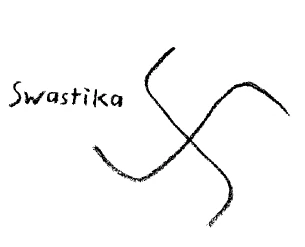
[ 20 ] For these wheels or lotus flowers—of which, for example, the two-petaled one is located in the region of the eyes, and the sixteen-petaled one in the region of the larynx—for these astral sense organs, which appear as luminous phenomena in the astral world, the symbol, the image, is the swastika. Or let us take another symbol, the so-called pentagram. You cannot discover the original meaning of the pentagram through speculation or philosophizing. The pentagram is a reality; it is an image of the workings of currents, of currents of force, found within the human etheric body. A certain flow of forces runs through the human being from the left foot up to a specific point on the head, from there to the right foot, from there to the left hand, from there through the body, through the heart to the right hand, and from there back to the left foot, so that you can draw the pentagram within the human being—in his head, his arms, hands, legs, and feet.
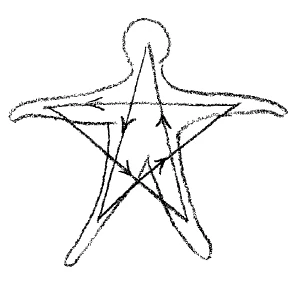
[ 21 ] You must create a mental image of this as a force field, not merely as a geometric figure. The pentagram is present in the human etheric body. The force fields follow exactly these lines of the pentagram. The lines can undergo the most varied distortions, but they always remain inscribed on the human body as a pentagram. The pentagram is an etheric reality, not a symbol, but a fact.
[ 22 ] Thus, every symbol in occultism is an image representing a reality of the spiritual world. One can only grasp its meaning when one can point to the world in which that reality is rooted. Therefore, even the greatest acumen cannot lead to the interpretation of occult signs. The meaning of occult signs and symbols can be found solely through experience [of spiritual worlds], and only with the knowledge of their meaning can a person make sense of them. It is therefore by no means useless when a person is told or informed of something that was first discovered through clairvoyant abilities. And from the fact that has been investigated, a person can in turn be led back to the causes of that fact itself.
[ 23 ] Just as with signs and symbols, so it is with ancient legends and myths. It is a theoretical construct of scholarly circles that legends and myths were invented by folk poetry. The people do not compose poetry. All legends and myths are remnants of a time when humans still possessed clairvoyant abilities to a certain degree. What is told to us in European legends and myths are records of facts that people once perceived. Everything in these legends, fairy tales, and myths was originally perceived clairvoyantly and is the retelling of original clairvoyant experiences. That is what mythology is: the retelling of clairvoyant experiences.
[ 24 ] Even today, we can observe all the events recounted in mythology on the astral plane. The deeds of Wotan or Odin are real events. We must seek reality behind the occult signs, symbols, and seals. And the less one allows oneself to be tempted to interpret these signs based on speculation, the better it is.
[ 25 ] This series of lectures is thus intended to introduce us to the factual meaning of occultism. No symbol is invented or imagined; it is a representation or reproduction of a real process in the spiritual world. And all the stories we encounter in mythology are renderings of what people saw when a large portion of humanity still possessed clairvoyant abilities.