

An Occult Physiology
GA 128
27 March 1911, Prague
Translated by Steiner Online Library
Seventh Lecture
[ 1 ] In the course of these lectures, we have likely gained the impression that the various organ systems and structures of the human organism participate in the overall processes of this organism in a wide variety of ways. We have been able to point out various aspects in this regard and have already, in the course of the lectures so far, felt compelled to provisionally assign the activities operating within the various organ systems to higher, supersensible members of the human organism. For example, we had to say that the human blood circulation is intimately connected with what we call the human ego, so that we could speak of the blood as an instrument of the human ego. We have also been able to assign what we call the life of consciousness to the nervous system. But we have also shown how a specific part of the nervous system—the sympathetic nervous system—has, in a certain sense, a task opposite to that of the other part of the nervous system, a task that consists in to hold back, so to speak, everything that takes place in the depths of the human organism, everything that is brought about by the activity of the inner world system, so that under normal physical conditions it does not rise up to the horizon of the ego, that is, into waking consciousness. Yesterday we also attempted to recognize, at least approximately, that what eludes human conscious life most of all is that which builds itself up within the solid skeletal framework; but we had to emphasize how, even within this solid human skeletal framework, there must be at work a vital force that ultimately enables the human being to develop the organ of their conscious ego life, the blood circulation. Thus we can also say: the embedding of the human skeletal system means for the human organism as a whole that it can take on a human form at all, and that everything that occurs within the processes taking place in the solid skeletal system is kept below the threshold of consciousness. We are always dealing with something similar in the human organism, namely—and let us be particularly clear on this point—that what is within this human organism is, as it were, shielded from the influences taking place in our surroundings and in the vast world of the cosmos. We have said that the members of the inner world system—those seven organs that, in a sense, mirror the outer planetary system within us—especially the spleen—retain the external laws of what we take in as food, freeing it, as it were, from these laws, and that the nutrients are thus taken up by the human organism in such a way that they prove to be filtered, so that they do not enter the human organism in a form that would allow them to act within it according to their own laws and their own activity. In the, I might say, most basic sense, we already have this protection of inner processes against external influences in the form of blood warmth for humans and higher animals. This blood warmth, which lies within narrow temperature limits, is maintained by an inner law and is independent of the thermal processes of the macrocosm, the greater world, that unfolds around us. Here you have a very vivid example of a kind of fundamental phenomenon in this constancy of blood temperature. Thus we must always point out that one of the most essential aspects of the inner organization of the human being consists in the fact that a limited, essential being is sealed off from the macrocosm and develops its own activities.
[ 2 ] Today, to gain a deeper understanding of the human organism, we would do well to approach the subject from a slightly different angle and take a brief look at conscious life. We already know from the previous lectures how human conscious life makes use of the instruments of the blood and the nervous system, but we have not yet been able to go into the finer processes. What I am about to say is something that is likely to shock the outer world—and, to be perfectly frank, the science commonly accepted today—to a great degree. But anyone who truly stands on the ground of genuine, true occultism will tell you that the trend in science is such that, within the course of a few decades, even those things that we can say today only on the basis of occult observations will be confirmed and recognized through it. If, instead of such a short series of lectures, I could speak here for half a year on these matters, it would be possible to draw from the findings of modern science everything that is suitable for providing external evidence to support what is to be said in today’s lecture. But I must leave much of this to the good will and abilities of my esteemed listeners. It is, after all, possible everywhere to seek paths to external science which, if it proceeds not from theoretical prejudices but from the facts, can already find confirmation everywhere today for what is said in the field of occultism. I ask that you take all these remarks in this spirit.
[ 3 ] When we take our conscious life as our starting point—specifically, when we consider the relationship between our conscious inner life and our physical body—it is first necessary to take into account everything we call our thinking activity in the broadest sense. In doing so, we need not concern ourselves with finer logical or psychological distinctions; for the time being, we need only place ourselves before our soul and recognize that we are dealing with the human life of thought, the human life of feeling, and the human life of will.
[ 4 ] Now, among those who stand on the ground of true occultism, you will never find any contradiction when it is said that all such processes—which take place in our soul life within our waking daytime consciousness and which fall under the categories of thought, feeling, or volitional impulse—actually bring about material processes in the organism—whether animate or otherwise — processes are actually brought about in the organism, so that for everything that takes place in our soul, we can find the corresponding material processes in our organism. This is of the utmost interest. For it is only in our time, due to certain trends that have only recently emerged in science, that it will be possible in the coming decades to truly identify these correspondences between soul processes and physiological processes in the organism and to confirm what has been gained from occultism.
[ 5 ] Every mental process corresponds to a process in our organism, just as every emotional process does, and just as every process that must be described as a “will impulse” does. We might say, as it were: When something takes place in our inner life, a wave is set in motion that propagates all the way down into the physical organism. - Let us first consider the process of thinking. It is best to focus on a thought process that, like purely mathematical thinking or similar objective thinking, leaves our feelings and will unaffected. Let us first consider such thought processes, which are “pure” thought processes. What happens in our organism when such thought processes take place in our inner life? Every time we think, every time we form thoughts, a process takes place in our organism that we can compare—I say this not as an analogy, but as a fact; the comparison is meant to lead us to facts—that we can compare to the process of crystallization. If we have a glass of water that has been heated to a certain degree, and we have dissolved some salt in it—rock salt, for example—and then, by cooling the water, cause this dissolved salt to crystallize, then the process opposite to dissolution takes place. When the salt is completely dissolved, the water is transparent. But when the water is cooled again and the process opposite to dissolution takes place in the water, the salt crystallizes out of the water once more; a salt reformation occurs, a salt deposit in the water. The process thus presents itself as follows: In the previously warm water, when we cool it, a solid forms; a solid is deposited in the liquid, a salt deposit. As I said, I have assumed that the presentation of occult findings may initially shock those who, in a purely philistine sense, wish to acknowledge only the facts recorded by science.
[ 6 ] An identical process now takes place in our body when we think. It is a process of thinking analogous to the deposition of salts, which originates from an effect of our blood and has an irritating effect on our nervous system—an organic process, in other words, that takes place at the boundary between our blood and our nervous system. And just as we can observe the crystallization of salt when looking at water in a glass, so too can we see—when observing a person who is in the favorable position to think—how such a process actually takes place, a process that is very clearly perceptible to the clairvoyant eye. Thus we have set before our soul the physical correlate of the thought process.
[ 7 ] Let us now ask ourselves: What does this correspond to in the experience of feeling? — When we feel, we are not dealing with the deposition of solidifying salts—that is, not with a reverse dissolution process—but rather with subtle processes taking place in our organism that unfold much like when a liquid becomes semi-solid. Imagine this: A liquid becomes semi-solid, like liquid egg white; it coagulates to the consistency of thickened egg white; in other words, a liquid is solidifying. While in the thought process we are dealing with the extraction of a solid, salt-like substance from a liquid that precipitates, in the emotional realm we are dealing with the transition of certain particles in the blood from a more liquid state to a denser state. The substance itself is brought into a denser state through a kind of coagulation. To the clairvoyant eye, this appears as the formation of small flakes, just as you can, in a glass containing a certain liquid, bring about a process of internal flocculation through certain procedures—the separation of small, swellable droplets from a liquid substance.
[ 8 ] If we now turn to what we might call our volitional impulses, their physical correlate is, in turn, different. This is actually easier to grasp, for here we are entering the realm where the matter becomes somewhat more apparent. The physical process corresponding to our volitional impulses is a kind of heating process that causes increases in temperature within the organism—a kind of heating up of the organism, in a certain sense. Since this heating is closely connected to the entire pulsation of the blood, we can say that the volitional impulses are associated with an increase in the blood’s temperature. It doesn’t take much; if one has even a modicum of aptitude for genuine observation, one can already observe in the animal organism that the volitional impulses have their physical correlate in the warming of the blood.
[ 9 ] In this way, we can to some extent characterize the physical correlates that occur during inner, psychological processes. What I have just described to you is, of course, not something that takes place in a very crude manner, but rather these are extraordinarily subtle, minute processes—processes of a subtlety that one usually cannot even begin to imagine. But with the exception of the warming processes, these processes take place in such a way that, compared to everything we know of similar processes in the external physical world, they exhibit an immense subtlety. All these are processes that the organism carries out with all its powers when the ego is active, with the aid of the instrument of blood. From salt deposition to swelling and heating, these processes unfold in such a way that the entire organism is involved, or, for example in the case of the thinking process, mainly a part of our organism—the brain and spinal cord system. These processes, which are the consequences of the influence of the soul processes, are distributed throughout the human organism in the most manifold ways. When one gradually comes to know these things as facts, one is led to the point of having to admit that what we call thoughts, feelings, or impulses of the will are real forces that have real effects within the physical organism and express themselves in real effects. We must speak, purely on the basis of occult observation, of a real effect of the soul on the human organism. These real effects on the human organism will gradually reveal themselves to science in the coming decades. These subtle processes within the organism will become accessible to science’s more careful and refined methods of investigation; and then the resistance that today—not based on the facts science has investigated, but rather on certain prejudiced theories linked to these facts—arises against assertions that can be made from occult knowledge will gradually cease of its own accord.
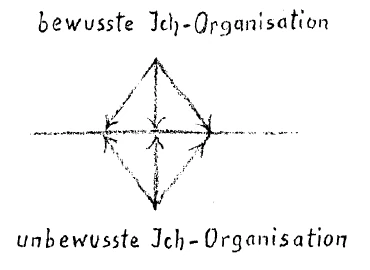
[ 10 ] We have also pointed out that what we perceive as a conscious activity of the ego is, in essence, only a part of the human being, and that beneath the threshold of what enters our field of consciousness in this way, processes are taking place that lie below the level of consciousness and are, as it were, kept at a distance from our consciousness by the sympathetic nervous system. We have been able to point out from various angles how what we carry within us in this unconscious way is also, in a certain sense, connected to our ego. We have said of the most unconscious aspect, our skeletal system, that it is organized from the outset in such a way that it can provide the very foundation for the instruments of the conscious ego. Thus, an unconscious ego-organization grows out of the unconscious toward the conscious ego-organization. As it were, the human being divides into two parts for us: the conscious ego-organization acts from one side, and the unconscious ego-organization acts from the other side into the human being (see diagram on p. 136). In this regard, we have seen that the blood system and the bone system form a certain contrast to the conscious ego organization, appearing as opposite poles. While the blood, in its inner activity, follows the ego’s activity as a pliable instrument, the other pole—the skeletal system—eludes the ego’s activity to such an extent that the ego has no awareness of anything that occurs in the skeletal system; that is to say, all processes taking place in the skeletal system unfold entirely beneath the surface of the actual conscious ego events. These are indeed processes that correspond to our ego activity, but they are just as dead as our blood processes are alive; they are thus, in essence, part of those processes that remain unconscious to the ego, which rise only gradually from the unconscious to consciousness.
[ 11 ] If we take a close look at the skeletal system and its overall function within the human organism, we cannot help but notice that it eludes all conscious life—more so than any other organ system. But when we now turn from the skeletal system to the organ systems—which we have called the inner world system of the human being—to the liver-bile-spleen system, the lung-heart system, and so on, we must say, in accordance with what was shared in earlier lectures on this subject: To a high degree, the processes within these systems are also hidden from our consciousness, but not quite to the same extent as the processes in our skeletal system. We need to think about our skeletal system far less, and pay far less attention to it, than to the organs just mentioned. Some of these organs even reveal their functions to the human being very clearly as something that rises above the unconscious. It is somewhat like an object floating in the sea, part of which rises up and becomes visible above the surface like an island. For example, much of what goes on in the heart rises into consciousness. You know from experience how particularly hypochondriacal types—to their detriment, of course—sense something of what is happening in their internal organs; admittedly, they become aware of it quite differently from what is actually happening inside, but they do perceive it. I am not speaking now of what it is like when a certain degree of illness has already set in within the organs. For when one falls ill, one becomes aware of the organs; yet there is a real cause at work whereby the effects of the inner world systems rise up into consciousness; rather, I am speaking of the fact that this boundary—which a healthy person maintains against illness—need not be reached by a long shot. Unfortunately, however, this boundary shifts quite often. What is often already referred to as illness can certainly be regarded as a lesser or greater degree of the intrusion of inner processes into consciousness. We must therefore always investigate the causes of various illnesses by asking ourselves: Do the causes of the pain lie in diseases of the organs, or must we look for them elsewhere?—We know, after all, that we are protected from the intrusion into consciousness of what is taking place down there in the organism by the sympathetic nervous system.
[ 12 ] If we see something in the skeletal system that structures the human being in such a way—in terms of its form and configuration—that the circulatory system can function within it as an instrument for the ego, then, in light of what has just been said, we must be clear that the other organ systems, too, grow in a certain way toward the human being’s conscious life, which is ultimately to unfold like a flower. We must be clear that all these organs, even though they are not permeated by fully conscious life, already contain what grows toward our conscious soul life, just as we have seen that our skeletal system grows toward the life of the ego.
[ 13 ] We must now ask ourselves: To what extent does this inner system—which we have described as an inner world system—develop in harmony with the conscious life of the human soul? — If, on the one hand, we consider that the skeletal system provides the firmest support in our physical body, giving the circulatory system its structure so that it acts in the right places to unfold as an instrument of the ego, then on the other hand we must also say that the skeletal system supports and holds in the correct position those organs that we previously referred to as inner world systems. For whatever happens to the blood also benefits these organs. If you consider all these organ systems, you will notice that you cannot discover anything in their arrangement that is as essentially and intimately connected with the outer form of the human being as the skeletal system. It is the foundation of the human form, and whatever builds itself up and settles around the skeletal system can only do so because the skeletal system provides the basic form. The skin, too, as the body’s outer boundary, is, as it were, preformed by the entire structure of the skeletal system. Goethe expressed this in a beautiful saying, not merely from an aesthetic but also from a scientific standpoint: “There is nothing in the skin that is not in the bone.” That is to say, the outer structure of the skin expresses what is already preformed by the skeletal system. We cannot say the same of our inner world system. On the other hand, however, the very fact that the effects of the inner world system emerge at lower levels of consciousness shows that this inner world system has something to do with our astral body; for the astral body is the bearer of consciousness. We must therefore say that, although this inner world system cannot appear to us as an expression of the subconscious ego—the form-shaping ego lying in the deep depths—it can appear to us as that which is so integrated into us through the entire world process as an expression of the environment that it has a similar relationship to our astral body just as the skeletal system provides the foundation for the human form encompassing the ego. We can therefore say: We have already preformed the human ego in the skeletal system, deep down in the subconscious, and in what we call our inner world system, we have preformed what we call our astral body.
[ 14 ] Now, because this inner world system lies just below the level of consciousness, its entire organization does not originate from the conscious life of the soul; it is embedded in our organism from the macrocosm. Thus, something we might call a cosmic astral realm is so embedded in the human being that it expresses itself as our inner world system. And in our skeletal system, we have in turn had something incorporated into our organism from our surroundings, from the great world system, and because this is connected to the entire form of our physical organism, we must say: This skeletal system is in fact the foundation for our ego in our physical body, because it is a macrocosmic or simply a cosmic system that makes us into this physically formed human being. Alongside this skeletal system, a macrocosmic astral world system is embedded within us as our inner world system. Insofar as our ego appears as a conscious ego, it has the blood system as its instrument; insofar as our ego is preformed as form and shape, it is based on a cosmic system of forces that drives toward solid formation, which finds its densest expression in our skeletal system.
[ 15 ] Let us now consider the matter from another perspective. We now know that everything we have described as conscious thought activity brought about by the “I” is expressed through a kind of extremely fine salt deposit in the blood. Conscious thinking thus reveals itself through a kind of internal salt deposit. We can therefore expect that where our skeletal system is preformed from the cosmic realm so that the organism can provide the material support for the human being as a thinking entity, we should also find the physical process of salt deposition. We should therefore be able to find salt deposits in the skeletal system; and indeed, the bones consist in part of phosphoric and carbonic calcium, that is, of deposited calcium salts.
[ 16 ] Here, too, we have the two opposing poles. When a person engages in thought, it is the thought processes that make us, inwardly, a coherent being. In a certain sense, our thoughts are our inner skeletal framework. Human beings have certain sharply defined thoughts; our feelings, on the other hand, are indefinite, fluctuating, and more or less different in every person. Thoughts form solid inclusions within the emotional system. While these solid inclusions express themselves in conscious life through a kind of active, dynamic salt-deposition process in the blood, what the ego prepares expresses itself in the skeletal system in such a way that the macrocosm shapes our skeletal system so that it is largely composed of deposited salts. These are now the resting element within us, the other, the opposite pole to the processes of inner activity that take place in the salt deposition processes in the blood. Thus, as human beings, we are made into thinkers from two sides within our organism: on the one hand unconsciously, through the formation of our skeletal system; on the other hand consciously, by consciously carrying out—following the pattern of our bone-building process—the very same processes that manifest in the organism as salt-deposition processes, which we can describe as internally active. The salts formed during thinking must be immediately dissolved and cleared away again through sleep; otherwise, they would bring about something like processes of decomposition or dissolution in the organism. We must therefore regard thinking as a genuine process of destruction. And through the restorative power of sleep, a process of regression is set in motion that frees the blood from salt deposits, enabling us to develop conscious thoughts anew in our waking daily life.
[ 17 ] However, it is not acceptable to simply say: “Thinking is a process of salt formation”—because if people do not understand this correctly, someone might well say that spiritual science asserts the most ridiculous nonsense.
[ 18 ] Let us now move on. We can imagine that between these two extreme poles of salt formation, all other processes in the human organism take place—namely, essentially those we have already pointed out. Just as we have active salt formation processes through thinking, which have their opposite pole in the salt formation process in the bones, which has come to rest to a certain degree, so we also have an opposite pole to what we have described as the inner swelling process, as coagulation, as the flocculation process, as something akin to protein-like inclusions that arise under the influence of our emotional life, as an outward expression of our emotional life. This counterpole manifests itself in what are more internal processes of our organism and participates in such an unconscious welling up, in a thickening of substances that form and are deposited as an effect of the macrocosmic astral system. It is the bone glue that participates in the bone-formation process and is incorporated into the other bone substances. This is the other pole of the swelling process, as opposed to what arises as a physical correlate through our emotions.
[ 19 ] Our volitional impulses are, after all, organically expressed in a thermal process, in an internal heating process. Compounds that form—and which we can describe as the products of internal combustion processes, as internal oxidation processes—are found throughout our entire organism. And insofar as they occur below the threshold of consciousness and have nothing to do with conscious life, they belong to the other side, the opposite pole, which is separated from that from which conscious life can receive influences. Thus, through a part of their organism, human beings are internally protected from disturbances, so that processes of the utmost delicacy, initiated by the life of the soul, can take place within it.
[ 20 ] As we have learned, physiological processes such as salt formation, swelling, and heat generation take place in our organism; these processes follow our conscious life, while other processes occur outside our conscious life in such a way that they first provide the foundation for what is being prepared in the human organism, so that conscious life can unfold at all. Thus, our entire organism is an interwoven tapestry of processes that we must describe as belonging to our conscious life, and those that we must describe as belonging to our unconscious life. This is an extraordinarily significant fact: that our organism truly represents something like a unity of two polarities—that processes of one kind take place in such a way that they penetrate the organism from the macrocosm and unfold, as it were, in the coarser realm, while on the other hand there are processes that can take place in the finer realm as consequences of human conscious life.
[ 21 ] In today’s fully developed organism, the situation is such that all these processes are thoroughly intertwined, and that, given the organism as it stands before us, we cannot really separate them from one another in such a way that we could define clear boundaries everywhere; one process flows into the other. You need only consider the circulatory system, the most active and delicate element. In the blood, you see both the agent of the salt-deposition processes and of the processes of coagulation of a liquid substance, as well as the processes of heating. In a similar way, we also find these processes in close relationship with one another in other organ systems. When, for example, we take in food from the outside into our digestive tract, this food still possesses what I have called its external activity. They undergo an initial stage of sifting by being taken into the mouth and prepared through the chewing process for the digestive process in the stomach; in a subsequent sequence of stages, they are processed by the organs we have referred to as the inner world system, and finally they are brought to the point where they can nourish the finest instrument of the human organism, the blood. Having thus outlined, in a certain sense, a sequence of stages in the sifting of nutrients through the internal organ systems, we can now easily imagine that, in fact, the finest system—the blood system—must take in, so to speak, the most thoroughly sifted nutritional activities, and that what reaches the blood already contains the very least of what the nutrients possessed of their own activity when they were ingested. When the substances are ingested, they still retain a good portion of their own nature and laws. They have had to relinquish these in the stomach and the subsequent organ systems they passed through, and to the extent that they are found in the blood, they have become something entirely new. Therefore, the blood is also the organ that is most protected of all against the influences of the external world, the one that carries out its processes most independently of the external world. That is one side of the matter; but we have already shown in detail that the blood turns toward two sides, that it is exposed to influences from both sides, like a tablet. On the one hand, the blood is indeed led to those organs in the deeper regions of the human organism where all the processes taking place are held back and repelled by the sympathetic nervous system, so that they do not reach consciousness. Now the blood must also turn toward the other side, the experiences of conscious soul life. It must not only take in the unconscious processes, but the conscious ego must also imprint itself upon the blood. Our conscious soul activities must be able to transform themselves until they reach the blood, so that they may find expression in this blood for what we have around us. What do we have around us? The physical-sensory world; for that which is incorporated into the plant world—the etheric body—is not present for normal consciousness. For clear daytime consciousness, the human being belongs only to the physical world; the world of life is invisible to us.
[ 22 ] Thus we stand face to face with the other side of the blood-table of the physical-sensory world. The entire life of the soul—as it unfolds under the impressions of the physical-sensory world, as it is stirred into thoughts, as it is kindled into feelings, as it is stimulated into impulses of will—must be able to find its instrument in the blood system, insofar as it is conscious ego-life. All of this must be able to pulsate in the blood. What does that mean? It means nothing other than that we must not have in our blood only that which comes from foodstuffs, after they have been highly filtered, stripped of their own activity, and protected from all macrocosmic laws, but—so that inscription on the blood tablet is also possible from the other side—there must also be found in the blood something related to the physical-sensory, to the inanimate of the physical-sensory world. For ordinary consciousness, what constitutes life can indeed be recognized only through the combination of physical-sensory impressions; in its reality, it can be recognized only through the lowest supersensible member of the human being, through the etheric body.
[ 23 ] Blood must therefore be related to the physical-sensory world, just as that world is immediate. We shall now see that something is incorporated into the blood of which we can say: This is not the case in our blood as if it were determined by the processes that rise up to the blood from our being, from the depths of our organism, whose laws are thus adapted to our own; rather, it is as if it were incorporated into our blood through the effects of external macrocosmic laws and activities. We must have something in our blood that is and acts like immediate external processes, but which unfold internally just as they do externally in the macrocosm, and thus do not lose their own laws. Physical, chemical, and inorganic processes must therefore be at work in our blood; these are necessary so that our ego can participate in the physical world. We must therefore seek in the blood such substances that can act in such a way that their physical character, their inherent laws, are preserved. We do indeed find this in the blood. In our red blood cells, we are given something that clearly shows that it is just beginning to live and is at the point where it transitions from life to lifelessness. On the other hand, we have incorporated into the blood a continuous heating process that can be compared to an external combustion process, where the oxidation process in turn provides new possibilities for life. We have thus incorporated into the blood that which makes the human being a physical-sensory being.
[ 24 ] Thus, even in the structure of blood, we see how significantly physical and chemical analysis can be illuminated by what can be conveyed from an occult perspective, and how this alone makes it possible to understand what presents itself to direct external observation.
[ 25 ] So we can say: In the human organism, in the blood, we have processes that are stimulated by the influence of the external world and are of a physical-sensory nature; but we also have processes in the blood that arise from within and are based on the storage of nutrients that have been filtered and transformed to the utmost degree. When we consider this, blood will appear all the more significant to us as “a very special fluid,” for on the one hand it turns its nature toward the lowest, most fundamental realm known to us and reveals itself as a substance capable of carrying out external chemical processes, thereby serving as a tool for the ego. On the other hand, blood is the substance best suited to carrying out internal processes that cannot be performed anywhere else, since all other organ processes are necessary prerequisites for this.
[ 26 ] The most subtle, the highest processes, which are stimulated from the depths of our organism, combine in our blood with physical-chemical processes such as we see everywhere in the world. In no other substance does the physical-sensory material world meet so directly with another, inner world—one that presupposes the existence and activity of supersensible force systems—as in our blood substance. This is evident in no other substance as much as in the blood that flows through our organism. This blood is indeed something in which the lowest, that which a human being can observe around them, merges with the highest, that which can organically develop within their nature. Therefore, it should be clear to us that, with regard to these complex processes taking place in the blood, we are dealing with something that, if it becomes somewhat irregular or disturbances occur, must cause irregularities in our entire organism to a high degree. And that wherever such irregularities appear, we must always consider how they arose. It will be difficult to distinguish whether, in individual cases, we are to attribute these irregularities to processes that follow the pattern of physical-chemical processes, or whether they correspond to other processes in the blood. If the irregularities follow the pattern of physical-chemical processes, then we must be clear that they must be addressed from the perspective of consciousness, specifically in the sense that consciousness is connected to the physical plane. This opens up a therapeutic field characterized by the need to observe whether certain irregularities are related to processes that we can describe as physical-chemical. Under these conditions, it is beneficial to intervene through external impressions, by appropriately regulating the external stimuli that can trigger these physical-chemical processes. This refers less to mental and spiritual impressions and more specifically to everything we can achieve by regulating the respiratory process and by monitoring the processes of interaction between the internal organism and the external world through the skin.
[ 27 ] But then we can also observe the most subtle organic processes in the blood from the other side, and we must realize that we are seeing, so to speak, the third stage of refinement of our pre-processed nutrients. If, in the blood organism, those subtle processes of salt formation, swelling, and heat are brought about by external processes—that is, if their chemical course is determined from the outside—then we must ask, on the other hand, what determines the processes in the blood from the inside. Here we must distinguish between the task that the blood has and the fact that it must be nourished just like any other organ. At the same time, we must also recognize it as the organ that stands at the highest level of organic activity. What comes into consideration here is what we can describe as the inner support of human life. Above all, the blood must be protected from the external world directly influencing it through nutrients; otherwise, its function as an instrument of our thinking is impeded, and the process we previously described as salt deposition is disrupted. This protection must emanate from the blood itself; it must be capable of building up, as it were, a spiritual skeletal system oriented toward the spiritual realm through the daily recurring processes of salt deposition. This is a task of the blood that distinguishes it from other organs. In this, it receives the least support from the other organs of the human organism. The other organs play the smallest role in this salt-forming process of the blood, so that the blood is most internalized with regard to the processes conditioned by thinking, just as our thoughts are indeed the most inner aspect of our being. With our feelings, we stand at the boundary between the external and the internal, and through their impulses of will, human beings flow so strongly outward that under certain circumstances they may not even recognize themselves. In their thinking, human beings will always recognize themselves, but not in their impulses of will. That it is not so clear how the impulses of will arise can already be seen from the fact that there is so much debate in the world regarding the freedom and lack of freedom of the human will. In our thinking, therefore, we have the innermost aspect of what the blood, as an instrument of the ego, is to accomplish. And because the process of salt deposition is the most internalized and must also be the most protected, this activity of the blood can also be most hindered by irregularities or abnormalities in the blood. And when we notice that the blood is so impeded that it no longer manifests its activities in this direction, we must be clear that it must be stimulated to regular activity if its own life has fallen below a certain threshold.
[ 27 ] But then we can also observe the most subtle organic processes in the blood from the other side, and we must realize that we are seeing, so to speak, the third stage of refinement of our pre-processed nutrients. If, in the blood organism, those subtle processes of salt formation, swelling, and heat are brought about by external processes—that is, if their chemical course is determined from the outside—then we must ask, on the other hand, what determines the processes in the blood from the inside. Here we must distinguish between the task that the blood has and the fact that it must be nourished just like any other organ. At the same time, we must also recognize it as the organ that stands at the highest level of organic activity. What comes into consideration here is what we can describe as the inner support of human life. Above all, the blood must be protected from the external world directly influencing it through nutrients; otherwise, its function as an instrument of our thinking is impeded, and the process we previously described as salt deposition is disrupted. This protection must emanate from the blood itself; it must be capable of building up, as it were, a spiritual skeletal system oriented toward the spiritual realm through the daily recurring processes of salt deposition. This is a task of the blood that distinguishes it from other organs. In this, it receives the least support from the other organs of the human organism. The other organs play the smallest role in this salt-forming process of the blood, so that the blood is most internalized with regard to the processes conditioned by thinking, just as our thoughts are indeed the most inner aspect of our being. With our feelings, we stand at the boundary between the external and the internal, and through their impulses of will, human beings flow so strongly outward that under certain circumstances they may not even recognize themselves. In their thinking, human beings will always recognize themselves, but not in their impulses of will. That it is not so clear how the impulses of will arise can already be seen from the fact that there is so much debate in the world regarding the freedom and lack of freedom of the human will. In our thinking, therefore, we have the innermost aspect of what the blood, as an instrument of the ego, is to accomplish. And because the process of salt deposition is the most internalized and must also be the most protected, this activity of the blood can also be most hindered by irregularities or abnormalities in the blood. And when we notice that the blood is so impeded that it no longer manifests its activities in this direction, we must be clear that it must be stimulated to regular activity if its own life has fallen below a certain threshold.
[ 29 ] Just as we have had to attribute certain illnesses to excessive activity in the circulatory system, we may also ask ourselves how we can address the organs of our inner astral world—our inner world system—such as the spleen, liver, gallbladder, and so on, when their activity is characterized by excessive inner agitation. Above all, we must bear in mind that these organs are indeed intended to influence the blood circulation, that they must take in the nutrients as they are supplied by the digestive tract and convey them in a transformed state to the blood; in other words, they are the mediators between these two systems. Just as the blood system proves to be the instrument of the greatest inner activity, of conscious intellectual life, so too is it stimulated to an activity that proves to be connected with our emotional life, which we have already described as a process of inner condensation, of inner welling up. Here the blood—apart from external influences—is stimulated by the activity of the inner world systems, which, in their characteristic nature, can radiate their effects into the blood. We have pointed here to an activity in the blood that already goes beyond the blood’s own life, but whose cause belongs to the inner world system. We can now raise the question: Can these organs—liver, gallbladder, spleen, kidneys, lungs, heart—not also develop excessive activity, an overflowing life, and thus an irregular effect on the blood? And if they do, how can we—in a similar way to what we do with the blood—therapeutically paralyze the excessive activity of these organs? Since these organs are directly connected to the cosmic astral system, we must supply substances that unfold the activity of cosmic life. Just as we can prevent the excessive internal activity of the blood by administering salt-containing substances, so can we dampen and counteract the pathological activity of the internal organs by administering substances whose energy corresponds to that of the organs in question and which are capable of bringing them back into harmony with the general laws of nature.
[ 30 ] This raises the question for us: How can we influence these organs? How can we address the irregularities in the individual organ systems, including the digestive system? This raises the fundamental question: How does a clinical picture present itself to us in the occult-physiological sense, and how are the symptoms of disease to be healed?—We will have to answer this tomorrow, taking into account, for example, the muscular system. Our reflections will conclude by showing how what appears to us as an admirable, fully formed organism is clearly foreshadowed as a developing organism in embryonic life. Then it will become clear to us quite naturally how the supersensible members participate in the human organism.