

Wonders of the World,
Trials of the Soul,
and Revelations of the Spirit
GA 129
20 August 1909, Munich
Translated by Steiner Online Library
Third Lecture
[ 1 ] In this series of lectures, I hope to provide you with an overview of key aspects of our spiritual science from a certain perspective. However, you will only be able to grasp the thread or outline to be followed in the final lectures, because a whole series of questions will be addressed, which will then come together into a complete picture in the last few days. Over the past two evenings, I have in some respects drawn upon the Eleusinian Mysteries and Greek mythology; I will have further opportunities to refer to our performances. But you will realize at the end that this series is also aiming for another goal. This evening I would like to awaken in you, from a different angle, a sense of how spiritual science in our time is working toward that great, mighty primordial wisdom, of which we have glimpsed a little, as it illuminates those powerful figures and images and mystery teachings that come down to us from ancient Greece. One must first become acquainted with this, my dear friends, if one wishes to grasp the full task and mission of spiritual science today: that many ideas and concepts prevailing in our present time must change. And in this regard, people today are often quite short-sighted, thinking scarcely beyond the immediate future. Precisely for this reason—to evoke a sense of how we must change our own imagination and thinking if we are to truly grasp the mission of spiritual science—reference was made to the entirely different nature of the Greek view of the world and life, of the relationship between human beings and the spiritual world. For the Greek heart and soul felt quite differently in this regard than modern human beings do. And I would like to mention one thing right at the outset today.
[ 2 ] There is a term that is very familiar to all of you, an idea that today is not only common in our vocabulary across all languages, but has also found its way into the terminology of a certain branch of science. It is the word “nature.” And the very utterance of the word “nature” immediately evokes a whole host of concepts that the modern mind associates with whatever is designated as “nature.” And we then contrast nature with the soul or the spirit. Now you see, my dear friends, everything that modern people mean when they use the term “nature”—everything we call nature today—simply did not exist in ancient Greek thought. You must completely set aside everything you today designate with the term “nature” if you wish to penetrate ancient Greek thought. That opposition, that duality between nature and spirit, as we perceive it today, was unknown to the ancient Greek. When he turned his gaze to the external processes as they unfold in forest and field, in sun and moon, in the world of the stars, then the ancient Greeks did not yet perceive a nature devoid of spirit, but to them everything that happened in the world was just as much the act of spiritual beings as, for us, the act consisting of, say, a hand movement is an expression of our soul activity. When we move our hand from left to right, we know that this hand movement is based on a soul activity, and we do not speak of a contrast between the mere movement of the hand and our will, but we know that what moves as the hand and what our will represents as an impulse to move are one and the same. There we still feel the unity when we make a gesture that our soul performs. When we turn our gaze outward to the course of the sun and moon, when we see the moving clouds, when we perceive the moving air in the wind, then we no longer see something like what the ancient Greeks saw—namely, hand movements, external gestures of divine-spiritual beings—but rather we see something that we observe according to external, abstract, purely mathematical-mechanical laws. Such a nature, viewed according to purely external, mathematical-mechanical laws, which does not merely represent the external physiognomy of divine-spiritual activity, was unknown to the ancient Greeks. We shall hear how the concept of nature, as understood by modern people today, first came into being.
[ 3 ] In those ancient times, spirit and nature were thus in complete harmony with one another. Consequently, what we today call a miracle did not yet carry the same emotional weight for the ancient Greeks as it does for us today. If we now set aside all finer distinctions, we can say today that a miracle is perceived when an event in the external world is observed that cannot be explained by already known laws of nature or laws related to them, but rather presupposes that the spirit intervenes directly. Wherever a person perceives something directly spiritual that cannot be understood or explained merely by purely external, mathematical-mechanical laws, they would speak of something miraculous. In this sense, the ancient Greeks could not speak of anything miraculous. For it was clear to them that the spirit causes everything that happens in nature; whether these were the everyday events that fit into our natural order or rarer natural phenomena, it made no difference. One was merely rarer, the other was the ordinary, but the spirit—divine-spiritual creation and divine-spiritual activity—intervened in all natural events for them. So you see how these concepts have changed. That is why it is also something essentially characteristic of our present age that spiritual intervention in the external events of the physical plane is perceived as something miraculous, as something that falls outside the ordinary course of events. It is characteristic only of our modern sensibility to draw a sharp line between what we believe to be governed by natural laws and that which requires us to acknowledge the direct intervention of the spiritual worlds.
[ 4 ] I have spoken to you of the convergence of two currents: the Demeter-Persephone current and, if I may put it that way, the Agamemnon-Iphigenia current. They are to be united through the mission of spiritual science. We could also, building on this union of the two currents, speak of the necessity for humanity to learn once again to sense that the spiritual is at work everywhere, in both everyday occurrences and in rarer events. For this, however, it is necessary that what modern man perceives as two currents also come before his soul, that he realize: Here, on the one hand, I have those things that fit into the laws of nature as a natural system, which today the physicist, the chemist, the physiologist, biologists recognize today; and on the other hand, I have phenomena that can simply be observed as facts just like other facts that fit into the physical, mathematical-chemical laws, but which cannot be explained unless one recognizes a spiritual weaving and life behind the physical plane as a reality.
[ 5 ] The entire conflict arising from this dichotomy and, at the same time, from the longing for the union of the two opposites—nature and spirit—within the human soul is laid bare in the Rosicrucian drama through the character of Strader. And how an event that falls outside the ordinary course of nature—such as Theodora’s revelation—affects one who is accustomed to accepting only what falls under the laws of physics and chemistry, and how this acts upon the mind like a trial of the soul, you can also see depicted in the character and the events of Strader’s soul in the Rosicrucian Mystery “The Gate of Initiation.” But in doing so, you have merely crystallized, as it were, something that expresses itself as the sensation of this contrast in numerous modern souls. These Strader souls are very common in the present day. For such Strader souls, it is necessary that they, on the one hand, recognize the peculiar nature of the regular, normal course of natural phenomena, which can be explained by physical, chemical, and biological laws. On the other hand, however, it is also necessary that such souls be led to recognize those facts that also occur on the physical plane but are simply ignored and not acknowledged by the purely materialistic mind as miracles and therefore as something impossible.
[ 6 ] I have already mentioned in other contexts that our friend Ludwig Deinhard deserves credit for having drawn attention to such facts in a clear and coherent manner, in a way that is precisely what the current Theosophical Movement needs. In the first part of his book *The Mystery of Man*, you will see precisely this aspect of modern life and the correct indication of the facts within the physical plane and their background in the spiritual world; you will see how the modern mind can take this aspect—which is absolutely essential for our movement—into consideration and account. In this respect, it is of particular importance that we now have this book, which can be especially useful and purposeful in the hands of all friends, because they can find an opportunity to open a path into spiritual life for those outside souls who still need a different approach than those who already feel the esoteric longing. And since this book attempts to strike a true harmony between this one path of modern scientific thinking and our esotericism, it is, in the hands of our friends, an excellent means of serving spiritual science, especially in our present time.
[ 7 ] We can therefore say that there is a longing today to reconcile the opposition between nature and spirit, an opposition that did not yet exist in ancient Greece. And the fact that attempts are being made—you will find these attempts described in the book I mentioned—that societies are being founded which pursue the interweaving and nature of laws in the physical world other than the purely chemical, physiological, and biological ones, is proof that a longing is felt in the widest circles to bridge this contrast. Thus, the bridging, the harmonization of the contrast between spirit and nature, lies within the mission of our spiritual scientific work. We must, so to speak, draw out from new sources of spiritual scientific insight; we must once again be able to see in what surrounds us more than what the eye of the physicist or chemist or the anatomist or the physiologist or the biologist sees. To this end, we must indeed start from the human being himself, who so strongly challenges us not only to study the chemical and physical laws at work in the physical body, but also to seek out the interplay of the physical, the psychological, and the spiritual—an interplay that, for the attentive observer, can appear before the mind’s eye and, in many cases, in the clearest manner, before the physical eyes as well.
[ 8 ] Modern human beings no longer perceive what I have so far only been able to hint at—namely, the influence of the forces of Demeter or Persephone on the human organism. They no longer perceive the great fact that we carry within us everything that is poured out in the outer universe. The Greeks sensed this. They sensed—even if they could not have expressed it in our modern sense—a truth, for example, of which modern spiritual science is only now slowly becoming convinced again—a truth that I would like to convey to you in the following way. Today you look up at the rainbow. As long as we cannot explain it, it is just as much a wonder of nature, a wonder of the universe, as anything else. There, emerging from the everyday, the wondrous arch with its seven colors appears before our eyes. We now set aside all physical explanations, for the physics of the future will have quite different things to say about the rainbow than today’s physics does. We say that out there our gaze falls upon the rainbow, which appears as if from the bosom of the universe surrounding us. There we look into the macrocosm, into the great world. From it the rainbow is born. Now let us turn our gaze inward a little. Within ourselves we can make the observation—it is a very ordinary observation; we need only place it in the right light—that, for example, certain thoughts relating to something emerge from thoughtless brooding; that, in other words, the thought flashes up in our soul. Let us take these two things: the fact of the macrocosm, that the rainbow is born from the bosom of the universe, and the other, that within ourselves the thought is born from our inner soul life. These are two facts of which the sages of ancient Greece already knew something, which people will learn again through spiritual science. The same forces that cause the thought to flash up in our microcosm are the forces that out there, in the bosom of the universe, bring forth the rainbow. Just as the Demeter forces draw in from outside into the human being and become active within, so too are the forces that form the rainbow out there from the ingredients of nature—where they would act spread out in space—active within us microcosmically, in the small world of the human being; there they let the thought flash forth from the indeterminate. External physics does not yet touch upon such truths today, yet this is indeed a truth.
[ 9 ] Everything that exists out there in space is within ourselves. People today do not yet recognize the complete harmony between the forces mysteriously at work within them and the forces at work out there in the macrocosm; indeed, they may regard this as mere daydreaming or fantasy. The ancient Greek could not say what I have just said about these things, because he did not penetrate them with intellectual culture, but it lived in his subconscious soul life; he saw or felt it clairvoyantly. And if we now wish to express this feeling in our present-day modern terms, we must say: The ancient Greek felt that within him, for example, the forces were at work that caused thoughts to flash up, and that these were the same forces that organize the rainbow out there. —That is what he sensed. He now asked himself: If there are soul forces within that cause thoughts to flash up, what is it then outside, what is it that spreads out spiritually across the vastness of space: above and below, right and left, front and back? What is spread out there throughout space? Just as the soul forces are within, just as they cause thoughts to flash within, just as they cause the rainbow to flash outside, the morning and evening glow, the radiance and sheen of the clouds—what is it out there in space? - Oh, for the ancient Greeks it was a spiritual being that, emerging from the entire universal ether, brought forth all these phenomena—the morning and evening glow, the rainbow, the radiance and sheen of the clouds, the lightning and thunder. And from this feeling, which, as I said, had not become intellectual knowledge but was an elemental feeling, the conception arose: This is Zeus. - And one cannot form a conception, much less a sensation, of what the Greek soul perceived as Zeus unless one approaches this sensation and this feeling through the lens of our spiritual-scientific perspective. Zeus was a directly, firmly formed being, but one could not imagine him unless one had a feeling that the forces which cause thoughts to flash up within us also work in the outer world—in lightning, in the rainbow, and so on. But today, on an anthroposophical basis, when we look into the human being and wish to learn from the forces that evoke within us such things as thought, as imagination, as everything that lights up and flashes within our consciousness: all of this is encompassed by what we call the human astral body. — And there we have the microcosmic-substantial, the astral body, and can now pose the question we just raised in a figurative form, in a more spiritual-scientific form, and can say: The astral body within us is microcosmic. What corresponds to the astral body in the vastness of space outside, what fills all spaces, right and left, front and back, above and below? Just as the astral body is spread out within our microcosm, so too are the expanses of space; so too is the universal ether permeated by the macrocosmic counterpart of our astral body. And we can also say: What the ancient Greeks imagined as Zeus is the macrocosmic counterpart of our astral body. Within us is the astral body; it causes the phenomena of consciousness to shine forth. Outside of us, astrality is spread out, giving birth from within itself—as from the womb of the world—to the rainbow, the morning and evening glow, lightning and thunder, clouds, snow, and so on. Modern man does not even have a word for what the ancient Greeks conceived of as Zeus and what is the macrocosmic counterpart of our astral body.
[ 10 ] Now let us ask further. Apart from the fact that thoughts, ideas, and feelings flare up within us—insofar as they last for a moment or a short time—we have our ongoing inner life with its passions, emotions, and the ebb and flow of feelings that remain with us, becoming habitual and part of our memory. We have this inner life of ours in such a way that we distinguish between individual human characters based on this inner life. There stands a person before us with stormy passions that fiercely seize upon everything that stands in their way; another person who faces the world with apathy. This is something other than the thought that arises momentarily; it is something that constitutes the enduring configuration of our inner life, which forms the foundations of our happiness, of our destiny. The person who has a fiery temperament, who possesses vivid passions, sympathies, and antipathies, can, under certain circumstances, through the ebbing and flowing movements of these sympathies and antipathies, bring about this or that to their good or ill. The forces that are within us, which signify this more enduring, consistent aspect that becomes memory and habit, are something other than the forces of the astral body. These forces are already bound within us to the etheric or life body; you know this from other lectures. But if we were to think in a Greek way, we would now ask again: Is there anything out there in the universe that consists of the same forces as those at work in our habits, passions, and enduring emotions? — And the Greek felt this, too, without bringing it to consciousness through intellectualization or exemplification. The Greek felt that in the surging sea and in the storms and hurricanes that rage across the earth, the same forces are at work as within us when the lasting emotion, the passion, the habit, and the memory pulsate. On a microcosmic level, these are the soul forces within us that we summarize under the concept of the etheric body, which brings about our enduring emotions and so on. On a macrocosmic level, these are the forces more closely bound to our Earth than the Zeus-like forces traversing the vastness of space; they are the forces that bring about wind and weather, storms and calm, and the sea’s stillness and turbulence. In all these phenomena I have just mentioned—storms and weather, the raging sea and the calm sea, hurricanes and calm—modern people see only nature, and modern meteorology is a purely external physical science. Such a purely physical science, as we have it today in meteorology, did not yet exist for the ancient Greeks. For the Greeks, it would have been just as absurd to speak of such a meteorology as it would be for us if we were merely to investigate which physical forces move our muscles when we laugh, and if we did not know that the forces of the soul’s substance pour into these muscular movements. Those were gestures, spiritual activity. Storms and gales, wind and weather were gestures that unfolded only outside, but corresponding to the same spiritual effect that manifested within us in the microcosm as enduring affects, passions, and memory. And the ancient Greek, who still had an essential awareness of the form accessible through clairvoyance, of the ruler of the central power of these forces in the macrocosm, referred to this under the name of Poseidon.
[ 11 ] And today we also speak of the physical human body as the densest aspect of the human being. In the physical human body, we must again see, on a microcosmic level, everything within us that belongs to the sphere which has not been mentioned among the other two. Attached to the astral body is everything within us that consists of fleeting thoughts and images, as they arise and vanish; attached to the etheric body is everything that appears in human nature as habitual, enduring affections—that which is not merely thought, that which therefore does not lead a self-contained, thought-like existence within the soul. For that which is not merely an affect but which passes over into a volitional impulse—the impulse to carry something out—the physical body is necessary for human beings in this earthly existence between birth and death. The physical body is all that which elevates the mere thought or even the mere affect to a volitional impulse, which initially underlies action in the physical world. So when we speak of impulses of the will, of the soul forces within us that underlie these impulses, and ask: What outwardly expresses these soul forces that are addressed as will? — we have this before us in the entire physiognomy of the physical body. The physical body is the expression of the impulses of the will, just as the astral body is the expression of mere thoughts and the etheric body is the expression of enduring emotions and habits. In order for the will to be able to act through the human being here in the physical world, the human being must have a physical body. In the higher worlds, the effect of the will is something quite different than here in the physical world. Thus, microcosmically, we have within us the soul forces that primarily bring about the impulses of the will necessary for the human being to be able to address the “I” at all as the central power of his soul forces. For without the human being having a will, he would never attain an “I”-consciousness. We can now ask again—this time from a different perspective than yesterday—what did the Greek feel when he asked himself: What lies out there spread out in the macrocosm as the same forces that evoke within us the impulse of will, the entire world of will? What lies out there? To this he answered with the name Pluto. Pluto as the central power out there in macrocosmic space, closely bound to the compacted planets—this was for the Greeks the macrocosmic counterpart of the impulses of will that drove the Persephone-like life down into the underworlds of the soul life as well.
[ 12 ] For a clairvoyant consciousness, for a glimpse into the true spiritual world, a person’s self-knowledge takes such a form that they can clearly distinguish the threefold nature of their being: the astral body, the etheric body, and the physical body. The ancient Greeks were not at all intent on focusing precisely on the microcosm in the same way we do today. In fact, attention was first directed toward the microcosm at the very beginning of our fifth post-Atlantean cultural epoch. Rather, the ancient Greeks had their eyes on the forces of Pluto, Poseidon, and Zeus outside themselves and took it for granted that these forces were working within them. They lived much more in the macrocosm than in the microcosm. This is how the ancient era differs from the modern one: the Greeks perceived the macrocosmic more strongly and thus populated the world with their divine figures, who were for them the central powers of the corresponding macrocosmic forces; whereas modern human beings are more concerned with the microcosm, the central being of our world, the human being, and therefore seeks the characteristics of the threefold world more within his own being. Thus we experience the peculiar fact that, emerging from Western esotericism in the most manifold ways precisely at the beginning of our fifth post-Atlantean cultural epoch, there arises an awareness of the inner activity of the soul forces, such that they specify the human being according to physical body, etheric body, and astral body.
[ 13 ] And much of what has been observed in this regard among the individual spirits of modern times can now be confirmed anew, as occult research into this microcosmic aspect is once again being deepened. In particular, what emerged in the 16th and 17th centuries regarding the clairgustance of one’s own being can be fully confirmed. Just as one can speak of clairvoyance or clairaudience, so too can one speak of clairgustance. And this clairgustance can relate to the threefold human being, and I can draw a comparison for you between external taste sensations and the various taste sensations that a person can experience in relation to their own threefold being.
[ 14 ] Imagine vividly, very vividly, that taste you experience when eating a rather tart fruit, such as a sloe, which makes your mouth pucker. Imagine this sensation intensified, and now imagine yourself completely permeated from within by this sensation of tartness, of constriction, of something literally writhing in agony; imagine you were to feel this sensation within yourself from head to toe, through your fingers and every limb of your entire organism, permeated by a constricting taste—then you would have that self-knowledge which the occultist must call the self-knowledge of the physical human body through the occult sense of taste, the spiritual sense of taste. Where self-knowledge works in such a way that one feels oneself completely permeated by this contracting taste, there the occultist knows that he stands before the self-knowledge of the physical body, for he knows that the etheric body and the astral body must taste differently, if one may put it that way. One tastes oneself differently as an astral and etheric being than as a physical human being. These things are not spoken of out of thin air, but are based on concrete insights that are just as widespread among those who know occult science as the external laws are among physicists and chemists.
[ 15 ] Now take that taste that isn’t exactly provided by sugar or a piece of candy, but rather that subtle, ethereal sensation of taste that most people don’t perceive, yet which can be experienced in physical life when you enter, for example, an atmosphere where you feel quite at home—say, a tree-lined avenue or a forest—where you feel so that you say: Ah, I really like being here, because I want my whole being to be one with everything the trees are exuding. — Imagine that kind of sensation, which can truly intensify into a kind of taste sensation you can experience when you lose yourself in your inner self and feel so at one with your surroundings that you want to taste your way into them. Imagine this sensation translated into the spiritual realm, and you will have that clear perception, that clear tasting, which the occultist knows when he seeks the self-knowledge that is possible for the human etheric body. It arises when one says: I now switch off my physical body, everything connected with impulses of will, I switch off even the thoughts that flash up, and I surrender myself only to what the enduring habits, emotions, and passions are, to what my nature of sympathy and antipathy is. When the occultist perceives this as a clairvoyant sensation, when he feels himself as a practical occultist within this etheric body of his, then the clairvoyant sensation appears in the same form, only spiritualized, as I have just described to you for the physical world. Thus, a precise distinction must be made between the self-knowledge of the physical body and that of the etheric body.
[ 16 ] The astral body can also be perceived in this way by the practical occultist—that is, by the occultist who is sensitive to and perceives the light. But one cannot really speak of a sense of taste in this context. It fails, just as the physical sense of taste fails in the presence of certain substances. We must characterize self-knowledge of the astral body differently. But it is also possible for the practical occultist to shut down his physical body, shut down his etheric body, and to relate his self-knowledge solely to his astral body—that is, to take into account within himself only what his astral body is. The ordinary person does not do this. When the ordinary person perceives themselves, they perceive the interaction of the physical, etheric, and astral bodies. They have never switched off the physical and etheric bodies to focus solely on the astral body. The ordinary person cannot perceive the astral body because they cannot set aside the physical and etheric bodies. When this occurs in practical occultism, however, a rather unpleasant sensation arises at first—a sensation that can only be compared to the feeling that overtakes the soul in the physical world when we have too little air, when we are short of breath. A frightening sensation reminiscent of shortness of breath arises when the etheric and physical bodies are switched off and self-awareness is directed toward the astral body. Therefore, self-awareness in relation to the astral realm is initially, in a certain sense, the one most accompanied by fear and anxiety, because it essentially consists of a kind of permeation by fear. We cannot, so to speak, perceive the astral body in its pure form without being overcome by fear. The fact that we do not take this constant sense of fear within us into account in ordinary practical life stems from the fact that the ordinary person, when perceiving themselves, perceives a mixture, a harmonious or even disharmonious interplay of the physical, etheric, and astral bodies, and not the individual members of the human being alone.
[ 17 ] Now that you have heard what the fundamental sensations are that arise in the soul as self-knowledge—both in relation to the physical body, which represents the forces of Pluto within us, and in relation to the etheric body, which represents the forces of Poseidon within us, and in relation to the astral body, which represents the forces of Zeus within us—you may be asking yourself: How do these individual forces interact? What is the relationship between the three forces or types of forces of the physical, etheric, and astral bodies? — How do we arrive at a relationship that we wish to express regarding things and processes in the world? It’s very simple! If someone were to give you something containing peas and beans, and perhaps lentils as well, all mixed together in a colorful jumble, you would have a mixture. If these individual quantities were not equal, you would have to separate them from one another and would then obtain a ratio of the quantities of beans, peas, and lentils. You could say that the quantity of beans is to the quantity of peas and that of lentils, say, as 1:3:5 or some other ratio; in short, when you are dealing with a mixture, you may be led to examine the ratio among the interacting or intermingled elements. Thus, questions may also arise within your soul: How does the strength of the forces of the physical body relate to that of the forces of the etheric body and that of the forces of the astral body within us? How can we express what is strong, what is weak, what is the measure of the physical body, the measure of the etheric body, the measure of the astral body? Is there a numerical formula or other means by which we can express the ratios of the strengths of the physical body, the etheric body, and the astral body? Today we shall begin to speak of this ratio, which allows us to look deeply into both the wonders of the worlds and, later, into the trials of the soul and spiritual revelations. It will lead us deeper and deeper; this relationship can be expressed. One can specify something that precisely indicates the quantities and strengths of our inner forces in the physical body, the etheric body, and the astral body, and their corresponding interaction. And I would like to first draw this relationship on the board for you. For it can only be expressed through a geometric figure and its proportions. What I am drawing on the board here is such that we must say of it: When one delves deeply into this figure, everything contained within it—like a symbol of occult writing for meditation—reveals the proportions and strengths of the forces of our physical body, our etheric body, and our astral body. And this symbol of occult writing is as follows:
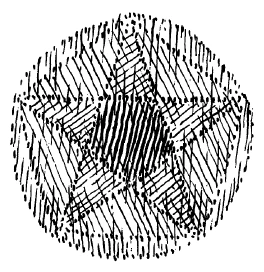
[ 18 ] You see, I am drawing the pentagram. When we first look at this pentagram, it serves as a symbol of the etheric body, if we consider the matter from an external perspective. But I have already said that this etheric body also contains the central forces for the astral body and the physical body, that all the forces which make us grow old and young emanate from it. Since the center for all these forces lies, so to speak, in the etheric body, it is also possible to demonstrate, through the figure of the etheric body—the seal of the etheric body—the relative strengths of the physical forces (the forces of the physical body) in relation to the etheric forces (the forces of the etheric body) and the astral forces (the forces of the astral body) within the human being. And you can determine the exact proportions quite precisely if you first say to yourself: Here, within the pentagram, a pentagon tilted downward is formed. I fill this pentagon completely with the chalk substance. There you have, to begin with, one of the sub-figures of the pentagram. You get another part of the pentagram’s figure when you consider the triangles that attach to the pentagon and which I have hatched with horizontal lines. So I have broken down the pentagram here into a central pentagon with its apex pointing downward, which I have filled with the chalk substance, and into five triangles, which I have hatched with horizontal lines. If you compare the size of this pentagon to the size of the triangles, that is, to the sum of all the areas occupied by the triangles—so if you consider how the size of this pentagon relates to the size of the individual triangles, and if you take the sum of the areas of the individual triangles, then the forces of the physical body relate to the forces of the etheric body in the human being. So, to put it another way, just as one might say that when lentils, beans, and peas are mixed together, the quantity of lentils is to the quantity of beans as three to five, so one can say: The strength of the forces in the physical body is to the forces of the etheric body as, in the pentagram, the area of the pentagon is to the sum of the areas of the triangles that I have hatched horizontally. — And now I will draw an upright pentagon, which is formed by circumscribing the pentagram. Now you must not take the triangles that arise there, as it were, like points, but the entire pentagon, including the area of the pentagram—that is, everything I have hatched vertically. So please take into account this vertically hatched pentagon circumscribed around the pentagram. Just as the area, the size of this small pentagon here, which points downward, relates to the area of this vertically hatched pentagon, which points upward, so do the forces of the physical body in their strength relate to the forces of the astral body in the human being. And just as the horizontally hatched triangles, when I add them up, relate to the size of the pentagon with the apex pointing upward, so does the strength of the forces of the etheric body relate to the strength of the forces of the astral body. In short, you have indicated in this figure everything that can be called: the mutual relationship of the forces of the physical body, the forces of the etheric body, and the forces of the astral body. Only, not all of this comes to the human being’s consciousness. The pentagon with the apex pointing upward encompasses everything astral in the human being, including that of which the human being is still unaware today—which is being developed as the ego increasingly transforms the astral body into the spiritual self or Manas.
[ 19 ] Now the question may arise in you: How do these three sheaths relate to the actual I? You see, regarding the actual I—which I have described as the baby, the least developed of the human constituents—human beings today, in their normal development, still know very little about this I. Yet all the powers of this ego are already present within it. If you wish to consider the total powers of the ego and examine their relationship to the powers of the physical body, the etheric body, and the astral body, you need only draw a circle around the entire figure. I do not wish to smudge the figure too much. If I were to shade this circle as a whole surface, the size of this surface, compared to the size of the surface of the pentagon pointing upward, compared to the sum of the surfaces of the triangular points that are shaded horizontally, compared to the small pentagon with its tip pointing downward, which I have filled with the chalk substance, indicate the ratio of the forces of the entire ego—represented by the area of the circle—to the forces of the astral body—represented by the area of the large pentagon—to the forces of the etheric body—represented by the horizontally hatched triangles attached to the small pentagon — to the forces of the physical body — as to the pentagonal area filled with the chalk substance. If, in meditation, you devote yourself to this occult symbol and inwardly gain a certain sense of the relationship between these four areas, you will gain an impression of the mutual relationship between the physical body, the etheric body, the astral body, and the I. You must therefore visualize the large circle in the same light and contemplate it in meditation. Then place the upright pentagon next to it. Because this pentagon is slightly smaller than the large circle—smaller by these circular segments here—this upright pentagon will make a weaker impression on you than the circle. To the extent that this is weaker than the impression of the circle, to that extent are the forces of the astral body weaker than the forces of the ego. And if you then place these five triangles—which are horizontally hatched—as a third element without the central pentagon, you will again have a weaker impression when you visualize everything in the same light. To the extent that this impression is weaker than the impressions of the previous two, to that extent are the forces of the etheric body weaker than the forces of the astral body and the I. And if you place the small pentagon there, you will receive the weakest impression of it under the same lighting. If you can now form a sense of the relative strength of these impressions and bring these four impressions together—just as you might think of the notes of, say, a melody as a single whole—if you consider these four impressions in terms of their magnitude, then you have that harmony of strength that exists between the forces of the ego, the astral body, the etheric body, and the physical body. This is what I present to you as an occult sign, as it were, a sign of occult writing. One can meditate on such signs.
[ 20 ] I have described to you, in general terms, the method for doing this. One gains an impression of the different intensities that these surfaces create—as uniformly lit surfaces—through their proportions. This gives one a sense of proportion that reflects the relative proportions of the forces within the four members of the human being. These things are there as signs of the true occult script emerging from the essence of things. To meditate on this script means: to read the great miraculous signs of the world, which lead us into the great mysteries of the world. Through this, we gradually gain an overall understanding of what is at work out there as wonders of the world, which consist in the spirit pouring itself into matter according to certain proportions. At the same time, I have thereby evoked in you something that was truly practiced as the most elementary thing in the ancient Pythagorean school. For through this, the human being begins to perceive, through his spiritual hearing, the harmonies and melodies of the forces in the world, so that he proceeds from the signs of the occult script, realizes them, and then already notices that he has beheld the world with its wonders in their truth. We will speak further about this tomorrow. Today, I wanted to present to your soul, as the culmination of our contemplation of this sign of occult writing, something that has once again led us a little deeper into human nature.