

Occult Reading and Occult Hearing
GA 156
6 October 1914, Dornach
Translated by Steiner Online Library
Fourth Lecture
[ 1 ] Yesterday I tried to speak about certain inner experiences that one might call “vocalism of the spiritual world.” We have just seen how what might be called occult reading and occult hearing is something living, how it unfolds in inner experiences in which one must engage one’s entire personality, one’s entire soul being. I mentioned three such experiences that require careful preparation: first, the one that arises when one gradually learns to consciously enter the supersensible world—in which one is, of course, always unconsciously present—and thereby reaches the threshold of death. I have also cited the experience one reaches when one acquires the so-called ability to transform into other beings. And I have then attempted to show how evil in the world can stand before one’s eyes in such a way that one recognizes its origin as stemming from a misuse of higher spiritual powers, which are entirely justified in their place and in their own way.
[ 2 ] Another such experience arises when one takes something that has often been spoken of quite seriously—something that, in essence, follows on from what was last discussed: One must transform oneself into something else, but in this transformation it is necessary to be able to hold fast to the thread of one’s inner spiritual experiences. If one could not hold onto this thread, one would fare just as one does on the physical plane when one does not remember what was experienced yesterday, the day before, or years ago in physical life. Just as this continuity of consciousness must be maintained in normal physical life, so must one hold onto the thread of memory through the transformations in the spiritual world. That is to say, at the moment when they have transformed into a particular being or a particular process, they must not lose themselves from within their soul. They must, as it were, retain something like a higher, purely spiritual memory of other forms, processes, and beings of the spiritual world. In other words, the human being must be manifold, must be able to fragment and divide within the spiritual world, must be able to merge into the multitude. Experienced entirely inwardly, this evokes a peculiar feeling: the feeling that “You are here, you are this being, but you are also another being; you are, in essence, present in separate beings.”
[ 3 ] Without this developed sense of diversity, one would not be able to form a true spiritual mental image, for example, of the beings of the higher hierarchies. One can still, by following the path we took yesterday, or the paths we have taken in other instances, gain a mental image of the beings of the first hierarchy above us, the beings of the Angeloi. But as soon as one wishes to ascend to a more accurate, I would say, spiritually appropriate mental image of the beings of the Archangeloi, one must understand something of multiplicity through inner feeling. For what these beings of the higher hierarchies are actually like, one learns to recognize only very gradually. One comes to recognize this only gradually because, from the physical world, all human mental images and all human thinking are bound to the ordinary conditions of space and time. But entirely different conditions of space and time exist when one ascends, for example, to the beings of the hierarchy of the Archangels.
[ 4 ] When we start from ordinary physical consciousness, we always have a certain basic feeling, a feeling that is entirely natural to this physical consciousness. I will characterize it as follows. If, for example, I wish to reach a person through clairvoyance who is living between death and rebirth, then I have—and by “I” I do not mean myself, but generally a person who seeks out a deceased individual through clairvoyance—the initial feeling: Well, the dead person is there, right there alongside you, and in terms of time, you can visit them just as you can visit another person on the physical plane, knowing full well that they live in the same time as you, and you only need to find the way to them. — When visiting a dead person, one has a correct mental image of them. One is even, in a certain sense, still correct when seeking to find a being from the hierarchy of the Archangels. But one no longer has a correct mental image of what is involved when one seeks to visit a being from the hierarchy of the Archangels in the same way, because a being from the hierarchy of the Archangels has concentrated its consciousness in a very specific time that is not the present one.
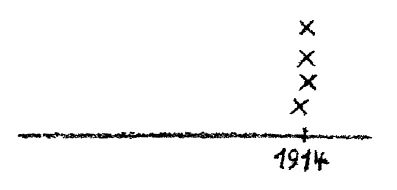
[ 5 ] Let us suppose that this line represents the passage of time, and that the seer was living here at a specific point in time, 1914; he assumes that he will find a deceased person or a being from the order of the Angeloi somewhere in the spiritual world at the same time (see drawing, X X X). But that is not possible if, for example, one wishes to seek out a specific being from the hierarchy of the Archangels, the Archangeloi. To do so, one must step outside of time; one must transcend simultaneity. For example, to find a specific Archangel, one must go back, say, to the 15th century.
[ 6 ] So one cannot say: I will remain in my own time — (see drawing: 1914) — but one must go back, say, to the year 1465 or thereabouts, and then seek out the relevant entity of the archangel here (see drawing). Even if this being cannot be found in the present, its influence still extends into our time. But in our time one finds only its influence; one does not find the being itself in its own selfhood.
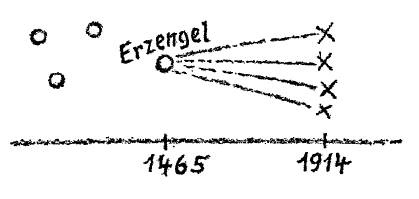
[ 7 ] Other archangels, on the other hand, must be sought at a different point in time (see illustration: circles). One must step outside of time. This is indeed a very difficult mental image to grasp, my dear friends, but one must come to understand it. One must realize that archangels always, in a certain sense, rightly bear their name. One only truly understands why they bear this name when one approaches their essence in the sense just described. They are called “Angels of the Beginning,” which means they are always present at the beginnings of historical periods—for instance, where peoples arise, where peoples first enter world history—there they are present with their full consciousness, with their own self. This remains present in the effects during the rest of the time. The effects flow into time. And if one wishes to find them, one must not merely remain in the present moment, but must step out of time and seek out the beginnings of time. No one, then, who as a soul wishes only to live, say, in October 1914, is capable of finding all the archangels—perhaps not even one—but certainly the one who is capable of transporting his soul-being back into other time periods in such a way that these other time periods become immediately experiential for him, so that he himself lives in these other time periods. However, when one transports oneself into other time periods, one must not forget how one got there, just as one must not forget today what one did yesterday in the physical world. This is something like a law of multiplication, of pouring out into the multitude.
[ 8 ] And the primordial beginnings, the spirits of personality, the Archai—one can only find them by transporting oneself back to the middle of the Lemurian epoch, when the Earth was at the dawn of its physical existence. Where the Earth went through the beginnings of its physical existence, there one finds the Archai in their own selfhood. If one remains in the present moment, one cannot find them.
[ 9 ] So you see how the soul’s entire relationship to time must change if one truly wishes to penetrate the spiritual world with insight. What one experiences in this way—or even simply by forming a mental image of these things and delving ever deeper into the inner experience of that mental image—gives rise in the soul to a mood of inner devotion, something like being poured into the real spiritual reality. This, in turn, is a kind of vowel of the spiritual world.
[ 10 ] You can see that, in this broader experience described here, human beings become increasingly independent of the spatial and temporal perspectives from which they perceive the physical world. You see that they not only step out of themselves, but in doing so also enter into the living fabric and essence of the cosmos; not merely in a one-sided way, by expanding, as it were, into the spatial spheres, but in a multifaceted way, by also experiencing themselves in time as a living being that possesses within itself the points of consciousness — I would say of the beings of the higher hierarchies. So when one no longer lives within oneself, nor lives in the space and time allotted to one as a physical being, when one has, as it were, made space one’s body and time one’s soul—note the word well, one only gradually learns to understand it in its full meaning after much meditation on it—if one has, as it were, made space one’s body and time one’s soul, then one has united with that which is not an abstract feeling in general, but a living weaving and being within a meaningful existence in the world. Everywhere one goes, there is meaning. And everywhere one goes, meaning springs into one’s own soul. And from individual meaning, a universal meaning is composed and weaves and exists in the world. From many of its points, the meaning of things springs forth in manifold ways, as if bearing fruit. And the spiritual, which sprouts in the individual senses, from the individual beings, weaves itself together into a world-word full of meaning, and one weaves and lives within the world-word. And this weaving within, this living within the world-word, is in turn another vowel of the spiritual world. That is, I would say, the primal vowel of the spiritual world itself. With this experience of the World Word—which one must create as a mental image in a multi-sensory vividness, not merely in spiritual hearing—all that is given which one may call inspiration in the higher sense. With it is given all that of which one may speak in such a way that one says: What I know in this World Word, the world knows within me; I am, in the end, entirely blameless for all that I know, for the world knows it within me. I can only become guilty of the knowledge of the World Word by being an imperfect instrument that allows this World Word to resound within me only in broken rays. But it is the World Word that resounds within me. — And the more humble one has become, the further one has gone in selflessly surrendering oneself, without harboring any pretensions regarding one’s own creative work, thinking, feeling, and willing, the more one has succeeded in allowing the World Word to reign in the weaving of one’s own being, the better, the more objectively one conveys what, as a mystery, the World Word floods the world with.
[ 11 ] Thus, we have once again spoken of such a vowel, the fifth vowel of the world. Since I can only present the fundamental and essential points in these four lectures, I wanted to give you just a glimpse—albeit a very rudimentary one—of what the vocalism of the world-being is.
[ 12 ] Now, if one has trained oneself inwardly in such feelings as I have described in these five world vowels, if one can experience in the soul what is, as it were, a precipitation from the spiritual world, then the soul can listen to what is happening in the spiritual world; then the spiritual world can speak to it.
[ 13 ] And what, then, happens when one actually enters into contact with the spiritual world through the path described above? It is the case that we are outside our physical and etheric bodies with our ego and astral body—though the ego has been raised to a higher level by having been selflessly subdued in the manner previously described and having been absorbed into the astral body. One is, of course, outside one’s physical and etheric bodies with one’s I and astral body when one stands here in life between birth and death and perceives spiritually; but one still looks back at the etheric body, and the etheric body reflects precisely the vowel sounds. It has the capacity to reflect in sevenfold ways. I have cited five of these reflections, five vowels. Two other vowels are added to these, which will be discussed in more detail on another occasion. But the peculiar surging and undulating of the etheric body—that which it reflects in its life processes when one stands outside of oneself—announces itself as such vowels. That is to say, something happens in the etheric body when one develops feelings such as those one can experience through the preparation of standing at the gate of death, or through the other, that of facing the evil with understanding, or that of standing within the living world-word, alive and weaving within it. Depending on whether one holds up one thing or another to the spiritual world, something different is reflected in the etheric body, which one then looks back upon, as it were. It is difficult to describe this.
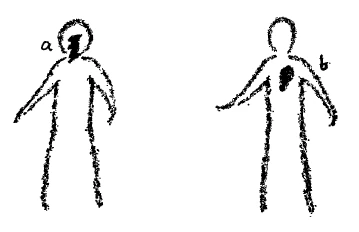
[ 14 ] I would like to say that the beings of the worlds are reflected sevenfold in the etheric body. I would like to illustrate this schematically (see drawing): If this represents the human etheric body—very schematically—then, for example, when the feeling of standing at the gates of death is presented to it—a feeling that arises through preparation—the etheric body would contract here in the uppermost region (see drawing, a); it takes on a certain radiance and sound. And from this glow and sound emerges something that can be called a vowel of the spiritual world.
[ 15 ] When one develops a different feeling, the etheric body, as it were, contracts toward another region—let us say, the region of the heart, b. Then one sees a different glow and hears a different sound, as if coming from a being into which one has transferred oneself with the ego and the astral body.
[ 16 ] What I have said so far refers to the vowels of the spiritual world. Just as there are seven vowels, there are also consonants in the spiritual world, twelve in number. These twelve consonants are most easily grasped by understanding the physical body in the same way that we have understood the etheric body in its—I might say—vocal nature. The physical body then reveals itself as a twelvefold structure.
[ 17 ] Of course, there is not enough time here to even begin to suggest how one arrives at the twelvefold structure of the physical body in the same way as one does at the sevenfold structure of the etheric body. But I must say this: For those standing outside their physical and etheric bodies, this very etheric body and this physical body become, as it were, something quite different from what they are when we live within them. When we live within them, the etheric body is what sustains our life processes, what makes us living beings, and the physical body is what primarily constitutes our sensory organism. We are situated within them. We need our etheric and physical bodies so that we can be the kind of human beings on the physical plane that we are. But as soon as we are outside the physical and etheric bodies in the sense indicated just now, we relate to them as we do to signs. Truly, the etheric body is then indeed a living being, but the task, the function it has as the life principle underlying our physical organism—it does not manifest that at all. It reveals itself to us as a sign of the seven vowels. It becomes something objective that we look upon, and which, in its variability, in its changeability, is a reflection of the vowelism of the whole world. We become, as it were, as alien to this etheric body as we are to the vowels of the outer, physical, coarse script. And we become as alien to our physical body—it becomes a sum of twelve signs combined within it—as we are to the consonants of the ordinary, coarse script. And just as consonants and vowels interpenetrate in the words of ordinary writing, so that we can read one word or another depending on how vowels and consonants are linked together, so in the spiritual world we read or hear different things depending on whether the etheric body, which can reveal itself in sevenfold ways, resonates with or is connected to one or the other consonant of the physical body. Just as, when we encounter a person on the physical plane, we communicate with them through their speaking to us—though we must have eyes to observe, ears to hear the word, and allow their language to penetrate our soul—and just as everything that constitutes a relationship with other people is mediated through our senses, so something similar occurs in the spiritual world.
[ 18 ] One prepares oneself, let us say, to find a human soul that is living between death and a new birth. One knows through inner experience that one is now united with this soul; one knows that one is experiencing things with it at the same time, in the same place in the spiritual world. But just as one needs the sense organs in the physical world to communicate with other people, so in the spiritual world one needs to look back upon the etheric body and the physical body. They reflect back the interplay of how the vocal processes of the etheric body fit together with the consonantal processes of the physical body. And the way these interact expresses what one speaks with the deceased with whom one is united—that is, what is necessary for communication with the deceased.
[ 19 ] So create a mental image in which you are united in the spiritual world with a deceased person, with a soul that lives there between death and rebirth. You look at the human physical form in which you yourself live on the physical plane, and you look at the human etheric form. You look back upon these, and through them is reflected everything the deceased has to say to you, everything he has to communicate to you, everything he thinks, feels, and wills. The human physical body and the human etheric body have become a single sensory organ. And we can say: We have received the physical and the etheric body within our physical life so that we may have sensory organs for the spiritual world. We are now once again made aware in a new way that life in the physical world is not merely life in a vale of tears from which one must long to escape, as a false asceticism would have it, but we are made aware that life in the physical world has a great, sublime, divine mission. Within physical life, we acquire what becomes the sense organs for the spiritual world.
[ 20 ] You will understand this even more clearly when I draw your attention to the way in which the perception of spiritual beings and processes takes place when we ourselves are in the time between death and new birth—that is, when we are not perceiving the spiritual world clairvoyantly from the physical plane, but are united with spiritual beings in the spiritual world. As long as we wear a physical and an etheric body as our garment, we have something to reflect upon; as long as we have them, they serve as our sense organs. When we shed them at death, we naturally no longer have these sense organs as an external reality. You might now easily ask: Can we not then, in the spiritual world between death and rebirth, perceive what we experience in connection with the other beings and processes of the spiritual world? — Yes, but then it is different; then we perceive it differently. Even the seer must, here in the physical world, in his physical and etheric bodies, receive a reflection of what he experiences in the spiritual world. This is true as long as they exist in the physical world, as long as the physical body has not been lost through decay, and the etheric body through dissolution, through pouring into the spiritual world. When we are in the spiritual world and no longer have a physical and etheric body, we are then able to draw, from the substance of the spiritual world, the world of signs from which the physical body and the etheric body were composed. We draw everything into the spiritual world. Suppose you are living as a soul between death and rebirth together with another human soul. Whatever she says to you, or whatever you say to her—everything that would otherwise have been reflected in your physical and etheric bodies—is now imprinted in the spiritual world into the Akashic Records. What would otherwise have been expressed in the reflection of the physical or etheric body, through vowels or consonants, you are now truly writing into the spiritual world, into the Akashic Records, of your own accord, only to erase it yourself again—figuratively speaking—when it is no longer necessary.
[ 21 ] I gave the first hint of this in my book *Theosophy*, at the beginning of the chapter on the so-called Spirit World, where it is mentioned that at a certain stage of development in Devachan, in the Spirit World, a person sees their previous incarnation lying there, in the “continental region” of the Spirit World, as I called it there. This is a kind of sketch from a spiritual text.
[ 22 ] Yes, the ideal situation would be if the study of a book such as *Theosophy* were pursued with such zeal that many readers would themselves arrive at something like what has now been explained, based on the hints given there. There is much contained in these books, and one could certainly arrive at these insights simply through reading them oneself, if one reads with the heart, with one’s entire inner spiritual experience. But books written in the field of Spiritual Science are, as a rule, not read with the attention they require. They really are not, for otherwise, after “Theosophy” and “How to Attain Knowledge of the Higher Worlds?” and perhaps also “An Outline of Esoteric Science” had been written, all the cycles could have been written or presented by someone other than myself. Basically, everything is contained in these books; people just usually do not believe it. And how much more could be written if everything contained in the four Mystery Dramas were brought to light! I do not say this to seek renown—I have already spoken sufficiently about the humility of the occultist, the spiritual researcher—I say it to encourage the genuine reading of these writings, which had to be given precisely in our time, and in which one personally has as little merit as possible.
[ 23 ] You see, then, that as human beings live on the physical plane, they develop something in relation to the spiritual worlds that serves as the seed for the experiences of the higher worlds. Just as human beings have their etheric body here in the physical world, this is not only the life principle of the human being, but it is also a means of preparation for experiencing the vowelism of the spiritual world. And the physical body is a means of preparation for experiencing the consonantism of the spiritual world.
[ 24 ] One can accomplish a great deal if one seriously endeavors to gradually free oneself from the purely materialistic view of the human physical body. In this way, one can do much to prepare oneself so that the feelings—which one might call feelings for the vocalism and consonantism of the cosmos—these inner experiences and impulses may awaken in the soul. However, for this preparation, one must evoke within oneself a feeling that, in relation to development into the higher worlds, is truly something akin to what a child must do in the physical world in order to learn to read and understand the words of our outer physical human language.
[ 25 ] Let us just consider for a moment how, in everyday life and from a materialistic perspective, the physical human body is accepted. It is accepted exactly as it physically presents itself. One really takes it just as one would if someone were to write down the word “INK,” and another were to come along and say: I want to examine this now—and proceed as follows. He would say: Here is a flourish, here is a stroke, this one goes up, this one goes down, here a stroke bends this way and so on; in short, he would describe the shapes of the letters. This is exactly how one approaches the physical body today. One describes the heart, lungs, liver, and so on, anatomically and physiologically, just as they appear externally. This is like describing a word by the strokes it consists of; but only the one who has learned to read the word “ink” from the strokes actually benefits from it.
[ 26 ] Thus, one must already make progress on the physical plane in order to read in the spiritual worlds, as has been discussed today. What is called occult reading and occult hearing is truly an individual experience. One prepares for this by attempting, even in the physical world, to grasp the human physical body in a certain sense as a system of signs. What is meant by this? I will give you an example of this grasping of the system of signs. I can, however, only give a brief example, and must leave it to your own meditation and serious reflection to determine what is actually meant by it. For language is truly insufficient in some cases to communicate about these things. It will only be sufficient when Spiritual Science has been at work in the world for a while and has transformed language in such a way that words are shaped to conform to what is spiritually real and essential. Language must become much more flexible for this to happen. But this will only be possible once Spiritual Science has been active for several centuries, once people have become accustomed, through their engagement with it, to understanding words differently than they do today, when they are used only for things and processes of the physical plane.
[ 27 ] We find that which takes place within the human head enclosed within the bony structure of the physical skull; it is, as it were, contained within it. There it is, with few exceptions, physically enclosed on all sides. Schematically, we can depict this by representing the head and its covering as follows:
[ 28 ] This head, when one begins to interpret it—rather than simply describing it as it appears to the senses—is something of immense significance, for within it take place complex processes that are enclosed on almost all sides by a bony shell. Thus, a part is separated from the entire physical human being, a part that is enclosed on all sides by the hardest human substance, namely bone. But this is a part of the human being, of the human organism. The human being is truly not such a simple creature that one can speak of him simply as “man.” Just how primitive the current mental images are regarding the matter at hand became particularly evident when my books were criticized for the fact that someone speaks of the human soul as a soul of sensation, intellect, or emotion, and a soul of consciousness, whereas we have, after all, made such magnificent progress in conceiving of the soul as a unified organ. From the perspective of our materialistic culture, one can understand this preference for the general mishmash and vagueness regarding the soul—whose description is today called psychology—as opposed to how the true, real constituents of being are described in Spiritual Science. It is not because one conceives of them in an abstract way that one divides the soul into the soul of sensation, the soul of understanding or the emotional soul, and the soul of consciousness, but because, in terms of their origin, they belong to different periods and are connected with different states. One can understand that contemporary spiritual culture might find such a view foolish, but in doing so, this contemporary spiritual culture merely characterizes itself, not that which it criticizes. |
[ 29 ] The human physical organism is, in fact, a rather complex entity, and by delving into this physical organization, one can, for example, develop the following ideas, which may, of course, seem foolish to those who call themselves scientists today. Certainly! But St. Paul already says: Much of what is foolishness to men is wisdom before God. — So perhaps it could be “wisdom before God” where science sees only foolishness.
[ 30 ] One might come to a mental image: What is it, really, with our hands? Our hands are most certainly connected in some way to our soul. And when someone has a keen sense of what is happening in their hands, and they stand facing another person and speak, it matters how they express what they are saying through the gestures of their hands. There is something to be said for that. Now I will skip over many intermediate steps and leave it to your own judgment to fill in the gaps. Imagine for a moment that it were the case—not through a process originating from the human being, but through a process rooted in the nature of the world—that our hands were not formed in such a way that we could move them completely freely and have them follow our will without further ado, but rather that they were so connected to us that we would have to keep them completely still; they would be naturally fused to us. What would happen then if we had hands but could not move them? Even if we had hands that we could not move because they were fused to us, we would still develop the will to move them. Even if we could not move them physically, we would still, at every moment when we wanted to move them, raise up the etheric hands and move them. The physical hands would lie still, the etheric hands would move. This is what we actually do with our brain. Certain lobes of our brain, which today lie enclosed within our skull, were still freely movable during the lunar stage of development. Today they are bound in place and cannot move physically. But etherically they move when we think. We move the etheric brain when we think. If we had not acquired this solid skull that holds these brain lobes together, we would grasp with our brain lobes and make gestures just as we do now with our hands. But in order for us to learn to think, our brain lobes first had to be physically held in place, and the etheric part of the brain had to be given the opportunity to be drawn out.
[ 31 ] What we are saying is not a figment of the imagination. A time will come when our hands will have grown firmly attached, when many other things will also be firmly attached to our middle body, near the heart, which now appears to be free; that will then be enclosed by a shell, just as the brain is now enclosed by the skull. That will be in the Jupiter era. What our hands are the visible expression of is something that is in the process of becoming a thinking organ. And for the time being, we have only rudimentary organs of this, which are not yet fully developed and remain small. Just as if we had only fragments of the skull here at the front of the forehead, so too do we have our shoulder blades lying in the area at the back that will one day enclose our future brain. And you interpret the shoulder blades in the human body correctly if you regard them as small pieces of bone that actually belong to a skull that closes over them, only the other part has not yet formed.
[ 32 ] In this way, you have, as it were, enclosed a second human being within the first. And now I am going to say something that seems quite paradoxical: There are other organs in the human organism that are also such fragments of a further cerebral cortex, which will only develop at a later stage—organs that are now quite tiny compared to the rest of the organism; these are the kneecaps. The kneecaps have only developed into these small surfaces. So far, they are merely hints of something that will later, in a different direction, make the human being a spiritual organ. We learn to interpret the human organism when, for example—this is just a random example—we learn to say to ourselves: You actually have three skull domes; one is reasonably developed, it is closed on all sides; the second is so far present only in two parts, the shoulder blades; the third cranial vault consists only of the kneecaps. — The latter two, shoulder blades and kneecaps, can be mentally supplemented, rounded out into what they are only partially now. Then one gets three brains. What will one day be our second brain is still poorly developed in our outer human form. Now it manifests externally; later it will be an inner brain. When you make gestures with your hands today, you are preparing future thoughts—thoughts that will then perceive the processes of the elemental world just as realistically as you now perceive the processes of the physical world with the thoughts of your head. As curious and paradoxical as it sounds: what lies outside the kneecaps—that is, the lower legs and the feet—are quite imperfect organs connected to the Earth’s gravity. The kneecaps are preparing themselves, in connection with what they now absorb spiritually from the Earth, to one day—when they no longer exist as physical organs—become spiritual organs and lead into the spiritual worlds, when the Earth will have been transformed into the future Venusian state. For this to happen, the present physical form must first be shed, and something else must take its place.
[ 33 ] You see, there is much to be found in the occult view of the world. For the most important thing one acquires is not the knowledge that such-and-such a book exists, or that such-and-such is said about the higher worlds. — That is not the most important thing. Of course, one must also acquire that knowledge, because only through it can one arrive at the truth. The most important thing, however, is a certain mood, a certain state of mind, through which one learns to face the world in a new way and to view things differently than one did before. That is what is important: to allow oneself to be prepared through what one reads there—in the inner flexibility of the weaving of thoughts, of experiencing thoughts within oneself—so as to thereby view everything, including what is physically present in the world, in a different light. For things, in their outer form, are not at all as they really are, as paradoxical as that may sound. Our shoulder blade is not merely a shoulder blade, as you see it externally; that is a maya, that is false. The shoulder blade only becomes fully understood when one sets out to truly grasp it as a more complex organ.
[ 34 ] When one sees a person kneeling, one may gradually come to realize: It is entirely wrong to view these kneecaps, as they lie there, merely as small parts; that is entirely wrong. The person who prays on their knees is preparing to live in the sphere that will one day encompass them, when their kneecaps will stretch and expand into a powerful curve like the surface of a sphere, of which they are currently only small parts. The person praying already reveals, in their very form, what humanity is destined to become when the Earth enters the Venusian state.
[ 35 ] In this way, one gradually learns to read the physical world. One does not merely look at a person kneeling or at some other human gesture. One learns to recognize how what one sees in a person—what presents itself directly to one—can be false and untrue, even though it is reality. One learns from the letters not what the cosmos is in its present being, but what it seeks to express in its becoming. Thus one gradually learns to decipher, interpret, read the essence of, and grasp that which the world truly is, and of which the physical world is no more than a written page lying before us that we must not merely stare at but read, otherwise we will not know what is written on it. Nor do we know anything about the world if we merely observe it through what physical perception provides and fail to realize that we must decipher it and penetrate it, just as we do not merely stare at a written page but must read it to understand its meaning.
[ 36 ] As we increasingly come to realize that the world is a book written for us by the hierarchies so that we may read it, we will, in the fullest sense of the word, become fully human. And fundamentally, the building we have erected here is, in its form and configuration, nothing other than one of those things which, by surrounding us, can draw forth from our innermost being such feelings, such intimate moods and states of mind, that enable us to read the world and hear the world’s secrets. That is why the building had to be as it is, so that it might draw out what lies within us, at least a little bit.
[ 37 ] It is good, my dear friends, to sometimes reflect in this way on what mental image one might form of the role that Spiritual Science might play in the world in relation to what already exists within it, what must develop from it, and how it should become part of what is destined to unfold historically. If only a circle could be found among our friends in the Anthroposophical Society that is sustained by the living awareness that something of this nature must be woven into and work upon the development of humanity.
[ 38 ] My aim in giving lectures such as these was not merely to convey truths, but to stir up such a feeling in people’s hearts.