

The Mystery of Death
The Nature and Significance of Central Europe
and the European National Spirits
GA 159
17 June 1915, Düsseldorf
Translated by Steiner Online Library
14. Human Experiences After Passing Through the Gates of Death
[ 1 ] It has often been said in connection with certain spiritual scientific considerations that, within our Spiritual Science movement and its endeavors, the primary concern is not merely to theoretically assimilate the concepts and ideas that can be acquired through Spiritual Science, but rather that the results of Spiritual Science should become part of the innermost movements, the innermost impulses of our spiritual life. Certainly, we must start from the findings of Spiritual Science, and such findings can only be acquired by studying them, by engaging with them. But Spiritual Science should not be received like any other science, so that one merely knows afterward that one has heard this or that, that this or that is true regarding one thing or another in the world; rather, Spiritual Science should act upon our soul in such a way that this soul is transformed in this or that realm of feeling, that it is transformed through the absorption of what can flow forth from Spiritual Science. The concepts, ideas, and mental images we take in through Spiritual Science should stir our soul to its very core, should unite with our sensibility, so that through Spiritual Science we learn not only to view the world differently, but also to feel it differently than we would without it. To be able to relate to certain situations in life in a way that is entirely different from what is possible without Spiritual Science—that is what the spiritual scientist should actually aim for. And if he can do that, then he has, in essence, only just achieved what is meant to flow to us from Spiritual Science.
[ 2 ] We are living in difficult times today, in which one of the most important questions of Spiritual Science—the question of death—is brought before our eyes, before our souls, and before our hearts in so many countless instances, closer to some, and very close to others. Even in these difficult times, the spiritual scientist should be able to prove the validity of Spiritual Science through his feelings. He should be able to view the events of the day differently than others, even when they affect him as deeply as they do others. One will certainly need comfort, the other encouragement; but both should find this in Spiritual Science as well. Only when this can be the case have we understood Spiritual Science in the sense it intends to be understood.
[ 3 ] The mental images of Spiritual Science must inevitably cause a certain upheaval in our souls, simply because they teach us to feel about certain things in a way that is entirely different from how we would feel about anything in the world without Spiritual Science. If you take together much of what has already been said within our Spiritual Science about the mystery of death, you will be able to understand what I would like to expound today—not merely by repeating, but by adding certain points to some earlier reflections. We must not only learn to think differently about death, but we must also learn to feel differently about death. For the mystery of death is indeed connected with the deepest mysteries of the world. Let us be quite clear about this: when we pass through the gate of death, we lay aside everything through which we acquire perceptions and knowledge in the physical world—everything through which we experience the outer world. In the physical world, we gain impressions of the world through our senses. We lay these senses aside when we enter the spiritual world. We no longer have the senses then. That alone must be proof to us that, when we think about the supersensible world, we must strive to think differently than we have learned to think through our senses.
[ 4 ] Certainly, we have a kind of point of reference in that even in the ordinary life we spend between birth and death, something analogous, something similar to the experiences in the spiritual world extends into it. These are the dream experiences that extend into ordinary life. Dream experiences do not come to us through our senses; our senses really have nothing to do with dream experiences. Nevertheless, they consist of images that sometimes recall life as experienced through the senses. In these dream images, we have, if only a faint reflection, yet a reflection of the way in which spiritual existence confronts us as an imaginative world between death and a new birth. We do, however, have imaginative perceptions after death; the experience emerges in images. Only when you see, for example, a red color in the sensory world and must entertain the thought: What is behind this red color? — then you will say to yourself: There is something that fills the space; something material lies behind it. — The red color also appears to you in the spiritual world, but behind it there is not something material, not something that would exert a material impression in the ordinary sense. Behind the red is a spiritual-soul being; behind the red is the very same thing you feel as your world within your soul. One might say: From the sensory impression of color, we descend outwardly in the physical realm into the material world; from the imaginations, we ascend ever higher and higher into spiritual regions within the spiritual world. And we must now be clear about this—it has been particularly emphasized in the new edition of Theosophy—that these imaginations, too, do not present themselves to us in the same way as the sensory impressions of the physical world. These imaginations are certainly there, but they appear as experiences: the red and the blue are experiences there. One can rightly call these imaginations red or blue, but they are nevertheless something other than the sensory impressions of the physical world. They are much more inner; we are much more intimately connected with them. Outside the red color of the rose, you are separate from it; within the red color of the spiritual world, you feel yourself to be within it; you are connected with the red color. As you perceive a red in the spiritual world, a will develops—the powerfully active will of a spiritual being. And this will radiates, and what it radiates is red. But you feel yourself within that will, and this being-within, this feeling-within, this experience you naturally describe as red. I would like to say that physical color is like a frozen spiritual experience, like a solidified spiritual experience. And so, in many areas, we must acquire the ability to think differently, to assign different values and meanings to our mental images, if we truly wish to rise to an understanding of the spiritual world.
[ 5 ] Then we must realize that, up in the spiritual world, what we call imaginations are not related to the spiritual beings—whose expression, for example, is color—in the same way that a color is related to a physical being. The rose is red; that is a property of the rose. But when a spirit comes near and, based on what has just been said, we must be aware that the spirit radiates red—then this red does not signify a property of the spirit in the same way that the red of the rose signifies a property; rather, this red is more of a kind of revelation of the spirit’s inner being; it is more of a symbol that the spirit inscribes in the spiritual world. And one must first see through the imaginations. The activity one develops there can be compared in the physical world only to its Ahrimanic counterpart, namely reading. We look at the red color of the rose and know: Red is a characteristic of the rose. We do not merely look at the red in the spiritual world, but we interpret it—not by speculating, however—against which I must always warn—but our soul finds on its own that it conveys something like a sound, a letter, like something that is to be deciphered and read, through which one first recognizes what is meant. The spirit means something when it reveals itself as red or blue or green, or when it reveals itself as C-sharp or G-sharp. The spirit means something by this; one begins to speak with the spirit, one begins to read its writing. External culture is based on the fact that such things, which have their deep wisdom in the spiritual world, are then also transplanted into the external world. We rightly speak of occult reading, for the one who acquires clairvoyant consciousness, who enters the spiritual world, who surveys the imaginations and reads within them, looks through them to the depths of the souls living there in the spiritual world—not merely through colors, but also through other impressions, impressions that resemble sensory impressions, and those that are newly added to the spiritual realm.
[ 6 ] This activity, which is a purely soul-spiritual activity, is, so to speak, subject to the governance of the truly evolving spiritual beings. Here in the physical world, Ahriman creates a reflection of precisely what I have just described. The external reading of written characters in the physical world is an Ahrimanic reflection of this occult reading. For all reading in the physical world through signs that have been artificially formed is an Ahrimanic “activity.” It is by no means unjustified that the invention of the art of printing has been perceived as an Ahrimanic art, as a “black art,” as it has been called. One must not believe that one can escape the clutches of Lucifer and Ahriman through any kind of activity. Lucifer and Ahriman must be present in outer culture. The point is simply to find the point of balance, to find the path, when life continually swings toward the Luciferic and Ahrimanic sides. If someone did not want to be touched by Ahriman at all, they would never have to learn to read. But the point is not that we flee from Ahriman and Lucifer, but rather that we establish the right relationship with them; that, even though they are present as forces around us, we can relate to them in the right way. If we know that we are following what we have so often described as the Christ impulse living within us, and if we cultivate the spiritual feelings that impose upon us, in every moment of our lives, the will to follow Christ, then we can also read. Then we can experience—and we will, when it is right for us according to our karma—that Ahriman has also established reading, and we will see this Ahrimanic art in its proper light. If we do not experience this, then we merely speak in words about Ahrimanic culture, about progress, about the glory of Ahrimanic culture, for example, of reading.
[ 7 ] But all these things also entail obligations, and the point is that such obligations must be fulfilled. Especially in our present age, many arguments can be cited to defend or condemn this or that. Indeed, we are witnessing what might be called a deluge of war literature. Every day brings not only pamphlets, but also books and so on. There you can often read: This country has so many illiterate people, in this country so many can read and write, and the like. To simply accept this at face value would not be in keeping with what the person well-versed in Spiritual Science has to say out of a sense of responsibility. If, for example, among the things I have to mention in relation to our time, I were to want to point out everything particularly bad about a people, and to suggest that by saying that among that people there are so many who cannot read and so many who cannot write, I would not be speaking in the correct way from a perspective of Spiritual Science. One must always cite only those things for which one can be accountable in light of one’s occult duties. From this—and I mention this merely as an example—you can see that Spiritual Science, in this deeper sense, must truly permeate life and impose duties. And when the spiritual researcher says things that others also say, you will always be able to see that they are said in a completely different context, and that is what matters. Therefore, of course, many things will often seem quite strange to those unfamiliar with Spiritual Science when they are stated within that context, because they are accustomed to holding different mental images, and sometimes they must say to themselves: This Spiritual Science calls black white, and white black! — And that is indeed sometimes necessary, for if one ascends into the spiritual world with the ordinary mental images and concepts one acquires in the physical world, it is truly the case that some concepts must be thoroughly changed.
[ 8 ] From this perspective, let us consider one of the most important and enigmatic concepts we must grasp from the impressions of the physical world: the concept of death. In the physical world, human beings always see death from only one side—from the perspective of observing human life as it develops up to the point where a person dies, that is, where the physical body first separates from the higher aspects of human nature and then undergoes dissolution within the physical world. One can truly say that what human beings perceive of death within the physical world amounts to viewing death from one side. To view death from the other side, however, means to see it in a completely different light, to see it in a thoroughly different way.
[ 9 ] When we enter physical life through birth, we initially go through an experience in which we feel that the peak of physical consciousness has not yet been fully reached. As you know, we do not recall the first years of our existence through ordinary physical consciousness. No one can remember their birth with ordinary physical consciousness. At least, no one in the world will come forward claiming that they can remember, through their physical consciousness, how they were born. We can say: It is a feature of physical consciousness that the birth of a human being must be forgotten. It is forgotten, and even the first years of life are forgotten. When we look back on our lives in the physical existence between birth and death, we remember up to a certain point. Then the memory breaks off. The point where it breaks off is not our physical birth, but is preceded by an experience. No one can know from experience that they were born. They can only infer it. We infer from this—and only from this—that we have been born, because after us, human beings are born whose births we perceive. If the natural scientist claims that he wishes to acknowledge only what can be seen, then according to this principle, if he is to be logical, no one could claim their own birth, for it is impossible to perceive one’s own birth except through clairvoyance; one can only infer it.
[ 10 ] Exactly the opposite occurs with regard to death. Throughout one’s entire life, between death and rebirth, the moment of death that one has previously experienced stands before the soul’s eye as the most vivid, the brightest impression. But do not think that you can conclude from this that it is a painful impression. You would then believe that the dead person looks back upon what you see of death in the physical world—decay and ruin. But he sees death from the other side; he sees in death something that must be described as the most beautiful thing even in the spiritual world. For there is nothing more beautiful in what a human being can initially experience in the spiritual world than the sight of death. To behold this victory of the spirit over the material, this shining forth of the soul’s spiritual light from the dark gloom of the material—this is the greatest, the most significant thing that can be beheld on the other side of life, which a person experiences between death and a new birth.
[ 11 ] When a person sheds the etheric body between death and rebirth and has gradually fully developed their consciousness—which does not take very long after death—they do not relate to themselves in the same way as they do here in the physical world. When a person sleeps here in the physical world, they are unaware of it, and when they wake up, they become aware of the fact that they now know: I have a self, an “I” within me. After death in the spiritual world, it is somewhat different—there his self-awareness is on a higher level—it is not exactly the same. I will speak of how it is in a moment. But there is also something there akin to a recollection of the I, the self. Just as one must reflect on the self in the morning upon waking, so it is in the spiritual world as well. But this reflection is a looking back to the moment of death. It is always as if, in order to perceive our I between death and a new birth, we said to ourselves: You have truly died, so you are I, you are an I!
[ 12 ] This is the most significant thing: one looks back on the victory of the spirit over the body; one looks back on the moment of death, which is the most beautiful experience the spiritual world has to offer. And in this looking back, one becomes aware of one’s self in the spiritual world. It is always—one cannot say it is like waking up—for that would also be a one-sided way of describing it—it is the act of reflecting on oneself, of looking back on one’s own death. That is why it is so important that a person has the opportunity, with full post-death consciousness—a consciousness that arises after death—to truly look back upon the moment of death, so that they do not merely dream in any way about what they see there, but can fully understand what they see; this is immensely important. And we can certainly prepare ourselves for this already during our lives by trying to practice self-knowledge. In particular, it is necessary for humanity from our time onward to practice self-knowledge. Essentially, Spiritual Science exists to give human beings the self-knowledge they need. For Spiritual Science is actually an introduction to the human being’s expanded self, that self through which one fundamentally belongs to the whole world. I said that consciousness after death is something different from what it is here in the physical world. If I were to illustrate to you quite vividly what consciousness is like after death, I could do so in the following way.
[ 13 ] Suppose we have an eye here, and an object there. How do we become aware that there is an object outside of us? Well, because the object makes an impression on our eye. The object makes an impression on our eye, and we come to know something about the object. The object is out there in the world; it makes an impression on our senses, and we take the mental image we can form of the object into ourselves, into our soul. The object is outside of us. The mental image we then form has been conveyed to us by it. It is different in the spiritual world. And because I cannot depict it any other way graphically, I would like to draw what I always call the soul’s eye for you as well—even though, strictly speaking, it is incorrect—as the soul’s eye. This soul-eye, which a human being possesses after death, is constituted in such a way that after death, for example, a human being does not see an angel or another human soul—which is also in the spiritual world—in the same way that they see a flower in the physical world; rather, this soul-eye is constituted — let us leave a human soul aside for the moment and consider only a being of the higher hierarchy — that when there is an angelic being here, an archangelic being, the soul does not have the consciousness: “I see this angelic being outside of myself,” but rather: “I am being seen by the angelic being; it sees me.” — It is precisely the opposite of the physical world. Thus we enter into the spiritual world in such a way that we gain the awareness, in relation to the beings of the higher hierarchies, that we are known by them, that they think of us. We feel embedded within them; we feel, in a sense of recognition, embraced by the angels, archangels, and spirits of personality, just as the mineral, plant, and animal kingdoms feel embraced by us.
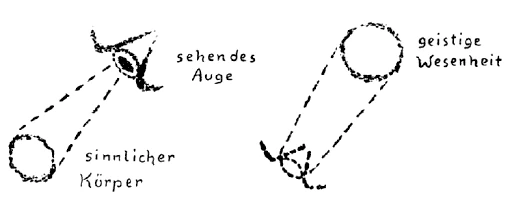
[ 14 ] It is only in relation to human souls that we can be seen by them—so that we have the feeling they are looking at us—and that we also have the feeling that our own gaze passes over into them. There is a seeing on our part and on the part of human souls. In relation to all other beings of the higher hierarchies, we have the feeling that we are perceived, thought of, and created as a mental image by them; and in being perceived, thought of, and created as a mental image by them, we are present in the spiritual world. And it is then like this: Let us suppose that we walk about as souls in the spiritual world, just as we walk about in the physical world. Then it is the case that everywhere we have the feeling of entering into a relationship with the beings of the higher hierarchies, just as here in the physical world we have the feeling of entering into a relationship with the mineral kingdom, the plant kingdom, and the animal kingdom. But we need to constantly remind ourselves that we have a self. Then we look toward our death and say to ourselves: That is you! — That is a continuous consciousness, a continuous content of consciousness.
[ 15 ] What has been said today complements the various mental images you can glean from the cycles and books. It is expressed in more spiritual terms than, for example, what is presented in the book Theosophy, which is written more from an external perspective. But it is only by viewing such things from a spiritual perspective that one truly enters into the feelings one must have toward these matters and toward the spiritual world in general.
[ 16 ] Self-knowledge is therefore what sustains us, what strengthens us for the life between death and a new birth. This has recently come to mind with particular vividness as I had the task of speaking at the cremations of friends of our cause on several occasions following their passing. There, the need always arose to say something that was intimately connected with the character, with the self of the one who had passed through the gate of death. Why did this inspiration or intuition arise to say something to the dead that was connected with their essence? This is evident in the lives of those concerned after death. What strengthens the powers of their self-knowledge comes to their aid. By speaking of these qualities that they feel within themselves immediately after death, when their consciousness had not yet awakened, one could, as it were, allow some of the strength they need to flow to them, so that they might gradually develop the ability to look back upon the moment of death, when their entire being appears concentrated, as it has developed between birth and death. One thus comes to the aid of the dead by allowing them, immediately after death, to receive something that reminds them of the qualities, experiences, and so on that were their own. In this way, one fosters the power of self-knowledge. And if, through clairvoyance, one has the ability to empathize with the soul of such a deceased person, then one senses in that soul the urge, especially at this time, to hear something about the kind of person they were, about this or that which they went through, or what their main characteristics are. You can understand: just as here on earth the life of one person does not resemble the life of another, but rather all people have lives that differ from one another, so it is also with those who have passed through the gate of death. No two soul lives are alike between death and new birth. I would like to say: Every soul life that can be observed there is, in turn, a new revelation, and one can always highlight only individual, specific characteristics. I would like to speak about such things today and then again the day after tomorrow in Cologne. I would like to speak of a specific case as an example.
[ 17 ] Some time ago in Dornach, we saw a member who had reached a fairly advanced age leave the physical plane. A member who had certainly spent his life in diligent, caring work, but who in recent years—and indeed for quite some time—had been deeply connected in his soul to our worldview based on Spiritual Science and had fully internalized it in his own heart and soul. So that one can say: this person had come so far that in the final days of their physical existence they were completely at one with our worldview, completely at one in feeling and sensibility. Now you know that when a person passes through the gate of death, they first shed their physical body, then carry the etheric body with them for a while, and then shed the etheric body as well. And then comes a time when the human being must gradually attain the consciousness that will then be his own between death and a new birth. Immediately after death, the human being is in his etheric body. There, as we know, he experiences a full review of his life as a great tableau of life. During this time, powerful impulses also arise in the soul—I would say, as if in a single stroke—so that many things that are significant in this regard can appear quite differently after death than they did during life. During life, the human being is, after all, often bound by the limitations imposed by the physical body. Immediately after death, one has overcome the heaviness, the oppressive, solid nature of the physical that dulls the clarity of many soul impulses. One still possesses the etheric body and has therefore not lost the memory of life. It is a wholly imaginative world that contains, first, the images of the past life, but also the particularly strong impulses. If a soul has absorbed the impulses of Spiritual Science so powerfully during life, if this soul has brought these impulses into itself down to the innermost feeling and sensation, then after death it can also unfold these impressions in a completely different way, since it has at its disposal the elastic, pliable etheric body, which is then no longer bound by what the physical body permits. This was particularly evident in the case of the individual I have just mentioned, who, very shortly after death—once she had succeeded in fully immersing herself in her soul—allowed what had lived within her from the impulses of Spiritual Science to flow forth from that soul. Of course, she would not have expressed this in such words during her physical life. But because the etheric body was still there, she was able to clothe it in physical words. She had not yet emerged from the elastic etheric body, and so what she had absorbed through Spiritual Science expressed itself in such a way that it became an expression of her soul. And I then felt compelled, a few days later at the cremation of the person in question, to speak precisely these words, which resonated from her very being—words that thus belonged to her, not to me:
Across the vastness of the world I will carry
My feeling heart, that it may grow warm
In the fire of the sacred working of the forces;In the thoughts of the world I will weave
My own thinking, that it may grow clear
In the light of eternal becoming-life;Into the depths of the soul I will dive
With devoted thought, that it may grow strong
For the true goals of human endeavor;In God’s peace I thus strive
Through life’s struggles and with worries,
Preparing my self for the higher Self;Seeking peace that comes from joyful work,
Perceiving the existence of the world within my own being,
I wish to fulfill my duty to humanity;Then I may live in anticipation
Toward my star of destiny,
Which grants me my place in the realm of the spirit.
[ 18 ] One might say that the words used to describe the experience after death encapsulate what the soul has become through Spiritual Science. Then came the time that everyone must go through to a greater or lesser extent after death, which is only improperly called a time of sleep; for once one has shed the etheric body, one is actually immediately fully within the spiritual world, only one is dazzled by the abundance of the spiritual world. One cannot take it all in at once; one must first adapt the strength one has brought with oneself to the spiritual world; one must attune oneself. One sees too much after death; consciousness is there, but one must first attune it down to the level of the powers one has acquired. Then one begins to be able to orient oneself and truly live in the spiritual world. It is actually not quite correct to say that one awakens to consciousness after some time; rather, one must say that one has too much consciousness and must attune it down to the degree one can bear. That is then the awakening. The soul I have just spoken of to you thus entered into this—once the etheric body has been shed—state of being unable to bear the light of the spirit. But it had great strength within it; you can see this in the words I have read, and that this strength had gradually become completely permeated by what Spiritual Science can make of human feeling and will. That is why this being, this soul, came to a state of consciousness some time after death that was bearable to it. Of course, there would be much to describe about the time that then begins for a soul, if one were to describe everything such a soul experiences. One always describes only parts; and it naturally belongs, since we stand within our movement, to the most significant things to observe in the souls what connects these souls to our movement. One can learn from this what connects human souls to the whole world after death; but one can best observe in such souls what the life of the soul is after death, especially when it has come as close to one as this soul of which I am now speaking here. And so it came to pass that it was possible to observe, first of all in this very soul, how it came to an orienting consciousness through participation in our gatherings—truly through participation in our gatherings. And this participation was fully expressed at an Easter celebration in Dornach this year, at that Easter celebration where an attempt was made to explain, especially to our dear friends there in Dornach, the depth of the meaning of Easter. This soul was present there. She participated; just as she had previously participated with heartfelt warmth, so now she participated as a soul. And she wanted to speak her mind, just as many people in the physical body feel the need to speak afterwards about what they have taken in. It wanted to express itself, and what is peculiar is that it again expressed itself in such words—because this is the means by which communication is possible—that it again expressed itself in such words as it now lives and lives precisely in relation to what it had experienced during our Easter lecture. And then came something like a supplement to what had come through at that time after death. This supplement, which now emerged from consciousness, is as follows:
In human souls I wish to guide
The spiritual feeling, so that it may willingly
Awaken the Easter message in hearts;With human spirits I wish to think
The warmth of the soul, so that it may powerfully
Enable them to feel the Risen One;
[ 19 ] It is clear that she wishes to continue working with those with whom she was connected in our Spiritual Science movement. She wants to devote herself to them so that the Easter message may be awakened in their hearts, as was indeed attempted in the Easter lecture, so that what we in Spiritual Science call the Risen One may be felt in the right way. But something that emerged in the following three lines was particularly significant. It is especially beautiful and deeply moving.
[ 20 ] In those very Easter lectures and in some other lectures given at that time, I had endeavored, time and again—as I have done on many previous occasions—to draw attention to the significance of Spiritual Science, not only here for earthly life, but for the entire world. Those who pass through the gate of death can also share in and experience what is being pursued here in Spiritual Science. That is why I advise so many people, if they have loved ones who have passed through the gate of death, to read to them or tell them about the teachings of Spiritual Science, for what is expressed in the language of Spiritual Science is significant not only for souls living in physical bodies, but it is also fully significant for souls who are disembodied. It is like spiritual life-air to them, like spiritual life-water, or one could also say that they perceive light through us here below. This light is, for us at first, one might say, symbolic, for we hear words and take them up as thoughts into our souls; but the dead truly see it as spiritual light.
[ 21 ] Now it is very significant that this very soul, having heard this so often, wanted to say, as it were: I have understood this, and it is truly so! — For her words on this subject are:
It shines brightly, the deathlight
Of the spirit's earthly flame...
[ 22 ] It is a reality for the soul. She means to say: What you speak of down below shines upward like a flame. — And she expressed this by saying “earthly flame”: “It shines brightly in the deathlight...” Why does she say “shades of death”? If you think about it, you will find out. She said this because she has always heard that we call the world maya: On earth it exists in the light of the senses; now it also exists in a light through which she must first perceive its essence:
The deathly glow shines brightly
The earthly flame of spiritual knowledge; —
[ 23 ] and something that now confirms this:
The self becomes the eye and ear of the world.
[ 24 ] She means the “world ear.” She means that the entire self now becomes like a powerful sensory organ, an organ of perception for the whole world. It is a beautiful way in which the deceased shows how he becomes aware that what Spiritual Science says is coming true. It is characteristic of this soul that immediately after death it wants to speak out and say: Yes, now I have reached the point where what I learned on earth appears to me as the truth.
[ 25 ] These words were of some importance to me personally because, after some time—perhaps a few weeks later—they came from the spirit world from the soul I had spoken of, following another event that had pleased me shortly before, a few weeks earlier.
[ 26 ] Friends of our movement lost a son who was still quite young in the current war; he had volunteered to serve. The young man fell in battle. One might say that he had come close to Spiritual Science during the last earthly life he lived. He was only seventeen or eighteen years old. Now he had passed away, had fallen. After some time, it could be seen how the soul of this young man—and this is the case with many souls who have now passed through the gate of death in the war, that they come to consciousness relatively quickly—it could thus be seen with this soul how he approached his parents, how he truly drew near to his parents. And it was as if—it could be heard clearly—he were saying to them: “Now I would like to make it truly clear to you that what I have often heard in your home about Spiritual Science, spiritual light, and spiritual beings can become clear to me; that it is true; that what I have heard there helps me.”
[ 27 ] I mention this not because it is meant to be something special, but because it clearly illustrates the connection between earthly life and spiritual life. I would, however, like to mention one curious detail. After a lecture I gave in one of our branches—I had written down the words that had come through at the time—I went to the young man’s parents and told them this, also describing the night on which it had happened: that the young man had approached his parents and, as it were, spoken to their souls. And then the father said: “That is quite remarkable; I very rarely have dreams. But that night, that very same night, I dreamed of my boy, that he appeared to me and that he wanted to tell me something; but I did not understand it.”
[ 28 ] Even today, people outside our spiritual movement will be deeply moved when these things are told to them; we therefore keep them to ourselves as much as possible. But it must certainly be important for us to address these matters concretely, for our knowledge is, after all, composed of these individual building blocks of experience from the spiritual world. And only then do we gain a concrete picture—not when we limit ourselves merely to hearing beautiful theories about the spiritual world, but when we can bring Spiritual Science to such a degree of vitality within our souls that we can accept the spiritual world being spoken of in the same way that reasonable people speak of what they experience in the physical world. Only in this way does Spiritual Science truly come alive within us in the proper sense, and that is what it should become—it should become fully alive within us—so that we gain a life—not merely a doctrine or a piece of knowledge—so that we gain a life through it; that it bridges for us the chasm that otherwise widens through materialism—which can spread only outside of Spiritual Science and must grow ever larger and larger—that it bridges for us this chasm between the physical-sensory realm, which we pass through between birth and death, and the spiritual realm, in which we live between death and a new birth, so that we may learn, little by little, to become citizens of the spiritual world as well. That is what matters, that we learn to feel: the one who has passed through the gate of death has merely taken on a different form of life and stands before our feelings after death just as someone who, through the events of life, has had to move to a distant land, to which we can only follow him later; so that we have nothing to endure but a time of separation. But this must be vividly perceived and vividly felt through Spiritual Science. And if you simply try to form a picture from individual concrete facts, you will see that these facts, even for those who do not look into the spiritual world, harmonize so well and support one another in such a way that the belief one holds before looking into the spiritual world is truly not blind faith, nor a belief based on authority, but a belief sustained by a feeling that is deeper than critical knowledge—the innate, original sense of truth inherent in the human soul.
[ 29 ] We are living in a time when the fateful events unfolding around us suggest how human life should be deepened. It would be far better if, instead of arguing about who is to blame for this war or who is doing this or that, people would view these warlike events as a reminder to deepen their souls more than has been the case for the vast majority of people up to now. I said this as I discussed the most important matters before your hearts: With regard to many things, we must learn through Spiritual Science to reshape and transform the mental images and concepts we hold. To these concepts—let this be added today to our reflection, which we have devoted to a subject as significant as death—we can also include the concept of war. One would be right, even from the perspective of Spiritual Science, to regard war as a disease of development. Certainly it is a disease, but just think for a moment that you do not do a disease justice either if you judge it as it is. What matters in a disease is often what preceded the disease in the human body: Disorder and disharmony have preceded it. Then comes the illness, which is often there precisely to counteract what was disordered in the body. This is true even when a person undergoes an illness before death. They carry within themselves disharmonies that make it impossible for them to enter the spiritual world immediately. Perhaps the spiritual world would remain shrouded in fog for too long, or other obstacles would arise, because there are disharmonies within them that simply cannot be carried into the spiritual world as they are. That is why an illness befalls them before death. It is this illness that first frees their soul from disharmony to such an extent that they can enter the spiritual world.
[ 30 ] And if it is an illness that leads to recovery, then that illness serves to balance out what preceded it—what was brought about by the karma of past lives, perhaps spanning thousands and thousands of years. For example, it does no good at all to say: The child has measles; if only it hadn’t gotten this measles! — One cannot know what might have befallen the child if it hadn’t gotten the measles. For in this, what had always lain deep within the child and sought its balance came to the surface.
[ 31 ] It is also good to view the war in this way, and not to see the evil so much in what must now be endured through blood and iron, but also to look at what has been unfolding for a long, long time within the currents of culture. People must learn to look more deeply into these connections! After this war, a time will come when people will begin to reflect specifically on this war. Then they will realize how many empty words have been spoken when people said: This one is to blame, that one is to blame. — And something will emerge, even if perhaps only quite a long time after the war. Then people will say something quite different from what they say today. There will be people who will say: Oh, if one really studies history the way it has been studied so far, one does indeed find this in these diplomatic files, that in those diplomatic files; here and there, this or that has been recorded. But if one proceeds as history has treated all this so far, and wants to ‘judge everything objectively,’ as they say, then one will never figure out why this war arose. Then one will realize that it is necessary to look beyond the external causes to the deeper reasons, which Spiritual Science will then have to explain. Unfortunately, only hints can be given about these things today. One will find that in various places, particularly at the outbreak of this war, this or that occurred where the most significant role was not played by consciousness, but by something unconscious, lying beneath the threshold of external events; so that those things which the historian is accustomed to regard as decisive for the causality at hand are by no means exhausted. Precisely from this example one will learn: history, as we have been accustomed to it so far, explains nothing to us. It will be a reminder to delve into deeper causes.
[ 32 ] And just as I have felt compelled to address a kind of warning to our souls at the end of nearly every lecture I have given recently, I would like to do so again today.
[ 33 ] A certain responsibility for souls arises simply from the fact that one has drawn near to the view of Spiritual Science concerning the world. One must become capable, through the spiritual-scientific worldview, of at least holding the thought that those superficial judgments—which are passed everywhere today precisely because materialism dominates the whole world—should not also become our judgments as adherents of Spiritual Science. What is happening in the world today is, after all, truly a superficial hatred from nation to nation. I have spoken about this many times in our branch lectures. It need not fill us in the same way, but that does not mean we should become unjust either. For we can learn from the old Theosophical Society how to be quite unjust! They instilled in their members, with regard to religions: All religions are the same. — That is roughly like trying to impress upon people: On the table are condiments: pepper, salt, sugar, paprika; well, everything is a condiment, one should not give preference to one over the other. So, if I have coffee here, well, I’ll just add some pepper to it—it’s all the same, after all! The same logic applies when people say that the same core of truth underlies all religions. This logic does spare one the trouble of studying the great, wondrous development of the world in detail, for one can simply get by with the statement: “A core of truth underlies everything.” But in this regard, we have long since freed ourselves from the most superficial judgments. Thus, what we rightly acknowledge—engaging with loving understanding toward every national characteristic—cannot prevent us from seeing, based on our insight, where our hearts must stand. It will not be possible for all friends to agree on this point. But that is not what matters; what matters is that our souls strive to rise above the standpoint of the external world and to engage with the peculiarities of the various Folk-souls. — Then we will see that professing our spiritual-scientific worldview imposes upon us, in many respects, a certain responsibility: the responsibility to achieve the thoroughness made possible by Spiritual Science and to engage more deeply with things.
[ 34 ] That is when one sometimes learns painful things. One learns that the great warning, which stands before us right now through our fateful events, does not stand before all souls in such a way that they feel compelled to truly engage their hearts more deeply and thoroughly with what is happening than with the superficial judgments of that very external materialism we are striving to overcome. In this regard, one would wish and hope that the souls within our movement might, so to speak, form a group that approaches the questions deeply moving us today with a certain thoroughness. And thoroughness is necessary in many respects. One cannot even imagine all that is possible in our time.
[ 35 ] Oh, I could tell many, many stories about what can break the heart of anyone who truly follows current events with a love for humanity. Today, many views and ideas are being spread—sometimes with the best of intentions—but stemming from an unhealthy worldview influenced by Ahriman. But precisely in the face of the deluge of war literature, we must in many cases immerse ourselves in deeper reflections on the tasks of cultural development. This is precisely what we are attempting in our lectures now by pointing to the true position of the individual peoples. For in many cases it is truly a matter of defending thoroughness against superficiality. For example, something very strange has come to light in recent weeks. For understandable reasons, I do not wish to name here the title of a book that has been published abroad, even in German, and which is claimed to have been written by a German. I would like to emphasize explicitly that one can bring oneself to understand any point of view whatsoever. One can perhaps understand even the most anti-German point of view, if this or that person advocates it. One will try to understand it; one need not share it, but one might perhaps understand it. But this book I am referring to has characteristics that make it irrelevant that it takes a thoroughly anti-German stance, one that is full of venom toward German culture and the German spirit in every line. That it is written in a venomous tone—even that one could understand. But still, no one will be allowed to come and say: If a German speaks of the book in this way, we can understand that, for he speaks disparagingly of Germanness. — But something else is at stake. The book is written in such a way that anyone with a modicum of sensitivity to inner objectivity and inner thoroughness, anyone with a modicum of education, must conclude: It is the most ghastly imitation of the worst back-staircase literature. — Quite apart from that point of view, it is so low in literary quality that anyone who finds anything in the book demonstrates that he accepts a back-alley work—a cobbled-together work written with ignorance, I would say, with ignorance displayed in the most obvious manner—as something that can be taken seriously. So it is not the standpoint that matters; rather, from the way it is written—in a manner no one who has learned to think—even formally—would write—one can see that one is dealing with a thoroughly inferior piece of book-making. Nevertheless, I have also had to hear opinions that this book, whose title I do not mention here for specific reasons, is taken seriously. When such things occur, it is precisely up to us not to shy away from forming a judgment based on a certain comprehensiveness. Even if someone might agree with the content of certain sentences expressed in that book, they need not take such a book seriously, if only because the book is a ghastly piece of trash, and because one does not take a ghastly piece of work seriously, since one cannot wish for even the truth to be expressed in a ghastly manner, in the worst of emotions and in an uneducated way. I wanted to characterize such an example only because I wish to draw attention to the fact that many factors come into play when the scholar of Spiritual Science attempts to form a judgment about the world.
[ 36 ] If it were truly possible to consider a book good even if it is stylistically a horror story, then this would indicate that one has not sufficiently brought Spiritual Science to life in one’s heart and soul. Certainly not to express anything other than to draw attention to the way in which Spiritual Science must truly permeate our feeling and thinking in the most profound sense—concrete examples are also cited in this area. And it is indeed necessary that such concrete impulses be sought within our souls. I must confess that what has been particularly gratifying so far when traveling through Germany is that even after great victories, no wild jubilation was to be seen. One sensed that in every soul there was, at the same time, the pain of the immense losses. I believe it is so. Not merely vain jubilation over victory should be heard. For these days of ours, heavy with destiny and bearing destiny, demand not only immense sacrifices, but they also inflict an immense number of wounds—including spiritual wounds—when one considers the behavior of many people. And that is why it is necessary that we sometimes remember, especially when we consider important matters in the realm of Spiritual Science, what responsibility is placed upon our souls and how we must long for times in which the effects of the young, unspent etheric bodies and the souls that are still down in the bodies of human beings can truly meet, and send upward the feelings and abilities of the soul,
[ 37 ] There will come a time, after this war, when the unspent etheric bodies of those who have passed through the gate of death will be at work; they have developed powers from the sacrifices they have made, and they could now send these down to spiritualize humanity. But there must be souls below who can receive this, who will look up with living faith to that which has ascended into the spiritual world from those who have passed away prematurely, in order to radiate down the forces for the spiritualization of humanity.
[ 38 ] I would like us to keep this in mind, in the spirit of the words I would like to repeat at the end of this reflection:
From the courage of the fighters,
From the blood of battle,
From the suffering of the forsaken,
From the sacrifices of the people
The fruit of the spirit grows
And souls, spiritually aware,
Send their thoughts into the realm of the spirit.