

Artistic and Existential Questions
in the Light of Spiritual Science
GA 162
17 July 1915, Dornach
Translated by Steiner Online Library
Sixth Lecture
[ 1 ] As a person gradually advances in their spiritual development toward perceiving the higher worlds, they must—as I have often mentioned—form new mental images regarding their entire relationship to these higher worlds. We are accustomed to judging our entire attitude toward the world in the same way we judge our attitude toward the world here on the physical plane. Here on the physical plane, we as human beings clearly feel that we stand in such a relationship to the other beings of the various kingdoms of this world that we, so to speak, look down upon the beings of these other kingdoms. We perceive them; as human beings, we feel ourselves to be the highest link in this physical world and perceive the other beings. We then form concepts, ideas, and mental images of these beings.
[ 2 ] I would like to say that we stand there, and the world is outside of us; we perceive this world, we take in—as it were—what it gives us, and we then carry it with us in our soul as we continue through the world. Objects are outside, beings are outside of us, and what they communicate to us through our perception of them, we then carry with us in our soul.
[ 3 ] If we were to speak from the perspective of the other creatures on Earth, we would have to say: The beings of the various kingdoms—the plant, animal, and mineral kingdoms—can be perceived by us; they are perceived by us.
[ 4 ] It is simply so natural for human beings to take what they have become so accustomed to regarding as their relationship to the world and to apply it quite directly when dealing with beings of higher orders—the higher hierarchies, for example. People have a mental image of what it would be like when they ascend into the higher worlds: the angels, archangels, spirits of personality, and so on are spread out around them just as minerals, plants, and animals are spread out around them in the physical world. But that is not exactly how it is, I would say. We must accustom ourselves to forming a completely different mental image of our relationship to the other, the spiritual world, the very moment we cross the threshold into the spiritual world. We must take completely seriously what has often been said: that the moment we take even a single step into the spiritual world—that is, the moment we expand our capacity for perception—we in a certain sense grow together with the beings around us, so that our own being extends over them. And I have often used the trivial—indeed, not very elegant, but nonetheless apt—expression: we crawl into the beings; we grow together with them. In relation to the physical plane, we always perceive the beings as being outside of us, and what we perceive of them enters into us. In relation to the beings of the higher worlds, we must feel as though we are entering into them. And just as the beings of the mineral, plant, and animal kingdoms allow themselves to be perceived by us, so must we allow ourselves to be perceived by the beings of the higher hierarchies; that is to say, we become objective objects of perception, beings of perception for the beings of the higher hierarchies. I would like to say: just as the various animals are spread out for us out there in space so that we can look at them, so are we looked upon by the beings of the higher hierarchies. They look down upon us. And we experience the fact that they are looking at us; this is actually what the perception of the higher beings consists of. One should therefore always say—not: “I perceive an angel”—for that does not quite correspond to the experience—but rather: “I sense, I feel that I am being perceived by an angel.”
[ 5 ] This experience is precisely what we must focus on when we speak of the worlds that lie beyond the threshold of the spiritual world. The language—the common vernacular—often has apt expressions that, I would say, are woven right into everyday life. When the vernacular draws our attention to the fact that, whatever we do, we are being observed—either, as the newer consciousness would say, by God Himself, or, as one would have said in the past, by a being of the next higher hierarchy—as is expressed, for example, in the beautiful folk proverb:
Wherever I am and whatever I do,
God, my Father, is watching over me,
[ 6 ] it is indeed an apt expression for the reality that Spiritual Science has uncovered. And so, if one were to search the vernacular specifically for older expressions, draw the irrefutable conclusion, based solely on the existence of such expressions, that in earlier times people knew more—through a naive, originally elementary perception—about what is actually the case regarding the observation of human beings by the beings of the higher worlds than people know about this reality today in our materialistic age.
[ 7 ] Now it stands to reason to ask what this actually entails in concrete terms when beings from the higher hierarchies are observing us, and it is indeed quite interesting to offer a reflection—albeit perhaps a somewhat tangential one—on precisely this subject. You will see tomorrow that we will move from this somewhat tangential reflection to a very obvious subject, so please forgive us if today’s reflection strays a bit from the main topic.
[ 8 ] In addition to what I just said, I would like to mention something else that has also been discussed on numerous occasions. We humans possess memory as an important soul faculty during our lives between birth and death, and I have often drawn attention to all that is connected to memory. The moment the memory for our recollections were to be severed, our entire coherent sense of self would be disrupted. The continuous thread of our sense of self would be broken. Such people—as I have often pointed out—who experience this find themselves in very unfortunate life situations. It can happen, for example, that someone’s thread of memory is suddenly severed by some elemental influences. This can occur without the intellect or the power of judgment suffering in the slightest; these faculties can remain entirely intact. And so it can happen that such a person—since they no longer know who they were yesterday, and have lost the connection to their experiences from yesterday, the day before, and so on—but, drawing on their intellect, which has remained completely intact, travels to Basel, buys another ticket there, gets on the train, and—well, now that would be difficult to believe, but such things have indeed happened—suddenly rediscovers in Bombay who he actually is. In the meantime, he managed everything necessary to complete the journey from one place to another—even to a location on a distant continent—quite competently. He lacked neither intellect nor sound judgment; he merely lacked the coherence of his memory. — There have been many, many such cases. I myself witnessed this in a man I knew, who one day lost his memory and traveled far and wide across the world, only to find himself back in a Central European city after he had checked into a shelter for the homeless there—while his memory was still impaired. It was only after three weeks that he came to his senses, once his memory had returned.
[ 9 ] This power of memory, this ability to hold our experiences together, is among the most important things we have on the physical plane. This power of memory is transformed at the moment when we either pass through the gate of initiation or when we pass through physical death. I will speak only of the latter case.
[ 10 ] When we pass through physical death, we no longer need the kind of memory we had in the physical world, for there we see what remains of events—what has been inscribed in the world’s Akashic Records. We need only look at something from the past; we do not need to remember it. But the power of memory is still there; it merely transforms into a different, more active force of the inner life of the soul. The power is there.
[ 11 ] Much now depends on the fact that, for our life on the physical plane, we have developed our memory precisely as it is between birth and death. The fact that, under normal circumstances, our memory does not extend back to states we experienced between our last death and this present birth is of essential importance. For only in this way can certain forces be condensed and, through this condensation, become the powers of memory that function exactly as our memory does between birth and death.
[ 12 ] It is a purely human characteristic that we possess a memory that essentially extends to the life between birth and death. No other being in the world possesses such a memory—a memory that functions in such a way that, when this being proceeds to its incarnation or—as we would have to say of angels—to its etherization, the memory is illuminated and then persists until another state, which for us humans is death. Beings of other world orders possess precisely these same powers—which in us reside in the memory—developed in an entirely different way.
[ 13 ] It is now extremely interesting to observe how the beings of the next higher hierarchy—the beings of the hierarchy of the Angeloi—differ from us, first in terms of their perceptual abilities and second in terms of their memory. These Angeloi perceive various aspects of what we humans accomplish, certainly including what underlies our deeds and actions on the physical plane; they look at us, they perceive us. We are objects of perception for them. But among other things, there is one aspect they perceive in us that is particularly important: the very essence of our speech.
[ 14 ] Our speech is, after all, more or less unconscious compared to what we regard as the course of our thinking, as the course of our ideas. Thinking, for us humans, takes place to a certain high degree of consciousness; speech is not conscious to the same degree. It requires only a very slight degree of self-observation to realize that one does not speak as consciously as one thinks. If one were to speak as consciously as one thinks—believe me—one would stammer out something quite a mess. It is only because we do not always have to think about how to form one letter or another that we speak as fluently as we do. If we first had to think—I don’t even mean down into the physical body, but only into the astral body—if we had to think about what we are supposed to do in our astral body when we are to form a t or a d or an h, then we truly would not be able to speak as fluently as we do. It is precisely because we handle language as something habitual that our consciousness does not extend over our speech in the same way as it does over our thinking, over which it extends at least to a certain degree. To a certain degree, for consciousness does not extend completely over our thinking either.
[ 15 ] But in fact, it is precisely through our language that we exist in the world. We humans just don’t pay attention to that. But imagine for a moment that you could retreat to some little cottage where you had a device through which you could perceive everything spoken by people on Earth in a single day; and so that you could do this better, let’s assume the cottage would be set up in such a way that you wouldn’t be disturbed by perceptions of anything else. So you would have some kind of device there that would convey to you only everything that is spoken on Earth. You would thus live entirely within what is spoken on Earth.
[ 16 ] Compare this to the environment you have as a human being. There you have the beings of the mineral, plant, and animal kingdoms: that is your real world. If you were sitting in your little house, as I described, then everything that is spoken there would be your world; that would be the realm that extends all around you.
[ 17 ] It actually doesn’t take much to feel at home in this realm through occult development—though it is, of course, not a little house, but a state of spiritual development. One feels so at home there that one knows: one is now in a region where—I would say, excluding what people on the physical plane put into their words through their often quite convoluted concepts, that is, excluding the world of concepts—the angels listen to how people speak. So one is in a world where one knows: Now the angels are listening to everything that people say.
[ 18 ] This is certainly a real experience; it is simply not given due attention by those undergoing occult development, because very soon—that is, right from the start—one enters a state of being, as it were, numbed by all the jumbled chatter going on. This causes, I would say, a kind of paralysis; as a result, it is not observed closely enough. But what matters is that one strengthens oneself inwardly accordingly, and then one comes to perceive something entirely different. One tunes out all that chatter and perceives something entirely different. One then finds oneself in the realm where speech exists in accordance with laws, just as, let us say, minerals exist in accordance with their natural laws here on the physical plane. One no longer perceives the useless chatter, but rather perceives the laws according to which speech occurs.
[ 19 ] Now, however, there are certain difficulties to overcome, for these perceptions are constantly interrupted—and here I come to the other point—namely, that one would need to possess the memory of the beings from the hierarchy of the Angeloi if one were to perceive the laws that govern the world I have just spoken of. For if one were to descend into the world below us—which we know as the mineral world, where only the laws of nature prevail—and were to enter it, we would initially be just as numbed in the mineral world as we are when we hear all the jumbled speech of humanity on Earth. But through our human development, we have already moved beyond this state of numbness; we perceive only the laws of the mineral world. In the same way, we would also perceive the laws of speech, but this requires the memory of the beings from the hierarchy of the Angeloi. And there one can experience in a truly vivid way what the relationship is—I would say—between one world layer and another.
[ 20 ] That is, in fact, the essential point in perceiving higher worlds: that when one passes from one layer of the world into another, one feels transported into entirely different circumstances, governed by entirely different inner laws. That is the essential point: that when one passes from one world to another, one says to oneself: it is not merely a matter of entering different regions of one and the same world, but rather one enters another world in such a way that one finds oneself in the region where the angels observe the laws governing human language on Earth. One enters a region where, I would say, entirely different concepts of time prevail than in our physical world—a region in which, for this reason, a longer thread of memory is also necessary.
[ 21 ] And so one comes to discover—I would say—from the other side of life something that, from a physical perspective, became clear to some people during the 19th century, such as Jakob Grimm: namely, certain laws governing the evolution of human language. In this way, one gains extraordinarily interesting insights into the inner, law-governed workings of the universe.
[ 22 ] You see, when a person speaks, they do not pay attention—and this, in turn, stems from the unconscious nature of speech—to the inner power of a letter or a sound; rather, this inner power, the interplay of the inner forces of the letter and the sound, takes place in the subconscious, and as human beings, our consciousness lies outside this region, where what is subconscious to us in speech is conscious. For the region of the Angeloi, however, this is conscious. Let’s assume, for example, that we pronounce a word in which the sound \(s\), or the English \(th\)—which is phonetically equivalent to our \(s\)—plays an important role. Isn’t it true that, with our human consciousness, when we pronounce such a word in which the \(s\) or a \(th\) plays an important role, we do not think of the cosmic forces that lie within the \(s\) or \ (th), but rather we think of the concept that is expressed in this context, in which the sound is contained, because our consciousness is not in the realm where the sound \(s\) develops an inner essence. For us, the sound lies outside our consciousness; it is not a direct experience; for the consciousness of the Angeloi, however, the sound is a direct experience. The angel experiences something very special in the power of the sound.
[ 23 ] Now, we, with our physical consciousness, have such a word before us which, I would say, contains this sound \(s\), \(ss\), or \(th\) as an important component; the being from the hierarchy of the Angeloi, upon perceiving this sound as spoken by a human being, recalls—through its far-reaching memory—earlier states of human speech, times long past, and must connect this sound, which is in this word, with the sound from which it originated. And so, when encountering an \(s\) or \(th\), such a consciousness of this being from the hierarchy of the Angeloi immediately recalls a \(t\); that is to say: there was once a time when the \(th\) or the \(s\) was a \(t\); and there was an even earlier time when the \(t\) was a \(d\).
[ 24 ] Now imagine a memory like that. So I said: an angel hears a word that contains an \(s\) or a \(th\); now he immediately recalls the form of the word as it once was, in which a \(t\) used to stand in the place where the \(s\) or \(th\) is now; and furthermore, he recalls that in even earlier times, a \(d\) used to stand in that same place.
[ 25 ] This stems from a very specific fact—namely, that such transformations of sounds occur according to a very specific law, that the sound progresses, and does so in such a way that it initially develops its power primarily from the astral realm.
[ 26 ] Now he has the following tendency: once he has lived this way for a time—in the sense that he has developed himself out of the astral realm— that is, when a person has primarily exerted—or continues to exert—their astral body to produce a sound, there will later be people who no longer exert the astral body but rather, and primarily, the etheric body in the same way, so that the sound is, as it were, initially formed in the etheric body. And when, in turn, a period has passed during which human beings have lived by forming the sound in the etheric, they come to shift it further down into the physical, to form it in the physical.
[ 27 ] This is very consistent: If, for example, one looks at any word that is spoken at a certain time in such a way that a sound—a primary sound in the word—is imprinted in the etheric, then one may find at a later time—quite apart from the meaning, for the word itself may change its meaning—that in the same word the sound is later imprinted in the physical, and still later in the astral; and even later, it would be imprinted once more in the etheric.
[ 28 ] Sounds tend to evolve as they develop. And just as we observe the progression of the plant world from the greening of the leaves in spring to the emergence of blossoms, to the development of fruit, and then back to decay, so too does the being from the hierarchy of the Angeloi observe the progression of sounds in the realm that I have described to you as the realm of language. They are, I might say, stationed at various points within language, within the realm of language. When a sound is first stationed in the astral realm, the being from the hierarchy of the Angeloi observes, after some time, that this sound appears in the etheric realm, and after some time again in the physical realm. When it observes a sound in the physical realm at any given time, after some time it is present in the astral realm. Thus, a rhythmic movement can truly be observed in the development of sounds when one considers the realm of language; a rhythmic movement circulates in this way (see diagram). This is the deeper basis for the law of sound shift, which some of you may be familiar with, and which Jakob Grimm characterized in the 19th century from a more materialistic standpoint.
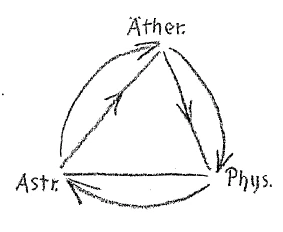
[ 29 ] If we take this particular example—the transformation of \(d\) into \(t\), then into \(s\), which has the same value as \(th\) —, if we take this example, we see that the \(d\) is brought about by the whole human being, with all four of its limbs, creating, as it were, a center of gravity in the astral realm: in this way, it brings forth the \(d\). It brings forth the \(t\) by creating a center of gravity in the etheric realm. He produces the \(s\) or \(th\) by establishing a center of gravity for himself in the physical realm.
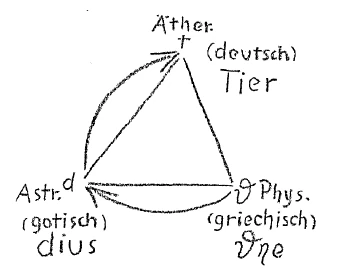
[ 30 ] You can see what is interesting about the underlying process of such a progression, such a transformation of a word through the ages. I would like to illustrate this with a simple example. Let’s take, for example, the word: \(ϑήρ\), dius, animal. This is the same word, just at different times. Here (in Greek) we have the word with a \(th\) \((ϑήρ)\); that would be the same \((ϑ)\) as our \(s\), the same as the English \(th\). The further development would take place in such a way that it tends to shift over here (Gothic): the \(th\) would become a \(d\); and as it develops further, the \(d\) would become a \(t\): it moves into the ethereal realm. Now we do indeed have \(ϑήρ\) (Greek) here; here we have “dius” (Gothic), and here we have “Tier” (German). So the word is \((ϑήρ)\) in Greek, it is “dius” in Gothic, and it is “Tier” in German. It is the same word, exactly the same word. In Greek, its emphasis lay in the physical realm. It tended to shift toward the astral realm in the next language, Gothic; it tended to shift toward the etheric realm, becoming the word “Tier” in German.
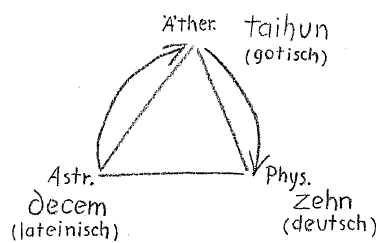
[ 31 ] Take another word, another example. Let’s assume that Greek is synonymous with Latin here—let’s take, for example, the word “decem.” Here in Latin, we have the word in the astral realm. If the word were to tend, as it did in Gothic, to shift over into the etheric realm, then the \(d\) would have to change into a \(t\); and in Gothic, it is also called “taihun.” As it develops from Gothic into German—from the etheric to the physical—the “t” would change to a “z,” so in German it would be “zehn.”
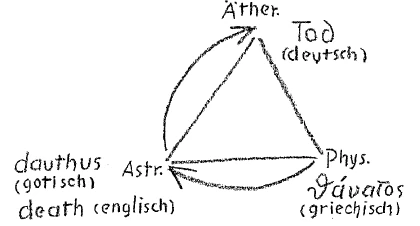
[ 32 ] Another word that is, incidentally, very interesting: take the Greek word “\(ϑάνατος\)”. Since it has the \(th\) sound here, it would primarily resonate with the physical realm. It would tend to shift toward the astral realm and, because it is astral, would then have to have a \(d\) in Gothic. It is also called “dauthus.” And now, as it evolves into German, it would have to move toward the etheric and have a \(t\). And that’s exactly what it does! It is, in fact, called “Tod.”
[ 33 ] Let us now take a word that exists here in the etheric realm and that has a τ in Greek: “\(τρεις\)” (treis). In Gothic, this would have to have a th or an s. And indeed it does, for it is called “threis.” Here it is in the physical realm; now we move into the astral realm, where it would have a “d” in German. And indeed it does—it is called “drei.”
[ 34 ] From this you can see that, if you set aside everything that lives in language—all the meanings that live in language—there is still something special in language: a triad that emerges, I would say, quite like a melody stretched out over time, a triad that can be found. If you have a starting point somewhere, then the other sounds that were in the same place in the word at a different time resonate along with it.
[ 35 ] Here I have chosen the simplest possible transformation for you. But that is entirely sufficient, because otherwise the matter would become a bit too complicated. Such laws of transformation underlie all language development; regulated down to the finest details, they underlie all language development; except that in actual development, the most diverse developmental impulses intersect. Thus, it is interesting to observe how progress in language development combines, in that certain languages advance more rapidly or make “progress” at all, while certain languages do not share in this progress.
[ 36 ] For example, in Greek, take the word “\(ϑάνατος\)” (thanatos), “death.” The regular progression is from th to d to t. The Gothic form corresponds to the d: “dauthus.” The English “death” has remained at the d, at the Gothic stage, and has not followed the further progression. In German, however, the word is spelled with \(T\): “Tod.” And this is the case everywhere; if we pay attention, we find that English, with regard to the development of certain letters, has retained the form of Gothic, but has cast off only the inner vitality, the inner soul of Gothic. It has adhered to this law to such an extent that it has remained at the Gothic stage everywhere. So when we write our “Tod,” we must find the earlier stage of Gothic script in English; we must go back one step. In German, here with “Tod,” we have a \(T\) in the etheric. For English, we must go back to the astral realm, and there we must have a \(d\). In English, the noun “death” ends with a \(th\). There we must go back to the physical realm. If we were to take the adjective “dead,” we would have a \(dam\) ending. If we continue the \(d\) as it is correctly done in German, we would spell it correctly by moving it one level further around (see diagram): then we would have a \(t\) here at the end instead of a \(d\). This is also spelled correctly; the adjective in German is “tot.”
[ 37 ] There you glimpse a realm that is just as much a realm spread out around us as the three natural kingdoms: the mineral, the plant, and the animal; a realm that has laws—laws of development—just as the mineral, plant, and animal kingdoms do; except that the time periods in which the rhythm unfolds—which is precisely expressed by a triangle—are long, and that, in order to always hear the echo of the stage the sound had previously occupied, the memory of a being from the hierarchy of the Angeloi is required.
[ 38 ] But there is something else connected with this. If you consider this law, you will have to admit: If we look back at the ancient Greek and Latin forms of language and compare them with modern German—insofar as the words have retained their meanings to some extent—we see everywhere that the Greek and Latin forms lag two levels behind modern German, and that the Gothic form lags one level behind.
[ 39 ] Much of the world’s development is based on the fact that what evolves over time also evolves in such a way that it remains coexisting in space while developing through the various stages of time. Just as in the natural kingdoms, where lower animals coexist alongside those that have evolved to a higher level, so too do older linguistic forms persist alongside newer ones—or, one might also say, just as a primitive population coexists for a time alongside a more highly developed one. Thus, what develops in different directions also remains such that the older form coexists in space alongside the one that has developed further. However, this coexistence is then combined with many other impulses that influence it.
[ 40 ] The impulse illustrated by this triangle applies specifically to the production of the sounds \(d\), \(t\), \(th\) (\(s\), \(ss\)). Incidentally, a similar triangle also applies to the sounds \(b\), \(p\), \(g\), \(k\), and \(ch\). In contrast, a triangle that would have to be drawn much larger applies, for example, to \(l\) and \(r\). And for the vowels, if one wishes to trace the course of their development, entirely different figures apply. But these laws apply to all of them.
[ 41 ] Let us assume, then, that what is temporal and transitory continues to coexist spatially; this does not mean, however, that the old simply lives on in the new, for then we would still have the old Greek and Latin words alongside the newer ones that developed from them. For example, German has developed in a straight line from Greek—at least as far as the majority of its vocabulary is concerned. Have the Latin-based languages simply stood still? They have indeed remained static, but they have not merely remained static; rather, alongside this stagnation, they have undergone very far-reaching, significant transformations: they have rearranged the words; they have not left the words as they were. While, for example, the word “\(ϑάνατος\),” “death” is simply the evolved form, this word did not remain in Latin as it was in Greek; rather, a different word took its place because the original meaning preserved in the word “death” was not developed at all in the Romance languages—so that the word one then has in the other language is not the same word at all. “Mort” is not the same word as “Tod”; rather, it is a very poor translation. But for what actually lies within the word “Tod”—what developed from “$advarog”—the Romance languages have no corresponding word at all. The word “Tod” expresses something in which the corresponding ethereal quality truly resonates. In the Romance languages, however, the same word resonates with something entirely different from an ethereal quality. It is very important to realize that significant changes have taken place here. You can thus see the problem inherent in all lexicographical and grammatical translations, as well as the problem inherent in what is called “precise understanding” when translating from one language to another.
[ 42 ] The principles underlying development here are extraordinarily profound and are connected to a different level of consciousness than the one in which we normally live through our thinking, feeling, and willing. But we, in turn, live to varying degrees within another layer of consciousness through our thinking, feeling, and willing. With our thinking, for example, we hardly live at all in the layer of language. Our thinking has very little to do with our speech. As strange as it may sound, it is usually the case that when we have thoughts and utter a word in connection with a particular thought, this has hardly any more to do with it than the written letters we put on paper, which are, after all, not the thought itself but merely a symbol of it. Similarly, the spoken word is no more closely connected to our thinking than it is a sign for the thought.
[ 43 ] Words are connected far more closely to our feelings than to our thinking, and even much more strongly to everything that lies within our will, because feeling belongs to a far more subconscious part of our soul than thinking, and in turn, the will belongs to even more subconscious parts of our inner life than feeling. When a person utters a word, its relationship to thought is—one might say—such that it is little more than a sign. Its relationship to feeling, however, is much more intimate; it is far more closely connected to feeling; and it is particularly closely connected to the will.
[ 44 ] If people today were at a stage where they were primarily developing the relationship between thought and speech, then, as speakers of different languages, they would not be able to get into the conflicts they find themselves in today; because the relationship between language and thought simply does not have the intimate character that it has with feeling and volition, since feeling and volition will only develop in humans in the future in the same way that thought has already developed today. Where feeling and willing are concerned, this intertwining with speech also comes into play to a very great extent.
[ 45 ] Today, through the development of the conscious soul, we are in the process of developing thinking—up to a certain level—as something that is objectively alive for us. And by the end of our era, we will have reached a point where we will no longer perceive the relationship between speech and thinking as something particularly intimate. But it will take much longer before the relationship between speech and feeling—and especially between speech and volition—can be perceived as something objective. For much longer, people will convince themselves that, in their humanity, they must identify with their language and their linguistic character through their feelings and volition rather than through their thinking.
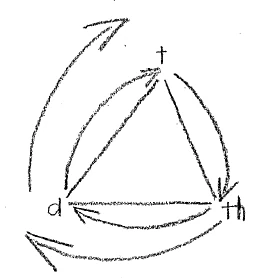
[ 46 ] If we truly bring to mind how a word has a life of its own, a life governed by such laws—as in the case of the word “\(ϑάνατος\)”, which becomes “death” and later “Tod,” and imagine that it lives on in this way, then we truly have the opportunity to form a mental image of how an organism lives—from Greek through Gothic all the way into German—an organism that lives just as we otherwise find an organism living, from its childhood stage through a later youthful stage to the stage of old age. For when such an organism in language has passed through the triad and returns, it does not continue in the same way; rather, the whole becomes spiritualized. Mind you, when d changes to t, and t to th (s, ss), it does not return to its original stage, but instead takes a lateral leap forward. So you need not create a mental image of the triangle on a flat plane (drawing). As it moves across in this way, the d, t, and th continue on and now advance in a spiral, thus always entering different realms. So you must not form a mental image of a word that has progressed to \(th\) returning again to d; rather, the word dies and transfers its transformative forces to another realm. The word is born in the physical, etheric, or astral realms, completes its cycle, dies, and then reappears on a higher level as a transformed force. Thus, a word that we can trace from the Greek “\(ϑάνατος\)” to “death,” and on to the German “Tod,” now has the potential to die as a word. The word “Tod” will die. At the end of the period we call our fifth post-Atlantean cultural epoch, it will no longer exist; it will have died. But the force that formed it will pass over, on a higher level, into the human soul’s power and help people to more easily understand the nature of death in the sense of our Spiritual Science. So that the power within our soul may arise to make it possible to understand the nature of death in the sense of our Spiritual Science, the word first had to be born in Greek, then had to undergo its development into youth in Gothic and in the English “death,” must undergo its development in German into later age: “Tod,” and will reach the point where it will die. It will die and surrender its power to the more spiritual forces of the soul.
[ 47 ] And just as we direct our gaze toward the coming into being of a lamb—or, let us say, a cow, an ox, or a bull—and see how they gradually develop, reach a peak, and then die, so the angel looks upon the coming into being of a word, upon the life of a word, upon the death of a word. This is part of its world, part of its observation, just as the observation of, say, the plant kingdom, the mineral kingdom, or the animal kingdom is part of our world.
[ 48 ] These are perspectives through which I wanted to draw your attention to a life that is, for us, an unconscious life—one that merely touches our consciousness—but which, at its higher levels, immediately develops into a true life of its own, as it instantly becomes a being. A window or a gate opens up for us, as it were, so that we can look in and see how beings develop—elemental beings—which are then reflected in our world in the form of our words. The angel turns his spiritual gaze toward ancient Greece, sees an elemental being being born out of the physical realm, sees it becoming etheric and astral, and will see it die as our fifth post-Atlantean period of development comes to an end. He sees this being in its development, and the fact that this being is developing has an effect in the physical world. And this effect consists in the fact that the ancient Greeks said “\(ϑάνατος\)”, the Goths said “dauthus”, the English say “death”, and we in German say “Tod”. The transformation of this word is the imprint of an evolving being that progresses in its development through the physical, etheric, and astral worlds. What we perceive in language is the reflection of the life of higher beings from a higher world—the reflection of their inner development in the world in which we find ourselves during the time between birth and death.
[ 49 ] We will use this as a starting point for our discussion tomorrow.