

Artistic and Existential Questions
in the Light of Spiritual Science
GA 162
24 July 1915, Dornach
Translated by Steiner Online Library
Eighth Lecture
[ 1 ] Essentially, when people first approach the Spiritual Science worldview, they are seeking answers to questions and solutions to mysteries. This is entirely understandable and natural, and one might even say justified. But something else must be added if the Spiritual Science movement is truly to become the living force that, according to the general course of Earth’s and humanity’s development, it must actually become. Above all, there must be a certain feeling, a certain sense that the more one strives to enter the spiritual world, the more the mysteries multiply; that the mysteries actually become more than they previously were for the human soul, and that, in a certain sense, they become more sacred—these great mysteries of life, whose existence we already sense beforehand, but which, as they are, only truly reveal themselves to us—even as mysteries—when we enter into the Spiritual Science worldview.
[ 2 ] Now, one of the greatest mysteries connected with the evolution of the Earth and humanity is the mystery of Christ, the mystery of Christ Jesus. And with regard to this mystery, we can indeed only hope to advance, so to speak, slowly toward its true depth and sanctity. That is to say, we can hope that, little by little, in our future incarnations, we will come to sense more and more the lofty and extraordinary nature of this mystery of Christ. We must not only hope that some aspects of the Mystery of Christ will be resolved for us, but we must also hope that some of what we have hitherto perceived as enigmatic regarding the entry of the Christ Being into human evolution will become even more difficult, and that many other things will be added to this, bringing us new mysteries—or, if you prefer, new aspects of this great mystery—regarding the Mystery of Golgotha.
[ 3 ] Here, too, one can only ever claim to shed light on this great mystery from one angle or another, so to speak, and I ask you to be fully aware that these are always, I might say, individual rays of light cast from the sphere of human perception upon this greatest mystery of human existence on Earth, and that they truly do not intend to exhaust this mystery, but are meant only to shed light on it from various angles. And so, in addition to what has already been said, let us add a few more points here that may in turn shed light on one aspect of the mystery of Golgotha.
[ 4 ] You will recall the widely cited words of Yahweh, which appear at the beginning of the biblical account, after the Fall had taken place. It is said there that human beings have now eaten from the tree of the knowledge of good and evil, and that they must therefore be removed from their previous dwelling place so that they do not also eat from the tree of life. The tree of life must be protected, so to speak, from being devoured by human beings who have already eaten from the tree of the knowledge of good and evil.
[ 5 ] Now, behind this dual origin—the eating from the tree of the knowledge of good and evil on the one hand, and the eating from the tree of life on the other—lies something that profoundly shapes our lives. Today, let us consider one of the many applications of this saying to life; let us bring to mind what we have long known: that the Mystery of Golgotha, as it unfolded within the course of earthly history, fell within the fourth post-Atlantean epoch—the Greco-Latin era.
[ 6 ] As we know, the Mystery of Golgotha occurred roughly after the completion of the first third of the Greco-Latin epoch, and the remaining two-thirds of this Greco-Latin epoch followed in order to facilitate the initial incorporation of the Mystery of Golgotha into human evolution.
[ 7 ] Now we must distinguish between two aspects of this Mystery of Golgotha. The first is what actually took place in terms of pure facts; in short, what occurred as the entry of the cosmic being Christ into the realm of Earth’s evolution. It would be hypothetically possible—we might say it would be conceivable—that this Mystery of Golgotha, that is, the entry of the Christ impulse into Earth’s evolution, could have taken place without any human being on Earth having understood, or perhaps even merely known, what had happened there. It could very well have been the case that the Mystery of Golgotha would have taken place, yet remained unknown to humanity—that no one would have been able to conceive of unraveling what had actually happened.
[ 8 ] That is not how it was meant to be. Humanity on Earth should gradually come to understand what took place through the Mystery of Golgotha. But from this we must recognize that there are two distinct things: that which human beings take into their souls as knowledge, as an inner process, and that which has objectively occurred within the human race and which exists independently of that human race, insofar as it belongs to the knowledge of that human race. Now, people tried to comprehend what had taken place through the Mystery of Golgotha.
[ 9 ] We know, of course, that the evangelists did not merely record the Mystery of Golgotha—as we find in the Gospels—through a certain clairvoyance; we should also be aware that attempts were made to comprehend this Mystery of Golgotha using the means of knowledge that people possessed prior to the Mystery of Golgotha. We know that since the Mystery of Golgotha, not only have accounts of the event spread among people, but also New Testament theology in its various branches. This New Testament theology, as is only natural, has used the concepts that people had to ask themselves: What actually happened with the Mystery of Golgotha? What took place there?
[ 10 ] We have often considered how Greek philosophy in particular—that which developed as Greek philosophy, notably in Plato and Aristotle—sought not only to understand the nature around them but also to comprehend what took place through the Mystery of Golgotha. And so, we can say, on the one hand, the Mystery of Golgotha occurs objectively, and on the other hand, coming to meet it, are the various worldviews that had been developed since time immemorial and that, by the time the Mystery of Golgotha took place, had undergone a certain development and continued to evolve.
[ 11 ] Where did these mental images come from, then? We know, after all, that all these mental images—even those that lived on in Greek philosophy and, from the earth, reached toward the Mystery of Golgotha—stem from ancient sciences, from those sciences that could not have been made available to humanity had there not been, so to speak, a primordial revelation. For it is not only a materialistic but downright absurd mental image that what existed in a diluted form as philosophy at the time of the Mystery of Golgotha could have been formed by human beings themselves at its very source. It is primordial revelation which, as we know, was formed in a time when human beings still possessed the remnants of ancient clairvoyance; primordial revelation which, for the most part, had been given to human beings in ancient times in pictorial, imaginative form, and which had precisely been diluted into concepts at the time of the Mystery of Golgotha, during the Greco-Latin era. In those ancient times, one could see an intense stream of primordial revelation emerging, which could be given to people because they still possessed the last remnants of the ancient clairvoyance that spoke to their ancient understanding, and which then gradually scattered—that is, withered away—in philosophy.
[ 12 ] So there was a philosophy, a worldview, existing in many, many shades and nuances, and these shades and nuances sought, in their own way, to understand the mystery of Golgotha. If we wish to consider its final offshoots—to see what, at that time, had diluted into a worldview that was more philosophical—if we wish to examine these final offshoots, we arrive, for example, at what existed in ancient Rome, during the Roman era.
[ 13 ] By this Roman period, I mean the era that begins roughly with the Mystery of Golgotha—that is, with the reign of Emperor Augustus—and gradually extends through the Roman Empire until the Migration Period and its consequences gave the European world a different face. What we see flaring up during this period like a final great light of the current flowing from primordial revelation is the Latin-Roman poetry that has played such a major role in the education of young people right up to our own time; it is everything that developed as a continuation of this Latin-Roman poetry until the decline of ancient Rome. All manner of nuances of worldviews had taken refuge within this Roman culture. This Roman culture was not a unified whole. It spread across numerous sects and religious views and was able to develop a certain commonality within this diversity only by retreating, as it were, into external abstractions.
[ 14 ] But this is also what allows us to recognize how, within this Roman culture—into which Christianity moved as a new impulse—something that is fading away finds expression. We see how this Roman world is striving—striving intensely—to incorporate into its concepts what lies behind the Mystery of Golgotha; how it attempts, in every possible way, to draw upon the entire, broad realm of worldview that it can survey, gathering all possible concepts in order to understand what lies behind this Mystery of Golgotha. And one can say, if one looks closely: it was like a desperate struggle for understanding, for a true understanding of the Mystery of Golgotha. And this struggle essentially continued throughout the entire first millennium as part of a certain current.
[ 15 ] Consider, for example, how Augustine first takes in all the elements of the old, scattered worldview, and how he attempts, through what he takes in, to comprehend that which flows in as the living blood of the soul, since he now feels Christianity flowing into his soul like a living impulse. Augustine is a great and significant figure; but one can see on every page of his writings how he struggles to bring into his understanding what is surging in from the Christ impulse. This is how it continues, and this is the nature of the entire Romanic endeavor: to bring into the Western conceptual world—into this worldview—the living substance of what is expressed in the Mystery of Golgotha.
[ 16 ] What is it, then, that is striving so hard, that is wrestling so fiercely—this force that, through Roman culture and Latin culture, is flooding the entire civilized world, this force that is desperately struggling within Latin culture to bring the mystery of Golgotha into the concepts that pulse within the Latin language? What is that? It is also a part of what the people ate in Paradise. It is a part of the Tree of the Knowledge of Good and Evil. And I would like to say that we can see how, in the earliest revelations—when ancient, clairvoyant human perceptions could still speak to people—these concepts lived vividly in that ancient time, still as imaginations, and how they gradually wither and die off, becoming ever more tenuous. They are so thin that by the middle of the Middle Ages, when Scholasticism flourished, it required the greatest mental effort to refine these concepts—which had already become so thin—to such an extent that one could bring into them that which exists as living life within the Mystery of Golgotha. These concepts had retained the most distilled form of the ancient Roman language, with its extraordinarily well-structured logic, but with its life almost entirely lost. This Latin language is preserved with its tightly disciplined logic, but with its inner life almost entirely extinguished, as if fulfilling the primordial divine decree: “People shall not eat from the Tree of Life.”
[ 17 ] If it had been possible for that which developed out of ancient Latin culture to have fully comprehended what took place with the Mystery of Golgotha, it would have been possible for Latin culture to have gained an understanding of the Mystery of Golgotha as if by a sudden impulse; then this would have been like eating from the Tree of Life. But that was forbidden after the expulsion from Paradise. The knowledge that had come to humanity in the sense of the ancient primordial revelation was not meant to ever have a living effect. Therefore, it could only grasp the Mystery of Golgotha with dead concepts.
[ 18 ] “You shall not eat of the Tree of Life”—this is also a saying that applies throughout all the eons of Earth’s evolution with regard to certain phenomena, and one fulfillment of this saying was that it also implied: The Tree of Life will appear in its other form—that of the cross erected on Golgotha—and life will flow forth from it. But this ancient knowledge must not partake of the Tree of Life.
[ 19 ] And so we see a dying insight struggling with life, see how it desperately strives to bring the life of Golgotha into its concepts.
[ 20 ] Now there is a peculiar fact, a fact that suggests that, in a sense, a kind of primordial opposition was established in Europe vis-à-vis the point of departure, the Orient. There is something like a primordial opposition to what was imposed upon humanity in connection with the primordial revelation. In saying this, however—I would say—one touches upon the edge of an immensely deep mystery, and much of what needs to be said about it can truly only be expressed in images. But I believe these images can be understood.
[ 21 ] In Europe, there is, in fact, a completely different legend, which has, however, undergone later alterations; yet even in these alterations, its essential elements can still be recognized. There is a legend about the origin of humankind that differs from the one found in the Bible. What is significant, however, is not merely the existence of this legend, but the fact that it has survived longer in Europe than in other parts of the world. But what is truly significant is that even after the Mystery of Golgotha had been fulfilled in the East, this different legend was still alive in the minds of Europeans. There we are also led to a tree—or at least to trees—found by the gods Wotan, Wili, and We on the seashore. And human beings are created from two trees: the ash and the elm. Thus, by the triad of gods—even if this was later Christianized, it still points to the European primordial revelation— humans are created by the triad of gods, as the two trees are transformed into humans: Wotan gives humans spirit and life, Wili gives humans movement and intellect, and We gives humans their outward form, language, the power of sight, and the power of hearing.
[ 22 ] People usually don’t notice the huge difference between this creation myth about humankind and the biblical one. But you need only read the Bible—and it is always beneficial to read the Bible—and even as you read the first few chapters, you will notice the truly magnificent difference that exists between the creation myth of humankind here and there. I would like to point out just one thing, and that is: according to the myth, a threefold divine essence flows into human beings. This must be a soul-like quality that expresses itself in its outer form and that, fundamentally, originates from the gods—something the gods have placed within him. In Europe, therefore, people are aware that as they walk the earth, they carry something divine within themselves. In the East, on the other hand, people are aware that they carry something Luciferic within themselves. Connected to eating from the Tree of the Knowledge of Good and Evil is something that has even brought death to humanity, something that has turned everyone away from the gods, and for which one deserves divine punishment. In Europe, people are aware that a threefold nature lives within the human soul, that the gods have infused a power into the human soul. This is very significant.
[ 23 ] As I said, this touches on the edge of a great secret, a profound mystery. But it will surely be understood: It does indeed appear as though, in this ancient Europe, a number of people were preserved who had not been so “deterred” from partaking of the Tree of Life, in whom the Tree or Trees of Life—the ash and the elm—lived on, so to speak. And this is in intimate harmony with the fact that this European humanity—and if one were to go back to the indigenous population of Europe, this would become clear in every detail—actually possessed none of the higher, more far-reaching knowledge that existed in the East and in the Greco-Roman world.
[ 24 ] One need only imagine the enormously stark contrast between the naive mental images of European humanity—which, even at the time of the Mystery of Golgotha, still perceived everything in images—and the highly developed, subtle philosophical concepts of the Greco-Latin world. In Europe, everything was “life”; there, everything was “knowledge of good and evil.” In Europe, something had, as it were, remained—like a preserved remnant of the original forces of life—but it could only remain because this humanity was, in a sense, preserved in such a way as to understand something of what was contained in the wonderfully refined concepts of Latin culture. To speak of a “science” among the ancient European peoples would be an absurdity. One can only say that these people lived with everything that sprouted within them, in their souls, and vitalized them. What they believed they knew was something that was immediate experience. This way of being attuned in the soul was radically different from the disposition that was perpetuated in the Latin world. And this is precisely one of the great, one of the wondrous mysteries of historical development: that, I might say, out of the culmination of the culture of knowledge, the culture of wisdom, the Mystery of Golgotha was to emerge; yet the depths of this Mystery of Golgotha were not to be grasped through wisdom, but through direct experience.
[ 25 ] It was therefore as if it were predestined that, once life in Europe had grown strong to a certain point—I would say that the “I-culture” emerged in a purely naive, purely lively, purely vitalistic manner precisely where the deepest darkness reigned; whereas, where the deepest wisdom reigned, the Mystery of Golgotha arose. This is like a pre-established harmony. From the culture of knowledge, which was beginning to wither there, this Mystery of Golgotha arises; but this Mystery of Golgotha is to be understood by those who, through their entire being and their whole existence, have not been able to reach this subtle crystallization of Latin knowledge. And so, in the history of human development, we see a lifeless, ever-more-fading body of knowledge encountering a life that is still devoid of knowledge—a life devoid of knowledge, yet one that inwardly, I would say, senses the continuing influence of the Divine that animates the world.
[ 26 ] These two currents were bound to meet and interact within the evolving human race. What would have happened if only Latin knowledge had continued to develop? Well, that Latin knowledge would have been able to spread among the descendants of the indigenous European population. In fact, it did so to a certain extent. It is hypothetically conceivable—though it could not have actually come to pass—that the indigenous European population might have experienced the aftereffects of this dissipating knowledge. For then, what these souls would have absorbed through this knowledge would gradually have led to people becoming more and more decadent. This withering, this dissipating knowledge could not have united with the forces that keep humanity alive. It would have dried people up. In a sense, under the influence of the lingering |Latin culture, European humanity would have been dried up, withered away. People would have come to possess ever more sophisticated concepts; they would have become ever more intellectualized; they would have thought more and more; but the human heart, the whole of human life, would have remained cold amid these refined, sophisticated concepts.
[ 27 ] I say that, hypothetically, that would be conceivable, but it could not really have come to pass. What actually happened was something else entirely. What actually happened was that the segment of humanity that had led a life devoid of knowledge poured into those people who were, so to speak, in danger of receiving only the remnants of Latin culture.
[ 28 ] Let’s approach the question from a different angle. At a certain point in time, we encounter—across Europe, specifically on the Italian Peninsula, the Iberian Peninsula, in the region of present-day France, and in the region of the present-day British Isles—certain remnants of a European indigenous population: in the north, the descendants of the ancient Celtic people; in the south, the descendants of the ancient Roman people. We encounter them there, and it is into these groups that what we have just characterized as the Latin influence first flows. Then, at a certain time, we encounter—spread across various territories of Europe—the Ostrogoths, the Visigoths, the Lombards, the Suevi, the Vandals, and so on. There was a time when we find the Ostrogoths in the south of present-day Russia, the Visigoths in eastern Hungary, the Lombards where the Elbe River has its lower course today; the Suevi in the region where Moravia and Silesia lie today, and so on. There we encounter various peoples of whom one can say: they lead a life devoid of knowledge.
[ 29 ] Now we can ask the question: Where did these peoples go? We know that, for the most part, they have disappeared from the actual development of European humanity. Where did the Ostrogoths go, where did the Visigoths go, where did the Lombards go? We can ask that. In a certain sense, they no longer exist as peoples; but what they once embodied as a way of life still exists, in roughly the following way. Let us consider the Italian peninsula, let us imagine it still inhabited by the descendants of the ancient Roman population, and let us suppose that what I have described as Latin knowledge, as Latin culture, had spread across this ancient Italian peninsula: the entire population would have withered away.
[ 30 ] If one were to examine the matter closely, one would have to regard it as incredible amateurism to believe that anything of a bloodline connection to ancient Rome still exists today. The Ostrogoths, Visigoths, and Lombards moved in, and through them flowed what was known as “Latin culture”—but only spiritually, as a seed of knowledge—over the life devoid of knowledge, and that life devoid of knowledge continued to provide the substance for it. In the more southern regions, it was a Norman-Germanic element. Thus, what remained of the life-sustaining population from the European heartland and the East flowed into the Italian Peninsula. In Spain, the Visigothic and Suebi cultures flowed in, later to merge with the purely intellectual element of Arab and Moorish culture; in the region of France, the Frankish culture flowed in, and in the region of the British Isles, the Anglo-Saxon culture.
[ 31 ] One is correct in saying the following: In particular, the regions of the South were in danger of completely losing—had they remained descendants of the ancient Romans and had Latin culture continued to influence them—the possibility of developing a sense of self. Therefore, the legacy of ancient Roman culture was removed, and what flowed into this region—where Latin culture was to spread—was that which came from the Ostrogothic and Lombard elements. Ostrogothic, Lombard, and Norman blood were absorbed into what had become a scattered Latin culture. For had the population remained Roman, it would have faced the danger of never being able to develop the element of the conscious soul.
[ 32 ] Thus, among the Lombards and the Ostrogoths, what we might call the “Wotan element”—spirit and life—spread southward. The Wotan element was, so to speak, carried in the blood of the Lombards and the Ostrogoths, and this made the further development and unfolding of this southern culture possible.
[ 33 ] The Wili element—reason and movement—went westward with the Franks; this would have been lost again if the descendants of the indigenous European population that had settled in these regions had simply continued to develop under the influence of Roman culture.
[ 34 ] What might be called “form and language”—and, in particular, the ability to see and hear—made its way to the British Isles, where it later found its expression in English empiricism: in physiognomy, language, the face, and hearing.
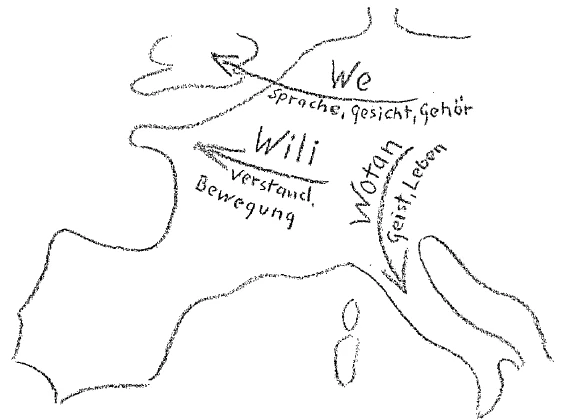
[ 35 ] Thus, since the new Italian element truly embodies the voice of the Folk-souls within the soul of feeling, we can express this differently by saying: the Wotan element flows into the Italian peninsula. Just as we can describe the Franks’ march westward by saying: the Wili element flows westward, toward France. And just as we can describe this in relation to the British Isles by saying: the We element flows into them.
[ 36 ] Thus, on the Italian Peninsula, there is no trace left of the blood of the indigenous European population; it has been completely replaced. In the west, in the region of present-day France, there is a slightly larger presence of the indigenous population, such that the Frankish element and the indigenous population are roughly balanced. The largest remnant of the indigenous population is still found on the British Isles.
[ 37 ] But everything I have just said is, in essence, merely another way of pointing to an understanding of what came from the South through Europe: pointing to the way the Mystery of Golgotha was enveloped in a wisdom that was fading away, and to its being received by a life that was still devoid of wisdom.
[ 38 ] One cannot understand Europe without taking this connection into account; however, one can understand Europe in all its details if one grasps this European life as a continuous process. For much of what I have said is still unfolding right up to the present day. For example, it would be interesting to examine even something like Kant’s philosophy in light of these two primordial opposites of European life and to show how Kant, on the one hand, seeks to set knowledge aside—to strip knowledge of all power—in order, on the other hand, to make room for faith. This is merely a continuation of that dark, secret consciousness: after all, one cannot really do anything with the knowledge that has risen from below; one can only do something with what comes down from above as original, knowledgeless life. The entire contrast between pure and practical reason lies therein: I had to set knowledge aside to make room for faith. The faith for which Protestant theology fights is a final remnant of life devoid of knowledge, for life wants nothing to do with a disjointed, abstract wisdom.
[ 39 ] But we can also consider earlier phenomena. For example, we can examine how, particularly among intellectual leaders, there is an effort to create, so to speak, a harmony between these two currents that have been brought to our attention. For the current physiognomy of Europe shows that Latin “knowledge” continues to exert an influence in European life to this very day, and that one can virtually visualize a map of Europe with Latin knowledge radiating southward and westward, while life in the center of Europe still persists. One can see how efforts were once made—I would like to cite an example—to overcome this dying knowledge. Certainly, this dying knowledge manifests itself with varying intensity in different spheres of life; but as early as the 8th to 9th centuries, European development had progressed to such an extent that the descendants of the European population could no longer make proper use of what had been formed in ancient Roman times as certain designations for cosmic or earthly conditions. Thus, as early as the 8th to 9th centuries, it was evident that there is nothing of particular significance to the soul’s original life in saying: January, February, March, April, May. The Romans could make sense of this, but the more northerly European populations could not make much of it; it poured over these European populations in such a way that it flowed not into the human soul but, in many cases, only into the language, and was therefore withering and dispersing. Consequently, efforts were made, particularly across Central and Western Europe—across the entire region that could be described as stretching from the Elbe to the Atlantic Ocean and as far as the Apennines—to introduce names for the months that could be felt by the European people. Such month names were to be:
1. Wintarmanoth.
2. Hornung.
3. Lenzinmanoth.
4. Ostarmanoth.
5. Winnemanoth (also Nannamanoth).
6. Brachmanoth.
7. Heuimanoth (derived from “Heu,” meaning “hay”).
8. Aranmanoth (Aran = “the harvest”).
9. Widumanoth (Wide = “what remains after walking across the field”).
10. Windumemanoth (Latin = vindemia: grape harvest).
11. Herbistmanoth.
12. Heiligmanoth.
[ 40 ] The person who sought to make these terms commonplace was Charlemagne.
[ 41 ] This is indicative of just how significant Charlemagne’s vision was, for he sought to introduce something that has scarcely taken root even to this day. We still see the last remnants of the far-reaching Latin culture of learning in the names of the months. Charlemagne was, in general, a figure who sought to achieve much that went beyond what was actually feasible. It was precisely after his time, in the 9th century, that the wave of Latinization truly swept across Europe. It would be interesting to consider what Charlemagne intended by seeking to bring the influence of the Wile element to the West. For Latinization did not occur there until later.
[ 42 ] Thus we can say that the part of humanity that was a race—which, as a race, was the successor to ancient Europe, the Europe from which Roman civilization emerged, and which was itself the descendant of Roman civilization—has simply died out entirely in the southern part and, to a large extent, in the northern part as well. Nothing of it remains in the blood. What came from Central Europe and Eastern Europe has poured into the void that was left behind. So one can say: the racial element, even in the European South and the European West, is the Germanic element, which is present only in various shades in the British Isles, in France, and in Spain—though there, too, it has been completely overwhelmed by Latin culture—on the Italian Peninsula.
[ 43 ] The racial element, then, is that which moves from east to west and south, while the element of knowledge moves from south to north. It is the racial element that moves from east to west and south, and along the western part of Europe toward the north, gradually spreading out toward the north. Thus, to speak accurately, one can speak of a Germanic racial element, but not of a Latin race. To speak of a Latin race is just as sensible as speaking of wooden iron; for Latin culture, as it has come to be, is not something inherent to a race, but rather something that has poured out as bloodless knowledge over a portion of the indigenous European population. But only materialism can speak of a Latin race, for Latinness has nothing to do with anything racial.
[ 44 ] Thus we see how, in a sense, the biblical saying continues to have an effect in this part of European history, how the fate of Latin culture is the fulfillment of the saying: “You shall not eat of the tree of life,” and how the life that was given to the earth through the Mystery of Golgotha could not fully harmonize with the ancient knowledge; but how new life had to enter into what remained of the primordial wisdom and what had faded away. If we are to answer the question objectively: Where is that which, from such new life, has not been preserved in its distinctive character but has vanished into history—the Visigothic, Suebi, Lombard, Ostrogothic elements, and so on?—then we must answer: It lives on as life within Latin culture. This is the true state of affairs, which one must, of course, be aware of in relation to what stems from the ancient biblical double-edged saying and what, in ancient times, influenced the development of Europe, in order to understand this development of Europe.
[ 45 ] I had to provide you with this historical overview today, so to speak, because I will have things to say that require you not to hold the false notions of today’s materialism and formalism regarding this historical development.