

Mystery Truths and Christmas Impulses
Ancient Myths and Their Significance
GA 180
30 December 1917, Dornach
Translated by Steiner Online Library
Sixth Lecture
[ 1 ] Today I would like to examine, from a somewhat different perspective, the connections that exist between human beings as microcosmic beings and the entire macrocosm of the world to which they belong—of which they are, in a sense, a part, an organ. One can view these matters from a wide variety of perspectives, and in doing so, the most diverse relationships will come into view, some of which may seem to contradict one another; yet the contradictions lie precisely in the fact that the matter must always be viewed from different angles.
[ 2 ] From certain observations we have made in recent days, you have seen that human beings, in the way they relate to the world around them, actually introduce something of themselves into their view of the world; that they do not, in fact, perceive the sensory world as it is; that, as I tried to express quite forcefully, he introduces into his perception of the world something that arises from within, that is formed from within, and that is actually a kind of transformation of the sense of smell. It is that which human beings combine in the most manifold ways regarding the world, what emerges when they apply their ordinary “acumen”—as it is called—which comes to them through their body; one could also call it “intuition.” What else would be given to a person if they could even easily attempt it—they cannot do so easily at all, for they cannot easily switch off their intuition—if a person were to simply take the sensory world as it presents itself to them, without immediately interweaving their intellect, their reasoning mind, into everything possible.
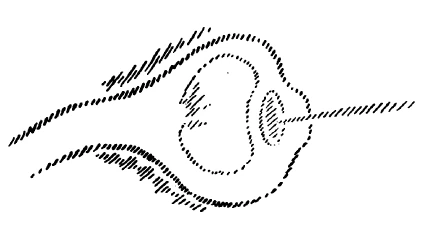
[ 3 ] Here we are touching on a topic that may present some difficulties for understanding. However, you can get an idea of what is actually meant if you consider how nature—and the essence of a particular sense, in particular—presents itself to you. The same is true of the other senses, but the matter does not become apparent to external observation with the same clarity—not as clearly as when one considers what is actually meant here in relation to the sense of sight, to the eye. Consider this: the eye, as a physical apparatus, actually lies within the human skull as a fairly independent organ and is, in fact, extended backward into the human body only through its appendages—the blood vessels and nerves. One could say: This is the human eye, and here is its extension (see drawing); but as an eye, it lies here within the bony cranial cavity with a high degree of autonomy, insofar as it is a physical apparatus—the lens, the incidence of light rays, the vitreous body—in other words, everything that constitutes the physical apparatus is actually quite autonomous. It is only through the optic nerve and the choroid, which extend inward toward the body, that the eye itself extends into the body, so that one can say that this eye, as a physical apparatus—that is, insofar as it perceives the external sensory world in its visibility—is an independent organism, at least to a certain degree.
[ 4 ] This is actually true of every sense; it’s just that with the other senses, the matter isn’t quite so striking. Every sense, as a sense, is essentially something independent, so that one can indeed speak of a “sensory zone.” It’s actually surprising that the study of the senses isn’t enough to inspire the scholars in question to some degree of spirituality. For it is precisely this independence of the senses that could lead scholars toward a certain spirituality. Why? You see, what is experienced through the optic nerve and the choroid—and this could easily be demonstrated even by ordinary science—would not be sufficient to make a person aware of what they experience through their senses. The remarkable thing about the senses is that the etheric body extends into this purely physical apparatus—and it is a purely physical apparatus. With all the senses, we are dealing with something that is set apart from the organism and is experienced solely by the etheric body. You would not be able to unite with your consciousness what is brought about in your eye by the incidence of light if you did not permeate the sense of sight—and likewise the other senses—with your etheric body.
[ 5 ] A ray of light enters the eye. This ray of light acts within the eye in exactly the same physical way as a ray of light acts in a camera obscura or in a photographic apparatus. And it is only through this that you become aware of what is happening in this natural camera of the eye: your etheric body lines the eye and captures what is not captured in the mere physical apparatus by an etheric body. In the mere physical apparatus, in the mere photographic apparatus, only the physical process takes place; so that, in the totality of their senses, human beings truly have a kind of extension into the external world. As physical apparatus, the receiving senses—at least the vast majority of them—belong more to the external world than to the human being. Your eye belongs far more to the external world than to your own body.
[ 6 ] In animals, the eye is much more closely connected to the body than in humans. This is what elevates humans above animals as sensory beings: they possess senses that are less closely connected to the body than those of animals. In certain lower animals, this can already be demonstrated anatomically. There one finds all sorts of organic appendages; for example, the fan is located inside lower animals. These are very complex structures—partly of the nervous system, partly of the blood—which lower animals possess in a more perfect form than higher animals and, above all, than humans.
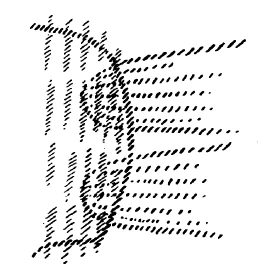
[ 7 ] The fact that, in human beings, the physical body plays such a minor role in their senses and leaves the bulk of that role to the etheric body is precisely what makes human beings such relatively perfect beings. So we can say: First and foremost, the human being is this inner, physical human being, viewed from a physical perspective, and the senses are embedded throughout him; but these senses are actually—as I once said in a public lecture in Zurich—like inlets that extend inward from the outside world. It would be much more accurate to draw it schematically like this. Instead of drawing: Here is a sense, and here is a sense, and here is a sense (see drawing), it would be much more accurate to draw it like this: Here is the human body, and here the human world—for example, the eye or the olfactory organ—extends itself into the external world, creating its own inlets through the sense organs. The external world reaches in through the senses—the eye and so on—and from within we meet it only with the etheric body, permeating what the external world sends us with our etheric body. Through this, the etheric body participates in the external world. Consequently, we are compelled to, so to speak, internally embrace with our etheric body that which the external world sends us.
[ 8 ] The fact that people don’t know what I’ve just said has led philosophy, for more than a hundred years, to talk about nothing more absurd than the way in which human beings perceive the external world through their senses. You can get an overview of all this—which is, essentially, absurd—by reading the chapter “The World as Illusion” in my book *The Riddles of Philosophy*. Because of the belief that the senses can really only be understood from within—from the body—people fail to grasp how a human being can actually know anything about the world through their senses. They always talk about it this way: The world makes an impression on the senses, but then what is brought about in the senses must be grasped by the soul. — The truth is that the external world itself builds itself into us; that is, we actually grasp the external world by the tip—we grasp the external world by the tip with our etheric body—when we, as human beings, perceive the external world through our senses. Everything that Locke, Hume, Kant, the 19th-century Neo-Kantians, Schopenhauer, Helmholtz, Wundt, and all the others have said—everything these people have said about sensory perception—has been spoken without any understanding of the true relationships. As I said, you can read about this in the chapter “The World as Illusion” in my book *The Riddles of Philosophy*. There you will see, from a philosophical perspective, what a calamity it has caused that—by excluding spiritual insight into the matter—a veritable mountain of nonsense regarding sensory physiology actually took hold in the 19th century.
[ 9 ] Now it is a matter of truly understanding what I just said. If you want to examine to some extent the truth of what I just called a “giant cabbage,” it is interesting to note that, in a certain sense, what Locke, Hume, Kant, Helmholtz, Wundt, and so on said about the senses does indeed hold true; but curiously enough, it applies to animals. Through their science, 19th-century people, in their attempt to understand human beings, do not go beyond understanding the conditions in the animal world. No wonder, then, that they also stop at the animal world when it comes to human origins! But this is connected to much more complicated circumstances. For, as I said, the etheric body touches upon what is called the sensory external world only at one corner. But what, ultimately, is the etheric body? The etheric body is, ultimately, that which the human being now receives from the cosmos, from the macrocosm. So that, as the human being draws off his etheric body from the macrocosmic relationships, the macrocosm grasps itself within the human being through the senses. We can feel ourselves to be children of the macrocosm by virtue of being etheric bodies, and we perceive the earthly sensory world through our macrocosmic aspect.
[ 10 ] The fact that this came about relatively late can, in turn, be proven with external science—I would say, with pinpoint accuracy—except that this external science cannot perceive the actual circumstances unless it is guided by spiritual science. I have already pointed out that the Greek language actually lacks the expression we have when we say, “I see a man coming toward us.” — We say, “I see a man coming.” — The corresponding Greek expression would be, “I see a man who is coming.” — One immerses oneself much more deeply in the activity itself, because in the Greek-Latin era there was a much stronger sense that one is already doing something when one sees or hears—that one is perceiving something with one’s etheric body while in the sensory world. This active element is lacking in the sleepy humanity of modern times. The sleepy humanity of modern times would actually prefer to sleep through world events entirely—that is, to let them approach as mere dreams—and does not wish to develop the awareness of actively participating when sensory perceptions arise. That is why it is already quite difficult to understand the Greek spirit today, for the Greeks had a much more active conception of the human being. They felt themselves to be much more active even in what we today call the passivity of sensory perceptions. The Greeks, therefore, would not have devised the imperfect, one-sided theory that a person sleeps because they are tired; rather, they knew that a person becomes tired when they want to sleep, that sleep is brought about by fundamentally different impulses, and that tiredness then arises solely from the impulse to sleep.
[ 11 ] But it is not this theory of sleep alone that has actually been invented out of modern man’s desire for comfort. Modern man wants to be as passive as possible, to be as little of an active being as possible. He is able to do this, and in a certain sense, modern humanity has trained itself to be a passive being. And this passivity is connected to what I perhaps somewhat abruptly described yesterday as the superstition, the idolatry of modern times.
[ 12 ] So the outer world extends into us—I would say, the outermost part of this outer world extends into us. Let’s draw this schematically once more. Suppose we were to draw the human body here (see drawing); the outermost part of the outer world extends into our body, and we encompass it with our etheric body (red and blue).
[ 13 ] You know, we actually have twelve senses; these twelve senses are, therefore, twelve different ways in which the outside world penetrates our body. What actually penetrates it? That is the big question. What actually penetrates our body?
[ 14 ] We actually see only one side of what penetrates us; without clairvoyance, we cannot turn around and look from the other side. With his etheric body, a human being receives the incoming ray of light or the incoming sound vibration. But it does not travel from the outside into the ear in pursuit of the sound; it does not travel from the outside into the eye in pursuit of the ray of light. If it did so—if the human being were to move inward from the outside into his sensory organs along with the sound wave, the ray of light, or the heat radiation, as far as the senses extend inward from the outside—then, in this movement, the human being would be in a specific realm. And this realm is the realm of the Exusiai, the spirits of form.
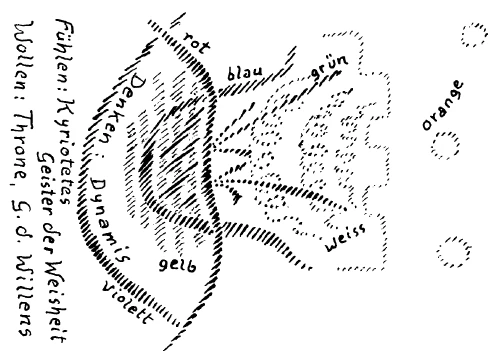
[ 15 ] So if you could turn yourself in such a way that you could move along with what extends into your senses here (arrows), you would be in the realm of the Exusiai, the spirits of form. You would see the intimate interweaving of the beings of the worlds. We walk through the world as human beings, opening our senses, and actually carry within us the Exusiai, the spirits of form, who reveal themselves to us as we open our senses to the external world. This world of the Exusiai—the spiritual world—is thus hidden behind the veil of the sensory world. But this world of the Exusiai, which is hidden behind the veil of the sensory world—the world that reveals itself within human beings—also has its universal, cosmic aspect as it permeates the cosmos. That which penetrates our senses—that which vibrates—ripples throughout the entire cosmos. So we can say that this realm, which extends into our senses, is not only present in the senses but also has its manifestation out there in the world. What is it, then? It is the planets that belong to our solar system.
[ 16 ] Truly, the interrelationship of the planets in our solar system forms a body that belongs to a spiritual being, and this spiritual being includes the Exusiai, who manifest themselves precisely in the revelations of our senses and whose objective aspect lies out there in the universe, in the planets. And embedded in all that which is now as it is—embedded, as it were, in this entire stream of Exusiai activity—are other beings. They lie behind these Exusiai. I would say that other beings do not advance as far as the Exusiai do. They are out there in the same realm, but they do not come near us (see drawing): these are the beings of the hierarchy of the Archai, the Archangeloi, and the Angeloi.
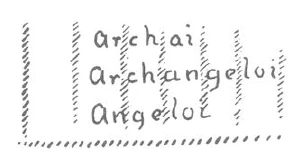
[ 17 ] They are all already present in what is revealed to our senses, but human beings cannot take this into their consciousness. It affects them, but they cannot take it into their consciousness. So you can say: Through our senses, we come into contact with a world—the realm of the Exusiai with the planetary system (red, blue, orange; see illustration on p. 97)—and embedded within this entire realm is also the hierarchy of the Archai, the Archangeloi, and the Angeloi. These are, so to speak, the servants of the Exusiai. But human beings perceive only the outer aspect of all this; they perceive only the tapestry of sensory impressions spread out before them.
[ 18 ] That is how it is with what lies outside of us. It is different, however, with what lies within us—what is now physically within us as well. Now that you have heard what lies adjacent to our senses, you can go on to ask: What lies immediately behind our senses, extending inward? — We have seen that the eye continues inward into the optic nerve. All the senses continue inward through their respective nerves. When the senses continue inward in this way, the twelve senses form a marvelous structure within. It is very complex. One could simplify it by saying: twelve strands leading inward, twelve spheres of the senses; that is, the sensory zone on the outside, followed by what the senses now send inward.
[ 19 ] This is a very complex structure. Where does it come from, if we consider the human being as a macrocosmic being? That which lies inwardly beyond the senses comes from the Dynamis, the spirits of movement. Thus, as we go further inward, the actions of the Dynamis—the spirits of movement—are connected to the senses (see drawing on p. 97). You could not think if the spirits of movement were not at work on the thinking apparatus, which is the continuation of the sensory apparatus. When you look outward, you see the Exusiai establishing the order of nature. You see these Exusiai approaching human beings with their servants, the Archai, the Archangeloi, and the Angeloi. But when you think of your inner self, you must realize that you owe this inner self to the spirits of movement, who prepare for you the thinking apparatus as an extension of your sensory apparatus inward; not the combining apparatus, which is merely a transformed olfactory apparatus, but the thinking apparatus, which human beings do not use at all in ordinary physical life. For human beings use the olfactory apparatus—the merely transformed olfactory apparatus. They have already weaned themselves from using the sensory sphere; they would think quite differently if they could truly use the twelve inward-directed extensions of the sensory sphere.
[ 20 ] In the brain, for example, the visual sphere lies behind the forebrain sphere, which is essentially a modified olfactory organ. Humans hardly use the visual sphere at all; they usually think solely through the olfactory sphere. They use it in a modified way by combining it with other functions. If they were to use it directly—that is, if they were to bypass their forebrain, which is designed solely for the external sensory world, and think directly with the quadrigeminal plate, the visual center, where it enters the brain—then they would have imaginations.
[ 21 ] The same is true of the other senses. Human beings already have imaginations in the physical world as well, because one world always extends into the other. But human beings do not recognize these imaginations they have in the physical world as true imaginations: they are, in fact, olfactory imaginations. What human beings smell is actually the only imaginative realm in ordinary sensory life. But a much nobler imaginative realm could, for example, originate from the sphere of sight and from other sensory spheres.
[ 22 ] Looking inward, we find the spirits of movement there. And going even further inward, we come to the realms that do not govern thought, but rather govern inner feeling—the organs of feeling, which are in reality mostly glandular organs. These organs are the works of the spirits we call the Kyriotetes, the spirits of wisdom. We are sentient beings as human beings because the spirits of wisdom work within us. We are volitional beings because the spirits of the will, the Thrones, work within us. Located even further inward, the Thrones—the spirits of the will—work on the organs of our will (see drawing on p. 97).
[ 23 ] Just as, on a macrocosmic level, the Exusiai—the spirits of form—have their bodies in the planets, which, in a sense, present their outer, visible side to us in ordinary consciousness, so too do the spirits of movement—strangely enough, but it is so—have their outer aspect in the fixed stars. Only the dead person, between death and a new birth, sees their inner side; this is the spiritual side, viewed from the other side. In contrast, the spirits of wisdom and the Thrones no longer possess any outer visibility at all; they are of a spiritual nature. One might say, by way of comparison, that they lie behind the planets and behind the fixed stars. And as the dead person looks down upon that which acts upon human beings in human feeling and human will, the dead person continually gazes upon the Kyriotetes, upon the Thrones. What I have told you—that the dead person has a connection with the human beings to whom he is karmically bound—is conveyed to him through the Kyriotetes and through the Thrones. The deceased looks into the sphere that works invisibly out there in the objective world and actually becomes visible only in its creation—in human feeling and human will. What people here feel and will shines up toward the deceased, and the deceased says: In the body of the Dynamis, in the body of the Kyriotetes, in the body of the Thrones, human thinking, feeling, and willing shine forth. — Just as we look up at the stars, the deceased looks down into the earthly sphere, into the human sphere. Only, we gaze upon the mineral aspect of the stars, the outer physical; the dead person does not see the outer physical aspect of the glands, the organs of movement—and thus also the blood—but instead sees the spiritual side: the Kyriotetes, the Thrones. Just as we look up at the heavens, perceiving their visible meaning from the outside, so the dead person looks down to behold the firmament of humanity. The spiritual essence of this firmament appears to him from above. This is the secret of the dead person.
[ 24 ] You can see the reciprocity that prevails throughout the universe. When one recognizes this reciprocity, the human being takes on a remarkable countenance! Curiously, it takes on a countenance that makes one say: We gaze up at the stars, seeking the spirits of form on the outer surfaces of the planets, the spirits of movement in the fixed stars; then it vanishes into the spirit in those distant perspectives. From this sphere, the dead look down, gazing upon what human beings here dream away and sleep through. But in that, they see their afterlife; there, the stars of the spirit shine up into their world. And human beings are embedded in this being.
[ 25 ] This sheds a unique light on what is said in the opening scenes of the mystery play *The Trial of the Soul*. Read through these opening scenes of *The Trial of the Soul*—the words of Capesius—and you will see that, from an ethical perspective, everything is said there that is now, in a sense, being said from the perspective of astronomy. The way in which this astronomy can influence people’s consciousness is highlighted in the opening scenes of “The Trial of the Soul.”
[ 26 ] And then come the higher worlds—if one wishes to use the word “higher”—that which lies above humanity and this universe out there. I will try to illustrate this schematically; but in doing so, I must appeal a little to your willingness to understand. We can say that if there is a kind of boundary here (see also the diagram on p. 97, in yellow), then the world of the planets and the world of the fixed stars merge into the spiritual realm here—and from the other side, it emerges again. So here we have the sphere of human will and the sphere of feeling, where the spirits of wisdom appear. That is the order of things.
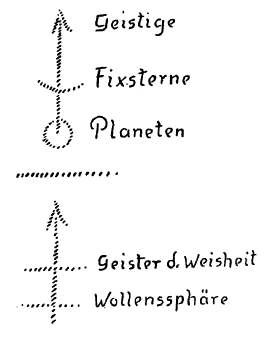
[ 27 ] Now, however, you can imagine an order that is common to both, one that encompasses both humanity and the universe, in which we are so embedded that, on the one hand, we—who shine upward toward the dead—and, on the other hand, the starry sky, which shines downward toward us, are both embedded within it. This brings us to the hierarchies that—if one wishes to use the term—stand higher than the Thrones: the Cherubim and Seraphim. You can imagine that from this perspective, which has just been outlined, one cannot speak of the physical outward forms of the Cherubim and Seraphim, because they are, of course, even higher spirits; but they are already so spiritual—here I must truly appeal to your willingness to understand—they are already so spiritual, these cherubim and seraphim, that their influence arises from another, entirely unknown aspect.
[ 28 ] Isn’t it true that the Exusiai, the spirits of form, can be perceived directly through the senses in the planets; that is simply the side they turn toward us. The spirits of motion can be perceived directly through the senses in the fixed stars; that is the side they turn toward us. But the Cherubim and Seraphim—they are not perceptible through the senses in this way, so that, in a sense, they turn their other side toward us. But they are so profoundly imperceptible—I ask you to simply accept this and reflect on it a bit—that this very imperceptibility becomes perceptible in turn. So that which lives in the world through the Cherubim and Seraphim is so profoundly imperceptible that this very imperceptibility is perceived in turn. It eludes human consciousness to such an extent that human beings become aware of this very elusion from consciousness.
[ 29 ] So one could say: The cherubim are already reappearing, even if this is manifested precisely in the way that they are so deeply hidden that one becomes aware of their concealment. The cherubim appear not only symbolically, but quite objectively in what takes place within a thundercloud, in what occurs when a planet is dominated by volcanic forces. And the seraphim truly come to light in what flashes from the cloud as lightning, or in what manifests as fire in volcanic phenomena, in such a way that their very imperceptibility becomes perceptible in these gigantic natural phenomena.
[ 30 ] That is why, in ancient times, when people understood such things, they looked up at the starry sky, which revealed to them the most diverse things: the mysteries of the Exusiai, the mysteries of the Dynamis. Then they sought to unveil the higher mysteries in what people today mock: from within the human body—as one might trivially say—from the bowels. But they were aware that the greatest forces, which are truly common to the solar system, announce themselves from a completely opposite direction in the phenomena of fire and thunderstorms, in earthquakes and volcanic activity. Curiously, the most creative aspect inherent in the Seraphim and Cherubim announces itself through its most destructive side. It is precisely the flip side, the absolute negative; yet the spiritual is so powerfully present there that even its imperceptibility, its non-existence, is perceived by the senses.
[ 31 ] There you have placed human beings back within the macrocosm. And at the same time, you can see that within this entire macrocosm there is something that begins with the cherubim and ascends toward them, and that is, I would say, merely reflected or shadowed in the gigantic effects we mentioned last. This gives you the perspective of a natural science that is at the same time a spiritual science; it gives you the perspective of a science that truly views the entire universe as a spiritual realm, one that is not content with vague pantheism and other forms of “pan-ism,” but which truly delves into that which, as the spiritual, underlies the universe.
[ 32 ] These things will also help you understand that, in a certain sense, human beings must have a dual nature. Let us consider a person as they live from the moment they wake up until they fall asleep; they live within their senses, in their sensory environment, if one perceives the outer world as I have indicated. But between falling asleep and waking up, the other part of the human being is active. In the present cycle of humanity, this part is so imperfect that the human being is not aware of what he experiences during sleep. Yet during sleep, the human being experiences his connection with the cosmos—with the extraterrestrial cosmos—just as he experiences his connection with the earthly cosmos through his senses while awake. It is just that the other aspect—this coexistence with the extraterrestrial cosmos—remains unconscious to them. The moment you fall asleep, you mentally participate in the movements of the cosmos and enter a completely different sphere. You become alert when you wake up; you become responsive to the cosmos by falling asleep. You participate in the life of the cosmos by falling asleep; you tear yourself away from the cosmos by waking up. So that you can say: Human beings can recognize within their own nature, within their own being, a part that floats within the cosmos, that lives within the cosmos. Therefore, when the ancient astrologer explored the cosmos with its mysteries—in the sense intended in the preceding reflections—he was exploring that in which human beings float along with the part of their being that sleeps. There, human beings float along with what the astrologer seeks to explore—the true astrologer, not the merely calculating, mathematical astrologer of more recent times.
[ 33 ] The moment a person perceives what they experience with that part of their being that is asleep, in that very moment they stand before what, up until about the 15th century, was actually called “nature.” What a person experiences there was called “nature.” The Greeks called the same thing—what was called “nature” in the Middle Ages—Proserpina, Persephone. Of course, the mysteries of Persephone were described differently in Greece than in the Middle Ages. But you can see for yourself that the Middle Ages were familiar with these things when you read descriptions of nature and its mysteries such as those found in the works of Bernardus Silvestris. In Bernardus Silvestris’s work *De mundi universitate*, he begins his account of the experiences a person has when they awaken to the part of themselves that participates in the cosmos—the part that is otherwise asleep.
[ 34 ] These matters are described particularly well by Alanus ab Insulis, from the region we have mentioned several times; for in Alanus ab Insulis’s work, the “island” refers to Ireland, Hybernia. In his work *De planctu naturae* and in his *Anticlaudianus*, you will find parallels between the Proserpinamythus and what he has to say about nature. And you will find that all of this resurfaces in the work of Dante’s great teacher, whom I have cited here before: Brunetto Latini. You will find that Brunetto Latini’s teachings have been incorporated into Dante’s own views. Read the passages of the *Divine Comedy* in which Dante describes Matelda—the passage that truly resembles the myth of Proserpina like two peas in a pod, a fact that even conventional scholarship has noted—and you will gain an understanding of this—from Bernardus Silvestris, from Alanus ab Insulis, from Brunetto Latini, and from Dante—and from many others as well—that, right up until the dawn of the new epoch, people were aware of that other world in which human beings, as microcosms, coexist with the macrocosm.
[ 35 ] On the one hand, there was nature—humanity’s shared experience with the cosmos—which the Middle Ages called *Natura* and antiquity called *Proserpina*. This was personified and, in turn, distinguished from Urania, who rules the celestial sphere just as Nature rules that which humans experience from falling asleep to waking up. And these medieval people believed they were glimpsing a profound mystery when they spoke of the marriage of Nature within the human being to the Nus, to the mind, to the intellect within the human being. And in both correct and incorrect ways, these people attempted to experience within the human being the union of nature with the nus, with reason or intellect, as a mystical wedding, which was contrasted with the alchemical wedding, just as I have described in the essay that is the first one about Christian Rosenkreutz.
[ 36 ] These are things that are not so very far behind us. And Dante’s powerful work—which depicts the world, humanity, and human mysteries with as much grandeur as it does humor— is like a work that sought to preserve what has been known over the centuries and millennia about the connection between human beings and the macrocosm. In Brunetto Latini, one finds the same thing that Dante depicts poetically in his own way, described from the standpoint of initiation, linked to an external event as well.
[ 37 ] The awareness of humanity’s connection to these spiritual mysteries had to be kept hidden, so to speak, for a time, so that what humanity can experience—isolated from the universe and, in a sense, dependent on itself—might be kindled within the human being. We are now living in an age in which, on the one hand, human beings are exposed to the rays that penetrate them from the constellation of Pisces, and on the other hand, to the rays of the oppositely acting constellation of Virgo. This age, however, must find a way to emerge from spiritual barrenness. Certainly, we can no longer simply adopt what humanity once knew, for that knowledge existed in a form that was useful to ancient humanity. Dante’s *Divine Comedy*, though a great revelation, is nonetheless more of a testament to a bygone era. A new era requires revelations from the spiritual universe from a different perspective.
[ 38 ] But one thing is possible. When we have, so to speak, such tangible evidence that people knew spiritual mysteries until just a few centuries ago, this has such an effect on the human spirit that it can inspire us to seek the path to these mysteries once again in a new way. That is why we can also draw inspiration from a historical perspective; we just have to approach this historical perspective in such a way that we go back to what is truly historical. Consider this: what are all the external events recounted in history—in this history with which, alas, our schoolchildren, right up to the oldest among them, are force-fed—what are these stories, recorded as history, compared to the facts that people such as Bernardus Silvestris, Alanus ab Insulis, Brunetto Latini, Dante, and so on, Pico de Mirandola, Fludd, and even Jakob Böhme, Paracelsus—if we consider a certain sphere of wisdom, indeed even up to the 18th century we could cite Jakob Böhme’s disciple, Saint-Martin—what is it? What are the ordinary events recorded in history compared to the fact that there have been people who possessed such cosmic knowledge within themselves and who, with that cosmic knowledge, actually brought about change! Yes, the present day is in many ways proud of what it has achieved. This intelligence of the present—I mentioned it today in connection with the Christmas plays—has always been rather dismissive of spiritual content; even when, as in Oberufer—where the Christmas plays were performed until the mid-19th century—this “intelligentsia” consisted of a single individual: the schoolmaster, who was also the village notary—that is, the legal representative—and at the same time the mayor. He was the “intelligentsia”; he was the sole opponent of all the Christmas plays. In his view, they were stupid and nonsensical. Schröer still learned that this intellectual figure from Oberufer had taken a hostile stance toward what was contained in the Christmas plays. It is very often the intellectual class that takes a hostile stance toward what is actually fruitful in human evolution.
[ 39 ] The point is to fuel what might be called the enthusiasm for history by contemplating real history and truly immersing oneself in what history is. History includes the spiritual aspect of events, and that unfolds differently from the external, physical, and material aspect.
[ 40 ] We must try again and again, especially in these difficult times, to stimulate spiritual impulses somewhat by making ourselves aware of how the Spirit has been at work in the historical development of humanity. Whether you can now count off the details on your fingers—how the Dynamis work, how the Exusiai work—is far less important than awakening this overall awareness of how it seeks to bring the individual human being into harmony with the spirit of humanity. For in the awakening of this awareness lies precisely that which is meant to bring healing into the development of humanity. Sometimes it is good to realize just how far removed we are from what today, as a prevailing global opinion, does not—I cannot say—move human souls, but seems to move them. As a result, there is often no sense at all of the weight of individual facts. The spirit weighs the facts for us correctly.
[ 41 ] More important than many other things for assessing the present—just think about it in light of what you’ve heard here—more important than many other things is a report that came in over the last few days: that the U.S. government has taken the railroads under its own administration. For this is part of a certain pattern of symptoms that clearly point to the measures being prepared to divert humanity as far as possible from the course in which it can only be sustained if it becomes fully aware that, without the spirit, reality can be nothing but a reality in the process of dying. One can, of course, choose death; in that case, life must simply flee from the realms in which one chooses death to other realms. The realm of truth is already emerging victorious. But one looks toward a realm where, in a sense, the one who looks more deeply into the world is also confronted by such powers on the left and right, as Dante was at the outset of his description of his *Divine Comedy*, or as Brunetto Latini was at the beginning of his initiation.
[ 42 ] Ah, how desperately the world needs to embrace spiritual ideas to the fullest extent! Instead—and it is indeed true—we are faced with the necessity of having to emphasize, time and again, that we must turn our gaze toward the spirit. Time and again, we are filled with the longing to be able to sufficiently emphasize the gravity of the matter. People do not want to look where the seeds lie; rather, they want to be passive, to let things come to them as much as possible, to sleep through the course of world events as much as possible. If many people did not sleep the way the present age is accustomed to sleeping through events, then one would already see that behind what is now swirling through the world in such an untruthful way lies a strange tendency. It may well be said—since the universal idol of modern times, of the present age, Woodrow Wilson, has himself boasted of such things—that four-fifths of humanity stand opposed to one-fifth. This idol of modern humanity, raised upon the altar—and raised far higher than one might think—has indeed boasted of this himself.
[ 43 ] One would have to admit that it would be a shame if humanity were to miss out on what lies in an ideal such as that of this idol, whose catchphrases—even those that are not copied, like its latest manifestation, from the good Don Pedro of 1864, but have grown in its own hollow—pardon me, I mean, in its own head—trace back to what actually lies within as a tendency. What is it, then? The aim is that one day it will be possible to say on Earth: Centuries ago, there was a legendary humanity in the heart of Europe; we succeeded in exterminating it. We had to exterminate it because it was terribly arrogant. It traced its origins to the gods and even named Goethe its chief poet, to imply that it had received a spirit sent directly from the gods. — People will not, of course, express themselves in such spiritual terms; but this will already be discernible in what lies as a seed, as a tendency, behind Wilsonianism. The only question will be whether this can be the path of humanity, whether this can be the future path of the Earth, or whether one must not, after all, reflect on how the Earth can be saved from the so-called ideals of Wilsonianism and similar things. One simply needs to avoid falling into nationalism or anti-nationalism in any way when dealing with such matters. The rhetoric about nations and national freedoms—well, in more recent times, one can leave that to Wilsonianism. But one cannot emphasize strongly enough what actually lies behind the idol that is being referred to here.
[ 44 ] I know full well that people today will not give much credence to such things, but I also know that some voices in the future will agree with what has been said here. May it always be possible, even then, to add another voice to those in the future: Humanity allowed itself to be led in all manner of ways by a strange idol; thanks be to the spirits of the world that the goals of this peculiar guide of humanity were not fulfilled—a man who, after all, reveals the grotesqueness of his existence to the world, in part, by theoretically proclaiming with grand words that the republic is the sole source of happiness and by copying his own republican manifestos from the Brazilian emperor of 1864. — That we are actually dealing with a grotesque phenomenon here is something that can certainly be said behind closed doors. Out there, truth is not the highest good today; rather, it is weighed on the political scales. One must not say what is true or untrue, but rather what is prescribed. Until March 15, one was absolutely forbidden to say anything against tsarism in the various countries; since March 15, one is, of course, allowed to say anything against it.
[ 45 ] Unfortunately, truth is not the highest standard. But this touches upon precisely those circumstances that it is necessary to engrave upon the soul today. It makes sense to supplement grand visions of the cosmos with those rather small thoughts—which, unfortunately, have great practical consequences—that stir passive, sleepy humanity today. For humanity must awaken, and the spirit must be the alarm clock.