

Earth-Death and Universal-Life
Anthroposophical Life-Gifts
Essential Aspects of Consciousness for the Present and the Future
GA 181
9 April 1918, Berlin
Translated by Steiner Online Library
Anthroposophical Life-Gifts IV
[ 1 ] In the course of my recent reflections, I have often pointed out here—albeit drawing on different sources—that occult truths have always been known to individual human beings throughout the history of human development; however, these individuals have taken great care to ensure that precisely those who have been initiated into such occult mysteries have not disclosed anything to the uninitiated outside their circle. Now we know that such things continue to exist even when they have lost their significance—indeed, their very justification—in the ongoing development of human life in general. Thus, certain truths are still strictly guarded today by those who know them. But we know that certain things simply must be pointed out today, that they must no longer remain hidden, but that, like other scientific truths, they too—as spiritual-scientific truths—must be made accessible to all of humanity.
[ 2 ] Now, this can only happen in relation to certain elementary things; it must happen solely in relation to these. Among the matters we have been discussing for some time, however, there are many things that are counted among such truths, such insights, which are carefully guarded by certain quarters. Nevertheless, we must continue in the spirit of these reflections, building upon some of what is thus guarded. And those who today receive such truths, simply as they are proclaimed, should recognize from the truths themselves that they must be regarded with a certain great seriousness, with a certain reverence. For among the things regarding which the initiates shrink from disclosure is, among other things, a fear of the lack of reverence that people today have toward the truth. Admittedly, not much reverence can arise toward what today’s materialistic mindset accepts as truth, and these things are not greatly profaned [by the fact] that we do not approach them with reverence—at least not outwardly. Nevertheless, certain things must be treated with delicacy and reverence if they are to be properly incorporated into the spiritual life of humanity.
[ 3 ] These include, above all, insights into human beings themselves—insights that, when they first touch our souls, seem simple, but which are of extraordinary significance and far-reaching implications. Precisely the reflections that have occupied us recently—all of which, to a greater or lesser extent, culminate in bringing us closer to the mystery that corresponds to the connection between life in the physical body and the life between death and rebirth—these truths bring our reflection very, very close to the human being, and tie in with many aspects of this kind that are intimately linked to the human being in terms of knowledge. Let us first direct our spiritual gaze toward things we have already discussed from other perspectives; today we wish only to reconsider such things from a certain angle in order to establish the perspective just characterized in these lectures here.
[ 4 ] As we know, modern science has brought humans very close to animals. However, as we have already emphasized: what actually distinguishes humans from animals in the true sense of the word is something that modern natural science does not take into account at all. For example, it points out the similarities in the shapes of bones between humans and higher animals and finds a great resemblance in them; it finds a great resemblance in their structure, in their morphology in general. It is certainly correct in this regard, but the most essential point is not even touched upon. This most essential point—which I have already pointed out once this winter, even in a public lecture—presents itself, first of all, from one perspective in such a way that one can say: Anyone who approaches the contemplation of human life with the necessary reverence and depth—so that they allow themselves to be moved by the great, significant contrast between a human being living physically here on Earth and a human corpse—has simply placed a mystery before their soul in this impression of these two opposites: the living human being and a corpse. What must first strike a person in this context is that the corpse is now claimed by the forces of the external earthly nature—forces to which it was not subject during the time from conception or birth until death, but from which it was shielded by the fact that the soul-life was connected to this material substance that stands before us in the corpse. Let us consider in our minds what becomes of a corpse, regardless of whether it is rapidly dissolved through cremation or more slowly through decomposition—for both processes are, after all, exactly the same, differing only in the brevity or length of time involved. Whatever was materially bound within the human being is, in a shorter or longer period of time, dissolved into the Earth’s overall material process and becomes part of it. Indeed, the human being can observe with his ordinary senses—and even with his ordinary thoughts—what becomes of all the parts of a corpse.
[ 5 ] The observer from the perspective of the humanities can go further in this regard. They may find that what remains together in the corpse immediately after death gradually merges into an immensely vast material realm; naturally, this process spans centuries, but it does merge into an immensely vast material realm, dissolving, so to speak, into the totality of what constitutes our visible, externally perceptible world.
[ 6 ] Now it is interesting to explore the connection between what constitutes our sense of self here in physical life and this decaying corpse. Curiously, these two things are linked in a certain way: the decaying corpse and the sense of self. I say: The “I”-consciousness—not, of course, the real, true “I,” for this “I” naturally passes through the gate of death—continues to live on between death and new birth. But what appears to human beings here in physical life as an image of the “I”—for they have no consciousness of the “I,” only an image of the “I” in their consciousness—is bound to the physical body, and specifically to that material structure that dissolves into the universe after “death.” This dissolution of the physical body into the universe is nothing other than the outer image of the entire sense of self; for in truth, our sense of self belongs to this universe into which our physical body dissolves. And the fact that, in the time between birth and death, we remain in the peculiar perception—a perception that is peculiar to the occultist but self-evident to the ordinary person—that “we are within the boundaries of our skin”—is due solely to the fact that the material masses of our body are held together between birth and death. It is because of this cohesion that we always attribute our existence to the space we fill with our flesh and blood. For in reality, it is absurd; we are not really there at all. In truth, we are everywhere, and from the moment we fall asleep until we wake up, we even strive to be wherever the particles of our body will be after death. It is only between birth and death that we are taught, through maya consciousness, that we exist within this spatial volume bounded by our skin. But this is merely a maya consciousness that has been instilled in us. And death is, among many other things, the refutation of this illusionary consciousness regarding the physical-material world. It carries the parts of our corpse to where, in truth, our sense of self always resides. That is indeed something very far-reaching.
[ 7 ] But you might ask: What is it that actually carries us—our sense of self and its outward image, the material particles of our body—out into the vast world once we have died? What kind of forces are these?
[ 8 ] There are three forces, which we can illustrate roughly as follows.
[ 9 ] This one force manifests itself during our lifetime in that, in the very earliest stages of our lives, we crawl on all fours and then raise ourselves upright. We only gradually orient ourselves along the vertical axis. As we transform from a crawling child into an upright human being, we follow a certain line of force into which we place ourselves and with which we identify. From a spiritual scientific perspective, this line of force is very clearly visible in the human being. A line runs upward from below, extending from the center of the Earth out into the universe. “In ancient times, this was simply described by saying: A line extends from the center of the Earth into the universe; for every human being—and even at every moment in time—this line is different, yet it always extends outward from the center of the Earth toward the universe. This is the one line of force that is significant within the human being. The way it acts in our physical life is limited to the duration of that physical life; for during that time, the physical gravity of our body maintains a balance with this force. The moment this physical gravity ceases to act as it does in the living body—at the moment when the living body becomes a corpse—this line of force unfolds from the center of the Earth out into the universe as the force that initially pushes and carries our material particles. Of course, they are then always driven further by their own weight, but if we were to follow what happens to our material particles over a long period of time, we would find that they disperse in the direction of this force, even if this takes centuries. — The second force to be considered here is one that finds its main expression in human speech. We speak—or at least we are capable of speaking. There is always a certain impetus in articulated speech. A certain momentum lies in the exhaled air when we speak. The spiritual scientist perceives this force as winding around that first line. It essentially takes a spiral form, winding around this vertical axis. This force slightly alters the pure repulsive force, setting it in motion. But it does not act alone; a third force comes into play, arising from the following. While speaking develops a certain momentum outwardly, thinking—which distinguishes humans from animals—acts in opposition to this force expressed in speech. This gives us the third force. If we were to draw it, we could do so as follows (see drawing). Through these three forces—the creative force, the force at work in speech, and the force at work in thought—the parts of the human body are gradually and slowly directed out into the universe. Of course, they are counteracted by gravity and other forces, such as chemical forces, that oppose them. But these three forces overcome these opposing forces.
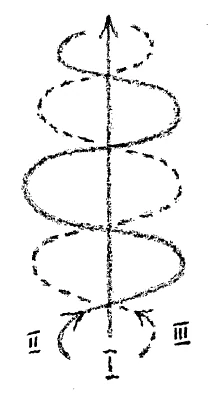
[ 10 ] These three forces, which are held together during physical life when we stand on our two feet as human beings, are set free and disperse what is held together here in form. In particular, what we call the etheric or formative body also follows these three forces. Already beforehand, immediately after death, after a few days, what we have often described as the dissolution of the etheric or formative body takes place, also in the direction of these forces. The other process—the disintegration of the physical body—is less important for the deceased; it merely serves, by fixing the moment of death for him, to preserve his memory of his earthly self. But what is more important is that these forces show the deceased the continuous, law-governed nature of this dissolution of the etheric or formative body. Yet if nothing else were present but these three forces, the deceased could not know that it is his own form, that it actually originates from him. He would perceive it, but as something foreign. Therefore, the point is not merely that he perceives what is dissolving, but that he may know that it originates from him, that it is the remnant of what he held together in his form on earth. And this leads us to something else.
[ 11 ] I must point out something that, in our dry, sober, paper-driven age, is truly not treated with the necessary reverence, even though it is always and everywhere before us. It is something that, within the physical world, actually appears to be the most mysterious of all—something that is present for everyone within the physical world, yet whose mysterious nature goes unnoticed: it is the human incarnation, that which reveals itself outwardly in the human flesh. You need only recall the wealth of individuality expressed in the fact that human beings approach us with their incarnate form, and how, fundamentally, this flesh color is different in every human being, appearing to us in as many shades as there are human beings. Anyone who sets out to unravel the mystery of the incarnate form—as has already been attempted—will begin to develop a sense of what is expressed in the flesh color, in the tint of human skin. There is something immensely mysterious that finds expression in the incarnate form. For those who approach this observation from a spiritual-scientific perspective, the question—What is the nature of the incarnate body?—takes on great significance. For this peculiar tinting of the incarnate body depends on two opposing forces; one might say: on counteracting forces of pressure, which are at work within the human being. Specifically, the etheric or formative body exerts a outward pressure in a certain way, while the astral body exerts an inward pressure in the opposite manner, and this occurs at every point. When the astral body seeks to contract—to press inward from the outside—the etheric or formative body seeks to press outward from the inside, to expand. And what arises from the encounter of these two forces—one from the outside and one from the inside—at the surface of the human being plays a part in what is revealed in the human incarnation. What the etheric body and the astral body have to say to one another is expressed in a mysterious way in the incarnation.
[ 12 ] When you look at a person as they are here on the physical plane, you also see their incarnate body. But this incarnate form would appear differently if one could view it from the inside out. Seen from the inside out, you, as an average Central European, would not have a flesh-colored, rosy incarnate form, but rather a greenish-bluish one. This greenish-bluish color also manifests in the aftereffects following death. When a person’s formative forces—or etheric body—expand in accordance with the three forces characterized earlier, and the deceased looks upon this formation, they see their incarnation, so to speak, in its afterimage from the other side. After death, it shimmers greenish-bluish before them.
[ 13 ] But it contains something else entirely than what we encounter when we observe it from the outside in physical life. Strictly speaking, this incarnate form, in its mysterious nature, is not only individually different for each person, but it also changes in the same person over the course of a lifetime, albeit in subtle nuances. Not that in certain pathological states we sometimes look rosy and sometimes sallow—for that is, of course, an abnormality—but apart from these major changes, the physical body is constantly changing. When viewed from the other side, however, as the deceased sees it, it reveals something else entirely. It reveals, as if painted on a tapestry, our entire world of memories. So if we wish to speak figuratively, we must imagine this complexion-tapestry as a garment—a very fine garment—and now turned inside out, just as one turns a garment inside out, or turns a glove inside out. Then we would see on the other side what is otherwise turned inward, and of which we, because it is turned inward, can only become aware when it enters consciousness as a memory—not as the content of thoughts, but as thoughts characterized by a distinct, vibrating quality. What we send down into our subconscious, we come to know only in its external manifestation. We do not come to know how it glimmers through our physical body; but the dead person comes to know this through the aftereffects of the physical body. When the deceased looks back on the dissolution of the body of formative forces, they have it behind them as a memory, and they then know: That is it; that is me!
[ 14 ] Research in the humanities shows that what is given less consideration in the natural sciences— the great distinction between humans and animals—upright posture, the capacity for language, articulate speech, and the capacity for thought—that these are the forces which carry humans into the universe after death, and that the incarnate human being is the physical expression in this life of what continues to have an effect after death as a remnant of memory. Thus, even after death, we reveal ourselves to the universe and carry within us—in what we possess and manifest here in our physical bodies—the outward signs of our cosmic being. Hence the feeling we associate specifically with something as mysterious as the incarnate form—this feeling, for it is the sense of the universal significance of what “meets us in the human being”: even more than through anything else, the human being is, through something like the incarnate form, a microcosm in relation to the macrocosm. And the basic hue is of great significance, for it is, so to speak, the color of the carpet upon which the deceased’s memories appear: greenish or greenish-bluish for white people, violet-reddish for the Japanese, and for Black people, simply flesh-colored after death.
[ 15 ] These are things that are intimately and meaningfully connected to life—between death and new birth—since they prepare the way for the new incarnation. There is an immense significance in these things. They contain the determining factor that leads a person, in a new incarnation, to a particular race and so on. Contemplating spiritual life is not merely a matter of satisfying curiosity or a thirst for knowledge. Rather, life—as it is here in the physical world, with those things that actually make a mysterious impression on our minds—can only be explained when we are able to view this physical life correctly in connection with the spiritual.
[ 16 ] Now, as you can imagine—the topics I am discussing are, after all, more or less fundamental and can be further elaborated upon—such elaboration is intrinsically linked to an intimate examination of human nature and development in general. It is precisely this insight into human nature and development that people today shy away from. They do not want it. And on the other hand, it is precisely those people—to whom I have drawn attention today and on many previous occasions—who guard certain occult truths and wish to wield power through their exclusive possession of such knowledge. This is of extraordinary significance. For there are indeed people—even if it is so hard to believe today—who participate in a certain way in the realization of the world plan by attempting, at their occult sites, to discover: How is the development of the world unfolding? What is the best course of action to take in order to exert a powerful influence on humanity of their own accord over the next thirty, forty, fifty, or one hundred years? — Nations that have among them such people—who investigate the course of human development and then shape political life accordingly—naturally have an advantage over others who do not address such matters. These things play a major role in human life. We are living today in an age when it is necessary for people to take note of the existence of such matters. Today I wish to draw attention to just one aspect in this regard.
[ 17 ] As immensely catastrophic as our current events are, and as much as they already—purely from an external, superficial perspective—surpass everything similar that has unfolded in human history, they are nonetheless partial events within a grand, all-encompassing process—a process that only those who view it with the necessary reverence and seriousness can truly grasp. Such a thing will have to be grasped. Above all, in certain places among humanity on Earth, people already know a great deal about human development. But it is precisely that part of the knowledge intended to place power in the hands of those who possess it that is carefully guarded. Now, I do not know to what extent you might doubt this, but the things I am referring to are stated in such a way that I leave it up to each individual to accept as much of it into their own belief as they deem credible. — Today, driven by certain impulses—which we may wish to characterize more precisely at a later time—the English-speaking population of the Earth is striving for a terrestrial-universal world domination. This is not the result of any kind of Central European chauvinism, but rather the result of entirely objective occult research, and it would certainly be least of all denied by the knowledgeable members of the Anglo-American population—perhaps denied, but not negated—except that those in the know do not want this information to become public under any circumstances. For these knowledgeable individuals also know the following, which I will illustrate by going into a little more detail.
[ 18 ] In the course of human evolution—as the developmental interrelationships have taken shape within materialism from the third and fourth into our fifth post-Atlantean epoch—many things that once expressed truths have been devalued, truly devalued. If you look for ancient traditions, you will find everywhere that the deepest truths are clothed in imagery. Today, people are only willing to accept myths, images, and figurative forms as fiction. In the case of Strindberg, for example, people tolerate them because he apparently intends to present fiction. But people are modest when they say: “One need not believe this, and one should not see in it anything that expresses real truth about these matters.” — Mythical, pictorial expression has been devalued. When it comes to imagination, people do not sense that there is something behind it. This process will extend to language itself in the course of the fifth post-Atlantean cultural epoch, particularly among the English-speaking population. Not only have images been devalued as a means of expression, but the word as such will be devalued. Just as people today combat the image from a materialistic perspective, so will they combat the word in the future. People will say that the word is not capable, in and of itself, of expressing anything true at all. Fritz Mauthner already attempted, in his Critique of Language, to pin all the superstition supposedly existing in humanity onto language itself. But perhaps he is not dealing with an unsuitable tool. His critical mind is, in fact, a suitable tool; but he is dealing with unsuitable material: the German language. In this, he is mistaken. The English-speaking occultists, however, have the suitable material: the English language. In its developmental impulse to devalue meaningful content, it is increasingly reduced to mere verbal flourishes. Consider how much mere verbal verbiage it already contains today, and how much is merely glossed over within it. And anyone who studies English philosophy at all can see that the language no longer yields any meaningful richness of expression. Take, for example, John Stuart Mill, Herbert Spencer, and others: the language offers nothing to help one penetrate the spirit. One can see from this how language plays a major role when the language problem is addressed by English-speaking occultists; for this is inherent in the impulses of the times. Therefore, the task is to devise ways and means from occult foundations to exercise world domination without the aid of language. And this is the great contrast between the Orient and the Occident: the Orient with its extraordinarily vivid intensity of language, the Occident with its rejection of the inner meaning of language. Once again, the Central European is placed between these two extremes. What is taking place there—and what is symbolized so significantly in something that is shouted as loudly as possible today— yet is as deceitful as possible in order to conceal the truth—this is not said out of any chauvinistic sentiment, but rather from the most sober discovery of the humanities—what is shouted so loudly and what the various peoples assert is said only to conceal the other: The will to achieve dominance in a realm where language is losing its dominance through its own course of development. This is something of which even the great, decisive, catastrophic events of the present are specific manifestations; this is something that inaugurates a great, all-encompassing struggle, which must manifest itself in the most diverse forms among the peoples of the earth in the near future. It is not something one can simply assume will turn out like all wars so far: that there have been wars in the past, that peace was subsequently made, and that things will continue as they were before. Rather, this is something one must view as a perpetual process; for only by taking such things into account can one form profound insights into the momentous events of the present. Today one must resolve to no longer think superficially about certain circumstances, but to delve into their depths; otherwise, nothing of significance will come of whatever one attempts to undertake. But it is quite difficult for people today to get used to what must flow from a spiritual-scientific perspective in this area. This struck me as grotesque recently in connection with a minor detail, and it was so grotesque precisely because it had an extraordinarily charming origin. I have been busy these past few days working on the new edition of The Philosophy of Freedom, which is scheduled to appear in the near future. It has, of course, been a long time since I wrote The Philosophy of Freedom as a young man; I was about thirty-two or thirty-three years old at the time, so it really has been quite a long time. And that brings many things to the surface of the soul. At the time, I derived great satisfaction from this work, as I also explained in the journal Das Reich. At the time, I corresponded extensively with Eduard von Hartmann, the author of The Philosophy of the Unconscious, and when he received my Philosophy of Freedom, he had jotted his comments in his copy and then made it available to me. I copied these remarks at the time and still have them today. As you can see, there is a truly charming reason—one that calls for all my gratitude—behind what I am about to recount.
[ 19 ] In The Philosophy of Freedom, I had initially presented spiritual essence in the form of self-conscious thought, because one can truly grasp the spiritual only by genuinely experiencing and living through what first presents itself to human beings as spiritual—namely, self-conscious thought that is grounded in itself. But as this became clear to me at the time, I found it necessary to speak of certain things in terms different from those used by others who approached the subject from different perspectives. For example, on one page I had the following statement: “The representation is an individualized concept; the concept is experienced intuitively in the mind; the representation is an individualized concept and is related by the ‘I’ to the object in the external world.” Among the things Eduard von Hartmann highlighted at the time, his mark appears here as well, and he remarked: “That is an unusual use of language.” One sees that it is a very amiable observation, but one that is highly characteristic. For if one may compare the great with the small, one could cite the following. When Copernicus had expressed the idea: “It is not the sun that revolves around the Earth, but the Earth around the sun”—if someone had written in the margin: “That is an unusual use of language”—what a peculiarity that would have been! Of course, an unusual use of language is bound to arise when something new emerges. But you see how, from a place where one might expect unconditional understanding to exist, one is met with the retort: “That is an unusual use of language!” — If people had never resolved to use language in unusual ways, there would be no progress at all, not only in the intellectual realm. This is an example where it becomes quite vividly apparent. You will find at every turn that there is resistance, especially toward the language used by spiritual science. However, what the old worldviews represent today—already like a thoroughly worn-out garment—not even the old worldviews themselves could use; for it is so worn out that even the “Reich Clothing Office” would no longer accept it if it were actually offered to them in the form of a garment befitting their standards. But when it appears as a worldview that lives within the soul, people do not notice it. One must develop a sense for this. This is part of what people today need in order to understand the times. And the times must be understood!
[ 20 ] This is what must be repeatedly impressed upon us. Otherwise, the individual scholars and those who guard their knowledge in the service of _ humanity will very easily gain the upper hand. What matters is ensuring that certain knowledge is not placed at the service of a part of humanity, but at the service of all of humanity. As soon as even the best knowledge is not imbued with this spirit, that very knowledge will become a calamity for humanity.