

Lectures to Priests: The Apocalypse
GA 346
Dornach, 9 September 1924
Lecture V
The most important thing we must do here is to read the Apocalypse in the way it should be read today. Already for the reason that we must become fully conscious of what is guiding spiritual life today, since spiritual development is now taking place under the sign of the consciousness soul. Hence it will be a matter of orienting ourselves to what the Apocalypticer tells us and of absorbing it in a fully conscious way.
The communications of the Apocalypticer have meant nothing to ordinary priests so far, and at most they meant something to the highest initiates, although there have been ever fewer of them in recent times. Priests must now become aware of the real contents of the Apocalypse.
We pointed to the seven churches from a particular point of view, for the world is very complex and one can look at things from many different viewpoints; so that we can describe the community in Ephesus in the way that we did yesterday. We then find that the Christianity there developed out of certain heathen conditions.
However, we can also point out that much of the basic structure of the first post Atlantean epoch was contained in these impulses—in fact, to an even greater extent than it was contained in the later phases of Indian civilization. So that in a way one can look upon the Christianity which developed in Ephesus as a Christian continuation of the first world view and view of life after the Atlantean epoch, whereas the original Persian culture lived more in the second community—Smyrna—and passed over into Christianity.
Then again, Pergamos is described as a community which cultivated the third post Atlantean culture. If we let the message to Pergamos work upon us, we find a more or less clear reference to the words of Hermes, which lived in this cultural milieu.
Then in Thyatira we are referred to the fourth post Atlantean culture, in which the Mystery of Golgotha took place. If we let this important message work upon us, we are constantly reminded of the direct way in which the message of the Mystery of Golgotha worked.
And then comes the church in Sardis, which we discussed yesterday. I showed you that this church in Sardis was somewhat astrologically oriented, and that it was oriented towards astronomical work. Therewith this community bears a lot of the past in it—which of course every community does from a historical viewpoint. But precisely this community in Sardis also bears a lot of the future in it.
And now take what we're trying to bring into our spiritual view of the present. We are living in the fifth post-Atlantean epoch. If one looks at Sardis' past one sees that there was still something germinal there which hadn't been taken to completion at the time when John wrote the Apocalypse. The whole tone of this fifth epistle is different. It points to the future. The future to which he pointed at that time, which is as it were germinally contained in Sardis is our future; it is the time in which we're living.
So the development of the successive post Atlantean periods is hidden in the developing Christian churches, and the same thing is indicated from another side in the seven seals.
We have another indication, as it were, of what the secret of the seven churches is in the seven seals. We will describe the other meaning of the seven seals later, but when the fourth seal is opened, it corresponds to a secret of the fourth post Atlantean epoch, for a pale horse appears, and there is talk about the death which has come into the world. This touches upon one of the most important secrets of the Apocalypse—at least, it is very important for our time. In a way, death really entered into humanity during the fourth Post Atlantean epoch. You should make this clear to yourselves. One finds out what human nature is if one contemplates something like this; one can really get to know it quite well.
If we go back to the first, second and third post Atlantean epochs we find that the way man felt about himself, and his whole frame of mind was different in these early times than it became later. Man had a distinct inner feeling that he was growing into his earthly abode. Even though this consciousness had dimmed considerably by the time of the Mystery of Golgotha, men had a distinct memory in their ordinary consciousness that they had lived up in the spiritual world before their life on earth. In the first, second and third post Atlantean epochs, everyone knew that they had been a spiritual being before they had become a child. One doesn't find this, in external documents very much, but the fact is that people, took the continuation of their stay upon earth backwards into the spiritual world for granted. Human beings only began to feel that their life on earth was closed off by the two portals of conception or birth and death in the fourth post Atlantean epoch, which coincided with the Mystery of Golgotha.
This consciousness or attitude of soul first arose in the fourth post Atlantean epoch, so that this consciousness of being strictly enclosed by the boundaries of earthly life developed from about the eighth century before Christ up to the 15th century after the Mystery of Golgotha. A new consciousness is being prepared in the present epoch, but we're only at the beginning of it. Only about five centuries have elapsed since then, and this corresponds to about the third pre-Christian century with respect to the preparation of the fourth post Atlantean consciousness. The consciousness which they had then was quite different from the one they had when the fourth post Atlantean consciousness was fully developed. Likewise, most men today are not wearing the clothes of the new consciousness yet, but they are still wearing the consciousness of the fourth post Atlantean epoch. Our whole civilization tends to create this situation.
Just think of how much has been carried over from the fourth post Atlantean epoch and of how much people are living in the fourth post Atlantean epoch in a matter of fact or coquettish way. The fourth post Atlantean epoch is still working on in our entire high school education. Scholars who use Latin are still back in the fourth post Atlantean epoch. People in public life still think in the way that they thought in the fourth post Atlantean epoch. We haven't arrived at full humanity with respect to the development of our consciousness soul, as it were, in the fifth post Atlantean epoch. And this is why men of the present still think that their earth life is closed off by the two portals of birth and death.
The consciousness soul is being developed, but this development only becomes evident in people who have a special talent for it. I have met quite a few talented people like this during my lifetime; but one usually doesn't notice them. There is an awareness that a man with this fifth post Atlantean consciousness doesn't completely fit into the period between birth and death, that death plays into earthly life, that one really dies a little bit every day, that we're dying continuously all the time and that death exists. Some people are very much afraid of death, because they feel that it is undermining their ability to be human on earth. On the other hand, I have also known people who loved death because it always accompanied them, and they were really longing for it.
This is something which will arise evermore during the fifth post Atlantean epoch, namely, people will see death walking alongside them. To put it even more concretely: men will perceive an intimate fire process in themselves which is connected with the development of the consciousness soul. They will experience this development of waking consciousness like a kind of fire process which consumes them, especially at the moments when they pass over from sleeping to waking consciousness. The consciousness soul is a very spiritual thing, and spiritual things always consume material ones. The consciousness soul consumes material and etheric things in human beings through a kind of intimate fire process or transformation process.
This is something which men will perceive more and more in the course of this fifth post Atlantean epoch. Except that you shouldn't think that it's like a burning candle flame; one shouldn't think of it in such a physical way. Rather he will incorporate this proximity of death into his moral soul.
The situation with most people today is as follows. If you see how the good resolves and firm intentions which they have disappear in the next moment, hour, day or month, then in accordance with the prevailing, materialistic world view, one considers this to be something which simply occurs. But one will gradually begin to feel differently about this. One will begin to feel that a good intention which one was too weak to carry out weakens one's life and reduces one's moral value, and one will see that one becomes morally lighter and less significant in the universe thereby.
People today generally feel that what is present here is a weakness in their soul, and not something which works on in the universe. But this will change. Likewise, there will be certain intellectual qualities which people will increasingly feel are weakening them, as if a fire in their soul were consuming them. These phenomena are already here, and some of them exist on a large scale. But they are not being felt in an honest way.
There is a way to find one's way into the spiritual world where one goes step by step and where one also takes what is given in How Does One Attain Knowledge of Higher Worlds? and in other books into account; thereby one arrives at a harmony between spirit, soul and body. But through the way in which most people cultivate a spiritual life today without these exercises, namely, through the way in which people in various confessions pursue a religious life, the latter is active in them in such a manner that it reduces their moral value and makes them lighter.
These are things which people are becoming aware of more and more. People in this fifth post Atlantean epoch are changing a great deal. For it is a significant change if one feels that one's whole manhood is strengthened or weakened by what one is in one's soul. It's quite a change if one feels that destiny is not only a matter of circumstances which work upon one and which are present around one outside, but that it is something which makes one morally lighter or heavier. It's not as if one's physical body were protected against this, for one feels that one becomes lighter or heavier as a whole human being.
You see, this is the consciousness which is being prepared, and one can see externally and empirically that it is being prepared. The time is beginning today when the priesthood will have to think of these things, when the faithful are standing before them. For it's a question of dealing with what is rising in men's consciousness in such a way that a man is comforted and strengthened. These things are not fully conscious yet, and they are coming up together with all kinds of unrest, nervousness and disharmonious emotional contents.
You priests will find that it's becoming increasingly impossible to treat individual people in accordance with the general ideas which you have formed. Don't be offended by this, but in a certain sense clichés have been the decisive thing in the past and in many respects they still are today. If you ask what a priest did with someone who came to him with some kind of delusive ideas, one will hear that he tried to make him feel aware that he was a sinner, and that he did the same with a second case, and so on. Thus everything is pervaded by clichés.
I once went to three burials in one day, and I noticed that the same priest began each burial with the statement, “As high as the heavens are above the earth, so much higher are my thoughts than your thoughts.” Here we have another cliché, which was relatively justified in the fourth post Atlantean epoch. Like the other things that I mentioned, this has reached over into the fifth and it rules our thinking, whereas a finer observation shows that all things must be transformed in our cultural epoch. Priests must begin to be able to look into the hearts of other human beings again.
Very few people can do this today. Human beings know terribly little about other human beings today. For you see, if one reads the passage about the white raiment which people who have fulfilled the task of the fifth cultural epoch will have to wear, and if one does this with a certain reverence—because one can't really read the Apocalypse without reverence—one gets the impression that here it's a question of looking deeply into the special kind of consciousness which each human being has with the eye of a priest. It's a question of their becoming acquainted with the people who appear before them in the fifth post Atlantean age. We are being admonished to become acquainted with each human being in his soul garment, and not just in the clothes which he wears through what he is in the outer world. This admonishment of the Apocalypticer is addressed to our present time through this letter.
Today's priests must penetrate the souls of human beings as they momentarily disregard all the external things into which men are placed. Priests must really begin to look at human beings in the way I described, namely, in the way one must look at them if one wants to investigate their karma. The day before yesterday I said that if one wants to investigate someone's karma one has to immerse oneself in his soul and in the qualities which can come to expression in any profession and basically in any capacity, and one shouldn't look at people from the viewpoint of their vocation, social ties, and ability or non-ability. For one has to look at what a human being was in his past earth life. Now priests don't have to go quite that far, but they must begin to see through external things and to look at man's inner life and his purely human side, and at what gives each inner human being an individual constitution. It's really the case that if we read up to this Book of Revelation we feel that what is written in it is like a direct exhortation to present-day humanity. And if we read on we can get an even deeper impression.
Just consider the following. We're going through the fifth post Atlantean epoch; during this fifth post Atlantean age man is changing his consciousness in such a way that he sees through the work and activity of death itself. He will understand it. He will not learn to see through it in such a way that he knows how much longer he has to live; but he will see the working of death itself; he will have it as a constant companion. Of course he will have to have a soul content which will make this standing next to him of death seem natural, and this is something which will have to be created in the various spheres of life. If one's soul forces are constantly alert one will be able to have death next to one as a good friend and a constant companion.
You should realize that when you look out into your environment today, you are still seeing things like a man of the fourth post Atlantean epoch. You're basically looking at life which has death in it in every plant and rock, but you don't see the death, because you still don't see it in yourself. People will soon begin to see death all the time. This is what one will increasingly have to say to present-day men. People's whole perception will change as they see death more and more.
If one sees death one sees many things which are completely hidden in the phenomena. We see nature in a rather stable way today because we don't look into certain fine, intimate things in nature at all. We walk through the countryside, and we see signs which say that there is a lot of foot and mouth disease in this area. However, in reality something happened in the more intimate things above such a place—if one can see it—which can be compared with an ocean which is roiled by a storm or with a volcanic eruption. This is what will approach mankind in the sixth post Atlantean epoch.
Today people can observe the eruption of a Vesuvius or a great earthquake by means of a seismograph, but because they don't see death yet they don't see the tensions in the etheric which become manifest in all kinds of things, such as when a significant genius lives somewhere or is born there. People can see the tremendous working and weaving of the spirit behind the planets and stars and their configurations just as little; the latter are just an external manifestation of the former.
People will see all of this in a certain way during the sixth post Atlantean epoch. The sun and the stars and planets in their present form will have fallen down from the heavens. One will see the working and weaving of spirit where the materially abstract stars shine today. Thus the way that men see themselves will change a great deal in the course of the fifth post Atlantean age and the way they see the whole world around them will change greatly in the course of the sixth. For example, don't think that an initiate sees the world like a non-initiate does. Something similar applies to successive stages of consciousness. Human beings see the world differently in successive epochs.
The fact that we are living at a time when man and the way the world looks are being transformed is indicated in a number of ways but also by the fact that there is a relative uniformity in the description of the first four letters. The first letter is unsealed and a horse appears, a white horse. The second letter is unsealed and a red horse appears, but it's a horse. The third letter is unsealed and a black horse appears, but it's a horse. The fourth letter is unsealed and a pale horse appears, but again it is a horse.
The fifth letter is unsealed and no horse appears; there is no mention of horses anymore. The decisive thing here is indicated in an entirely different way. If we go on reading the letters, we find that a very important transformation which is occurring during our age is pointed to in this way.
We can only say that we must prepare ourselves to become the new, transformed community of Sardis. This new and transformed community in Sardis must realize that it's rather trivial to know plants, animals and rocks, for one only really knows these things if one finds the activities of the stars and planets in every stone and in every plant. The stars must fall down from heaven in a spiritual way. One can already begin to perceive this.
I would just like to give a particular example of this. People accept the outer forms of such things. One doesn't pay much attention to the way in which something like this is present in the whole spiritual evolution of mankind. Each person can only do something at the place where he stands. Before I went on my last trip to England, the following thing happened. You may know that when I'm here I give the people who are working on our building one or two hours a week during their working time, where I talk to them about scientific and spiritual things. I let the workers give me the themes, and they really like to do this. The workers like it if they can choose the themes. Now they wanted to know about things which are possible in present-day spiritual life. This is one of the things which priests should really understand.
When I walked into the classroom before I went on my trip to England, a worker had a prepared question: Why is it that only certain rocks and plants have an odor? Where does the fragrance of flowers come from? Now these workers were educated by the lectures which have been given for years to such an extent that they're not particularly interested in chemical explanations, where one tells them that one has this or that substance which is giving off this or that aroma, along the lines of explanations which tell one that destitution comes from poverty. The workers want real explanations.
Now you see, I had to tell them the following. I will briefly repeat what I explained to them for about an hour. Things which smell refer us to our sense organs; we perceive the aroma through our organ of smell. But let's ask ourselves whether we have developed our organ of smell to the point where we can compete with a police dog. You will have to admit that we can't. On the contrary, you will have to admit that man has a rather crude organ of smell and that one runs into more sensitive organs of smell if one goes down to certain lower forms in nature.
One can see this from the following. Take a dog, which has this sensitive organ of smell, so that it can become a police, dog. You will see that it has a receded forehead which follows the olfactory nerves that bear smells into its system. All of this is puffed up into a forehead in us; our intellectual apparatus and especially our ability to recognize things is a transformed organ of smell. This explains why we find more sensitive organs of perception when we descend to lower creatures.
Now spiritual science teaches us that the fragrant flowers of a large number of plants are really organs of smell; they're vegetable organs of smell which are extraordinarily sensitive. And what do they smell? They smell the omnipresent, world's aroma. The worldly smell which is emitted by Venus is different from the ones which are given off by Mars or Saturn. For instance, violet smells are the aromatic echo of the cosmic smell which violets perceive. Such pleasant smelling plants perceive the elements of the world's smell which come from Venus, Mercury and Mars. Stinky asafetida smells Saturn odors and reproduces them.
Here one has to explain to people how the stars fall down, because they want to know this; for the things of the world are basically nothing else than what they give out or radiate down. If one wants to talk about things in a realistic way, one has to say that the stars are really falling down already, because they are in the plants. Plants are aromatic and they are also olfactory organs. This morning I let the workers give me some more questions. One of the questions was: If what was said about smells is correct and plants are sensitive organs of smell, where do plant colors come from?
I had to explain that although plant aromas come from the planets, plant colors come from the power of the sun. I gave an example to make this seem plausible. However, one of the workers wasn't entirely satisfied with this answer, and he said: this doesn't explain why rocks have colors; I can understand why plants have colors, for if there's a plant growing in the cellar where there's no sunlight, it has a form which has an aroma, because the world's aroma passes through the walls of the cellar; but the sun doesn't shine through the walls and so plants remain pale or even white; but how do rocks become colored? Then I had explain[ed] that we have the course of the day, with a revolution with respect to the sun in hours, and we have the course of the year which brings about the seasons during which the sun goes up towards the zenith and back down again; but we also have something else. I had to explain the Platonic year, and I explained that although the sun is now in Pisces at the vernal equinox it was previously in Aries, Taurus and Gemini, and that it takes 25.920 years for it to go all the way around. So that the sun is connected with the course of a day, the course of a year and the course of a world year; and whereas plants get their colors from the sun in the course of a year, rocks get their colors in the course of a world year.
The power which the sun develops in its movement through a Platonic year lives in the colors of green emeralds, wine yellow topaz and red rubies. And so you see that if one begins to speak about the spiritual world people are no longer satisfied if one explains their questions about earthly things with the trivialities which come out of our laboratories and dissecting rooms. They want to know things, and they feel very satisfied if they know them in a Sardisian way or in a way where one brings in the stars and planets and their activities. After all, by placing Sardis into the present time, one is doing the same thing that the Apocalypse is doing.
You see, this is an example, but on the other hand, one has to begin to carry this sensing of the stars and their beings into the present People will have to begin to see that the Christ is a sun being again. But this is what they fight most of all. But if I tell you such things, namely, if I tell you that our modern, fifth post Atlantean epoch must be the resurrected Sardis, in the way that this is concisely and wonderfully described in the fifth community and in the fifth seal, when these things are unsealed, if I say this to you, you will feel that one of our tasks is to develop this particular understanding of the Apocalypse today, namely, to be able to understand the tasks which are demanding our heartfelt attention every day. It doesn't do any good to merely interpret the Apocalypse today. We must put the Apocalypse into practice in everything we do, otherwise we might just as well forget about it. A desire to interpret it in order to satisfy one's curiosity doesn't have much value.
Thus I have tried to show you the second thing which belongs to a reading of the Apocalypse. Yesterday I tried to indicate the formal aspect to you; today I tried to indicate that it takes will power to read it. But this is only natural. For apocalypses have always arisen through inspirations of the will, and here we touch upon a really apocalyptic point, because it is an apocalyptic point which is full of life.
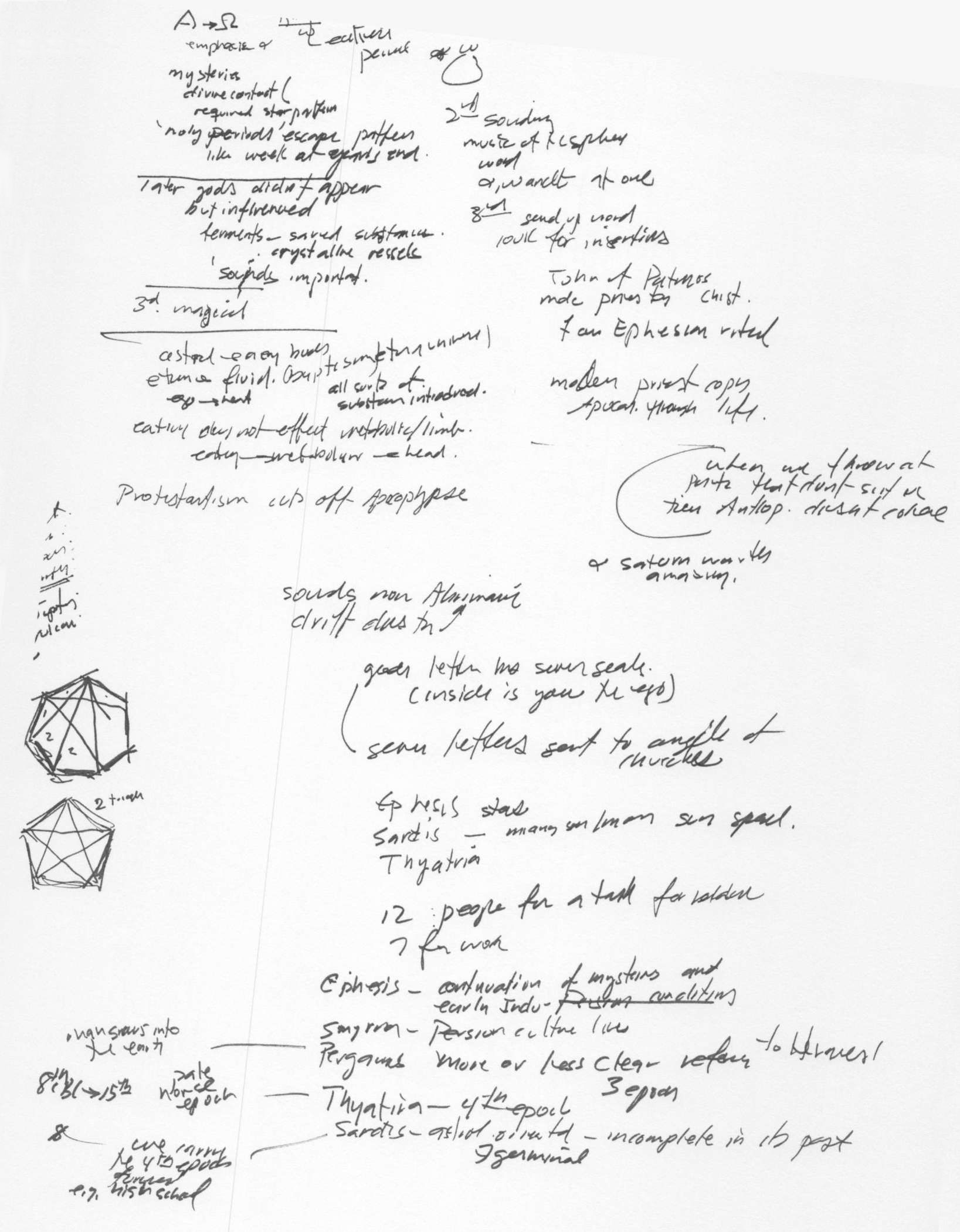
We already have people today who are being trained in an apocalyptic way; but they are being apocalyptically trained so that they receive their training of the will in a way which is oriented specifically towards the Roman catholic church; these are the Jesuits. There is something very apocalyptic about the Jesuits' training and exercises. The Jesuits' exercises involve a training of the will, which always underlies the perception of apocalyptic things. Hence anyone who takes a real priesthood in the sense of a Christian renewal seriously today has to keep this training of the Jesuits in mind.
He must understand the Apocalypse so that he can find the right impulse for his will in it, whereas although the impulse for the will which was given by Ignatius of Loyola was wonderful, it was very one-sided, and it has become Ahrimanically hardened today. For Ignatius of Loyola is a good example of how wrongly we can look at the world if we don't gain knowledge of it in a spiritual scientific way.
People ascribe the present development of the Jesuits to Ignatius of Loyola. But it no longer has anything to do with him. Ignatius of Loyola reincarnated a long time ago, and of course he has separated himself from the movement completely, for he lived as Emanuel Swedenborg; and so the Jesuitic movement has become completely Ahrimanic since then. It is no longer connected with Ignatius and it is active in an Ahrimanic way. Here you have a kind of shadowy counter image of what you must train yourself to do, when you take apocalyptic things into your ego in the way I mentioned, so that your ego becomes' a sum of active forces which are also apocalyptic.
Fünfter Vortrag
[ 1 ] Uns muß es ja vor allen Dingen darauf ankommen, die Apokalypse so zu lesen, wie sie in der Gegenwart gelesen werden soll. Schon aus dem Grunde, weil in der Gegenwart die geistige Entwickelung des Menschen im Zeichen der Bewußtseinsseele sich zu entfalten hat, muß dasjenige, was die Führung des geistigen Lebens ist, auch voll ins Bewußtsein hineintreten. Daher wird es sich für uns darum handeln, die Orientierung über das, was der Apokalyptiker gibt, vollbewußt in uns aufzunehmen.
[ 2 ] In früheren Zeitaltern bedeuteten die Mitteilungen des Apokalyptikers vielleicht mehr oder weniger nur etwas für die höchsten Eingeweihten, die es ja in späteren Zeiten immer weniger gab, aber sie bedeuteten nichts für die gewöhnliche Priesterschaft. Heute muß das, was in der Apokalypse enthalten ist, wirklich in das Bewußtsein der Priesterschaft einziehen.
[ 3 ] Nun haben wir gestern hingewiesen auf die sieben Gemeinden, und wir haben von einem Gesichtspunkt aus hingewiesen auf die Gemeinde von Ephesus. Die Welt ist wahrhaftig reich an Gesichtspunkten, und in ein und dieselbe Sache können viele Gesichtspunkte hereinspielen. Wir können die Gemeinde von Ephesus so charakterisieren, wie wir das gestern getan haben, und wir finden dann, wie aus heidnischen Voraussetzungen heraus innerhalb dieser einen Gemeinde das Christentum entwickelt worden ist. Wir können aber auch darauf hinweisen, wie in diesen Impulsen wirklich viel von dem enthalten war, was die Grundstruktur der ersten nachatlantischen Zeit war, mehr als das im Indien der späteren Zeit der Fall war. So daß man in dem, was zu Ephesus sich als Christentum entwickelte, in gewissem Sinne die christliche Fortsetzung der Weltauffassung und Lebensanschauung der ersten nachatlantischen Zeit sehen kann, während in der Gemeinde von Smyrna, die in der Apokalypse an zweiter Stelle genannt wird, zunächst die urpersische Kultur gelebt hat, die dann übergegangen ist in das Christentum.
[ 4 ] Pergamon wiederum wird angeführt als diejenige Gemeinde, in der die dritte nachatlantische Kultur gelebt hat. Wir finden, wenn wir gerade das Sendschreiben an die Gemeinde von Pergamon auf uns wirken lassen, wie da mehr oder weniger deutlich hingewiesen wird auf das Hermeswort, das innerhalb dieser Kultur gelebt hat.
[ 5 ] Dann werden wir in dem Brief an die Gemeinde von Thyatira verwiesen auf jene Kultur, die wir die vierte nachatlantische nennen, das ist diejenige, in die das Mysterium von Golgatha selbst hineinfällt. Wir werden da, wenn wir dieses bedeutende Sendschreiben auf uns wirken lassen, überall daran erinnert, wie wirklich die Botschaft des Mysteriums von Golgatha unmittelbar wirkte.
[ 6 ] Und dann die schon gestern besprochene Gemeinde von Sardes. Ich zeigte Ihnen, wie diese Gemeinde von Sardes ja in einer gewissen Weise astrologisch orientiert war, wie sie auf den Sternendienst hinorientiert war. Damit aber trägt diese Gemeinde von Sardes, wie es ja gewiß historisch nicht anders sein kann, viel Vergangenheit in sich, aber vor allen Dingen trägt gerade diese Gemeinde Zukunft in sich. Und jetzt wollen wir versuchen, das in unsere spirituelle Anschauung der Gegenwart hineinzubekommen. Wir leben in der fünften nachatlantischen Periode. Wenn man hinschaut auf das, was in Sardes Vergangenheit war, so ist da auch etwas Keimhaftes, was noch nicht vollendet war zur Zeit, als Johannes die Apokalypse schrieb. Der ganze Ton dieses fünften Sendschreibens ist schon auch ein anderer als bei den vier vorangehenden. Johannes weist im Schreiben an die Gemeinde von Sardes hin auf die Zukunft. Die Zukunft, auf die er damals hinwies, die gewissermaßen keimhaft in Sardes verkörpert war, das ist unsere Zeit; das ist die Zeit, in der wir selber leben.
[ 7 ] Nun aber wird ja die aufeinanderfolgende Epochenreihe der Entwickelung der nachatlantischen Zeit und zugleich die innere Entwickelung des Christentums noch von einer anderen Seite her in den sieben Siegeln angedeutet; in diesem Sendschreiben ist ja ineinander geheimnißt die Entwickelung der nachatlantischen Zeit und die Entwickelung des Christentums. Auch da haben wir in den sieben Siegeln die Geheimnisse der sieben Gemeinden angedeutet. Wir werden da gewahr — den anderen Sinn der sieben Siegel werden wir noch beschreiben —, wie auf die Eröffnung des vierten Siegels, das also entspricht einem Geheimnis der vierten nachatlantischen Epoche, ein fahles Pferd erscheint, und wie nun die Rede ist von dem Tode, der in die Welt gekommen ist (Apk. 6, 8). Damit wird zunächst eines der wichtigsten Geheimnisse der Apokalypse berührt, insofern dieses Geheimnis ganz besonders wichtig ist für unsere Zeit. In der vierten nachatlantischen Epoche tritt in gewissem Sinne wirklich der Tod in die Menschheit ein. Machen Sie sich das nur klar. Man lernt die menschliche Natur gut erkennen, wenn man so etwas wie den Tod betrachtet.
[ 8 ] Gehen wir zunächst in die erste, zweite und dritte nachatlantische Epoche zurück. Die menschliche Seelenverfassung, überhaupt die ganze Verfassung des Menschen, sein Sich-Fühlen, ist in den früheren Epochen anders, als sie später geworden ist. Es war einst so, daß der Mensch ein deutliches inneres Fühlen seines Hineinwachsens in den Erdenaufenthalt hatte. Der Mensch hatte in seinem gewöhnlichen Bewußtsein noch eine deutliche Erinnerung daran, daß er vor seinem irdischen Leben droben in der Geisteswelt lebte. Wenn auch in der letzten Zeit vor dem Mysterium von Golgatha dieses Bewußtsein schon stark abgeschwächt war, es war doch in der ersten, zweiten und dritten nachatlantischen Epoche so bedeutsam vorhanden in jeder menschlichen Persönlichkeit, daß der Mensch wußte: Ich bin auch ein geistiges Wesen gewesen, bevor ich ein Kind geworden bin. — Diese Art von Seelenverfassung ist weniger in äußeren Dokumenten enthalten, aber es war so. Man rechnete nicht allein mit dem Erdenaufenthalt, man rechnete mit einer Fortsetzung des Erdenaufenthaltes nach rückwärts in die geistige Welt hinein. Das war es, was in der vierten nachatlantischen Epoche auftrat, gerade in der Epoche, die zusammenfiel mit dem Mysterium von Golgatha, daß der Mensch sein irdisches Leben sozusagen deutlich eingeschlossen sah durch die zwei Tore: das Tor der Geburt oder Empfängnis und das Tor des Todes.
[ 9 ] Dieses Bewußtsein, diese Art von Seelenverfassung, trat wirklich erst in der vierten nachatlantischen Epoche ein, so daß wir es also zu tun haben mit der Entfaltung dieses Bewußtseins, daß der Mensch streng eingeschlossen ist innerhalb der Grenzen des irdischen Lebens, etwa vom achten vorchristlichen Jahrhundert an bis in das 15.Jahrhundert nach dem Mysterium von Golgatha. Seit dieser Zeit bereitet sich ja ein neues Bewußtsein vor, aber da stehen wir erst im Anfang. Sie müssen nur denken, es sind ja seit dem Beginn dieser Zeit erst vier, fünf Jahrhunderte vergangen; das ist so, wie sich das vierte nachatlantische Bewußtsein im dritten vorchristlichen Jahrhundert entwickelt hatte. Es war eben dazumal noch ein ganz anderes Bewußtsein, als es in der Zeit der vollen Entfaltung der vierten nachatlantischen Epoche war. Die Menschheit der Gegenwart trägt ja zumeist noch nicht das Kleid des neuen Bewußtseins an sich, sondern sie trägt vielfach noch an sich das Bewußtsein, das eigentlich das Bewußtsein der vierten nachtatlantischen Epoche ist. Dafür sorgt eigentlich die ganze Zivilisation.
[ 10 ] Bedenken Sie nur, wieviel eigentlich herübergetragen worden ist aus der vierten nachatlantischen Epoche, wie stark die Menschen noch wie in der vierten nachatlantischen Epoche auf selbstverständliche oder auch auf kokette Weise leben. Unsere ganze Gymnasialbildung ist so, daß noch die vierte nachatlantische Epoche in ihr wirkt. Solange das Lateinische die Gelehrtensprache war — vierte nachatlantische Epoche. Und wir denken ja im öffentlichen Leben durchaus auch noch so, wie in der vierten nachatlantischen Epoche gedacht worden ist. Wir sind sozusagen für die fünfte nachatlantische Epoche, für die Entwickelung der Bewußtseinsseele noch gar nicht zur vollen Menschlichkeit gekommen. Und deshalb sehen die Menschen der Gegenwart noch immer die Sache so, daß ihr Erdenleben zwischen den beiden Toren, dem Tor der Geburt und dem Tor des Todes, eingeschlossen ist.
[ 11 ] Es ist dieses Bewußtsein schon in der Entwickelung begriffen, es kommt nur bei den meisten Menschen noch nicht heraus; es kommt nur heraus bei einzelnen, besonders dafür Veranlagten. Ich habe eine Anzahl von so veranlagten Menschen in meinem Leben kennengelernt, aber man beachtet sie für gewöhnlich nicht. Es ist das Bewußtsein, das der Mensch in der fünften nachatlantischen Zeit entwickelt so, daß es gar nicht völlig hinreicht für das Leben zwischen der Geburt und dem Tode, sondern so, daß der Tod eigentlich immer hereinspielt in das Erdenleben. Dem Menschen wird bewußt werden, daß man eigentlich jeden Tag ein bißchen stirbt, daß eigentlich fortwährend das Sterben im Menschen anfängt, daß der Tod fortwährend da ist. Einzelne Menschen gibt es, die entweder den Tod stark fürchten, indem sie ihn als zehrend an ihrer Erdenmenschlichkeit empfinden; aber ich habe auch solche Menschen kennengelernt, die den Tod liebten, weil er sie immer begleitet, und die eigentlich immer nach ihm verlangten.
[ 12 ] Das ist etwas, was in der fünften nachatlantischen Epoche immer mehr und mehr heraufkommen wird: das Bewußtsein, den Tod neben sich hergehen zu sehen. Ich will es noch konkreter beschreiben. Der Mensch wird jenen intimen Feuerprozeß, der mit der Entwickelung der Bewußtseinsseele zusammenhängt, an sich wahrnehmen. Insbesondere wird der Mensch in solchen Momenten, wo er aus dem Schlafbewußtsein heraustritt und in das Wachbewußtsein tritt, dieses Wachbewußtsein wie eine Art Feuerprozeß in sich erleben, der ihn verzehrt. Denn die Bewußtseinsseele ist schon ein Hochgeistiges; das Geistige aber verzehrt immer das Materielle. Und die Art und Weise, wie die Bewußtseinsseele das Materielle und das Ätherische im Menschen verzehrt, ist eine Art intimer Feuerprozeß, ein Verwandlungsprozeß. Das wird der Mensch im Verlauf dieser fünften nachatlantischen Epoche immer mehr und mehr in sich wahrnehmen. Nur dürfen Sie sich dieses Feuer nicht so vorstellen wie eine brennende Kerzenflamme; so physisch muß man sich das nicht vorstellen. Sondern der Mensch wird es sozusagen in seiner Seele moralisch sich konstituieren fühlen, dieses Neben-ihm-Stehen des Todes.
[ 13 ] Bei den meisten Menschen ist es ja heute so: Wenn sie sehen, wie gute Vorsätze oder starke Absichten, die sie haben, in dem nächsten Augenblick, in der nächsten Stunde, dem nächsten Tage, dem nächsten Monat sich verflüchtigen, so nimmt man das ja bei der herrschenden materiellen Weltanschauung als etwas hin, was eben einfach geschieht. Das wird man aber immer mehr anders fühlen lernen. Man wird fühlen lernen, wie eine gute Absicht, zu deren Erfüllung man zu schwach war, am Leben zehrt, den Menschen vermindert in seinem moralischen Gewicht, man wird fühlen lernen, wie er dadurch moralisch leichter, unbedeutender wird im Weltenall. Heute empfindet man das nur als eine Schwäche der Seele, nicht aber als etwas im Weltenall Fortwirkendes. Das wird man aber in der Zukunft empfinden. Ebenso wird der Mensch gewisse intellektuelle Tätigkeiten immer mehr als an ihm zehrend empfinden, wie durch ein seelisches Feuer zehrend. Es sind ja diese Erscheinungen durchaus heute schon gegeben, auch in großem Maßstab, aber sie sind bisher nicht in dieser Weise empfunden worden.
[ 14 ] Es gibt eine Art, sich in die geistige Welt Stufe für Stufe hineinzufinden, zum Beispiel indem man das berücksichtigt, was in dem Buch «Wie erlangt man Erkenntnisse der höheren Welten?» angegeben ist. Dadurch kommt man in eine Harmonie hinein zwischen Geist, Seele und Leib. Aber so, wie die meisten Menschen heute das geistige Leben betreiben, ohne diese Übungen, namentlich auch, wie in einzelnen Konfessionen das religiöse Leben betrieben wird, da wird dieses religiöse Leben in dem Menschen so wirksam, daß es ihn an moralischem Gewicht vermindert, leichter macht.
[ 15 ] Das sind Dinge, die immer mehr im Bewußtsein wahrgenommen werden. Es ist schon so, daß der Mensch in dieser fünften nachatlantischen Epoche sich sehr ändern wird. Denn es ist eine bedeutende Änderung, wenn man durch das, was man seelisch ist, in seiner ganzen Menschlichkeit sich gekräftigt oder vermindert fühlt, wenn man das Schicksal nicht bloß als eine Sache der Verhältnisse fühlt, die äußerlich um einen herum sind und auf einen wirken, sondern wenn man das Schicksal als etwas fühlt, das einen moralisch leichter oder schwerer macht.
[ 16 ] Sehen Sie, das ist das Bewußtsein, das sich in den Menschen vorbereitet, das man auch äußerlich, empirisch sich vorbereiten sehen kann. Es beginnt heute die Zeit, wo die Priesterschaft auf diese Dinge hinzuschauen hat, wenn die Gläubigen vor ihr stehen. Denn da handelt es sich nun darum, das, was da heraufzieht in das Bewußtsein der Menschen — was jetzt noch nicht voll bewußt ist, aber in allerlei Unruhe, Nervosität, disharmonischen Empfindungsgehalten sich zeigt -, dies so zu behandeln, daß der Mensch Trost hat, Stärkung hat.
[ 17 ] Es wird immer weniger möglich sein, von seiten der Priesterschaft sich nur allgemeine Ideen zu bilden, nach denen man die einzelnen Menschen behandelt. In gewissem Sinn — Sie nehmen mir das nicht übel - war und ist ja auch heute noch die Schablone in vieler Beziehung das Maßgebende. Man kann ja wirklich hören, wenn man bei einem Menschen nachfrägt, der irgendwie an Wahnideen leidet und der bei einem Pfarrer Zuflucht gesucht hat, was der Pfarrer mit ihm gemacht hat. Nun, da konnte man hören, daß der Pfarrer versuchte, bei dem Menschen das Sündenbewußtsein zu erwecken. Und auch in einem zweiten Fall konnte man hören, daß der Pfarrer wiederum versuchte, das Sündenbewußtsein zu erwecken. So geht die Schablone durch alles hindurch.
[ 18 ] Als ich einmal an einem Tage drei Begräbnisse anhörte, ist mir aufgefallen, daß von demselben Pfarrer jedes Begräbnis mit demselben Satz begonnen wurde: «So hoch der Himmel über der Erde ist, so viel sind meine Gedanken höher als eure Gedanken.» Immer war da diese Schablone, die noch verhältnismäßig berechtigt war in der vierten nachatlantischen Epoche. Das hat sich, mit anderem, das ich erwähnt habe, herübererstreckt auch in die fünfte Epoche und herrscht noch bei uns, während gerade in unserer Kulturepoche in alldem eine feinere Beobachtung und eine Umwandlung eintreten muß.
[ 19 ] Damit muß heute die Priesterschaft beginnen. Die Priesterschaft muß damit beginnen, wieder den Seelenblick hinüberlenken zu können in das Herz des anderen Menschen. Das können ja heute die wenigsten Menschen. Der Mensch bleibt dem anderen Menschen heute furchtbar unbekannt. Sehen Sie, wenn man mit einer gewissen Ehrfurcht - und ohne Ehrfurcht geht ja das Lesen der Apokalypse nicht —, wenn man mit Ehrfurcht in der ApokaIypse die Stelle von den weißen Kleidern liest (Apk. 3, 4-5), mit denen diejenigen angetan werden müssen, die die Aufgabe der fünften Kulturepoche erfüllt haben, dann bekommt man den Eindruck: Hier handelt es sich darum, tief in diese besondere Bewußtseinsart des Menschen durch den Priesterblick hineinzuschauen, den Menschen, wie er nun im fünften nachatlantischen Zeitraum vor ihn hintritt, sozusagen kennenzulernen. Das ist die Mahnung: den Menschen kennenzulernen, nicht an den Kleidern, die er trägt, nicht durch das, was er in der äußeren Welt darstellt, sondern ihn an seinen Seelenkleidern kennenzulernen. Durch diesen Brief an die Gemeinde von Sardes spricht der Apokalyptiker diese Mahnung gerade in unsere Gegenwart hinein.
[ 20 ] In unserer Gegenwart muß der Priester von allem Äußeren, in das der Mensch gestellt ist, durchdringen in seine Seele hinein. Der Priester muß in gewissem Sinne anfangen, den Menschen so anzusehen, wie ich es vorgestern charakterisiert habe, daß man den Menschen ansehen muß, wenn man auf sein Karma kommen will. Ich habe gesagt: Wenn man auf das Karma des Menschen kommen will, darf man ihn nicht auf seinen Beruf, nicht auf seine sozialen Verhältnisse und nicht auf sein Können oder Nichtkönnen ansehen, sondern man muß tief in seine Seele hineingehen, in die Eigenschaften, in die Fähigkeiten, die in jedem Beruf im Grunde genommen zum Ausdruck kommen können. Denn man muß ja hinschauen auf dasjenige, was der Mensch im vorigen Erdenleben war. Nun, soweit braucht ja der Priester nicht zu gehen. Aber anfangen muß der Priester damit, alles Äußerliche zu durchschauen und auf das Innerliche zu sehen, das rein Menschliche, das, wodurch der Mensch jedesmal innerlich eben Mensch, individuell gearteter Mensch ist.
[ 21 ] Es ist schon so, wenn wir uns bis zu diesem Sendschreiben an die Gemeinde von Sardes in dem Buch der Apokalypse herauflesen, dann fühlen wir das, was da steht, wie eine unmittelbare Aufforderung an die Gegenwart. Und wir können dann beim weiteren Lesen schon einen noch tieferen Eindruck empfangen.
[ 22 ] Denken Sie nur einmal über das folgende nach. Denken Sie, die fünfte nachatlantische Epoche geht vorüber. Während dieser Epoche verändert der Mensch sein Bewußtsein so, daß er das Arbeiten, das Wirken, das Werk des Todes an sich durchschaut. Er wird es durchschauen lernen, aber er wird es nicht so durchschauen, daß ihm in jedem Augenblick sein Alter, das er erreichen kann, vor der Seele steht. Sehen wird er das Arbeiten des Todes an sich. Er wird den Tod fortwährend als Begleiter um sich haben. Um sich haben wird er ihn natürlich, aber was neu geschaffen werden muß auf den verschiedenen Lebensgebieten, das ist, daß der Mensch einen seelischen Gehalt wird haben müssen, der ihm dieses Den-Tod-neben-sich-stehen-Haben als etwas Naturgemäßes erscheinen läßt. In sich die Kräfte ewigen Seelenwachens erweckt zu haben, das bedeutet: den Tod neben sich als einen guten Freund immerfort als Begleiter haben zu können.
[ 23 ] Wenn Sie hinausschauen in die Umgebung, so sehen Sie sie heute noch ganz im Lichte der vierten nachatlantischen Epoche. Sie sehen im Grunde genommen Leben, das den Tod in sich trägt, in jeder Pflanze, in jedem Stein, aber Sie sehen den Tod nicht, weil Sie ihn noch nicht in sich sehen. Die Menschen werden aber anfangen, den Tod immer zu sehen. So wird man zu den Menschen der Gegenwart immer mehr sprechen müssen, denn wenn man mehr und mehr den Tod sieht, verwandelt sich ja das ganze Schauen des Menschen.
[ 24 ] Ja, den Tod sehen, heißt mancherlei zu sehen, das sich heute hinter den Erscheinungen ganz und gar verbirgt. Wir sehen in einem gewissen Sinn die Natur heute sehr stabil, weil wir in gewisse feine Intimitäten der Natur gar nicht hineinschauen. Wir gehen durch das Land und sehen zum Beispiel Tafeln, auf denen steht: In diesem Ort ist Maul- und Klauenseuche. - In Wirklichkeit ist über einem solchen Ort etwas im Intimeren geschehen, was so gesehen werden kann, daß es sich vergleichen läßt mit demjenigen, was das sturmbewegte Meer oder ein Vulkanausbruch darstellt. Und so wird das sein, was in der sechsten nachatlantischen Epoche an den Menschen herantritt.
[ 25 ] Weil der Mensch noch nicht den Tod schaut, sieht er heute nur, wenn zum Beispiel der Vesuv speit oder wenn mächtige Erdbeben durch den Seismographen wahrgenommen werden, aber jene Spannung im Ätherischen, die sich zum Beispiel dann auslebt, wenn in irgendeiner Gegend ein bedeutender Genius lebt oder geboren wird, sieht der heutige Mensch nicht. Ebensowenig sieht der Mensch jenes gewaltige Geisterwalten und Geisterweben, für das ja die Sterne und ihre Konfigurationen nur der äußere Ausdruck sind.
[ 26 ] Das alles in einem gewissen Sinne zu sehen, steht dem Menschen in der sechsten nachatlantischen Epoche bevor. Die Sonne, wie sie jetzt ist, wird vom Himmel heruntergefallen sein, die Sterne werden vom Himmel heruntergefallen sein. Wo jetzt die Sterne in ihrer materiellen Abstraktheit erglänzen, wird man Geisteswalten und Geistesweben schauen. So wird sich im Laufe der fünften nachatlantischen Epoche die Selbstanschauung des Menschen sehr ändern und im Laufe der sechsten Epoche wird sich die ganze Welt um den Menschen herum ändern. Aber glauben Sie nicht, daß zum Beispiel der Initiierte die Welt geradeso sieht wie der Nicht-Initiierte. Und so ist es auch mit den aufeinanderfolgenden Bewußtseinsstufen. Der Mensch in den aufeinanderfolgenden Bewußtseinsstufen sieht die Welt nicht in gleicher Weise.
[ 27 ] Daß wir als Menschen in einem solchen Umwandlungsprozeß leben, in einem Prozeß der menschlichen Umwandlung und der Umwandlung des Weltbildes, das wird in der Apokalypse unter anderem dadurch angedeutet, daß in den ersten vier Briefen verhältnismäßige Gleichheit herrscht. Der erste Brief wird entsiegelt: ein weißes Pferd erscheint, ein Pferd. Der zweite Brief wird entsiegelt: ein rotes Pferd erscheint, wieder ein Pferd. Der dritte Brief wird entsiegelt: ein schwarzes Pferd erscheint, wiederum ein Pferd. Der vierte Brief wird entsiegelt: es erscheint ein falbes Pferd, aber eben ein Pferd (Apk. 6. Kapitel).
[ 28 ] Der fünfte Brief wird entsiegelt: es erscheint nicht mehr ein Pferd; es ist nicht mehr vom Pferd die Rede. Es wird das, um was es sich handelt, ganz anders angedeutet. Wenn wir fortschreiten im Lesen der Briefe, finden wir, wie in dieser Weise hingedeutet wird auf eine grundbedeutsame Verwandlung, die gerade während unserer Zeitepoche eintritt.
[ 29 ] Und man kann nicht anders als sagen: Wir müssen uns schon vorbereiten, die neue, verwandelte Gemeinde von Sardes zu werden. Diese neue, verwandelte Gemeinde von Sardes, die wird Verständnis dafür haben müssen, daß es ja schließlich ein Triviales ist, Pflanzen, Tiere, Steine zu kennen, und daß man das alles erst richtig kennt, wenn man in jedem Stein, in jeder Pflanze die Sterne wirksam findet. Auch geistig müssen die Sterne herunterfallen vom Himmel. Man kann auch das schon wahrnehmen.
[ 30 ] Ich möchte dafür nur ein besonderes Beispiel anführen. Solche Dinge werden ja in ihrer äußeren Konfiguration von den Menschen genommen, aber man sieht nicht viel hin auf die Art, wie so etwas in der ganzen geistigen Entwickelung der Menschheit drinnensteht. Jeder kann nur etwas tun auf seinem Platz, auf dem Platz, auf dem er steht. Bevor ich auf die letzte Reise nach England gefahren bin, ergab sich hier folgendes. Sie wissen ja vielleicht, daß ich, wenn ich in Dornach bin, den Arbeitern dieses Baues jede Woche während der Arbeitszeit eine oder zwei Stunden gebe, in denen ich ihnen von naturwissenschaftlichen und von geisteswissenschaftlichen Dingen spreche. Weil das unter der Arbeiterschaft sehr gerne gesehen wird, mache ich das so, daß ich mir von den Arbeitern das Thema geben lasse. Die Arbeiter haben es gerne, wenn sie das Thema selbst geben können, und sie begehren von mir auch solche Dinge zu wissen, wie sie im heutigen Geistesleben möglich sind. Das gehört schon zu dem, wofür auch die Priester volles Verständnis haben müssen.
[ 31 ] Bevor ich die englische Reise machte, da kam ich in die Stunde, und ein Arbeiter hatte die Frage präpariert: Ja, woher kommt es eigentlich, daß manche Pflanzen duften und andere nicht? Woher kommt der Duft der Blumen? - Ja, soweit sind nun diese Arbeiter erzogen durch die Vorträge, die ja schon seit langem stattfinden, schon seit Jahren, daß sie natürlich nicht vorlieb nehmen damit, daß man ihnen irgendeine chemische Erklärung gibt und ihnen etwa sagt: das ist dieser oder jener Stoff, der diesen oder jenen Duft verbreitet —- Sie kennen ja die Art, wie unsere naturwissenschaftlichen Erklärungen meistens sind: die Armut kommt von der pauvreté —, sondern die Arbeiter verlangen nach wirklichen Erklärungen.
[ 32 ] Nun, sehen Sie, da mußte ich ihnen das folgende sagen - ich will hier nur kurz wiederholen, was ich eine Stunde lang auseinandergesetzt habe -: Zunächst weist uns das, was duftet, auf unsere Sinnesorgane hin; wir nehmen den Duft durch unser Geruchsorgan wahr. Aber fragen wir uns einmal, ob wir unser Geruchsorgan so ungeheuer fein ausgearbeitet haben, daß wir es bis zum Polizeihund bringen können. Daß das nicht gut möglich ist, werden Sie wohl zugeben müssen. Im Gegenteil, Sie werden zugeben müssen, daß der Mensch ein grobes Geruchsorgan hat, nicht ein feines, und daß man, wenn man die Reihe in der Natur heruntergeht, auf verfeinerte Geruchsorgane trifft.
[ 33 ] Nehmen Sie zum Beispiel den Hund, der so feine Geruchsorgane hat, daß er es zum Polizeihund bringen kann. Wenn Sie den Hund betrachten, so werden Sie sehen, daß seine Stirne zurückgeht, sie folgt den sich fortsetzenden Geruchsnerven, die hineintragen in das Wesen des Hundes den Geruch. Bei uns Menschen ist das aufgeplustert zur Stirne. Unser Intelligenzapparat ist ein umgewandeltes Geruchsorgan, besonders das Apperzeptionsvermögen. Schon daraus geht hervor: Wenn wir zu niederen Wesen heruntersteigen, kommen wir zu feineren Geruchsorganen.
[ 34 ] Nun lehrt die Geisteswissenschaft: Eine große Anzahl von Pflanzen sind nichts weiter in ihrer Blüte und in ihrer Geruchsentfaltung als Geruchsorgane, richtige vegetabilische Geruchssorgane von ungeheurer Feinheit. Und was riechen diese? Sie riechen den Weltgeruch, der immer vorhanden ist. Und der Weltgeruch, der von der Venus ausgeht, ist ein anderer als der, der vom Mars oder vom Saturn ausgeht. Es ist zum Beispiel so, daß Veilchengerüche das Geruchsecho desjenigen sind, was das Veilchen als Weltgeruch wahrnimmt. Solche wohlriechenden Pflanzen nehmen aus dem Weltgeruch dasjenige wahr, was von Venus, Merkur oder Mars kommt. Der Stinkasant, Ferula asa-foetida, nimmt den Geruch vom Saturn wahr und gibt ihn wieder.
[ 35 ] Da muß man den Leuten erklären, weil sie es verlangen, wie gewissermaßen die Sterne herunterfallen. Denn was sind schließlich die Wesen der Welt anderes als das, was die Sterne heruntergeben. Wenn man der Realität nach über diese Dinge spricht, so muß man sagen: Jetzt fallen ja wirklich schon die Sterne herunter, denn sie sind in den Pflanzen drinnen. Nicht nur der Geruch ist in ihnen, sondern die Pflanzen sind richtige Geruchsorgane.
[ 36 ] Nun kam ich heute zur ersten Stunde wieder zu den Arbeitern und ließ mir die Fragen geben, die sie beantwortet haben wollten. Da haben sie die Frage gestellt: Wenn nun das in der letzten Stunde über die Gerüche Gesagte richtig ist und die Pflanzen feine Geruchsorgane sind, woher kommen dann aber die Farben der Pflanzen?
[ 37 ] Nun mußte ich die Erklärung abgeben, daß allerdings die Düfte der Pflanzen von den Planeten kommen, aber die Farben der Pflanzen von der Kraft der Sonne. Ich setzte das weiter auseinander an Beispielen, aus denen das ersehen werden kann. Da war aber einer unzufrieden und sagte: Da haben Sie noch übersehen, warum auch die Steine Farben haben. Ich verstehe schon - so sagte er —, warum die Pflanzen Farben haben, und daß eine Pflanze, wenn sie im Keller wächst, wo die Sonne nicht hinkommt, zwar Form und Duft hat, aber weil die Sonne nicht die Kellermauern durchdringt, die Pflanzen fahl bleiben, sogar bis zur Farblosigkeit. Wie ist es aber mit den Steinen?
[ 38 ] Jetzt mußte ich auseinandersetzen: Es gibt einen Tageslauf der Sonne, eine Umdrehung der Erde in 24 Stunden, einen Jahreslauf, der die Jahreszeiten bewirkt, der die Sonne hinaufgehen läßt bis zum Zenit und heruntergehen läßt. Es gibt aber noch etwas anderes. Jetzt mußte ich das platonische Weltenjahr klarmachen, ich mußte erklären, daß die Sonne ihren Frühlingsaufgangspunkt den sie jetzt in den Fischen hat - früher im Widder, noch früher im Stier, in den Zwillingen hatte und so weiter, und daß sie im Verlaufe von 25 920 Jahren einmal mit dieser Konstellation rund herum durch den ganzen Tierkreis geht, daß es also einen Tageslauf, einen Jahreslauf und einen Weltenjahreslauf der Sonne gibt. Und während der Jahreslauf der Sonne den Pflanzen ihre Farben gibt, brauchen die Steine, um ihre Farben zu bekommen, den Weltenjahreslauf der Sonne. In den Farben der Steine, im Grün des Smaragd, im Weingelb des Topas, im Rot des Korund, da lebt die Kraft, die sich entwickelt durch den Umgang der Sonne durch das platonische Weltenjahr.
[ 39 ] Sehen Sie, wenn man da anfängt, aus dem Spirituellen heraus über die Welt zu sprechen, dann fragen die Leute auch über das Irdische so, daß sie nicht mehr zufrieden sind, wenn man ihnen das Irdische mit den Trivialitäten unserer Laboratorien und Seziersäle erklärt. Sie wollen schon richtig erkennen und fühlen sich dann sehr zufrieden, die Sache auf «Sardessche» Weise zu erkennen, indem man die Sterne und ihre Wirksamkeit zu Hilfe nimmt. Was tut man da schließlich anderes, als es der Schreiber der Apokalypse tut: man stellt Sardes hinein in die Gegenwart.
[ 40 ] Sehen Sie, es ist das nur ein Beispiel. Aber es muß eben damit begonnen werden, dieses Sternenempfinden, diese SternenwesenEmpfindung hereinzutragen in die Gegenwart. Es muß damit begonnen werden, daß die Menschen wieder einsehen: Der Christus ist ein Sonnenwesen. — Das wird aber am allermeisten bekämpft.
[ 41 ] Wenn ich Ihnen solche Dinge sage, namentlich wenn ich Ihnen sage, wie diese moderne fünfte nachatlantische Epoche gewissermaßen das auferweckte Sardes sein muß, wie wir es kurz, prägnant, großartig charakterisiert finden in der fünften Gemeinde und im fünften Siegel, das nun entsiegelt werden muß, wenn ich Ihnen das sage, werden Sie fühlen, wir haben heute die Aufgabe, dieses besondere Verständnis der Apokalypse zu entfalten: Die Apokalypse verstehen zu können als Aufgabe, die täglich an unser Herz herandringt. Es nützt heute nichts, die Apokalypse bloß zu interpretieren. Es ist notwendig, daß wir die Apokalypse in allem tun, sonst können wir es überhaupt lassen. Das bloße Interpretierenwollen hat nicht viel Wert.
[ 42 ] So habe ich Ihnen das zweite anzudeuten versucht, was zum Lesen der Apokalypse gehört. Gestern versuchte ich ja, das Formale anzugeben, heute versuchte ich Ihnen zu zeigen, wie zum Lesen der Apokalypse das Dabeisein mit dem Wollen gehört. Und das ist auch natürlich, denn die Apokalypsen sind immer entstanden durch Inspirationen des Willens. Und hier berühren wir einen wirklichen, einen lebensvollen apokalyptischen Punkt.
[ 43 ] Es gibt heute schon Leute, die in gewisser Beziehung apokaIyptisch erzogen werden, aber sie werden apokalyptisch so erzogen, daß sie eine Art und Weise der Willenserziehung erhalten, die spezifisch auf die römisch-katholische Kirche hinorientiert ist: das sind die Jesuiten. In der Jesuitenerziehung, namentlich in den Jesuitenexerzitien, liegt etwas stark Apokalyptisches. Die Jesuitenexerzitien enthalten eine Schulung des Willens, wie sie immer dem Schauen des Apokalyptischen zugrunde liegt.
[ 44 ] Die Willenserziehung ist also dasjenige, was vor allen Dingen ins Auge gefaßt werden muß von demjenigen, der es heute mit einer wirklichen Priesterschaft im Sinne der christlichen Erneuerung ernst nimmt. Er muß die Apokalypse verstehen, damit er in ihr sehen kann den richtigen Impuls für den Willen, während in der Tat ein sehr einseitiger Impuls für den Willen gegeben worden ist durch Ignatius von Loyola, zwar in großartiger Weise, aber in außerordentlich einseitiger Weise. Heute ist das schon ahrimanisch verhärtet, aber gerade bei der Betrachtung des Ignatius von Loyola zeigt sich, wie falsch wir die Welt anschauen, wenn wir sie nicht geisteswissenschaftlich erkennen. Die Leute führen die heutige Jesuitenentwickelung noch immer auf Ignatius von Loyola zurück. Das ist aber nicht richtig. Ignatius von Loyola war längst wieder da in einer neuen Verkörperung und hat sich damit natürlich ganz herausgelöst aus der früheren Strömung. Er hat wieder gelebt als Emanuel Swedenborg, und die Jesuitenentwickelung ist seit jener Zeit völlig ins Ahrimanische hineingesegelt; sie knüpft nicht mehr an Ignatius an, sondern sie ist heute in ahrimanischem Sinne wirksam. Sie haben da, ich möchte sagen, das Schatten-Gegenbild dessen, was Sie selber sich anerziehen müssen, indem Sie, wie ich gesagt habe, in Ihr Ich das Apokalyptische aufnehmen, so daß Ihr Ich zur Summe von Wirkenskräften wird, die selber apokalyptisch sind.
Fifth Lecture
[ 1 ] Above all, we must read the Apocalypse as it should be read in the present. For the simple reason that in the present, the spiritual development of human beings must unfold under the sign of the consciousness soul, that which guides spiritual life must also enter fully into consciousness. Therefore, it will be a matter for us to take in fully and consciously the guidance provided by the apocalyptic writer.
[ 2 ] In earlier ages, the messages of the apocalyptic writer may have meant more or less only something to the highest initiates, who became fewer and fewer in later times, but they meant nothing to the ordinary priesthood. Today, what is contained in the Apocalypse must truly enter into the consciousness of the priesthood.
[ 3 ] Yesterday we referred to the seven churches, and we referred to the church of Ephesus from one point of view. The world is truly rich in perspectives, and many perspectives can come into play in one and the same thing. We can characterize the church of Ephesus as we did yesterday, and we then find how Christianity developed within this one church from pagan premises. But we can also point out how these impulses really contained much of what was the basic structure of the early post-Atlantean period, more so than was the case in India in later times. So that in what developed as Christianity in Ephesus, one can see in a certain sense the Christian continuation of the worldview and outlook on life of the first post-Atlantean epoch, while in the community of Smyrna, which is mentioned second in the Apocalypse, the original Persian culture was initially lived, which then transitioned into Christianity.
[ 4 ] Pergamon, in turn, is cited as the church in which the third post-Atlantean culture lived. If we allow the epistle to the church of Pergamon to sink in, we find that it refers more or less clearly to the Hermetic wisdom that lived within this culture.
[ 5 ] Then, in the letter to the church of Thyatira, we are referred to the culture that we call the fourth post-Atlantean culture, which is the one in which the mystery of Golgotha itself falls. When we allow this important epistle to sink in, we are reminded everywhere of how truly the message of the mystery of Golgotha had an immediate effect.
[ 6 ] And then there is the church of Sardis, which we discussed yesterday. I showed you how this church of Sardis was, in a certain way, astrologically oriented, how it was oriented toward the service of the stars. With this, however, the church of Sardis carries within itself much of the past, as is certainly inevitable historically, but above all, this church carries within itself the future. And now let us try to incorporate this into our spiritual view of the present. We are living in the fifth post-Atlantean period. When we look at what was in Sardis' past, we see something embryonic that was not yet complete at the time John wrote the Apocalypse. The whole tone of this fifth epistle is also different from the four preceding ones. In his letter to the church of Sardis, John points to the future. The future to which he referred at that time, which was in a sense embodied in Sardis, is our time; it is the time in which we ourselves live.
[ 7 ] But now the successive series of epochs in the development of the post-Atlantean era and, at the same time, the inner development of Christianity are indicated from another perspective in the seven seals; in this epistle, the development of the post-Atlantean era and the development of Christianity are mysteriously intertwined. Here, too, we have hinted at the secrets of the seven churches in the seven seals. We become aware there — we will describe the other meaning of the seven seals later — how, at the opening of the fourth seal, which corresponds to a mystery of the fourth post-Atlantean epoch, a pale horse appears, and how there is now talk of death coming into the world (Rev. 6:8). This touches on one of the most important secrets of the Apocalypse, inasmuch as this secret is particularly important for our time. In the fourth post-Atlantic epoch, death truly enters humanity in a certain sense. Just make that clear to yourself. One learns to recognize human nature well when one considers something like death.
[ 8 ] Let us first go back to the first, second, and third post-Atlantean epochs. The human soul constitution, indeed the whole constitution of the human being, his feeling of himself, was different in earlier epochs than it later became. It was once the case that human beings had a clear inner feeling of their growing into their earthly existence. In their ordinary consciousness, human beings still had a clear memory of having lived in the spiritual world before their earthly life. Even though this consciousness had already greatly weakened in the last period before the Mystery of Golgotha, it was still so significantly present in every human personality in the first, second, and third post-Atlantean epochs that human beings knew: I was also a spiritual being before I became a child. — This kind of soul state is less evident in external documents, but it was so. People did not reckon only with their earthly life, they reckoned with a continuation of their earthly life backwards into the spiritual world. This was what occurred in the fourth post-Atlantean epoch, precisely in the epoch that coincided with the Mystery of Golgotha, that human beings saw their earthly life clearly enclosed, so to speak, by two gates: the gate of birth or conception and the gate of death.
[ 9 ] This consciousness, this kind of soul state, really only came into being in the fourth post-Atlantean epoch, so that we are dealing with the development of this consciousness, that human beings are strictly enclosed within the boundaries of earthly life, from about the eighth century BC to the 15th century AD, after the Mystery of Golgotha. Since that time, a new consciousness has been preparing itself, but we are only at the beginning. You only have to think that only four or five centuries have passed since the beginning of this time; it is just as the fourth post-Atlantean consciousness had developed in the third century BC. At that time, consciousness was still very different from what it was during the full development of the fourth post-Atlantean epoch. Most of humanity today does not yet wear the garment of the new consciousness, but in many cases still wears the consciousness that is actually the consciousness of the fourth post-Atlantean epoch. This is actually ensured by the whole of civilization.
[ 10 ] Just consider how much has actually been carried over from the fourth post-Atlantean epoch, how strongly people still live in the same natural or even coquettish way as in the fourth post-Atlantean epoch. Our entire secondary school education is such that the fourth post-Atlantean epoch still has an effect on it. As long as Latin was the language of scholarship — fourth post-Atlantean epoch. And in public life, we still think in the same way as people did in the fourth post-Atlantean epoch. We have not yet fully reached humanity, so to speak, for the fifth post-Atlantic epoch, for the development of the consciousness soul. And that is why people today still see things in such a way that their earthly life is enclosed between the two gates, the gate of birth and the gate of death.
[ 11 ] This consciousness is already in development, but it does not yet emerge in most people; it only emerges in individuals who are particularly predisposed to it. I have met a number of such predisposed people in my life, but they are usually not noticed. It is the consciousness that human beings develop in the fifth post-Atlantean epoch in such a way that it is not entirely sufficient for life between birth and death, but rather in such a way that death actually always plays a role in earthly life. People will become aware that they actually die a little every day, that dying actually begins continuously in human beings, that death is constantly present. There are individuals who either fear death greatly, perceiving it as consuming their earthly humanity; but I have also met people who loved death because it always accompanies them, and who actually always longed for it.
[ 12 ] This is something that will come up more and more in the fifth post-Atlantean epoch: the awareness of seeing death walking beside you. I want to describe it even more concretely. Human beings will perceive within themselves that intimate process of fire which is connected with the development of the consciousness soul. In particular, in those moments when they emerge from sleep consciousness and enter waking consciousness, human beings will experience this waking consciousness as a kind of process of fire within themselves that consumes them. For the consciousness soul is already a highly spiritual entity, and the spiritual always consumes the material. And the way in which the consciousness soul consumes the material and etheric in human beings is a kind of intimate fire process, a process of transformation. Human beings will perceive this more and more within themselves in the course of this fifth post-Atlantean epoch. But you must not imagine this fire as a burning candle flame; you must not imagine it in such physical terms. Rather, human beings will feel it constituting themselves morally in their souls, so to speak, this standing beside them of death.
[ 13 ] For most people today, when they see their good intentions or strong resolutions evaporate in the next moment, the next hour, the next day, the next month, they accept this as something that simply happens in the prevailing materialistic worldview. But people will increasingly learn to feel differently. They will learn to feel how a good intention, which they were too weak to fulfill, consumes life, diminishes people in their moral weight, and they will learn to feel how this makes them morally lighter, more insignificant in the universe. Today, people perceive this only as a weakness of the soul, but not as something that continues to have an effect in the universe. But in the future, people will feel this. Likewise, people will increasingly feel that certain intellectual activities consume them, as if by a spiritual fire. These phenomena already exist today, even on a large scale, but they have not yet been felt in this way.
[ 14 ] There is a way to find one's way into the spiritual world step by step, for example by taking into account what is stated in the book “How to Gain Knowledge of Higher Worlds.” This leads to harmony between spirit, soul, and body. But the way most people live their spiritual lives today, without these exercises, and especially the way religious life is practiced in certain denominations, this religious life has such an effect on people that it diminishes their moral weight and makes them lighter.
[ 15 ] These are things that are increasingly being perceived in consciousness. It is true that human beings will change greatly in this fifth post-Atlantean epoch. For it is a significant change when one feels strengthened or diminished in one's entire humanity by what one is spiritually, when one feels destiny not merely as a matter of circumstances that are externally around one and affect one, but when one feels destiny as something that makes one morally lighter or heavier.
[ 16 ] You see, this is the consciousness that is preparing itself in human beings, which can also be seen preparing itself externally, empirically. Today marks the beginning of a time when the priesthood must look at these things when the faithful stand before them. For now it is a matter of treating what is rising up in people's consciousness — what is not yet fully conscious, but manifests itself in all kinds of restlessness, nervousness, and disharmonious feelings — in such a way that people find comfort and strength.
[ 17 ] It will become less and less possible for the clergy to form only general ideas according to which they treat individual people. In a certain sense — please don't take this the wrong way — the template was and still is the decisive factor in many respects. When you ask someone who suffers from delusions and has sought refuge with a pastor what the pastor has done with them, you can really hear it. Well, you could hear that the pastor tried to awaken a sense of sin in the person. And in a second case, you could hear that the pastor again tried to awaken a sense of sin. So the template runs through everything.
[ 18 ] When I once listened to three funerals in one day, I noticed that the same pastor began each funeral with the same sentence: “As high as the heavens are above the earth, so much higher are my thoughts than your thoughts.” This template was always there, and it was still relatively justified in the fourth post-Atlantean epoch. Along with other things I have mentioned, it has carried over into the fifth epoch and still prevails among us, even though in our cultural epoch a more subtle observation and transformation must take place in all these matters.
[ 19 ] The priesthood must begin with this today. The priesthood must begin by being able to turn the soul's gaze back to the heart of other human beings. Very few people are capable of this today. Human beings remain terribly unknown to one another today. You see, when one reads the Apocalypse with a certain reverence — and without reverence it is impossible to read the Apocalypse — when one reads with reverence the passage in the Apocalypse about the white robes (Rev. 3:4-5) with which those who have fulfilled the task of the fifth cultural epoch must be clothed, then one gets the impression: This is about looking deeply into this special kind of human consciousness through the priest's gaze, getting to know, so to speak, the human being as he now stands before him in the fifth post-Atlantean epoch. This is the admonition: to get to know human beings, not by the clothes they wear, not by what they represent in the outer world, but by the clothes of their souls. Through this letter to the church in Sardis, the apocalyptic writer addresses this admonition directly to our present day.
[ 20 ] In our present time, the priest must penetrate through all the external circumstances in which the human being is placed and into his soul. In a certain sense, the priest must begin to look at the human being as I characterized it the day before yesterday, that one must look at the human being if one wants to understand his karma. I have said: if one wants to understand a person's karma, one must not look at their profession, their social circumstances, or their abilities or lack thereof, but must look deep into their soul, into the qualities and abilities that can be expressed in any profession. For one must look at what the person was in their previous earthly life. Well, the priest does not need to go that far. But the priest must begin by seeing through everything external and looking at the inner, the purely human, that through which the person is always inwardly human, an individual human being.
[ 21 ] It is true that when we read up to this letter to the church of Sardis in the Book of Revelation, we feel what is written there as a direct challenge to the present. And as we read on, we can gain an even deeper impression.
[ 22 ] Just think about the following. Consider that the fifth post-Atlantean epoch is coming to an end. During this epoch, human beings are changing their consciousness in such a way that they are beginning to see through the workings, the effects, the work of death itself. They will learn to see through it, but they will not see through it in such a way that their age, which they can reach, is constantly before their eyes. They will see the work of death itself. They will have death constantly with them as a companion. They will have it with them naturally, but what must be newly created in the various areas of life is that human beings must have a spiritual content that makes this having death beside them appear natural. To have awakened within oneself the powers of eternal soul awakening means to be able to have death beside oneself as a good friend and constant companion.
[ 23 ] When you look out into your surroundings, you still see them today in the light of the fourth post-Atlantean epoch. Basically, you see life that carries death within it in every plant, in every stone, but you do not see death because you do not yet see it within yourself. But people will begin to see death more and more. So we will have to speak more and more to the people of the present, because when we see death more and more, our whole way of seeing is transformed.
[ 24 ] Yes, to see death means to see many things that are completely hidden behind appearances today. In a certain sense, we see nature as very stable today because we do not look into certain subtle intimacies of nature. We walk through the countryside and see, for example, signs that say: Foot-and-mouth disease is present in this area. In reality, something more intimate has happened in such a place, which can be seen as comparable to what a stormy sea or a volcanic eruption represents. And this is what will happen to human beings in the sixth post-Atlantic epoch.
[ 25 ] Because human beings do not yet see death, they only see today, for example, when Vesuvius erupts or when powerful earthquakes are detected by seismographs, but they do not see the tension in the ether that is expressed, for example, when a significant genius lives or is born in a particular area. Nor do they see the powerful workings and weavings of spirits, of which the stars and their configurations are only the outer expression.
[ 26 ] In a certain sense, people in the sixth post-Atlantean epoch will be able to see all this. The sun as it is now will have fallen from the sky, the stars will have fallen from the sky. Where the stars now shine in their material abstractness, one will see spiritual forces and spiritual weaving. Thus, in the course of the fifth post-Atlantean epoch, man's self-perception will change greatly, and in the course of the sixth epoch, the whole world around man will change. But do not believe that, for example, the initiated person sees the world in the same way as the uninitiated. And so it is with the successive stages of consciousness. Human beings in the successive stages of consciousness do not see the world in the same way.
[ 27 ] The fact that we as human beings are living in such a process of transformation, in a process of human transformation and the transformation of the world view, is indicated in the Apocalypse, among other things, by the fact that relative equality prevails in the first four letters. The first letter is unsealed: a white horse appears, a horse. The second letter is unsealed: a red horse appears, again a horse. The third letter is unsealed: a black horse appears, again a horse. The fourth letter is unsealed: a pale horse appears, but still a horse (Rev. 6).
[ 28 ] The fifth letter is unsealed: no horse appears; there is no longer any mention of the horse. What is at stake is indicated in a completely different way. As we continue reading the letters, we find how this points to a fundamental transformation that is taking place in our own time.
[ 29 ] And one cannot help but say: We must prepare ourselves to become the new, transformed church of Sardis. This new, transformed church of Sardis will have to understand that it is ultimately trivial to know plants, animals, and stones, and that one only truly knows all of this when one finds the stars at work in every stone and every plant. Spiritually, too, the stars must fall from the sky. One can already perceive this.
[ 30 ] I would like to give just one special example of this. Such things are taken by people in their outer configuration, but one does not pay much attention to the way in which such things are embedded in the whole spiritual development of humanity. Everyone can only do something in their own place, in the place where they stand. Before I went on my last trip to England, the following happened here. You may know that when I am in Dornach, I give the workers on this building one or two hours each week during working hours, in which I talk to them about scientific and spiritual matters. Because this is very popular among the workers, I let them choose the topic. The workers like to be able to choose the topic themselves, and they also want to know from me about things that are possible in today's spiritual life. This is something that priests must also have a full understanding of.
[ 31 ] Before I went on my trip to England, I came to the lesson and a worker had prepared the question: Yes, where does it actually come from that some plants smell and others do not? Where does the scent of flowers come from? — Yes, these workers have been educated by the lectures, which have been going on for a long time, for years, so that they are naturally not satisfied with being given some chemical explanation and being told, for example, that it is this or that substance that spreads this or that scent — — You know what our scientific explanations are usually like: poverty comes from pauvreté — but the workers demand real explanations.
[ 32 ] Well, you see, I had to tell them the following — I will just briefly repeat here what I explained at length for an hour —: First of all, what smells points us to our sensory organs; we perceive the smell through our sense of smell. But let us ask ourselves whether we have developed our sense of smell to such a degree that we can become police dogs. You will have to admit that this is not really possible. On the contrary, you will have to admit that humans have a coarse sense of smell, not a fine one, and that if you go down the scale in nature, you will find more refined senses of smell.
[ 33 ] Take, for example, the dog, which has such a fine sense of smell that it can become a police dog. If you look at the dog, you will see that its forehead recedes, following the olfactory nerves that carry the smell into the dog's being. In us humans, this is puffed up to form the forehead. Our intelligence apparatus is a transformed sense of smell, especially the faculty of perception. This alone shows that when we descend to lower beings, we come to finer sense of smell.
[ 34 ] Spiritual science teaches us that a large number of plants are nothing more than olfactory organs in their blossoms and in their unfolding scent, true vegetative olfactory organs of tremendous delicacy. And what do they smell? They smell the scent of the world, which is always present. And the world scent that emanates from Venus is different from that which emanates from Mars or Saturn. For example, the scent of violets is the olfactory echo of what the violet perceives as the world scent. Such fragrant plants perceive from the world scent that which comes from Venus, Mercury, or Mars. The stinking asafoetida, Ferula asa-foetida, perceives the smell from Saturn and reproduces it.
[ 35 ] One must explain to people, because they demand it, how the stars fall down, so to speak. For what are the beings of the world other than what the stars give down? If one speaks about these things in reality, one must say: Now the stars are really falling down, for they are inside the plants. Not only is the smell in them, but the plants are real organs of smell.
[ 36 ] Today, I returned to the workers at the first hour and asked them to give me the questions they wanted answered. They asked the question: If what was said in the last hour about smells is correct and plants are fine organs of smell, where do the colors of plants come from?
[ 37 ] Now I had to explain that the scents of plants come from the planets, but the colors of plants come from the power of the sun. I elaborated on this with examples from which this can be seen. But one person was dissatisfied and said: You have overlooked why stones also have colors. I understand, he said, why plants have colors, and that a plant growing in a cellar, where the sun cannot reach it, has form and fragrance, but because the sun cannot penetrate the cellar walls, the plants remain pale, even colorless. But what about stones?"
[ 38 ] Now I had to explain: there is a daily cycle of the sun, a rotation of the earth in 24 hours, a yearly cycle that causes the seasons, that makes the sun rise to its zenith and set. But there is something else. Now I had to explain the Platonic world year, I had to explain that the sun has its spring point of origin, which it now has in Pisces – formerly in Aries, and before that in Taurus, in Gemini, and so on, and that in the course of 25,920 years it goes through the entire zodiac once with this constellation, so that there is a daily cycle, an annual cycle, and a world year cycle of the sun. And while the annual cycle of the sun gives plants their colors, stones need the world year cycle of the sun to get their colors. In the colors of stones, in the green of the emerald, in the wine yellow of the topaz, in the red of the corundum, there lives the power that develops through the sun's passage through the Platonic world year.
[ 39 ] You see, when you start talking about the world from a spiritual perspective, people also ask about earthly matters in such a way that they are no longer satisfied when you explain earthly matters to them with the trivialities of our laboratories and dissection rooms. They want to understand things properly and then feel very satisfied to understand things in the “Sardessian” way, with the help of the stars and their influence. What else can one do but what the writer of the Apocalypse does: one places Sardis in the present.
[ 40 ] You see, this is just one example. But we must begin by bringing this feeling for the stars, this feeling for the star beings, into the present. We must begin by helping people to realize once again that Christ is a sun being. — But this is what is most strongly opposed.
[ 41 ] When I tell you such things, namely when I tell you how this modern fifth post-Atlantean epoch must be, in a sense, the awakened Sardis, as we find it briefly, concisely, and magnificently characterized in the fifth church and in the fifth seal, which must now be unsealed, when I tell you this, you will feel we have the task today of developing this special understanding of the Apocalypse: to be able to understand the Apocalypse as a task that touches our hearts every day. It is of no use today to merely interpret the Apocalypse. It is necessary that we do the Apocalypse in everything, otherwise we might as well leave it alone. Merely wanting to interpret it is of little value.
[ 42 ] So I have tried to suggest to you the second thing that is part of reading the Apocalypse. Yesterday I tried to indicate the formal aspects, today I tried to show you how presence and will are part of reading the Apocalypse. And that is only natural, because apocalypses have always been inspired by the will. And here we touch on a real, a vital apocalyptic point.
[ 43 ] There are already people today who are being educated in a certain apocalyptic way, but they are being educated apocalyptically in such a way that they receive a kind of will training that is specifically oriented toward the Roman Catholic Church: these are the Jesuits. There is something strongly apocalyptic in Jesuit education, particularly in the Jesuit retreats. The Jesuit retreats include training of the will, as is always fundamental to the contemplation of the apocalyptic.
[ 44 ] The training of the will is therefore what must be considered above all by those who today take seriously a true priesthood in the sense of Christian renewal. They must understand the Apocalypse so that they can see in it the right impulse for the will, whereas in fact a very one-sided impulse for the will has been given by Ignatius of Loyola, in a magnificent way, but in an extraordinarily one-sided way. Today, this has already become Ahrimanic hardened, but it is precisely in considering Ignatius of Loyola that we see how wrongly we view the world when we do not recognize it through spiritual science. People still trace the development of the Jesuits today back to Ignatius of Loyola. But that is not correct. Ignatius of Loyola had long since returned in a new incarnation and had thus, of course, completely detached himself from the earlier current. He lived again as Emanuel Swedenborg, and since that time the development of the Jesuits has sailed completely into the Ahrimanic; it no longer connects with Ignatius, but is effective today in the Ahrimanic sense. You have there, I would say, the shadow counterpart of what you yourself must cultivate by taking in the apocalyptic into your ego, as I have said, so that your ego becomes the sum of forces that are themselves apocalyptic.