

Lectures to Priests: The Apocalypse
GA 346
Dornach, 21 September 1924
Lecture XVII
Aside from the more obvious content of the Apocalypse which we have discussed, it is also an initiation book. We can definitely look upon the Apocalypse as an initiation book through the way that the successive stages of evolution are presented—through the inner nature of the thing—, the stages that can be experienced by those who have eyes to see and ears to hear, whereas they will of course pass people by who have no eyes or ears.
We should realize that when we enter the world with our cognition that increasingly becomes a perception, that content of our soul life which is basically a kind of a reflection of outer nature disappears. In other words, the physical sense world disappears and the spiritual world gradually appears from the other side as if out of the background. The Apocalyptist clearly shows that he has a very intense, correct idea of this way of entering into a relation with the spiritual world. This enabled him to find the things in his imaginative visions as objectively as he found them.
It is simply a fact that one can arrive at a view of the world in two ways. The one way is to lovingly devote oneself to the physical sense world and to become familiar with all its aspects; thereby one increasingly becomes familiar with the work of the gods. If one looks at nature in an inner, spiritual way and not just in an external mechanical one, one then has what one could call nature in the widest sense of the word. However, one could also imagine—and the idea is a correct one—that one can get the same world content in a purely spiritual way from within through one's own soul. So that someone with sufficient inner force will be able to see that some natural phenomenon is involved at a particular point in world events, even if he has no access to any historical reports about it. One can definitely say that it's possible to arrive inwardly at the knowledge that earthquakes or something else occurred in some year when something was going on in mankind. Many people have the more or less clear feeling that they can know concrete details about the world from within, and it is a perfectly correct one. Now one can ask what is actually involved when a man gets into the spiritual world in this Imaginative way.
We can definitely discuss what is involved here in connection with the Apocalypse, for we encounter a number of series of stages where the Apocalyptist sees something that leads into the spiritual world in each case, first he presents the letters, then the seals, then he passes on to what can only be expressed in auditory terms in our human language, namely, to the trumpets, and then he goes on to what I described yesterday as divine love, whose counterpart is divine wrath.
If we understand the Apocalyptist rightly, he's saying that wherever he gives the content of the Apocalypse through the letters he was inspired to write, it refers to the physical world. The moment he goes over to the seals and treats them seriously, what he has to say with these seals refers to the astral, Imaginative world or to what one can call the soul world. When he passes over to the trumpet sounds we get into spirit land, and when we experience divine love and divine wrath in accordance with their content we really get into the interior regions of spirit land.
Now one should consider that while man treads this Imaginative path, he's basically standing in the world with his experiences, so that his experience of things is the world's experience. However, he doesn't notice this at first. During the course of his esoteric training he gradually becomes aware that everything that happens to him, through him and in him is a world event at the same time. He increasingly feels that he is poured out into the objective world content, and the Apocalyptist makes this very clear. So that we can say: physical world = the content of the letters.
Now let's take a look at the way the physical world appears to us. This physical world is more than it seems to be. This physical world would not present us with its manifold nuances of color and warmth and all the rest of what inundates us from all parts of our environment if it weren't permeated by spirit. We should realize that what we think of as a physical content in our present age is really spiritual.
One could say that one has to learn the soul language of someone like the Apocalyptist if one wants to try to imagine what his soul is like. And when we adopt this soul language for our own personal, spiritual use we must become so united with it that it passes over into our flesh and blood, to use a rather trivial expression.
I would like to give you a few examples of the inner soul language of an initiate, which he doesn't always use outwardly or exoterically, but inwardly in order to form his ideas about his particular experience of the spiritual world. For instance, he might say: Dampen lightning and you will understand color. That is initiates' language. What does it mean? An initiate sees flashes of lightning; he sees something flaming up as it comes out of the universe; he looks upon it as a flickering up of the spirit in world space, and he imagines that when this lightning becomes ever dimmer or milder he gets a dampened or mild development of colors. Lightning spreads out, as it were, and becomes a colored surface. This is the way initiates think of it.
Or an initiate says: Let thunder become quieter and ever more quiet; then listen to its modulation—and musical things will arise. Thus initiates look upon the sensory tapestry that is spread out before us as one side of revelation, and it is a real idea for them to think the following: One has the colored manifold world content;—what I'm drawing here could be sounds just as well as colors. It could be like the world content that approaches our senses, that is, like the sensory, physical veil that is spread out before us as our world of perceptions, into which we weave our abstract, unreal thoughts.
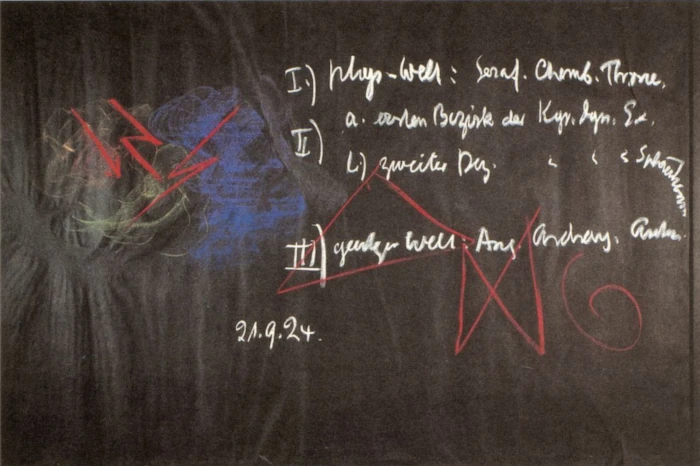
If you imagine that this blackboard is a tapestry that is spread out everywhere and that it consists of sounds, colors and warmth, an initiate sees lightning flashes behind it. The real flashes of lightning that are sometimes visible simply break through this sensory tapestry from behind and from the spiritual world. Wherever lightning appears there is a radiating in of the spiritual world. And if we look at the way this lightning is dampened and toned down to an even display of colors in nature we have our colorful earth before us.
If we look up to the heavens and its stars, we have points that also appear to us out of the spirit, except that they are an enduring, living revelation of flashing lightning. However, an initiate looks upon all of this as the outer I manifestation of what is behind it. He tells himself: You should really see—and he does see it, as his soul becomes increasingly active—you should really see the red in a rose begin to spray out above and below as tiny flashes of lightning, and whereas the front part becomes dulled, the red in the rear interacts with the sphere of the Seraphim, and all sounds are linked with the sphere of the Cherubim, and everything that we touch I is connected with the sphere of the Thrones. When one sees nature around one in the physical world it is really all an illusion, for in reality it is the toned down work of the Seraphim, Cherubim and Thrones.
If we look out into the colorful world and at the way it appears,—it is only the evenly toned down lightning flashes and action of the Seraphim. People in ancient times used to speak about the Maya character of the sensory, physical world, but that was only because they didn't know that there are Seraphim, Cherubim and Thrones everywhere in it. Now let's go a little further on the path of initiation. Let's go to where the Apocalyptist emphasizes the opening of the seals. What is going on there? Here color and warmth separate off from the world and increasingly spiritual effects appear which become similar to the true shapes of the lightning-like things which form. Instead of the spiritual world breaking through the sensory tapestry in a zig zag way, we see more gentle lightning flashes, etc., behind it (drawing). We know that the beings who live in them are the servants of the Seraphim, Cherubim and Thrones. Something similar applies to sounds, warmth and barely perceptible touches.
Now just as the earthly, sensory tapestry fades away and such lightning-like and enclosed figures behind it form out of the astral fire and expand ever more, so the stars begin to shine down and their threads of light enable us to see what they are. Starry threads, starry radiations or lights mingle with things that work in an elemental way. Earthly and heavenly things become connected, and we realize that we are in a second world—that was the first one—, and we arrive at the first condition of the second world, where everything is still shining in a natural way, and where we have an inkling that there are beings behind it. At most we perceive elemental beings here, but we know that these beings are the agents of powerful, important and sublime beings; we get to the first precinct, as it were, of the Kyriotetes, Dynamis and Exusiai. They are still behind this, as it were, but they mingle with these beings. The real nature of the Kyriotetes, Dynamis and Exusiai is gradually revealed, the further we go on the path of initiation. This is connected with the emergence of the harmony of the spheres that resounds through the world. The Apocalyptist presents the individual sounds of this world harmony as trumpet sounds, although they really only combine into harmonies and melodies during the course of long periods of time, when time becomes a unity. So we have the pure life of the second hierarchy in the clear sounds of the trumpets, whereas the very powerful beings in the first hierarchy underlie actual sense experiences. This is a world in which one could say that all the sensory effects have become flowing, grand and majestic, so that they're not just located around the things and processes of the physical world, but they have become the expression of beings who work in and with the second hierarchy and through elemental beings. Then we eventually arrive at a third region where we no longer perceive anything natural, or any natural things that have been broken up into elemental things, for if we want to perceive something there we have to perceive it in a spiritual way.
We arrive at a region of the spiritual world which we have to describe as follows. When you went through what is like a dissolving and a reshaping of earthly sense perceptions, that are taken hold of by the expanding sense perception of the stars, you were able to see everything that is working in the universe in Kyriotetes, Exusiai and Dynamis as if it were in the last residues of sense perception—in such a way that these beings are as if inwardly bound to the real substantiality of the stars.
The starry world has become transformed into the beings of the hierarchies for us; instead of looking up to the stars' sensory semblance we live in the world of the hierarchies. Here the hierarchies are still saturated with what I would like to call sprayed and dissolved sensory knowledge. We now get to the third region where we no longer perceive earthly things in a sensory way and where we must perceive souls and supersensible things without sensory inclusions. We arrive in the actual spiritual world, and we become acquainted with its angels, archangels and Archai.
We get to know the spiritual aspects of these beings, and when we depict them in paintings and the like we should realize that they only have the sensory forms we give them because they are woven into the soul, spiritual elements and essences of the higher hierarchies. For instance, the wings we paint on them get their substantiality from the beings of the second hierarchy, and the shape and contents of their heads are derived from the first hierarchy. We should realize that we can only see what is within the third hierarchy of angels, archangels and Archai in a spiritual; way.
What. I'm telling you here is of very great historical importance, because you won't be able to read books that are basedon ancient ideas, and which deal with these spiritual worlds in an intimate way unless you are aware of the fact that when we investigate the spiritual world we perceive the lowest hierarchy in a spiritual way, as it were, whereas the higher hierarchies that we perceive still contain the ingredients of the sense world. This is why quite a few misunderstandings gradually arose when spiritual life became decadent, concerning the descriptions that are found in the ancient initiation wisdom.
We find that the more worldly initiates in the Middle Ages always describe the matter in such a way that the Seraphim, Cherubim and Thrones stand close to the earth, as the lowest hierarchy, and that one ascends through Dynamis, Kyriotetes and Exusiai to the angels, archangels and Principalities. If you look at illustrated books from the Middle Ages you will be confused about what you're seeing and you will ask yourself why the angels are sitting above the Seraphim. This came about because one no longer knew the exact details that are connected with these processes and one didn't imagine these things in a very organic way anymore. The error first arose during the Jews' Babylonian captivity in B.C. times when the whole doctrine became contaminated with Babylonian symbols through the contact of the Jews with the Babylonians, and this error in the order of precedence of the spiritual hierarchies was perpetuated by the Jewish cabala in the Middle Ages.
However, one must be familiar with such matters if one wants to understand the development of ideas about spiritual things in the course of human evolution, and this is the right place in our clarification of the Apocalypse to discuss these things. So we get out to the spiritual world, and the first beings we meet there are those in the third hierarchy. The Apocalyptist shows how well acquainted he is with all of these things whenever he describes something now, because he increasingly tries to let angels appear, and they carry the events. The phenomenal thing is that earth regions can reflect something that angels bring in as the messengers of higher hierarchies; and namely these angel appearances bring us into a region where we see that divine love is the real ingredient of the world to which we human beings belong. For we become aware that the as it were normal angels, archangels and Archai are r something like the embodiments of higher hierarchies, just as we look at|_ the hands, arms, feet, legs and the rest of a person's body and we have the feeling that this is a body for the soul and spirit.
Thus as one ascends into the world of the third hierarchy one gets the impression: these are angels, but they are like the limbs of higher, divine spirits. They are really the soul, spiritual corporeality of higher divine spirits. So that one feels that one is in a pure spirituality and in God's corporeality at the same time. That is something to which one ascends; one has to occupy oneself with such an idea, and that is something which anyone who really wants to get to know the occultism that underlies spiritual life must do.
If you look at a human being on earth in his physical body, one cannot really think of this body's structure in terms of mere growth or in terms of the shooting and sprouting that goes on in it. You must add some degradative processes to the organism, that lead to excretions. They represent degradation and they show that the physical body is in a continual process of destruction which, however, is destined to absorb spiritual things, since it is degradation at the physical level; so that the spirit can then live in the physical, degradative processes. We know that spiritual things don't live in a human organism's anabolic processes. Spiritual things are suppressed and not promoted when man grows and when physical processes are becoming more active. Materialists are very silly when they say that man only has to purify the shooting and sprouting life in his brain, and that a continuation of biological processes becomes refined and transformed there—and that this amounts to thinking. If the brain would only be a continuation of digestive processes it would have dull, vegetative inner experiences. Spiritual things only enter the brain because it is continuously punctured by physical processes, as it were, so that it decomposes and falls apart. Spiritual things intervene in physical things in a creative way via degradation. The physical body absorbs degradative processes. We see that an inhibition and a holding back is built into the growth.
It is extremely interesting to take a look at the details of this phenomenon with one's spiritual perception. For instance, when Fichte's individuality descends into its physical body in that tiny village one sees how the boy grows. One sees that hindrances which are slightly greater than normal are mixed into his growth a little at a time; it's really very little, but it's there. So this little boy Fichte gets bigger and bigger, but he could have grown faster if something wasn't continuously holding back his growth very slightly. Fichte's particular philosophical talent was connected with this inhibition of his growth; he remained small throughout his lifetime. Here the spiritual becomes active within the physical so that one has to look upon degradation in a sympathetic way and not just in an antipathetic one. One can comfort oneself about degradation in a loving way, for hindrances to growing, sprouting life must exist.
When one realizes that the world of angels, archangels and Archai is really the corporeality of the divine spirit, and when one sees the weaving and moving and working of the angels, archangels and Archai and when one sees how individual soul lives are taken care of by their angel, groups of men by an archangel, and how streams of world events are pushed on from age to age by Archai, if one takes this whole weaving of this wonderful garment that is woven there, which is so nicely described in the Proserpina saga—, if one takes this whole garment of the world, one sees that divine love flows in it like the red blood in our bodies, and that this is necessarily accompanied by a stream of divine wrath. The latter is always formed from hindrances to world events by beings who feel things in a really moral way and who must first harmonize their moral characteristics with the course of world events.
We see the sprouting and shooting of the divine corporeality in divine love, as it were, and through its connection with the weak creatures which nevertheless characterize the ways that the gods want to direct the world we see that this spiritual body is permeated by something which is like the secretory products in man's physical body. Something like human glandular secretions become exuded here; the secretory centers appear as the divine vials of wrath which are woven into the course of world events.
We see the connection between divine love and divine wrath within these three worlds, and this gives rise to the idea, which must be accompanied by inner reverence; What happens when the vials of wrath are poured out? Here divine spiritual beings are stimulated by the misdeeds of weak creatures, and they think of how they can keep world events going and of how they can transform the hindrances into a vehicle for spirit-filled events that are pressing forwards, just as a man can make soul and spiritual progress in his body through the degradative processes that occur in it, so that he doesn't just vegetate. The Apocalyptist imagines all of this in accordance with the paths of initiation. As we saw yesterday and also earlier, the Apocalypse acquaints us with concrete physical things that are happening in the world, and it also makes us familiar with the path of initiation in a marvelous way.
If one looks at the Apocalypse in this way it firstly enables us to get an insight into the course of world events, so that we're looking into things in the future that we need and which we can add to our ideas, and it also becomes a meditation book, and it can be used as a meditation book in a wonderful way; it is really marvelous in this respect. If you come to a place in the Apocalypse that seems to be paradoxical or difficult to understand, stop thinking about it and start to meditate on it; for it is always accompanied by a passage where you can become spiritual, as you inwardly absorb and elaborate what you can't grasp intellectually anymore.
For instance, if one runs into a passage that refers to a bad gland, then of course intellectual types will say that glands can only be in men and animals, so what is that supposed to mean, it must be a poetic image—and they race on; but they're wrong about this. The Apocalyptist uses the word gland because he knows that it's just as justified to think of this real thing in the microcosm, as it is to think about the corresponding thing in the macrocosm. You begin to realize that the introduction of such a glandular thing that has to do with secretions leads over to the functions of divine wrath. Thus seemingly paradoxical things in the Apocalypse enable one to pass over from a merely intellectual course of the soul life, which is so common today, to a spiritual one.
Here we come to a point where it is very necessary to see things clearly and accurately, especially for priestly activity. People feel that our age intellectualizes souls completely, and that's why they react, and they long for hearty feelings in all fields. Just look at how religious confessions are resisting the widespread intellectualism; they don't want salvational truths to be preached in intellectual forms anymore; they want them to be shaped out of feelings and irrational things. No doubt this longing is partly justified, but one is in danger of losing the religious element altogether if one only wants to feel religious contents.
Priests should note the strange course which pedagogy has taken. Pedagogy proceeded from the life of instincts, and it was most effective when one did things instinctively, so that one didn't think in a pedagogical way at all. People were not really pedagogically active in ancient times, they just followed their instincts. Teachers only began to talk a lot about pedagogy after they had forgotten how to teach in an instinctive way. All our talk about it proves that we are the worst teachers in the whole of evolution. People begin to talk a lot about something when they don't know much about it anymore. Like one began to talk about transubstantiation when one no longer knew its secret. Whenever one notices predominantly intellectual contents of discussion in a particular age one has to ask: what are these people lacking? At the time when there was a lot of discussion about the labor question, all that this really meant was that they knew very little about it. Of course this applies to an even greater extent to the time when the printing press replaced writing. That was a time when people gradually lost their understanding for the divine script that speaks out of the sun, wind and stars.
It was not at all necessary to write things down at the time when the knights around King Arthur's table could still read the script which arose from the spouting ocean, the waves that sprayed up against the rocks along the shore, and the mingling of spraying billows with air currents that were saturated with light. Thus one basically has to deduce the dying out of spiritual and invisible things from the luster of visible things, and on the other hand one has to perceive how sensory, physical outer symbolism died down during the time when spiritual things became particularly prominent.
This is what makes us realize that we shouldn't react to intellectualism by denying it or by developing a dark, nebulous feeling life, but we should sublimate this feeling life by letting intellectual things run into a metamorphosis of the spiritual life more and more. Then we will find that we can ennoble our feeling life with the spiritual content of revelations that are really objective and no longer subjective.
Siebzehnter Vortrag
[ 1 ] Meine lieben Freunde! Außer dem, was wir als Inhaltliches der Apokalypse besprochen haben, ist ja die Apokalypse, so wie sie vor uns steht, auch ein Einweihungsbuch, und zwar durch die Art und Weise, wie sie die Evolution in der Zeit schildert, die aufeinanderfolgenden Stadien, die eben erlebbar sein werden für diejenigen, die Ohren haben zu hören und Augen haben zu sehen, während sie natürlich vorübergehen werden an den ohren- und augenlosen Menschen. Diese verschiedenen Stadien werden uns durch das innere Wesen der Sache so vorgeführt, daß wir die Apokalypse durchaus als Einweihungsbuch ansehen können. Wir müssen uns ja klar sein darüber, daß beim erkennenden Hineingehen in die Welt — das immer mehr ein Anschauen werden wird — dasjenige verschwindet, was wir zunächst als den Inhalt des Seelenlebens haben und was im wesentlichen eine Art Spiegelbild der äußeren Natur ist. Also die physisch-sinnliche Welt verschwindet beim erkennenden Voranschreiten und allmählich tritt wie aus dem Hintergrund von der anderen Seite her die geistige Welt hervor. Von dieser Art, sich zur geistigen Welt in ein Verhältnis zu setzen, hat nun der Apokalyptiker, wie er deutlich zeigt, eine ganz intensive, richtige Vorstellung, und das hat es ihm möglich gemacht, so sachgemäß die Dinge zu finden in seinen imaginativen Visionen, wie er sie gefunden hat. Denn, meine lieben Freunde, es ist einfach richtig, daß man auf zwei Wegen zur Anschauung der Welt kommen kann. Der eine Weg ist derjenige, wenn man sich einfach im Sinnlich-Physischen ergeht, es nach allen Seiten kennenlernt mit gewisser liebevoller Hingabe an das Sinnlich-Physische. Dann lernt man es immer mehr als das Werk der Götter kennen. Man hat dasjenige vor sich, was man im weitesten Umfange die Natur nennt, wenn man die Natur nicht bloß äußerlich-mechanisch, sondern auch innerlich-geistig betrachtet. Aber man könnte sich vorstellen — und es ist durchaus eine richtige Vorstellung -, daß man denselben Weltinhalt auch auf eine rein geistige Weise, von innen heraus durch die eigene Seele erhält. So daß man durchaus soweit gehen kann, davon zu sprechen, daß derjenige, der genügend innere Kraft hat, sehen kann — auch wenn er gar nichts von historischen Nachrichten hat —, daß an einer bestimmten Stelle des Weltgeschehens irgend etwas geschehen ist, das selbst in einer Naturerscheinung besteht. Man kann durchaus davon sprechen, daß man von innen heraus zu dieser Erkenntnis kommen kann: In irgendeinem Jahre, wo sich für die Menschheit etwas abgespielt hat, haben Erdbeben und so weiter stattgefunden. Diese Empfindung - die ja viele Menschen leise oder laut haben -, daß der Mensch von innen heraus die Welt wirklich in ihren konkreten Einzelheiten kennenlernen kann, ist eine durchaus richtige Empfindung. Nun handelt es sich darum, was eigentlich vorliegt, wenn der Mensch auf diesem Wege der Imagination in die geistige Welt hineinkommt.
[ 2 ] Wir können das, um was es sich dabei handelt, durchaus im Zusammenhang mit der Apokalypse erörtern, denn in der Apokalypse treten uns die aufeinanderfolgenden verschiedenen Etappen entgegen, in denen der Apokalyptiker etwas sieht, was immer mehr und mehr in die geistige Welt hineinführt. So führt er zunächst vor die Briefe, dann die Siegel, geht dann über zu demjenigen, was sich in der Menschensprache nur ausdrücken läßt durch Hörbares, also zu den Posaunen, und geht dann über zu dem, was ich Ihnen vorgestern charakterisiert habe als die göttliche Liebe, deren Widerpart der göttliche Zorn ist. Wenn wir den Apokalyptiker recht verstehen, so will er sagen: Soweit er dasjenige, was Inhalt der Apokalypse ist, durch Briefe gibt, die ihm inspiriert sind, bezieht sich dieser Inhalt auf die physische Welt; in dem Augenblicke, wo er übergeht zu den Siegeln und die Siegel eröffnet, bezieht sich das, was er mit diesen Siegeln zu sagen hat, auf die astralische, die imaginative Welt, auf das, was man die Seelenwelt nennen kann; wo er übergeht zu den Posaunenklängen, kommen wir in das Geisterland hinein, und indem wir erleben göttliche Liebe und göttlichen Zorn, dem Inhalt der ApokaIypse gemäß, kommen wir in das eigentliche Innere des Geisterlandes hinein. Man muß nur bedenken, daß, während der Mensch diesen imaginativen Weg durchmacht, er ja mit seinem Erleben im Grunde genommen in der Welt drinnensteht, so daß sein Erleben Welterleben ist. Das bemerkt er nur nicht in den Anfangsstadien. Im Verlaufe des Initiiertwerdens erfährt er es immer mehr, daß alles, was an ihm, durch ihn, mit ihm, in ihm geschieht, zu gleicher Zeit Weltgeschehen ist. Er fühlt sich immer mehr und mehr hinausgegossen in den objektiven Weltinhalt. Das läßt der Apokalyptiker sehr deutlich durchblicken. So daß wir also schon sagen können: Der Inhalt der Briefe bezieht sich auf die physische Welt.
[ 3 ] Nehmen wir die physische Welt so, wie sie uns zunächst entgegentritt. Diese physische Welt ist ja nur scheinbar das, als was sie uns entgegentritt. Denn diese physische Welt würde uns nicht die Mannigfaltigkeit ihrer Farbennuancen, ihrer Wärmenuancen und alles desjenigen, was von allen Seiten der Weltumgebung auf den Menschen einfließt, so darbieten, wenn wir bei all dem, wie die Welt uns jetzt in diesem gegenwärtigen Zeitalter erscheint, nur an den physischen Inhalt denken und dabei eben übersehen würden, daß dasjenige, was uns physisch erscheint, eigentlich geistig ist. Wenn wir uns in die Seele einer solchen Menschenwesenheit versetzen, wie der Apokalyptiker ist, müssen wir uns, ich möchte sagen, die Seelensprache einer solchen Menschenwesenheit aneignen, und diese Seelensprache muß uns für unseren eigenen persönlichen spirituellen Gebrauch so zu eigen werden, daß man mit einem trivialen Ausdruck sagen kann: sie muß uns in Fleisch und Blut übergehen.
[ 4 ] So möchte ich Ihnen solche Teile der inneren Seelensprache eines Initiierten geben, die er exoterisch nach außen nicht immer gebraucht, die aber eigentlich sein Mittel ist, um seine Vorstellungen, sein besonderes Miterleben der geistigen Welt innerlich zu formen. Da ist zum Beispiel dieses: Dämpfe den Blitz und du begreifst die Farbe. - Das ist Initiiertensprache. Was heißt das? Der Initiierte sieht den Blitz in seiner Erscheinung, er sieht dieses aus dem Weltall herauskommende Aufflammen, er betrachtet es als das Aufglimmen des Geistes innerhalb des Weltenraumes, und er denkt diesen Blitz abgedämpft und immer abgedämpfter, also immer milder und milder, und bekommt die Abdämpfung, die milde Ausgestaltung des Farbigen; der Blitz verbreitet sich gewissermaßen und wird zur farbigen Fläche. Das ist die Vorstellung eines Initiierten. Oder der Initiierte sagt: Lasse den Donner leiser werden, immer leiser und leiser und höre sein Modulieren, und das Musikalische ersteht. - Und so sieht der Initiierte dasjenige, was sich gewissermaßen als Sinnenteppich ausbreitet, als die Offenbarung nach der einen Seite hin, und es ist für ihn eine durchaus reale Vorstellung, wenn man so denkt: Man hat den Weltinhalt in seiner kolorierten Mannigfaltigkeit - das, was ich aufzeichne (Tafel 12, links), könnte ebensogut wie es Farbe ist, auch Tönendes sein —, und wie der Weltinhalt an unsere Sinne herantritt, das ist wie der sinnlich-physische Schleier, der sich ausbreitet als unsere Wahrnehmungswelt, in die wir zunächst unsere abstrakten, scheinhaften Gedanken verweben. Hinter alldem sieht der Initiierte — also wenn Sie sich die Tafel (Tafel 12, ganz links) als den Teppich vorstellen, der überall ausgebreitet ist, es ist das, was in der Welt das Tonliche, das Farbige, das Wärmige ist —, hinter diesem Teppich sieht der Initiierte die einfallenden Blitze. Die sind dahinter, und dasjenige, was man ab und zu als wirklichen Blitz sieht, bricht einfach durch diesen Sinnenteppich von rückwärts aus der geistigen Welt durch. In jeder Erscheinung des Blitzes ist ein Hereinstrahlen der geistigen Welt. Und schauen wir uns diesen Blitz an, wie er gemildert und gedämpft ist zum gleichmäßig Farbigen auf der Erde, so haben wir eben die Erde in ihrem Farbenkolorit vor uns.
[ 5 ] Schauen wir zum Himmel und nach den Sternen, so haben wir in den Sternen Punkte, die uns ebenfalls erscheinen wie aus dem Geistigen herauskommend, nur in dauernd lebender Offenbarung des Blitzenden. Aber in alldem sieht ja der Initiierte die äußere Offenbarung desjenigen, was dahinter ist, und er sagt sich: Eigentlich mußt du sehen — und er sieht es auch, wenn seine Seele immer aktiver und aktiver wird - die rote Rose. Sie beginnt ihr Rot nach oben und unten wie in leisen Blitzen zu verspritzen, und während das Vordere sich abstumpft, greift nach rückwärts das Rot ein in die Sphäre der Seraphim, ebenso wie alles Tonliche eingreift in die Sphäre der Cherubim, und wie alles, was wir tasten, eingreift in die Sphäre der Throne. Und wenn man die Natur um sich sieht, hat man eigentlich in der physischen Welt alles als Illusion vor sich, denn in Wahrheit sind es die abgedämpften Werke der Seraphim, Cherubim und Throne. Schauen wir, meine lieben Freunde, in die farbige Welt, so wie sie erscheint, so ist sie nur die gleichmäßig abgetönte Blitzwirkung der Seraphim. Das ist eigentlich dasjenige, was in uralten Zeiten der Maja-Charakter der sinnlich-physischen Welt genannt worden ist, daß man nicht weiß, daß da in Wirklichkeit überall Seraphim, Cherubim, Throne da sind.
[ 6 ] Nun gehen wir etwas weiter in der Initiation. Gehen wir über zu dem, wo der Apokalyptiker den Hauptwert auf das SiegelEröffnen legt. Ja, was geschieht denn da? Da löst sich ab das Farbige der Welt, das Wärmeartige löst sich ab, und immer mehr und mehr treten Wirkungen auf, die geistig sind und die schon ähnlich werden den wahren Gestalten des Blitzartigen, die sich formen. Statt das Zickzack-Hervorbrechen der Blitze zu sehen, sehen wir beim Durchbrechen durch den Sinnesteppich dasjenige, was dahinter ist als geistige Welt; wir sehen dahinter sanftverlaufende Blitze. Wir wissen, daß darin zunächst diejenigen Wesen leben, die die Diener sind der Seraphim, der Cherubim und der Throne. Ähnlich ist es mit dem Tonlichen, ähnlich ist es mit dem Wärmehaften, ähnlich ist es mit dem Faßbaren, Tastbaren. Und so, wie dasjenige verlöscht, was ja zunächst uns als der irdische Sinnenteppich erscheint und dahinter diese Welt von solchen blitzartigen Gebilden erscheint und solche in sich geschlossene Figuren aus dem Astralfeuer bildet und sich immer mehr und mehr erweitert, in demselben Maße beginnen die Sterne herunterzustrahlen; so daß wir so wie Fäden des Lichtes dasjenige verfolgen, was sie sind, und es mischen sich in die Dinge, die elementar wirken, Sternenfäden, Sternenstrahlungen, Lichter hinein. Es ver
[ 7 ] bindet sich das Irdische mit dem Himmlischen, und wir wissen, wir kommen in den ersten Zustand der zweiten Welt hinein, wo alles noch naturhaft leuchtend ist, wo wir nur ahnen, daß dahinter Wesenheiten sind. Wir gewahren höchstens Elementarwesenhaftes, aber wir sehen in diesen Elementarwesenheiten gewissermaßen die Wirkungsorgane von starken, bedeutsamen, erhabenen Wesenheiten. Wir kommen sozusagen in den ersten Bezirk der Kyriotetes, Dynameis, Exusiai. Die sind gleichsam noch dahinter, aber sie treten herein in diese Wesenheiten, und wir kommen, indem wir weiter auf dem Initiationswege kommen, allmählich dazu, daß diese Wesen Kyriotetes, Dynameis, Exusiai sich allmählich immer mehr in ihrer eigenen Wesenheit enthüllen. Das ist verknüpft damit, daß die weltentönende Sphärenharmonie hereintritt, aber die einzelnen Töne dieser Weltenharmonie, die jetzt erklingen und die sich eigentlich nur in großen Zeiträumen zu Harmonien und zu Melodien zusammensetzen, die sich auch in der Zeit nur zu Harmonien bilden, wenn die Zeit eine Einheit wird, die führt der Apokalyptiker als Posaunenklänge an, so daß wir in den Tönen der Posaunen das reine Leben der zweiten Hierarchie haben, während die erste Hierarchie in ganz großer Mächtigkeit dem eigentlichen Sinnenerleben zugrundeliegt.
[ 8 ] Und weiter gelangen wir dazu, aus dieser Welt, in der, ich möchte sagen, alle Sinneswirkungen flutend und grandios und majestätisch geworden sind und damit sich nicht nur über die Dinge und Vorgänge der physischen Welt hinlagern, sondern der eigentliche Ausdruck des Wesenhaften sind, das in der zweiten Hierarchie in den Elementarwesen wirkt —, wir gelangen immer mehr dazu, aus dieser Welt in eine dritte Region hineinzukommen, wo wir gar nichts Naturhaftes mehr, auch nicht in Elementarisches aufgelöstes Naturhaftes mehr wahrnehmen, sondern wo wir alles, was wir wahrnehmen wollen, geistig wahrnehmen müssen. Wir kommen hinein in einen Bezirk der geistigen Welt, von dem wir in der folgenden Weise sprechen müssen; wir müssen uns sagen: Indem wir dasjenige durchgemacht haben, was wie die sich auflösenden, aber zu gleicher Zeit in Formen sich gestaltenden Sinneswahrnehmungen der Erde ist, die ergriffen werden von der sich erweiternden Sinneswahrnehmung der Sterne, sind wir dazu gelangt, wie in letzten Residuen der Sinneswahrnehmung alles, was in Kyriotetes, Exusiai, Dynameis im Weltenall wirkt, so zu erkennen, daß diese Wesenheiten wie innerlich gebunden sind an die wahre Substantialität der Sterne. Die Sternenwelt hat sich uns in die Wesenheiten der Hierarchien verwandelt, Wir leben, statt daß wir im Sinnenscheine aufblicken zu den Sternen, in der Welt der Hierarchien. Da sind die Hierarchien noch durchtränkt mit dem, was ich nennen möchte verspritzte und aufgelöste Sinneserkenntnis. Jetzt gelangen wir in den dritten Bezirk, wo wir nicht mehr sinnlich alles Irdische wahrnehmen, wo wir das SeelischÜbersinnliche wahrnehmen müssen ohne den Einschlag des Sinnlichen; wir gelangen in den Bezirk der eigentlichen geistigen Welt und lernen sie zuerst kennen in Angeloi, Archangeloi, Archai. Diese Wesenheiten kann man in ihrer Geistigkeit erkennen, und man muß wissen, wenn man ihnen als Maler und dergleichen Gestalt gibt, daß sie diese sinnliche Gestalt nur dadurch haben, daß sie in die seelisch-geistigen Elemente eingewoben sind, in die Wesenheit der höheren Hierarchien. Wir müssen wissen, wenn wir ihnen zum Beispiel Flügel malen, daß diese Flügel von den Wesenheiten der zweiten Hierarchie sind, die ihnen ihre Substantialität leihen, daß sie aber ein Haupt von der ersten Hierarchie erhalten, die ihnen diese Gestaltung und deren Inhalt leihen. Wir müssen uns nur durchaus bewußt sein, daß wir das, was innerhalb der dritten Hierarchie ist - Angeloi, Archangeloi, Archai -, nur im Geiste erblicken können.
[ 9 ] Das, was ich jetzt auseinandersetze, meine lieben Freunde, hat eine ungeheuer große historische Bedeutung, weil Sie, wenn Sie Schriften aus alter Zeit übernehmen, die sozusagen intim von diesen geistigen Welten handeln, diese überhaupt nicht lesen können, ohne sich des Umstandes bewußt zu sein, daß durch das Hineinleben in die geistige Welt wir zunächst gewissermaßen die niedrigste Hierarchie auf geistige Art wahrnehmen, während wir die höheren Hierarchien noch mit den Ingredienzien der Sinneswelt wahrnehmen. Und Sie müssen sich bewußt sein, daß die alte Initiationsweisheit, die das durchaus ganz richtig so geschildert hat, wie ich es jetzt schildere, allmählich in den Zeiten der Dekadenz des Spirituellen in allerlei Mißverständnisse hineingekommen ist. So finden wir bei den mehr weltlich gearteten Initiierten des Mittelalters die Sache immer so geschildert, daß der Erde nahestehen als die niedrigsten Hierarchien die Seraphim, Cherubim, Throne, und daß man aufsteigt durch Dynameis, Kyriotetes, Exusiai zu den Engeln, Erzengeln und Urkräften. Sehen Sie sich nur einmal mittelalterliche Bücher an, die illustriert sind, so werden Sie sich nicht auskennen und werden fragen, warum die Engel über den Seraphim sitzen. Das ist, weil man diese Vorgänge nicht mehr genau intim kannte und nicht mehr ganz organisch sich vorstellte. Der Irrtum entstand namentlich, als die ursprünglich ganz reine Lehre schon während der Zeit der jüdisch-babylonischen Gefangenschaft in der vorchristlichen Zeit durch die Berührung der Juden mit den Babyloniern sich verunreinigt hat an den Symbolen der Babylonier, und durch die Kabbala, durch die mittelalterliche jüdische Mystik, hat dieser Irrtum von der Rangordnung der geistigen Hierarchien sich weiter ausgebreitet. Wenn man überhaupt die Entwickelung der Vorstellungen über das Geistige im menschlichen Entwickelungsgang verstehen will, muß man mit solchen Sachen bekannt sein, und es ist hier der richtige Ort, im Zusammenhang mit dem Verständlichmachen der ApokaIypse diese Dinge zu besprechen.
[ 10 ] So kommen wir hinaus in die geistige Welt. Die ersten Wesenheiten, die uns im wirklich Geistigen entgegentreten, sind eigentlich die der dritten Hierarchie. Der Apokalyptiker zeigt, wie er intim vertraut ist mit alledem, denn immer mehr ist sein Bestreben ein solches, daß er für alles, was er nun schildert, Engel erscheinen läßt, die die Erscheinungen tragen. Das ganz Phänomenale ist, daß Erdgebiete etwas widerspiegeln können, was die Engel als Boten der höheren Hierarchien hereintragen, und namentlich kommen wir mit diesem Engelerscheinen hinein in das Gebiet, wo wir wirklich erblicken, wie da durchaus die göttliche Liebe waltet als die eigentliche Ingredienz der Welt, zu der wir Menschen gehören. Denn zunächst gewahren wir, wie die gewissermaßen normalen Angeloi, Archangeloi, Archai etwas sind wie die Verleiblichung der höheren Hierarchien. So wie wir, wenn wir Hände, Arme, Füße, Beine und den übrigen Leib des Menschen anschauen, die Empfindung haben: Das ist der Leib des Seelisch-Geistigen —, so bekommt man, indem man aufsteigt in die Welt der dritten Hierarchie, den Eindruck: Das sind Engel, aber sie sind wie Glieder, eigentlich wie die Leiblichkeit der höheren göttlichen Geister; sie sind geistig-seelische Leiblichkeit. So daß man empfindet, meine lieben Freunde, man ist in reiner Geistigkeit, aber mit dieser Geistigkeit in der Leiblichkeit Gottes. Das ist das, zu dem man aufsteigt.
[ 11 ] Und nun muß man sich mit einer solchen Vorstellung befassen. Das ist etwas, was jeder tun muß, der wirklich den Okkultismus kennenlernen will, wie er dem Geistesleben zugrundeliegt. Sehen Sie sich einen Menschen auf Erden an in seiner physischen Leiblichkeit, meine lieben Freunde, und Sie werden sich unmöglich die Organisation denken können im bloßen Aufbau, also bloß in dem, was im Menschen als Sprossendes, Sprießendes im Aufbau vor sich geht. Sie müssen sich vielmehr Abbauprozesse in den Organismus hineindenken, die zu Aussonderungen führen. Dieser Abbau, der die Leiblichkeit in einem fortwährenden Zerstörungsprozeß zeigt, ist aber dazu bestimmt — weil er Abbau im Physischen ist -, das Geistige aufzunehmen, so daß der Geist dann in den physischen Abbauprozessen leben kann. Es lebt ja im menschlichen Organismus das Geistige nicht in den Aufbauprozessen. Wenn der Mensch wächst, wenn die physischen Vorgänge, die physischen Prozesse im Steigen sind, wird das Geistige unterdrückt, nicht gefördert. Es ist eine ganz alberne Vorstellung der Materialisten, daß sie denken, der Mensch brauche in seinem Gehirn nur das sprießende, sprossende Leben zu läutern, und die Fortsetzung der Lebensvorgänge verfeinere, verwandle sich da, und das bedeute Denken. Das Gehirn, wo es bloße Fortsetzung der Verdauungsvorgänge darstellen würde, würde nur dumpfes, pflanzenhaftes inneres Erleben haben. Nur indem abgebaut wird, indem das Gehirn fortwährend zerfällt, sozusagen durchlöchert wird von den physischen Vorgängen, tritt das Geistige in das Gehirn ein. Das Geistige findet eben auf dem Wege des Abbaues seine Bahn, um schaffend in das Physische einzugreifen. Und es werden die Abbauprozesse nun aufgenommen vom Physischen. Wir sehen, daß in das Wachstum ein Zurückhalten, ein Hemmen des Wachstums hineingebaut wird.
[ 12 ] Es ist, ich möchte sagen, eine unglaublich interessante Erscheinung, das im einzelnen zu beobachten. Wenn man zum Beispiel den geistigen Blick hinwendet auf eine solche Erscheinung wie diese, so kann man sehen, wie da in einem elenden Dorfe heruntersteigt die Fichtesche Individualität in den irdischen Leib, wie sie sich hineinverkörpert in den physischen Leib, man sieht da, wie der Knabe heranwächst, man sieht, wie sich Stück für Stück in sein Wachstum hineinmischen Hemmungen des Wachstums, etwas zu stark gegenüber dem Normalen; es ist nicht viel, es ist außerordentlich wenig, aber es ist so. Da wächst dieser Knabe Fichte heran, wird immer größer und größer, aber er könnte schneller wachsen, wenn nicht fortwährend etwas ganz Winziges dieses Wachstum zurückhielte. In diesem Zurückhalten des Wachstums Fichtes — bei ihm war es so, daß er auf Lebenszeit klein blieb -—, da entwickelte sich eben diese besondere Art seiner philosophischen Anlage. Da tritt das Geistige in Wirksamkeit innerhalb des Physischen. So daß man in dem Abbau etwas sehen muß, was einen nicht nur antipathisch berührt, sondern etwas, was einen sympathisch berührt, worüber man sich tröstet, etwas, was durchaus mit Liebe betrachtet werden kann, weil außer dem wachsenden, sprossenden Leben auch das da sein muß, was Hemmungen darstellt.
[ 13 ] Wenn man nun gewahr wird, wie diese Angeloi-, Archangeloi-, Archai-Welt eigentlich die Leiblichkeit des göttlichen Geistes ist und man da dieses Weben und Leben und Treiben und Tun und Arbeiten von Angeloi, Archangeloi und Archai schaut, wie da die Welt gewoben wird, wie der einzelne Mensch versorgt wird in seinem Seelischen von seinem Angelos, wie verschiedene Menschengruppen von den Archangeloi und Weltenströme des Geschehens von Zeitalter zu Zeitalter weitergeschoben werden durch die Archai, wenn man dieses ganze Weben dieses wunderbaren Gewandes, das da gewoben wird - das so schön ausgedrückt ist in der Proserpina-Sage, der Persephone-Sage Griechenlands —, wenn man dieses ganze Gewand der Welt nimmt, dann flutet darinnen wie das rote Blut im Körper die göttliche Liebe. Aber es gestaltet sich als notwendige Beigabe die Strömung des göttlichen Zornes, der sich immer aus alle dem bildet, was Hemmungen im Weltgeschehen sind, bewirkt durch wirklich moralisch empfindende Wesenheiten, die sich erst mit ihrem Moralischen mit dem Weltengange in Einklang setzen müssen, und wir sehen gewissermaßen in der göttlichen Liebe die göttliche Leiblichkeit in ihrem Sprießen und Sprossen, wir sehen in dem Zusammenhang mit den schwachen Geschöpfen, die aber doch die Wege kennzeichnen, in denen die Götter die Welt leiten wollen, wir sehen in dem, was von schwachen Geschöpfen ausgeht: Diesen Geistleib des göttlichen Geistes durchsetzt etwas wie die Absonderungsprodukte im menschlichen physischen Leibe; dasjenige, was sich im Menschen absondert in Drüsen, sondert sich da ab. Es erscheinen die Absonderungszentren wie die göttlichen Zornesschalen, die eingewoben sind in den Weltengang. Wir erkennen den Zusammenhang gerade innerhalb dieser drei Welten zwischen göttlicher Liebe und görttlichem Zorn, und wir bekommen innerlich die Ehrfurcht gebietende Vorstellung: Ja, was geschieht denn, indem die Zornesschalen sich ausgießen? Da denken die göttlich-geistigen Wesenheiten, wie sie unter den angeregten Untaten der schwachen Geschöpfe, wie sie gegen die Hemmungen den fortlaufenden Weltengang weiterbringen, und wie sie diese Hemmungen umformen in Vehikel des vorwärtsdringenden, geist-erfüllten Geschehens, damit der Mensch in seinem Abbauwesen die Möglichkeit ergreift, nicht bloß physisch vegetierend, sondern geistig-seelisch im Leibe vorzudringen. Das alles stellt der Apokalyptiker ganz den Wegen der Initiation gemäß vor. Es ist ein großartiges Hineinleben in den Weltengang durch die Apokalypse, bis in die konkreten physischen Ereignisse hinein, wie wir gestern und schon vorher gesehen haben. Es ist zu gleicher Zeit ein grandioses Hineinleben in die Wege der Einweihung, der Initiation.
[ 14 ] Wenn man so die Apokalypse betrachtet, dann wird sie erst etwas, was uns in gewisser Beziehung sehend macht für den Weltengang, so daß wir hineinschauen in dasjenige, was wir von der Zukunft brauchen und es in unsere Vorstellungen aufnehmen können. Sie wird aber weiter auch ein Meditationsbuch; sie ist in einer wunderbaren Weise als Meditationsbuch zu gebrauchen, sie ist in dieser Beziehung ganz großartig. Wenn Sie in der Apokalypse an eine Stelle kommen, die Ihnen zunächst für das Vorstellen, für das Erfassen etwas Paradoxes bietet, so hören Sie ja auf zu denken und beginnen Sie zu meditieren, denn das ist immer auch eine Stelle, wo Sie spiritueller werden können, indem Sie das, was Sie intellektuell nicht mehr erfassen können, innerlich aufnehmen und verarbeiten. Wenn also zum Beispiel ein Satz auftritt, wo vom Erscheinen einer bösen Drüse die Rede ist (Apk. 16, 2), dann sagt natürlich der Intellektualist: Drüsen können nur bei Menschen und Tieren sein. Was soll das? Das ist so ein poetisches Bild. - Man geht rasch darüber hinweg. Aber es ist nicht so. Der Apokalyptiker gebraucht das Wort Drüse, weil er weiß, daß das Reale im Mikrokosmos auch die Berechtigung hat, vorgestellt zu werden im Makrokosmos. Sie werden schon darauf kommen, wie das Drüsenhafte, das mit den Absonderungen zu tun hat, hinüberführt zu den Funktionen des göttlichen Zornes. So führen gerade die scheinbaren Paradoxa der Apokalypse dazu, das, was der heutige Mensch ja so gewöhnt ist, das bloß intellektuelle Verlaufen seines Seelenlebens, übergehen zu lassen in spirituelles Verlaufen.
[ 15 ] Und da kommen wir an den Punkt, wo es so notwendig ist, gerade bei priesterlichem Wirken, die Dinge klar und richtig zutreffend zu sehen. Die Menschen fühlen, daß das heutige Zeitalter die Seele ganz verintellektualisiert, deshalb bilden sich diese Reaktionen: sie möchten auch Gemüt und Gefühl haben, sie ersehnen es auf allen Gebieten. Sehen Sie nur, wie die religiösen Bekenntnisse aufmucken gegenüber dem allgemeinen Intellektualismus. Sie wollen nicht mehr in intellektuellen Formen die Heilswahrheiten gepredigt haben, sie wollen sie aus dem Gefühl, aus dem Irrationalen heraus gestaltet haben. Es liegt dem gewiß eine berechtigte Sehnsucht zugrunde, aber wenn es nur in diesen Bahnen verläuft, führt es eben doch dazu, mit dem bloßen Fühlenwollen des religiösen Inhaltes das Religiöse überhaupt zu verlieren.
[ 16 ] So ist es auch in der Pädagogik, die ja einen ganz merkwürdigen Gang durchgemacht hat, den die Priesterschaft wohl beachten sollte. Die Pädagogik ist ja von dem Instinktleben ausgegangen, sie hat am besten da gewirkt, wo man überhaupt nicht pädagogisch gedacht hat, sondern dasjenige gemacht hat, was der Instinkt eingegeben hat. Man hat in alter Zeit nicht Pädagogik getrieben, sondern gemacht, was der Instinkt eingegeben hat. Erst seit man das instinktive Erziehen verlernt hat, redet man viel von Pädagogik, und unser vieles Reden davon ist das Zeugnis, daß wir die schlechtesten Pädagogen der ganzen Entwickelung sind. Die Menschen fangen dann an, am meisten von einer Sache zu reden, wenn sie sie nicht mehr haben. So fing man auch an, über die Transsubstantiation zu reden, als man sie und ihr Geheimnis nicht mehr verstand. Wenn man die oft vorzüglichen intellektuellen Diskussionsinhalte einer Zeitströmung ins Auge fassen will, muß man bei dem, was sich da ausdrückt, fragen: Was fehlt eigentlichen diesen Menschen? In der Zeit, in der die Arbeiterfrage besonders stark diskutiert wurde, bedeutete diese Diskussion, daß man möglichst wenig von dieser Frage verstand in Wirklichkeit. Das geht natürlich viel weiter in der Zeit, in der in die Menschheit die Schrift gekommen ist und immer mehr ihr Gebrauch sich umgewandelt hat in den Druck. Es war das Zeitalter, in dem die Menschen immer weniger die göttliche Schrift verstanden, die aus Sternen, Sonne und Wind spricht.
[ 17 ] Als die Teilnehmer der alten Artusrunde noch lesen konnten im aufsprudelnden Meer, im an die Felsen des Landes heranspritzenden Wogengetriebe, im Vermischen desjenigen, was in den aufsprühenden Wogen sich verbindet mit den lichtgesättigten Luftwellen, in dieser Zeit, in der das alles abgelesen werden konnte wie eine deutliche Schrift, war nicht das geringste Bedürfnis da, irgendeine fixierbare Schrift zu Hilfe zu nehmen. Es ist im Grunde genommen so, daß man überall von dem Glanze des Sichtbaren auf das Abglimmen des Unsichtbaren, des Spirituellen schließen muß, um dann, wenn in der Zeit das Spirituelle besonders an die Oberfläche tritt, wahrzunehmen, wie die sinnlich-physische äußere Symbolik zurücktritt.
[ 18 ] Das ist es, was uns eben darauf aufmerksam macht, daß wir nicht mit einer Verleugnung des Intellektualismus reagieren sollen, mit einem dunklen, nebulosen Gemütsleben, sondern daß wir dieses Gemütsleben dadurch erhöhen, wenn wir das Intellektuelle immer mehr in die Metamorphose des Spirituellen einlaufen lassen. Dann werden wir finden, daß sich unser Gemütsleben mit dem Geistgehalt der Offenbarungen, die objektiv sind, nicht mehr subjektiv, wirklich veredeln kann.
Seventeenth Lecture
[ 1 ] My dear friends! In addition to what we have discussed as the content of the Apocalypse, the Apocalypse, as it stands before us, is also a book of initiation, namely through the way in which it describes evolution in time, the successive stages that will be experienced by those who have ears to hear and eyes to see, while they will naturally pass by those who have no ears or eyes. These different stages are presented to us through the inner essence of the matter in such a way that we can certainly regard the Apocalypse as a book of initiation. We must be clear that when we enter the world with recognition — which will increasingly become a way of seeing — that which we initially have as the content of our soul life, and which is essentially a kind of reflection of outer nature, disappears. Thus, the physical-sensory world disappears as we advance in our knowledge, and gradually the spiritual world emerges from the background on the other side. The apocalypticist, as he clearly shows, has a very intense and accurate idea of this way of relating to the spiritual world, and this has enabled him to find things in his imaginative visions as appropriately as he has found them. For, my dear friends, it is simply true that there are two ways of coming to a view of the world. One way is simply to indulge in the sensory-physical, to get to know it in all its aspects with a certain loving devotion to the sensory-physical. Then one comes to know it more and more as the work of the gods. One has before one what is called nature in the broadest sense, if one considers nature not only externally and mechanically, but also internally and spiritually. But one could imagine — and it is quite a correct idea — that one can also obtain the same world content in a purely spiritual way, from within, through one's own soul. So that one can go so far as to say that those who have sufficient inner strength can see — even if they have no knowledge of historical events — that something has happened at a certain point in world history that itself consists of a natural phenomenon. One can certainly say that one can come to this realization from within: In a certain year, when something happened for humanity, earthquakes and so on took place. This feeling — which many people have quietly or loudly — that human beings can really get to know the world in its concrete details from within is an entirely correct feeling. Now the question is what actually happens when human beings enter the spiritual world in this way through imagination.
[ 2 ] We can certainly discuss what this is all about in connection with the Apocalypse, for in the Apocalypse we encounter the successive stages in which the apocalyptic writer sees something that leads more and more into the spiritual world. So he first presents the letters, then the seals, then moves on to what can only be expressed in human language through audible sounds, that is, the trumpets, and then moves on to what I characterized to you the day before yesterday as divine love, whose counterpart is divine wrath. If we understand the apocalyptic writer correctly, he wants to say: Insofar as he conveys the content of the Apocalypse through letters that are inspired by him, this content refers to the physical world; at the moment when he moves on to the seals and opens them, what he has to say with these seals refers to the astral, the imaginative world, to what can be called the soul world; When he moves on to the sounds of the trumpets, we enter the spirit world, and as we experience divine love and divine wrath, according to the content of the Apocalypse, we enter the very heart of the spirit world. One must only consider that while the human being is going through this imaginative path, he is basically standing inside the world with his experience, so that his experience is world experience. He just does not notice this in the early stages. In the course of becoming initiated, they experience more and more that everything that happens to them, through them, with them, and in them is at the same time world events. They feel themselves more and more poured out into the objective content of the world. The apocalyptic writer makes this very clear. So we can already say that the content of the letters refers to the physical world.
[ 3 ] Let us take the physical world as it first appears to us. This physical world is only apparently what it appears to be. For this physical world would not present us with the diversity of its color nuances, its warmth nuances, and everything that flows into human beings from all sides of the world environment if, in all this, we only thought of the physical content as the world appears to us now in this present age, and in doing so overlooked the fact that what appears to us physically is actually spiritual. When we put ourselves in the soul of a human being such as the apocalypticist, we must, I would say, acquire the soul language of such a human being, and this soul language must become so much our own for our own personal spiritual use that, to use a trivial expression, it must become second nature to us.
[ 4 ] So I would like to give you those parts of the inner soul language of an initiate that he does not always use exoterically, but which is actually his means of forming his ideas, his special experience of the spiritual world, inwardly. Here is an example: Dim the lightning and you will understand color. This is the language of the initiated. What does it mean? The initiate sees the lightning in its appearance, he sees this flash coming out of the universe, he regards it as the glimmering of the spirit within the space of the world, and he thinks of this lightning as muted and increasingly muted, that is, increasingly milder and milder, and obtains the muting, the mild formation of color; the lightning spreads, so to speak, and becomes a colored surface. That is the idea of an initiate. Or the initiate says: Let the thunder become quieter, quieter and quieter, and hear its modulation, and the musical arises. - And so the initiate sees what spreads out, as it were, as a tapestry of meaning, as the revelation on one side, and it is a thoroughly real idea for him, if one thinks of it this way: One has the content of the world in its colored diversity — what I am recording (plate 12, left) could just as well be sound as it is color — and the way the content of the world approaches our senses is like the sensual-physical veil that spreads out as our world of perception, into which we first weave our abstract, illusory thoughts. Behind all this, the initiate sees — that is, if you imagine the plate (plate 12, far left) as the carpet that is spread out everywhere, it is what is sound, color, and warmth in the world — behind this carpet, the initiate sees the incoming flashes of lightning. They are behind it, and what we occasionally see as real lightning simply breaks through this sensory carpet from behind, from the spiritual world. Every appearance of lightning is a ray of light from the spiritual world. And when we look at this lightning, how it is softened and muted to an even color on the earth, we have the earth in its colorful hues before us.
[ 5 ] When we look up at the sky and the stars, we see points in the stars that also appear to us as coming from the spiritual world, only in a constantly living revelation of the flashing. But in all this, the initiate sees the outer revelation of what lies behind it, and he says to himself: Actually, you must see — and he sees it too, when his soul becomes more and more active — the red rose. It begins to spray its red color upward and downward like soft flashes of lightning, and while the front part becomes dull, the red color reaches backward into the sphere of the seraphim, just as everything tonal reaches into the sphere of the cherubim, and everything we touch reaches into the sphere of the thrones. And when we see nature around us, we actually have everything in the physical world as an illusion before us, for in truth it is the muted works of the seraphim, cherubim, and thrones. When we look at the colorful world as it appears, my dear friends, it is only the evenly toned flash effect of the seraphim. This is actually what in ancient times was called the Maya character of the sensual-physical world, that one does not know that in reality seraphim, cherubim, and thrones are everywhere.
[ 6 ] Now let us go a little further in the initiation. Let us move on to where the apocalypticist places the main emphasis on the opening of the seal. Yes, what happens there? The colorfulness of the world dissolves, the warmth dissolves, and more and more effects appear that are spiritual and already resemble the true forms of lightning that are taking shape. Instead of seeing the zigzag bursting forth of lightning, as we break through the tapestry of the senses, we see what is behind it as a spiritual world; we see gently flowing flashes of lightning behind it. We know that the beings who live there are the servants of the seraphim, the cherubim, and the thrones. It is similar with the tonal, similar with the warm, similar with the tangible, the palpable. And just as that which initially appears to us as the earthly tapestry of the senses fades away, and behind it this world of lightning-like formations appears, forming self-contained figures from the astral fire and expanding more and more, to the same extent the stars begin to shine down; so that we follow what they are like threads of light, and they mix into the things that have an elemental effect, star threads, star rays, lights. It binds the earthly with the heavenly, and we know that we are entering the first state of the second world, where everything is still naturally luminous, where we only need to look at the stars to see the light.
[ 7 ] the earthly is bound to the heavenly, and we know that we are entering the first state of the second world, where everything is still naturally luminous, where we only suspect that there are beings behind it. At most, we perceive elemental beings, but in these elemental beings we see, as it were, the organs of action of strong, significant, sublime beings. We enter, so to speak, the first district of the Kyriotetes, Dynameis, Exusiai. They are still behind, as it were, but they enter into these beings, and as we continue on the path of initiation, we gradually come to the point where these beings, Kyriotetes, Dynameis, Exusiai, gradually reveal themselves more and more in their own being. This is linked to the entry of the world-resounding harmony of the spheres, but the individual tones of this world harmony, which now resound and which actually only combine into harmonies and melodies over long periods of time, which also only form harmonies in time when time becomes a unity, are cited by the apocalypticist as trumpet sounds, so that in the sounds of the trumpets we have the pure life of the second hierarchy, while the first hierarchy underlies the actual sensory experience with great power.
[ 8 ] And further, we come to realize that in this world, in which, I would say, all sensory effects have become flowing and grandiose and majestic, and thus not only lie over the things and processes of the physical world, but are the actual expression of the essential being that works in the second hierarchy in the elemental beings — we increasingly come to enter from this world into a third region, where we no longer perceive anything natural, not even nature dissolved into elemental beings, but where we must perceive everything we want to perceive spiritually. We enter a region of the spiritual world, of which we must speak in the following way; we must say to ourselves: Having gone through what is like the dissolving but at the same time form-forming sensory perceptions of the earth, which are seized by the expanding sensory perception of the stars, we have come to recognize, as in the last residues of sensory perception, everything that is active in Kyriotetes, Exusiai, Dynameis in the universe, to recognize that these beings are as if inwardly bound to the true substantiality of the stars. The starry world has been transformed for us into the beings of the hierarchies. Instead of looking up at the stars in sensory light, we live in the world of the hierarchies. There the hierarchies are still imbued with what I would call scattered and dissolved sensory knowledge. Now we enter the third district, where we no longer perceive everything earthly with our senses, where we must perceive the soul-supersensible without the influence of the senses; we enter the realm of the actual spiritual world and first get to know it in Angeloi, Archangeloi, Archai. These beings can be recognized in their spirituality, and when giving them form as painters and the like, one must know that they only have this sensory form because they are woven into the soul-spiritual elements, into the essence of the higher hierarchies. We must know, for example, when we paint wings for them, that these wings belong to the beings of the second hierarchy, who lend them their substantiality, but that they receive a head from the first hierarchy, who lend them this form and its content. We must be fully aware that we can only see what is within the third hierarchy — Angeloi, Archangeloi, Archai — in the spirit.
[ 9 ] What I am now explaining, my dear friends, has tremendous historical significance, because when you take up writings from ancient times that deal intimately, so to speak, with these spiritual worlds, you cannot read them at all without being aware of the fact that by living into the spiritual world, we first perceive, in a spiritual sense, the lowest hierarchy, while we still perceive the higher hierarchies with the ingredients of the sensory world. And you must be aware that the ancient wisdom of initiation, which described this quite correctly as I am now describing it, gradually became entangled in all kinds of misunderstandings during the times of spiritual decadence. Thus, among the more worldly initiates of the Middle Ages, we always find the matter described in such a way that the seraphim, cherubim, and thrones are closest to the earth as the lowest hierarchies, and that one ascends through dynameis, kyriotetes, and exusiai to the angels, archangels, and primal forces. If you look at illustrated medieval books, you will not understand and will ask why the angels sit above the seraphim. This is because people no longer knew these processes intimately and could no longer imagine them organically. The error arose in particular when the originally pure doctrine was contaminated during the Jewish-Babylonian captivity in pre-Christian times through the contact of the Jews with the Babylonians and their symbols, and through the Kabbalah, through medieval Jewish mysticism, this error concerning the order of the spiritual hierarchies spread further. If one wants to understand the development of ideas about the spiritual in the course of human development at all, one must be familiar with such things, and this is the right place to discuss these things in connection with making the Apocalypse understandable.
[ 10 ] Thus we enter the spiritual world. The first beings we encounter in the truly spiritual realm are actually those of the third hierarchy. The apocalyptic writer shows how intimately familiar he is with all this, for his endeavor is increasingly to have angels appear who carry the phenomena for everything he now describes. The truly phenomenal thing is that earthly realms can reflect something that the angels, as messengers of the higher hierarchies, bring in, and it is precisely with this appearance of angels that we enter the realm where we truly see how divine love reigns as the actual ingredient of the world to which we humans belong. For at first we perceive how the more or less normal angeloi, archangeloi, and archai are something like the embodiment of the higher hierarchies. Just as when we look at the hands, arms, feet, legs, and the rest of the human body, we have the feeling: This is the body of the soul-spiritual —, so when we ascend into the world of the third hierarchy, we get the impression: These are angels, but they are like limbs, actually like the physicality of the higher divine spirits; they are spiritual-soul physicality. So that we feel, my dear friends, that we are in pure spirituality, but with this spirituality in the physicality of God. That is what one ascends to.
[ 11 ] And now one must deal with such an idea. This is something that everyone who really wants to know occultism as it underlies spiritual life must do. Look at a human being on earth in their physical physicality, my dear friends, and you will find it impossible to imagine the organization in its mere structure, that is, merely in what is going on in the human being as something sprouting and growing in structure. Rather, you must think of processes of decay within the organism that lead to excretion. This decay, which shows the physical body in a continuous process of destruction, is intended — because it is decay in the physical — to take in the spiritual, so that the spirit can then live in the physical processes of decay. For the spiritual does not live in the processes of growth in the human organism. When the human being grows, when the physical processes are on the rise, the spiritual is suppressed, not promoted. It is a very silly idea of the materialists to think that the human being only needs to purify the sprouting, budding life in his brain, and that the continuation of the life processes refines and transforms itself there, and that this means thinking. The brain, where it would merely represent the continuation of digestive processes, would have only a dull, plant-like inner experience. Only by being broken down, by the brain continually decaying, being perforated, so to speak, by the physical processes, does the spiritual enter the brain. It is precisely through the process of decay that the spiritual finds its way to creatively intervene in the physical. And the processes of decay are now taken up by the physical. We see that a restraint, an inhibition of growth, is built into growth.
[ 12 ] It is, I would say, an incredibly interesting phenomenon to observe in detail. If, for example, one turns one's spiritual gaze to such a phenomenon as this, one can see how, in a miserable village, the spruce individuality descends into the earthly body, how it embodies itself in the physical body; one sees how the boy grows up, one sees how, bit by bit, inhibitions of growth, something too strong compared to the normal, interfere with his growth; it is not much, it is extremely little, but it is so. This boy Fichte grows up, getting bigger and bigger, but he could grow faster if it weren't for something very tiny that constantly holds back his growth. In this holding back of Fichte's growth — in his case, he remained small for his entire life — this particular type of philosophical disposition developed. This is where the spiritual becomes effective within the physical. So that one must see in the decay something that not only touches one antipathetically, but something that touches one sympathetically, something that comforts one, something that can be regarded with love, because in addition to the growing, sprouting life, there must also be that which represents inhibitions.
[ 13 ] When one becomes aware of how this world of Angeloi, Archangeloi, and Archai is actually the physicality of the divine spirit, and one sees this weaving and living and bustling and doing and working of Angeloi, archangels, and archai, how the world is woven, how the individual human being is cared for in his soul by his angel, how different groups of people are moved forward from age to age by the archangels and world currents of events through the archai, when one takes in this whole weaving of this wonderful garment that is being woven — which is so beautifully expressed in the Proserpina saga, the Persephone saga of Greece — when one takes this whole garment of the world, then divine love floods through it like red blood in the body. But it takes shape as a necessary addition, the current of divine wrath, which always arises from everything that is an obstacle in world events, caused by truly morally sensitive beings who must first bring their morality into harmony with the course of the world, and we see, in a sense, in divine love the divine physicality in its sprouting and budding, we see in connection with the weak creatures, who nevertheless mark the paths along which the gods want to guide the world, we see in what emanates from weak creatures: this spirit body of the divine spirit is permeated by something like the secretions in the human physical body; that which is secreted in humans in glands is secreted there. The centers of secretion appear like divine bowls of wrath woven into the course of the world. We recognize the connection within these three worlds between divine love and divine wrath, and we are filled with a sense of awe: Yes, what happens when the bowls of wrath are poured out? The divine-spiritual beings think about how they can help the weak creatures overcome their inhibitions and continue the course of the world, and how they transform these obstacles into vehicles of the advancing, spirit-filled events, so that human beings, in their process of degeneration, seize the opportunity not merely to vegetate physically, but to advance spiritually and soulfully in the body. The apocalypticist presents all this entirely in accordance with the ways of initiation. It is a magnificent immersion into the world process through the Apocalypse, right down to the concrete physical events, as we saw yesterday and before. At the same time, it is a magnificent immersion into the paths of initiation.
[ 14 ] When we look at the Apocalypse in this way, it becomes something that, in a certain sense, enables us to see the world cycle, so that we can look into what we need from the future and take it into our imaginations. But it also becomes a book of meditation; it can be used in a wonderful way as a book of meditation, and in this respect it is truly magnificent. When you come to a passage in the Apocalypse that at first seems paradoxical to your imagination or understanding, stop thinking and begin to meditate, for this is always a place where you can become more spiritual by taking in and processing inwardly what you can no longer grasp intellectually. So, for example, when a sentence appears that mentions the appearance of an evil gland (Rev. 16:2), the intellectualist naturally says: Glands can only be found in humans and animals. What is this? It is such a poetic image. People quickly gloss over it. But that's not the case. The apocalyptic writer uses the word gland because he knows that what is real in the microcosm also has a right to be represented in the macrocosm. You will come to understand how the glandular, which has to do with secretions, is transferred to the functions of divine wrath. Thus, it is precisely the apparent paradoxes of the Apocalypse that lead to what modern man is so accustomed to, the mere intellectual wandering of his soul, being transformed into spiritual wandering.
[ 15 ] And this brings us to the point where it is so necessary, especially in priestly work, to see things clearly and correctly. People feel that the present age has completely intellectualized the soul, and that is why these reactions arise: they also want to have heart and feeling; they long for it in all areas. Just look at how religious confessions are rebelling against general intellectualism. They no longer want to have the truths of salvation preached in intellectual forms; they want them to be shaped out of feeling, out of the irrational. There is certainly a justified longing behind this, but if it only proceeds in this direction, it will lead to the loss of religion altogether, with the mere desire to feel religious content.
[ 16 ] This is also the case in education, which has undergone a very strange development that the clergy should take note of. Pedagogy originated from instinctive life; it worked best where people did not think pedagogically at all, but did what instinct dictated. In ancient times, people did not practice pedagogy, but did what instinct dictated. Only since we have forgotten how to educate instinctively have we started talking a lot about pedagogy, and our frequent talk of it is proof that we are the worst educators in the entire history of development. People start talking most about something when they no longer have it. This is how people started talking about transubstantiation when they no longer understood it and its mystery. If one wants to consider the often excellent intellectual content of a current trend, one must ask, in regard to what is being expressed: What is actually lacking in these people? At a time when the labor question was being discussed particularly intensely, this discussion meant that, in reality, as little as possible was understood about this question. This goes much further back in time, of course, to when writing came into being and its use increasingly transformed into printing. It was an age in which people understood less and less of the divine writing that speaks from the stars, the sun, and the wind.
[ 17 ] When the participants of the old Arthurian round table could still read in the bubbling sea, in the waves crashing against the rocks of the land, in the mixing of what connects in the spraying waves with the light-saturated air waves, in this time when all this could be read like clear writing, there was not the slightest need to to resort to any fixed script. Basically, one must infer the glimmer of the invisible, the spiritual, from the brilliance of the visible everywhere, in order to then perceive, when the spiritual comes to the surface in a particular way, how the sensual-physical external symbolism recedes.
[ 18 ] This is what makes us realize that we should not react with a denial of intellectualism, with a dark, nebulous emotional life, but that we elevate this emotional life by allowing the intellectual to flow more and more into the metamorphosis of the spiritual. Then we will find that our emotional life can truly be ennobled by the spiritual content of revelations that are objective, no longer subjective.