

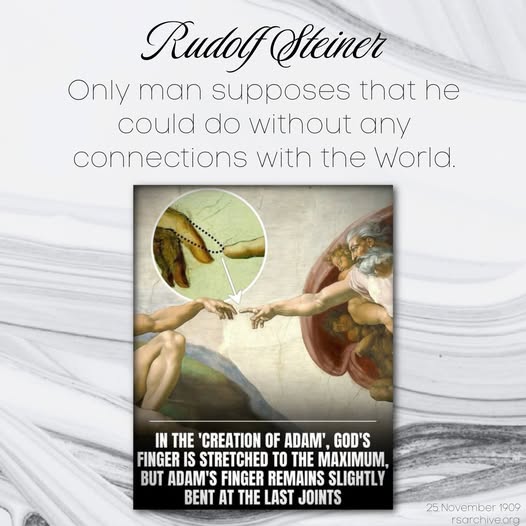
Here is an appropriate occasion to refer once more to the widely misunderstood saying, “Know thyself!”, which has a meaning valid for all epochs. Only when a man realises that he belongs to the whole world, that his Self is not confined within his skin but is spread out over the whole world, over sun and stars, over all earthly creatures, and that this Self has only created an expression of itself within his skin—only if he recognises that he is interwoven with the entire world—only then can he make proper use of the saying, “Know thyself”. For self knowledge is then world-knowledge. A man who fails to realise this is like a finger which imagined it could achieve an individual existence apart from the rest of the organism. Cut it off, and in three weeks it will quite certainly no longer be a finger. The finger has no illusions about that; only man supposes that he could do without any connections with the world. World-knowledge is self-knowledge and self-knowledge is world-knowledge. Any sort of inward brooding is merely a sign that we cannot get away from ourselves.
Very great harm is therefore done when in certain theosophical circles today it is said: A solution of the riddle of existence will not be found in the world outside, or in phenomena permeated by the spirit, but in your own self. “Look for God in your own breast”—that is the injunction often heard. “You need not exert yourself to seek for revelations of the cosmic Spirit out there in the universe. You have only to look within yourself; you will find it all there.” This kind of instruction does the student very bad service. It makes him proud and egoistic with regard to knowledge. The result is that certain theosophical directives, instead of training a person in selflessness, instead of freeing him from himself and bringing him into relation with the great riddles of existence, have a hardening effect on him.
One can appeal to man's pride and vanity by telling him: “You need learn nothing from the world; you will find it all in yourself.” We appeal to truth when we show that to be in harmony with the great world can enable a man to become greater in himself and therefore greater in the world.
Rudolf Steiner, Metamorphoses of the Soul I, VII. Human Egoism, GA 58,25 November 1909, Berlin.