Cosmic Christianity and The Changing Countenance of Cosmology
by Willi Sucher
Part II: The Stars during the Three Years of Christ’s Ministry and Practical Viewpoints with Regard to Evolution
IV. The Sun During the Three Years
Today we shall speak about the Sun in connection with the Three Years. The Three Years must be regarded altogether as a kind of embryonic development. The Baptism was like a conception and Golgotha like a birth. It was the birth of the Christ Impulse on the Earth and in humanity. This “embryonic” development had as its ultimate goal the aim to establish the resurrection body, the incorruptible body. There are many suggestions and much information contained on this in Rudolf Steiner’s lecture cycle From Jesus to Christ, particularly in the later chapters, where he describes the nature of the incorruptible body. In the most ancient times, before the Fall, the human being had lived in such a body. But it was spoiled in the loss of Paradise. This spiritual form-body was torn down into the realm where the laws of nature rule the world of physical matter. Through the Deed of Christ the seed was laid for times to come when it will be possible again for us to attain this incorruptible body that is not subject to the laws of matter, which means death and decomposition. The moment of Golgotha, that is, the time from the 3rd to the 5th of April 33 AD, displays a unique situation in the heavens. During those days there existed a harmony throughout the heavens, right down to the Earth, which did not exist before and will not come back to the universe for a long time, if it will recur at all. A period of about 26,000 years is involved in this rhythm, which is the precession of the vernal point. During such a time interval, the total composition and organization of the universe will fundamentally change, so we cannot be sure whether a similar configuration will return in the heavens. There was a harmony between the three Zodiacs that we can discern in the universe. First there is the Zodiac of the constellations, of the visible constellations that are indicated (drawn up, so to speak) on the map of the heavens by the positions of the fixed stars. Thus we distinguish the 12 constellations of the Zodiac (Fig. 4.1). We start with Aries, Taurus, carry on with Gemini, Cancer, Leo, Virgo, Libra, Scorpio, Sagittarius, Capricorn, Aquarius, until we arrive at Pisces. Apart from this we recognize a second Zodiac. This one is mostly used in traditional astrology. It is the Zodiac of the “signs” of the ecliptic, which are employed in the newspapers almost exclusively. How does this come about? We imagine the path of the Sun in the course of one year. It completes a circle around the Earth, apparently, as we say according to Copernican astronomy. On the 21st of March of every year, the commencement of spring, the Sun arrives at a definite point in this circle. From this point we divide the circle into 12 equal parts, starting from that point where the Sun appears to stand on the 21st of March. So, we have here a circle that is closer to the Earth than the fixed-star constellations, which are deep in space. The astronomers tell us that some of the fixed stars are thousands of “light years” away from our solar system.
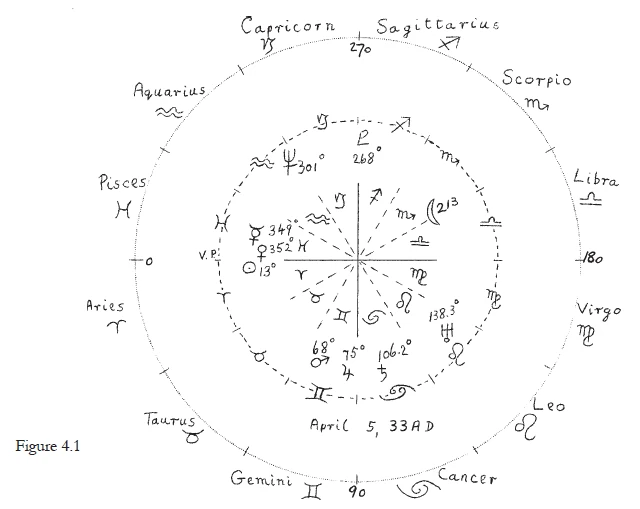
We have divided this inner circle of the ecliptic into 12 equal parts of 30° each. These are the ecliptic signs. One is almost inclined to say, it is unfortunate that they bear the same symbols and the same names as the constellations. Thus we speak of the sign of Aries, sign of Taurus, sign of Gemini, and so forth. Of course, this circle is not fixed forever. There is nothing within this universe in which we live that is fixed forever. Even the fixed stars move, and over thousands of years they completely change their relative positions within the constellations to which they belong at a certain time. Also this inner circle of the ecliptic changes in relationship to the constellations. This is brought about by the rotation of the axis of the Earth. The present axis of the Earth points to the so-called pole star in the Northern Hemisphere. After some thousands of years, one would notice that it pointed to another star, no longer to that which we now call the pole star in the heavens. So in previous millennia it pointed to different stars in the heavens; thereby the position of the ecliptic is changed.
The ecliptic is, as we said, the (apparent) path of the Sun in one year. This we combine with the equator of the Earth, which we project into space around our planet. The two circles cross in two points. One point is the vernal equinox, that is, the point where the Sun appears to stand on the 21st of March. The other one is where the Sun appears to stand on the 21st of September, the autumnal equinox. They are called equinoxes because on these two dates we have equal length of day and night. The vernal equinox marks the commencement of spring in the Northern Hemisphere. In the Southern Hemisphere this is reversed.
In the present age, if we could observe the Sun on the 21st of March and at the same time see the fixed stars far out behind it in space, we would make a remarkable discovery. We would not find behind this spring Sun the fixed stars of Aries. Although we know it is then in the ecliptic sign of Aries, it is not in the Zodiac constellation of Aries. The stars of Pisces can be discerned behind that spring Sun. One would even find the right-hand or western end of that constellation behind the Sun. In fact, in a few hundred years time, we shall see the Sun on the 21st of March even still further back, right in the constellation of Aquarius, and so forth. This is the so-called precession of the vernal point. We use it as a foundation for the discernment of the Ages of our civilizations. In Dr. Steiner’s lectures and books we read so often the expression: “We are living now in the Age of Pisces, and the Age of Aquarius is to come.” The Age of Pisces was preceded by the Age of Aries, and so forth. The precession of the vernal equinox is the foundation of all that.
Around the time of Christ, it was indeed thus, that when the Sun entered the ecliptic sign of Aries on the 21st of March, one would also have seen behind the Sun, far out in space, the first stars of the constellation of Aries already coming up. At that time the signs and constellations coincided. There was a harmony, established once, within the course of about 26,000 years. We also have to take into account a third Zodiac. This is the Earth Zodiac, which is established by the rotation of the Earth. Wherever we are on the Earth we realize that the Sun has a certain relationship to our horizon. In the daytime it has reached a definite height in space. At the same time we would find a certain constellation rising on the eastern horizon, another one setting in the west, a third one culminating in the meridian of the place. From all this we could deduce that below the horizon the opposite constellation is deep down in the nadir of the place. The Sun is not standing still; it is rising higher till noon, when we find the Sun at the meridian. After that, in the afternoon it slowly descends toward the west, until it sets in the evening. Thus we have a set of space coordinates to deal with. Any place on the Earth has a meridian, a circle that rises from the south point, goes through our zenith directly above us, and then descends to the north point. From there it continues as a circle underneath the horizon until it comes up again at the south point. Our horizon constitutes another space coordinate. Thus the circle, which is the meridian of any given place, south point, zenith, north point, and nadir directly under us, together with the horizon, divides our regional geographic space into four segments. One segment lies between the eastern horizon and the meridian, another one between the meridian and the western horizon. A third sector is situated between the western horizon and the nadir. This is followed by a fourth sector between the nadir and the eastern horizon. Thus we now have four segments, which look like the pieces of an apple cut into four equal parts. We divide all four pieces again into three subdivisions each, so that in the end the space around us looks like an orange divided into 12 segments. The axis of our space-orange would have to lie on the south-north axis of our particular geographical locality. These 12 sub-sectors are the so-called astrological houses.
This Zodiac of “houses” radiates, as it were, from the place where we stand into cosmic space like the segments of an orange. The great configurations of the Zodiac, the constellations, also the ecliptic and the planets, are received or organized into this space-organism. The “houses” of the third Zodiac resemble 12 receptacles that relate cosmic facts to Earth reality.
What do the three different Zodiacs mean? The visible constellations of the fixed stars are the astral world. One can even say, with certain reservations, that this fixed-star Zodiac is an image of the astral body of the cosmos. World astrality—world soul-forces—moves the stars. It is in this sense that we take the Zodiac of the constellations as an expression of the astral body of the cosmos. The signs of the ecliptic rest on the vernal point in which the Sun indicates in the heavens the commencement of spring. This is a Zodiac associated with the seasons, with the yearly rhythms of life in nature. It is particularly obvious in the plant world, as an image of the ether, or life forces, in the universe. Here too we can say, with certain reservations, that this Zodiac of the ecliptic signs is an image of the ether body of the cosmos, particularly of the solar cosmos. Finally, that which radiates as space segments from the geographical point where one stands is an image of the physical body, which is given to us as earthly physical reality. They are also given the symbols and names of the constellations. The sector immediately below the eastern horizon, the first “house,” is called Aries, the following one, deeper down, Taurus, the third Gemini, next Cancer, then Leo, Virgo, and so on. The sector, or “house,” immediately above the western horizon is Libra, the following one is Scorpio. The one that adjoins the meridian from the western side is called Sagittarius. Then, toward the east follow Capricorn, Waterman, and Pisces or Fishes. At the time of the Mystery of Golgotha, particularly on Easter Sunday morning, before sunrise, these space sectors were oriented into space in perfect harmony. Rising in the east were at that moment in the Earth-space sector of Aries, the first “house,” the ecliptic sign of Aries and the fixed star constellation of Aries. So, the “astral” Aries and the “etheric’ Aries were received into the “house” or spacesector Aries. With slight differences that one can calculate, all three Zodiacs were in perfect harmony. It will take another 26,000 years until the same harmony can happen again in the cosmos. But by then the conditions and the constellations might have changed completely. They certainly will no longer resemble the present shapes. In this sense a unique situation in this universe occurred at that moment when the Resurrection took place. We remember from the Gospels that on Easter Sunday morning two of the disciples went to the sepulcher and found it empty, to their great amazement. The Resurrection had taken place. This wonderful harmony of the three Zodiacs, between heaven and Earth, is a vivid symbol, or image, of the resurrection body that was then re-established. The disharmony before was connected with the Fall of humanity, and with the corruption of the spirit body.
The Fall in Paradise did not mean that only Adam and Eve went through those experiences of which we read in Genesis. The entire universe was affected and changed in that moment. The position of the Earth was changed. We are faced in our work with the difference between the geocentric and heliocentric world conceptions. Rudolf Steiner, on the basis of his spiritual investigations, pointed out that in the medieval Rosicrucian schools the pupil was first introduced to the geocentric view. Then, when the pupil had learned this, he was told that this is how it should be, but that it is not so on account of the Fall, on account of the “Sin of the World.” The Earth had thereby lost its central position. That which happened in Paradise affected the entire Earth and therefore the possibility of disharmony entered cosmic history. However, on that Sunday morning just before sunrise, the original harmony was re-established. It was, of course, not the cosmos that re-established it, but the cosmos was jubilant about what happened when the Christ rose from the grave of the Earth. At the same time it was the hope of all future Earth existence and of all future humanity.
The distinguishing features of this event are the special aspects and the positions of the planets in the Zodiac during those days. They were unique because the same things would not happen again for a long time. The Sun was at that moment in the house or space sector of Aries, in the sign of Aries, and in the constellation of Aries. What did this pronounce? It described what happened on Earth as a new beginning. The constellation of Aries is connected with the head. So this “head” or seed point in the cosmos was shining with the glow of that morning Sun. Next we find Mars and Jupiter related in that moment to the space sector Gemini, sign of Gemini, and constellation of Gemini. This is no longer the hierarchically oriented, vertical Gemini, because the Washing of the Feet had taken place shortly before. It can now become a manifestation of brotherhood. This is one aspect, but there are, of course, more. We find another viewpoint if we go back in time with the precession of the vernal point. For instance, 2,000 or 3,000 years earlier we would find it in Taurus. That was associated with the Egypto-Chaldean Civilization. If we go still further back we discover the vernal point in the constellation of Gemini. That was the civilization of Ancient Persia. The leading ethical and moral motif of Ancient Persia was the world contradiction of light and darkness. The principle of light was the divine being of Ahura Mazdao in the heights. His dwelling was not the Sun that we see, but rather the Ahura, the “aura,” of the Sun, which was clairvoyantly experienced by Zarathustra in the heights of the cosmos. He saw that the Spirit of the Universe prepared for His incarnation as the Christ. And deep down in the Earth, he perceived Ahriman, the Lord of Darkness, who fights against the light. These are very practical views. The foundation of organized agriculture was built on them. By ploughing the soil we open it up to the light from the cosmos. We thereby make the growth of the plant possible. The human being’s head is oriented toward the cosmos, but the plant is the reverse, it lowers its head—the root—into the soil and stretches its limbs, that is, its trunk and branches, toward the Sun. The humanity of the future will learn to relate to the cosmos in full consciousness of self. This will be the Spiritual-Cosmic Communion of humanity. Not for much longer will humans be able to passively watch the things that are going on in the heavens and ask: What will they do to me? Many still look up to the heavens with great apprehension. This is an attitude that we must overcome. The Christ Event can give us the ways and means to take up a positive relationship of spiritual activity toward the cosmos. Dr. Steiner gave some indications of this future perspective: “In times past the stars spoke to us. They have become silent, at least to a very high degree. Now, and ever more in the future, we must learn to speak to the stars.” This is not meant in a metaphorical sense; there is great reality in this perspective.
The two planets Mars and Jupiter were, as we said, in Gemini at Golgotha. Mars stands for the old or first creation, which must be superseded. Jupiter is a seed point for the future. In its sphere spiritual beings are already preparing Future Jupiter. All this is associated with the house, sign, and constellation of Gemini. From a certain perspective, Gemini can be connected with the hands. Painters in the Middle Ages who painted the Christ always presented this in wonderful gestures of His blessing, healing, guarding hands. Dr. Steiner gave it expression in a huge statue that he carved. It shows Christ holding down Ahriman, who wants to chain humanity eternally to earthly matter. Above his head He holds back Lucifer, who would tempt humanity to forsake the Earth. At Golgotha Gemini was transformed into a threefoldness. Christ, the Savior of the human soul, created a balance of protection between the Twins of the adversaries, Lucifer and Ahriman.
Venus and Mercury were on the point of rising, in the house, sign, and constellation of Pisces. In a certain sense, Pisces from any of the three perspectives reflects the end of an evolution. It is the end of the Zodiac and also a new beginning. Of the two Fishes in this constellation, one swims in the heavens toward Aries, the other toward Aquarius. They are connected by a faint ribbon of stars. Thus the past appears connected with the future. This is, for instance, the task of the present Age of the Fishes-Pisces. We still have to overcome the past, of which much remains from the last Ages of Aries, and even Taurus. On the other hand we must prepare the Age of Waterman-Aquarius, which is yet to come. Venus and Mercury, that is, the planet of spiritual love and compassion and the planet of the power of spiritual fire, had just risen on Easter Sunday morning. They were associated, so to speak, with the feet by being positioned in Pisces. They proclaimed in the heavens that the Risen Christ stood and walked on these principles. What can we read in this?
Gemini has been connected since ancient times with a vertical or hierarchical structure of social order. We need only think of the great empires in Ancient Asia where the potentate, or ruler, sat on his throne high above the common people. Many steps led up to it, on which the entire court was arranged according to rank. This was an image of hierarchy on Earth, an imitation of the divine hierarchies. This is contrasted by Pisces. There the two Fishes swim side by side. The two feet and the two hands of the human being, which are also an image of the two Fishes, are equal, though their functions may be distinct. As far as the social order is concerned, Pisces displays much more a principle of brotherhood.
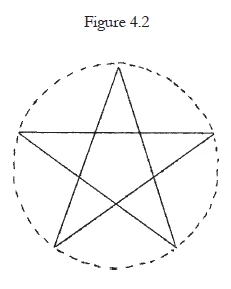
An additional viewpoint is provided by the angular relationship between Venus in Pisces and Mars in Gemini. They were 76° apart on that April 5, 33. This is close to the pentagram or quintile aspect. The pentagram-quintile (Fig. 4.2) divides the ecliptic into five times 72°. It is well known to astrology but not much used. This aspect is made by the conjunction rhythm of Venus, the planet of spiritual love and compassion. It confirms additionally that Mars received here an impulse from Venus, an impulse of healing and progress. In one sense it is the overcoming of vertical social order by horizontal order, or brotherhood order. Saturn emphasized this even more by its position in Cancer—constellation, sign, and house. Saturn, so to speak, proclaims in that moment that the spiritual power of the Christ Event can put the earthly house of humanity in order. Cancer is an image of this “earthly house.” It manifests in the formation of the human chest, which is made of 12 pairs of ribs. If we imagine that this introverted region would open up through a powerful spiritual effort, it would appear like a Sun radiating out into space with 24 rays. Thus the narrow house of the human being would become a cosmopolitan house. This is one of the many imaginations that are latent in this Saturn.