Isis Sophia II
by Willi Sucher
I. Ancient Greek Mythology of the Constellations in the Northern Hemisphere
In this present age, we are confronted with many ancient and often strange remnants of bygone civilizations. Not the least among them is the so-called astrology, which has its roots in very old tradition. This astrology claims to be able to make predictions with regard to the constitution and the destiny of human beings. Such predictions are based, generally speaking, on the positions of the planets of our solar universe at the time of birth. The relationship of the planets, the Sun, and the Moon among themselves and their positions in the ecliptic, as well as in relation to terrestrial space, are considered as a kind of symbolic language, which, if it can be read properly, is supposed to reveal the future as determined by the influences of the celestial bodies. Unfortunately, this conventional astrology cannot give a satisfactory scientific explanation for the supposed cosmic influences on earthly occurrences. There exist among modern astrologers many theories concerning these problems. But in all of these theories, one can detect a deep cleavage between the modern scientific views on the cosmos of the stars and the representations of astrology. Modern science has created a spatial picture of the starry universe, in whose gigantic dimensions our planet Earth disappears completely; it has nothing to say about the human being on this planet. Besides these seemingly irreconcilable views of modern astronomy and conventional astrology, there arise other difficulties. For instance, conventional astrology cannot explain why it attributes a certain, definite influence to the Sun when it occupies one of the 12 partitions or signs of the ecliptic. It cannot give a reason why the influence is then just as it is described by the traditional rules and not otherwise. The specific rule is taken for granted, and it remains to be seen whether the prognosticated effect occurs in the future. As a matter of experience, this is not always the case. The lives of modern people increasingly reveal that the traditional rules of astrology move more and more away from reality. One is inclined to think that modern humanity has to a high degree emancipated itself from the pretexts of an astrology that is rooted in ancient world conceptions.
Summing up all the available facts and symptoms, it becomes evident that conventional astrology, which would like to pose as a science, cannot really be regarded as a science in a modern sense. It cannot answer the great questions in the mind of people today. These questions culminate in the yearning for a satisfactory knowledge about the creation, the being, and the future of the universe and humanity. Astrology cannot answer these questions. In fact, conventional astrology is very often like a blind guide who cannot really answer the burning problems of knowledge about life, and whose guidance rather tends to deprive us of the capacity to mold our existence from our own inner resources. To this, one can object that modern science, also, cannot provide the answers to the great problems and obvious tasks of modern humanity. The nature of modern science, especially natural science, must be regarded as irrefutable evidence of the spiritual battle which is going on in modern humanity. Unless astrology can find a way to respond to this wrestling of the modern mind, it will become more and more obsolete and ultimately be discarded.
Conventional astrology is the daughter of a mother who herself comes from the remotest past. The excavations in Asia Minor, in Mesopotamia and Egypt, during the 19th and 20th centuries, have shown that those ancient peoples had a magnificent cosmology thousands of years before Christ. They were obviously able to give answers to those questions to which the modern mind, including the modern astrologer, cannot provide satisfactory solutions. Of course, we ought not to forget that human beings in those times had totally different capacities and dwelt altogether on another level of consciousness. Nowadays, one may be inclined to pity the so-called primitive “beliefs” of those peoples; but one thing is certain, those ages had the gift of perceiving in the movements and gestures of the celestial bodies the expressions of a Divine world. The archaeological and ethnological evidence brought to light by research has proven that the movements and relationships of the cosmic entities were regarded as manifestations of the intentions and actions of the Gods. Obviously, whole communities and nations were guided by such manifestations of a Divine world, indicated in the movements of the stars. There is no doubt that we can no longer employ such methods. We have lost the ancient capacities of cognition. Any revival of such practices in a modern age would also be wrong. But it would be unjust if we were to allow ourselves to condemn that ancient star wisdom as superstition, only pardonable because of the supposed ignorance of the ancient peoples. We can by no means really judge the peculiarities and capacities of consciousness of our forefathers only from the standpoint of modern intellectuality. We have no proof that the horizon of the modern mind, with its present limitations of cognition, is a standard condition valid for all ages of the development of the human race, past as well as future. The latest history of modern humanity sometimes creates the impression that the modern mind, with its magnificent achievements in certain fields, has utterly failed to procure an efficient equivalent of the ancient star wisdom for the ordering of the social life of humanity. Such an equivalent, or source of knowledge, may already exist unrecognized among humanity; meanwhile, it may be wiser not to ridicule the so-called primitive and dark ages of history, as long as we have not as yet found efficient means to put our own house in order.
The ancient star wisdom was especially at the disposal of the political leaders of the nations, who were usually at the same time the high priests. Thus they were enabled to guide their peoples in the right ordering of society. For instance, we know with certainty that the pharaohs of the first Egyptian dynasties had been initiated into the wisdom of the stars so that they could fulfill these functions. They were expected to perceive the manifestations of the Gods and to execute their will to the benefit of their people. This was the beginning of that development in evolution which led to the conviction that celestial events were related to the existence of the individual, not only to nations as a whole. In the meantime, the ancient and magnificent vision of the Divine world, through the medium of the starry universe, had gradually faded. It became increasingly impossible for humanity to recognize in the movements and gestures of the heavenly bodies the revelations and directions of the deity. Yet humanity still looked up to the stars, knowing by tradition that their movements had a certain connection with events on the Earth. However, the stars and the planets were increasingly experienced only as abstract entities in the universe. The vision of the Gods existing and acting “behind” the stars had been lost. Thus astrology came slowly into existence in the form in which it was introduced to European civilization. The positions of the stars, their gestures and movements, were regarded as the makers of human destiny. Less and less was civilized humanity able to recognize the manifestation of the divinity itself through the presence of the stars. Astrology, which thus came into being, gradually lost the capacity to provide satisfactory explanations for the traditional rules that have since been used for astrological prognostications. This astrology became less and less able to give convincing answers to the question why the starry world should have an influence at all on the human being. The original ancient star wisdom would not have been embarrassed by such problems. It was able to see “through” the visible starry world into the realm of the creating and moving divinity itself.
The original star wisdom had a deep effect on the cultural development of humanity, even in fairly recent times. For instance, we still find its influence in the grandeur of Greek sidereal mythology. Nearly all the names of constellations, which we know in the Northern Hemisphere, have come to us from ancient Greece, though many of them are of even much greater antiquity.
It is a fact that people today usually considers the constellations that are shown to us in the sky, as a highly illogical and confusing accumulation of pictures of Greek world of Gods and heroes. This is partly due to the fact that we have almost completely lost the understanding for the deep spiritual wisdom of the mythological heritage of humanity. We consider these figures and pictures as the invention of a rather productive fantasy and as the result of primitive world conceptions, which we in our enlightened age ought to discard. Yet we shall attempt to show in the following pages the strict logical interconnection and the wise, uninterrupted continuity of the constellations, as we perceive them in the sky. Thus we will realize that the Greek sky was a harmonious and organic structure, revealing the ancient vision of the heavens as the coordinating link between divine will and human evolution. Then the world of Greek sidereal mythology will no longer appear as the invention of a primitive mind, but as a means of describing the profound spiritual truths of human evolution.
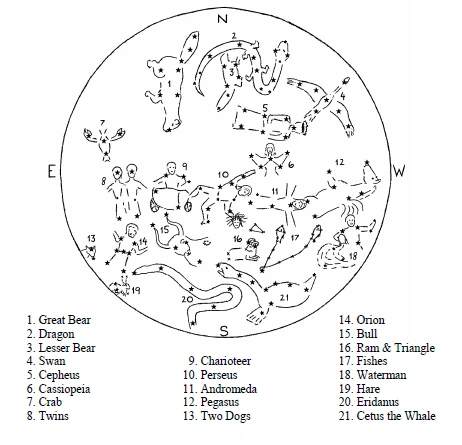
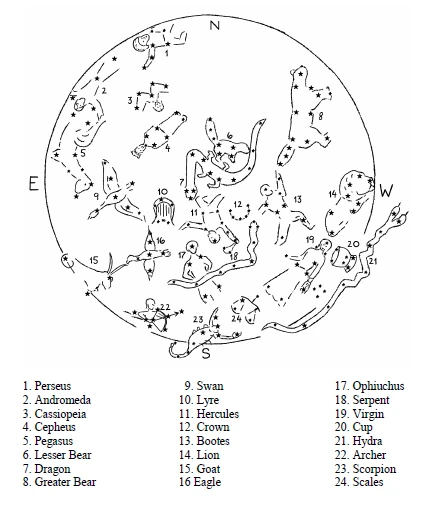
In order to enable readers to combine our explanations with actual observations of the stars, we will divide the northern sky into two parts. The sky shows a different configuration during a winter night, especially in southern (Greek) latitudes, from that of a summer night. This is due to a slight difference in time between the normal day of 24 hours and the so-called sidereal day. To explain this fact here would lead too far, but it can be studied in any handbook on astronomy. We have added, on the last two pages of this chapter, two star maps that show the different aspects of the sky in summer and in winter.
If we study the winter sky (approximately at the beginning of February, between 9:00 and 11:00 p.m.), we first notice the familiar constellations of the Zodiac, starting with Waterman and Fishes and Ram in the western sky. Below Ram, toward the southern horizon, we observe Cetus, or the Whale. Above Ram we can find the Triangle; still higher is Andromeda, and in the neighborhood of the Pole Star we see Cassiopeia and Cepheus. Starting from Ram and moving on in an easterly direction, we detect Bull and Twins. Below Bull appears the long, stretched-out constellation of Eridanus, and below—in the space between Bull and Twins—Orion stands with the Greater and Lesser Dogs in its neighborhood. (The Greater Dog can be recognized by the brilliant fixed-star Sirius.) Between Bull and Cassiopeia, appears the mighty image of Perseus. Starting from Perseus toward Twins, we observe the Charioteer or Auriga with the bright fixed-star Capella. Passing further east from Twins we can find Crab, which is not very easy to distinguish.
The leader of this whole group of constellations is Ram. In ancient times it was called the Prince of the Zodiac, and, as a matter of fact, it is depicted on medieval star maps turning its head backwards, watching the flock of zodiacal constellations following it. In Greek sidereal mythology, we learn that the Greeks experienced in this constellation the mighty figure of Zeus. We know that Zeus was considered by the Greeks to be the head and father of the Olympian Gods. Thus he was deeply connected with the development of Greek civilization. Who was Zeus? Was he only an invention of Greek priesthood? The Greek people still had capacities of cognition very different from ours. They did not and could not speak of ideas as abstract thoughts existing only in the brains of people. They experienced them as objective and individual spiritual beings. Thus they witnessed, in more classical times, the great impulse and the unceasing power that inspired their thinking, the development of Greek philosophy, as a divine being. This was Zeus. He was for the Greek people the divine power that was innate in them and which made them grasp the beauty and grandeur of the universe through their senses. Zeus was also the impulse that enabled them, so they felt, to climb to that well-known perfection of Greek plastic art, unsurpassed in later ages of civilization. This power or impulse was not experienced as an abstract idea, as it would be in our age, but as an individual divine being. Zeus, this Divine being, had a long and tedious way to go in order to achieve his final aim. Tremendous battles had to be fought, until Zeus and those who followed him could firmly establish their rule. Only gradually was the preceding hierarchy of Gods, the Cronides, conquered—a generation of divine beings who had established a previous phase of human development. So these battles swayed to and fro. A new impulse always has the old and established foundations as its sworn enemies. On one such occasion, Zeus and his followers were nearly beaten, and Zeus himself had to flee to Egypt in disguise. In order to escape unrecognized, he transformed himself into a ram. We still possess ancient depictions that show him with ram’s horns. Thus he was venerated in Egypt and Libya as Zeus Ammon or Jupiter Ammon. This legend succeeds in describing, in wonderful mythological language, how a young impulse had to seek protection in an older civilization and draw strength from it for the tasks of humanity on the road of cultural progress. The ram’s horns are a picture or imagination of the development of the brain, its refinement, and its curvatures. This was a necessary condition for the foundation of the typical Greek capacity of thinking and reasoning, of the loving perception of the light-filled world that entered into humanity through the senses. Humanity was not able to develop this kind of perception and thinking before the Greek Age. Before that age the brain had not yet become such a perfect instrument, able to support intellectual capacities as in modern humanity. The development of the new brain faculties set in gradually during the Greek Age, and Zeus represented the Greek experience of that personified divine power, which initiated and guided those processes.
Another mythological picture that makes this fact plain, is the birth of Pallas Athene. The myth says that she descended in full armor from the head of Zeus, the father of the Olympian Gods. Thus one can say that she is a kind of divine emissary of the guiding deity of the Greek people, whose impulse it was to instill brain faculties into the Greeks. Pallas Athene was consecutively that divine being who helped the Greeks to realize in practical life the great impulse that had been imparted to them by Zeus, and also she was the protector of their culture. Thus she became the protecting deity of Athens. Her statue stood on the Parthenon, the central temple fort of Athens, and her brilliant armor shone in the sunlight, visible from afar by the sailors who approached the coast. She also taught the Greeks, as the myth says, the art of weaving, which is an expression of the faculty of combining thought. Furthermore, she is said to have taught humanity to make oil from olives, to build walled cities, etc. The Greeks saw all these faculties, and the cultural development leading to their handling by humanity, personified in the constellation of the horned Ram.
In the following constellation of Bull, Greek mythology experienced another manifestation of Zeus. The myth says that one day he saw, when he was looking down from the lofty heights of Olympus, the beautiful Europa, daughter of King Agenor of Phoenicia. She was guarding her father’s herd of cattle in the fields. Zeus decided to take her away and bring her into his own realm. In order to achieve this, he transformed himself into a beautiful white bull and mingled with the herd in Europa’s care. She noticed the splendid animal, stroked it, and finally sat on its back. No sooner had she done this, then the bull plunged into the sea and swam across to the island of Crete with Europa on his back. There he brought her ashore and founded the famous Cretan royal dynasty. The Cretan civilization was the predecessor of Greek culture, a first step toward implanting human civilization into Europe.
This myth is a magnificent picture that seeks to describe how the civilization of Europe was founded. The young Cretan/Grecian culture had to borrow at first from the much older civilizations of the East, of which Phoenicia and Egypt were the nearest. Only later were the foreign elements of the acquired heritage of ancient times gradually overcome. Judged by the remnants of Cretan civilization, it is obvious that those people had a strong heritage, both spiritually and externally, from the Phoenicians. It has even been discovered that the Greek myth of Heracles (or Hercules) has its roots in the Phoenician myth of Melkarth. The Greeks experienced the spiritual forces, which were at work in this interconnection with the East, as manifest in the sky by the constellation of Bull.
No sooner had the first foundations of Greek/European culture been established, than the forces of the “old” were roused to resist the “new”. For the “old” does not willingly give way to the “new”. It is a natural reaction that the ancient impulses want to preserve their own existence. In Greek mythology, the battles of Zeus and the Olympians against their divine predecessors were reflected on the Earth in the deeds and labors of the great Greek heroes. One of these was Perseus, whose constellation we see in the sky above Bull. We hear in Greek mythology of 12 such heroic figures. The 13th is Heracles/Hercules of whom we shall speak later. The myth of Perseus is this: There was a King in Argos, whose name was Acrisius. His daughter was named Danae. The King had heard of a prophecy that his grandchild would one day kill him and take the throne. In order to forestall this, he shut Danae up in a tower so that she would have no children. However, Zeus descended to her in the tower in the form of a rain of gold, and soon she gave birth to Perseus. No sooner had Acrisius heard this news than he placed mother and child in a small frail boat on the sea, hoping they would find certain death in the waves. The Gods interfered and Perseus was safely taken to a lonely island whose inhabitants brought him up and educated him in secret. The forces of the “old”, represented by the figure of the grandfather, Acrisius, opposed Perseus and wanted to destroy him.
As soon as Perseus was grown, he went on his first errand against the resisting powers of bygone ages. There lived in the region of eternal night a terrible monster, who endangered the human race. It was the Medusa, who transformed every living thing that looked at her into lifeless stone. The myth says that Medusa was originally a beautiful being, and only later in life she became a creature of deadly ugliness. This gives us a clue to understanding what she represented. She was a spiritual power who enabled humanity in ancient times to perceive clairvoyantly the spirit in nature. She had snakes upon her head instead of hair. This reminds us of another picture, the famous Uraeus symbol, which the Egyptian Pharaohs wore on their foreheads as a sign of clairvoyant capacities. For the serpent was regarded in ancient times as a symbol of divine wisdom. But those ancient capacities had gradually faded away, and in Greek times the remnants of the old dream-like clairvoyance had already begun to be regarded as decadent—even dangerous. The Greek impulse was to wake up to independent, “day-wake” thinking. Thus the serpent symbol of wisdom had become the image of Medusa’s poisonous snake head. Her once clairvoyant vision of nature had died into realization of the physical outlines of objects in nature. She was on the road of that long descent of the human soul-faculties toward the realization of only the mineral, lifeless properties of nature. Therefore, to look at her was to be transformed into stone. Perseus, the hero of half-divine descent, desired to kill this monster, but he had to be equipped for his task with divine weapons. Hermes, or Mercury, lent him his winged sandals, and Pallas Athene contributed her shield. Thus he proceeded to that terrible region where the Medusa dwelt with her two sisters. After many adventures, he arrived in the realm of eternal darkness. He knew that he could not approach the Medusa directly, lest he be transformed into stone. So he cautiously drew near by walking backwards, observing the monster in the mirroring surface of Pallas Athene’s shield. Then he finally severed the Medusa’s head from her body with one mighty blow of his sword.
If we saw in the constellation of Bull the foundation of European civilization by the powers whom the Greeks called Zeus, then we realize in the constellation of Perseus, above Bull, a further magnificent interpretation of the deed of Zeus. Hermes had endowed Perseus with his winged sandals, and it was the task of Perseus not to let that newborn faculty of brain-employing thinking die in cold and lifeless intellectualism, which it later became in humanity. A Michaelic power of light and wingedness in thought lived in Perseus. Thus protected, he could make use of the reflective intellect, borne by the new Zeus faculties. This is the reflecting shield of Pallas Athena, being an imagination of the brain that acts as a reflecting mirror between the reality of the objective external world and our inner life. Thus Perseus contributed toward the foundation of typical European culture; he employed brain-born thinking, but through his thoughts there still shone the presence of the spiritual world. His very deed was the destruction of the deadening forces, which together with the new capacities had come as a grave danger to humanity.
We see Perseus in the sky coming back from his first great deed. He holds in his hand the bleeding head of the Medusa, represented by a group of stars, of which the largest is Algol. This star is very interesting, because in a rhythm of about three days it loses four-fifths of its light capacity, after which it then regains its former strength. In ancient days this star was called the Demon Star, or the Winking Demon.
However, on his way back Perseus encountered another adventure. He flew through the air with the aid of the winged sandals of Hermes. Another version of the myth says that he was riding on Pegasus, a winged horse, which can also be found in the sky above the constellation of Fishes and Waterman. This version is rather revealing, because it says that Pegasus had risen from the blood of the Medusa, after Perseus had severed her head from the body. The degenerated clairvoyant faculties of an older humanity, represented by the Medusa, are allowed to live on into later ages as the winged imagination of poetic creation. Pegasus was, in Greek mythology, the favorite of the Muses. Riding on the back of this divine animal, Perseus flew across Ethiopia. There a terrible disaster had happened. The Queen, Cassiopeia, whose husband was King Cepheus (both can be found in the sky, near Perseus), had angered Poseidon, or Neptune, the Divine Lord of the Sea. She had boasted that she was fairer than the sea nymphs, the daughters of Neptune. In revenge, Neptune sent a horrible sea monster to Ethiopia, the Cetus, which ravaged the kingdom. An oracle revealed that relief could only be obtained if the daughter, Andromeda, of Cepheus and Cassiopeia was given as a prey to the sea monster. So the unhappy parents had to look on while their child was chained to a rock near the coast. The monster approached to devour Andromeda, but at that moment Perseus came, gliding through the air. He realized at once the plight of the maiden and he attacked the monster. Swooping down, he still carried the horrible head of the Medusa in his hand and, through its deadly power, the monster was in an instant frozen into stone.
We find all the actors of this drama in the sky: To the west of Perseus, above Fishes, is Andromeda chained to the firmament with outstretched arms. Higher toward the north is Cassiopeia sitting on her throne with King Cepheus. Cetus swims below the Zodiac constellation of Fishes.
The story of Andromeda and Perseus is a significant contribution toward the understanding of the Perseus myth. Whereas Perseus was obviously battling with supernatural powers when he destroyed the Medusa, so he was descending to the human level when he rescued Andromeda. We always find that female figures in ancient myths represent the receptive soul element. Cassiopeia, the mother, had realized the spiritual supremacy of the human being, the anthropos, over the elemental forces working in nature, though they are of divine origin. Thereby she had angered those powers represented by Neptune, because they do not want to cede their hold on nature to the human being. Their reaction followed swiftly. Andromeda, the representative of the soul, was chained to the rock, the image of the downdragging powers working through the material properties of the Earth. Perseus, the hero of the new power of thinking and perception in the human being, who had remained victor on a higher plane over the dark forces of the past, was able to rescue Andromeda. He was the representative of the spirit in humanity, who grasped, with a fiery will, the new capacities that were offered to humanity and so freed the soul from the bondage of fear and timidity.
The fearsome monster, Cetus the Whale, stands below the constellation of Fishes. His gaze is directed toward Perseus. Who was Cetus? The myth tells us that he belonged to a whole generation of monsters, who had all descended from Pontus. Pontus was the great elemental spirit of the Black Sea. The Greeks looked toward that region with awe. They experienced the untamed powers working behind nature much stronger there than anywhere else. These powers were the descendants of mighty divine beings; but they had fallen too deeply—partly in those battles of Zeus against the preceding Titans—and had become the gigantic, blindly creative but also destructive forces of nature. Thus the Greeks experienced them as a fallen hierarchy of Gods, whose divine origin was, however, still shining through their being. We shall meet a kind of cosmic biography of this great Fall as we move along with the constellations below the Zodiac, starting from Cetus.
Below the constellation of Bull and to the east of Cetus, we find the constellation of Eridanus. In Greek mythology, Eridanus is a river connected with the fate of Phaeton, who was of very lofty descent; the Sun-god, Phoebus Apollo, was his father. The son saw his father driving the golden chariot of the Sun every day across the sky. He longed to do the same, and he persuaded Apollo to give him the reins of the heavenly vehicle for one day. At first Apollo refused because be knew the dangers. Finally Phaeton employed a ruse in order to obtain his father’s permission, and Apollo had to agree. So Phaeton mounted the chariot, took the reins, and went off into celestial space. However, soon the fiery steeds of Apollo noticed the feeble hand of the inexperienced driver. They raced in mad career through celestial space, upsetting the order of the stars. Finally they approached the Earth so closely that it was threatened by a general conflagration. The mountain tops were already aflame. Smoke arose everywhere. The rivers were dried up or appeared as molten lava. At the height of the chaos Zeus was called to the scene and begged to restore order. He smote Phaeton with one of his dreaded thunderbolts. The unhappy youth fell from the chariot and was drowned in the river Eridanus. The nymphs, who witnessed the tragic end of Phaeton, swelled the river with the floods of their tears, until Zeus transformed them into poplars. This river Eridanus is the constellation of the same name that we observe in the sky.
It may seem that the story of Phaeton and Eridanus is only an invention that was intended to teach a moral lesson about the fatal consequences of ambitious and presumptuous aspirations, but there is much deeper wisdom hidden in this apparently naive myth. In a certain sense, the fall of Phaeton reminds us of the age-old legend of the Fall of Lucifer from the heights of Heaven, when he was cast out by the hosts of the Archangel Michael. Phaeton was obviously a being who tried to penetrate into the depths of the universe. He is of half-divine origin; therefore, his desire is not really only presumption. The myth wants to tell us of a one who had still retained certain capacities, arising from the original divine, sun-like spark of the human spirit. In very ancient times, under totally different conditions of consciousness, certain individuals were able to penetrate into the spiritual depths of the cosmos. Of course, such an experience did not take place in the sense of an ascent to the external spatial universe. After long years of preparation in the sanctuaries of the ancient temples, an individual who had been found suitable was put into a state of deep, trance-like sleep. He actually went through an experience similar to death. His soul wandered, similar to the souls of the dead, through the spiritual spheres of the stars. After a certain time, he woke up again to normal day consciousness, but then remembered and spoke of the spiritual facts and heavenly beings with whom they had met in the realm of the stars. It was in this way that very ancient star wisdom, of which we spoke in the beginning, had come into existence. There still exist in ancient documents faint hints and indications of such carefully prepared inner experiences or initiations. For instance, the Mythras Mysteries, which originated in Persia, spoke of seven great steps or degrees of initiation. The sixth degree was the Sun Hero, in whom we can recognize the individual who had attained to the stage of Phaeton in our legend.
Yet we realize that such an inner experience or initiation was only possible in those ancient times during a state of deep sleep, even a deathlike condition. With the rise of Greek culture, an age had come during which humanity was supposed to develop the intellect and the power of thinking, the perception of the world revealing itself to a day-wake consciousness. Also, the physiological structure of the human being of the Greek Age had changed considerably. Therefore it became less and less possible to employ the ancient methods of cognition of the spiritual cosmic world. It happened ever more frequently that the neophytes in the temples did not wake up from their deathlike trances but actually died during initiation. We realize in Phaeton, a mythological figure that represents the dramatization of that closing of the door to the ancient Sun mysteries. He can no longer master the chariot of the Sun—the spiritual journey through cosmic space. The loss of this capacity was not only a sad event, for it also contained grave dangers. People still had some traditional knowledge of the ancient star wisdom, but they increasingly lost the ability to handle it correctly. It became a threat and obstacle to the development of spiritual freedom. The history of astrology proves this abundantly.
Thus, Eridanus/Phaeton is in a certain sense on the same level as Cetus: both are representative of remnants of a glorious and highly spiritual past. However, as they do not fit into the new requirements of human evolution, they become gigantic and threatening shadow beings. The constellations below the ecliptic also contribute their interpretations to the zodiacal constellations, as those above the ecliptic interpret in their own way. Perseus is the master or the new Sun Hero of the day-wake capacities of sense perception and thinking, and thereby the myth connected with him is an interpretation of the constellation of Ram. Cetus and Eridanus/Phaeton tell us of those shadows of the past that the Greeks sought to overcome or to transform. In modern times we should have to search again for entirely new interpretations, both of the constellations and of the myths connected with them.
Next to Eridanus, further east, we observe the constellation of Orion. The myth tells us that he was a mighty giant and a most skillful hunter. No animal on the Earth was safe from his never-failing arrows. In the sky he is surrounded by constellations of animals, which represent hunting. Beneath his feet is the Hare, and further to the east are the two dogs: the Greater Dog, with the well-known sparkling fixed-star Sirius, and the Lesser Dog, with Prokyon. Orion’s domain was the dusky depth of the forests, penetrated by the soft light of the Moon. Artemis, the goddess of the Moon and of hunting, loved him deeply. But her brother Apollo, the god of the Sun, resented his sister’s passion for Orion, and he thought of a way to destroy the hunter. One day he was standing beside Artemis in the heights of heaven. In the depths below they saw a shining spot moving across the sea. Apollo asked his sister to show him her famous skill with bow and arrow, intimating to her to shoot at the point that shone in the light of the Sun. Ignorant of the nature of it, she shot one of her never-failing arrows. How great was her sorrow when she realized that she had killed Orion; for it was Orion, who was so tall that he could wade through the deepest oceans.
In this myth of Orion, we are again confronted with the termination of very ancient forms of human existence and consciousness. It is not only the fact that Orion was a hunter which points toward this, although this seems also to be of some significance, but Orion was deeply connected with the night and the ruler of the night, the Moon, and his opponent was the lord of the day, the Sun God. Thus Orion was also a representative of ancient humanity, which had not yet attained to the capacities of the Greeks, i.e., to face the sunlit universe with the fully perfected faculties of sense perception and clear thinking. He was groping around in the dusky twilight of a kind of dream consciousness. One can even say that he was inspired by a dream bound clairvoyance, uncontrolled by logical thought. The animals surrounding him in heaven also point to this fact. The Hare beneath his feet was known everywhere as an imaginative picture of clairvoyant dream consciousness, which was a common faculty of all humanity in ancient times. Also the two dog constellations represent an instinctive knowledge of nature, which we have almost entirely lost. We can detect another confirmation of this aspect in the fateful connection of Orion with Artemis. Her brother Apollo, the All-Knower, the ruler of the day, knew the identity of that shining spot in the sea. However, she was blind to the objects that appear in daylight. She was only used to the dimness of the night, when nature abounds with the richness of elemental life but does not appear in sharp outlines. Thus, she herself killed her favorite, the representative of an ancient civilization who was guided by Moon wisdom.
The ancient conditions had to be eliminated in order to make room for the modern self-conscious human beings, who were to take into their hands the solution of the problems of the physical plane. The most spiritually developed ways of life and cognition, prior to the Greek Age, were practiced, especially in Asia. We know very well that Eastern world conceptions are even now in the West generally considered to be unfit and impracticable for the progress of modern humanity. This attitude was justified for a certain time, because humanity had to learn to cope as self-conscious and independent beings with the world in which it was living. The turning point of the tide away from ancient conditions was Greece. Therefore the Greeks could look to Orion in the sky as a figure that reminded them of a heritage of the past, which they carried in their own being and that was destined to be transformed.
Thus the constellation of Orion contributes, in a certain sense, toward the interpretation of Bull. The Greek seer saw in Bull an image of Zeus, who had taken Europa from Phoenicia into his own realm. Here in Orion, we have a picture of the ultimate fate of those ancient forces whose shadowy presence was never quite overcome during the Greek Age. They merged into the imagination of the great unknown Hades, the realm of the dead.
Above the zodiacal constellations of Ram and Bull, we see Perseus, the shining hero of the newborn Greek culture. He had rescued Andromeda, the soul, from the fetters of the ancient impulses and conditions. Further to the east of Perseus, we observe the constellation of the Charioteer, or Auriga, with the bright fixed-star Capella. He holds the upper end of a straight line that runs from Orion through the horns of Bull. Thus Orion and Auriga are a kind of twin being; although the latter’s mythological background is totally different from that of the Orion. There are indications in Greek mythology, suggesting that the Greeks experienced Erechtheus in this constellation, who was the son of the divine smith Hephaestos, and is said to have invented the quadriga, the chariot drawn by four horses. We find this constellation actually depicted on ancient star maps as a man standing in a chariot holding the reins in one hand. More remarkable is the fact that he embraces in his free arm a mother goat with her kids. He is a breeder of animals and thus forms an illuminating contrast to Orion, who was a hunter of animals.
Ancient Egyptian mythology provides interesting information about the background of Auriga. The fixed-star Capella in the Charioteer was connected with the god Ptah. It has been discovered that certain Egyptian temples dedicated to Ptah, which were partly built as far back as about 5000 BC, were pointing with their long axes toward the rising point of Capella. We know that Egyptian temples are mostly constructed as long passages leading to the interior of the sanctuaries. Coming from the sunlit Egyptian world, one entered the precincts of the holy enclosure by walking along an alley of sphinxes. This led to the dominating and impressive temple towers, which opened the way to the inner courtyards and flanked by the well-known massive Egyptian pillars. Going further, one was led to descend through courtyards and halls. The light grew dimmer until one had reached the innermost sanctuary, which was in complete darkness. Looking back in the direction of one’s approach, one would have had an impression similar to looking through a tall chimney. As though peering through a chimney from the inner sanctuary of the temple, one would have seen the stars even in bright daytime. From the temples of Ptah, one could observe the star Capella rising once in 24 hours, the time of rising varying according to the seasons.
Who was this god Ptah whose star was obviously seen in Auriga? He appears already in the most ancient Egyptian teachings. His name means “opener of the mouth”. It was he who had given all beings in the universe their divine names. The name of a being in the ancient world meant something utterly different from our concepts. Naming a thing in the world signified at the same time creating it. Thus it is said of Ptah that he had created the Gods, the human beings, and the whole universe. We need not misunderstand this; Ptah is the creative Word that was infused into human beings and which enabled them to re-create in their own consciousness the meaning and the spiritual significance of all existing things in the universe. Therefore, Ptah was also the Divine Craftsman, who endowed human beings with the capacity to grasp the world and to mold it according to the faculty of reason with which he had been implanted. The myth says that Ptah built temples and cities, created the statues of the Gods, and arranged the rituals dedicated to them. He was also the protector of the arts and crafts. Thus Ptah was recognized as that divine power working through and in human beings that inspired them to grasp the material world and to penetrate it with the spirit inherent in them. Similarly the Greeks must have experienced the constellation of the Charioteer with Capella, because Erechtheus, the inventor of the Quadriga, was a son of Hephaestos. who is none other than the Ptah of the Egyptians, the Divine Craftsman. Nothing could illuminate the meaning of the constellation of Bull better than the constellations of Auriga (the Charioteer) above and of Orion below. They illustrate the essential impulses that helped Zeus to create Europa. Whereas we realize in the constellations below the Zodiac, especially in Orion, the heritage of a glorious past, so the constellations above the Zodiac point to the future. The Charioteer, especially, is a heavenly image of the development of intellectual power in the West, which enabled us to master matter step by step until we had finally acquired the capacity to harness matter for our own purposes through the achievements of modern technology.
If we go further in the sky toward the east, to the constellation of Twins, we see those two tendencies that we described finally penetrating humanity itself. In the constellations of Orion, Bull, and Charioteer, we still saw them in the vesture of divine nature. The two main stars of the constellation of Twins are Castor and Pollux. Here we are referred to two well-known figures of Greek and Roman mythology. Castor was of mortal nature, Pollux was immortal. Castor was slain in a combat, but Pollux implored Zeus to restore him to life. The request was finally granted on the condition that Pollux would spend half his time in Hades. Furthermore, we hear that Pollux was famous for his skill and valor in battle. He was very proud, if not conceited. Castor, the mortal twin, was of a different character, engaging in more peaceful occupations; for instance, he reared horses and tamed them. In order to understand the meaning of this constellation, we must realize that Pollux, the immortal twin, stands in the sky below Castor. Thus, Pollux expresses more his kinship to the constellations below the Zodiac, to Orion, Eridanus, Cetus, and so on; whereas Castor, the practical one, is related to the world above the Zodiac, to the Charioteer and the preceding constellations. If we recollect all the available details about Twins, we can detect in them a most illuminating realization of the Greek mind, in that Pollux was related to those figures of the past that preserved the knowledge of the existence of a spiritual world into the Greek Age. But this knowledge, springing from an ancient, dreamlike consciousness, had become during the new age a source of denial of physical reality and its tasks. However, this heritage of the past was still present in humanity. It could not descend to practical occupations, it could only live on in pride and, ultimately, in the destructive deeds of the warrior. Even the certainty about the existence of a spiritual world was dimmed, and Pollux had to submit to the law of dwelling for half his time in the realm of the shades. The other twin, Castor, was more the one suited to the requirements of our modern age; but, alas, he had “to taste death”. Thus we see in the constellation of Twins, the Greek picture of the human being, who still lived the consciousness of the imperishable spirit, which was becoming more and more a shadowy and fear-inspiring world. The other part of the human being became more inclined to descend into the material world, as indicated by the classical Greek proverb: “Better to be a beggar on Earth than a king in the realm of the shades”. It was that part of the human being who had to experience death and decay in the earthly realm.
The Twins reveal the crisis in which humanity of the Greek Age found itself. The mythological interpretation of the following constellation of Crab will confirm this aspect. We have numberless myths about Crab. One version is that it was the Crab that bit Heracles on his heel, while he was battling with the Lernean monster. According to another legend, it was the ass that carried the god Bacchus, or Dionysos, across a huge swamp to save him from persecution. The motif of the ass comes again and again in the many stories about Crab. For instance, one ancient interpretation saw in it a crib from which two asses were feeding. Other peoples experienced it as the picture of a beehive. What do all these legends about Crab mean? Obviously there are strands hidden in the ancient consciousness that we cannot very easily disentangle. However, if we turn toward the ancient Egyptian interpretation, we may get further. The Egyptians realized this constellation as the image of a scarabaeus. The scarab is a very common beetle that has the strange habit of making a ball of clay—sometimes bigger than the beetle itself—and rolling or pushing it along with great effort. Images of the scarabaeus have been found in sarcophagi. The dead were provided with them in order to find their way to the subterranean realm of Osiris, in other words, to find the “Sun shining through the Earth”. The beetle laboring with the Earth became a symbol of the promise of resurrection after death, after earthly struggle. Thus we come nearer to an understanding of the multitude of legends connected with Crab. In Twins we saw the crisis of humanity, the dwindling away of the consciousness of the spiritual world and humanity’s seemingly senseless labor on the Earth, which contained no hope. In Crab the ancient world saw a promise of the spiritual renewal of Earth existence. This promise was clad in pictures that come close to the features of the Christ story: the ass on which the new Dionysos entered Jerusalem, the beehive of the Christ community of humanity, which transforms the substances of the Earth into the sweetness of the spirit, and the hope for the true scarabaeus, who is the Resurrection.
Thus we have come in the sky to a kind of gate. The Crab or Scarabaeus spoke to the ancient peoples in terms of hope and promise. If we enter this gate and go further along the constellations following Crab, we will find more details about the yearning hope of the ancients. Thereby we are already entering the second part of the sky, the sky that we observe in midsummer, about midnight (see second diagram). There we see the mighty constellation of Lion above the western horizon. If we had an opportunity to watch the sky in southern latitudes of the Earth, we could see beneath Lion, the long stretched-out constellation of the Hydra, or Water Serpent. Still in the western sky, but more toward the zenith, we observe the constellation of Virgin, above it Bootes the Bear Driver, and further toward the north the familiar constellation of the Great Bear. Looking toward the south, we find to the left of Virgin and just above the southern horizon, Scales and Scorpion. Above Scorpion we detect Ophiuchus, the Bearer of the Serpent. Almost at the zenith stands Hercules, who treads on the head of the Dragon, which curls itself between the Great Bear and the Lesser Bear. To the right of Hercules we find the Crown, and to the left of him the Lyre. Above the southeastern horizon, following Scorpion, appears Archer; whereas Goat, or Fish-goat, is just rising. Above Archer and Goat we observe the Eagle, and still further north in the sky the Swan.
The central figure of the summer sky is Hercules, whereas Perseus dominated the winter sky. It is the mythology of Hercules in particular, but also the legends of all the constellations of this part of the Zodiac that will provide us with certain answers to the questions that arose when we looked at Crab. In the summer sky, which we are here considering, Crab has just descended beneath the western horizon. Following it is Lion, which we can still observe. This constellation was connected in Greek mythology with the famous twelve labors of Hercules or Heracles. His first deed was the destruction of the Nemean Lion. The myth makes great efforts to emphasize that this monster was not an ordinary lion. He had jumped down to the Earth from the Moon, had terrible strength, and had become an intolerable plague to a large part of Greece. Hercules killed the monster in a hard battle. Afterwards he skinned the beast and clad himself in the hide. The skull of the lion he put on his own head like a helmet, and thus he appears in all ancient pictures.
By trying to realize the cosmic nature of the Nemean Lion, we become aware of the character of the twelve labors of Hercules. The myth does not suggest that they were merely the memorable deeds of some hero who freed the Greek landscape from a number of wild beasts that had become a menace. The legends endeavor to tell us that the labors of Hercules were of a spiritual nature, and the images of strange monsters that are used, pictorially describe the nature of that spiritual struggle. Preceding the constellation of Lion we saw Crab. We tried to read the cosmic script of Crab as a sign of hope and promise to a humanity that had entered a phase of great crisis. In the constellations following Crab, we find a detailed description, as it were, of the being on whom that hope was concentrated. It said, “He who will come will be a divine Hercules and He will perform great spiritual deeds. Thus He will go before humanity and prepare the path of its future evolution”. Certainly there also lived an historic Hercules; however, his struggles and failures were recognized as a prophecy of the One who was to come. This may sound strange and possibly far-fetched, but the details of the later cult and rituals dedicated to Hercules betray this fact.
Hercules appears clad in the skin of the lion that he had strangled. This is the symbol of his royal dignity in a spiritual sense. Still today we find the image of the lion used in coats-of-arms and other insignia of royal authority and office. It was once a sign of a certain degree of initiation. Initiation is an inner process that leads one through stages of cognition of the hidden spiritual forces working in nature and in the human being. In ancient times, initiation was enacted in the sanctuaries of the temples. The first labor of Hercules indicates that he was treading the path of such an inner development; but there is one remarkable feature, he was not initiated within the precincts of a temple. He went his own way and was, so to speak, a “self-made man”, only guided and strengthened by the newborn capacities of the Greek nation, the power of clear sense-perception and enlightened thinking. The methods he used in fighting and performing his tasks speak clearly enough of his employment of those capacities. For instance, the story of the Augean stables confirms this: Hercules was sent to King Augeas in order to clean the stables. This had not been done for 30 years, and as the king had immense droves of cattle, incredible filth bad accumulated in the place. Hercules, confronted with a seemingly impossible task, simply diverted a nearby river and made it flow through the stables. Thus the filth was removed in the shortest time. This story describes someone who must have been very alert in his observation and thinking.
We saw Hercules, the Greek imagination of hope and promise, standing at the gate of Crab. First he encountered the Lion, which is signified by the constellation of that name. He had entered the road to initiation, but he had taken his destiny into his own hands. By hard labor in search of a real cognition of the spiritual facts of life, he went further on the path to solve that great crisis of humanity, which is recorded in the mythological script of the constellation of Twins. As he was on the road to selfinitiation, or in other words, as soon as he had entered a region that is beyond the threshold of normal day consciousness, he at once encountered the great foes of humanity’s spiritual progress. The legend relates this as the labors of Hercules following the destruction of the Nemean Lion. First he was sent out to destroy the Lernean Serpent. This monster, which devoured man and beast, had descended from the same family of which Cetus the Whale and the Nemean Lion had come. She had nine heads, one of them being imperishable. In the most terrible battle, Hercules finally destroyed the dreaded monster. The imperishable head he buried deep in the Earth and rolled a heavy rock on top of it.
Who is the Lernean Serpent, or, as it is sometimes called in the myth, the Hydra? What is the legend trying to tell us by describing this second labor of Hercules? An investigation of the constellations in the neighborhood of Lion can provide the clue for a satisfactory answer. Beneath Lion we observe the long stretched-out constellation of the Hydra. Its head is underneath Crab and its body stretches as far as Scales. Whereas Lion was recognized in Greek mythology as identical with the Nemean Lion, so the Hydra was with the Lernean Serpent. Thus we have hit upon a remarkable fact: the Hydra is the continuation of the constellations underneath the Zodiac. The head of the Hydra is not very far from the Lesser Dog. If we recall now what we said of the constellations starting with Cetus, then we have an excellent interpretation of the Hydra. It was the heir of that very ancient, clairvoyant world experience that we saw represented in Cetus, Eridanus/Phaeton, Orion, and finally Pollux. However, this heritage had now been incorporated into the ugliness and destructiveness of the Lernean Serpent. There is still a faint indication of that world of the eternal spirit of which that ancient world experience was aware. One of the nine heads was imperishable. What had become of that ancient, once magnificent heritage? We get the answer if we read the myth carefully. After the Hydra lay slain on the ground, Hercules dipped the tips of his arrows in the blood streaming from the serpent. He knew that this blood was poisoned and proved unfailingly fatal. Thus his arrows became the deadly weapon which was feared by all his foes. We shall hear more of this blood as we go into further details of the Hercules myth.
By destroying the Lernean Serpent, Hercules combated a heritage that lives in every human being, the blood-ties connecting the generations of every individual since the most ancient times. The blood, in its natural uncontrolled state, is the instrument of our emotions and passions. It can become a grave danger and a terrible fetter for one who is reaching out for spiritual freedom, because if it is not purified by a spiritual discipline, it can claim the individual as solely subject to and answerable to herd instincts. We call these the luciferic powers in the human being and in the universe. This Hydra danger stands in the sky at the Lion Gate, through which we saw Hercules advancing. There is another obstructive figure standing on the other side of this gate, the constellation of the Great Bear (the Lesser Lion, which appears on modern star maps, is a rather late designation and, therefore, has no place in Greek star mythology). The Great Bear belongs to the group of constellations that is above the Zodiac, and which is the bridge from the Charioteer to the Dragon and Lesser Bear, which contains the Pole Star at present. In the Great Bear, the ancients also saw a manifestation of those powers that obstruct the human being from entering the realm of the spiritual world. Greek mythology refers to this fact in the myth of Calisto or Helice, the beautiful daughter of a King of Arcadia, who drew the attention of Zeus to herself and kindled his passion for her. However, Hera, the Olympian consort of Zeus, soon became aware of this. In order to eliminate the unwelcome rival, she transformed Calisto into a bear. Zeus, pitying her, transfixed the bear to the sky, where she appeared as the constellation of the Great Bear. In this myth, the fate of a human being is indicated, who attempts to draw spiritual divine forces too deeply into the world of mortal existence. Yet we seem to need further elaboration in order to elucidate the nature of the Great Bear as the counterpart of the Hydra.
The Great Bear doesn’t appear to have a direct bearing on the legends connected with Hercules. Yet, if we search diligently enough, we can find some very illuminating viewpoints. There is, for instance, the story of the wild boar of Erymanthus, which is usually counted as the third labor of Hercules, who drove the destructive beast into deep snow, bound it, and brought it home alive. This feature seems to have a certain relationship to the Great Bear. Of course, we must admit that a boar is not a bear! However, we know that many features of the Hercules myth have their origin in the western Asiatic continent. There the boar had a definite mythological meaning; it was a boar that had killed Tammuz, the beloved of the goddess Ishtar. This legend played an enormous role in the eastern religions. Ritualistic performances were connected with it, which had a deep significance. The same motif appeared again in the Adonis cult of western Asia. Adonis is the same being as Tammuz, and, as a matter of fact, the corresponding cult was a kind of prophetic prevision of the god who dies and rises again after three days. If we now recall what we said about the mysterious figure of Hercules being a prophetic vision of the expected coming of the Messiah, the bringer of resurrection, we may feel again on familiar ground. The Boar of Erymanthus, which Hercules captured, was none other than the boar who had killed Tammuz/Adonis. In it the law of earthly death was signified. In order to complete our story, evidence has been found that eastern peoples did not always imagine Tammuz/Adonis as being killed by a boar. Monuments on Nahr Ibsahim (Lebanon) depict Adonis being killed by a bear (see Jeremias: Das Alte Testament, p. 607; Leipzig 1930). Other traditions speak of a lion as having been the cause of the disaster. It should therefore not appear too absurd if we connect the constellation of the Great Bear with the third labor of Hercules, the capture of the Erymanthian Boar.
If we can accept this interpretation, we witness an illuminating pattern of constellations at the Gate of the Lion, in the sense of Greek mythology. Below Lion we find the Hydra, the spiritual power that works as adversary, chiefly through the mysteries of the blood. Above Lion is the Great Bear, which belongs to that group of constellations that hold the northern pole of the sky in their grasp. In him we see a representation of those forces that develop the tendency to be too much bound to the Earth. The Great Bear is a continuation of the constellations of Andromeda, Perseus, and the Charioteer above the Zodiac. This whole group is represented, as we worked out previously, by Castor of Twins. In the myth, Castor was a practical, almost rationalistic being, compared with his brother Pollux. But he was subject to death.
If we go further, to the Great Bear, we are told in terms of mythological language where a one-sided Castor-Charioteer tendency ultimately leads. Along this road the divine stream is finally swallowed, as Tammuz/Adonis was killed by the Boar or Bear. The Great Bear, and with it the constellations nearby, the Dragon and the Lesser Bear, stand for that world power which in esoteric language is called Ahriman. He is that adversary power who tries to fetter the human being to the world of matter, mainly through abstract spirit-forsaken thinking. His ideal is to make of the whole Earth, including the humanity, a kind of perfect machine which excludes any possibility of failure (for example, in the social realm), but at the price of eliminating the free individuality.
Thus the two adversaries stand at the Gate of the Lion, through which Hercules was about to enter to a higher realm of existence. They are always present if a person treads the path to higher knowledge and stands upon the threshold to the spiritual world. At the same time, this whole complex is a comprehensive interpretation of the constellation of Lion in the Zodiac.
We shall now leave the following labors of Hercules and concentrate on the last two labors. As we have seen so far, these labors are connected with the constellations of the starry sky. We can detect the reflections of all 12 deeds in the stars. Yet, we should not imagine that they are found just by plain sailing through the Zodiac, as it were. It is a far more complicated matter, because the constellations outside the Zodiac are also concerned. It ought to be emphasized that the connection between the stars and the twelve labors of Hercules is not a kind of arbitrary allegory, nor is the Hercules myth a star myth without any background of real historical events. These events took place on Earth, though not in a literal, material sense. However, they coincided with cosmic happenings and configurations. As a matter of fact, ancient peoples realized that the great cosmos of the stars also works in our bodily nature and penetrates our doings on the Earth. Thus the human being was perceived as a microcosm within the greater body of the macrocosm; and in the earthly existence of human beings, the reflection of the cosmic events were detected. Therefore, the twelve deeds of Hercules were perceived as an earthly reflection of great laws and of the divine order in the heavenly world. This was the viewpoint of eastern wisdom on its road toward the west. Thereby the human being increasingly became the onlooker. This is the character of our times, inasmuch as the original wisdom has deteriorated.
The ancient western world, whose last representative is the ancient Celtic culture, went a different way. These peoples realized more clearly their oneness with the great universe. They did not separate from the cosmic world to the same extent as the ancient eastern peoples, when they experienced themselves as microcosm within the macrocosm. This oneness was expressed in many ways, and we still have glimpses of it; for instance, in the runes and spells of the ancient bards. The druid Amergin, who is connected with the mythological foundation of Ireland, and later the Welsh bard Taliesin, sing of their magical power over all nature, animate and inanimate. Both speak of being or having been all existing things in the universe, including the stars: “There is nothing in which I have not been.” Therefore, the mythology of Celtic background also has a deep inner connection with cosmic events, which is even more pronounced and impressive than that of Greek and eastern mythology. The western “cosmomythology” led in another way out of its innermost nature. For those peoples the cosmos descended to the Earth and was active within its being, and foremost within the human race. Therefore the fading cultures of the west left to our ages the heritage, even the task, to cope with the material world, to handle and to transform it. For the divine cosmic world had descended into the world of matter. The eleventh labor of Hercules leads us to the very center of the summer sky, where we see the kneeling figure of Hercules himself. On ancient star maps we find him holding a club in one hand and in his other hand a branch of the Golden Tree of the Hesperides. Sometimes he is depicted grasping Cerberus, the famous Hound of the Underworld of Greek mythology, instead of the twig. Both pictures refer to the last two of the twelve labors of Hercules. Also the Dragon upon which he stands is connected with the eleventh deed.
In the course of the tenth labor, Hercules had to journey to the far west. There, on an island in the ocean, lived the giant Geryones, who united the upper parts of three human beings in one single body. The task was to destroy this monster and to bring home the huge herds of cattle that were in his possession. After the successful completion of this errand, Hercules was again sent out to the dim and mysterious west, or north of the world. This time he was commanded to fetch a branch of the tree on which grew the golden apples of the Hesperides, and nobody knew where that tree was standing. Hercules traveled through the whole world from east to west asking everywhere for information of the whereabouts of those golden apples. He encountered numberless adventures, and finally he was sent to Atlas, who lived in the far west and who carried the sky on his shoulders. The myth grows here to gigantic cosmic dimensions, and we are left in no doubt whatever about the great significance of this adventure. Atlas knew where the tree of the Hesperides stood, and he directed Hercules on his way. So he went and entered the beautiful garden of the Hesperides, who were, according to one version, the daughters of Atlas and Hesperis, the Evening Sky. There in the midst he saw the tree with the golden fruits. Gaea herself (Mother Earth) had planted it and had given it as a wedding present to Zeus and Hera. But the tree was guarded by a mighty dragon. A terrific fight ensued as soon as Hercules drew near. Finally Hercules killed the dragon. Now he could safely break off a branch of the sacred tree and return home.
This is one version of the story. Another runs as follows: Hercules came to Atlas and asked him for the way to the Garden of the Hesperides. He was then told that as a mortal being he could not enter that sacred realm. Atlas agreed to go if Hercules, in the meantime, would take the burden of the sky on his shoulders. This Hercules did and Atlas went on his errand. He overcame the dragon that guarded the sacred tree and safely brought back a branch with three of the golden apples. As he approached Hercules, it came into his mind that he had now carried the burden of the sky long enough. So, he told Hercules that he would himself carry the branch with the golden apples to Greece. However, the human hero was more clever than Atlas, the descendant of the ancient divine Cronides. He seemed to agree, but asked Atlas to take the sky just for a moment so that he could make himself a cushion. No sooner had the unsuspecting Atlas again taken the heavy burden on his shoulders than Hercules grasped the branch of the Hesperian tree and departed.
We find all the figures of this story in the summer sky. There stands Hercules in the center, holding the branch with the golden apples in his hand. Beneath his feet is the Dragon, the guardian of the Hesperian tree, whom Hercules slew. To the west of Hercules appears the constellation of Bootes, the Bear Driver, as he is sometimes called. The main star of that constellation is Arcturus which, according to very ancient traditions, was also called Atlas. This is not strange because Arcturus/Atlas is near the Pole Star and seems to support the sky. In ancient times, about 5000 BC, the Pole of the celestial dome was near the tail of the Dragon. At present it is in the tail end of the Lesser Bear, where it has moved since then, following the law of the precessional movement of the axis of the Earth. Bootes/Arcturus, or Atlas, must have appeared then as if supporting the Celestial Pole with one outstretched arm.
What was the inner meaning of the eleventh labor of Hercules? What are the golden Hesperian apples? The second version of the story gives us an interesting clue. Hercules is not able to enter the realm of the Hesperides himself. Atlas, the supporter of the sky, has to do it for him; so that sacred garden must have been an extremely lofty region. The fact that the great Atlas is called upon to perform the task may lead us to the conclusion that it was the region of the sky, the cosmos itself, where the tree was standing. Also the owners of the garden, the Hesperides, suggest that it was considered to be a realm in which one can only enter by mighty efforts of cosmic contemplation and meditation; for the Hesperides are the daughters of Atlas, i.e., those forces which can carry the heavens, and of Hesperis, the mysterious and all-knowing night. Thus it may not seem too absurd to say that the sacred garden is the cosmos itself, in the middle of which stands the Tree of Life of eastern tradition, the unceasing source of life in the great cosmos. Bootes/Atlas stands as a guardian to the west of Hercules. Therefore, Hercules must “become Atlas” or, in other words, he must carry his burden for a while. But can we then also find the garden of the Hesperides in the sky? We can detect it as the constellation of Virgin in the west, beyond Bootes/Atlas. An abundance of myths is connected with Virgin, and it is quite evident that it was considered to be a very ancient constellation. The ancient Egyptians saw in it, Isis, the divine sister of Osiris. In Mesopotamia it seems to have been associated with Ishtar, the Queen of Heaven, who is the same divinity as Isis. In ancient temples of Egypt she was heard saying of herself, “I am the Universe that was, that is, and that will be. No mortal being has ever lifted my veil.” In Greece this constellation was experienced as Ceres, the mighty goddess of never-ceasing life and fertility in the universe. She was seen holding in her left hand a sheaf of corn, the brilliant fixed-star Spica. Thus we can say that the eleventh labor of Hercules was really the search for the eternal sources of existence and life in the cosmos. His penetration to the region of the Hesperides, the attainment of a branch of the tree of the golden apples, was the earthly equivalent of a spiritual conquest of the constellation of Virgin. Again, the mythology of this whole complex is, as in the preceding descriptions, a vivid interpretation of the spiritual properties of Virgin. All ancient star wisdom described it as the womb of all cosmic and earthly existence.
We have come to the constellation of Virgin by trying to find the inner meaning of the eleventh labor of Hercules. The first three labors we found reflected in Lion and in the neighboring Hydra and Greater Bear. This progress from Lion to Virgin may seem to have been very slow; yet we need to take into account that Hercules had to go through an intense process of inner development and catharsis before he was able to proceed on his journey to that exalted spiritual region of cosmic existence, of which the constellation of Virgin is the external reflection. We can find the fourth labor to the tenth labor chiefly reflected in the constellations of the winter sky, about which we have spoken earlier. In those intervening seven deeds, Hercules encountered to the fullest extent the spiritual heritage of forces that are represented by the constellations starting with Cetus, Eridanus, and so forth—in other words, the starry imaginations below the Zodiac. We shall see later on that he was not really able to fully overcome the impact of that region in which dwelled beings of a high divine descent, but who had fallen into the whirlpool of down-dragging Earth forces. His partial failure ultimately became the reason for his downfall. With the eleventh labor, Hercules was finally able to approach, through the Gate of Lion, that world which is represented by the constellations of the summer sky. Whereas before this he had struggled for cognition and domination of the cosmic heritage that was embedded in his own physical organization, he now advanced to those regions where he hoped to find answers to the great questions of existence: of becoming and dying. Searching for the golden apples of the Hesperides, he finally penetrated into that region where the divine foundation of all creation and birth can be found. This realm is represented in the sky by Virgin. Having found the cosmic wells of life, or at least having come near them, there remained for Hercules the last and greatest riddle: the secret of death itself. This last or twelfth labor is reflected in the constellation of Scorpion as the descent into Hades, the “realm of the shades”, the place of the ultimate fate of all existing creatures.
The Gate of Hades was guarded by Cerberus, the three-headed hound of Hell. The last task of Hercules was now to bring this monster to the upper world. He descended into this realm and forced Charon, the sinister ferryman, to take him across the river Styx, which separated the world of the living from that of the Dead. Beyond the river he found the heroes Theseus and Pirithous chained to a rock. They had previously attempted to descend into Hades but had been retained there by Pluto, the dark prince of the underworld. Then Hercules wrestled with his most powerful foe, Death itself, forcing him to release Theseus; however, the unlucky Pirithous had to remain in the land of the shades. Then Hercules also overcame Cerberus and brought him to the upper world. Afterward there followed a horrifying sight: the saliva flowing from the mouth of the monster created poisonous plants all over the Earth. No human being could stand his appearance, and so he finally sank down to Hades again. This is a remarkable feature of the story, for it shows that even Hercules could not conquer the terrors of death, under whose spell humanity of the Greek Age found itself.
We can recognize this myth reflected in the constellation of Scorpion. We may now ask: Is there any mythological background to the constellation of Scales, which we find in the sky between Virgin and Scorpion, who are the cosmic representations of the last two labors of Hercules? This question leads us to the interesting fact that the imagination of Scales, or Balance, did not exist in ancient mythology. In part, people experienced the stars of Scales as belonging to either Scorpion or to Virgin. Only as late as in the time of Julius Caesar does it seem to have been recognized as Balance. However, there are indications that this constellation was regarded as an Altar, or as the Tower of Babel, in very ancient times. An Akkadian representation of the Zodiac calls it the Holy Altar. (The Akkadian culture was a contemporary of Sumerian civilization, about 3000 BC.) This Altar stands between Virgin and Scorpion. Virgin is the cosmic representation of the eternal source of all existence—the spirit-cosmos itself. However, as we shall see later on, Scorpion is the cosmic imagination of death—Pluto and the underworld. Therefore Balance, or the Altar, is situated in the sky as a place of reconciliation between the images of the cosmos and the depths of the Earth. It is most illuminating to hear in the myth that Hercules was initiated in the Eleusinian Mysteries, thus sustaining himself for his dreadful descent to Hades/Pluto or, in cosmic language, to Scorpion. The Eleusinian Mysteries were a precise representation of Balance/Altar. Proserpina, the daughter of Ceres-Virgin, was once stolen away by the dark Pluto. Ceres, after a long and weary search, finally found her daughter in the realm of Pluto, in the dreaded subterranean place. Pleading for her return, Ceres finally had to agree to Proserpina being allowed to come back to the upper world for only half a year. For the second half she had to go back to the palace of Pluto. This mystery of the sacrifice of life-sustaining forces is cosmically represented in the constellation of Balance-Altar, and Hercules needed this grand imagination in order to face the descent to Hades-Scorpion.
In all ancient star wisdom, Scorpion was connected with death and the realm of the shades. For instance, the ancient Egyptians commemorated the death of the god Osiris every year when the Sun was in Scorpion, because it was a tradition among them that Typhon killed Osiris when the Sun was once in that constellation. Since that time, Osiris was residing in the underworld as the almighty judge of the dead. In Greek mythology the death of Orion seems to have been connected with Scorpion, and we can find many more instances of ancient mythology associating Scorpion with death.
Although Hercules succeeded on his errand to Hades-Scorpion, we see clearly that he, or rather the humanity of his age, failed to solve the riddle of Death, for he was not permitted to free Pirithous from the bonds of Pluto, and the dreadful image of Cerberus, the hound of Hell, sank back to the underworld because no human being could bear his appearance. Hercules did not really conquer Death, rather he represents the problems of his age and the great hope that one day the One might come who would overcome death.
After the completion of the twelfth labor, Hercules was a free man. We hear in the myth that he then lived his own personal life, if we may call it such. However, the stories about his life present anything but a happy and peaceful life. It is full of the most tragic events and, if we really take the time to go into the details of these stories, we find one dominating trend in them. Hercules was subject to the mysteries of the unpurified blood, which is saturated with emotions. We met the mystery of the blood once before in the career of Hercules. This was when he destroyed the Lernean Serpent, whose blood was poisonous, and he then made use of it by dipping his arrowheads in it. Thus the destiny of the poisonous blood accompanied him on his further errands, and it ultimately became the reason for his own death, as we shall see.
Once, when Hercules was with his wife Deianira on one of his errands, they had to cross the river Euenus. The centaur Nessus lived there, who used to carry travelers on his back across the river. Hercules asked Nessus to bring his wife to the other shore, but in mid-stream Nessus suddenly decided to carry Deianira off. The woman shouted for help and Hercules could do nothing but shoot the malicious centaur with one of his deadly arrows. Nessus knew that he must inevitably die, and in his last moments his thought was of revenge. He advised Deianira to soak a garment in the blood which was flowing from his wound. He told her to give this cloak to Hercules as a kind of magic device if in future she had the impression that his love for her was waning. Deianira, of course, did not know that the blood of the centaur had become deadly poison, caused by the arrowhead that Hercules had dipped in the blood of the Hydra. Eventually, the moment came when Deianira thought she should present Hercules with the magic love-vesture. This came when Hercules sent back the beautiful Iole from one of his warlike expeditions. On returning with his army, he put on the priestly garment, which Deianira had sent him in advance, and he proceeded to perform the rites of sacrifice for his victory. No sooner had the vesture touched his skin than he felt a burning pain penetrating his body. The Hydra poison, with which the linen garment was polluted, became active and began to destroy his physical frame. He demanded that a pyre be built, and with a last effort he mounted it. Soon the flames reached his body, but now those standing near saw a miraculous sight: they saw him carried up toward the sky. Zeus had taken his son from the pyre and placed him among the stars. Thus the constellation of Hercules came into being, according to the myth. And there he still stands, high above Scorpion, dominating the cosmic image of death.
Next to Scorpion we find the constellation of Sagittarius or Archer. In Greek mythology this is also connected with Hercules. A certain tradition says that it was a Centaur that was killed by Hercules for attacking his bride. We recognize in this picture, Nessus, and the story that we related above. This Nessus became, as we heard, the cause of Hercules’ own death. Thus the Centaur was involved in his destiny, and indeed the centaur “race” accompanied Hercules, as if it were a shadow of his own being. The famous centaur Chiron is said to have taught him music and the use of medical herbs. They became friends and yet, in the course of one of the earlier labors of Hercules, he killed Chiron by a tragic mistake. Thus, when Hercules went out to catch the Erymanthean Boar, he was involved in a fight with the centaurs. Chiron hastened to appease the foe, but unfortunately he was struck by one of the poisoned arrows of Hercules. The dying centaur, about whose fate Hercules himself was deeply grieved, was transplanted into the sky, and the Greeks said that he appeared as the constellation of Centaurus, below Scorpion and the Hydra. This deep connection between the Greek hero and the centaurian race coincides with an illuminating fact: the constellation of Hercules has also been called Nessus in Greek cosmomythology. The Scorpion (image of death) is surrounded by the centaurs Chiron and Nessus, and we can very well say that Nessus-Archer is a part of Hercules. In the Centaur, he was confronted with his own still unpurified blood; therefore, the poisonous blood of the Hydra plays such a prominent part in the episodes with Chiron and Nessus. In Sagittarius-Nessus we can see a picture of that Hercules, who had gone through death (Scorpion) and was confronted after death with his own emotional being, which had to be purified during the first stages after death. This picture of the experience of a purifying fire immediately after death is common to all ancient cosmologies and religions. Thus the constellation of Sagittarius-Centaur becomes an imagination of the ceaseless struggle of humanity for its evolution and ascent to higher forms of existence. The body of the Centaur is still bound to animal nature, but the front part, which reaches out to human nature, aims with bow and arrow at a far distant goal, the overcoming of evil and death indicated by Scorpion.
After his purification Hercules ascended to the realm of the Gods. We also find this further step in the sky in the constellation of Capricorn, or Goat, which the Greeks called the Gate of the Gods, the gate through which the souls of human beings ascend to heaven. Above this constellation flies the Eagle of Zeus, of which it is said that he took the youth Ganymede away from the Earth, because Zeus intended to make him the cup bearer of the Olympian Gods. This coincides with a later pictorial representation of the ascending Hercules. He stands upon a horned lion, and the group is enclosed by a triangular or pyramidal structure that rests on a cubic base called Pyra. From the apex of the pyramid, an eagle rises carrying the immortal being to the heavens. This picture has been found on Roman coins, but it seems to go back to Tarsus, even to Phoenician sources. As a matter of fact, it has been ascertained that the Greek Hercules myth has a deep connection with the Phoenician Melkarth myth. The god Melkarth of the Phoenicians of Tyre is, in a certain sense, a Divine figure equivalent to Hercules.
When Hercules entered the realm of the Gods, Hebe, the goddess of eternal youth, was betrothed to him. Apart from the intention of the ancient Greeks to indicate in this picture that Hercules had entered the region of the spiritual world where neither old age nor death exists, it has also a cosmological significance. This further step of Hercules in the life after death is represented in the constellation of Aquarius or Waterman, which follows that of Capricorn. In Greek mythology, Waterman signified Ganymede, who had been taken away from the Earth by Zeus, so that he might serve the Gods as their cup bearer. The necessity to find a cup bearer had arisen because Hebe, who had held this office previously, had lost it. Thus we can well say that the original meaning of Waterman was Hebe, carrying the cup that contained the cosmic draught of eternal youth. It is this cup, in a certain sense, that is the ancient equivalent of the Christian cup of the Holy Grail, which is significant for Waterman. The constellation of Swan, standing high above Waterman, eminently illuminates this picture. Greek mythology says that Orpheus, the great musician-magus, became the swan in the sky after his death.
We can thus say that the constellations of the summer sky signify the great Greek myth of Hercules, and the constellation of the same name stands there in a central place. In the ancient presentation he is kneeling upon the Dragon, and above his head the Serpent hovers, which is carried by Ophiuchus. He stood there for Greek humanity as a cosmic symbol, as a sign of hope and expectation of the One who would one day come and in truth defeat death (Scorpion) and decay, for even the human Hercules had not succeeded in this. How was the One who was to come supposed to achieve the great victory? The ancient answer was, by holding the Dragon and the Serpent in check. Who is the Dragon? It is the same constellation that holds in its grasp the pole of the ecliptic—the apparent path of the Sun and the planets. Furthermore, it almost completely occupies the circle which is described by the so-called precession of the pole of the celestial equator. We know that the Earth is revolving in the course of its diurnal movement around its axis, which extends between the North and South Pole. Thereby the impression is created that the whole sky is rotating daily from east to west around an axis which extends between the northern and southern pole of the sky. At present the northern celestial pole is in the Lesser Bear, and this celestial pole is swinging round in a circle that is completed in about 26,000 years. This movement is called precession, and it is due to a swinging movement of the axis of the Earth. In other words, the celestial pole, which is at present in the Lesser Bear, was some thousands of years ago in the tail of the Dragon. Still further back it was at the feet of Hercules, and so on. Thus in time it describes a complete circle in the sky, and within this circle stands the Dragon. However, as we said above, this circle is really a reflection of the movement of the axis of the Earth (see Fig. 1). As the axis of the Earth is the external expression of the “uprightness” of our planet in cosmic space, we can well compare it with the meaning of uprightness in the human being. It is our uprightness that distinguishes us from the animal. Our posture is due to our capacity for inner independence and thinking.
Figure 1 Dragon Lesser Bear Celestial North Pole of Earth In 20th century AD Celestial Equator Sky of the Fixed Stars Axis of the Earth Equator Globe of Earth Celestial North Pole about 15000 AD Movement of North Pole from c.2000 AD to 15000 AD Globe of Earth Celestial Sky of the Fixed Sars Equator Earth’s Equator Axis of the Earth 25
Thus, we may say that the precessional circle of the celestial pole, within which the Dragon dominates, is a cosmic representation of the capacity of the “thinking” of the Earth. The danger of this capacity for us, besides its merits, is complete detachment and emancipation from the universe—consequently, a kind of extreme spiritual sterility and death. This cosmic power is kept in check by the image of Hercules. Therefore, Hercules was an expression of the hope of humanity that the One might come who will save humanity from the Death resulting from the loss of all contact with the living universe.
What is the Serpent? It is, in a certain sense, the continuation of the constellations of the Hydra, Orion with the two Dogs, Eridanus, and Cetus. All of them occupy successively, in time, the celestial equator, which is the continuation of the equator of the Earth into the sky. In other words, these constellations have stood, or will stand, alternately on the celestial equator, according to the precession of the vernal point. At present Orion is in this position. Some time ago, when the vernal point was in Ram (about one to two millenniums BC), the major part of the Serpent covered the celestial equator.
In the equator of the Earth, as well as in the celestial equator, we can see an expression of the “feeling” of the Earth, i.e., if we can accept the idea that the Earth is a living organism and that its movements are brought about by a kind of inherent psychical faculty. We compare it with feeling, because it is an expression of the impulse of the Earth to turn toward the Sun and the stars or to turn away, which is a kind of expression of sympathy or antipathy. Therefore these constellations, especially the Serpent, are representations of a dream-bound consciousness that is constantly in danger of being overpowered by egotistical emotions and desires. Greek mythology has expressed this in a picture on a majestic scale. It regarded Ophiuchus, the Bearer of the Serpent, as the starry image of Aesculapius. He was a son of Apollo and a famous healer, who performed miracles of healing deeds. He not only cured all kinds of illnesses but he even saved people from certain death. Finally Pluto, the prince of Hades, became alarmed because Aesculapius brought back to life people who had already died. The realm of Hades became depopulated on account of these miracles, and Pluto complained to Zeus. The unlucky Aesculapius was struck down by a thunderbolt, but he ascended to the sky and there he stands as Ophiuchus. He holds in his strong arms the serpent, in which we can see the symbol of ancient healing, the Caduceus, a staff with a serpent wound around it. These forces that are more akin to the horizontal plane of the equator, in contrast to the uprightness of the Dragon forces, can have a healing quality. They correspond to the rhythmic organism of our body, to breathing and the heartbeat. But they become deadly poison if they are abused for egotistical purposes. The myth expresses this when it speaks of the punishment of attempts to prolong human existence unrighteously, thus robbing humanity of the possibility to be spiritually reborn through death. Again one might say that the hope expressed in this picture was that the One might come who will not escape death, but will make it the portal to higher existence—to resurrection.
The constellations of the Crown and of the Lyre, to the left and right of Hercules, fit very well into this great cosmic imagination, although in Greek mythology they are not directly connected with the Hercules myth. The Crown, or Diadem, is said to have been presented to Ariadne by Bacchus (Dionysos) after she had been deserted by her husband Theseus. This beautiful constellation stands to the west of Hercules, and it is more connected with that part of the sky in which we saw the cosmic images of the main labors of the great Greek hero. We can say that to those who labored on the Earth were offered the insignia of royalty, the celestial Diadem. The Lyre to the east of Hercules was recognized by the Greeks as the Lyre of Apollo, which he presented to Orpheus, who latter played upon it in such a masterly way that even Pluto, the prince of Hades, was charmed when Orpheus pleaded for the release of his wife Eurydice from the underworld. A poet says of this magic instrument:
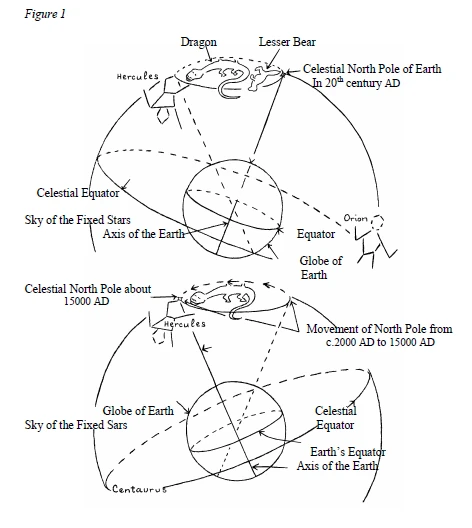
I saw with its celestial keys,
Its chords of air, its frets of fire,
The Samian’s great Aeolian lyre
Rising through all its sevenfold bars
From earth unto the fixed stars.
The Greeks regarded it as the instrument of the “music of the spheres”, the seven strings being the harmonic ratio of the order of the seven planets. A modern astronomer of the 17th century, Kepler, still had an understanding of that harmonic ratio of the distances of the planets, or the music of the spheres. This lyre is connected with that part of the sky in which we saw the stages of the dramatic ascent of Hercules to the heavens. He was endowed with the magic instrument leading to the realization of the harmonies of the spheres, the planetary spheres through which the soul passes after death.
Thus we can indeed find that the constellations of the stars were for the Greek mind something like a gigantic chronicle, in which they could read the deeds of a Divine world and their manifestations in humanity. There is nothing in this picture of the world that is not in its proper place and relationship. The entire sky is like a living organism; and if modern humanity experiences this picture as a chaotic and arbitrary assortment of Greek mythology, then the fault lies with the limitations of the modern mind, which can no longer comprehend the grandeur and meaning of ancient mythology.
We saw that the winter sky was, for the Greek mind, the grand vision of the opening phases of a struggle for the attainment of new capacities in humanity. In Greek terms these were the powers of thinking and of day-wake sense perception. At the same time, their attainment meant the closing of the door to more ancient faculties of penetration into the depths of the meaning of human existence. Thus, the vision of the summer sky was more an attempt and a hope than an actual achievement. It was the hope that one day divine guidance might again give to humanity the power to penetrate with that spiritual background of existence new faculties.
We can ultimately look at the Greek sky of mythology as an ingenious interpretation of the constellations of the Zodiac. The Zodiac was the expression of that closing of the door following in the wake of the new capacities. This had to happen. It was, so to speak, included in the divine plan of evolution in order to give humanity a chance to develop self-consciousness and independence. That the Zodiac was the vision of that central drama of the closing door of the Greek Age, is clearly expressed in the Greek interpretation of the constellation of Fishes, the last of which we have to discuss. It was connected with the myth of Venus and Cupid, or in Greek terms, with Aphrodite and Eros. Aphrodite and her son, Eros, were persecuted by a terrible giant, whose name is recorded as Typhon. In order to save them from destruction, the two were transformed into fishes. These, the Greeks said, are the two fishes that one can see in the constellation of Pisces.
In this seemingly simple story, we see the central drama of the Greek Age. Aphrodite is none other than the Egyptian Isis, or the Mesopotamian Ishtar of very ancient days. In Egyptian mythology, Isis is the wife, or sister of Osiris. We hear that Osiris was slain by his sinister brother Set, or Typhon. Thus, so the myth says, the glorious golden age of Egypt came to an end. Isis rescued the body of her divine husband, but again it was taken away by Set and cut up into 14 pieces. Then Isis collected the pieces and buried them in various places all over Egypt. The myth then goes on to say that temples dedicated to Osiris were erected above these burial places.
Thus we can see in Isis, the guardian of the ancient temples or mystery places. She was, in the garment of a female deity, the divine soul of Osiris, in whom we can see the being of the ancient, direct, Sun wisdom, working in the natural clairvoyance of an ancient humanity. The soul of Osiris-Isis was the reflection of the spiritual light of the Sun, as the Moon in the sky bears the reflection of the sunlight, and the being of Osiris was buried in the depths and the secrecy of the ancient temples.
Then came a time when even Isis and her son, Horus, were persecuted by the powers of darkness and spiritual ignorance. So she was transformed, and transferred into the world of the far distances of the universe. Another version even speaks clearly of Isis having been killed by Set-Typhon and put into the grave of the stars. We see here a remarkable difference; Osiris is put into the grave of the Earth, but Isis vanishes into the opposite direction, into the depths of the starry world.
We have here, indeed, a most masterful description of the “closing of the door”, which the Greek spirit saw approaching humanity. And we need not go very far in order to realize the actual facts in modern times. The world of the stars is the grave of Isis. The descendants of that original sun-like power of thinking, after having become the modern cold and deadening power of the intellect, have created aspects of the starry universe that indeed represent it as a graveyard. In ancient times, the external cosmos was the expression and manifestation of a powerful and creative Divine world. Since the 16th century AD, modern science has presented a universe that consists only of dead material bodies moved by sheer mechanical forces. The cosmos is considered to be a kind of gigantic, lifeless machine. This is the grave of Isis, after she had been slain by the power of the death-spreading intellectualism.
The myth also spoke of the age when Isis will rise again from her grave. Horus will grow up, it said, and will avenge the death of his father. This time seems to be at hand. The withdrawing Isis was experienced in Egypt as saying to those who still tried to approach her in the mysteries, “I am the Great Universe that was, that is, and that will be. No mortal being has ever lifted my veil.” To this, a modern poet and scientist, Novalis, remarked that, if no mortal being can lift the veil of Isis, then we must become immortals in order to find the mysteries again. Such a remark is a confirmation that the age of the awakening of Isis is approaching. It is certainly true, however, that we must first find the eternal, spiritual kernel of our own “human” being. Then, and only then, will we be able to see the living Isis again, the wisdom of the deity manifest in the world of the stars, face to face. Divine beings can die only in the consciousness of the human being, and it is there that they can also rise again. Through the means of modern spiritual science, the universe of the stars can be perceived as a living, breathing organism. Such concepts of the cosmos need not contradict the objective facts found by modern astronomy; however, in time they will certainly destroy the hypothetical conclusions that have been attached to the mere facts of astronomical research.
What is written here, however small and incomplete it may appear, seeks to be a contribution toward that high aim of the reawakening of Isis, the Divine Sophia. The forces of darkness, of Set, are still threatening humanity. Therefore, so much the more must we make the first steps toward the New.