

The Temple Legend and the Golden Legend
as a symbolic expression of humanity’s past
and future secrets of development
GA 93
2 January 19056, Berlin
Translated by Steiner Online Library
20. The Royal Art in a New Form
[ 1 ] Today I would like to speak to you about a subject that is the source of many misunderstandings and about which an extraordinary number of misconceptions are circulating in the world. Most of you know that I have already spoken on the same topic on the occasion of this year’s General Assembly, and that at that time, in accordance with an old occult custom, I addressed men and women separately. For certain reasons, which may become even clearer from the lecture itself, I have departed from this old occult custom today—precisely because the very reasons that prompted me to speak to you about this subject today, as well as at that time, are connected to the fact that sooner or later—hopefully sooner—this old custom will be abandoned altogether.
[ 2 ] I said: Many misunderstandings are widespread regarding this subject. I need only point to one fact from my own life that will show you that it really isn’t exactly easy today to move beyond the downright fanciful and superstitious notions that exist regarding this matter; and, on the other hand, I need only point out how easy it is to make a complete fool of oneself when faced with these extraordinary things.
[ 3 ] I would simply like to recount this fact from my life. You may find it hard to believe, and yet it is true. It was perhaps seventeen or eighteen years ago that I was in the company of university professors and some quite talented poets. Among the professors were also several theologians from the Faculty of Theology at the university in that town. They were Catholics. In this gathering, the following story was told in all seriousness. There was a well-founded rumor about one of these theologians—a very learned gentleman—that he no longer went out in the evenings because he believed that Freemasons were about. The man in question was an expert in a wide range of subjects. But he was not the one telling the story; it was someone else. This person recounted that during his stay in Rome, a number of monks from a certain order—eleven, twelve, or thirteen of them—had undertaken to swear to the following events.
[ 4 ] In Paris, a very prominent bishop once delivered a sermon in which he spoke about the terrible danger posed by the Masonic Order to the world. After the sermon, a man approached him in the sacristy and said that he was a Freemason and would like to give the bishop the opportunity to observe a meeting of the Order. The bishop agreed and thought to himself: “But I will take some consecrated relics with me so that I am protected.”—A location was then arranged. The man in question led the bishop into the lodge, where he was shown a hidden spot from which he could, however, observe everything that was taking place there. He took his seat, held his consecrated relics before him, and waited for what was to come. What he then saw was recounted as follows; I emphasize that among those present at the time were some who regarded the matter as debatable.
[ 5 ] The lodge would have been opened—it would in fact have been called the “Lodge of Satan,” while outwardly it had a completely different name—and a strange figure would have appeared. According to an old custom—he did not say where he had learned of this custom—it did not walk; as is well known, ghosts do not walk, but according to some beliefs, they glide. This strange figure would have opened the séance. The bishop absolutely refused to recount what would have happened next; it would have been too terrible. However, he would have invoked the full power of the relics, and then, like a clap of thunder, a cry rang out through all the ranks: “We have been betrayed!”—and the one who had presided over the séance vanished. In short, it was a resounding victory of the bishop’s powers over what was presumably intended to be done there.
[ 6 ] So this was discussed [in society] as a very serious matter. From this you can see that there are people in our time who were perhaps more learned than some others who have big names, and who nevertheless take the view that such events can occur in Freemasonry.
[ 7 ] The fact is that in the mid-1980s, a French book was published that depicted the secrets of Freemasonry in a truly gruesome manner—though it was more gruesome than mysterious. Specifically, the book described how Freemasons hold satanic rituals. This book was orchestrated by a French journalist named Leo Taxil. He caused quite a stir by subsequently presenting a woman named Miss Vaughan as a witness. As a result, the Church considered the Freemasons and their nocturnal activities so dangerous that it deemed it necessary to establish a worldwide alliance against them. A sort of council was held in Trent. It was not a true council, but it came to be known as the Second Council of Trent. It was attended by numerous bishops and hundreds of priests; a cardinal presided. [The congress was a great success for Taxil.] However, counter-writings were subsequently composed, and in response, Mr. Taxil declared that the entire content of his books, as well as the individuals mentioned therein, were his own inventions.
[ 8 ] As you can see, there are plenty of opportunities to make a complete fool of oneself in such matters. This was one of the worst embarrassments ever suffered by a widely recognized organization. From this, you must at least draw the conclusion that very little is actually known about Freemasonry. For if people knew particularly much about it—and could easily educate themselves on the subject—it would go without saying that such things could not be said or done.
[ 9 ] In wider circles of the public, various opinions about Freemasonry prevail today. It is not at all difficult these days to form an opinion, since there is a fairly extensive body of literature on the subject—some of which is written by those who have researched many documents, while other parts contain information that Freemasons would say has been leaked to the outside world by traitors. Anyone who familiarizes themselves with this literature to some extent will gain a certain understanding of what it is all about. However, gaining a true understanding of it is entirely out of the question, precisely because what Lessing—who was himself a member of the Masonic Order—said is even more true today. For when he was initiated, the Master of the Chair asked him: “Surely you can see for yourself that you are not being initiated into anything that is particularly hostile to the state or religion?” — And Lessing replied: “Yes, I must admit, I have not learned such things. I would certainly be glad if I had learned something like that, for then I would at least have learned something.”
[ 10 ] This is the statement of a person who was able to view the matter with sound judgment and who admitted that he had learned absolutely nothing from what had been going on there. From this, however, you can at least conclude that those outside Freemasonry know nothing, but that even those within it know nothing of substance; they usually come to the conclusion that they have gained nothing of particular value. And yet it would be entirely wrong to draw such a conclusion.
[ 11 ] There is also another theory, though it has little to do with Freemasonry proper. There is a treatise, published in 1875, in which the author claims that Adam was the first Freemason. However, when searching for the founder of a fraternity, one can hardly go back further than to the first human being.
[ 12 ] Others claim that Freemasonry is an ancient Egyptian art—in short, what has always been called the “Royal Art”—and some trace even this back to the most ancient times. Finally, many rites—that is, the symbolic practices of Freemasons—bear Egyptian names, so that these names alone serve as an indication that they stem from ancient Egyptian culture. In any case, the view is widespread both within and outside Freemasonry that it is something ancient.
[ 13 ] Now, Freemasonry is something that can certainly give people pause for thought. Even the name itself gives rise to two entirely different views. One school of thought—and this is not a very large faction within Freemasonry—asserts that all Freemasonry originated from the craft of masonry, from the art of constructing buildings; while the other faction dismisses this as a childishly naive view and maintains that Freemasonry has in truth always been a spiritual art, and that the symbols borrowed from the craft of masonry—such as the apron, the hammer, trowel, chisel, compass, ruler, square, plumb line, spirit level, and so on—should be regarded as symbols of the inner work on the human being himself. Thus, the term “Masonry” is understood to mean nothing other than the building of the inner self, the work of one’s own self-improvement. If you speak with a Freemason today, you will find that they will tell you it is a childishly naïve view to believe that Freemasonry ever had anything to do with stonemasonry. Rather, it has never been about anything other than building the wondrous temple that is the seat of the human soul, working on this human soul itself—which is to be perfected—and the art that must be applied to achieve this. All of this, so as not to expose it to the eyes of the uninitiated, has been expressed through these symbols.
[ 14 ] From our present-day perspective, both views are entirely incorrect. This is because, with regard to the first view, people today—when they speak of Freemasonry having emerged from stonemasonry—no longer attach as much significance to this as they actually should; and because the second view—that the symbols exist solely to serve as allegories for the work on the soul—even though it is presented by the majority of the Masonic Order as an irrefutable certainty—is, when properly understood, nonsense. It is far more accurate to say that Freemasonry is connected to stonemasonry, though not in the way that stonemasonry and architecture are understood today, but in a much deeper sense.
[ 15 ] Today, there are two branches within Freemasonry everywhere. One is represented by the far greater number of those who call themselves Freemasons today. And this vast majority now claims that all Freemasonry is encompassed by what they call “symbolic” or “Johannine” Freemasonry, which is outwardly characterized, first and foremost, by its division into three degrees: the degree of apprentice, the degree of fellow craft, and the degree of master mason; we will have more to say about the inner aspects shortly. In addition to this Johannine Freemasonry, there is still a large number of Freemasons who claim that this Johannine Freemasonry is merely a product of the decline of the general, grand Masonic ideal. It is a departure from this grand Masonic ideal, they say, to claim that Freemasonry comprises only these three symbolic or Johannine degrees, whereas the essence, the great significance of Freemasonry, lies in the so-called High Degrees, which are preserved in their purest form in the so-called Scottish or Accepted Rite, in which, in a certain sense, that which is called the Egyptian Rite, the Misraim or Memphis Rite, is preserved.
[ 16 ] Thus, we have two opposing movements: Johannine Freemasonry and High-Degree Freemasonry. The Johannite Freemasons claim that high-degree Freemasonry is nothing more than a frivolity, founded on human vanity, which takes pleasure in possessing something special and spiritually aristocratic for itself through the ascent from degree to degree, and in boasting of holding the 18th, 20th, or even higher degrees.
[ 17 ] You have already learned quite a few things that are likely to lead to misunderstandings.
[ 18 ] High-degree Freemasonry traces its origins back to the ancient mysteries, to the institutions as they have been and are described by our theosophy to the extent possible: to institutions that existed in ancient times and still exist today, and which have preserved higher supersensible knowledge for humanity. This supersensible knowledge, accessible to human beings, was imparted to those who were able to gain access to these mystery schools by developing within themselves certain supersensible powers that made it possible to perceive the supersensible world. Within these primordial mysteries—which have changed today, and which we do not wish to discuss at this time—were also contained the primordial seeds of all subsequent spiritual culture. For what was presented in these primordial mysteries was not what constitutes human culture today.
[ 19 ] If you wish to understand today’s culture and delve deeply into it, you will find that it can be divided into three realms: the realm of wisdom, the realm of beauty, and the realm of strength. These three words, in fact, encompass the entire scope of spiritual culture. They are therefore also called the three pillars of human culture. They are the same as the three kings in Goethe’s fairy tale of the Green Snake and the Beautiful Lily: the golden king, the silver king, and the bronze king. This is why Freemasonry is called the “Royal Art.” Today, these cultural realms are separated from one another. Wisdom is essentially contained in what we call science; beauty is essentially embodied in what we call art; and what, in Masonic terms, is called strength is contained in the structured, organized social coexistence of people within the state. The Mason summarizes all of this as the relationship of the will to these three elements: wisdom, beauty, and strength.
[ 20 ] In ancient times, what they were meant to give to humanity flowed to the candidates for the mysteries from their contemplation of the mysteries’ secrets. We are looking back to a time when religion, science, and art did not yet exist separately, but were still united. Indeed, those who are able to perceive in the supersensible, astral realm do not see these three elements as separate: wisdom, beauty, and the sphere of volitional impulses form a unity for them. In the higher realms of perception, there is no such thing as abstract science. There is only a science that lives in images, in that which has only a shadowy existence in the world and is expressed in a shadowy way in the imagination. One did not describe what can be read in an abstract manner in books or in this or that account of creation [concerning the origin of the world and of humankind]; rather, one presented it in living images—vibrant with color and resounding with sound—before the student’s eyes. And what the student perceived there as wisdom was at the same time art and beauty; it was that which stirred, to an even greater degree, the feelings we experience when we stand before sublime works of art. The drive for truth and beauty, the drive for wisdom and art, and also the religious element developed simultaneously. The artist’s eye looked upon what was taking place [in the mysteries], and those who wished to be devout found in these higher processes, unfolding before their eyes, the object of their religious fervor. Religion, art, and science were one.
[ 21 ] Then came the time when this unity split into three cultural regions, the time when the intellect went its own way. At the time when the mysteries I have just described lost their significance, science arose. You know that Western philosophy and science—true science—begins with Thales. That was the time when it developed out of the former richness of the mystery tradition. That was also when what is understood in the Western sense as art began: Greek dramatic art then developed out of the mysteries. Whereas in India and even in Egyptian worship one dealt with the suffering and dying deity, the great Greek tragic poets—Aeschylus, Sophocles, and so on—one is dealing with individual characters who are images of the great deity, through whom the initiate reconstructs in his dramas the suffering, struggling, and afflicted deity, and thus presents the god to the beholder in his human images.
[ 22 ] Anyone who wants to understand what Aristotle meant by “purification,” or catharsis, must explain the concept in terms of the astral realm and the secrets of the mysteries. The terms he uses [to explain] tragedy are a faint reflection of what the initiate learned in the Mysteries. Recall how Lessing investigated the powers of the soul—fear and pity—that are supposed to be aroused by tragedy. Since Lessing’s time, this has been the subject of many great and scholarly discussions. In truth, these feelings were aroused in [the mystery student] when the god was presented to him in his cosmic journey. There, the passions present in the human soul were literally stirred up, drawn out—as one draws out a fever—and brought to their peak. Through this, purification took place, so that one could then proceed to rebirth. All of this appeared in shadowy reflections in the ancient Greek tragedies. Just as science did, art, too, developed out of these ancient mysteries.
[ 23 ] High-degree Masons trace their origins back to these ancient mysteries. Their high degrees are nothing more than a replica of the high degrees of the mysteries, into which the initiates were gradually initiated. Now we can also understand why Johannine Freemasonry is so adamant that such high degrees should no longer exist. In fact, within Freemasonry over the past few centuries, the high degrees have more or less lost their significance. What has taken place in culture over the past few centuries has, for the most part, come about without any impetus from this quarter. But there was a time when the great cultural impulses emanated precisely from what Freemasonry is meant to be. To understand this, we must look a little deeper into an era to which I have referred here on several occasions, but which I would like to highlight today from a Masonic perspective: namely, the 12th century of our European cultural development.
[ 24 ] Back then, occultism—which appeared under a wide variety of names—played a much greater role in modern culture as a whole than anyone can even imagine today. But all these different names are no longer relevant today, and I will also tell you why. Using an example from Freemasonry itself, I want to show you why these names do not contribute anything essential to an understanding of the matter.
[ 25 ] What I am about to describe is something that anyone who becomes an apprentice in Freemasonry can already experience, and since these things are known, at least by name, I can certainly mention them.
[ 26 ] A common custom is what is known as “Decken.” When the lodge is opened, the Master has taken his seat, and the Door Keeper stands at the door, the Master’s first question is: “Brother Keeper, is the lodge covered?” — Very few Masons probably understand this expression: “Is the lodge covered?” But since the matter is simple, I can already explain this expression to you. Back then, in the era I am referring to, being a Freemason meant being in fierce opposition to everything associated with external, official authority. Therefore, it was necessary for the activities of the Masonic Order to be conducted with the utmost caution. Precisely for this reason, it was necessary at that time for Freemasonry to operate under various names that appeared harmless. Among other things, they called themselves the Brothers of St. John and so on. Today, a large part of what Freemasonry strove for back then has been realized. Today, it is itself officially a power in the world.
[ 27 ] If you ask me what Freemasonry actually consists of, I must answer in abstract terms: it consists of its members anticipating, several centuries in advance, the events that are to advance the world; of their deliberately developing the lofty ideals of humanity, so that these ideals are not merely abstract ideas.
[ 28 ] When a Mason speaks of ideals today and is asked what he means by the highest ideals, he says: “The highest ideals are wisdom, beauty, and strength”—but on closer inspection, this is usually nothing more than a cliché. When, in the past or even today, those who truly understand these matters speak of these ideals, they are referring to something very specific; something so specific that it relates to the course of events over the next few centuries in the same way that the vision of an architect building a factory relates to that factory once it is built.
[ 29 ] Back then [in the 12th century], it was dangerous to know [in advance] what has since come to pass. That is why it was also necessary to use innocuous-sounding names as code names. And that is also where this expression comes from: “Is this lodge covered?”—which means: “Are only those present here who truly know about these matters, which are to be incorporated into the future of human development through Freemasonry?” - For everyone had to tell themselves: if we appear in public, no one must recognize us as Freemasons. This precaution, once necessary, has persisted into our own time. Whether many Freemasons know what is meant by this is questionable. Most think it is some kind of formal phrase, or interpret it in a more or less witty way. I could cite countless other examples that would show you how external circumstances have led to the adoption of practical measures, from which people today strive to derive profound symbolic interpretations.
[ 30 ] But now let us turn to the very essence of what was intended back in the 12th century. This is expressed in the symbolically profound legend of the Holy Grail, that wondrous vessel said to have originated in the distant Orient and to possess the power to rejuvenate people, bring the dead back to life, and so on.
[ 31 ] What, then, is the Holy Grail—from a Masonic perspective—and what is the underlying theme of the entire legend? The easiest way to understand what underlies the legend is to consider a symbol used by certain Masonic organizations, one that is misunderstood today in the most crude way imaginable. It is a symbol drawn from sexual life. It is absolutely true that precisely what belongs to the deepest mysteries of Freemasonry consists of symbols drawn from sexual life, and that many who today attempt to interpret such symbols are merely following their own dirty imaginations when they interpret these symbols in a spiritually impure sense. It is very likely that the interpretation of these sexual symbols will play no small role in the near future, and that this very fact will soon reveal both how badly the ancient, great secrets of Freemasonry are faring in the present day and, on the other hand, how necessary it is in this day and age to preserve the pure, noble, and profound foundation of Masonic symbols in a lofty and untainted manner.
[ 32 ] Those who heard my recent lecture at the General Assembly know that the actual original meaning of these symbols is why, until recently, women were not admitted to Freemasonry, and why, until recently, such matters could only be discussed separately with men and women. On the other hand, you also know that these symbols are connected—and I emphasize this in particular—to the two great currents that run through the entire world and extend even into the highest spiritual realms, currents that confront us as the law of polarity, including in the forces of the masculine and the feminine. Within the culture that is relevant to us, Masonic language expresses the priestly principle in the feminine principle in the spiritual realm—the spiritual realm that is of primary importance for cultural development. Priestly rule is expressed through the feminine. The masculine principle, on the other hand, is everything that stands in opposition to this priestly rule—but in such a way that this opposition represents nothing less than the holiest, the noblest, the greatest, and the most spiritual in the world. We are thus dealing with two currents: a feminine and a masculine current. The Mason sees Abel as the representative of the feminine current and Cain as the representative of the masculine current.
[ 33 ] This brings us to the fundamental idea of Freemasonry, which is, however, ancient—truly ancient. Freemasonry emerged in ancient times as a counterpoint to priestly culture. But we must also properly understand what was meant by “priestly culture.”
[ 34 ] What is at issue here has nothing to do with petty opposition to churches or creeds. For the “priestly element” can indeed manifest itself even in the most perfect form of lay life. But even what appears today as science and prevails in many intellectual circles is nothing other than what, in Masonic terms, is called the “priestly element”; and other things, in turn, are Masonic in the deepest sense. We must therefore consider these matters in all their depth if we are to understand them correctly. I would like to illustrate with an example that what appears in science is often precisely what the Mason refers to as the priestly element.
[ 35 ] What doctor today would not laugh derisively if someone were to tell him about the healing properties of the Lourdes spring? On the other hand, what doctor would not consider it self-evident that for certain people, the most rational course of action is to go to Wiesbaden or Karlsbad? I know that I am expressing something terribly heretical; but I do not advocate the priestly principle, nor do I advocate medicine; yet a time will come when people will judge both impartially. And if there were true medicine today, belief in healing power would be among the things the doctor prescribes. But then the reasons for which he sends someone to Karlsbad would be the same as those for which someone else sends someone to Lourdes. Call it, on the one hand, the greatest piety, and on the other, the crassest superstition: in the end, it is the same thing.
[ 36 ] What underlies the principle of the priest understood in this way can be described as a failure to get to the bottom of things, as an acceptance of things as they present themselves from somewhere in the world, and as being content with what is given. The symbol for that which is beyond human control—the very emblem of what is, in the truest sense of the word, given to humankind—has been drawn from sexual life. There, human beings are productive. But what is expressed in this productive power has nothing to do with human art, nothing with human knowledge, and nothing with human skill. It excludes everything that can be expressed through the three pillars of the “Royal Art.” Therefore, when certain Freemasons place sexual symbols before the human race, they mean to say: This is how human nature expresses itself—not as man has made it, but as it has been given to him by the gods. This finds its expression in Abel, the hunter and shepherd, who sacrifices the sacrificial animal, the sacrificial lamb—that is, something he himself did nothing to bring into being, something that came into being without him.
[ 37 ] Cain, on the other hand, what does he offer as a sacrifice? He offers what he has produced himself—the fruits of the field he has harvested by tilling the soil. He offers that which required human skill, knowledge, and wisdom; that which one must be able to comprehend, where one must be clear about what one has made oneself—something that, in a spiritual sense, is based on human freedom and self-determination. One must earn this through guilt, by first killing the living thing given by nature or by the divine powers, just as Cain killed Abel.
[ 38 ] The path to freedom lies through guilt. Everything that is brought forth in the world—and in which human beings can, at most, play an active role through their contribution— everything that is bestowed upon humankind by the divine powers—that which exists without humankind having to labor ceaselessly to bring it about—is first given to us in the realms of nature over which we have no dominion, in the realms of nature whose forces are beyond human influence: in the plant, animal, and human kingdoms, insofar as these realms concern physical production. All reproductive power in these kingdoms is bestowed upon us by nature. Insofar as we accept the living for our own use—by making the world, which is built up from the living, our dwelling place—we sacrifice the animal given to us, just as Abel sacrificed the animal given to him.
[ 39 ] The symbol of these three kingdoms is the cross. The lower bar symbolizes the plant kingdom, the middle bar—the crossbar—the animal kingdom, and the upper bar the human kingdom.
[ 40 ] The plant’s root is sunk into the ground, and in its bloom it directs upward what humans have directed downward. What comes to light in the bloom is the plant’s sexuality, its gender. The downward-pointing part, the root, is the plant’s head, sunk into the earth. The animal is the partially inverted plant, with its spine oriented horizontally toward the ground. The completely inverted plant, with its lower part pointing upward, is the human being.
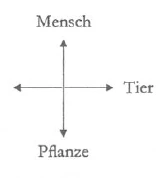
[ 41 ] This view underlies all the mysteries of the Cross. And when theosophy shows us how human beings, in the course of their evolution, must pass through the various kingdoms—the plant, animal, and human kingdoms—this is the same idea that Plato expresses in these beautiful words: The world soul is nailed to the cross of the world body. - The human soul is a spark of the world soul, and human beings, as physical beings, are at the same time plants, animals, and physical human beings. By dividing itself into the individual sparks of human souls, the world soul has, so to speak, been nailed to the world cross—that which finds expression in the three kingdoms: the plant, animal, and human kingdoms. Forces are at work in these kingdoms that human beings cannot master. If they wish to become masters, they must make a new kingdom their very own—one that is not expressed in the Cross.
[ 42 ] When I speak about this subject, people often ask: Where, then, is the mineral kingdom? — The mineral kingdom is not symbolized by the cross. For it is the kingdom in which human beings can already express themselves today with bright, clear lucidity, where they learn to apply the arts of weighing and counting, geometry and arithmetic—in short, all the things that belong to inorganic nature—to the inorganic, mineral kingdom.
[ 43 ] When you stand before a temple, you know that it was erected by human hands using a ruler, compass, set square, plumb line, and level—and, ultimately, with the ideas that inorganic nature has imparted to the architect through geometry and mechanics. And if you examine the entire temple, you will find that this temple—insofar as it is inanimate—has emerged from human freedom and intellectual labor. But you cannot say the same if you subject a plant or an animal to human observation.
[ 44 ] So you see that what human beings have mastered—the realm in which they can be masters—remains, to this day, the realm of the inanimate. And everything that human beings bring from the inanimate realm into harmony and order is the symbol of their royal art on Earth. What they imbue into this mineral realm through this royal art of theirs has, in the first instance, been the outflow and incarnation of divine wisdom. Go back to the time of the ancient Chaldeans and the ancient Egyptians, when people did not merely build with the intellect but imbued everything with lofty feelings; there, the mastery of inorganic nature was perceived as the “Royal Art.” And that is why this mastery of nature was then referred to as “free masonry.” While this may at first seem like a fantasy, it is more than that.
[ 45 ] Imagine for a moment that point in Earth’s history when no human had yet intervened in the shaping of inorganic nature, when the entire globe was left to humanity just as nature had created it! And what happened then? Look back at the construction of the Egyptian pyramids, where stone upon stone was set together by human hands. Through human thought, what nature had formed was transformed into new shapes. In this way, human wisdom has reshaped the Earth. This was perceived as the true mission of the free, creative human being on Earth. Through a variety of tools, human power—from ancient times right up to the present day, when human power can act even in the farthest reaches without mechanical mediation—has brought about the gradual transformation of the mineral realm through human wisdom. And this is the first pillar, the pillar of wisdom.
[ 46 ] A little later, we see the second pillar come into play: the pillar of beauty, of art. Through art, too, the human spirit is poured into inanimate matter, thereby once again bringing about an animation (conquest) of the inanimate elements found in nature. Try to imagine how, in a gradual transition, the wisdom in art masters lifeless nature, and you will see how, piece by piece, that which exists without human intervention is transformed by human beings themselves. For my sake, imagine—in a fantastical way—the moment when the entire Earth will have been transformed by human hands, when the entire Earth will have become a work of art radiating wisdom and beauty, built by human hands, conceived by human wisdom! It may seem fantastical; but it is more than that. For it is the mission of the human race on Earth to artistically transform the globe. You expressed this in the second pillar, the pillar of beauty.
[ 47 ] To this you can add, as the third pillar, the shaping of the human race in the life of the state and among nations, and you have the spread of the human spirit throughout the world; you find it here as well, in the realm of the inanimate.
[ 48 ] That is why the medieval people of the 12th century, looking back on the wisdom of antiquity, told themselves that the wisdom of ancient times is preserved in marble monuments, while the wisdom of the present still rests within the human heart. It then emerges through the artist and, through the work of his hands, becomes a work of art. What the artist feels, he imprints upon the unformed material, chiseling it out of the lifeless stone. Although the lifeless stone itself does not come to life, the inner soul of the human being is revealed within it. Everything in art is dedicated to this mission. Whether the sculptor chisels the marble or the painter applies colors, light, and shadow, it is always a mastery of inanimate, inorganic nature. And the statesman, too, shapes nature [?] ... you are always dealing—insofar as the forces of plants, animals, and humans are not taken into account—with the human spirit itself.
[ 49 ] Thus, the 12th-century medieval thinker looked back upon the ancient Chaldean occult wisdom, upon Greek art and beauty, and upon the strength inherent in the political ideal of the Roman Empire. These are the three great pillars of world history: wisdom, beauty, and strength. Goethe depicted them in his “Fairy Tale” through the three kings: the golden king representing occult wisdom; the silver king representing beauty, as in Greece; and the bronze king representing strength, which found its expression in world history through the Roman concept of the state and then passed into the organization of the Christian Church. And the Middle Ages, with its chaos caused by the upheavals of the Migration Period and its mixed styles, is expressed in the shapeless, composite king, who is formed of gold, silver, and bronze. In him, what was distributed among the various cultures of antiquity is thrown into disarray. Only later must the individual forces emerge from the chaos to develop into a higher stage.
[ 50 ] Those who, in the Middle Ages, regarded the Holy Grail as their great symbol set themselves the task of elevating these individual forces to a higher level through human effort. The Holy Grail was meant to be something fundamentally new, even though its symbolism initially drew upon ancient, legendary traditions and their allegories.
[ 51 ] So what is the Holy Grail? For those who truly understand this legend, it means the following—and this can even be demonstrated through literary analysis.
[ 52 ] So far, humankind has mastered only the inanimate aspects of nature. The transformation of living forces—the transformation of what sprouts and grows in plants, and what manifests in animal [and human] reproduction—lies beyond its power. Humanity must leave these mysterious forces of nature untouched. It cannot intervene there. What arises through these forces cannot be fully comprehended by humanity. The artist may indeed create a Zeus of wondrous beauty, but he cannot fully comprehend this Zeus. In the future, humankind will reach a stage where it will be able to do so. Just as it is true that humankind has gained mastery over inanimate nature—controlling gravity with a spirit level and plumb line, and the directional forces of nature with the tools available to it in geometry and mechanics— it is equally true that in the future they will master through their own efforts that which they today possess only as a gift from nature or the divine powers: the living.
[ 53 ] By offering up in the past what he had received from the hand of God, Abel also offers, in the realm of the living, only what he has received from nature. Cain, on the other hand, offered what he had wrested from the earth through his own labor as the fruit of his diligence. That is why a fundamentally new direction emerges in Freemasonry during this period [the Middle Ages]. And this direction is the one symbolized by the Holy Grail: the power of self-sacrifice. I have said many times before: Harmony within humanity is not created by preaching it, but by establishing it. Where true powers are awakened in human nature, there is no longer any lack of brotherhood. In what is expressed in Masonic symbols, majority and minority have no significance. There can be no dispute there, for it is solely a matter of ability or lack thereof. No majority can decide whether the plumb line or the spirit level should be used; the matter itself must decide. In this, all people are brothers; here, all find common ground. There can be no dispute about this if everyone follows the path of objectivity—the path that consists in the acquisition of higher powers. Thus, the Fraternity [of Freemasons] is, of course, a fraternity that is based, to the greatest extent, on what humans have in common with inanimate nature.
[ 54 ] However, not all forces are present in inanimate nature anymore. Some things that once existed have disappeared again because, in the cycle of nature in which we currently find ourselves—and which we call Earth—material knowledge takes center stage, while intuitive knowledge has been lost. I would like to point out just one fact here: the ability to create truly acoustically sound buildings has been completely lost in architecture. Yet this art was once understood. Anyone who constructs a building solely on the basis of its external form will never achieve good acoustics. But those who think intuitively, whose thinking is rooted in higher realms, will be able to create acoustically sound buildings. Those who know this also know that just as gravity, light, and electricity have been harnessed by humans in inanimate nature, so too will those forces in the future—over which we still have no control today—need to be harnessed, as far as the external natural world is concerned.
[ 55 ] Even if our time has not yet come to be able to rule over outer, living nature, even if that cultural epoch has not yet been reached in which even the living, life-giving forces are mastered, there is already today a preparatory stage for this, which was inaugurated by that movement known as the Lodge of the Holy Grail. But the time will come—and there is a very specific moment—when people, departing from their current inclinations, will realize that decisions regarding deeper inner soul forces cannot be made by majority vote; that it is impossible to determine, through a vote, matters concerning the vast realm of love, or what one perceives and feels. The force that lives uniformly within all human beings and that expresses itself in the intellectual realm as that great unity over which there can be no dispute is called Manas. And when human beings have reached the point where they are in agreement not only intellectually but also in their sensibilities and feelings, harmonizing in their deepest soul life, finding common ground in what is noble and good, and come together in love in the objective, in the common—just as they already come together without dispute today in the fact that two times two is four and three times three is nine—then the time will have come when human beings will also be able to master the living. Unity—objective unity in perception and feeling—a truly objective life in love poured out over all humanity: this is the prerequisite for mastering the living world.
[ 56 ] This mastery of the living once existed—so say those who founded the Holy Grail movement in the 12th century—it existed among the gods who created the cosmos and descended to give humankind the seed of these divine powers that they themselves possessed: so that man today is a god-in-the-making, since there is something within him that strives upward, toward where the gods once stood. Today, reason—the intellect—is the ruling force; love [Buddhi] will become so in the future, and in even more distant times, man will attain the level of Atma.
[ 57 ] This collective power (the power of community), which gives human beings power over that which, through the cross

[ 58 ] is symbolized; it is—insofar as this power pertains to the gods—expressed by a symbol, namely, the triangle pointing downward. And insofar as this power expresses itself in human nature—as it strives upward toward the divine power in a seed-like manner—it is symbolized by a triangle with its apex pointing upward. The gods have risen above humanity and distanced themselves from it; but they have left behind in humanity the triangle, which will continue to develop within it. This triangle is also the symbol of the Holy Grail.

[ 59 ] Medieval occultists used the shape of a triangle to represent the symbol of the Holy Grail, the emblem of the awakening of mastery within living beings. This does not require a single, unified church with a rigid organizational structure that wraps itself around the globe; such a church may well offer something to the individual soul; but if all souls are to harmonize, the power of the Grail must be awakened within each one. It is of no use for one who wishes to awaken this power of the Grail within himself to turn to the official ecclesiastical authorities to ask if they might have something to say to him; rather, he must ask few questions and awaken this power from within himself. Human beings begin in a state of dullness and ascend through doubt to the power. This pilgrimage of the soul is expressed in the figure of Parzival, who makes a pilgrimage to the Holy Grail. This is one of the manifold, deeper meanings of the figure of Parzival.
[ 60 ] What good is it to my knowledge if even the largest organization proclaims the truth of mathematics through its official bodies? If I want to learn to understand mathematics, I must engage with it myself and acquire an understanding of it. And what good is it if an organization embodies the power of the Cross? If I wish to apply the power of the Cross—the mastery of the living—then I must attain it myself. Another cannot tell me this, nor convey it through words; at most, he can show it to me symbolically, by giving me the luminous symbol of the Grail, but he cannot express it in intellectual formulas.
[ 61 ] The first manifestation of this medieval occultism would thus be what is asserting itself in the most diverse movements across Europe: the quest for individuality in religion, the breaking away from the rigid, uniform church organization. It is difficult to fully grasp just how much of Wolfram von Eschenbach’s Parzival is rooted in this direction. What only came to expression during the Reformation is already fully contained in the symbol of the Holy Grail. Anyone who has a sense of the great significance of what this symbolism reveals to us will recognize the profound cultural value of such symbolism. Greatness in the world is born not from what resounds loudly, not from tumult, but from what is intimate and silent. Humanity is not propelled forward in its development by the roar of cannon fire, but by the power of what is intimately born in such secret societies, by the power of what is expressed in such universal symbols, through which humanity lifts itself up.
[ 62 ] Since that time, through countless sources, what was thought by those who were initiated into the mysteries of the Holy Grail in the middle of the 12th century—who had to hide from the world under pseudonyms but were in fact the pioneers, the leaven of culture over the last four hundred years—has flowed into the hearts of people.
[ 63 ] Thus, within the occult societies live the guardians of great secrets and of those forces that continue to influence the development of humanity. I can only hint at what is actually involved here, for the matter itself extends deep, deep into the occult realm.
[ 64 ] For those who truly gain access to such mysteries, a practical consequence is a clear overview of what will happen [in the future] in the world.
[ 65 ] Slowly and gradually, organic, living forces are beginning to influence humanity’s current cycle of development. A time will come—as fantastical as it may seem to people today—when human beings will no longer merely paint pictures or create lifeless sculptures, but will be able to create, in a living form, what they can today only paint or shape with paint and a chisel.
[ 66 ] What will seem less fantastical, however, is the fact that even today, in the fabric of social life, the first dawn of the use of these living forces is beginning to break: the very secret that surrounds the Grail. The last event in the social sphere brought about by ancient Freemasonry was the French Revolution, in which the fundamental idea of ancient Freemasonry in the social sphere—the ideas of equality, liberty, and fraternity—was consistently brought into the public sphere. Those who know this also know that the ideas originating from the Grail were disseminated through countless channels and were, in fact, the active forces behind the French Revolution.
[ 67 ] What is today called socialism stands there merely as a failed, an impossible attempt—as a final, I would say, desperate struggle within the wave of humanity that is drawing to a close. It cannot bring about a truly positive result. What it is meant to achieve can only be achieved through living action; the pillar of strength is not enough. Socialism can no longer be mastered by lifeless forces. The ideas of the French Revolution—liberty, equality, fraternity—were the last ideas to flow from the lifeless. Everything that remains on the same track is fruitless and doomed to die. For the great evil existing in the world today—the immense misery that manifests itself with such terrible force in what is called the social question—can no longer be overcome by the lifeless. This requires a royal art; and it is this royal art that has been inaugurated in the symbol of the Holy Grail.
[ 68 ] Through this royal art, human beings must acquire something akin to the power that causes a plant to sprout—the same power that the magician employs when he causes the plant before him to grow more rapidly. In a similar way, a portion of this power must be used for the benefit of society. This power, which has been described by those who know something of the Rosicrucian mysteries—such as Bulwer in his futuristic novel Vril—is currently still in an elementary, embryonic state. In the Freemasonry of the future, it will be the very essence of the higher degrees. The royal art will be a social art in the future.
[ 69 ] Once again—and I would say, because of the all-encompassing, all-enveloping nature of the idea—I must say something that will seem fantastical to the uninitiated. That which human beings impress upon matter on our earthly sphere as the form emanating from their souls is eternal and imperishable. Even if the shaped matter decays outwardly, that which the royal art has shaped since time immemorial in pyramids, temples, and churches is imperishable. What the human spirit has shaped in matter remains present in the world as a force that continues to work. This becomes completely clear to those who are initiated into such matters. The Gothic Cathedral of Cologne, for example, will pass away; yet the fact that the atoms once existed in this form is of far-reaching significance. This form itself is the imperishable element that will henceforth contribute to the ongoing development of humanity just as the living force within the plant contributes to the ongoing development of nature! The painter who paints a picture today, who imprints the blood of his soul upon lifeless matter, also creates something that will, in a shorter or longer period of time, disintegrate into a thousand atoms. But the fact that he has created it—that something from his soul has flowed into the material, that something has been formed at all—has an imperishable, enduring value; it has eternal value.
[ 70 ] Nations and all other human communities, too, arise and pass away before our very eyes. But what human beings have formed from the depths of their souls as such communities are the ideas they have imbued them with—ideas of eternal value, with significance that endures forever. And when the human race reappears on Earth in a new form, it will behold the fruits of these elements of eternal value.
[ 71 ] Anyone who looks up at the starry sky today sees a wonderful harmony. This harmony has come into being; it was not always there. Just as we today lay stone upon stone when we build a cathedral, place color beside color when we paint pictures, and formulate law after law when we organize societies, so too did creative beings once work on what we now encounter as the cosmos. Neither the moon nor the sun would shine, nor would any animal or plant reproduce, if everything we encounter in the cosmos had not been shaped by beings, if there had not been beings before us who worked just as we work today to transform the cosmos. Just as we today build the cosmos through wisdom, beauty, and strength, so too did the beings—who do not belong to the present human realm—once build the cosmos.
[ 72 ] Harmony is always the result of the disharmonies of earlier times. Just as the stones were shaped into a Greek temple, just as they thereby flowed into other forms and the bewildering diversity gave rise to an orderly structure, and just as the jumble of colors on the palette is meaningfully arranged in the painting, so too was the entire material world chaotically arranged in other combinations before the creative spirit shaped it into this cosmos. The same process repeats itself at a new level, and even in the smallest things, only those who grasp the greatest picture act correctly. Everything in the world that has truly been significant for the progress of the human race has come into being through prudence and insight, through initiation into the great laws of the world plan. What the day creates is fleeting. But that which is created in the day from the knowledge of the eternal laws is imperishable. To create in the day from the knowledge of the eternal laws—that is tantamount to free masonry.
[ 73 ] So you see that, in fact, whatever we encounter in art, science, and religion—insofar as it is not a gift from the gods and is expressed in the symbol of the cross—has emerged from free masonry. From it has sprung what has truly been built in the world. Therefore, Freemasonry is first and foremost connected to everything that human hands have shaped in the world—to what has created culture out of raw, lifeless matter. Look back at what the great cultural epochs have produced; consider, for example, Alomer’s poems! What do they contain? That which the initiates have taught humanity as the great, universal ideas. The great artists did not invent their subject matter; rather, they gave form to what encompasses all of humanity. Is a Michelangelo conceivable without Christian spiritual forces? Try, in a similar way, to trace back to its origin whatever has attained deep, truly profound significance in culture, and you will be led back everywhere to that which sprang from initiation.
[ 74 ] Everything must ultimately pass through a school. The last four centuries have also been a school for humanity: the school of being forsaken by God, in which there is only human trial and error—from a certain point of view, a regression into chaos. Today, everyone is experimenting without knowing the connection to the higher worlds—with the exception of those who have once again sought and found that connection to the spiritual worlds. Today, almost everyone lives entirely for themselves, unaware of the real, all-pervading common structure. This has also given rise to terrible dissatisfaction in all areas.
[ 75 ] What we need is a renewal of the Order of the Grail in a modern form. Those who can draw closer to it will thereby come to know the true forces that are still hidden in the course of human development today.
[ 76 ] What many people today—who take the ancient symbols and do not understand them—misinterpret as sexual symbols is far from the correct understanding of Masonic thought. Understanding is to be found in that which supersedes mere natural force: to master and penetrate the living in much the same way as the geometer masters and penetrates the inanimate with a ruler, compass, spirit level, and so on; to create the living just as one who builds a temple joins together inanimate stones. This is the great vision of the future of Freemasonry.
[ 77 ] There is an ancient symbol in Freemasonry known as the Tau:

[ 78 ] This Tau symbol plays a major role in Freemasonry. It is, in essence, nothing more than a cross with the upper beam omitted. The mineral kingdom is omitted in order to arrive at the cross in the first place; humankind already masters it. If one allows the plant kingdom to come into play, one obtains the upward-pointing cross...2See the notes on page 347. That which unfolds from the earth, from the soul, as a power over the earth, is the symbol of future Masonry.
[ 79 ] Anyone who heard my previous lecture on Freemasonry will recall that I mentioned at the time that the Masonic legend of Hiram Abiff recounts how he intervened at a certain point using the Tau sign. The Queen of Sheba wished for him to summon once more the workers who were engaged in building the temple. At Solomon’s signal, the people working together in social community never appeared. At the sign of the Tau—raised by Hiram Abiff—the people appeared from all sides. This sign of the Tau symbolizes an entirely new power, founded on freedom and consisting in the awakening of an entirely new force of nature.
[ 80 ] I think I may now return to the remark with which I concluded last time. I told you what such complete mastery of inanimate nature leads to. It doesn’t take much imagination to visualize what this entails with an example: Wireless telegraphy transmits signals over long distances from the transmitting station to the receiving station. If one wishes, one can set the apparatus in motion and trigger effects over great distances, thereby communicating. A force similar to that at work in this wireless telegraphy will also be available to humans in the future, even without an apparatus, enabling them to cause great devastation at great distances without anyone being able to discover the source of this destruction. When the peak of this development is reached, it will ultimately lead to its collapse.
[ 81 ] What the dew represents is a driving force that can only be set in motion by the power of selfless love. It can even be used to power machines, but those machines will come to a standstill if selfish people operate them.
[ 82 ] Perhaps you are aware that Kee/y built a motor that only worked when he was present. He wasn’t pulling the wool over anyone’s eyes, for he possessed within himself that driving force that springs from the soul and can set mechanical things in motion. A driving force that can only be moral—that is the idea of the future; the most important force that must be instilled in culture if it is not to collapse upon itself. The mechanical and the moral will interpenetrate, because then the mechanical is nothing without the moral. We stand today right on the threshold of this boundary. In the future, machines will be driven not merely by water and steam, but by spiritual power, by spiritual morality. This power is symbolized by the Tau sign and has already been poetically alluded to through the image of the Holy Grail. Just as humankind is no longer merely dependent on using what nature willingly provides, but rather shapes and transforms nature—just as it has become the architect of the inanimate—so too will it become the architect of the living.
[ 83 ] As something that must be conquered, the ancient phallic symbol stands at the threshold of Freemasonry. Just as if a stone, hewn from the rock and covered with wild grass, were placed next to a wonderfully crafted statue by a sculptor, so you can place the ancient sexual symbol of Freemasonry alongside the new symbolism of the future Freemasonry. Those who were somewhat initiated into the royal art knew this. For example, Goethe expressed this wonderfully in the second part of Faust, in the episode of the homunculus. Therein lie many mysteries that have yet to be unraveled.
[ 84 ] These things are meant to indicate that humanity is on the threshold of a new era of development in the occult royal art. Those who officially represent Freemasonry today are the least aware of what this future Freemasonry will be. They are the least aware that something entirely new will take the place of the old symbols—which they have so often misunderstood—and that these symbols will take on an entirely new meaning.
[ 85 ] Just as it is true that in the past everything truly great arose from the royal art, so it is true that everything truly great in the future will arise from the cultivation of the royal art. Certainly, today any schoolboy can prove the Pythagorean theorem; yet only Pythagoras was able to discover it because he was a master of the royal art. So it is with the future of the royal art. Thus you see that the Masonic art stands at a turning point in its development and that it is most closely connected with what was active in the Grail Lodge and what may appear as salvation in the terrible struggles that surround us today.
[ 86 ] These struggles are only just beginning. Humanity does not realize that it is dancing on a volcano. But it is dancing on a volcano. Revolutions are beginning on our Earth that necessitate a new phase of the royal art. Those who do not live their lives thoughtlessly will know what they must do; they will know that they must play a part in the development of our Earth. That is why, in a certain sense, this ancient royal art must be portrayed in a new form and accompany the ancient. Nevertheless, an inexhaustible power lies within this ancient tradition. Those who grasp the new Masonic ideas will once again kindle sparks from the old Masonic symbols. Then it will also become clear that the disputes over Johannine or High-Degree Freemasonry are of no significance compared to the aspirations of true Freemasonry.
[ 87 ] To do this, it is necessary—which brings us back to our starting point—to answer the question: What has the royal art been up to now? — This royal art has been the soul of our culture up to now. And our culture has two fundamental characteristics. On the one hand, it is built upon those forces in the human soul that deal with the inanimate, and on the other hand, upon those forces among human beings who make it their primary task to master the inanimate simply through the forces generated by their own organism: these are men. Therefore, the royal art has thus far been a man’s art. Women were therefore excluded and could not participate in it. The work carried out in the lodges—the details of which are irrelevant—was conducted in isolation and separate from that which pertains to the family and the procreation of the purely natural foundation of the human race. In Freemasonry, therefore, a double life was led: the great ideas expressed in the lodge were not to be mingled with matters pertaining to the family. The work of the lodge, relating to the innermost life of the soul, went hand in hand with the cultivation of family life. These two currents were at odds with one another. Women were excluded from Freemasonry. This came to an end the moment Freemasonry ceased looking backward and instead turned its gaze forward. For precisely that which flowed in from outside [?] was designated as the feminine current; that which existed by nature was designated by Freemasonry as something priestly. And until then, Freemasonry had regarded this as the enemy.
[ 88 ] By nature, man is the representative of the creative force in the inanimate world, while woman represents the living, creative forces that further develop the human race from its natural foundations. This opposition must be overcome.
[ 89 ] What is to be achieved in the future can only be achieved once that which in the world is based on the old symbols—which are expressed precisely in matters of gender—has been overcome. Freemasonry, which is now outdated, uses these symbols precisely because it wants to say: this is what we must overcome; but this gender aspect must remain outside, in the institutions that relate to the natural; it can only be overcome in isolation. The architect, the artist, the statesman—none of them have anything to do—in their way of thinking, of course; I ask you to consider this—with the natural basis of sexuality. They all work with the mind, with the intellect, to master the inanimate forces. This is expressed in the Masonic symbols. Overcoming this natural foundation in the distant future, mastering the forces of life—just as humanity began to master the inanimate forces in the distant times of the Lemurian race—will be expressed in new symbols. Then the natural foundation will be overcome not only in the realm of the inanimate, but also in the realm of the living.
[ 90 ] When we consider this, the ancient gender symbols appear to us precisely as that which, in the broadest sense, must be overcome; and we find in the idea of the union of masculine and feminine spiritual forces that which is to be the creative, the truly active force in the future. The outward manifestation of this progress in Freemasonry is therefore the admission of women.
[ 91 ] There is a meaningful custom in Freemasonry that relates to this matter. Anyone who is initiated into the lodge receives two pairs of gloves: one pair to put on himself, and the other pair to put on the person he loves most. This is meant to symbolize that the two should touch only with gloves on, so that sensual impulses have no place in Freemasonry. This idea is also expressed in another symbol: the apron is the symbol for the overcoming of the sexual. This is covered by the apron. Anyone who does not recognize this profound idea in Freemasonry will also have no idea what the apron actually means. The apron cannot be associated with Freemasonry in the narrower sense.
[ 92 ] So, on the one hand, we have the overcoming of the natural by the freely creative spirit; on the other hand, however, we also have the separation caused by gloves. But we will ultimately be able to take off the gloves as well, once we have overcome the base, by applying the direct, free spiritual power of both sexes. Only then will that which today manifests itself in sexuality finally be overcome. In a free—utterly free—human endeavor, in the collaboration of man and woman in the great edification of humanity, gloves will no longer be handed out, because they will be able to shake hands freely, because now spirit speaks to spirit, not sensuality to sensuality. That is the great vision of the future.
[ 93 ] If anyone today wishes to draw upon the traditions of ancient Masonry, he will only be in step with the Masonic ideal for shaping the future of humankind if he acts in this spirit and, despite the age of this Order, understands what the times demand of us. If it becomes possible to gain an understanding of what is called the secret of the royal art, then the future will undoubtedly bring us the rebirth of the old, good, and glorious Freemasonry, which has fallen into decline today.
[ 94 ] One of the ways in which occultism will penetrate humanity will be through the resurgence of Freemasonry. It is precisely this that distinguishes the very best: that it is most exposed to the flaws inherent in its virtues. And even if, today, Freemasonry can only be described as a caricature of the great royal art, we must not lose heart in our efforts to reawaken the powers slumbering within it—a task that falls to us in a field that runs parallel to the Theosophical Movement. If we do not approach the question that weighs upon us in a superficial manner, but truly seek to grasp it from the depths of world events; if we wish to understand what is expressed today in the souls of the sexes and in the struggle between the sexes, then we will see that the formative power for the future must flow from these forces.
[ 95 ] All the talk going around today is meaningless. These questions cannot be answered unless the answer is drawn from the depths. What exists in the world today as a social or women’s issue is meaningless unless it is recognized from the depths of the world’s forces and brought into harmony with them.
[ 96 ] Just as it is true that great deeds in the past have been drawn from Freemasonry, so it is true that the great practical deeds of the future must be drawn from the depths of future Masonic ideas.