

Myths and Legends
Occult Signs and Symbols
GA 101
14 October 1907, Berlin
Translated by Steiner Online Library
3. Declining and Ascending Organ Development in the Human Body. The Physiognomy of Death
on the occasion of the General Assembly of the German Section of the Theosophical Society
[ 1 ] From the various lectures that have been given on legends and myths, you can see that ancient insights into the spiritual world live on in such stories, symbols, and the like—whether they are passed down among the people or otherwise perpetuated by the human spirit. In the legends and myths, we find a state of human feeling and perception, so to speak, preserved, through which humanity was still in possession of a much, much higher knowledge than that which human beings can attain with the help of the ordinary powers of observation bound to the external senses. For those who have a sense of such things, profound wisdom can sometimes shine forth from brief legendary tales.
[ 2 ] As you know from the various lectures I have given here and there, a great migration once took place from west to east, during which a certain portion of the Atlantean population moved from west to east, carrying with them memories of conditions from the ancient Atlantean era and from even earlier times. Whoever observes the legendary allusions of these various peoples, settled here and there, with eyes sharpened by Spiritual Science, will find deep insights into ancient times unfolding within these legends. And then not only does our thinking, not only our philosophizing, but also our feeling—which can be deeply moved by those wisdoms—become part of the divine world order. For the more wisdom rushes toward the intellect, the colder, the more unfeeling it becomes; the more wisdom soars upward toward the higher regions of true spiritual life, the warmer, the more imbued with feeling it becomes.
[ 3 ] Who could possibly follow an abstract theory of materialistic natural science—no matter how thoroughly grounded in true observations, such as Darwinism—with warm emotion and deep feeling? Whose heart could possibly beat faster upon hearing the words “heredity,” “adaptation,” and the like? They feel nothing at all. But whoever hears how the Earth has passed through the earlier stages of the Saturn, Sun, and Moon eras, whoever hears how humanity has ascended from the Lemurian to the Atlantean era and so on—whoever hears this and remains unmoved must be in an unhealthy state of mind. For those who are able to feel with an open heart, such tales cut deep into the heart. Whoever listens to such legends and fairy tales senses the depth of the wisdom contained within them in the feelings they stir within him.
[ 4 ] There is a simple tale that has been passed down among the Mongols of Asia and has also spread as far as Eastern Europe, where Mongolian legends and stories are still told. Can we not feel something deeply moving, even if we do not yet grasp the wisdom contained within, when we are told this Mongolian legend, which says:
[ 5 ] There is a mother who has a single eye at the top of her head. This mother wanders desolately through the world, for she has lost her only child. She rushes through the world, picking up every stone, holding it up to her eye at the top of her head, and, disappointed, she throws it back down onto the ground so that it shatters into a thousand pieces, for she has had to convince herself that it is not her lost child. She does the same with every object; in every object she believes she will find her lost child; she picks it up, holds it to her eye, and throws it away in disappointment. Thus she rushes restlessly through the world, repeating this procedure over and over again.
[ 6 ] This narrative is nothing other than the memory of that tribe, driven farthest to the east, which still knew of ancient Atlantis, of the primordial state of humanity, when people were still closer to the spiritual worlds and could still glimpse into them themselves.
[ 7 ] As you all know, in children, the bones at the top of the head close only slowly after birth. In ancient times, humans still had a connection to the outside world. If one could have seen back then as we can today, one would have seen an organ protruding from that part of the head like a luminous body, whose rays penetrated the human boundary and slowly disappeared into the outside world. One would have seen something like a wondrous lantern, which is wrongly called an eye, for that organ was not an eye. But it was an organ of sensation and perception for humanity in those very ancient times, with which human beings could still look out freely and openly into what we call the astral world, with which they could see not only bodies but also souls, and what lived within those souls around them.
[ 8 ] This organ, now covered by the top of the head, has shrunk into what is known as the pineal gland. But today, as a legacy of this ancient organ—with which he was once able to experience the spiritual worlds around him—the human being carries one thing within his soul, and that is the longing for these worlds, to which the gate has closed for him: the gate of his own head. The longing for this world has remained, but not the ability to look into it. This longing, which lives in human souls, finds expression in religions. Whereas in the past humans saw warm, sentient beings around them in the spiritual realms, today they see themselves surrounded by physical, contoured forms through their eyes.
[ 9 ] Is that story not deeply moving—the story of the woman who is the mother of humanity, who wanders the world in search of what will satisfy her longing, yet finds it not in all the external objects, because she can no longer see what she once could perceive when the single eye at the top of her head still functioned? It can no longer be found in all the external objects that are given to humanity today through the senses. So profoundly does the mouth of the World Spirit speak to us through legends and fairy tales; and only then can we understand their deep meaning when we view them from the standpoint of true Spiritual Science. We might believe, when we hear such a story, that this explanation, which ties in with humanity’s memory of a true historical fact, is profound enough. Yet it is far more profound. In these legends, it is not only what is said that matters, but also how it is said. If one truly explores their core of wisdom, one sees that an apparent contradiction is resolved. For it might indeed appear contradictory that the woman who has preserved this organ holds external objects up to one eye and sees and perceives with that eye, whereas one can only see the things of the external world with the two eyes we have today. Yet it is precisely here that a profound mystery truth lies, which we need only grasp deeply enough; then we can cast a glance into the events in which humanity is interwoven. We shall see how practical and applicable in everyday life such a truth is, which we draw from the depths of mystery wisdom.
[ 10 ] The scientist who observes human beings from the outside—whether in the dissection room or elsewhere—focusing on their physiological and biological components, feels that he approaches each organ with the same attitude; he applies his instruments in the same manner when dissecting the heart, the brain, the liver, or the stomach. He believes that the only thing that matters is understanding the chemical components of which these organs are composed and formed. He has no inkling that these organs are fundamentally different depending on what they are made of. The nerves would not exist if an astral body were not integrated into the human being, and it is this inner being that distinguishes the nervous system and thereby makes the nervous substance something fundamentally different from the other substances. In the astral world dwell and live the formers and builders of the nervous substance, and they create wisely, very wisely.
[ 11 ] In certain even higher realms of spiritual existence there are beings who are identical and of the same nature as the human ego itself, and who were the first to give rise to the formation of red blood. You can read about this in the text “Blood Is a Very Special Fluid.” Ego-beings are the creators and architects of this red blood. They acted from the outside so that the ego could become immersed in human beings. Animals do not yet possess the ego. Where there is red blood in an animal, beings act from the outside; the animals are “possessed” by the red blood. Human beings, however, attain freedom through being “possessed” by their ego, by themselves. They had to take possession of themselves in order to gain dominion over their blood.
[ 12 ] The etheric body is at work in the secretory organs we call glands; that is to say, the beings that are active in the etheric realm are at work there. To understand these glands, we must clarify something. If human beings had only an etheric body and no astral body, then only beings from the world of the ether would be active in the human body, and the organs we call glands could not arise at all; instead, only organs similar to those found in the plant kingdom would develop. For there, too, the etheric body is at work, permeating the plants and bringing the inorganic to life. Every new principle that is added has a transforming effect on all existing ones. By penetrating the human body and constructing the nervous system for itself, the astral also acts back upon the world of the ether and transforms the original plant organs so that they become glands.
[ 13 ] It is now possible to study the human organs in terms of their varying significance by tracing them back to their primordial sources, which are to be found in the spiritual worlds. We find that the liver, gallbladder, spleen, and so on are something entirely different when one knows how various worlds are involved in their formation, compared to when we merely dissect them physiologically with the ordinary instruments of science. They are legacies from the spiritual world. We must view all human organs from their spiritual origins if we wish to understand their significance correctly. Here we look toward a future approach to treating the human body, in which one will be conscious of this spiritual origin of the organs and will apply these insights in everyday medicine. This is a process that must be undergone slowly and patiently. It cannot happen overnight, but it is being prepared and will take place in the future.
[ 14 ] There is one point in particular that is important to note when considering the human body. It contains organs that acquired their present form relatively late, and others that have had their present form since time immemorial. There are organs whose present form is destined to wither away more and more and to fall away from the human body; and there are organs that are now in their initial form, which are destined to perfect this form more and more and to play a truly important role in the future in everything that happens through human beings. Among the organs that will be truly creative in the future are all those connected with the human heart and the human larynx. These organs are only at the beginning of their development; in the future, they will be reproductive organs. You can already see a faint hint of this today in the fact that a man’s voice changes when he reaches sexual maturity. The heart and larynx will change; they will become more and more perfect, and later human beings will spring from them.
[ 15 ] Today’s reproductive organs, on the other hand, are on the verge of extinction; they will become increasingly rigid and detach themselves from the human body. One can only understand the human body correctly if one knows that it is composed of a dying part and a part that is progressing in its development, and how the dying part relates to the progressing part. The human body contains within itself something that is increasingly moving toward death, and something that is increasingly blossoming into new life. Anyone who views human beings from an occult perspective can indicate for each organ whether it is one that belongs to the ebbing phase of development, that is hastening toward death, that humanity will no longer possess in the future, or whether it is one that stands at the stage of youth and will only become larger and more powerful in the future. You can see such organs in the human body that have already shrunk in nature and become dulled in their activity, that now have only a sparse activity. One such organ is the pineal gland. It once had a powerful function and has now declined to an almost insignificant organ. Certain organs go almost to the point of death and are then revived in a different way. Other organs die off completely; they disappear in their form from the physical plane and then reappear in a different form.
[ 16 ] Let us now consider the human body, both where it is most clearly hurtling toward death along the descending path, and where it unfolds a new, young life along the ascending path. These two things intertwine. The most important organs are embedded in this path of ascending and descending development, so that they contain both death and life within themselves. Their treatment is, under certain circumstances, the most important thing in human life. Let us therefore examine them using a significant example.
[ 17 ] You all know from my other lectures the very basic fact that the human being consists of the physical body, the etheric body, the astral body, and the I. You know that the I first works on the astral body and is constantly transforming a part of it. If you look back to that point in human evolution when the I, so to speak, descended from the bosom of the Deity and began for the first time to work on the astral body, you will realize that the astral body was once a gift from the Deity to humanity. If we wish to visualize this human being schematically at the very moment when the ego was implanted within him, we can say: There was his physical body (it is drawn), his etheric body, and his astral body.
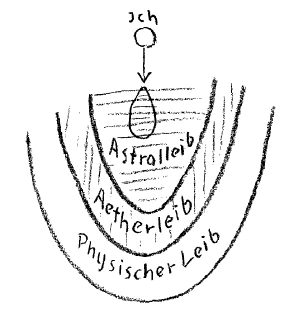
[ 18 ] Then the I descends from above into the astral body and begins to work within the human being, and we then have a part of the astral body that is formed by the I itself. This astral body consists today of two parts: one part that the animal also has, and another that only the human being has, which arises because the human being has worked on the astral body with his or her ego through many incarnations. Now something different is at work in the human being than in the animal. The animal does not have this impact of the ego on the astral body. It has shaped its astral body only in a very specific way, just as it received it from the outer forces. Now everything that comes from the higher worlds acts back upon the whole of the human organism, reshapes everything in a certain way, and brings about new formations of the old organs; it transforms the old organs.
[ 19 ] Let us consider the relationship between these three bodies from this perspective. The physical body consists of substances and forces similar to those found in the mineral world outside—physical and chemical substances and forces. If it possessed only these, it would be a mineral, however artfully formed. It is permeated on all sides by the etheric or Life-Body. What does this Life-Body do? It counteracts the decay of the physical body at every moment; it is the fighter against this decay of the physical body. Without it, the physical body, if left to its own devices, would follow the physical forces and gradually decay. During life, the physical body and the etheric body are connected, and the etheric body continually fights against the decay of the physical body.
[ 20 ] What, then, does the astral body do? It is extremely important to know this. In a certain sense, during waking life—not during sleep—the astral body is occupied with constantly killing the etheric body, constantly diminishing and dampening the forces that the etheric body develops. Therefore, the expression of the astral body’s activity is fatigue, the weariness of the body during the day. The astral body is constantly destroying the etheric body. If it did not do so, no consciousness would arise, for consciousness is not possible without life being constantly and gradually destroyed. It is extremely important to note this. This spiritual activity—life in the etheric world, the wondrous flickering of life in the etheric world, which expresses itself in the most magnificent movements and rhythms, and the constant dampening of this rhythm of the etheric body by the astral body—this is what brings forth consciousness, even the simplest animal consciousness. These spiritual processes now express themselves in the physical world in such a way that the moment consciousness enters mere life, hardening and ossification occur in the physical body. There are, of course, transitional forms, mollusks, and so on; these also possess a quite peculiar consciousness. Consciousness only becomes distinct through this process; the more the soft, organic masses of life assert themselves internally with hard, bony inclusions, the closer it comes to self-consciousness. It is thus the astral body, in its effect on the etheric body, that—as in the case of mollusks, snails, mussels, and so on—secretes the hard shell parts outwardly in order to generate within them that dull consciousness which lives in these animals. In higher animals, where self-consciousness becomes stronger, it is a secondary activity of the astral body—alongside the formation of the nervous system—to secrete all that is bony and hardening. To the same extent that self-consciousness grows stronger, the firm, cartilaginous, and bony elements separate from the soft, gelatinous mass. In the highest animals, this formation is nearly complete; the astral body has developed a skeletal system that is, in its kind, almost fully formed.
[ 21 ] Something special happens to the astral body in human beings; a new influence takes hold. The astral body is partially transformed by the ego, and this reverses the tendency toward ossification that existed previously. If human beings had left the astral body unchanged and continued to develop the skeletal structure, there would be no human culture on Earth. All progress in human development is conditioned by the fact that parts of the human astral body are separated out and subjected to the ego. This separated part of the astral body has a special task; it brings about a new tendency, whereby skeletal formation—ossification—comes under the dominion of the separated part of the astral body.
[ 22 ] How does this manifest itself? Very strange. Whereas in the past the tendency of the astral body was to harden the being more and more, as it were, to bring the development of the skeletal system to a close, the human astral body retains a force, a tendency to soften again, so that further development becomes possible once more. If this were not the case, if everything that can become solid were to flow into the human skeletal system, there would be no human progress, no culture. Just as the animal species knows no progress—the species of lions and tigers is complete, finished—so it would be with human beings. But humans can, through the separate part of the astral body, take back what has hardened. Alongside the tendency toward hardening, toward bone formation, there is always a tendency in the human body to retain something, so that new organs can be formed that are soft. It is extremely important to note this. This tendency is not present in animals.
[ 23 ] Let us now consider a person in the prime of life, standing on one side with a tendency to harden, and on the other side with a tendency to hold something back. We see these two tendencies diverge around the time a person gets their second set of teeth, around the age of seven. The tendency to move into bone formation, to close off in hardening, finds its expression in the teeth that the child gets around the age of seven. The separate part of the astral body causes the human being—unlike the animal—to retain certain life forces so that he can continue to develop. Up to the age of seven, only the species-specific, the generic, was expressed in the human being; now the time comes when he can live into the cultural progress of our time. School begins. These two things are intrinsically linked: the tendency toward hardening, which is expressed in tooth formation, and the tendency toward softening, which must retain something that the etheric body—which becomes free in the seventh year—needs for its further development. These two tendencies are bound together; this is clearly evident in life.
[ 24 ] It is easy to observe that certain phenomena occur in life that are difficult to connect with one another unless viewed from the perspective of Spiritual Science. For example, anyone observing what is known as puerperal fever may find that it is usually associated with defective teeth. Women who have puerperal fever often have defective teeth. Why? Because these two tendencies—the tendency toward hardening, which is expressed in tooth formation, and the tendency to develop further, to open up, and to transcend oneself, which is expressed in reproductive power and procreation—are interconnected. If one is impaired, the other is also impaired.
[ 25 ] Throughout human life, we encounter how these two tendencies—one toward hardening and the other toward remaining soft—are interrelated in certain organs. It is important that these two tendencies balance each other out. One must strive to organize life in such a way that they remain in balance, for the cultural conditions in which a person is placed often lead to significant changes. For example, if farmworkers are taken away from the countryside, from a life in the open air, from an environment where their ancestors already lived, and transplanted to the city, employed in factories and so on, they lose—due to the completely changed living conditions—the harmony, the equilibrium between the hardening and softening forces in their organism. And what is the consequence? One of the two tendencies will then gain the upper hand, either the hardening or the softening forces. These are the causes in the spiritual world; you can see the effects in the physical world for yourselves. Suppose the softening forces gain the upper hand; then civilizational diseases such as rickets and similar illnesses arise. If, on the other hand, the hardening tendencies gain the upper hand, then certain soft tissues of the organism will begin to harden in a very peculiar way. If the hardening process comes to the fore in an inappropriate manner, then tuberculosis arises. You will not find such diseases in animals that live in nature. But if you remove them from their natural environment and place them in ours—for example, monkeys—and then confine them as well, they very often contract tuberculosis and perish in captivity. Why does this happen? Because the hardening tendencies prevail when the monkey is placed in an environment where it does not belong.
[ 26 ] In this way, you can see how spiritual forces influence our physical lives, and in this way we understand the external physical effects in terms of their spiritual causes. I would have much more to say if I wanted to explain these connections in greater detail. However, since very few of you are medical professionals, you will have to be satisfied with this explanation.
[ 27 ] And now consider how everything that has just been said is connected to human happiness or suffering, how the equilibrium of the whole of human life depends on the fact that one’s organs have taken on the correct form at the right stage of development. If an organ remains at an earlier stage, and softening or hardening is caused in an irregular manner, an unhappy life is the result. Every organ must achieve the formation of its specific shape at a specific stage of life. If an old organ is retained at its earlier stage, misfortune and suffering must follow. Even the hidden, not entirely visible organs of the human being can either lag behind or run ahead in development. Tuberculosis is something that will no longer harm humans in the future; it is merely a premature manifestation of a condition that will later become natural. Today the condition is pathological; later it will be healthy. These so-called diseases of civilization differ from the common diseases also found in the animal kingdom.
[ 28 ] Do you not hear this truth echoing in the Mongolian folktale of the woman who searches in vain for her lost child? She still has the organ at the top of her head at the wrong time. It brings her misfortune. Restlessly she rushes through the world, yet she cannot find what suits her, what belongs to her. What wisdom is hidden in these simple folk tales by the guides of humanity.
[ 29 ] We can now go even further. Consider human beings as they are today, how they consist of organs in an ascending line of development and organs in a descending line. Human beings did not always have an astral body; it was incorporated into them only gradually. Before he had incorporated the astral body, his organs were plant-like; they were of a plant nature. By incorporating the astral body, human beings have woven the flesh into the entire organism of the plant body. This weaving of the astral body into the plant body is the Incarnation. But this took place gradually; it developed step by step; it did not affect all organs at the same time.
[ 30 ] If we trace human evolution back through the entire Atlantean period and parts of the Lemurian period, and even further back, we would find a human body that still clearly bore plant organs. Parts of the human body had already been transformed into flesh, while others were still of a plant nature. All those organs of the human body that carry the desires within them to a lesser degree were transformed into flesh earliest; and those that carry the desires within them most strongly—the sexual organs—were transformed latest. They were of a plant nature for a long, long time, and they will also be the first to return to a plant nature. It was only when, in the course of human evolution, the ego had already descended deep into the astral body and selfish desires had penetrated deeply that the formerly plant-like organs transformed and became fleshly organs.
[ 31 ] Spiritual Science looks back to that ancient, sacred time when human beings knew nothing of sexual forces. In the ancient mysteries, an image was venerated that depicted human beings who were still asexual, in whom the sexual aspect had not yet been transformed. In the part of the body where the sexual organs are today, we can glimpse vine-like, plant-like organs that are merely permeated by the etheric body and do not yet contain anything of the astral body. The hermaphrodite of ancient art appears before us in this way. He was depicted as early humanity can also be described through spiritual research. He has plant organs in the place of today’s reproductive organs, and vine-like plant formations sprout from his back. Now we understand—in a different way than the childish way in which this is usually understood—why the ancient myths and the biblical story speak of the fig leaf: Not to cover or conceal anything, but to point to a real fact in human evolution, to that ancient sacred state of which the ancients still knew that humanity had stood at a higher level there, and that the organs in that region had still been of a plant-like nature.
[ 32 ] But let us go even further. We can observe the overcoming of the tendency toward hardening in human beings in yet another way. It is remarkable that the occult schools take this into account in a very peculiar way. When the human ego descended to Earth from the bosom of the Deity, this tendency toward hardening had to be overcome by it. But there are other beings who had already reached the completion of their development much earlier. These are the birds. They also have an ego, but one that lives much more in the external world. They have therefore also missed out on something that is important for all human higher development, for the occult development of the human being. They have not undergone what finds its expression in the development of certain parts of the skeletal structure, the bone marrow, the innermost contents of the bones. Birds have much more hollow bones than humans and than other animals; they have preserved a much older state. Human beings have moved beyond this state; the higher animals have also moved beyond it. Human beings send the forces of the ego right into the bone marrow, and a significant part of occult development consists in ensuring, through exercises, that human beings transform that passive, inactive way in which they relate to their bone marrow into a conscious one. Today they can only act upon the contents of the bony cavity of their skull, upon their brain. But a future state of humanity will be prepared by the fact that he will gain power over the element that permeates his bones as a semi-fluid substance. The structure of the bones has given human beings—and also animals—their form on Earth. The fact that human beings have developed their bones in this way has given them the possibility of their present development. In the future, human beings must gain the power to revitalize their bones, to remove their tendency to harden, and to transform them. They will gain mastery over their blood, so that the power of the ego will be present in it to a much greater degree, and this blood will then be the instrument with which human beings can act to the point of transforming the bone substance. What, after all, is bone formation other than mineralization? When human beings master the tendency toward softening—which today manifests inappropriately as rickets—and when they master the blood to such an extent that they can act down to the bone substance, then they will grow beyond the tendency toward mineralization; he will shape himself, he will transform his physical body into what we call the Atma or Spirit-Man. There, humanity will overcome the principle of hardening, that powerful principle leading to death, whose true physiognomy is expressed in the human skeleton. It is a correct intuition to visualize death in the image of the skeleton. Humanity will bring this physiognomy of death under its control. It will overcome it when it masters its form—just as it now masters it from the outside through the mechanical power of the muscles—from the inside through the power of the spirit, and shapes itself. Today, humans can only send their thoughts down into their bones; when later their feelings take effect in the bones, and even later their conscious will, then they will have overcome the physiognomy of death.
[ 33 ] Now just imagine how beneficial the sciences could be for humanity if those who are called upon to represent the sciences were once again aware of how the human organs are subject to this principle of hardening and softening. In this sense, it is meant that what Spiritual Science says is practically applicable in its effect on life. When these things are applied and have an effect in life, and when one penetrates such truths—as they are hinted at in the old Mongolian fairy tale—with a spiritual-scientific gaze, then one will be able to better understand many things that now appear mysterious and recognize their truth. One will view the world with different senses and will, for example, learn to understand the remarkable phenomenon of bird flight. Along wondrous paths, the birds migrate with the onset of the cold autumn season from the far north to the warmer south, sometimes hundreds of miles, and return in the spring by different routes. We have said that birds are a species that has remained at an earlier stage of development. You know that true progress on Earth only began at the moment when the Moon separated from the Earth. In the past, when the Earth and the present Moon together formed a single celestial body—the so-called Earth-Moon or Moon-Earth—this body moved around the Sun in a specific orbit and over a certain period of time, always keeping one side facing the Sun. During that time, all living beings circled the Moon once in order to receive the Sun’s influence. That movement around the planet is still preserved today in the flight of birds, because the birds, back then, before the ego entered Earth’s evolution, separated themselves from the ongoing development on Earth.
[ 34 ] Something else is even more remarkable. As humans and higher animals have progressed physically, sexuality has taken hold of the individual body. That desire, which resides within the individual body and is now entirely centered on sexuality, did not exist there before; it was a cosmic force. It flowed from the Sun to the ancient Earth-Moon. It was the cause of those orbits around the planet that were connected to the way reproduction took place. The spring migration of birds is in reality nothing other than a kind of nuptial procession. In these beings, the sexual force is still in the environment, and the cosmic force is the directing power that steers and guides the migration from the outside, whereas in other beings this force has been drawn into the individual bodies. The same forces that act within the human being, in his body, also act in the outer macrocosm. The same force that brings human beings together, which acts in the human body as sexual force, does not act within the birds but from the outside, and expresses itself in the birds’ outer migration around the planet.
[ 35 ] Thus the forces that are external migrate into the inner being of human beings, so that they may find within the human being the possibility of acting outward again once he has acquired the ability to become one once more with the entire cosmos, with the extraterrestrial. What people expressed in such a moving way in the ancient legends and fairy tales—as in the Mongolian fairy tale of the woman with one eye—future humanity will express in other forms. The power of spiritual vision will come alive again in human beings. That power of spiritual vision, which is a quality of the eye of the head, will no longer leave people feeling unsatisfied when looking at the physical things of the world around us, like the woman in the legend who casts away every being brought near her. This power will permeate the human being’s present nature, and he will then see not only the outer, physical aspect of things, but also what is expressed in the outer objects as spiritual. What has become material today will be spiritual for him; his now hardened physical body will then be spiritualized once more. That woman from the Mongolian legend will live again and look out into the world. And while today she casts aside beings who show her only their sensory side, because she does not find in them what she seeks, the human being of the future will once again see the spirit in matter and find in beings what belongs to him; he will be able to grasp it and press it lovingly to his heart. He will find in beings the spiritual aspect of the world, that which he can lovingly embrace.
[ 36 ] Human development will be a process of slowly merging into the cosmos. It must be very slow; it cannot be seized in a flash. If humanity were not willing to undergo it with patience, then the power of the eye that sits upon the head of the Ancients would not flow through its entire being, through all its organs, as a fluid of love. This power would be exhausted, and humanity would then have to close itself off from the outside world in lovelessness and wither away. But man is called to lovingly permeate everything that is on his planet, to take the planet with him and to redeem it. The redemption of the inner self cannot take place without the redemption of that which is outside of us. Humanity must redeem its planet along with itself. Redemption can only occur if humanity pours its powers into the cosmos; it must not only become a redeemed being, but it must become a redeemer.