

Myths and Legends
Occult Signs and Symbols
GA 101
29 December 1907, Cologne
Translated by Steiner Online Library
15. Pictorial Representations as a Necessary Educational Tool for Mental Training
[ 1 ] Today I would like to discuss a few more characteristic symbols and signs so that we can gain an ever clearer understanding of the actual central theme of our lectures, which is to show how signs and symbols relate to the astral and spiritual worlds, also known as the Devachanic world.
[ 2 ] We have seen that symbols and images, as well as numerical and formal relationships truly drawn from the nature and essence of the higher worlds, once absorbed by the soul, evoke within it genuine soul forces in the form of mental images, thoughts, ideas, and feelings that have a formative effect. Indeed, we have even seen that Noah’s Ark had a formative influence on the present physical body of humanity, and that the Temple of Solomon, when its forms affect the people of the present, will have great significance for the formation of humanity in the sixth race. From this information you can already see that the guides of humanity, who are constantly active in the course of human development, actually follow a path similar to that of the individual human being in the elemental mystery schools. There, too, we are dealing with a concentration of feelings, thoughts, mental images, and so on—many other factors are involved as well—that are active and formative for the human being.
[ 3 ] In many of today’s occult movements, there is a prevailing view that, in our time, it is possible to ascend to the higher worlds by means other than the use of imaginative and symbolic mental images. And among people today, there is a certain fear, even aversion, associated with ascending into the astral world with the help of symbolic signs or other occult methods of training. If one asks the question: Are such fears justified?—one can say: Yes and no. — In a certain sense, they are justified; in another sense, they are entirely misplaced, because no one can truly ascend to the higher worlds without passing through the astral world. It is a mistaken assumption to believe that one can pass through the astral world with one’s eyes closed. You must simply be aware that the spiritual world as such comprises various realms. Humanity descended through the astral world into the physical world, and must ascend through the astral world once again into the spiritual world. What must be avoided is for humanity to regress to earlier states during its development. Humanity must never regress to earlier states. Every mediumistic state is a regression to an earlier state, whereas true esoteric training is an ascent to higher states. Human beings must ascend through the astral world with full, clear daytime consciousness in order to reach the higher realms of the spiritual world. Whatever desires, passions, and instincts modern human beings carry within themselves are anchored in the astral body; the astral body is their vessel. If a person wishes to ascend into higher worlds, they must, however, work with sensations and feelings; there is no other way. But the point is that they must never attempt to ascend into the higher worlds without fully maintaining the achievements of our physical world—that is, never by dimming their consciousness. When we observe mediums, we always find that they are thrown back into an earlier state of consciousness. Their clear daytime consciousness is dimmed, weakened, and an earlier state of consciousness — one that the person has already overcome — is evoked. Anyone who wants to become a clairvoyant in the modern sense must retain and carry forward their present clear waking consciousness. They can do this only by passing through the point of “sense-free thinking,” and nothing can ever happen when a person passes through sense-free thinking. Let us make it perfectly clear what this means.
[ 4 ] Thinking and mental images that are imbued with sensibility are those that arise from the sensory perception of the objects surrounding us. If you form your mental images in such a way that you first look at an object, perceive it, and then retain it in memory, and if your inner life proceeds in such a way that you are stimulated by such mental images, then you have thinking filled with sensuous. This constitutes by far the greatest part of the inner experiences of modern human beings. And when a person asks themselves how much remains if they cast out of their soul all the mental images that are caused by sensory perception, then they will first become aware of what content still remains in the soul. Once the mental images stimulated by the external world have been removed, they will understand what the Greek philosopher Plato meant when he wrote on the gate of his school that no one unfamiliar with geometry should enter. This means that no one should enter who has not been able to rise to a form of thinking free from sensuousness. He did not require ordinary geometry. Nor is this required today of those who wish to ascend to higher worlds. Nor would it be necessary today for intrinsic, objective reasons. But through mental images of geometry, one can form an idea of what thinking free from the senses is. If you lay down three beans here, add three more beans, and then three more, you can learn from this sensory impression that 3 times 3 equals 9. The child or the primitive human learns this using their fingers. That is thinking filled with the senses. When you no longer need your fingers or the beans, but instead learn the same thing through purely mental visualization, that is thinking free from the senses. The child starts their learning from a bridge [beans or fingers] and only later rises to thinking free from the senses. When we draw a circle on the blackboard, this does not in reality produce a circle; what we draw there is an accumulation of small chalk mounds. You will not be able to grasp what a real circle is through sensory perception alone. Only the circle perceived mentally and constructed internally is free of the senses.
[ 5 ] The best means for a wider circle of people to attain thinking free from sensuousness is theosophy today, provided that theosophy is understood in such a way that people learn to detach their mental images from sensuousness. Especially in areas that go a little beyond the most elementary, theosophy leads people to thinking free from sensuousness. If, for example, you want to understand what the etheric body or the astral body is, you cannot see these externally. This is precisely what Theosophy offers you: it describes things you cannot see externally. Or when we describe the ancient Moon in Theosophy, we sketch a picture of it—a rather dramatic one, in fact—by combining sensory and supersensory mental images, so that a materialistically minded person would say: “He’s painting a picture of something that is simply impossible.” — Yes, in Theosophy one must teach something that is downright impossible by today’s standards and describe the ancient Moon in such a way that it did not contain rocks, minerals, and stones like those found on our Earth today. The entire ancient Moon consisted of a living substance that could be compared in density to a kind of spinach puree or cooked lettuce—that is, a body situated midway between minerals and plants, a body that was half-vegetal, half-mineral. We find on the ancient Moon something like a semi-vegetal life. Minerals such as those found today did not yet exist back then. If you look at today’s peat bogs, where there is also a kind of semi-vegetal substance, you would get a picture outwardly similar to what the substance of the ancient Moon was like. Instead of rocks and mountains, on the ancient Moon you would have found at most something like what is today the bark of our trees. Now every natural scientist today will object that such a thing could not exist as a planet. — But that is precisely the point—and it is a necessity for understanding other epochs of development—that human beings detach their thinking from what is attached today to the mental images of ordinary sensory thinking and feeling, and arrive at a thinking free of sensuousness. Thinking free of sensuousness is not abstract thinking, but very, very real thinking. If we imagine the old moon as a kind of large head of lettuce with an enclosed rind and so on, that is “sensible-supersensible” thinking, as Goethe says. By detaching color and form from the senses and projecting them freely out into space, you have gained mental images through thinking free from the senses. Whoever regards this as a firm foundation will never stumble when ascending into higher worlds.
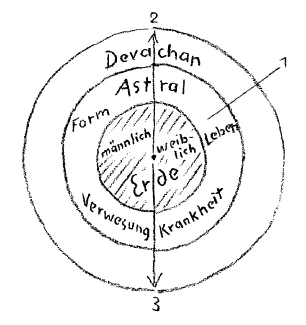
[ 6 ] Let us try to draw a schematic diagram. After all, some things become unclear when represented by inaccurate symbolic drawings. While it is true that, for understanding certain relationships, it suffices to draw the physical plane, the astral plane, and the devachanic plane one above the other; it is more accurate, however, to have a mental image of the physical world as a self-contained sphere, with the astral realm surrounding it, and the Devachanic realm in turn surrounding that. Instead of drawing horizontal layers, it is better to depict it this way (see drawing), because this allows us to distinguish between two regions of the astral plane. If we look into two very specific regions of the astral plane, which we indicate here with arrow 1, then in the astral world, for what we here on Earth call the masculine and the feminine, there are the two opposites “form” and “life.” Form and life are opposites on the astral plane. However, if we wish to encounter Form and Life on the astral plane, we would only encounter them if we move in this direction (from the center upward, see arrow 2). If we go in the other direction (from the center downward, see arrow 3), we do not encounter the beneficial opposites of form and life there at all, but rather the opposites “decay” and “disease.” Thus, when we proceed from the physical world, we encounter the opposites of form and life on the astral plane as we move upward; corresponding to this on the astral plane downward—that is, descending, as it were, beneath the physical—is the contrast of decay and disease. Whenever we go to one side, where we see qualities beneficial to the physical world, these are matched on the other side by influences that are destructive and harmful to the physical world. Here we now have a way to distinguish between the parts of the astral plane. In fact, two entirely distinct regions of the astral plane act upon the human soul. If we wish to form a mental image of how these two entirely different regions act upon the soul, we must consider that in the human being we have: the physical body, the etheric body, the astral body; and depending on their development, which has indeed been described frequently: Manas or the Spirit-Self, Budhi or the Life-Spirit, and Atma or the Spirit-Man; and in between, filled with the I, we have the soul. So that we can distinguish, in a certain sense: body—which actually encompasses the three bodies—soul, and spirit. Now the three lower members—the astral body, the etheric body, and the physical body—are reflected in the soul. Insofar as the physical body, the etheric body, and the astral body are reflected in their original form, they introduce into the human soul lower, dragging-down qualities. But what is higher is also reflected in the human being: Manas, Budhi, Atma, and through this we have in the soul equally uplifting, purifying elements. In strict Christianity, one was also aware of this twofold nature of reflection in the human soul. One saw that the higher human nature is reflected in the soul, or that the lower nature is reflected in the soul. Some sensed this, even if they were not esotericists. That is why it was said: When a person faces death, they perceive the reflection of the spiritual world as the collection of laws of Moses; and when the lower nature is reflected in the soul, the devil reads the record of sins to the soul at death.
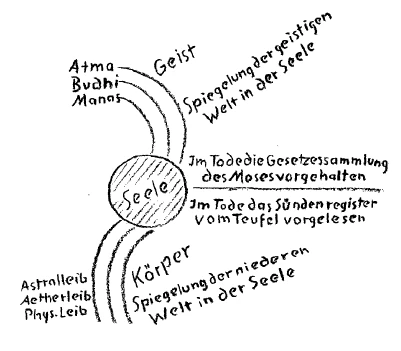
[ 7 ] This means that all the qualities inherent in the soul are presented before its eyes: what is reflected from above is held up to it as the Tablets of the Law of Moses; and what is reflected from below in the soul is described by saying: The devil reads the register of sins to the soul. If the soul does not take the right path, however, it can sink into its base passions; that can happen. But this must not be presented to people as a deterrent.
[ 8 ] All mental images that focus on imagination and the visual help to educate people, gradually bringing them to that point in their development where they learn to look more and more into the higher worlds. Mental images, such as the mental image of the old moon, are a powerful educational tool in this direction. Through such mental images, the idea of development is presented to people in a truly esoteric manner. If one presents people only with dry, abstract concepts, their thinking remains on the physical plane, for ordinary thinking as such never departs from the physical plane. It is indeed a reflection from the Devachan plane; but the thought that a person holds is something that belongs to the physical plane; it is merely like a shadow image of the higher processes. No matter how refined your mental images may be about how evolution proceeds, how a being on the first stage of existence differentiates, descends, and envelops itself—these are all merely mental images that give you concepts of the physical plane, but which do not advance you in your development. Only sensory-supersensory mental images and concepts can gradually take you a step further. First, one must transform the concepts into images, into imaginations, and repeat this process over and over again.
[ 9 ] If one were to frame this approach—which was taught, for example, in the Rosicrucian schools—as a dialogue between teacher and student, it could be expressed as follows: — In reality, such a dialogue never actually took place, but we can present it this way to illustrate what the student had to gradually go through during long, long experiences. — The teacher said to the student: Look at the plant, how it sends its roots into the earth, how it grows toward the sun with its stem and flower, and brings its fruiting organs to fruition. And now create a mental image of the human being in contrast. — The human being is poorly compared to the plant when one compares his head to the flower and his reproductive organs to the plant’s root. Even Darwin, the great naturalist, used this comparison correctly by comparing the human head to the plant’s root, so that even for Darwin, the plant is the human being turned upside down. What the plant chastely holds up to the sun’s rays—its reproductive organs—man directs toward the center of the earth, so that we must thus conceive of man as a reversal of the plant, in that he freely directs all the forces that in the plant are directed toward the center of the earth out into the sun-filled cosmos, and those organs that the plant chastely stretches toward the sun’s rays, it modestly directs toward the earth. The animal stands right in the middle of this.
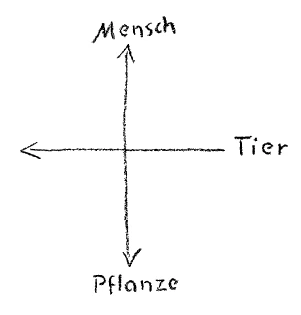
[ 10 ] If, therefore, we wish to depict the actual directions of force that exist in the world, we can do so as follows: The true esoteric meaning of the sign of the cross is a sum of forces. One direction of force points downward: the plant kingdom is governed by this force. In human beings, it is directed in the opposite direction. The animal has its spine oriented horizontally; in it, the force manifests horizontally, encircling the earth. The soul principle ascends from the plant realm to the animal realm, to the human realm. And Plato, who so often expressed things derived from initiation, uttered the beautiful sentence: The world soul is crucified upon the world body. — That is to say, the world soul passes through plant, animal, and human; it is crucified in the forces of the three kingdoms: the plant kingdom, the animal kingdom, and the human kingdom. And when we thus inscribe the cross into the three kingdoms of nature, the cross becomes for us a sign of the direction of development.
[ 11 ] So the teacher said to the student: You must create a mental image of how the plant stretches its calyx toward the sunbeam, how the fruit organs ripen when the plant is kissed by the sunbeam. — The development into a human being occurs through the pure, chaste plant substance being permeated by desires, instincts, and passions. Through this, the human being conquers his consciousness; through this, he becomes a human being by passing through the animal nature. By weaving the lower nature of desire into the pure plant nature, the human being has, on the other hand, ascended from the dull plant consciousness to the bright consciousness of the day.
[ 12 ] From this stage of the present-day human being, the teacher pointed the student toward a higher stage. Just as the human being has evolved from a state similar to that of a plant, so too will he purify his instincts and desires to reach a higher, chaste stage. The Teacher showed the student the faculties within the human physical body through which the higher levels of consciousness can be attained, and through which human substance can in turn become a substance similar to that of a plant. Every being must use a physical body if it wishes to appear on Earth. But the human body will undergo ever greater transformation in the future. With regard to the human organs, we distinguish between a descending and an ascending development. A portion of the human organs is in a state of descending development; humanity will shed these over time, though this process will take millennia. Other organs are in the process of becoming; they will undergo a higher development in the future, for example, the human larynx; it is only at the beginning of its development. The human heart will undergo a different kind of higher development; in the future, it will become a completely different organ. While other organs have already passed their peak, are severing themselves from human nature, and are withering away, we have in the heart an organ that is only at the beginning of its development.
[ 13 ] In the human body, we can distinguish between striated and smooth muscles; these are voluntary and involuntary muscles. The voluntary muscles of the hand, for example, are striated. The muscles of the intestines, on the other hand, which involuntarily propel food forward, are smooth. The heart is an exception here, and this poses a dilemma for today’s physiological and anatomical scientists. Although the heart belongs to the category of involuntary muscles, it has striated musculature. This is why our anatomists cannot comprehend the heart either. After all, they regard all organs as being of the same nature. If one considers the organs spiritually, they may well consist chemically of the same components, yet one may be in a descending phase of development while the other is in an ascending one. The heart is on its way to becoming a voluntary muscle in the future; it already bears the characteristic features of this in its anatomical structure. Today, very little of this is noticeable. Today, it contributes to the way emotional experiences affect the blood. You can see how, when you feel fear, the blood withdraws from the periphery of the body toward the interior, or how, when a feeling of shame arises, the blood is driven from the interior of the body toward the periphery. In the future, in addition to the transformation of the heart, a transformation of our larynx will also take place. Today, the larynx serves to translate my thoughts into words by setting the air into vibrations. You can receive and hear my words with your ears; this is caused by the vibrations of the air. The human larynx of today is capable of translating what is happening in the soul into air vibrations. The future human body will transform its larynx into a reproductive organ, and the word, which today creates only in the air, will in the future become creative in our environment. Reproduction will then take place through the larynx, which will create the race of the future.
[ 14 ] Just as the teacher pointed out to the student the chaste calyx of the plant, and just as he pointed out the human being who, in the process of descent, has permeated his plant substance with the lower nature of passions, desires, and instincts, but in exchange has acquired his present clear waking consciousness, so the teacher showed how present-day humanity will ascend to higher states of consciousness, and how future humanity will in turn transform the substance filled with desires into pure and chaste organs. The student was directed toward the past, present, and future. Just as the calyx of the plant chastely stretches toward the sun and its fruiting organs grow toward the sun, so this will be present again on a higher level, where man will offer his larynx as a calyx to the spiritual sunbeam. This spiritual calyx, the transformed organ of speech, was called the Holy Grail. This is a real ideal. The beginning, middle, and end of human development—here you see the idea of humanity’s evolution transformed into an image.
[ 15 ] Through the feelings we develop in response to these images, the forces that truly open up the higher worlds to us flow into us. All of this takes place without magic. The images stimulate the feelings that lead people into the higher worlds. Feelings and sensations lead people into the astral world, just as the will leads them into the devachanic or spiritual world. Thinking corresponds to the physical world, feeling to the astral world, and the purified will to the devachanic world.
[ 16 ] When we observe the plant in its original, pure substance, we find green as the color of the plant’s life. In those parts where the etheric body is actively at work, the plant is permeated by chlorophyll, the substance known as chlorophyll. The etheric body has a fundamental law, which is the law of repetition. If only the etheric body were active in the plant, the same form would repeat itself over and over again; leaf after leaf would grow. But when the astral body of the Earth begins to influence the plant, it concludes its growth and begins to flower. The effect of the etheric body manifests itself in repetition. This principle also applies to human growth. The etheric body exerts its influence in the formation of the vertebrae, which, however, comes to an end where the astral body begins to act and the skull cavity bulges. We can therefore only influence the etheric body through the principle of repetition. When you think and comprehend, this affects only the astral body. But when you pray or meditate, for example, and repeat the same prayer or meditation daily, you are acting into the etheric body. The way things are is that in the cosmos, the principle of repetition first manifests in the actions of the etheric body, then the principle of completion through the astral body. Where the astral body withdraws, the principle of repetition naturally reemerges. This is why your hair and nails grow—because the astral body has withdrawn from those areas. It doesn’t hurt when you cut your hair, because pain is an expression of the astral body.
[ 17 ] We begin with the pure, chaste plant substance, where the plant, subject solely to the law of the etheric body, produces leaf after leaf. Now this pure, chaste plant substance increasingly permeates what is called Kama in theosophy—the realm of instinct and sensation, the realm of desire—all the way up to the realm of mental images. And now, in human beings, that which has developed within them since they had a plant nature must be overcome once more. As human beings evolved, they took in red blood. Through the red blood, that which makes a person self-aware is brought about within them. It is the chlorophyll of the plant, permeated by astral substance and the ego, that has been transformed into red blood. If you could permeate the green plant substance with the ego and astral substance, you would obtain red blood. Now think of the image of the cross. In the image of the cross, you also have something that points to humanity’s future. Where does humanity’s future lie? He is to regain the plant nature, but connected to the higher level of consciousness that modern humanity has already attained. The red roses of the Rosicrucians signify what has been attained through the blood, but also what he had as plant nature and is to have again. This is prefigured in the rose. It has plant nature, and it also has the red color of blood. The etheric body is at work in the green leaves; in the red blossom, where the process culminates, the astral body is at work; the rose blossom owes its red color to the most intense influences of the Earth’s astral body.
[ 18 ] In the future, the human astral body will become free and will act consciously from the outside, from beyond the physical body, just as the astral body of the Earth now acts upon the rose. Then what now exists as the plant rose on a lower level will appear on a higher level as the human rose. Thus, in the wreath of roses surrounding the black wood of the cross, we actually have a symbol of human evolution. In the black wood we see what is dying; it is an image of what will also die in the human being. And in the red rose we see what will continue to develop until it becomes that calyx which—like the plant calyx of the sun—holds itself up to the spiritual rays of the sun. And the Rosicrucian symbol, where the red roses surround the black cross, depicts this process for us.
[ 19 ] The essential thing about symbols is that we do not merely think them, but that we feel and sense them. For only when we feel, through the red rose, that it is telling us: “This is what you will one day become; this is what represents the goal of human development”—and when our hearts open and our feelings become pure in the process—only then are the forces within us set in motion that lead us upward into a higher world. Thus, these symbols are workers upon our soul. They permeate and work through our soul; they are the greatest and most effective educators of our human race.
[ 20 ] Just as we present images and mental images to the soul here, so too, in even higher realms, the inner forces of numbers are presented to human beings. Human beings must learn to perceive the inner relationships of numbers as a kind of spiritual music. One can describe the relationships between the physical body, the etheric body, the astral body, and the I by attempting to provide images of how these four members of human nature relate to one another. Through this, a person experiences a kind of imagination. Thus, one can describe the relationship between the physical body and the etheric body by saying: The physical body comes into being through the fact that all the forces and substances spread out in the mineral kingdom are connected by the etheric body; it would disintegrate if the etheric body did not permeate it; the etheric body is an inner fighter against the disintegration of the physical body. In this way, we work our way up to a mental image of the etheric body.
[ 21 ] And when we try to form a vivid mental image of the astral body, we imagine how it emerges at night and acts from the outside on the etheric body and the physical body by removing the waste products of fatigue. Let us visualize this clearly. But there is an even higher way of conceiving this relationship; one must consider the inner significance of certain numbers. One must recognize that the ratio of 1:3 is something entirely different from the ratio of 1:7. This is not a trivial matter. When considering the ratio of 1:3, one must create a mental image of the 3 being differentiated within itself, and one must envision the interrelationships of the individual quantities with one another.
[ 22 ] What matters, however, is the ratio of 1:3:7:12. If you interpret the ratio of these numbers to one another as a tonal ratio—by creating a mental image of a tone that makes three vibrations in a given time, another that makes seven vibrations in the same time, and yet another that makes twelve vibrations—then you have expressed in these numbers the ratio that, in spiritual music, indicates the relationship between the ego, the astral body, the etheric body, and the physical body.
I = 1
Astral body = 3
Etheric body = 7
Physical body = 12
[ 23 ] There is a good reason for this in the history of the world. If we were to trace the development from the earliest Saturn existence to the present Earth existence, we would soon discover how this is rooted in human existence. In its first incarnation, the Saturn incarnation, the Earth was surrounded by the twelve signs of the zodiac. They provided the first seed for the physical body. Through the influence of the corresponding signs on the body, this relationship between the number twelve and the individual members of the physical body arose. The seven planets acted upon the etheric body. When the Earth was a sun, the other planets stood around it, and thus the number seven acted upon the etheric body. When the Earth was in its lunar incarnation, the sun initially acted upon it. But then, as a result of the sun and then the moon separating from the Earth, three bodies arose from one body, and thus the number three acted in the formation of the astral body. And when the I descended from the higher worlds, this was expressed in the number one. The ratio of 1:3 gives you the relationship of the I to the astral body, 7 the relationship to the etheric body, and 12 the relationship to the physical body.
[ 24 ] 1:3:7:12 thus describes the relationship between the four constituent parts of the human being, which you must sense within yourselves. It is not easy to awaken the sense that one must create a mental image of the physical body as the most perfect of the four parts, the etheric body as the less perfect, the astral body as even less perfect, and the I as the “baby” among the four members of human nature. One must conceive of the physical body as twelve times as perfect as the I, the etheric body as seven times as perfect, and the astral body as three times as perfect. These numbers indicate the degrees of perfection for the four members of human nature. Thus, these numbers provide us with profound symbols of the actual relationships.
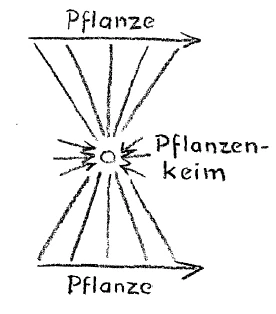
[ 25 ] In the occult schools, there were instructions for gradually becoming familiar with numerical values. For example, the significance of the number three was taught by saying: Let us consider the development of a plant; there are three aspects to observe. Let us begin with the plant seed. You have an inconspicuous, small plant seed, from which the plant gradually develops. We can illustrate this by depicting the plant seed radiating outward in all directions, until it becomes leaves, flowers, and fruit. Now the seed has become a plant, and from the plant, in turn, the plant seed again. What has unfolded in the plant into leaves, flowers, and fruit—all of that is wound up in the seed; it has, as it were, slipped back into the seed. In a developed plant, everything is revealed in the physical realm. Then the sensible enters into something very small, into the seed. There, in the seed, we have the sensible as small as possible and the spiritual as large as possible.
[ 26 ] But a third process also takes place. While the seed forms from the plant and the new plant in turn arises from the seed, elemental forces from the surrounding environment continually act upon the plant. The seed is there, which arose from the plant, and from it the new plant arises in turn; but the third element comes from the entire surrounding world; and it is this third element that alters every plant once again. The higher a being stands, the more the influence of the third element works to bring about change.
[ 27 ] Let us now turn our attention once more to the human soul as it lives between birth and death. There it unfolds what it has brought with it as the fruits of a previous incarnation. Just as external influences act upon the unconscious life of a plant, so too does the human being consciously experience the most manifold external influences in the life between birth and death. And everything the human being experiences there was not yet predisposed in the seed; it is something entirely new, an enrichment whose fruits the human being takes with them into a later life, into a subsequent incarnation. What was predisposed in the old plant continues to work in the new plant; but in the form of the new plant, something else is revealed that was not present in the old plant.
[ 28 ] Thus, in all processes of becoming, we must consider three things: First, the unfolding from a state that is, as it were, wrapped up; we call this development or evolution. Then, what lies in the seed must come into being through the reverse process, the wrapping up or involution. These two processes alone, however, do not yet constitute progress. Only through a being’s ability to absorb external influences and transform them into inner experiences can something new—progress in the world—come into being. This is the third; it is called creation ex nihilo. You are constantly developing what has been predisposed within you from earlier times; you are constantly taking in something from your environment, which you transform into experiences, and you then carry this into a new incarnation. In all life, the triad of evolution, involution, and creation out of nothing is at work. In human beings, we find this creation out of nothing in the workings of their consciousness. They experience the processes in their environment and transform them into ideas, thoughts, and concepts. Predispositions stem from previous incarnations, but all progress in life is based on the production of new thoughts and new ideas. The conditions of the environment are “consumed,” and inner experiences lead to new thoughts and ideas. Therefore, three is the number of life; it is called the number of creation or of action.
[ 29 ] In contrast, another number is referred to as the number of revelation. You can easily imagine which number is referred to as the number of revelation. Whenever you look at anything in the world, it must always reveal itself in a duality. Just as we cannot perceive light without darkness, so too does every real concept always present us with a diminished or opposite aspect. Light and darkness, good and evil, and so on. Duality reigns throughout the revealed world. Therefore, two is the number of revelation. Opposites are united only in the realm of the occult, which lies beneath the revealed. Therefore, the number one is the number of unity. Evolution and involution are not opposites, because they would always unfold in the same way without the third—from seed to plant and from plant to seed. Only in connection with the third, creation out of nothing, does the new arise, which is expressed by the number three.
[ 30 ] Thus, in the first three numbers, you have important symbols of the spiritual world. Individual examples should be given to show you how what are called symbols relate to the higher worlds, and how, for example, symbols such as the Holy Grail or the Rosicrucian Cross express higher development in the image.
[ 31 ] Another beautiful symbol is found in the image of the mirror. What surrounds us is often called a mirror of the spiritual, because in truth nothing external shows us anything other than the reflection of spiritual being. You can observe this yourself in physical life. When you perceive a physical object, what does your eye actually see? Your eye would not see the object at all if rays of sunlight did not fall upon it and be reflected back into your eye by the object. In truth, your eye does not see ordinary objects, but rather the sunlight reflected back by the objects, and through this an object appears to you in a certain form. In truth, you do not see yourself either when you look in the mirror, for your spiritual part lies outside your physical being. What you see in the mirror is the reflection of the rays falling upon you from the spiritual world. What you see reflects the light of the spirit just as ordinary objects reflect sunlight. The outer body of a human being is, in fact, the mirror in which his true being is reflected.
[ 32 ] During the Atlantean epoch, human beings did not perceive external objects at all. They knew that they were immersed in a spiritual substance and were therefore able to perceive the spiritual world inwardly. It was only around the last third of the Atlantean era that the light of the spirit went out, and human beings could see only the reflected rays of that light. Imagine you are looking into a pane of glass and are conscious of your own spiritual qualities. Now someone applies a mirror coating to the back of the glass; as a result, you no longer see your own being in the glass, but only the image reflected by the mirror. Humanity now sees its own image; and this gives rise to the illusion that what it sees there is its true self. This illusion is beautifully expressed in the Bible. Humanity lost Paradise when it became so engrossed in sensuality that it saw itself. Before, Adam and Eve had not “seen”; now “their eyes were opened, and they realized that they were naked.” And because a deception actually occurred here, the legend attributes the fact that objects became visible externally to the Luciferic principle.
[ 33 ] In Eastern Europe, there is a folk tale that goes like this: Once upon a time, there was a monk who wanted to test whether the biblical saying was true: “Those who seek shall find, and to those who ask, it shall be given.” — He wanted to test whether this was truly true, so he prayed for what he desired. He wanted nothing higher and nothing lower than the king’s daughter herself. He asked for the king’s daughter. She told him: Yes, she would be his on one condition—he must bring her an instrument in which she could see herself from head to toe. This was in a time when there were no mirrors yet. So he went out and searched; in the process, he encountered the devil, who revealed to him the secret of how mirrors work. When he returned with it, he received the princess’s consent; however, he later renounced her. To obtain the mirror, he had thus to resort to the devil.
[ 34 ] In the manifold signs and symbols we have encountered in these lectures, we have been able to perceive the true meaning of these images. Sensory perception is the substance of the physical world. Images and imaginations are the expression of the astral world. Sphere harmony and sphere sound are the expression of the spiritual world. Whoever ascends to this spiritual world perceives its inner spiritual resonance; it penetrates them. Inspiration is the life-element of the spiritual world, just as imagination is the life-element of the astral world. A truly inspired world is created out of the spirit.