

Myths and Legends
Occult Signs and Symbols
GA 101
29 December 1907, Cologne
Translate the original German text into any language:
Versions Available:
Myths and Legends, Occult Signs and Symbols, tr. SOL
15. Bildhafte Vorstellungen als notwendiges Erziehungsmittel zur Geistesschulung
15. Pictorial Representations as a Necessary Educational Tool for Mental Training
[ 1 ] Ich möchte heute noch einige charakteristische Symbole und Zeichen besprechen, damit wir uns immer klarer und klarer über das eigentliche Grundthema unserer Vorträge werden, das ja darin bestehen soll, zu zeigen, wie Zeichen und Symbole in Beziehung stehen zur astralen und zur geistigen Welt, die man auch die devachanische Welt nennt.
[ 1 ] Today I would like to discuss a few more characteristic symbols and signs so that we can gain an ever clearer understanding of the actual central theme of our lectures, which is to show how signs and symbols relate to the astral and spiritual worlds, also known as the Devachanic world.
[ 2 ] Wir haben gesehen, daß die Symbole und Bilder und die wirklich aus der Natur und Wesenheit der höheren Welten herausgeholten Zahlen- und Formenverhältnisse, wenn die Seele sie aufgenommen hat, in ihr wirkliche Seelenkräfte in Form von Vorstellungen, Gedanken, Ideen und Empfindungen hervorrufen, die gestaltende Wirkung haben. Ja, wir konnten sogar sehen, daß die Arche Noah für den gegenwärtigen physischen Leib des Menschen gestaltend war, und dafß3 der Salomonische Tempel, wenn er in seinen Formen auf die Menschen der Gegenwart wirkt, eine große Bedeutung für die Gestaltung des Menschen in der sechsten Rasse haben wird. Aus diesen Angaben können Sie schon ersehen, daß durch die Führer der Menschheit, die fortwährend am Entwickelungsgange der Menschheit tätig sind, eigentlich ein ähnlicher Weg eingeschlagen wird wie für den einzelnen Menschen in den elementaren Geheimschulen. Auch da haben wir es zu tun mit einer Konzentration von Empfindungen, Gedanken, Vorstellungen und so weiter — es kommt noch manches andere hinzu —, die wirksam und gestaltend sind für den Menschen.
[ 2 ] We have seen that symbols and images, as well as numerical and formal relationships truly drawn from the nature and essence of the higher worlds, once absorbed by the soul, evoke within it genuine soul forces in the form of mental images, thoughts, ideas, and feelings that have a formative effect. Indeed, we have even seen that Noah’s Ark had a formative influence on the present physical body of humanity, and that the Temple of Solomon, when its forms affect the people of the present, will have great significance for the formation of humanity in the sixth race. From this information you can already see that the guides of humanity, who are constantly active in the course of human development, actually follow a path similar to that of the individual human being in the elemental mystery schools. There, too, we are dealing with a concentration of feelings, thoughts, mental images, and so on—many other factors are involved as well—that are active and formative for the human being.
[ 3 ] Es herrscht in den verschiedenen okkulten Strömungen der Gegenwart vielfach die Meinung, als ob es in unserer Zeit auch auf anderem Wege als durch die Anwendung imaginativer und symbolischer Vorstellungen, ein Aufsteigen in die höheren Welten geben könne. Und es ist bei den Menschen der Gegenwart mit einer gewissen Furcht, ja sogar Aversion verbunden, in die astrale Welt mit Hilfe symbolischer Zeichen oder sonstiger okkulter Erziehungsmittel aufzusteigen. Wenn man die Frage aufwirft: Sind solche Furchtzustände berechtigt?, so kann man sagen: Ja und Nein. — In einer gewissen Beziehung sind sie berechtigt; in einer anderen Beziehung sind sie ganz und gar nicht am Platze, weil in die höheren Welten niemand wirklich hinaufkommen kann, ohne durch die astrale Welt hindurchzugehen. Es ist eine irrige Annahme, wenn jemand meint, er könne mit verbundenen Augen durch die astrale Welt hindurchgehen. Nur müssen Sie sich darüber klar sein, daß die geistige Welt als solche verschiedene Gebiete hat. Der Mensch ist durch die astrale Welt heruntergestiegen in die physische Welt, und er muß durch die astrale Welt wiederum hinaufsteigen in die geistige Welt. Was vermieden werden muß, ist, daß der Mensch bei seiner Entwickelung in frühere Zustände zurückfällt. Der Mensch darf niemals in frühere Zustände zurückfallen. Jeder mediale Zustand ist ein Zurückfallen in einen früheren Zustand, während wahre Geheimschulung ein Aufsteigen in höhere Zustände ist. Der Mensch muß durch die astrale Welt mit vollem, hellem Tagesbewußtsein hinaufsteigen, um in die höheren Gebiete der geistigen Welt zu gelangen. Was der heutige Mensch an Begierden, Leidenschaften, Instinkten in sich trägt, das ist verankert im Astralleib, deren Träger ist der Astralleib. Der Mensch muß, wenn er aufsteigen will in höhere Welten, allerdings wiederum mit Empfindungen und Gefühlen arbeiten; einen anderen Weg gibt es nicht. Aber es handelt sich darum, daß er niemals versuchen soll, anders als unter voller Aufrechterhaltung der Errungenschaften unserer physischen Welt in die höheren Welten hinaufzukommen, das heißt, niemals mit einer Herabdämpfung des Bewußtseins. Wenn wir Medien betrachten, finden wir immer, daß sie in einen früheren Bewußtseinszustand zurückgeworfen werden. Ihr helles Tagesbewußtsein wird heruntergedämpft, abgeschwächt, und ein früherer Bewußtseinszustand, den der Mensch schon überwunden hat, wird hervorgerufen. Wer in modernem Sinne Hellseher werden will, muß sein gegenwärtiges helles Tagesbewußtsein behalten und mitnehmen. Das kann er nur dadurch, daß er durch den Punkt des «sinnlichkeitsfreien Denkens» hindurchgeht, und niemals kann irgend etwas passieren, wenn der Mensch durch das sinnlichkeitsfreie Denken hindurchgeht. Machen wir uns ganz klar, was das heißt.
[ 3 ] In many of today’s occult movements, there is a prevailing view that, in our time, it is possible to ascend to the higher worlds by means other than the use of imaginative and symbolic mental images. And among people today, there is a certain fear, even aversion, associated with ascending into the astral world with the help of symbolic signs or other occult methods of training. If one asks the question: Are such fears justified?—one can say: Yes and no. — In a certain sense, they are justified; in another sense, they are entirely misplaced, because no one can truly ascend to the higher worlds without passing through the astral world. It is a mistaken assumption to believe that one can pass through the astral world with one’s eyes closed. You must simply be aware that the spiritual world as such comprises various realms. Humanity descended through the astral world into the physical world, and must ascend through the astral world once again into the spiritual world. What must be avoided is for humanity to regress to earlier states during its development. Humanity must never regress to earlier states. Every mediumistic state is a regression to an earlier state, whereas true esoteric training is an ascent to higher states. Human beings must ascend through the astral world with full, clear daytime consciousness in order to reach the higher realms of the spiritual world. Whatever desires, passions, and instincts modern human beings carry within themselves are anchored in the astral body; the astral body is their vessel. If a person wishes to ascend into higher worlds, they must, however, work with sensations and feelings; there is no other way. But the point is that they must never attempt to ascend into the higher worlds without fully maintaining the achievements of our physical world—that is, never by dimming their consciousness. When we observe mediums, we always find that they are thrown back into an earlier state of consciousness. Their clear daytime consciousness is dimmed, weakened, and an earlier state of consciousness — one that the person has already overcome — is evoked. Anyone who wants to become a clairvoyant in the modern sense must retain and carry forward their present clear waking consciousness. They can do this only by passing through the point of “sense-free thinking,” and nothing can ever happen when a person passes through sense-free thinking. Let us make it perfectly clear what this means.
[ 4 ] Sinnlichkeitserfülltes Denken und Vorstellen ist ein jegliches, das ausgeht von dem sinnlichen Wahrnehmen der uns umgebenden Gegenstände. Wenn Sie Ihre Vorstellungen so bilden, daß Sie zunächst einen Gegenstand ansehen, wahrnehmen, und ihn dann im Gedächtnis behalten, und Ihr Gedankenleben verläuft so, daß Sie angeregt sind durch solche Vorstellungen, dann haben Sie ein sinnlichkeitserfülltes Denken. Dies füllt den weitaus größten Teil der seelischen Erlebnisse des gegenwärtigen Menschen aus. Und wenn der Mensch einmal mit sich zu Rate geht, wieviel ihm bleibt, wenn er alle Vorstellungen aus seiner Seele herauswirft, die durch sinnliche Wahrnehmung veranlaßt sind, dann wird er erst einmal gewahr werden, was da noch an Inhalt in der Seele ist. Wenn die Vorstellungen, die durch Äußeres angeregt wurden, weggebracht sind, dann begreift er, was der griechische Philosoph Plato meinte, als er vor das Tor seiner Schule schrieb, kein mit Geometrie Unbekannter solle eintreten. Das ist so gemeint, daß kein solcher eintreten solle, der sich nicht zu einem sinnlichkeitsfreien Denken erheben konnte. Keine gewöhnliche Geometrie hat er verlangt. Das wird auch heute nicht von denen verlangt, die zu höheren Welten aufsteigen wollen. Es würde auch heute aus inneren sachlichen Gründen nicht notwendig sein. Aber an den geometrischen Vorstellungen kann man sich eine Idee bilden, was sinnlichkeitsfreies Denken ist. Wenn Sie hier drei Bohnen hinlegen, noch drei Bohnen dazulegen, und noch einmal drei Bohnen, dann können Sie an diesem sinnlichen Eindruck lernen, daß 3 mal 3 = 9 ist. Das Kind oder der primitive Mensch lernt es an den Fingern. Das ist sinnlichkeitserfülltes Denken. Wenn Sie nicht mehr die Finger brauchen oder die Bohnen, sondern wenn Sie dasselbe lernen durch rein geistige Anschauung, dann ist das sinnlichkeitsfreies Denken. Das Kind geht beim Lernen von einer Brücke aus [Bohnen oder Finger], und erhebt sich erst später zu einem sinnlichkeitsfreien Denken. Wenn wir an die Tafel einen Kreis zeichnen, so ergibt dies in Wirklichkeit keinen Kreis; was wir da hinzeichnen, ist eine Anhäufung von kleinen Kreidebergen. Sie werden mit der sinnlichen Wahrnehmung allein nicht erfassen können, was ein wirklicher Kreis ist. Nur der geistig angeschaute, innerlich konstruierte Kreis ist sinnlichkeitsfrei.
[ 4 ] Thinking and mental images that are imbued with sensibility are those that arise from the sensory perception of the objects surrounding us. If you form your mental images in such a way that you first look at an object, perceive it, and then retain it in memory, and if your inner life proceeds in such a way that you are stimulated by such mental images, then you have thinking filled with sensuous. This constitutes by far the greatest part of the inner experiences of modern human beings. And when a person asks themselves how much remains if they cast out of their soul all the mental images that are caused by sensory perception, then they will first become aware of what content still remains in the soul. Once the mental images stimulated by the external world have been removed, they will understand what the Greek philosopher Plato meant when he wrote on the gate of his school that no one unfamiliar with geometry should enter. This means that no one should enter who has not been able to rise to a form of thinking free from sensuousness. He did not require ordinary geometry. Nor is this required today of those who wish to ascend to higher worlds. Nor would it be necessary today for intrinsic, objective reasons. But through mental images of geometry, one can form an idea of what thinking free from the senses is. If you lay down three beans here, add three more beans, and then three more, you can learn from this sensory impression that 3 times 3 equals 9. The child or the primitive human learns this using their fingers. That is thinking filled with the senses. When you no longer need your fingers or the beans, but instead learn the same thing through purely mental visualization, that is thinking free from the senses. The child starts their learning from a bridge [beans or fingers] and only later rises to thinking free from the senses. When we draw a circle on the blackboard, this does not in reality produce a circle; what we draw there is an accumulation of small chalk mounds. You will not be able to grasp what a real circle is through sensory perception alone. Only the circle perceived mentally and constructed internally is free of the senses.
[ 5 ] Das beste Mittel für einen größeren Menschenkreis, zu einem sinnlichkeitsfreien Denken zu kommen, ist heute die Theosophie, wenn die Theosophie so aufgefaßt wird, daß der Mensch lernt, die Vorstellungen loszulösen von der Sinnlichkeit. Namentlich auf den Gebieten, die ein wenig über das Allerelementarste hinausgehen, wird der Mensch durch Theosophie zu sinnlichkeitsfreiem Denken geführt. Wenn Sie sich zum Beispiel klarmachen wollen, was der Ätherleib oder der Astralleib ist, so können Sie diese ja äußerlich nicht sehen. Gerade das gibt Ihnen die Theosophie, daß sie Dinge beschreibt, die Sie äußerlich nicht sehen können. Oder wenn wir in der Theosophie den alten Mond beschreiben, dann entwerfen wir von ihm ein Bild, ein möglichst drastisches sogar, in dem wir sinnliche und übersinnliche Vorstellungen zusammenfügen, so daß ein materialistisch gesinnter Mensch sagen würde: Der malt da etwas hin, was gar nicht möglich ist. — Ja, man muß in der Theosophie etwas für heutige Verhältnisse geradezu Unmögliches lehren und den alten Mond so beschreiben, daß auf ihm keine solchen Felsen, Mineralien und Steine waren, wie sie heute auf unserer Erde sind. Der ganze alte Mond bestand aus einer lebendigen Substanz, die man vergleichen könnte in der Dichtigkeit mit einer Art Spinatbrei oder Kochsalat, also ein Körper zwischen Mineralien und Pflanzen mittendrin, ein halb pflanzlicher, halb mineralischer Körper. Wir finden auf dem alten Mond etwas wie ein halb-pflanzliches Leben. Solche Mineralien wie heute gab es damals noch nicht. Wenn Sie die heutigen Torfmoore betrachten, wo auch eine Art halb-pflanzliche Substanz ist, würden Sie ein äußerlich ähnliches Bild bekommen, wie die Substanz des alten Mondes war. Statt Felsen und Berge würden Sie auf dem alten Monde höchstens so etwas gefunden haben, wie es heute die Borke unserer Bäume ist. Nun wird Ihnen jeder Naturforscher heute einwenden, so etwas könne nicht als Planet existieren. — Aber darauf kommt es ja gerade an — und es ist eine Notwendigkeit, um andere Entwickelungsepochen zu verstehen —, daß der Mensch sein Denken losreißt von dem, was heute den Vorstellungen von gewöhnlichem sinnlichen Denken und Empfinden anhaftet, und zu einem sinnlichkeitsfreien Denken kommt. Sinnlichkeitsfreies Denken ist nicht abstraktes Denken, sondern sehr, sehr wirkliches Denken. Wenn wir uns den alten Mond als eine Art großen Kochsalat denken mit eingeschlossener Borke und so weiter, so ist das «sinnlich-übersinnlich» gedacht, wie Goethe sagt. Indem Sie Farbe und Form loslösen von der Sinnlichkeit und sie frei in den Raum hinaus projizieren, haben Sie durch sinnlichkeitsfreies Denken Vorstellungen gewonnen. Wer dies als eine feste Grundlage betrachtet, der wird niemals straucheln können beim Aufsteigen in höhere Welten.
[ 5 ] The best means for a wider circle of people to attain thinking free from sensuousness is theosophy today, provided that theosophy is understood in such a way that people learn to detach their mental images from sensuousness. Especially in areas that go a little beyond the most elementary, theosophy leads people to thinking free from sensuousness. If, for example, you want to understand what the etheric body or the astral body is, you cannot see these externally. This is precisely what Theosophy offers you: it describes things you cannot see externally. Or when we describe the ancient Moon in Theosophy, we sketch a picture of it—a rather dramatic one, in fact—by combining sensory and supersensory mental images, so that a materialistically minded person would say: “He’s painting a picture of something that is simply impossible.” — Yes, in Theosophy one must teach something that is downright impossible by today’s standards and describe the ancient Moon in such a way that it did not contain rocks, minerals, and stones like those found on our Earth today. The entire ancient Moon consisted of a living substance that could be compared in density to a kind of spinach puree or cooked lettuce—that is, a body situated midway between minerals and plants, a body that was half-vegetal, half-mineral. We find on the ancient Moon something like a semi-vegetal life. Minerals such as those found today did not yet exist back then. If you look at today’s peat bogs, where there is also a kind of semi-vegetal substance, you would get a picture outwardly similar to what the substance of the ancient Moon was like. Instead of rocks and mountains, on the ancient Moon you would have found at most something like what is today the bark of our trees. Now every natural scientist today will object that such a thing could not exist as a planet. — But that is precisely the point—and it is a necessity for understanding other epochs of development—that human beings detach their thinking from what is attached today to the mental images of ordinary sensory thinking and feeling, and arrive at a thinking free of sensuousness. Thinking free of sensuousness is not abstract thinking, but very, very real thinking. If we imagine the old moon as a kind of large head of lettuce with an enclosed rind and so on, that is “sensible-supersensible” thinking, as Goethe says. By detaching color and form from the senses and projecting them freely out into space, you have gained mental images through thinking free from the senses. Whoever regards this as a firm foundation will never stumble when ascending into higher worlds.
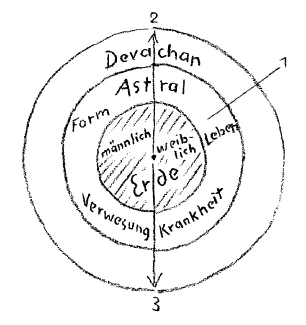
[ 6 ] Wir wollen uns einmal eine schematische Zeichnung machen. Manches wird ja durch unrichtiges symbolisches Zeichnen unklar. So genügt es zwar für das Verständnis gewisser Verhältnisse, wenn man den physischen Plan, den Astralplan und den Devachanplan übereinander zeichnet; richtiger ist es aber, sich die physische Welt als eine in sich geschlossene Sphäre vorzustellen, wo das Astralische ringsherum ist, und das Devachanische dann wieder um dieses herum. Statt horizontale Schichten zu zeichnen, ist es gut, die Sache so (siehe Zeichnung) zu zeichnen, weil dies eine Möglichkeit bietet, zwei Gebiete des Astralplanes voneinander zu unterscheiden. Wenn wir in zwei ganz bestimmte Gebiete des Astralplanes hineinschauen, die wir mit dem Pfeil 1 hier bezeichnen, so gibt es in der astralen Welt für das, was wir hier auf der Erde das Männliche und das Weibliche nennen, die beiden Gegensätze «Form» und «Leben». Form und Leben sind Gegensätze auf dem Astralplan. Nun würden wir aber, wenn wir auf dem Astralplan Form und Leben treffen wollen, sie nur treffen, wenn wir in dieser Richtung (von der Mitte nach oben, siehe Pfeil 2) gehen. Gehen wir nach der anderen Seite (Mitte nach unten, siehe Pfeil 3), so treffen wir dort keineswegs den wohltätigen Gegensatz von Form und Leben an, sondern wir treffen den Gegensatz «Verwesung» und «Krankheit» an. Wenn wir also von der physischen Welt ausgehen, treffen wir auf dem Astralplan nach oben den Gegensatz Form und Leben; dem entspricht in der astralen Welt nach unten, also gleichsam unter das Physische hinuntergehend, der Gegensatz von Verwesung und Krankheit. Immer wenn wir nach der einen Seite gehen, wo wir für die physische Welt wohltätige Eigenschaften sehen, entsprechen diesen auf der anderen Seite für die physische Welt zerstörende, schädliche Einflüsse. Da haben wir jetzt eine Möglichkeit, zu unterscheiden zwischen den Teilen des Astralplanes. Auf die menschliche Seele wirken tatsächlich zwei ganz voneinander verschiedene Gebiete des Astralplanes. Wenn wir uns eine Vorstellung davon bilden wollen, wie diese zwei ganz verschiedenen Gebiete auf die Seele wirken, müssen wir uns denken, daß wir beim Menschen haben: den physischen Leib, den Ätherleib, den Astralleib; und je nach deren Ausbildung, die ja öfter beschrieben worden ist: Manas oder Geistselbst, Budhi oder Lebensgeist, und Atma oder den Geistesmenschen; und zwischen drinnen haben wir, vom Ich erfüllt, das Seelische. So daß wir in gewisser Beziehung unterscheiden können: Leib — der eigentlich die drei Leiber umfaßt —, Seele und Geist. Nun spiegeln sich in der Seele die drei unteren Glieder Astralleib, Ätherleib und physischer Leib. Insofern sich physischer Leib, Ätherleib und Astralleib in ihrer ursprünglichen Art spiegeln, versetzen sie in die Seele des Menschen niedere, herunterziehende Eigenschaften. Aber es spiegelt sich im Menschen auch das, was das Obere ist: Manas, Budhi, Atma, und dadurch haben wir in der Seele ebenso heraufziehende, läuternde Elemente. Im strengen Christentum wußte man auch von dieser zweifachen Art der Spiegelung in der menschlichen Seele. Man sah, es spiegelt sich die höhere Menschennatur in der Seele, oder es spiegelt sich die untere Natur in der Seele. Das ahnten manche, auch wenn es nicht Esoteriker waren. Deshalb sagte man: Wenn der Mensch zum Tode kommt, nimmt er die Spiegelung der geistigen Welt als die Gesetzessammlung des Moses wahr; und wenn sich das Untere in der Seele spiegelt, wird der Seele im Tode vom Teufel das Sündenregister vorgelesen.
[ 6 ] Let us try to draw a schematic diagram. After all, some things become unclear when represented by inaccurate symbolic drawings. While it is true that, for understanding certain relationships, it suffices to draw the physical plane, the astral plane, and the devachanic plane one above the other; it is more accurate, however, to have a mental image of the physical world as a self-contained sphere, with the astral realm surrounding it, and the Devachanic realm in turn surrounding that. Instead of drawing horizontal layers, it is better to depict it this way (see drawing), because this allows us to distinguish between two regions of the astral plane. If we look into two very specific regions of the astral plane, which we indicate here with arrow 1, then in the astral world, for what we here on Earth call the masculine and the feminine, there are the two opposites “form” and “life.” Form and life are opposites on the astral plane. However, if we wish to encounter Form and Life on the astral plane, we would only encounter them if we move in this direction (from the center upward, see arrow 2). If we go in the other direction (from the center downward, see arrow 3), we do not encounter the beneficial opposites of form and life there at all, but rather the opposites “decay” and “disease.” Thus, when we proceed from the physical world, we encounter the opposites of form and life on the astral plane as we move upward; corresponding to this on the astral plane downward—that is, descending, as it were, beneath the physical—is the contrast of decay and disease. Whenever we go to one side, where we see qualities beneficial to the physical world, these are matched on the other side by influences that are destructive and harmful to the physical world. Here we now have a way to distinguish between the parts of the astral plane. In fact, two entirely distinct regions of the astral plane act upon the human soul. If we wish to form a mental image of how these two entirely different regions act upon the soul, we must consider that in the human being we have: the physical body, the etheric body, the astral body; and depending on their development, which has indeed been described frequently: Manas or the Spirit-Self, Budhi or the Life-Spirit, and Atma or the Spirit-Man; and in between, filled with the I, we have the soul. So that we can distinguish, in a certain sense: body—which actually encompasses the three bodies—soul, and spirit. Now the three lower members—the astral body, the etheric body, and the physical body—are reflected in the soul. Insofar as the physical body, the etheric body, and the astral body are reflected in their original form, they introduce into the human soul lower, dragging-down qualities. But what is higher is also reflected in the human being: Manas, Budhi, Atma, and through this we have in the soul equally uplifting, purifying elements. In strict Christianity, one was also aware of this twofold nature of reflection in the human soul. One saw that the higher human nature is reflected in the soul, or that the lower nature is reflected in the soul. Some sensed this, even if they were not esotericists. That is why it was said: When a person faces death, they perceive the reflection of the spiritual world as the collection of laws of Moses; and when the lower nature is reflected in the soul, the devil reads the record of sins to the soul at death.
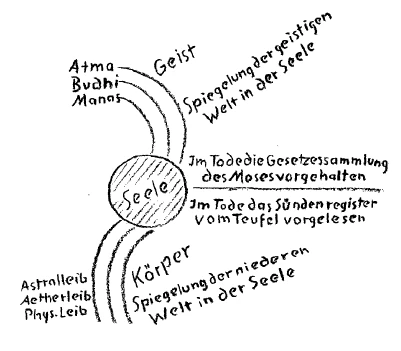
[ 7 ] Das bedeutet, es werden der Seele alle Eigenschaften vor das Auge gestellt, die ihr anhaften: Das, was sich von oben spiegelt, wird ihr als Gesetzestafel des Moses vorgehalten; und das Untere, das sich in der Seele spiegelt, wurde beschrieben, indem man sagte: Der Teufel liest der Seele das Sündenregister vor. Wenn der Weg nicht richtig eingeschlagen wird von der Seele, kann die Seele allerdings in ihre niederen Leidenschaften versinken; das kann eintreten. Das darf aber nicht als ein Abschreckungsmittel vor den Menschen hingestellt werden.
[ 7 ] This means that all the qualities inherent in the soul are presented before its eyes: what is reflected from above is held up to it as the Tablets of the Law of Moses; and what is reflected from below in the soul is described by saying: The devil reads the register of sins to the soul. If the soul does not take the right path, however, it can sink into its base passions; that can happen. But this must not be presented to people as a deterrent.
[ 8 ] Alle auf Imaginationen, auf das Bildliche hinzielenden Vorstellungen erziehen den Menschen, um ihn allmählich zu jenem Punkte der Lebensentwickelung zu bringen, wo er lernt, immer mehr und mehr in die höheren Welten hineinzublicken. Bildhafte Vorstellungen, wie zum Beispiel die Vorstellung vom alten Mond, sind ein mächtiges Erziehungsmittel nach dieser Richtung. Durch solche Vorstellungen bringt man die Entwickelungsidee in richtiger esoterischer Art an den Menschen heran. Wenn man vor den Menschen nur trokkene, abstrakte Begriffe hinstellt, bleibt er mit dem Denken auf dem physischen Plan, denn das gewöhnliche Denken als solches kommt niemals vom physischen Plan weg. Es ist zwar eine Herunterspiegelung vom Devachanplan; aber der Gedanke, den der Mensch hegt, ist etwas, was zum physischen Plan gehört, er ist nur wie ein Schattenbild der höheren Vorgänge. Wenn Sie sich noch so feine Vorstellungen davon bilden, wie die Entwickelung vor sich geht, wie ein Wesen auf der ersten Stufe des Daseins sich differenziert, sich herabsenkt und umhüllt, — das sind alles nur Vorstellungen, die Ihnen Begriffe des physischen Planes geben, die Sie aber nicht in der Entwickelung weiterbringen. Erst sinnlich-übersinnliche Vorstellungen und Begriffe können Sie nach und nach wirklich eine Stufe weiterbringen. Zuerst muß man die Begriffe in Bilder, in Imaginationen umwandeln und diesen Vorgang immer und immer wiederholen.
[ 8 ] All mental images that focus on imagination and the visual help to educate people, gradually bringing them to that point in their development where they learn to look more and more into the higher worlds. Mental images, such as the mental image of the old moon, are a powerful educational tool in this direction. Through such mental images, the idea of development is presented to people in a truly esoteric manner. If one presents people only with dry, abstract concepts, their thinking remains on the physical plane, for ordinary thinking as such never departs from the physical plane. It is indeed a reflection from the Devachan plane; but the thought that a person holds is something that belongs to the physical plane; it is merely like a shadow image of the higher processes. No matter how refined your mental images may be about how evolution proceeds, how a being on the first stage of existence differentiates, descends, and envelops itself—these are all merely mental images that give you concepts of the physical plane, but which do not advance you in your development. Only sensory-supersensory mental images and concepts can gradually take you a step further. First, one must transform the concepts into images, into imaginations, and repeat this process over and over again.
[ 9 ] Wenn man dieses Vorgehen, das zum Beispiel in den Rosenkreuzer-Schulen gelehrt wurde, in einen Dialog zwischen Lehrer und Schüler fassen würde, so könnte man das so ausdrücken: — In Wirklichkeit hat ein solcher Dialog nie so stattgefunden, wir können es aber einmal so darstellen, um zu zeigen, was der Schüler in langen, langen Erlebnissen nach und nach durchmachen mußte. — Der Lehrer sagte dem Schüler: Sieh dir einmal die Pflanze an, wie sie ihre Wurzel in die Erde hinein richtet, wie sie mit dem Stengel und der Blüte der Sonne entgegenwächst und ihre Fruchtorgane zur Entfaltung bringt. Und jetzt stelle dir dagegen den Menschen vor. — Der Mensch wird schlecht verglichen mit der Pflanze, wenn man seinen Kopf mit der Blüte und seine Fortpflanzungsorgane mit der Wurzel der Pflanze vergleicht. Selbst Darwin, der große Naturforscher, hat diesen Vergleich richtig gebraucht, indem er den Kopf des Menschen mit der Wurzel der Pflanze verglich, so daß selbst für Darwin die Pflanze der auf den Kopf gestellte Mensch ist. Was die Pflanze keusch dem Sonnenstrahl entgegenhält, ihre Fortpflanzungsorgane, das richtet der Mensch dem Mittelpunkte der Erde zu, so daß wir also im Menschen eine Umkehrung der Pflanze zu denken haben, indem er alle die Kräfte, die bei der Pflanze nach dem Mittelpunkte der Erde gerichtet sind, frei nach dem sonnenerfüllten Kosmos richtet, und jene Organe, die die Pflanze keusch dem Sonnenstrahl entgegenstreckt, schamvoll nach der Erde richtet. Das Tier steht mitten darinnen.
[ 9 ] If one were to frame this approach—which was taught, for example, in the Rosicrucian schools—as a dialogue between teacher and student, it could be expressed as follows: — In reality, such a dialogue never actually took place, but we can present it this way to illustrate what the student had to gradually go through during long, long experiences. — The teacher said to the student: Look at the plant, how it sends its roots into the earth, how it grows toward the sun with its stem and flower, and brings its fruiting organs to fruition. And now create a mental image of the human being in contrast. — The human being is poorly compared to the plant when one compares his head to the flower and his reproductive organs to the plant’s root. Even Darwin, the great naturalist, used this comparison correctly by comparing the human head to the plant’s root, so that even for Darwin, the plant is the human being turned upside down. What the plant chastely holds up to the sun’s rays—its reproductive organs—man directs toward the center of the earth, so that we must thus conceive of man as a reversal of the plant, in that he freely directs all the forces that in the plant are directed toward the center of the earth out into the sun-filled cosmos, and those organs that the plant chastely stretches toward the sun’s rays, it modestly directs toward the earth. The animal stands right in the middle of this.
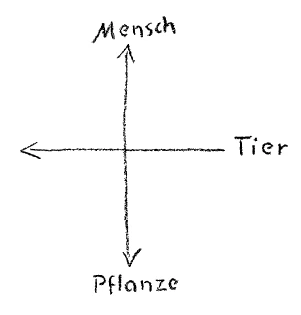
[ 10 ] Wenn wir daher die realen, in der Welt vorhandenen Kraftrichtungen zeichnen wollen, können wir das so tun: Die wahre esoterische Bedeutung des Kreuzeszeichens ist eine Summe von Kräften. Die eine Kraftrichtung geht nach unten: das Pflanzenwesen wird dirigiert von dieser Kraft. Beim Menschen ist sie nach der entgegengesetzten Seite gerichtet. Das Tier hat sein Rückgrat horizontal gerichtet, bei ihm zeigt sich die Kraft horizontal die Erde umkreisend. Das seelische Prinzip steigt hinauf vom Pflanzendasein zum Tierdasein, zum Menschendasein. Und Plato, der so oft Dinge zum Ausdruck brachte, die der Einweihung entstammen, sprach den schönen Satz aus: Die Weltenseele ist an den Weltenleib gekreuzigt. — Das heißt, die Weltenseele geht durch Pflanze, Tier und Mensch hindurch; sie ist gekreuzigt in den Kräften der drei Reiche: Pflanzenreich, Tierreich und Menschenreich. Und wenn wir so das Kreuz hineinschreiben in die drei Naturreiche, dann wird uns das Kreuz zum Zeichen der Entwickelungsrichtung.
[ 10 ] If, therefore, we wish to depict the actual directions of force that exist in the world, we can do so as follows: The true esoteric meaning of the sign of the cross is a sum of forces. One direction of force points downward: the plant kingdom is governed by this force. In human beings, it is directed in the opposite direction. The animal has its spine oriented horizontally; in it, the force manifests horizontally, encircling the earth. The soul principle ascends from the plant realm to the animal realm, to the human realm. And Plato, who so often expressed things derived from initiation, uttered the beautiful sentence: The world soul is crucified upon the world body. — That is to say, the world soul passes through plant, animal, and human; it is crucified in the forces of the three kingdoms: the plant kingdom, the animal kingdom, and the human kingdom. And when we thus inscribe the cross into the three kingdoms of nature, the cross becomes for us a sign of the direction of development.
[ 11 ] Nun sagte also der Lehrer zum Schüler: Du hast dir vorzustellen, wie die Pflanze ihren Kelch dem Sonnenstrahl entgegenstreckt, wie die Fruchtorgane zur Reife kommen, wenn die Pflanze geküßt wird vom Sonnenstrahl. — Die Entwickelung zum Menschen geschieht dadurch, daß die reine keusche Pflanzensubstanz durchzogen wird von Begierden, Instinkten und Leidenschaften. Dadurch erobert sich der Mensch sein Bewußtsein, dadurch wird er zum Menschen, daß er hindurchgeht durch die Tiernatur. Dadurch, daß der Mensch in die reine Pflanzennatur die niedere Begierdennatur hineinverwoben hat, ist er auf der anderen Seite aufgestiegen vom dumpfen Pflanzenbewußtsein zum hellen Tagesbewußtsein.
[ 11 ] So the teacher said to the student: You must create a mental image of how the plant stretches its calyx toward the sunbeam, how the fruit organs ripen when the plant is kissed by the sunbeam. — The development into a human being occurs through the pure, chaste plant substance being permeated by desires, instincts, and passions. Through this, the human being conquers his consciousness; through this, he becomes a human being by passing through the animal nature. By weaving the lower nature of desire into the pure plant nature, the human being has, on the other hand, ascended from the dull plant consciousness to the bright consciousness of the day.
[ 12 ] Von dieser Stufe des gegenwärtigen Menschen wies der Lehrer den Schüler auf eine höhere Stufe hin. So wie der Mensch sich aus einem Zustand heraufentwickelt hat, wie ihn die Pflanze hat, so wird er auch seine Instinkte und Begierden wiederum läutern zu einer höheren, keuschen Stufe. Der Lehrer zeigte dem Schüler die Anlagen im physischen Leibe des Menschen, durch welche die höheren Stufen des Bewußtseins errungen werden können und die menschliche Substanz wiederum zu einer der Pflanze ähnlichen Substanz werden kann. Ein jegliches Wesen muß einen physischen Leib benutzen, wenn es auf der Erde erscheinen will. Aber der Leib des Menschen wird sich in der Zukunft immer mehr und mehr umgestalten. Wir unterscheiden in bezug auf die menschlichen Organe eine absteigende und eine aufsteigende Entwickelung. Ein Teil der menschlichen Organe ist in absteigender Entwickelung; diese wird der Mensch im Laufe der Zeit, die allerdings nach Jahrtausenden zählt, abwerfen. Andere Organe sind im Werden, sie werden in der Zukunft eine Höherentwickelung haben, zum Beispiel der menschliche Kehlkopf; er ist erst im Anfange seiner Entwickelung. Eine andere Höherentwickelung wird das menschliche Herz nehmen, das in der Zukunft ein ganz anderes Organ werden wird. Während andere Organe ihren Höhepunkt bereits überschritten haben, sich abschnüren von der menschlichen Natur und verdorren, haben wir im Herzen ein Organ, das erst am Anfange seiner Entwickelung ist.
[ 12 ] From this stage of the present-day human being, the teacher pointed the student toward a higher stage. Just as the human being has evolved from a state similar to that of a plant, so too will he purify his instincts and desires to reach a higher, chaste stage. The Teacher showed the student the faculties within the human physical body through which the higher levels of consciousness can be attained, and through which human substance can in turn become a substance similar to that of a plant. Every being must use a physical body if it wishes to appear on Earth. But the human body will undergo ever greater transformation in the future. With regard to the human organs, we distinguish between a descending and an ascending development. A portion of the human organs is in a state of descending development; humanity will shed these over time, though this process will take millennia. Other organs are in the process of becoming; they will undergo a higher development in the future, for example, the human larynx; it is only at the beginning of its development. The human heart will undergo a different kind of higher development; in the future, it will become a completely different organ. While other organs have already passed their peak, are severing themselves from human nature, and are withering away, we have in the heart an organ that is only at the beginning of its development.
[ 13 ] Wir können bei den Muskeln des Menschen quergestreifte und längsgestreifte unterscheiden; das sind willkürliche und unwillkürliche Muskeln. Die willkürlichen Muskeln der Hand zum Beispiel sind quergestreift. Die Muskeln der Gedärme dagegen, welche die Speise unwillkürlich vorwärtstreiben, sind längsgestreift. Das Herz macht hierbei eine Ausnahme, und das ist für die heutigen physiologischen und anatomischen Wissenschaftler eine Crux. Das Herz gehört zwar zu den unwillkürlichen Muskeln, aber es hat quergestreifte Muskulatur. Daher können unsere Anatomen auch das Herz nicht begreifen. Sie betrachten ja alle Organe als gleichartig. Wenn man die Organe geistig betrachtet, können sie durchaus chemisch aus denselben Bestandteilen bestehen, aber doch kann das eine in einer absteigenden und das andere in einer aufsteigenden Entwickelung sich befinden. Das Herz ist auf dem Wege, in der Zukunft ein willkürlicher Muskel zu werden, es trägt in seinem anatomischen Bau schon jetzt die charakteristischen Merkmale dafür. Heute ist davon nur sehr wenig zu merken. Heute trägt es dazu bei, daß seelische Erlebnisse auf das Blut wirken. Sie können sehen, wie, wenn Sie ein Angstgefühl bekommen, die Blutmasse von der Peripherie des Leibes nach dem Innern sich zurückzieht, oder wie bei Auftreten von Schamgefühl das Blut vom Innern des Leibes nach der Peripherie hingetrieben wird. In der Zukunft wird außer der Umgestaltung des Herzens auch eine Umgestaltung unseres Kehlkopfes vor sich gehen. Heute dient der Kehlkopf dazu, meine Gedanken in Worte umzusetzen, indem er die Luft in Schwingungen versetzt. Sie können mit Ihren Ohren meine Worte aufnehmen und hören; das wird durch die Schwingungen der Luft verursacht. Der heutige menschliche Kehlkopf ist imstande, in Luftschwingungen umzusetzen, was in der Seele vorgeht. Der zukünftige Menschenleib wird seinen Kehlkopf zum Befruchtungsorgan umgestalten, und das Wort, das heute nur in der Luft schafft, wird zukünftig in unserer Umgebung schaffend werden. Die Reproduktion wird dann durch den Kehlkopf vor sich gehen, der die Rasse der Zukunft schaffen wird.
[ 13 ] In the human body, we can distinguish between striated and smooth muscles; these are voluntary and involuntary muscles. The voluntary muscles of the hand, for example, are striated. The muscles of the intestines, on the other hand, which involuntarily propel food forward, are smooth. The heart is an exception here, and this poses a dilemma for today’s physiological and anatomical scientists. Although the heart belongs to the category of involuntary muscles, it has striated musculature. This is why our anatomists cannot comprehend the heart either. After all, they regard all organs as being of the same nature. If one considers the organs spiritually, they may well consist chemically of the same components, yet one may be in a descending phase of development while the other is in an ascending one. The heart is on its way to becoming a voluntary muscle in the future; it already bears the characteristic features of this in its anatomical structure. Today, very little of this is noticeable. Today, it contributes to the way emotional experiences affect the blood. You can see how, when you feel fear, the blood withdraws from the periphery of the body toward the interior, or how, when a feeling of shame arises, the blood is driven from the interior of the body toward the periphery. In the future, in addition to the transformation of the heart, a transformation of our larynx will also take place. Today, the larynx serves to translate my thoughts into words by setting the air into vibrations. You can receive and hear my words with your ears; this is caused by the vibrations of the air. The human larynx of today is capable of translating what is happening in the soul into air vibrations. The future human body will transform its larynx into a reproductive organ, and the word, which today creates only in the air, will in the future become creative in our environment. Reproduction will then take place through the larynx, which will create the race of the future.
[ 14 ] So wie der Lehrer den Schüler hinwies auf den keuschen Pflanzenkelch, und wie er hinwies auf den Menschen, der im Herabsteigen seine Pflanzensubstanz durchzogen hat mit der niederen Natur der Leidenschaften, Begierden und Instinkte, dafür aber eingetauscht hat sein heutiges helles Tagesbewußtsein, so zeigte der Lehrer, wie der gegenwärtige Mensch aufsteigen wird zu höheren Bewußtseinszuständen, und wie der zukünftige Mensch die von Begierden erfüllte Substanz wiederum umwandeln wird zu reinen und keuschen Organen. Auf Vergangenheit, Gegenwart und Zukunft wurde der Schüler hingewiesen. Wie der Kelch der Pflanze keusch der Sonne sich entgegenstreckt und ihre Fruchtorgane der Sonne entgegenwachsen, das wird wieder da sein auf einer höheren Stufe, wo der Mensch seinen Kehlkopf als Kelch dem geistigen Sonnenstrahl darbieten wird. Diesen geistigen Kelch, das umgestaltete Sprachorgan, nannte man den Heiligen Gral. Das ist ein reales Ideal. Anfang, Mitte und Ende der Menschheitsentwickelung, hier sehen Sie den Entwickelungsgedanken der Menschheit verwandelt in ein Bild.
[ 14 ] Just as the teacher pointed out to the student the chaste calyx of the plant, and just as he pointed out the human being who, in the process of descent, has permeated his plant substance with the lower nature of passions, desires, and instincts, but in exchange has acquired his present clear waking consciousness, so the teacher showed how present-day humanity will ascend to higher states of consciousness, and how future humanity will in turn transform the substance filled with desires into pure and chaste organs. The student was directed toward the past, present, and future. Just as the calyx of the plant chastely stretches toward the sun and its fruiting organs grow toward the sun, so this will be present again on a higher level, where man will offer his larynx as a calyx to the spiritual sunbeam. This spiritual calyx, the transformed organ of speech, was called the Holy Grail. This is a real ideal. The beginning, middle, and end of human development—here you see the idea of humanity’s evolution transformed into an image.
[ 15 ] Durch die Empfindungen, die wir an diesen Bildern entwickeln, strömen uns die Kräfte zu, die uns wirklich die höheren Welten erschließen. Alles geht ohne Zauberei vor sich. An den Bildern werden die Empfindungen angeregt, die den Menschen hineinführen in die höheren Welten. Gefühle und Empfindungen führen den Menschen in die astrale Welt, wie der Wille ihn in die devachanische oder Geisteswelt führt. Denken entspricht der physischen Welt, Gefühl der astralischen Welt und der geläuterte Wille der Devachanwelt.
[ 15 ] Through the feelings we develop in response to these images, the forces that truly open up the higher worlds to us flow into us. All of this takes place without magic. The images stimulate the feelings that lead people into the higher worlds. Feelings and sensations lead people into the astral world, just as the will leads them into the devachanic or spiritual world. Thinking corresponds to the physical world, feeling to the astral world, and the purified will to the devachanic world.
[ 16 ] Wenn wir die Pflanze in der ursprünglichen keuschen Substanz betrachten, so finden wir das Grün als Farbe im Leben der Pflanze. Die Pflanze ist in denjenigen Teilen, in denen der Ätherleib lebendig tätig ist, durchdrungen vom Blattgrün, von dem, was man das Chlorophyli nennt. Der Ätherleib hat ein Grundgesetz, das ist das Gesetz der Wiederholung. Würde in der Pflanze nur der Ätherleib allein tätig sein, so würde sich immer wieder ein und dieselbe Form wiederholen; Blatt um Blatt setzt sie an. Wenn aber der Astralleib der Erde auf die Pflanze einzuwirken beginnt, schließt sie das Wachstum ab und setzt die Blüte an. Die Wirkung des Ätherleibes offenbart sich in der Wiederholung. Auch beim menschlichen Wachstum macht sich dieses Prinzip geltend. Der Ätherleib zeigt seinen Einfluß in der Bildung der Rückenwirbel, die aber da ihren Abschluß findet, wo der Astralleib zu wirken beginnt und sich die Schädelkapsel wölbt. Wir können daher auf den ätherischen Leib nur einwirken durch das Prinzip der Wiederholung. Wenn Sie denken und begreifen, so wirkt das nur auf den Astralleib. Wenn Sie aber zum Beispiel beten oder meditieren und täglich dasselbe Gebet oder dieselbe Meditation wiederholen, so wirken Sie bis in den Ätherleib hinein. Die Dinge sind so, daß im Kosmos sich zuerst das Prinzip der Wiederholung zeigt in den Taten des Ätherleibes, dann das Prinzip des Abschlusses durch den Astralleib. Wo der Astralleib sich zurückzieht, tritt mit Selbstverständlichkeit wieder das Prinzip der Wiederholung auf. So wachsen Ihre Haare und Nägel, weil sich der Astralleib dort zurückgezogen hat. Es schmerzt ja auch nicht, wenn Sie sich die Haare abschneiden, denn der Schmerz ist ein Ausdruck des Astralleibes.
[ 16 ] When we observe the plant in its original, pure substance, we find green as the color of the plant’s life. In those parts where the etheric body is actively at work, the plant is permeated by chlorophyll, the substance known as chlorophyll. The etheric body has a fundamental law, which is the law of repetition. If only the etheric body were active in the plant, the same form would repeat itself over and over again; leaf after leaf would grow. But when the astral body of the Earth begins to influence the plant, it concludes its growth and begins to flower. The effect of the etheric body manifests itself in repetition. This principle also applies to human growth. The etheric body exerts its influence in the formation of the vertebrae, which, however, comes to an end where the astral body begins to act and the skull cavity bulges. We can therefore only influence the etheric body through the principle of repetition. When you think and comprehend, this affects only the astral body. But when you pray or meditate, for example, and repeat the same prayer or meditation daily, you are acting into the etheric body. The way things are is that in the cosmos, the principle of repetition first manifests in the actions of the etheric body, then the principle of completion through the astral body. Where the astral body withdraws, the principle of repetition naturally reemerges. This is why your hair and nails grow—because the astral body has withdrawn from those areas. It doesn’t hurt when you cut your hair, because pain is an expression of the astral body.
[ 17 ] Wir haben zunächst die reine keusche Pflanzensubstanz, wo die Pflanze, lediglich dem Gesetz des Ätherleibes unterliegend, Blatt für Blatt ansetzt. Jetzt durchdringt diese reine keusche Pflanzensubstanz immer mehr dasjenige, was in der Theosophie das Kama genannt wird, das Instinkt- und Empfindungsmäßige, das Begierdenreich, bis hinauf zu den Vorstellungen. Und nun soll im Menschen dasjenige wieder überwunden werden, was sich in ihm hinaufentwickelt hat, seit er eine Pflanzennatur hatte. Indem der Mensch sich hinaufentwickelte, hat er in sich das rote Blut aufgenommen. Durch das rote Blut wird dasjenige im Menschen bewirkt, was ihn selbstbewußt macht. Es ist das von astralischer Substanz und vom Ich durchzogene Chlorophyll der Pflanze, das sich umgewandelt hat in das rote Blut. Wenn Sie die grüne Pflanzensubstanz durchziehen könnten mit Ich und astralischer Substanz, würden Sie das rote Blut bekommen. Denken Sie nun an das Bild des Kreuzes. Im Bild des Kreuzes haben Sie auch etwas, das auf des Menschen Zukunft hinweist. Wo liegt des Menschen Zukunft? Die Pflanzennatur soll er wieder erringen, aber verbunden mit der höheren Stufe des Bewußtseins, die der heutige Mensch sich schon errungen hat. Die roten Rosen des Rosenkreuzes bezeichnen, was durch das Blut errungen wurde, aber auch, was er als Pflanzennatur hatte und wieder haben soll. Das ist vorgebildet in der Rose. Sie hat Pflanzennatur, und sie hat auch die rote Farbe des Blutes. In den grünen Blättern wirkt der Ätherleib, in der roten Blüte, wo der Abschluß ist, wirkt der Astralleib; die Rosenblüte verdankt das Rot den intensivsten Einwirkungen des Astralleibes der Erde.
[ 17 ] We begin with the pure, chaste plant substance, where the plant, subject solely to the law of the etheric body, produces leaf after leaf. Now this pure, chaste plant substance increasingly permeates what is called Kama in theosophy—the realm of instinct and sensation, the realm of desire—all the way up to the realm of mental images. And now, in human beings, that which has developed within them since they had a plant nature must be overcome once more. As human beings evolved, they took in red blood. Through the red blood, that which makes a person self-aware is brought about within them. It is the chlorophyll of the plant, permeated by astral substance and the ego, that has been transformed into red blood. If you could permeate the green plant substance with the ego and astral substance, you would obtain red blood. Now think of the image of the cross. In the image of the cross, you also have something that points to humanity’s future. Where does humanity’s future lie? He is to regain the plant nature, but connected to the higher level of consciousness that modern humanity has already attained. The red roses of the Rosicrucians signify what has been attained through the blood, but also what he had as plant nature and is to have again. This is prefigured in the rose. It has plant nature, and it also has the red color of blood. The etheric body is at work in the green leaves; in the red blossom, where the process culminates, the astral body is at work; the rose blossom owes its red color to the most intense influences of the Earth’s astral body.
[ 18 ] Der Astralleib des Menschen wird künftig frei werden und bewußt von außen, von außerhalb des physischen Leibes wirken, so wie jetzt der Astralleib der Erde auf die Rose wirkt. Dann wird das, was jetzt als Pflanzenrose auf niederer Stufe da ist, auf höherer Stufe erscheinen als die Menschenrose. So haben wir in dem Kranz von Rosen, der das schwarze Holz des Kreuzes umgibt, tatsächlich ein Zeichen für die Entwickelung des Menschen. In dem schwarzen Holz blicken wir auf das Absterbende, es ist ein Bild für das, was auch beim Menschen absterben wird. Und in der roten Rose blicken wir auf das, was sich weiter entwickeln wird bis zu jenem Kelch, der sich — wie der Pflanzenkelch der Sonne — den geistigen Sonnenstrahlen entgegenhält. Und das Rosenkreuz, wo die roten Rosen das schwarze Kreuz umgeben, stellt uns diesen Vorgang im Bilde dar.
[ 18 ] In the future, the human astral body will become free and will act consciously from the outside, from beyond the physical body, just as the astral body of the Earth now acts upon the rose. Then what now exists as the plant rose on a lower level will appear on a higher level as the human rose. Thus, in the wreath of roses surrounding the black wood of the cross, we actually have a symbol of human evolution. In the black wood we see what is dying; it is an image of what will also die in the human being. And in the red rose we see what will continue to develop until it becomes that calyx which—like the plant calyx of the sun—holds itself up to the spiritual rays of the sun. And the Rosicrucian symbol, where the red roses surround the black cross, depicts this process for us.
[ 19 ] Das ist das wesentliche bei den Symbolen, daß wir sie nicht bloß denken, sondern daß wir sie fühlen und empfinden. Denn nur, wenn wir an der roten Rose fühlen, daß sie uns sagt: das werdet ihr einstmals sein, das ist das, was euch das Ziel der Menschenentwickelung darstellt —, und wenn uns dabei das Herz aufgeht und unsere Gefühle rein werden, dann werden die Kräfte in uns ausgelöst, die uns hinaufführen in eine höhere Welt. So sind diese Symbole Arbeiter an unserer Seele. Sie durchkraften und durchwirken unsere Seele, sie sind die größten und wirksamsten Erzieher unseres Menschengeschlechtes.
[ 19 ] The essential thing about symbols is that we do not merely think them, but that we feel and sense them. For only when we feel, through the red rose, that it is telling us: “This is what you will one day become; this is what represents the goal of human development”—and when our hearts open and our feelings become pure in the process—only then are the forces within us set in motion that lead us upward into a higher world. Thus, these symbols are workers upon our soul. They permeate and work through our soul; they are the greatest and most effective educators of our human race.
[ 20 ] So wie wir hier Bilder, Imaginationen vor die Seele hinstellen, so stellt man auf noch höheren Gebieten die inneren Kräfte der Zahlen vor den Menschen hin. Der Mensch muß lernen, die inneren Verhältnisse der Zahlen wie eine geistige Musik zu empfinden. Man kann die Verhältnisse des physischen Leibes, Ätherleibes, Astralleibes und Ich zueinander beschreiben, wenn man versucht, Bilder dafür zu geben, wie das Verhältnis dieser vier Glieder der menschlichen Natur zueinander ist. Dadurch erlebt der Mensch eine Art von Imagination. So kann man das Verhältnis von physischem Leib und Ätherleib zueinander beschreiben, indem man sagt: Der physische Leib entsteht dadurch, daß alle Kräfte und Stoffe, die im Mineralreich ausgebreitet sind, durch den Ätherleib verbunden sind; er würde zerfallen, wenn der Ätherleib ihn nicht durchdringen würde; der Ätherleib ist ein innerer Kämpfer gegen den Zerfall des physischen Leibes. Auf diese Weise arbeiten wir uns hinauf zu einer Vorstellung des Ätherleibes.
[ 20 ] Just as we present images and mental images to the soul here, so too, in even higher realms, the inner forces of numbers are presented to human beings. Human beings must learn to perceive the inner relationships of numbers as a kind of spiritual music. One can describe the relationships between the physical body, the etheric body, the astral body, and the I by attempting to provide images of how these four members of human nature relate to one another. Through this, a person experiences a kind of imagination. Thus, one can describe the relationship between the physical body and the etheric body by saying: The physical body comes into being through the fact that all the forces and substances spread out in the mineral kingdom are connected by the etheric body; it would disintegrate if the etheric body did not permeate it; the etheric body is an inner fighter against the disintegration of the physical body. In this way, we work our way up to a mental image of the etheric body.
[ 21 ] Und versuchen wir, eine bildhafte Vorstellung vom Astralleib zu gewinnen, so stellen wir uns vor, wie er herausrückt in der Nacht und von außen auf Ätherleib und physischen Leib wirkt, indem er die Ermüdungsstoffe fortschafft. Machen wir uns das bildlich klar. Nun gibt es aber eine noch höhere Art, sich dieses Verhältnis vorzustellen; da muß man sich den inneren Wert gewisser Zahlen vorstellen. Man muß erkennen, daß das Verhältnis von 1: 3 etwas ganz anderes ist als das Verhältnis von 1: 7. Das ist nicht gleichgültig. Man muß sich bei dem Verhältnis von 1: 3 vorstellen, daß die 3 in sich selbst differenziert ist, und man muß sich die Wechselbeziehungen der einzelnen Größen zu den anderen vorstellen.
[ 21 ] And when we try to form a vivid mental image of the astral body, we imagine how it emerges at night and acts from the outside on the etheric body and the physical body by removing the waste products of fatigue. Let us visualize this clearly. But there is an even higher way of conceiving this relationship; one must consider the inner significance of certain numbers. One must recognize that the ratio of 1:3 is something entirely different from the ratio of 1:7. This is not a trivial matter. When considering the ratio of 1:3, one must create a mental image of the 3 being differentiated within itself, and one must envision the interrelationships of the individual quantities with one another.
[ 22 ] Worauf es aber ankommt, das ist das Verhältnis von 1:3:7:12. Wenn Sie das Verhältnis dieser Zahlen zueinander als Tonverhältnis auffassen, indem Sie sich vorstellen, daß ein Ton in einer bestimmten Zeit drei Schwingungen macht, ein anderer in derselben Zeit sieben Schwingungen, und noch ein anderer zwölf Schwingungen, dann haben Sie in diesen Zahlen jenes Verhältnis ausgedrückt, das in geistiger Musik das Verhältnis angibt von Ich, Astralleib, Ätherleib und physischem Leib.
[ 22 ] What matters, however, is the ratio of 1:3:7:12. If you interpret the ratio of these numbers to one another as a tonal ratio—by creating a mental image of a tone that makes three vibrations in a given time, another that makes seven vibrations in the same time, and yet another that makes twelve vibrations—then you have expressed in these numbers the ratio that, in spiritual music, indicates the relationship between the ego, the astral body, the etheric body, and the physical body.
Ich = 1
Astralleib = 3
Ätherleib = 7
physischer Leib = 12
I = 1
Astral body = 3
Etheric body = 7
Physical body = 12
[ 23 ] Das hat seinen guten Grund im Weltendasein. Wenn wir die Entwickelung vom ältesten Saturndasein bis zum jetzigen Erdendasein verfolgen würden, könnten wir bald finden, wie dies im Menschendasein begründet ist. Die Erde war in ihrer ersten, in der Saturn-Verkörperung, umgeben von den zwölf Zeichen des Tierkreises. Sie gaben die erste Keimanlage zum physischen Leib. Durch die Einwirkung der entsprechenden Zeichen auf den Leib entstand dieses Verhältnis der Zwölfzahl zu den einzelnen Gliedern des physischen Leibes. Auf den Ätherleib wirkten die sieben Planeten. Als die Erde Sonne war, standen um sie die anderen Planeten, und so wirkte die Siebenzahl auf den Ätherleib. Als die Erde in ihrer Mondenverkörperung war, wirkte auf sie zunächst die Sonne. Dann aber entstanden dadurch, daß sich die Sonne und dann der Mond von der Erde abtrennten, aus einem Körper drei Körper, und dadurch wirkte bei der Bildung des Astralleibes die Dreizahl. Und als das Ich aus den höheren Welten herunterkam, drückte sich das aus in der Zahl Eins. Das Verhältnis von 1: 3 gibt Ihnen das Verhältnis des Ich zum Astralkörper, zu 7 das Verhältnis zum Ätherleib, und zu 12 das Verhältnis zum physischen Leib.
[ 23 ] There is a good reason for this in the history of the world. If we were to trace the development from the earliest Saturn existence to the present Earth existence, we would soon discover how this is rooted in human existence. In its first incarnation, the Saturn incarnation, the Earth was surrounded by the twelve signs of the zodiac. They provided the first seed for the physical body. Through the influence of the corresponding signs on the body, this relationship between the number twelve and the individual members of the physical body arose. The seven planets acted upon the etheric body. When the Earth was a sun, the other planets stood around it, and thus the number seven acted upon the etheric body. When the Earth was in its lunar incarnation, the sun initially acted upon it. But then, as a result of the sun and then the moon separating from the Earth, three bodies arose from one body, and thus the number three acted in the formation of the astral body. And when the I descended from the higher worlds, this was expressed in the number one. The ratio of 1:3 gives you the relationship of the I to the astral body, 7 the relationship to the etheric body, and 12 the relationship to the physical body.
[ 24 ] 1:3:7:12 bezeichnet also das Verhältnis der vier Wesensglieder des Menschen, das Sie innerlich fühlen müssen. Es ist nicht leicht, die Empfindungen zu erwecken, daß man den physischen Leib als den vollkommensten der vier Teile sich vorzustellen hat, den Ätherleib als den weniger vollkommenen, den Astralleib noch weniger vollkommen, und das Ich als das «Baby» unter den vier Gliedern der Menschennatur. Man muß den physischen Leib zwölfmal so vollkommen denken wie das Ich, den Ätherleib siebenmal so vollkommen, und den Astralleib dreimal so vollkommen. Diese Zahlen geben die Vollkommenheitsgrade für die vier Glieder der Menschennatur an. Es werden uns also in diesen Zahlen tiefe Symbole für die realen Verhältnisse gegeben.
[ 24 ] 1:3:7:12 thus describes the relationship between the four constituent parts of the human being, which you must sense within yourselves. It is not easy to awaken the sense that one must create a mental image of the physical body as the most perfect of the four parts, the etheric body as the less perfect, the astral body as even less perfect, and the I as the “baby” among the four members of human nature. One must conceive of the physical body as twelve times as perfect as the I, the etheric body as seven times as perfect, and the astral body as three times as perfect. These numbers indicate the degrees of perfection for the four members of human nature. Thus, these numbers provide us with profound symbols of the actual relationships.
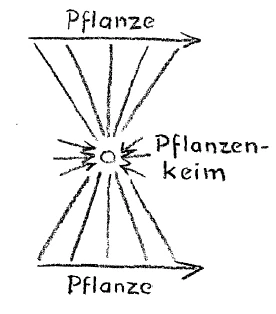
[ 25 ] Es gab in den okkulten Schulen Anleitungen, die Zahlenwerte nach und nach kennenzulernen. So lehrte man die Bedeutung der Dreizahl, indem man sagte: Fassen wir einmal die Entwickelung der Pflanze ins Auge, da haben wir auf dreierlei zu achten. Fangen wir zunächst an beim Pflanzenkeim. Sie haben einen unscheinbaren, kleinen Pflanzenkeim, aus diesem entwickelt sich nach und nach die Pflanze. Wir können das zeichnerisch so darstellen, daß wir den Pflanzenkeim strahlenförmig auseinandergehen lassen, bis zu Blättern, Blüten und Frucht. Nun ist der Keim zur Pflanze und dann aus der Pflanze wiederum der Pflanzenkeim geworden. Was in der Pflanze auseinandergewickelt zu Blättern, Blüte und Frucht geworden ist, das alles ist im Keim zusammengewickelt, es ist gleichsam hineingeschlüpft in den Keim. In einer entwickelten Pflanze ist alles im Sinnlichen offenbart. Dann geht das Sinnliche in ein ganz Rleines hinein, in den Keim. Da haben wir im Keim das Sinnliche so klein wie möglich, das Geistige so groß wie möglich.
[ 25 ] In the occult schools, there were instructions for gradually becoming familiar with numerical values. For example, the significance of the number three was taught by saying: Let us consider the development of a plant; there are three aspects to observe. Let us begin with the plant seed. You have an inconspicuous, small plant seed, from which the plant gradually develops. We can illustrate this by depicting the plant seed radiating outward in all directions, until it becomes leaves, flowers, and fruit. Now the seed has become a plant, and from the plant, in turn, the plant seed again. What has unfolded in the plant into leaves, flowers, and fruit—all of that is wound up in the seed; it has, as it were, slipped back into the seed. In a developed plant, everything is revealed in the physical realm. Then the sensible enters into something very small, into the seed. There, in the seed, we have the sensible as small as possible and the spiritual as large as possible.
[ 26 ] Aber noch ein Drittes findet statt. Während aus der Pflanze der Keim sich bildet und aus diesem wiederum die neue Pflanze entsteht, wirken fortwährend von außen elementare Kräfte der Umgebung auf die Pflanze. Der Keim ist da, der aus der Pflanze entstand, und aus ihm entsteht wiederum die neue Pflanze; aber das Dritte kommt aus der ganzen umgebenden Welt; und dieses Dritte ist es, was jede Pflanze wieder etwas verändert. Je höher ein Wesen steht, desto mehr wirkt der Einfluß des Dritten verändernd.
[ 26 ] But a third process also takes place. While the seed forms from the plant and the new plant in turn arises from the seed, elemental forces from the surrounding environment continually act upon the plant. The seed is there, which arose from the plant, and from it the new plant arises in turn; but the third element comes from the entire surrounding world; and it is this third element that alters every plant once again. The higher a being stands, the more the influence of the third element works to bring about change.
[ 27 ] Betrachten wir nun wieder die menschliche Seele, wie sie lebt zwischen Geburt und Tod. Da hat sie ausgebreitet, was sie mitgebracht hat als Früchte einer vorhergehenden Verkörperung. So wie auf das unbewußte Pflanzenleben äußere Einflüsse einwirken, so erfährt der Mensch im Leben zwischen Geburt und Tod bewußt die mannigfachsten Einflüsse von außen. Und alles, was er da erfährt, das war im Keim noch nicht veranlagt; es ist etwas ganz Neues, eine Bereicherung, deren Früchte der Mensch wieder mitnimmt in ein späteres Leben, in eine folgende Inkarnation. Was in der alten Pflanze veranlagt war, wirkt in der neuen Pflanze fort; aber in der Ausgestaltung der neuen Pflanze zeigt sich noch etwas, was in der alten Pflanze nicht gelegen hat.
[ 27 ] Let us now turn our attention once more to the human soul as it lives between birth and death. There it unfolds what it has brought with it as the fruits of a previous incarnation. Just as external influences act upon the unconscious life of a plant, so too does the human being consciously experience the most manifold external influences in the life between birth and death. And everything the human being experiences there was not yet predisposed in the seed; it is something entirely new, an enrichment whose fruits the human being takes with them into a later life, into a subsequent incarnation. What was predisposed in the old plant continues to work in the new plant; but in the form of the new plant, something else is revealed that was not present in the old plant.
[ 28 ] So haben wir bei allem Werden dreierlei zu beachten: Zuerst die Entfaltung aus einem gleichsam eingewickelten Zustande heraus; wir nennen das Entwickelung oder Evolution. Dann muß, was im Keime liegt, entstehen durch den umgekehrten Prozeß, die Einwickelung oder Involution. Diese beiden Prozesse allein geben aber noch keinen Fortschritt. Einzig und allein dadurch, daß ein Wesen imstande ist, Einflüsse von außen aufzunehmen und zu inneren Erlebnissen zu verarbeiten, kann ein Neues, ein Fortschritt in der Welt entstehen. Das ist das Dritte; man nennt es Schöpfung aus dem Nichts. Fortwährend entwickeln Sie, was in Ihnen von früher her veranlagt ist, fortwährend nehmen Sie etwas aus Ihrer Umwelt auf, das Sie umgestalten zu Erlebnissen, und das tragen Sie dann in eine neue Verkörperung hinein. In allem Leben wirkt die Dreiheit von Evolution, Involution und Schöpfung aus dem Nichts. Beim Menschen haben wir diese Schöpfung aus dem Nichts in der Arbeit seines Bewußtseins. Er erlebt die Vorgänge in seiner Umwelt und verarbeitet sie zu Ideen, Gedanken und Begriffen. Veranlagungen stammen aus früheren Verkörperungen, aber aller Fortschritt im Leben beruht darauf, daß neue Gedanken und neue Ideen produziert werden. Die Verhältnisse der Umgebung werden «konsumiert», und die inneren Erlebnisse führen zu neuen Gedanken und Ideen. Daher ist Drei die Zahl des Lebens, man nennt sie die Zahl der Schöpfung oder des Wirkens.
[ 28 ] Thus, in all processes of becoming, we must consider three things: First, the unfolding from a state that is, as it were, wrapped up; we call this development or evolution. Then, what lies in the seed must come into being through the reverse process, the wrapping up or involution. These two processes alone, however, do not yet constitute progress. Only through a being’s ability to absorb external influences and transform them into inner experiences can something new—progress in the world—come into being. This is the third; it is called creation ex nihilo. You are constantly developing what has been predisposed within you from earlier times; you are constantly taking in something from your environment, which you transform into experiences, and you then carry this into a new incarnation. In all life, the triad of evolution, involution, and creation out of nothing is at work. In human beings, we find this creation out of nothing in the workings of their consciousness. They experience the processes in their environment and transform them into ideas, thoughts, and concepts. Predispositions stem from previous incarnations, but all progress in life is based on the production of new thoughts and new ideas. The conditions of the environment are “consumed,” and inner experiences lead to new thoughts and ideas. Therefore, three is the number of life; it is called the number of creation or of action.
[ 29 ] Dagegen bezeichnet man eine andere Zahl als die Zahl der Offenbarung. Sie können sich leicht denken, welche Zahl man als die der Offenbarung bezeichnet. Wenn Sie sich irgend etwas in der Welt ansehen, muß es sich immer in einer Zweiheit offenbaren. Wie wir Licht nicht ohne Finsternis wahrnehmen können, so tritt uns immer zu jedem realen Begriffe ein Abgeschwächtes oder Entgegengesetztes entgegen. Licht und Finsternis, Gut und Böse und so weiter. In aller geoffenbarten Welt herrscht die Zweiheit. Daher ist die Zwei die Zahl der Offenbarung. Vereint sind die Gegensätze nur im Bereich des Okkulten, dem unter dem Offenbaren liegenden. Daher ist die Zahl Eins die Zahl der Einheit. Evolution und Involution sind keine Gegensätze, weil sie immer auf gleiche Weise sich entfalten würden ohne das Dritte — vom Keim zur Pflanze und von der Pflanze zum Keim. Erst in Verbindung mit dem Dritten, der Schöpfung aus dem Nichts, ergibt sich das Neue, das durch die Dreizahl ausgedrückt ist.
[ 29 ] In contrast, another number is referred to as the number of revelation. You can easily imagine which number is referred to as the number of revelation. Whenever you look at anything in the world, it must always reveal itself in a duality. Just as we cannot perceive light without darkness, so too does every real concept always present us with a diminished or opposite aspect. Light and darkness, good and evil, and so on. Duality reigns throughout the revealed world. Therefore, two is the number of revelation. Opposites are united only in the realm of the occult, which lies beneath the revealed. Therefore, the number one is the number of unity. Evolution and involution are not opposites, because they would always unfold in the same way without the third—from seed to plant and from plant to seed. Only in connection with the third, creation out of nothing, does the new arise, which is expressed by the number three.
[ 30 ] So haben Sie in den ersten drei Zahlen wichtige Symbole der geistigen Welt. Es sollte Ihnen an einzelnen Beispielen angegeben werden, wie das, was man Symbole nennt, sich zu den höheren Welten verhält, und wie zum Beispiel Symbole wie der Heilige Gral oder das Rosenkreuz im Bilde die Höherentwickelung ausdrücken.
[ 30 ] Thus, in the first three numbers, you have important symbols of the spiritual world. Individual examples should be given to show you how what are called symbols relate to the higher worlds, and how, for example, symbols such as the Holy Grail or the Rosicrucian Cross express higher development in the image.
[ 31 ] Ein weiteres schönes Symbol haben Sie in dem Bilde des Spiegels. Man nennt oft das, was uns umgibt, einen Spiegel des Geistigen, weil in Wahrheit kein Äußeres etwas anderes uns zeigt als die Spiegelung geistigen Wesens. Sie können das selbst im physischen Leben beobachten. Wenn Sie einen physischen Gegenstand wahrnehmen, was sieht denn da Ihr Auge? Ihr Auge würde den Gegenstand gar nicht sehen, wenn nicht Sonnenstrahlen auf ihn fielen und von dem Gegenstand in Ihr Auge zurückgeworfen würden. In Wahrheit sieht Ihr Auge nicht die gewöhnlichen Gegenstände, sondern das von den Gegenständen zurückgeworfene Sonnenlicht, und dadurch erscheint Ihnen ein Gegenstand in einer bestimmten Form. In Wahrheit sehen $ie auch nicht sich selbst, wenn Sie in den Spiegel schauen, denn Ihr geistiger Teil ist außerhalb Ihrer physischen Wesenheit. Was Sie im Spiegel sehen, ist die Reflexion der Strahlen, die aus der geistigen Welt auf Sie fallen. Das, was Sie sehen, reflektiert ebenso das Geisteslicht, wie die gewöhnlichen Gegenstände das Sonnenlicht reflektieren. Der äußere Körper des Menschen ist tatsächlich der Spiegel, in dem sich sein wahres Wesen spiegelt.
[ 31 ] Another beautiful symbol is found in the image of the mirror. What surrounds us is often called a mirror of the spiritual, because in truth nothing external shows us anything other than the reflection of spiritual being. You can observe this yourself in physical life. When you perceive a physical object, what does your eye actually see? Your eye would not see the object at all if rays of sunlight did not fall upon it and be reflected back into your eye by the object. In truth, your eye does not see ordinary objects, but rather the sunlight reflected back by the objects, and through this an object appears to you in a certain form. In truth, you do not see yourself either when you look in the mirror, for your spiritual part lies outside your physical being. What you see in the mirror is the reflection of the rays falling upon you from the spiritual world. What you see reflects the light of the spirit just as ordinary objects reflect sunlight. The outer body of a human being is, in fact, the mirror in which his true being is reflected.
[ 32 ] In der atlantischen Zeit hat der Mensch gar nicht Gegenstände draußen gesehen. Er hat gewußt, daß er in einer geistigen Substanz darinnen ist und konnte deshalb Geistiges innerlich sehen. Erst ungefähr im letzten Drittel der atlantischen Zeit ist ihm das Geisteslicht erloschen, und der Mensch hat nur noch die zurückgeworfenen Strahlen des Geisteslichtes gesehen. Denken Sie sich, Sie blicken in eine Glasscheibe und haben das Bewußtsein Ihrer eigenen geistigen Eigenschaften. Nun streicht jemand auf die Rückseite der Glasscheibe Spiegelsubstanz; dadurch sehen Sie in der Glasscheibe nicht mehr Ihre eigene Wesenheit, sondern nur das vom Spiegel zurückgeworfene Bild. Der Mensch sieht jetzt sein Bild; und nun entsteht ihm die Illusion, daß das, was er da sieht, sein Ich sei. Diese Illusion ist wunderbar ausgedrückt in der Bibel. Der Mensch verlor das Paradies, als er so in die Sinnlichkeit hineinverschlungen wurde, daß er sich selbst sah. Vorher hatten Adam und Eva nicht «gesehen», jetzt «wurden ihnen die Augen aufgeran, und sie wurden gewahr, daß sie nackt waren». Und weil hier eigentlich eine Täuschung eintrat, schreibt die Sage den Tatbestand des äußeren Sichtbarwerdens der Gegenstände dem luziferischen Prinzip zu.
[ 32 ] During the Atlantean epoch, human beings did not perceive external objects at all. They knew that they were immersed in a spiritual substance and were therefore able to perceive the spiritual world inwardly. It was only around the last third of the Atlantean era that the light of the spirit went out, and human beings could see only the reflected rays of that light. Imagine you are looking into a pane of glass and are conscious of your own spiritual qualities. Now someone applies a mirror coating to the back of the glass; as a result, you no longer see your own being in the glass, but only the image reflected by the mirror. Humanity now sees its own image; and this gives rise to the illusion that what it sees there is its true self. This illusion is beautifully expressed in the Bible. Humanity lost Paradise when it became so engrossed in sensuality that it saw itself. Before, Adam and Eve had not “seen”; now “their eyes were opened, and they realized that they were naked.” And because a deception actually occurred here, the legend attributes the fact that objects became visible externally to the Luciferic principle.
[ 33 ] Im östlichen Europa gibt es eine Volkssage, die erzählt: Einst war einmal ein Mönch, der prüfen wollte, ob der biblische Ausspruch auf Wahrheit beruhe: Diejenigen, die suchen, werden finden, und denen, die bitten, wird gegeben. — Er wollte prüfen, ob das wirklich wahr sei, und da betete er um das, was er sich erflehen wollte. Er wollte nichts Höheres und nicht Geringeres haben als gleich die Königstochter. Er hielt um die Königstochter an. Diese sagte ihm: Ja, sie würde die Seine werden unter einer Bedingung, er müsse ihr ein Instrument bringen, in dem sie sich von oben bis unten besehen könne. Es war in der Zeit, als es noch keine Spiegel gab. Da ging er hin und suchte; dabei begegnete er dem Teufel, der ihm das Geheimnis des Spiegelprinzips mitteilte. Als er damit zurückkam, erhielt er das Jawort der Königstochter; er entsagte ihr allerdings nachher. Um den Spiegel zu erhalten, mußte er also seine Zuflucht zum Teufel nehmen.
[ 33 ] In Eastern Europe, there is a folk tale that goes like this: Once upon a time, there was a monk who wanted to test whether the biblical saying was true: “Those who seek shall find, and to those who ask, it shall be given.” — He wanted to test whether this was truly true, so he prayed for what he desired. He wanted nothing higher and nothing lower than the king’s daughter herself. He asked for the king’s daughter. She told him: Yes, she would be his on one condition—he must bring her an instrument in which she could see herself from head to toe. This was in a time when there were no mirrors yet. So he went out and searched; in the process, he encountered the devil, who revealed to him the secret of how mirrors work. When he returned with it, he received the princess’s consent; however, he later renounced her. To obtain the mirror, he had thus to resort to the devil.
[ 34 ] In den mannigfachen Zeichen und Symbolen, die uns in diesen Vorträgen entgegengetreten sind, konnten wir die reale Bedeutung dieser Bilder sehen. Sinnliche Wahrnehmung ist der Inhalt der physischen Welt. Bilder und Imaginationen sind der Ausdruck der astralen Welt. Sphärenharmonie, Sphärenklang ist der Ausdruck der geistigen Welt. Wer aufsteigt zu dieser geistigen Welt, der nimmt ihre innere geistige Klangfülle wahr, sie dringt in ihn ein. Inspiration ist das Lebenselement der geistigen Welt, wie Imagination das Lebenselement der astralen Welt ist. Eine wirklich inspirierte Welt ist aus dem Geiste heraus geschaffen.
[ 34 ] In the manifold signs and symbols we have encountered in these lectures, we have been able to perceive the true meaning of these images. Sensory perception is the substance of the physical world. Images and imaginations are the expression of the astral world. Sphere harmony and sphere sound are the expression of the spiritual world. Whoever ascends to this spiritual world perceives its inner spiritual resonance; it penetrates them. Inspiration is the life-element of the spiritual world, just as imagination is the life-element of the astral world. A truly inspired world is created out of the spirit.