

Occult History
Esoteric Reflections on the Karmic Connections
between Personalities and Events in World History
GA 126
29 December 1910, Stuttgart
Translated by Steiner Online Library
Third Lecture
[ 1 ] Some of what has been said so far as a brief insight into the occult course of human development will already point out to you that the course of incarnations, as determined by the individual character and development of human beings themselves, is modified by the intervention of spiritual forces from the higher hierarchies. Reincarnation is simply not quite as straightforward a process in human evolution as one might like to assume out of a certain theoretical convenience. Certainly, the fact remains that human beings incarnate again and again, that what we call their essential core appears in ever-new incarnations; and it is equally true that there is a causal connection between the lives that later appear as incarnations and the earlier lives. The law of karma also exists, which is, so to speak, the expression of this causal connection. Beyond that, however, there is something else, and it is this other factor that leads us to an understanding of the historical course of human development. The development of humanity would proceed quite differently if nothing else were taken into account but the causal connections between one incarnation and the next, or between preceding and subsequent incarnations of the human being. However, in every incarnation—and especially in the case of historically significant figures—other forces of considerable significance continually intervene in human life to a greater or lesser extent and make use of the human being as an instrument. From this it can be concluded that the actual karmic course of life, lying purely within the human being itself, is modified throughout the incarnations; and this is indeed the case.
[ 2 ] Now we can speak of a certain law—let us limit ourselves for the time being to the post-Atlantean era—a law describing how, from the post-Atlantean era right up to the present day, the influences of other worlds and the individual karma of human beings are interrelated. And there is no other way than through a schematic diagram to make clear to you how these influences take shape and how they relate to the individuality of the human being. Let us imagine: This area drawn here in the center of the board is to represent what we are accustomed to calling the human ego, the core of our present human being. (See drawing on p. 47.) And let us now draw in the other members of the human being, initially setting aside the division of the soul into the soul of feeling, the soul of understanding, and the soul of consciousness. Thus, we have schematically represented here the astral body, the etheric body, and the physical body.
[ 3 ] Now, since we wish to remain focused on post-Atlantean development, let us clarify what the future of humanity will initially consist of, based on what we have already discussed in various places. We know, of course, that we are right in the midst of post-Atlantean development, though we have already passed the actual midpoint somewhat. It suffices here to briefly repeat what has been said on other occasions: that within the Greco-Latin cultural epoch, it was primarily what we call the intellectual or emotional soul that underwent a special development, and that we are now in the development of the conscious soul. During the Babylonian-Egyptian cultural period, the feeling soul developed; prior to that, during the Persian epoch of development, the feeling or astral body developed, and in the ancient Indian development, the etheric body of the human being. The adaptation of the physical body to our post-Atlantean earthly conditions already took place in the last epochs before the great Atlantean catastrophe. So that, when we now proceed to outline the other members as well, we can say: The ego develops within our post-Atlantean era in such a way that development during the Indian period takes place primarily in the etheric body, that of the Persian period in the astral body, that of the Egyptian-Chaldean period in the feeling soul, that of the Greek period in the intellectual soul, and our culture in the conscious soul — in the fifth member of the human being, if we count the individual soul members. In a sixth cultural epoch, human beings will develop further upward, and the soul aspect of the human being will, in a certain sense, grow into Manas. In a seventh, the final post-Atlantean cultural epoch, a kind of growth of the human being into the life spirit or Buddhi will then come to fruition, while that which could grow into Atma will, after the great catastrophe that will conclude our post-Atlantean era, only develop in a later age.
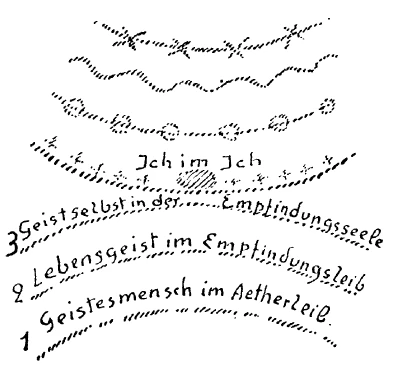
[ 4 ] These are things that are known from the cycle of the Apocalypse. Now, however, we must take into account that during the first period, the Indian one, humanity was, in terms of its development, still below the level at which the ego lives; that, in essence, the ancient Indian, pre-Vedic culture was essentially an inspired culture—that is, a culture that flowed, as it were, into the human soul without that work of the ego which we know today as our work of thought and imagination. Since the Egyptian cultural period, human beings have had to engage actively with their ego, so to speak. They must turn their ego through the senses toward the external world in order to receive impressions; they must, in a sense, be actively involved in the process of working through their own part of the process. Ancient Indian culture was a more passive culture, a culture that was, so to speak, attained through a surrender to what flowed into the human being like an inspiration. Therefore, it will also seem understandable that we must attribute this ancient Indian culture to an activity different from that which the human ego performs today; that, so to speak, the present-day activity of the ego had to be replaced for the Indian soul of that time by higher beings sinking into the human being and inspiring the human soul. If we ask what was, so to speak, brought into this human soul from the outside at that time, what was poured into it by beings of the higher hierarchies, then we can say: It is the very same thing that humanity will one day attain as its own activity, as its own initiative, when it has raised itself to what we call the Atma or the spiritual human being. In other words, in the future, human individuality will rise to a state of working its way into the Atma. This working will be the soul’s own work, the work of the human core of being, something directly connected to the innermost being. And just as the human being will then work within themselves, so did beings of the higher hierarchies work upon the Indian soul. If we wish to describe what was taking place in the etheric bodies of the Indian souls, we can say: there was, as it were, still a darkened, slumbering ego-consciousness at work; Atma was at work in the etheric body. We can quite rightly say that the ancient Indian soul was a stage upon which, in essence, a superhuman work was taking place: the work of higher beings within the etheric body of the ancient Indians. And what was woven into the etheric body there was a work such as humanity will later attain in the manner indicated, when Atma works upon the etheric body. — In Persian culture, it was the case that Buddhi, or the life spirit, worked within the astral body, within the feeling body. — And in Chaldean-Babylonian-Egyptian culture, Manas, or the mental self, worked within the feeling soul. Thus, in Egyptian-Babylonian-Chaldean culture, a fully active working of the ego within the soul itself is still not fully developed. Human beings are, albeit to a lesser degree than before, still a passive arena for the work of Manas in the soul of feeling. It is only in the Greco-Latin period that human beings, so to speak, enter fully and actively into their own soul life. We know, of course, that it is in the intellectual soul that the ego first asserts itself as an independent inner human member, and we can therefore say: Within Greek culture, the ego does indeed work within the ego, that is, the human being as such within the human being. We shall see in the course of these lectures that within the Greek epoch, the distinctive character of the culture of that time emerges precisely through the fact that the ego works within the ego.
[ 5 ] But we have now been beyond this cultural epoch for quite some time; and whereas in pre-Greek times higher beings, so to speak, immersed themselves in the core of the human being and worked within it, we have a task to fulfill in our time that is the opposite of that. We must first be able to acquire in a wholly human way that which we have worked out through our ego, that which we are capable of taking in through our activity from the impressions of the external world. But then we must not remain at the stage where the people of the Greco-Roman era remained, by working out only the human, pure humanity as such. Rather, we must carry what we have worked out upward and weave it into what is to come; we must, so to speak, take the upward path toward what is to come later: Manas or the spiritual self. But this is not to be expected until the sixth cultural epoch. We now stand between the fourth and sixth. The sixth promises humanity that it will be able to carry up into higher regions what is worked out through the external impressions the ego receives through its senses. In our fifth cultural epoch, we are only able, so to speak, to make the initial effort to shape all that we acquire through external impressions and what we gain through the processing of these impressions in such a way that it can receive the upward direction. In this respect, we are truly living in a transitional epoch, and if you recall what was said yesterday about the spiritual power at work in the Maid of Orleans, you will see that something was already at work in the Maid of Orleans that moves in the opposite direction to the influences of higher powers in pre-Greek times. If, let us say, any member of Persian culture received the influence of a supersensible power that used him as an instrument, then this very power worked into the core of his human being; it lived itself out there, and the person saw and experienced what this spiritual power implanted in him, with which it inspired him. The human being of our time, when entering into a relationship with such spiritual powers, can, so to speak, carry upward what he experiences in the physical world through the work of his ego, through the impressions of his ego; he can direct it upward. Thus, with such personalities as the Maid of Orleans, it is the case that the expressions, the manifestations of those spiritual powers that wish to speak to her, are indeed situated in the sphere to which she rises; yet something stands before this revelation that, while not impairing the reality of these revelations, gives them a certain form; it is what the ego experiences here in the physical world. In other words: the Maid of Orleans has revelations, but she cannot see them as directly as the ancients; rather, the world of ideas that the Maid of Orleans has absorbed in the physical world interposes itself between her ego and these objective powers: the image of the Virgin Mary, of the Archangel Michael, as she has absorbed them from her Christian conceptions; these interpose themselves.
[ 6 ] Here we have an example of how, when dealing with spiritual matters, we must distinguish between the objectivity of a revelation and the objectivity of a content of consciousness. The Virgin of Orleans saw the Virgin Mary and the Archangel Michael in a certain image. We must not immediately interpret these images as spiritual reality; we must not attribute direct objectivity to the form of these images. But if someone were to say that it is merely a figment of the imagination, that would be nonsense. For revelations from the spiritual world come to the maiden in a form that humanity will be able to see—in the form it is meant to see in the post-Atlantean period—though only in the sixth cultural epoch. But even if the Maid of Orleans does not see the true form, this true form nevertheless descends upon her. The Maid of Orleans presents her with the religious ideas of her time; she covers them, as it were; her world of ideas is challenged from within by the spiritual power. Thus, the revelation must be regarded as objective. Even if in our time someone can demonstrate that subjective elements flow into a manifestation from the spiritual world, even if we cannot regard the image that the person in question forms of the spiritual world as objective—even if this is a veil—we must not therefore interpret the objective revelations as such veils. They are objective. They conjure the content forth from our own soul. We must distinguish between the objectivity of the content and that of the facts coming from the spiritual world. — I had to emphasize this in particular because in this field, both those who acknowledge the spiritual world and its opponents make mistakes that, though opposite in nature, are nevertheless present everywhere.
[ 7 ] Thus, the Maid of Orleans presents us, as it were, with a historical figure who already embodies the spirit of our age, in which everything we can produce—so to speak—on the basis of our external impressions must be directed toward the spiritual. But what does this mean when we apply it to our culture? It means: We may initially turn our gaze naively toward our surroundings. But if we persist in directing our eyes solely toward external impressions, then we are not fulfilling our duty. We fulfill it only when we are conscious that we must relate external impressions to the spiritual forces lying behind them. If we pursue science and do so in the manner of scholarship, then we are not fulfilling our duty. We must regard everything we can learn about the laws of natural phenomena and the laws of psychological phenomena in such a way that we view it as a language intended to lead us up into a divine-spiritual revelation. If we are conscious that we should regard all physical, chemical, biological, physiological, and psychological laws in such a way that we relate them to something spiritual that reveals itself to us, then we are doing our duty.
[ 8 ] This is true of the sciences of our time, and it is true of art as well. The art that we characterize as Greek art—which, so to speak, reflected more simply upon the human being, which depicted entirely the merely human, the working of the ego with the ego, insofar as the ego expresses itself in the sensory-physical material—this art has had its epochs. In our time, the truly great artistic personalities have instinctively felt the urge to shape art into a kind of sacrificial service to the divine-spiritual worlds, that is, to regard what is clothed in sound, for example, as an interpretation of spiritual mysteries. Thus, from a cultural-historical and occult perspective, one will have to examine Richard Wagner in every detail. Thus, one will have to regard him in particular as a representative figure of our fifth cultural epoch, who always felt the urge to express, in what lived within him as sound, the striving toward the spiritual world, which viewed the work of art as an outer language of the spiritual world. And here, in our time, the remnants of the old culture and the dawn of a new culture stand in sharp, even jarring, contrast to one another. For we have seen how, so to speak, the purely human weaving in the sounds—the purely formal music that Richard Wagner sought to overcome—was fiercely defended by Richard Wagner’s opponents, because they were unable to sense that it was precisely in Richard Wagner that a new impulse was rising instinctively like the dawn.
[ 9 ] I do not know if most of you are aware that Richard Wagner faced the harshest, most ferocious critics and opponents for a long time. These critics and opponents found a certain kind of leadership in the extraordinarily witty musical work of Eduard Hanslick in Vienna, who wrote the interesting little book *On Musical Beauty*. I don’t know if you are aware that, in a sense, the old was thus set against the dawning of a new historical era. This book “On Musical Beauty” may become a historical monument for the latest times. For what did Hanslick want? He says: One cannot make music in the manner of Richard Wagner; that is not music at all, for there the music, so to speak, takes a running start to point toward something that lies outside the musical, toward something supernatural. But music is “arabesque in tones”—that was one of Hanslick’s favorite phrases. That is, an arabesque-like arrangement of tones, and the musical-aesthetic pleasure can consist in taking purely human delight in the way the tones sound together and one after another. Hanslick said that Richard Wagner was no musician at all, that he did not understand the essence of music at all. The essence of music, he claimed, must lie in a mere architecture of the tonal material. — What can one say about such a phenomenon? Nothing other than that Hanslick was, in the most eminent sense, a laggard, a reactionary of the fourth cultural epoch. In that he was right—for that cultural epoch; but what is true for one cultural epoch no longer applies to the next. From his standpoint, one can say that Richard Wagner was no musician. But then one would have to go on to say: This epoch is now over; we must now be content with what stems from this epoch; we must come to terms with the fact that what is musical in the Hanslickan sense expands beyond itself into something new.
[ 10 ] And so we could study this clash between the old and the new in various fields, particularly in our cultural era. This is especially fascinating in the individual branches of science. It would take us far too far afield to demonstrate how there are reactionaries everywhere and those who, within the individual sciences, work to bring out what science should become: the expression of the divine-spiritual reality lying behind phenomena. The fundamental element through which the present must be permeated in order to make the divine-spiritual ever more consciously the goal, the focal point of our work—that is precisely what spiritual science is meant to be, and spiritual science is meant to awaken everywhere the impulses from below to above; it should everywhere call upon human souls to make a sacrifice, that is, to sacrifice what we acquire through external impressions in favor of what we are to attain by working our way up into the regions of the spiritual self, the life spirit, and the spiritual human being.
[ 11 ] When we consider this picture of human history, of occult history, we will find it understandable that a soul who was incarnated during the Indian and then the Persian epochs could have been imbued with the inspiring element of an individuality from the higher hierarchies; but that then, when it entered the Greco-Latin era, this soul was left to itself, that this soul worked in such a way that the I worked within the I. All that which in the pre-Greek epoch appears for all the individual cycles of the post-Atlantean cultures as a divine inspiration, as a revelation from above—and this also holds true at the beginning of the Greek cultural period for the 9th, 10th, 11th centuries of the pre-Christian era—what presents itself to us as an inspired culture, into which flows from without that which is meant to sustain it spiritually, increasingly takes shape as a purely human-personal self-expression. And this finds its strongest expression precisely in Greek civilization. No era before has seen, nor will any era after be able to see, such an expression of the outer human being—as it manifests itself in the physical world—for what the human being is as a self-conscious I-being. The purely human-personal, the human-personal that is entirely self-contained, comes to light historically in the ancient way of life of the Greeks and in their creations. Let us compare how the Greek sculptor has imbued his divine figures with the human-personal! We can say: Just as a Greek sculptural work of art confronts us, insofar as it can be perceived through physical means, so does the human being stand before us entirely as a personality. And if, when considering the works of art of the Greeks, we could not forget that this incarnation, which is expressed to us there, was preceded by other incarnations—and will be followed by others—if we were to think for just a moment that the figure of Apollo and the figure of Zeus are based on only a single incarnation out of many, then we would not perceive the Greek work of art correctly. There we must be able to forget that the human being has embodied himself in successive incarnations. There the personality is entirely poured into the form of that one personality. And such was the whole life of the Greeks.
[ 12 ] If, on the other hand, we go further back, the figures become symbolic; there, the figures hint at something that is not purely human; there, they express something that human beings do not yet feel within themselves. There, he could only express in symbols what came from divine-spiritual worlds. Hence the ancient symbolic art. — And let us again observe how art emerges precisely among the people who are to provide the material for our fifth cultural epoch—we need only recall older German art—; there we see that we are dealing neither with symbolism nor with a manifestation of the purely human, but with the soul life deep within; we see how the soul, so to speak, cannot quite fit into the human form. Who could characterize the figures of Albrecht Dürer in any other way than to say that in them, that which in man yearns for the supersensible world—one might say, in the Greek sense—finds only an imperfect expression in the outward form of physicality. Hence the deepening toward the soul, the further the art ascends.
[ 13 ] And now you will no longer find it incomprehensible that I said in the first lecture: What was once embodied appears in the physical world as an image; beings from the higher hierarchies flowed into the individuality. So that when we speak of a person from the Greek world in earlier times and say that he was incarnated, we must not only see this self-contained being, but also, standing behind it, the individuality of a higher hierarchy. Thus Alexander appears to us in the Greco-Roman period, and thus Aristotle stands before us. We trace their individualities backward. There we must go back from Alexander to Gilgamesh and say: In Gilgamesh is this individuality, which then appears, as if projected onto the physical plane, as Alexander; behind it we must see a fire spirit that makes use of him as an instrument. And in Aristotle, looking back in time, we see the powers of ancient clairvoyance at work in the friend of Gilgamesh. Thus we see both young and old souls, behind whom clairvoyance once stood, fully manifested on the physical plane during the Greek era. And this is particularly evident in the great mathematician Hypatia, in whom, so to speak, the entire mathematical and philosophical wisdom of her time lived as personal skill, as personal science and wisdom. This was embodied in the personality of Hypatia. And we shall yet see how this individuality had to take on the form of the female personality in order to express such a gentle synthesis of all that she had previously absorbed in the Orphic Mysteries, in order to express as a personal mode of action all that she had received there through the inspirers as a student of the Orphic Mysteries.
[ 14 ] Thus we see how influences from the spiritual world come to bear in successive human incarnations, shaping them. And I can only point out that it was precisely an individuality such as that which was incarnated as Hypatia—who thus brought with her the wisdom of the Orphic Mysteries and lived it out personally—who was then called upon in a subsequent incarnation to take the opposite path: to carry all personal wisdom back up to the Divine-Spiritual. Thus, around the turn of the 12th to the 13th century, Hypatia appears as a significant, comprehensive, universal spirit of recent history, exerting a great influence on what constitutes the synthesis of scientific and philosophical knowledge. Thus we see how historical forces penetrate the successive incarnations of individual personalities.
[ 15 ] When we look at the course of history in this way, we truly see a kind of descent from spiritual heights down into the Greco-Roman era, and then an ascent once more: a gathering of material to be gained purely from the physical plane during the Greek era—which, of course, extends right into our own time—and a carrying back up into the spiritual world, for which an impulse is to be created through spiritual science, and for which a personality such as Hypatia, who was reincarnated in the 13th century, had already possessed an instinctive impulse.
[ 16 ] At this point, my dear friends, since the General Theosophical Society is, in a certain sense, a hotbed of misunderstandings, I would like to point out that an infinite number of these misunderstandings are truly pure fabrications. For example, people are quick to contrast what is presented here within our German movement with what was originally the revelation of the Theosophical Movement in modern times. That is why I am happy to take this opportunity to point out how what is presented here, originating from Rosicrucian sources, is in harmony with much of what was originally given to the Theosophical Movement. And we have, in fact, the very opportunity at this moment to point out something of this nature. It has thus been stated by me—and developed entirely independently of traditions—that certain later historical figures are, as it were, the shadow images of earlier figures depicted in myths, behind whom higher hierarchies stand. One must not bring this into contradiction with those teachings that were introduced into the Theosophical Society by H.P. Blavatsky. For otherwise, through a mere misunderstanding, one could very well find oneself in contradiction to the good old teachings that flowed into the Theosophical Movement through the extraordinary, useful instrument of H.P. Blavatsky. But with regard to what has been discussed here, I would like to read to you a passage from Blavatsky’s later writings, where she refers to *Isis Unveiled*, her earliest occult work. I would like to read the following passage to you so that you may see how what is said about such a contradiction is, in essence—I cannot put it any other way—purely fabricated:
[ 17 ] “Apart from constantly reiterating the age-old, ever-present fact of reincarnation and karma—specifically as taught by the world’s oldest science, not by modern spiritualism—occultists should teach a cyclical form of reincarnation that keeps pace with evolution: that kind of rebirth, mysterious and still incomprehensible to the many who know nothing of that history of the world to which we have cautiously alluded in *Isis Unveiled*. A general rebirth for every individual with intervals of Kama Loka and Devachan, and a cyclical, conscious incarnation with a great and divine goal for the few. Those great figures who tower like giants in the history of humanity—such as Siddhartha Buddha and Jesus in the spiritual realm, and Alexander of Macedonia and Napoleon the Great in the realm of physical conquests—are nothing but reflected images of great archetypes that existed — not ten thousand years ago, as was cautiously mentioned in *Isis Unveiled*, but over millions of successive years, from the beginning of the Manvantara. For as explained above—with the exception of the true Avatars, these images of their archetypes, each corresponding to its own parental flame, are the same unbroken rays (Monads), called Devas, Dhyan Chohans, or Dhyani Buddhas, or also Planetary Spirits and so on, which have shone like their archetypes through eons of eternity. Some human beings are born in their image, and when some special humanitarian goal is envisaged, these latter are hypostatically animated by their divine archetypes, which are brought forth again and again by the mysterious powers that guide and direct the destinies of the world.”
[ 18 ] “No more could be said at the time when *The Unveiled Isis* was written; therefore, what was said was limited to the mere observation that there is no outstanding figure in the annals of sacred or secular history whose archetype we could not find in the half-legendary and half-real traditions of past religions and mythologies. Just as the star that shines in the boundless infinity of the heavens at an immeasurable distance above our heads is reflected in the still waters of a lake, so is the image of humanity in antediluvian times reflected in those periods that we can encompass with a historical retrospective...”
[ 19 ] As I said, I am happy to take this opportunity to emphasize the correspondence between what we can investigate in the immediate present and what, in a certain sense, was the original revelation. You know, of course, that it is our principle here to hold fast, in a certain sense, to the traditions of the Theosophical Movement; but I wish to emphasize explicitly that nothing is repeated here without being examined—that is what matters. Where a correspondence between what has been recognized and other knowledge can be emphasized, it should be sharply highlighted for the sake of the continuity of the Theosophical Society, in accordance with justice; but nothing should simply be repeated without verification. This is connected to the mission we have specifically within our German Theosophical Movement—namely, to bring our own unique contribution, our individual contribution, into this Theosophical Movement. But precisely such examples can give you a picture of how unfounded the prejudice is that arises here and there, as if we always wanted something different in these matters. We continue to work faithfully; we do not, so to speak, constantly dig up the old dogmas; we also examine what is offered today from other quarters. And we uphold what can be said with the best occult conscience, based on the original occult research and the methods handed down to us through our own sacred traditions of the Rosicrucians.
[ 20 ] It is now extremely interesting to demonstrate, using a single individual as an example, how the ancient wisdom that was inspired into humanity under the influence of higher powers has, so to speak, taken on a character adapted to the physical plane among the people of the Greco-Roman era. We can cite as an example how Eabani, in that incarnation of his which lies between the personalities of Eabani and Aristotle, was able—under the influence of the ancient mystery teachings with their forces descending from the supersensible worlds—to absorb that upon which the further development of the human soul actually rests in certain mystery schools. We do not wish to repeat here what the distinctive characteristics of the various mystery schools were; rather, we wish to direct our spiritual gaze toward a certain type of them—those in which the soul was developed through the arousal of very specific feelings, so that it learned to penetrate the supersensible world. In such mysteries, those feelings and impulses were specifically aroused in the soul that were suited to eradicating all egoism from the soul at its very root. It was made clear to the soul how, fundamentally speaking, it must always be egoistic when embodied in the physical body. The full scope and significance of egoism for the physical plane was, so to speak, poured out in impulses upon the corresponding soul. And deeply, deeply contrite did such a soul feel, having to say to itself: I have known nothing but egoism until now; in the physical body I can be nothing other than an egoist. Indeed, such a soul has been far removed from the shallow perspective of those people who have as their every other word: “I do not want this for myself, but for another.” Overcoming egoism and acquiring the impulse toward the universal human and the cosmic is not as easy as some imagine. This acquisition must be preceded by a complete shattering of the soul over the extent of the egoism in the impulses of that soul. Compassion for all that is human, for all that is cosmic, the soul had to learn in the Mysteries I am referring to—compassion through the overcoming of the physical plane. Then one could hope that it would bring down again from the higher worlds true compassion for all that lives and all that exists.
[ 21 ] But there is yet another feeling that must be developed specifically as a primary feeling alongside many others. If a person is to enter the spiritual world, they must be clear that everything there is different from the physical world. One must stand before something completely unknown when facing the spiritual world eye to eye. There truly exists a feeling that puts one in danger: the feeling of fear of the unknown. And that is why, in such mysteries, the soul had to experience everything that the human soul could possibly experience in terms of fear, anxiety, terror, and horror, in order to wean itself from these very feelings of fear, anxiety, terror, and horror. Then the human being was prepared to ascend into the spiritual world, the contents of which were unknown to him. Thus the soul of the initiate had to pass through training in the comprehensive universal feeling of compassion and in the universal feeling of fearlessness. Every soul underwent this in those ancient mysteries in which Eabani participated when he reappeared in the incarnation that lies between Eabani and Aristotle. He, too, underwent this. And now this came to light in Aristotle as a memory of earlier incarnations. He was able to formulate the theory of tragedy because, drawing on such memories while observing Greek tragedy, he realized how it contains an echo—as it were, an external, physical manifestation of the aftermath of the mystery training, in which the soul is purified through compassion and fear. Thus the dramatic hero and the entire structure of a tragedy were to enact before the audience something through which the spectator could experience, albeit in a mitigated form, compassion for the fate of the tragic hero and fear of the outcome of his fate, of the terrifying death that beckons him. Thus, woven into the dramatic unfolding of the tragedy, into the fabric and life of the tragedy, was what took place in the soul of the ancient mystic: the purification, the cleansing, the catharsis through fear and compassion. And like an echo, the member of the Greek cultural period was to experience on the physical plane the passage through fear and compassion. Artistically, one was to experience, aesthetically enjoy, what had formerly been a great educational principle. And when what Aristotle had learned in earlier incarnations entered his personality, he was the right man to give this unique definition of tragedy, which has become so classical and had such a magnificent effect that it was still taken up by Lessing in the 18th century and played such a role throughout the 19th century that entire libraries have been written about this definition. Incidentally, one would not lose much if most of what lies in the libraries were burned, for it was written with a complete misunderstanding of what was said earlier—namely, that we are dealing with something being projected down into art from the spiritual realm. And those who wrote this did not realize that Aristotle was revealing an ancient mystery when he said: A tragedy is a composition of successive actions, grouped around a hero, and capable of arousing in the spectator a feeling of fear and pity, so that a catharsis may take place in the spectator’s soul.
[ 22 ] Thus we see that within a single personality—in what she wills and says—there is a reflection of something that becomes comprehensible to us only when we look through the personality to the one who stands behind it, to the inspirer. Only when you view history in this way can you see what the personality and the superpersonal forces mean for historical life, how something comes into play in the individual incarnations—what Madame Blavatsky calls the interplay of personal, individual incarnations—and what she describes when she says: “But alongside the ancient, ever-present fact of reincarnation and karma, occultists should proclaim a cyclical reincarnation that keeps pace with evolution” and so on. She calls this conscious reincarnation, because for most people today the successive incarnations remain unconscious to the ego, whereas the spiritual forces acting from above do in fact carry their power cyclically from one age to the next with consciousness.
[ 23 ] What is presented here as a revelation of what Blavatsky stated in her early days regarding the Rosicrucian mysteries can certainly be verified and confirmed through original research. From this, however, you will see that the convenient approach which always regards an incarnation merely as the effect of a previous incarnation is significantly modified. And you will understand that reincarnation is a far more complex reality than is commonly assumed, and that we can only fully understand it when we connect human beings to a higher, superphysical world that continually influences our own. We can say that in that intermediate period we call the Greco-Roman culture, human beings were given time to re-experience and allow to resonate, once upon a purely human ego, all that had been placed into the soul from higher worlds through long series of incarnations. What the Greco-Roman world lived out was like a human-personal living out of infinite memories that had previously been placed into those same individualities from higher worlds. Should we therefore be surprised if the most significant minds of the Greek world in particular bring this to consciousness? When they looked into their inner world, they said to themselves: There it flows out; there worlds expand into our personality; but these are memories of what was once poured into us from the spiritual worlds. — Read in Plato how he traces what a human being can experience back to a memory of the soul of its past experiences. There you see how a spirit such as Plato drew from a deeply real consciousness of the fourth post-Atlantean epoch. We only begin to understand what such a single utterance from such a striking personality means when we can look inward occultly into the spirit of the epochs.