

An Occult Physiology
GA 128
28 March 1911, Prague
Translate the original German text into any language:
Versions Available:
An Occult Physiology, tr. SOL
Achter Vortrag
Eighth Lecture
[ 1 ] Es wird heute in diesem letzten Vortrage meine Aufgabe sein, die Betrachtungen der letzten Tage über okkulte Physiologie, die manches, wenn auch zum Teil recht skizzenhaft, von den Vorgängen der menschlichen Organisation darzustellen versuchten, zu einer Art von Gesamtbild zu vereinigen, das ja wieder nur skizzenhaft sein kann, durch das wir in den Stand gesetzt werden können, eine Anschauung zu bekommen von dem lebendigen Leben und Weben des menschlichen Organismus. Wir werden dabei am besten tun, wieder von dem gröbsten auszugehen, von der Wechselbeziehung zwischen dem menschlichen Organismus und der äußeren Welt, unserer physischen Erde, in der Aufnahme der Nahrungsstoffe.
[ 1 ] In this final lecture today, my task will be to to bring together the reflections of the past few days on occult physiology—which have attempted, albeit in a somewhat sketchy manner, to depict the processes of the human organism—into a kind of overall picture, which can, of course, only be sketchy, but through which we may be enabled to gain an insight into the living life and activity of the human organism. We would do best to start once again with the most general aspects—the interrelationship between the human organism and the external world, our physical Earth, in the absorption of nutrients.
[ 2 ] Diese Nahrungsstoffe werden ja, nachdem sie aufgenommen sind, in der mannigfaltigsten Weise umgewandelt und stufenweise so umgeändert durch die verschiedenen Organwirkungen, daß sie hingeleitet werden können zu den einzelnen Gliedern des menschlichen Organismus, zu den einzelnen Systemen der menschlichen physischen Wesenheit. Es ist ja nicht schwer einzusehen, daß alles, was aus den Nahrungsstoffen im menschlichen Organismus wird, im Grunde genommen den Menschen, wie er vor uns steht in der physischen Welt, eigentlich erst zum physischen Menschen macht. Es liegt hier ja allerdings eine gewisse Schwierigkeit für das Verständnis vor. Allein, wenn wir Ernst machen mit den bisher eingehaltenen Prinzipien und die übersinnliche Erkenntnis wirklich auf die Betrachtung des Menschen anwenden, so müssen wir sagen, daß es nur die Nahrungsstoffe sind, die von der äußeren Welt substantiell in den menschlichen Organismus aufgenommen werden. .Alle übrigen auf den Menschen einwirkenden Einflüsse haben wir uns im Grund genommen zu denken als übersinnliche, unsichtbare Kräfte. Wenn sie sich für einen Moment alles wegdenken, was den menschlichen Organismus, von den Nahrungsstoffen herrührend, ausfüllt, so behalten Sie in physischer Beziehung noch weniger — verzeihen Sie den trivialen Ausdruck -, viel weniger übrig als einen leeren Sack, nämlich gar nichts. Denn auch was an Haut, an Umhüllung des physischen Organismus vorhanden ist, ist nur dadurch vorhanden, weil entsprechend verarbeitete Ernährungsstoffe an die betreffenden Partien hingeführt worden sind. Rechnen Sie die Nahrungsstoffe und was aus ihnen wird, weg, so haben Sie dahinter den menschlichen Organismus nur als ein übersinnliches Kraftsystem zu denken, das die Verteilung der assimilierten Nahrungsstoffe nach allen Richtungen hin bewirkt. Wenn Sie diesen Gedanken, wie er jetzt ausgesprochen worden ist, sich so richtig vor die Seele stellen, so werden Sie sich sagen: Eines ist aber eigentlich die Voraussetzung, bevor irgend etwas, auch das kleinste, von den Nahrungsstoffen aufgenommen werden kann, denn diese Stoffe können nicht von der Außenwelt in jedes beliebige Wesen hineinbefördert werden, damit dasjenige in ihm vorgehe, was im menschlichen Organismus vorgeht. Es muß der Mensch schon bei der allerersten Nahrungsaufnahme den physischen Nahrungsstoffen eine innere Kraftwirkung entgegenstellen können, welche aus der übersinnlichen Welt stammt, und es muß in diesem inneren Kräftesystem der Mensch als solcher schon enthalten sein. Im Okkultismus nennen wir dasjenige, was so den eigentlichen physischen Ausfüllungsmaterialien vom Menschen zunächst entgegengehalten wird, was durchaus schon übersinnlich zu denken ist, das nennen wir im umfassendsten Sinne die menschliche Form. Wenn wir uns die allerunterste Grenze der menschlichen Organisation denken, so müssen wir uns vorstellen, daß sich gegenüberstehen die physische Materie und die übersinnliche Form, welche als ein aus den übersinnlichen Welten herausgeborenes Kraftsystem dazu bestimmt ist, die Materie aufzunehmen - nicht wie ein physischer Sack oder Balg, sondern wie ein Überphysisches, ein Übersinnliches - und dasjenige herauszubilden, was überhaupt den Menschen erst physisch-sinnlich erscheinen läßt. Erst dadurch, daß sich dieser übersinnlichen Form eingliedert das assimilierte Ernährungsmaterial, wird der sonst rein übersinnliche menschliche Organismus zu einem physisch-sinnlichen Organismus, den man mit Augen sehen und mit Händen greifen kann. Man nennt das, was so entgegengehalten wird der physischen Materie, aus dem Grunde «Form», weil eigentlich in aller Natur ein solches Gesetz wirkt, ein genau gleiches Gesetz, das überall «Formprinzip» genannt wird. Wenn wir die äußere Welt betrachten, so finden wir, daß bis zum Kristall hinunter überall das Formprinzip tätig ist. Die Substanzen, welche in den Kristall eintreten, müssen, um das zu werden, als was der Kristall sich darstellt, gleichsam eingefangen werden von dem Formprinzip, und dieses macht mit Hilfe der Substanzen den Kristall erst zu dem, was er ist. Nehmen Sie zum Beispiel das Kochsalz, Chlornatrium, so haben Sie als physische Substanzen miteinander verbunden Chlor und Natrium, ein Gas und ein Metall. Sie werden leicht einsehen, daß diese beiden Stoffe, so wie sie sind, bevor sie eingefangen werden durch eine formende Wesenheit und dadurch erst zu einer chemischen Verbindung in Würfeln kristallisiert erscheinen, jede für sich völlig andere Formen zeigt. Bevor sie eintreten in dieses Formprinzip, haben sie nichts Gemeinsames; aber sie werden eingespannt, aufgenommen von diesem Formprinzip, und dieses bildet den physischen Körper Kochsalz.
[ 2 ] Once ingested, these nutrients are transformed in a wide variety of ways and gradually altered by the various organ functions so that they can be directed to the individual parts of the human organism, to the individual systems of the human physical being. It is not difficult to see that everything that the human organism makes out of these nutrients is, in essence, what actually makes the human being, as he stands before us in the physical world, a physical human being in the first place. There is, of course, a certain difficulty in understanding this. However, if we take the principles we have upheld so far seriously and truly apply supersensible knowledge to the study of the human being, we must say that it is only the nutrients that are substantially taken up into the human organism from the external world. All other influences acting upon the human being we must, in essence, conceive of as supersensible, invisible forces. If you were to imagine for a moment that everything filling the human organism—derived from nutrients—were removed, you would be left, in physical terms—forgive the trivial expression—with far less than an empty sack: namely, nothing at all. For even what exists in the form of skin, the covering of the physical organism, exists only because appropriately processed nutrients have been directed to the relevant parts. If you set aside the nutrients and what becomes of them, you must conceive of the human organism behind them solely as a supersensible system of forces that brings about the distribution of the assimilated nutrients in all directions. If you truly bring this thought, as it has now been expressed, before your soul, you will say to yourself: But one thing is actually the prerequisite before anything, even the smallest thing, can be absorbed from the nutrients, for these substances cannot be transported from the external world into just any being so that what takes place in the human organism might take place within it. From the very first intake of food, the human being must be able to counter the physical foodstuffs with an inner force that originates from the supersensible world, and the human being as such must already be contained within this inner system of forces. In occultism, we call that which is thus initially set against the actual physical building materials of the human being—and which must certainly be conceived as supersensible—we call this, in the broadest sense, the human form. When we consider the very lowest boundary of the human organism, we must imagine that physical matter stands opposite the supersensible form, which, as a system of forces born out of the supersensible worlds, is destined to receive the matter—not like a physical sack or bag, but as something superphysical, something supersensible—and to shape that which first makes the human being appear physically and sensually at all. It is only through the assimilation of the nutritional material into this supersensible form that the otherwise purely supersensible human organism becomes a physical-sensory organism that can be seen with the eyes and grasped with the hands. What is thus set against physical matter is called “form” for this reason, because in fact such a law operates throughout all of nature—an exactly identical law that is called the “principle of form” everywhere. When we observe the external world, we find that the principle of form is at work everywhere, right down to the crystal. The substances that enter the crystal must, in order to become what the crystal appears to be, be captured, as it were, by the principle of form, and it is this principle that, with the help of the substances, makes the crystal what it is. Take, for example, table salt, sodium chloride: here you have chlorine and sodium, a gas and a metal, combined as physical substances. You will easily see that these two substances, as they are before they are captured by a formative entity and thereby crystallize into a chemical compound in the form of cubes, each exhibit completely different forms on their own. Before they enter into this principle of form, they have nothing in common; but they are harnessed, taken up by this principle of form, and this forms the physical body of table salt.
[ 3 ] So setzt auch alles, was als umgewandelte Nahrungsstoffe im menschlichen Organismus erscheint, die unterste übersinnliche Wesenheit, die übersinnliche Form voraus. Wenn nun neue Ernährungsstoffe in den menschlichen Organismus eintreten sollen, der durch das Wirken des Formprinzips bereits nach außen abgegrenzt ist, so müssen sie unter normalen Verhältnissen durch den Mund in den Ernährungskanal aufgenommen werden. Dabei machen sie gleich schon vom Munde ab die allererste Umwandlung durch. Durch den Ernährungskanal werden weitere Umwandlungen bewirkt. Diese Ummwandlungen kompliziertester Art könnten nicht bewirkt werden, wenn nicht dem menschlichen Organismus ein höheres Prinzip eingegliedert wäre, das wir Formprinzip genannt haben, durch dessen Wirksamkeit die Nahrungsstoffe — die zunächst, wenn sie aufgenommen werden, sich zueinander neutral, gleichgültig verhalten — modifiziert würden, so daß sie in die Lage kommen, lebendige Organe zu bilden. Wir können uns, obgleich es beim Menschen ein ganz anderer Prozeß ist, weil er auf einer anderen Stufe geschieht, diese Umwandlung der Nahrungsstoffe im menschlichen Verdauungskanal vergleichsweise so vorstellen, wie wenn die Pflanzen ihre Ernährungsstoffe aufnehmen aus dem mineralischen Boden und sie dergestalt umwandeln, daß sie sich zu der Form der betreffenden Pflanze aufbauen. Da ist nur möglich, weil bei der Pflanze der Ernährungsstrom von einem Lebensprozeß oder, wie wir im Okkultismus sagen, vom Ätherleib als dem ersten übersinnlichen Prinzip aufgenommen wird. So werden auch beim Menschen die in den Organismus eintretenden Nahrungsstoffe vom Ätherleibe bearbeitet, das heißt, der Ätherleib sorgt für ihre Umwandlung, für ihre Eingliederung in die inneren Gesetzmäßigkeiten des menschlichen Organismus. So haben wir also dieses erste übersinnliche Glied des Menschen, den Ätherleib, anzusehen als den Erreger der ersten Umwandlung der Nahrungsstoffe. Wenn nun diese Nahrungsstoffe soweit umgewandelt sind, daß sie in den Lebensprozeß aufgenommen sind, dann müssen sie in dem Sinne, wie wir es in den vorhergehenden Vorträgen geschildert haben, weiter verarbeitet und dem menschlichen Organismus angepaßt werden. Sie müssen so verarbeitet werden, daß sie nach und nach denjenigen Organen im menschlichen Organismus dienen können, die ein Ausdruck der höheren übersinnlichen Prinzipien sind, des Astralleibes und des Ich. Kurz, wir müssen uns klar sein, daß die höheren Prinzipien, Astralleib und Ich, die eigentümliche Art ihrer Regsamkeit hinuntersenden müssen bis zu den Vorgängen in den Organen des Ernährungs- und Verdauungsapparates und daß sie bis in die verwandelten Nahrungsstoffe hinab wirken müssen.
[ 3 ] Thus, everything that appears in the human organism as transformed nutrients presupposes the lowest supersensible entity, the supersensible form. When new nutrients are to enter the human organism—which is already demarcated externally by the action of the form principle—they must, under normal circumstances, be taken in through the mouth into the digestive tract. In doing so, they undergo their very first transformation right from the moment they leave the mouth. Further transformations are brought about through the digestive tract. These transformations of the most complex nature could not take place if a higher principle—which we have called the form principle—were not integrated into the human organism; through its activity, the nutrients—which initially, when ingested, behave neutrally and indifferently toward one another—are modified so that they are able to form living organs. Although the process is entirely different in humans because it occurs on a different level, we can imagine this transformation of nutrients in the human digestive tract, by way of comparison, as if plants were absorbing their nutrients from the mineral soil and transforming them in such a way that they build themselves up into the form of the plant in question. This is only possible because, in the plant, the flow of nutrients is taken up by a life process or, as we say in occultism, by the etheric body as the first supersensible principle. In the same way, the nutrients entering the human organism are processed by the etheric body; that is, the etheric body ensures their transformation and their integration into the inner laws of the human organism. We must therefore regard this first supersensible member of the human being, the etheric body, as the agent of the initial transformation of the nutrients. Once these nutrients have been transformed to the point where they are incorporated into the life process, they must then be further processed and adapted to the human organism in the sense described in the preceding lectures. They must be processed in such a way that they can gradually serve those organs in the human organism that are an expression of the higher supersensible principles, the astral body and the ego. In short, we must be clear that the higher principles—the astral body and the ego—must extend their unique mode of activity down to the processes in the organs of the alimentary and digestive systems, and that they must work their way down into the transformed nutrients.
[ 4 ] Da stellen sich nun dem Nahrungsstrom diejenigen Organe entgegen, welche uns schon bekannt sind, die wir bezeichnet haben als die sieben Organe des inneren Weltsystems. Wir zeichnen nochmals ganz schematisch das innere Weltsystem des Menschen:
[ 4 ] Here, the organs we are already familiar with—those we have referred to as the seven organs of the inner world system—stand in opposition to the flow of nourishment. Let us once again sketch out the inner world system of the human being in a very schematic way:
[ 5 ] Die Nahrungsstoffe werden also aufgenommen und zunächst in der mannigfaltigsten Weise umgearbeitet im Verdauungskanal, dann stellen sich ihnen entgegen Leber, Galle, Milz, Herz, Lunge, Nieren und so weiter. Wenn wir uns nun darüber klar sind, daß diese Organe durch die ihnen entsprechenden Kraftsysteme dazu bestimmt sind, den Nahrungsstrom weiter umzuarbeiten, so können wir fragen: Welches ist der Sinn dieser weiteren Umwandlung? — Wenn der Nahrungsstrom nur so weit bearbeitet würde, wie es im Verdauungskanal geschieht, um der Lebensform dienen zu können, so würde der Mensch nur ein unbewußtes Pflanzendasein führen können, denn er hätte es nicht zur Ausbildung solcher Organe gebracht, die Werkzeuge sein können für seine höheren Fähigkeiten. Die sieben Organe wandeln den Ernährungsstrom aber weiter um, und wir wissen, daß diese Vorgänge durch das sympathische Nervensystem davon abgehalten werden, in das menschliche Bewußtsein einzutreten. Daher haben wir in dem sympathischen Nervensystem mit den sieben Organen zusammen dasjenige, was sich dem Nahrungsstrom entgegenstellt.
[ 5 ] Nutrients are thus absorbed and initially processed in a wide variety of ways in the digestive tract; they are then processed further by the liver, gallbladder, spleen, heart, lungs, kidneys, and so on. Now that we understand that these organs, through their corresponding energy systems, are designed to further process the flow of nutrients, we may ask: What is the purpose of this further transformation? — If the flow of nourishment were processed only to the extent that occurs in the digestive tract in order to serve the life form, then human beings would be able to lead only an unconscious, plant-like existence, for they would not have developed such organs that can serve as tools for their higher faculties. The seven organs, however, further transform the food stream, and we know that these processes are prevented by the sympathetic nervous system from entering human consciousness. Therefore, in the sympathetic nervous system, together with the seven organs, we have that which opposes the food stream.
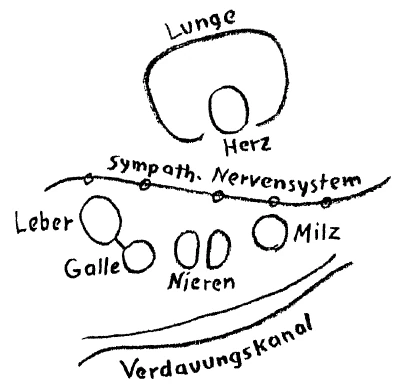
[ 6 ] Damit sind wir schon bis zu einem hohen Grade von außen in das Innere des menschlichen Organismus hineingedrungen. Aber das, was da drinnen vorgeht, man möchte sagen als die gegenseitige Angelegenheit der sieben Organe, da ist etwas, was nirgends in unserer Erdenwelt so vorgehen könnte wie da drinnen. Es kann nur dadurch so vorgehen, daß dieses Innere von der Außenwelt völlig abgeschlossen ist und für diese Tätigkeit des Innern die Stoffe vorbereitet sind durch den Verdauungskanal. Also wir stehen damit schon im Inneren des menschlichen Organismus darinnen.
[ 6 ] We have thus already penetrated to a high degree from the outside into the interior of the human organism. But what takes place in there—one might call it the mutual interaction of the seven organs—is something that could not occur anywhere else in our earthly world as it does in there. It can only happen this way because this inner realm is completely sealed off from the outside world, and the substances are prepared for this inner activity through the digestive tract. So we are already standing right inside the human organism.
[ 7 ] Nun haben wir das Eigentümliche zu verzeichnen, daß, indem wir so im Innern des Organismus darinnenstehen, der Organismus sich ja selbst innerlich organisieren, sich selbst innerlich differenzieren muß. Um allen diesen an ihn herantretenden Anforderungen zu genügen, muß der Organismus eine Vielheit zusammenwirkender Organe herausbilden. Für die mannigfaltigen inneren Verrichtungen ist gerade diese Vielheit der Organe notwendig. Was durch diese erreicht werden muß, werden wir im folgenden sehen. Wenn wir uns denken, daß nur der Nahrungsstrom umgewandelt würde durch die sieben Organe des inneren Weltsystems, da würde der Mensch nimmermehr . sein Wesen dem Bewußtsein aufschließen können. Er würde nicht einmal die dumpfeste Form des Bewußtseins haben können, weil ja alles, was da vorgeht, verhüllt wird, abgehalten wird vom Bewußtsein durch das sympathische Nervensystem. Es ist also eine Verbindung notwendig zwischen diesen sozusagen von außen her aufgebauten inneren Organsystemen und dem, was weiter im Inneren des menschlichen Organismus ist. Diese Verbindung wird dadurch hergestellt, daß in der Tat durch alles das, was der Ernährungsprozeß in seiner Ganzheit gibt, die gesamte Form des menschlichen Organismus durchzogen wird von dem, was wir im weitesten Sinne Gewebe nennen. Eine gewisse Art von Gewebe einfachster Organisation durchzieht alle einzelnen Glieder der menschlichen Wesenheit, das fähig ist, sich so umzuwandeln und auszugestalten, daß sich die verschiedensten Organe herausbilden können. Gewisse Arten des Gewebes zum Beispiel bilden sich so um, daß sie sich durch Einlagerung besonderer Zellen zu den Muskeln umgestalten; andere bilden sich so um, daß sie fest werden und sich die Knochenzellen einlagern, indem sie die entsprechenden Substanzen sich aneignen. So daß wir in den einzelnen Organen des menschlichen Organismus stets an das zu denken haben, was ihnen zugrundeliegt, nämlich das den Körper nach allen Richtungen durchziehende Gewebe, aus dem die einzelnen Organe sich herausbilden. Dieses bildungsfähige Gewebe würde aber, wenn es noch so sehr zu wachsen und die verschiedensten Organe aus sich herauszubilden imstande wäre, doch nichts anderes darstellen als im Grunde nur etwas Pflanzenhaftes; denn das ist ja das Wesentliche des Pflanzenhaften, daß die pflanzlichen Wesen wachsen, daß sie aus sich Organe hervortreiben und dergleichen. Indem sich aber der Mensch über das Pflanzenhafte hinaus erhebt, muß sich uns ein ganz neues Element darbieten, durch welches der Mensch in die Lage kommt, zu dem Pflanzenleben dasjenige hinzuzufügen, was ihn über das Pflanzenleben hinaushebt. Der Mensch muß hinzufügen das Bewußtsein, zunächst die einfachste Form des Bewußtseins, das dumpfe Bewußtsein, das ihn fähig macht, das eigene innere Leben wahrzunehmen. Solange nicht ein Wesen das eigene innere Leben bewußt miterlebt, solange es noch nicht in der Lage ist, sich innerlich gleichsam zu durchspiegeln, um dieses eigene innere Leben mitzuerleben, so lange können wir nicht sagen, daß es sich über die Pflanzenhaftigkeit hinauferhebt. Erst dadurch erhebt sich ein Wesen über die Pflanzenhaftigkeit hinauf, daß es nicht bloß in sich Leben hat, sondern dieses Leben bewußt erlebt, daß es zunächst diese inneren Vorgänge durchspiegelt und miterlebt.
[ 7 ] Now we must note the peculiar fact that, since we are situated so deep within the organism, the organism must organize itself internally and differentiate itself internally. In order to meet all the demands placed upon it, the organism must develop a multitude of interacting organs. It is precisely this multiplicity of organs that is necessary for the manifold inner processes. We shall see in the following what must be achieved through them. If we imagine that only the flow of nourishment were transformed by the seven organs of the inner world system, then human beings would never be able to open up their being to consciousness. He would not even be able to possess the most rudimentary form of consciousness, because everything that takes place there is veiled, kept from consciousness by the sympathetic nervous system. A connection is therefore necessary between these internal organ systems—built up, so to speak, from the outside—and what lies further within the human organism. This connection is established by the fact that, through everything the nutritional process provides in its entirety, the entire form of the human organism is permeated by what we call, in the broadest sense, tissue. A certain type of tissue of the simplest organization permeates all the individual parts of the human being, capable of transforming and developing itself in such a way that the most diverse organs can form. Certain types of tissue, for example, transform themselves by incorporating special cells to become muscles; others transform themselves by hardening and incorporating bone cells as they assimilate the corresponding substances. So that in the individual organs of the human organism we must always bear in mind what underlies them, namely the tissue that permeates the body in all directions, from which the individual organs develop. This formative tissue, however, no matter how capable it might be of growing and forming the most diverse organs from within itself, would still represent nothing other than, at its core, something plant-like; for that is indeed the essence of the plant-like: that plant beings grow, that they produce organs from within themselves, and the like. But as the human being rises above the plant-like, a completely new element must present itself to us, through which the human being is enabled to add to plant life that which elevates him above plant life. Human beings must add consciousness, initially the simplest form of consciousness, the dull consciousness that enables them to perceive their own inner life. As long as a being does not consciously experience its own inner life, as long as it is not yet able to, as it were, reflect inwardly upon itself in order to experience this inner life, we cannot say that it rises above the plant-like state. It is only by doing this—by not merely having life within itself, but by consciously experiencing this life, by first reflecting on and witnessing these inner processes—that a being rises above the plant-like state.
[ 8 ] Wodurch kommt nun überhaupt Erleben zustande? Dafür haben wir uns schon den Begriff gebildet. Wir haben ja in den früheren Vorträgen schon gezeigt, daß Erleben zustande kommt durch Absonderungsprozesse. Deshalb werden wir als die Grundlagen des inneren Erlebens, des dumpfen, die inneren Lebensprozesse durchziehenden Bewußtseinserlebens, Absonderungsprozesse suchen müssen. Wir werden voraussetzen müssen, daß überall aus den Geweben heraus Absonderungsprozesse stattfinden; und in der Tat treten uns diese Absonderungsprozesse schon bei der äußeren Betrachtung des menschlichen Organismus entgegen, wenn wir sehen, wie fortwährend Stoffe aus allen Teilen des Gewebes aufgenommen werden durch das, was wir die Lymphgefäße nennen, die wie eine Art anderes System neben dem Blutsystem den ganzen Organismus durchziehen. In das Lymphgefäßsystem münden sozusagen von allen Bezirken des menschlichen Organismus diejenigen Absonderungsprozesse, welche das dumpfe innere Erleben vermitteln. Könnten wir uns einmal in abstracto das gesamte Blutsystem wegdenken und könnten wir uns das Gewebe so denken, daß es nichts mehr hat von blutartigem Charakter, so würden wir uns vorzustellen haben, daß im Blutsystem sich höhere Prozesse abspielen gegenüber den Prozessen des Lymphsystems. In diesen Absonderungen fühlt der Mensch gleichsam in einem dumpfen tierischen Bewußtsein seinen eigenen physischen Leib. Dumpf durchspiegelt er seine Organisation. Und ebenso wie auf der einen Seite durch das sympathische Nervensystem von dem Bewußtsein alles abgehalten wird, was vom Verdauungs- und Ernährungsprozeß und den sieben Organen heraufdringen will, so wird auf der anderen Seite gleichsam durch Rückstrahlung der Tätigkeit des sympathischen Nervensystems, durch Verbindung und Wechselwirkung mit den Lymphbahnen, ein für den heutigen Menschen allerdings vom hellen Tagesbewußtsein überstrahltes dumpfes Bewußtsein ausgebildet. Es wird überstrahlt vom hellen Tagesbewußtsein des Ich, wie ein schwaches Licht überstrahlt wird durch ein starkes. Dieses dumpfe Bewußtsein ist gleichsam die andere Seite jenes Bewußtseins, das sich des sympathischen Nervensystems als seines Werkzeuges bedient.
[ 8 ] How does experience actually come about? We have already coined a term for this. We have already shown in earlier lectures that experience arises through secretion processes. Therefore, we must look to secretion processes as the foundations of inner experience—that dull experience of consciousness permeating the inner life processes. We will have to assume that secretion processes take place everywhere within the tissues; and indeed, these secretion processes are already evident to us upon external observation of the human organism, when we see how substances are continuously absorbed from all parts of the tissue through what we call the lymphatic vessels, which, like a kind of separate system alongside the circulatory system, permeate the entire organism. The secretory processes that mediate the dull inner experience flow, so to speak, from all regions of the human organism into the lymphatic system. If we could, in the abstract, imagine the entire blood system removed and conceive of the tissue as having nothing of a blood-like character, we would have to imagine that higher processes take place in the blood system compared to those of the lymphatic system. In these secretions, the human being feels, as it were, his own physical body in a dull, animal-like consciousness. It reflects his organization in a dull manner. And just as, on the one hand, the sympathetic nervous system keeps everything from reaching consciousness that seeks to rise up from the digestive and nutritional processes and the seven organs, so, on the other hand, through a sort of reflection of the activity of the sympathetic nervous system, through connection and interaction with the lymphatic channels, a dull consciousness is formed—one that is, however, overshadowed by the bright daylight consciousness of modern human beings. It is overshadowed by the bright daylight consciousness of the ego, just as a weak light is overshadowed by a strong one. This dull consciousness is, as it were, the other side of that consciousness which makes use of the sympathetic nervous system as its instrument.
[ 9 ] Würde der Mensch seinen Organismus nur entwickelt haben bis zur Bildung des Körpergewebes und der Organe, die für die inneren Verdauungsvorgänge und für die Absonderungen in die Lymphbahnen notwendig sind, so würde er nur ein dumpfes Bewußtsein seines Innenlebens vermittelt erhalten können. Er würde aber nicht eine Ausbildung des Ich-Bewußtseins erreichen können; das kann er nur erwerben, wenn er sich nicht bloß in seinem Inneren erlebt, sondern sich auch nach außen aufschließt. Hier haben wir wiederum ein Sichaufschließen nach außen zu verzeichnen. Wir haben ja schon früher davon gesprochen, wie es dem Menschen durch die Atmung möglich wird, unmittelbar mit der Außenwelt in Verbindung zu treten. Jetzt können wir weitergehen und sagen: Sofern wir den inneren Menschen betrachten, dürfen wir eigentlich nur bis zum Verdauungssystem gehen, denn wir können sagen: Insofern Ausläufer der Organe des inneren Weltsystems bis zum Verdauungskanal sich hinwenden, haben wir in diesem Anstoßen des inneren Weltsystems an den Verdauungskanal schon ein Sichaufschließen nach außen zu sehen, denn der Mensch ist gleichsam bereit, Nahrungsstoffe von außen aufzunehmen. Indem er mit aus der Umwelt entnommenen Nahrungsstoffen in enge Berührung tritt, ist er eigentlich schon nicht mehr nur innerlich. Ein weiteres Sichaufschließen nach außen haben wir kennengelernt in der Atmung, und in noch höherem Maße ist es zu erkennen in jenen Organen, die den seelischen Funktionen dienen.
[ 9 ] If human beings had developed their organism only to the point of forming the bodily tissues and organs necessary for internal digestive processes and for secretions into the lymphatic system, they would be able to perceive their inner life only with a dull awareness. However, they would not be able to achieve the development of ego-consciousness; this can only be acquired when they do not merely experience themselves internally, but also open themselves outward. Here we again observe an opening outward. We have already spoken earlier of how breathing enables human beings to enter into direct contact with the external world. Now we can go further and say: Insofar as we consider the inner human being, we may actually only go as far as the digestive system, for we can say: Insofar as the extensions of the organs of the inner world system turn toward the digestive tract, we must already see in this contact of the inner world system with the digestive tract an opening up to the outside world, for the human being is, as it were, ready to take in nutrients from the outside. By coming into close contact with nutrients taken from the environment, the human being is, in fact, no longer merely internal. We have encountered a further opening outwards in respiration, and to an even greater extent it can be recognized in those organs that serve the soul functions.
[ 10 ] So also sehen wir, wie dem bewußten Leben des Menschen zugrundeliegt einerseits ein dumpfes Innenleben, andererseits die Fähigkeit, sich der Außenwelt aufzuschließen, mit der Außenwelt Verbindung zu haben. Dadurch erst kann der Mensch ein Ich-Wesen sein. Nur dadurch, daß er nicht nur die Widerstände in seinem eigenen Innern in seinen Absonderungsprozessen spürt, sondern auch die Widerstände, die die Außenwelt ihm entgegensetzt, kann der Mensch sein Ich-Bewußtsein entwickeln. So ist in der Tatsache, daß sich der Mensch auch wieder nach außen aufschließen kann, die Grundlage gegeben für die physische Ichheit des Menschen. Damit aber muß der Mensch auch die Möglichkeit haben, in der mannigfaltigsten Weise das Organ dieser Ichheit auszubilden. Und wir haben ja gesehen, wie in der Tat das Organ der Ichheit, das Blut, sich eingliedert in den Organismus und wie der Blutkreislauf alle Organe durchzieht, um ein Werkzeug zu sein für die Ichheit. So wie die Ichheit geistig-seelisch den gesamten Menschen durchlebt und durchwebt, so durchzieht physisch der Blutkreislauf den gesamten menschlichen Organismus und wendet sich dabei gleichsam nach zwei Seiten, nach dem Innenwesen des Menschen mit den sieben Organen und so weiter, und dann haben wir wieder ein Sichaufschließen nach außen, ein In-Verbindung-Treten mit der äußeren Welt. Wir können also im höchsten Sinne des Wortes von einem Kreislauf der Kräfte sprechen, welche hinter den physischen Erscheinungen stehen und welche durch das Ich einen Verbindungspunkt finden.
[ 10 ] Thus we see that human conscious life is grounded, on the one hand, in a subdued inner life and, on the other hand, in the ability to open oneself to the external world and to connect with it. Only through this can a human being be an “I”-being. Only by sensing not only the resistances within his own inner being during his processes of separation, but also the resistances that the external world opposes him, can a human being develop his sense of self. Thus, the fact that a human being can also open himself up to the outside world again provides the foundation for the physical selfhood of the human being. But this also requires that human beings have the opportunity to develop the organ of this ego in the most manifold ways. And we have indeed seen how the organ of the ego, the blood, integrates itself into the organism and how the blood circulation permeates all the organs to serve as an instrument for the ego. Just as the ego permeates and interweaves the entire human being spiritually and psychologically, so the blood circulation physically permeates the entire human organism, turning, as it were, in two directions: toward the inner being of the human being with its seven organs and so on, and then we have again an opening outwards, a coming into connection with the external world. We can therefore speak, in the highest sense of the word, of a circulation of forces that lie behind physical phenomena and that find a point of connection through the ego.
[ 11 ] Nun müssen wir uns einmal mit den einzelnen Phasen dieses Kreislaufes noch etwas beschäftigen. Da handelt es sich ja zunächst darum, daß wir noch einmal den Ernährungsprozeß verfolgen, das Aufnehmen der Nahrungsstoffe, welche dadurch, daß sie vom Ätherleibe oder vielmehr von der Kraft des Ätherleibes ergriffen werden, zu einem lebendigen Strom im menschlichen Organismus werden; dann stellt sich ihnen gegenüber das innere Weltsystem, die sieben Organe, und zwar deshalb, weil - wie wir schon gesehen haben — der Mensch sonst nicht hinauskommen würde über das pflanzenhafte Dasein. Auf einer weiteren, höheren Stufe ist es notwendig, daß sich entgegenstellen dem Nahrungsstrom die Funktionen dieser sieben Organe. So wirkt also das, was aus der eigentlichen astralischen Natur des Menschen kommt, dem belebten Nahrungsstrom entgegen; der Nahrungsstrom kommt von außen, und das, was die innere Menschennatur ist, wirkt dem entgegen. Zunächst begegnet dem Nahrungsstrom, also der aufgenommenen Außenwelt, der Ätherleib, der die Nahrungsstoffe umwandelt im Verdauungssystem; dann tritt ihm entgegen der Astralleib des Menschen, wandelt die Nahrungsstoffe weiter um und gliedert sie so ein, daß sie immer mehr und mehr der inneren Regsamkeit des Organismus angepaßt werden. In seinem weiteren Verlauf muß der Nahrungsstrom auch erfaßt werden von den Kräften des Ich, des Blutes selber. Das heißt, es muß das Werkzeug des Ich mit seinem Wirken herunterreichen bis dahin, wo der Ernährungsstrom aufgenommen wird. Tut dies das Blut? Bewahrheitet sich das, was wir aus der okkulten Anschauung heraus sagen müssen?
[ 11 ] Now we need to take a closer look at the individual phases of this cycle. First of all, we must once again trace the process of nutrition—the intake of nutrients—which, by being taken up by the etheric body, or rather by the power of the etheric body, become a living stream within the human organism; then the inner world system, the seven organs, stands opposite them, precisely because—as we have already seen—otherwise the human being would not be able to transcend a plant-like existence. At a further, higher stage, it is necessary for the functions of these seven organs to oppose the stream of nourishment. Thus, what comes from the actual astral nature of the human being counteracts the animated stream of nourishment; the stream of nourishment comes from outside, and what constitutes the inner human nature counteracts it. First, the stream of nourishment—that is, the external world taken in—encounters the etheric body, which transforms the nutrients in the digestive system; then the human astral body opposes it, further transforming the nutrients and integrating them in such a way that they become increasingly adapted to the organism’s inner activity. In its further course, the stream of nourishment must also be taken up by the forces of the ego, of the blood itself. That is to say, the instrument of the ego must reach down with its activity to the point where the stream of nourishment is taken in. Does the blood do this? Is what we must say from the occult perspective true?
[ 12 ] Ja, das Blut wird heruntergetrieben in die Ernährungsorgane ebenso wie in alle anderen Organe. Es macht in den Ernährungsorganen einen Prozeß durch, durch den es erst das vollständige Werkzeug des menschlichen Ich in der physischen Welt sein kann. Wir wissen, daß das Blut als Werkzeug des menschlichen Ich den Übergang durchmachen muß von dem sogenannten roten in blaues Blut. Das Ich wirkt mit seinem Werkzeuge, dem Blut, bis herunter zu den Anfängen der Verdauungs- und Ernährungsprozesse. Da haben wir es nun auch wieder mit einem Widerstand zu tun. Wie geschieht das? Das geschieht, indem das Blut durch das Pfortadersystem in die Leber eintritt und dort aus sozusagen verändertem Blut die Galle bereitet wird und die Galle sich wiederum unmittelbar dem Nahrungsstrom entgegenstellt. Hier in der Galle haben wir eine wunderbare Verbindung der beiden Enden der inneren menschlichen Organisation. Auf der einen Seite stellt der vom Verdauungskanal aufgenommene Nahrungsstrom das äußerste Materielle dar, was in unseren physischen Organismus hineingelangt, auf der anderen Seite steht das Ich, das Edelste, was der Mensch innerhalb der Erdenwelt haben kann, mit seinem Werkzeug, dem Blut. Das Ich stellt eine unmittelbare Verbindung her mit dem äußersten Materiellen, indem es am Ende des Blutprozesses auf dem Umwege über die Leber die Galle bereitet, und in der Galle stemmt sich - in dem umgewandelten, veränderten Blut - dem Nahrungsstrom entgegen das Ich.
[ 12 ] Yes, the blood is driven down into the digestive organs as well as into all other organs. In the digestive organs, it undergoes a process through which it can finally become the complete instrument of the human ego in the physical world. We know that the blood, as the instrument of the human ego, must undergo a transformation from so-called red blood to blue blood. The ego works through its instrument, the blood, all the way down to the very beginnings of the digestive and nutritional processes. Here, too, we are once again confronted with a resistance. How does this happen? It happens as the blood enters the liver via the portal vein system, where bile is produced from this, so to speak, transformed blood, and the bile in turn directly confronts the flow of food. Here in the bile, we have a wonderful connection between the two ends of the inner human organism. On the one hand, the stream of food absorbed from the digestive tract represents the outermost material that enters our physical organism; on the other hand stands the I, the noblest thing a human being can possess within the earthly world, with its instrument, the blood. The ego establishes a direct connection with the outermost material by preparing the bile at the end of the blood process via the liver, and in the bile—in the transformed, altered blood—the ego stands in opposition to the flow of food.
[ 13 ] Da sehen wir das Ich hinunterwirken bis in das gröbste Materielle und dann wieder hochorganisierte Stoffe wie die Galle aus sich heraussetzen. Und wer diese intimen Vorgänge zwischen Blut, Galle und Ernährungsprozeß verstehen will, der kann gerade in diesen Tatsachen etwas finden, was ihm viele Geheimnisse des menschlichen Organismus klarer erscheinen läßt; und er kann, wenn er diese Prozesse weiterverfolgt, zum Beispiel auch abnorme Prozesse, wie sie sich aus einer Rückstauung der Galle, einer Rückergießung der Galle ins Blut bei der sogenannten Gelbsucht ergeben, richtiger beurteilen und behandeln. Doch das würde heute zu weit führen, wenn wir solche Dinge auch noch ausführten.
[ 13 ] Here we see the ego working its way down into the coarsest material realm and then producing highly organized substances such as bile. And anyone who wishes to understand these intimate processes between blood, bile, and the digestive process can find in these very facts something that makes many of the human organism’s mysteries appear clearer to them; and by continuing to study these processes—including, for example, abnormal processes resulting from a backflow of bile or a reflux of bile into the blood, as seen in so-called jaundice—they can assess and treat them more accurately. But that would take us too far afield today if we were to elaborate on such matters as well.
[ 14 ] So sehen wir, wie in der Tat die sieben Organe sich bis in das Wirken des Ätherleibes hinuntererstrecken und die Einwirkungen des Ich von oben in sich aufgenommen haben. Wir haben also in der Galle etwas, das sich unter dem Einfluß des Ich dem Nahrungsstrom direkt entgegenstellt. Will die Galle auf den Nahrungsstrom wirken, der im Verdauungsprozeß schon ein Lebendiges geworden ist, so muß sie ihm auch als eine lebendige Substanz entgegentreten können. Das geschieht dadurch, daß sie eben aus einem Organ heraus gebildet wird, welches zu den sieben Gliedern des inneren Weltsystems gehört, die das innere des Menschen beleben, so daß damit die Galle als inneres Leben dem von außen kommenden begegnet.
[ 14 ] Thus we see how the seven organs actually extend down into the workings of the etheric body and have taken in the influences of the I from above. We thus have in the gall something that, under the influence of the ego, directly opposes the flow of food. If the gall is to act upon the flow of food, which has already become a living substance in the digestive process, it must also be able to oppose it as a living substance. This occurs because it is formed within an organ that belongs to the seven members of the inner world system which animate the inner being of the human being, so that the bile, as an inner life force, encounters that which comes from without.
[ 15 ] Wie die Galle mit der Leber in Verbindung steht, so finden wir die Leber wiederum in Verbindung mit der Milz. Wenn wir diese Organe Leber, Galle, Milz ins Auge fassen, so müssen wir sagen, diese Organe sind es, welche sich dem Ernährungsstrom unmittelbar entgegensetzen und ihn so umwandeln, daß er fähig wird, zu höheren Stufen der menschlichen Organisation aufzusteigen. Sie haben aber auch diejenigen Organe zu versorgen, die sich nach außen aufschließen, und das tun das Herz, die Lungen, auch schon der Verdauungskanal selber, vor allen Dingen aber die Organe des Kopfes, die Sinnesorgane.
[ 15 ] Just as the gallbladder is connected to the liver, so too is the liver connected to the spleen. When we consider these organs—the liver, gallbladder, and spleen—we must say that it is these organs that directly confront the flow of nourishment and transform it in such a way that it becomes capable of ascending to higher levels of the human organism. However, they must also supply those organs that open outward—namely, the heart, the lungs, and even the digestive tract itself—but above all the organs of the head, the sensory organs.
[ 16 ] Nun haben wir uns schon früher klar gemacht, daß alles innere Erleben mit Absonderungsprozessen eng verbunden ist. Deswegen haben wir auch diese Absonderungsprozesse besonders betrachtet. Leber, Galle und Milz haben im Sinne jener Vorgänge in der Gesamtorganisation zunächst nichts unmittelbar mit Absonderungsprozessen zu tun, sie sondern zwar Stoffe ab, aber das hat mit der Ernährung zu tun. Sie vermitteln das aufsteigende Leben, das von den niedersten Lebensformen sich hinwendet zum Organ der Bewußtheit, zum Bewußtsein selbst. Indem aber diesen Organen als ein viertes Organ das Herz sich angliedert und das Herz durch den Blutumlauf sich auch nach außen aufschließt, erlangt der Mensch sein IchBewußtsein. Er würde aber nicht in der Lage sein, dieses Ich als das zu erleben, was der Außenwelt gegenübersteht, wenn er nicht dieses nach außen schauende Ich in Beziehung bringen würde zu dem, was er als dumpfes Bewußtsein seines inneren Leibeslebens schon besitzt. Er muß zu den Absonderungsprozessen des inneren Organismus noch einen anderen hinzufügen, welcher ihm auch ein Erleben seines Inneren vermittelt mit dem Ich, das im Blute sein Werkzeug hat.
[ 16 ] We have already established that all inner experience is closely linked to secretory processes. That is why we have also given special attention to these secretory processes. In terms of those processes within the overall organism, the liver, gallbladder, and spleen initially have nothing directly to do with secretory processes; they do secrete substances, but this is related to nutrition. They mediate the ascending life that turns away from the lowest forms of life toward the organ of consciousness, toward consciousness itself. But as the heart joins these organs as a fourth organ and the heart, through the circulation of blood, also opens itself to the outside, the human being attains self-consciousness. However, he would not be able to experience this “I” as that which stands opposite the external world if he did not relate this outward-looking “I” to what he already possesses as a dull awareness of his inner bodily life. He must add yet another process to the secretory processes of the inner organism, one that also conveys to him an experience of his inner self through the “I,” which has its instrument in the blood.
[ 17 ] Zunächst erlebt der Mensch durch die Absonderung der Lymphe sein Innenleben nur in dumpfem Bewußtsein. Dann aber muß auch aus dem Blute abgesondert werden können, und in dieser Absonderung wird der Mensch gewahr, daß er als Eigenwesenheit der Außenwelt gegenübersteht, als inneres Ich. Der Mensch würde aber in seinem Erleben der Außenwelt so gegenüberstehen, daß er sich selbst innerlich verlöre, würde er nicht wissen, daß das dasjenige, was da die Luft atmet und die Ernährungsstoffe von außen aufnimmt und verarbeitet, dasselbe Wesen ist wie das, welches er im Inneren erlebt. Daß der Mensch sich nicht verliert, daß er mit seinem Eigenwesen der Außenwelt gegenübersteht, das ist dadurch möglich, daß er durch die Lungen aus dem umgewandelten Blut absondert die Kohlensäure und durch die Nieren die umgewandelten Stoffe absondert, die aus dem Blut heraus kommen.
[ 17 ] At first, through the secretion of lymph, a person experiences their inner life only with a vague sense of awareness. But then secretion must also be possible from the blood, and in this secretion the person becomes aware that they stand before the external world as a distinct being, as an inner self. However, in their experience of the external world, human beings would face it in such a way that they would lose themselves internally if they did not know that the being which breathes the air and takes in and processes nutrients from the outside is the same being as the one they experience within. That human beings do not lose themselves, that they stand before the external world with their own being—this is made possible by the fact that they excrete carbon dioxide from the transformed blood through the lungs and excrete the transformed substances that come out of the blood through the kidneys.
[ 18 ] Damit sind in ihrer Funktion sowohl die Organe gekennzeichnet, die einen aufsteigenden Prozeß vermitteln, Leber, Galle, Milz, wie auch diejenigen Organe, die einen absteigenden Prozeß vermitteln, Lungen und Nieren. Wir dürfen da aber nicht schematisieren — das geht bei theosophischen Betrachtungen überhaupt nicht —, wir müssen sehen, daß die Lungen, indem sie sich nach außen aufschließen, auch einen aufsteigenden Prozeß vermitteln. Wir sehen also, wie diese sieben wichtigsten Glieder des inneren menschlichen Weltsystems zusammenhängen mit dem inneren Erleben des Menschen und mit dem Sichaufschließen nach außen. Diese sieben Glieder verwandeln auf der einen Seite die Eigenregsamkeit der Nahrungsstoffe in innere Regsamkeit des Organismus und versorgen mit diesen umgewandelten Stoffen den menschlichen Organismus. Sie machen es möglich, daß der Mensch sich wieder nach außen aufschließt. Sie machen es aber auch möglich, daß das, was der Mensch als eine zu starke innere Regsamkeit entwickelt, abgestoßen wird nach außen durch die Absonderungsprozesse der Lungen und Nieren. Durch die Arbeit der Lungen und Nieren haben wir also eine regelmäßige Regulierung der Regsamkeit der menschlichen Organsysteme. Dieses ganze Verhältnis, in dem die menschlichen Organsysteme zueinander stehen, das drückt sich so aus, daß man im Okkultismus in der Tat kein besseres Bild dafür geben konnte, als daß man sagte: Das Herz als Sonne steht im Mittelpunkt und beeinflußt die drei Organe des inneren Weltsystems, die die aufsteigenden Prozesse besorgen, Leber, Galle, Milz. So wie im Makrokosmos die Sonne im Planetensystem steht zu den äußeren Planeten Jupiter, Mars, Saturn, so steht im Mikrokosmos, im menschlichen Organismus, die innere Sonne, das Herz, zu Leber-Jupiter, Galle-Mars, Milz-Saturn. Ich müßte nun nicht wochenlang, sondern monatelang reden, wenn ich Ihnen alle die Gründe auseinandersetzen wollte, warum vor einem genauen und intimen okkulten Beobachten das Verhältnis der Sonne zu den äußeren Planeten unseres Planetensystems wirklich in Parallele gesetzt werden darf zu dem Verhältnis, das im menschlichen Organismus das Herz hat zu dem inneren Weltsystem, zu Leber, Galle und Milz. Es ist in der Tat das äußere Verhältnis absolut so hereingenommen, daß in der Wechselwirkung dieser Organe sich das widerspiegelt, was in der großen Welt des Makrokosmos, in unserem Sonnensystem vor sich geht. Und ebenso ist es berechtigt, davon zu sprechen, daß die Vorgänge, die sich abspielen zwischen der Sonne und den inneren Planeten bis zu unserer Erde herunter, sich widerspiegeln in dem Verhältnis des Herzens zu den Lungen und zu den Nieren. So haben wir in diesem inneren Weltsystem des Menschen etwas, was das äußere Weltsystem widerspiegelt.
[ 18 ] This characterizes, in terms of their function, both the organs that mediate an ascending process—the liver, gallbladder, and spleen—and those that mediate a descending process—the lungs and kidneys. However, we must not oversimplify this—which is entirely inappropriate in theosophical considerations—but rather recognize that the lungs, by opening outward, also mediate an ascending process. We thus see how these seven most important members of the inner human world system are connected to the inner experience of the human being and to the opening outwards. On the one hand, these seven members transform the inherent activity of the nutrients into the inner activity of the organism and supply the human organism with these transformed substances. They make it possible for the human being to open outwards again. But they also make it possible for what the human being develops as excessive inner activity to be expelled outward through the excretory processes of the lungs and kidneys. Through the work of the lungs and kidneys, we thus have a regular regulation of the activity of the human organ systems. This entire relationship between the human organ systems is expressed in such a way that, in occultism, one could indeed give no better image of it than to say: The heart, as the sun, stands at the center and influences the three organs of the inner world system that carry out the ascending processes—the liver, gallbladder, and spleen. Just as in the macrocosm the Sun stands in the planetary system in relation to the outer planets Jupiter, Mars, and Saturn, so in the microcosm, in the human organism, the inner Sun, the heart, stands in relation to the liver-Jupiter, the gallbladder-Mars, and the spleen-Saturn. I would have to speak not for weeks, but for months, if I were to explain to you all the reasons why, in the context of precise and intimate occult observation, the relationship of the Sun to the outer planets of our solar system may truly be set in parallel with the relationship that the heart has, within the human organism, to the inner world system—to the liver, gallbladder, and spleen. In fact, the outer relationship is so precisely mirrored that the interaction of these organs reflects what is taking place in the great world of the macrocosm, in our solar system. And it is equally justified to speak of the processes taking place between the Sun and the inner planets down to our Earth as being reflected in the relationship of the heart to the lungs and to the kidneys. Thus, in this inner world system of the human being, we have something that mirrors the outer world system.
[ 19 ] Wir haben im Verlaufe der Vorträge auch schon angedeutet, wie in der Tat, wenn wir hellseherisch hinuntertauchen in das eigene Innere, wir aufhören, unsere inneren Organe nur so wahrzunehmen, wie sie sich dem äußeren Anblick des physischen Auges darbieten. Wir müssen hinauskommen über das Phantasiebild, das sich die äußere Anatomie von unseren Organen macht, indem wir aufsteigen zur Betrachtung der wirklichen Gestalt, die diese Organe haben, wenn wir berücksichtigen, daß diese Organe ja Kraftsysteme sind. Durch die äußere Anatomie kann gar nicht das wirkliche Sein dieser Organe ergründet werden, denn sie sieht ja in ihnen nur die hineingestopften umgewandelten Nahrungsstoffe. Und gerade dadurch, daß die äußere Wissenschaft nur diese Anschauung gelten lassen will, kann sie nicht die inneren Kraftsysteme, welche den Organen zugrundeliegen, erkennen. Für denjenigen aber, der in der Lage ist, das, was diesen Organen als Kraftsysteme zugrundeliegt, durch hellseherische Beobachtung zu schauen, der sieht, wie berechtigt es ist, die Organe mit den Namen der Planeten zu benennen, weil er erkennt, wie das Verhältnis zwischen den Planeten unseres äußeren Weltsystems sich wiederholt in unserem inneren Organsystem.
[ 19 ] We have already hinted at this during the course of the lectures: when we delve into our own inner being through clairvoyance, we cease to perceive our internal organs merely as they appear to the physical eye. We must move beyond the mental image that external anatomy forms of our organs by rising to contemplate the true form these organs possess, when we take into account that these organs are, in fact, systems of force. The true nature of these organs cannot be fathomed through external anatomy, for it sees in them only the transformed nutrients that have been stuffed into them. And precisely because external science is willing to accept only this view, it cannot recognize the inner systems of forces that underlie the organs. But for those who are able to perceive, through clairvoyant observation, what underlies these organs as systems of forces, it becomes clear how justified it is to name the organs after the planets, because they recognize how the relationship between the planets of our outer solar system is repeated in our inner organ system.
[ 20 ] Nun haben wir gestern gesagt, daß die Organe eine zu starke innere Regsamkeit entwickeln können. Jedes einzelne der Organe kann eine zu starke Regsamkeit entwickeln, und diese Unregelmäßigkeit kann sich so ausdrücken, daß sie sich auf den ganzen Organismus auswirkt. Nun habe ich schon gestern darauf hingedeutet, daß wenn durch solche zu starken inneren Regsamkeiten etwas wie ein eigensinniges Eigenleben in den inneren Organen auftritt, es notwendig ist, dasjenige entgegenzusetzen, was diese inneren Regsamkeiten dämpft. Das heißt, wenn die inneren Organe zu stark umsetzen, zu stark umwandeln die äußeren Regsamkeiten der Nahrungsstoffe, wenn sie ein zu starkes inneres Verwandlungsprodukt liefern, dann müssen wir ihnen etwas von außen entgegensetzen, das sie eindämmt, das die übermäßige innere Regsamkeit dämpft.
[ 20 ] Now, we said yesterday that the organs can develop excessive internal activity. Each individual organ can develop excessive activity, and this irregularity can manifest in such a way that it affects the entire organism. Now, I already pointed out yesterday that if, as a result of such excessive internal activity, something like a willful life of its own arises in the internal organs, it is necessary to counteract it with something that dampens this internal activity. That is to say, if the internal organs are processing too vigorously, if they are transforming the external activities of the nutrients too intensely, if they are producing an excessive internal metabolic product, then we must counteract them with something from the outside that restrains them, that dampens the excessive internal activity.
[ 21 ] Wie kann das geschehen? Wenn wir ein Organ des inneren Systems treffen wollen, das eine zu starke innere Regsamkeit entwickelt, so müssen wir in der Außenwelt dasjenige suchen, welches die entgegengesetzte Regsamkeit hat, und dies dem Organismus zuführen, um dadurch die zu starke Regsamkeit des Organs bekämpfen zu können. Das heißt, wir müssen versuchen, jene äußeren Regsamkeiten aufzufinden, welche den Regsamkeiten der einzelnen Organe entsprechen. Im Mittelalter haben die Menschen noch vieles davon gewußt, wie die Stoffe der Umwelt, also äußere Substanzen, der übertriebenen Regsamkeit der Organe entgegenwirken können. Für den heutigen Menschen, dem solche Dinge oft nur aus verballhornten Schriften des Mittelalters entgegentreten, in denen er nichts als bunten Aberglauben sehen kann, hört sich das ganz sonderbar an. Aber von der okkulten Wissenschaft ist das Entsprechen der Organe des inneren Weltsystems mit gewissen äußeren Substanzen durch Jahrtausende sorgfältig, tief und gründlich untersucht worden, und unzählige Beobachtungen, die mit dem hellsichtigen Auge gemacht worden sind, haben erwiesen, daß zum Beispiel dem übermäßig tätigen inneren Jupiter, der Leber, Einhalt geboten werden kann durch die Metallsubstanz des Zinns. Die übermäßige innere Regsamkeit der Galle bekämpfen wir durch dasjenige, was in der Metallsubstanz des Eisens zum Ausdruck kommt. Das ist gar nicht zu verwundern, denn Eisen ist das einzige Metall, das wir in unserem Blut haben müssen als wesentlichen Bestandteil für das Werkzeug des Ich, und wir haben ja gesehen, daß in der Galle gerade dasjenige Organ vorliegt, welches vermittelt die Verbindung von dem Ich mit dem dichtesten Materiellen, das dem Menschen eingelagert wird, dem Nahrungsstrom. Ebenso können wir sagen, daß die Milz ihre äußere Entsprechung hat in dem Metall Blei. Dem Herzen - Sonne - entspricht das Gold. Den Lungen — Merkur -, das sagt der Name selbst, entspricht das Quecksilber und den Nieren das Metall Kupfer, also die Venus. (Es wird an die Tafel geschrieben:)
[ 21 ] How can this be done? If we wish to treat an organ of the internal system that has developed excessive internal activity, we must look for something in the external world that possesses the opposite activity and introduce it into the organism in order to counteract the organ’s excessive activity. That is to say, we must try to identify those external activities that correspond to the activities of the individual organs. In the Middle Ages, people still knew a great deal about how environmental substances—that is, external substances—can counteract the excessive activity of the organs. To modern people, who often encounter such things only in distorted medieval texts in which they see nothing but colorful superstition, this sounds quite strange. But in occult science, the correspondence between the organs of the inner world system and certain external substances has been carefully, deeply, and thoroughly investigated over millennia, and countless observations made with the clairvoyant eye have proven that, for example, the excessively active inner Jupiter—the liver—can be restrained by the metallic substance of tin. We combat the excessive inner activity of the gallbladder through that which is expressed in the metallic substance of iron. This is not at all surprising, for iron is the only metal we must have in our blood as an essential component for the instrument of the ego, and we have indeed seen that the gallbladder is precisely the organ that mediates the connection between the ego and the densest material stored within the human being—the stream of nourishment. Likewise, we can say that the spleen has its external counterpart in the metal lead. The heart—the Sun—corresponds to gold. The lungs—Mercury—as the name itself suggests, correspond to mercury, and the kidneys to the metal copper, that is, Venus. (It is written on the board:)
[ 22 ] Saturn Milz Blei
Jupiter Leber Zinn
Mars Galle Eisen
Sonne Herz Gold
Merkur Lungen Quecksilber
Venus Nieren Kupfer
[ 22 ] Saturn Spleen Lead
Jupiter Liver Tin
Mars Gallbladder Iron
Sun Heart Gold
Mercury Lungs Mercury
Venus Kidneys Copper
[ 23 ] Nun müssen wir, wenn wir mit den Regsamkeiten, die in diesen Metallen sich finden, die überhandnehmenden Regsamkeiten des inneren Organismus bekämpfen wollen, uns darüber klar sein, daß alles im Organismus mehr oder weniger zusammenhängt und daß ja die einzelnen Organsysteme parallel miteinander gebildet werden, daß also nicht etwa der Mensch zuerst als kopfloses Wesen entstanden ist; sondern es bilden sich natürlich diejenigen Organe, welche in Zusammenhang stehen mit dem oberen Blutkreislauf, das GehirnRückenmarksystem, gleichzeitig mit den Organen des inneren Weltsystems.
[ 23 ] Now, if we wish to combat the excessive activity of the inner organism using the active forces found in these metals, we must be clear that everything in the organism is more or less interconnected and that the individual organ systems are formed in parallel with one another; in other words, human beings did not first emerge as headless beings; rather, the organs associated with the upper circulatory system—the brain-spinal cord system—develop naturally at the same time as the organs of the internal world system.
[ 24 ] Wie wir gesehen haben, daß es einen nach oben gehenden und einen nach unten gehenden Blutkreislauf gibt, so haben wir auch ein Hinaufwirken des Lymphprozesses, dem wir ein dumpfes Bewußtsein zuerkannt haben, zu den oberen Partien des menschlichen Organismus. Und es besteht nun die Tatsache, daß das, was dem Blutstrom oben eingegliedert ist, in gewisser Weise demjenigen entspricht, was dem unteren Blutstrom eingegliedert ist, und wir können sehen, daß die vorher genannten Metalle auch eine Verwandtschaft haben zu dem oberen Organsystem des Menschen. Sie wissen, daß die Lunge sich aufschließt nach außen zum Kehlkopf, der ein Organ des oberen menschlichen Organismus ist. Wie wir für die Galle im unteren Organsystem einen Zusammenhang zu sehen haben mit dem Eisen, so können wir das Eisen im oberen Organsystem in Verbindung bringen mit dem Kehlkopf. Diese Dinge sind natürlich schwierig, aber ich möchte doch einiges davon andeuten. So wie wir einen Zusammenhang vermerkt haben zwischen Galle und Kehlkopf in bezug auf das Eisen, so gibt es auch in bezug auf das Zinn — Jupiter — eine gewisse Entsprechung zwischen den oberen Teiles unseres Kopfes mit allem, was als Vorderhaupt und als Gehirnbildung dazugehört, und der Leber; und in bezug auf das Blei — Saturn - eine Entsprechung zwischen Hinterhaupt und Milz.
[ 24 ] Just as we have seen that there is an upward and a downward blood circulation, so too do we have an upward action of the lymphatic process—to which we have attributed a dull consciousness—toward the upper parts of the human organism. And it is now a fact that what is integrated into the upper blood circulation corresponds in a certain way to what is integrated into the lower blood circulation, and we can see that the metals mentioned earlier also have a connection to the upper organ system of the human being. You know that the lungs open outward toward the larynx, which is an organ of the upper human organism. Just as we see a connection between the gallbladder in the lower organ system and iron, so we can relate iron in the upper organ system to the larynx. These things are, of course, difficult, but I would still like to hint at some of them. Just as we have noted a connection between the gallbladder and the larynx in relation to iron, so too, in relation to tin—Jupiter—there is a certain correspondence between the upper part of our head, with everything that belongs to the forehead and the brain, and the liver; and in relation to lead—Saturn—a correspondence between the back of the head and the spleen.
[ 25 ] Auf diese Weise haben wir unsere Betrachtungen erstrecken können auf alles das, was dem menschlichen Blutkreislauf eingegliedert ist in den sieben Gliedern des inneren Weltsystems, und darauf, wie es in Zusammenhang steht mit der äußeren Welt. Für das normale wie für das abnorme Leben können wir diese Entsprechungen in Betracht ziehen. In diesen Entsprechungen der Metalle zu den inneren Organen haben wir eine höchst interessante Tatsache. Und wenn einmal nicht in chaotischer Weise, sondern systematisch dasjenige untersucht und zusammengestellt würde, was unsere therapeutischen Bücher an vielfachen Angaben enthalten, dann würden diese Entsprechungen sich schon ganz von selbst nachweisen lassen aus den äußeren Tatsachen. Und wenn heute solche Ausführungen noch als Phantasiegebilde betrachtet werden, so kann sich der Okkultist dazu ganz ruhig verhalten, denn er weiß, daß die Zeit kommen muß, wo die äußeren Tatsachen seine Behauptungen bestätigen werden.
[ 25 ] In this way, we have been able to extend our considerations to everything that is integrated into the human circulatory system within the seven members of the inner world system, and to how it relates to the outer world. We can take these correspondences into account for both normal and abnormal life. In these correspondences between the metals and the internal organs, we have a highly interesting fact. And if the manifold information contained in our therapeutic books were to be examined and compiled not in a chaotic manner but systematically, then these correspondences would prove themselves quite naturally from the external facts. And if such explanations are still regarded today as figments of the imagination, the occultist can remain quite calm about it, for he knows that the time must come when external facts will confirm his assertions.
[ 26 ] Nun dürfen wir nicht denken, daß wir zum Beispiel bei einer Nierenkrankheit ohne weiteres gewöhnliches Kupfer geben müßten; das wäre natürlich ein Fehler. Wenn wir dem Organismus metallische Substanzen zuführen wollen, so müssen wir sie erhitzen, so daß sie in eine Art Metalldampf übergehen. Dabei entwickelt sich etwas wie dampfförmige Körperchen, und in dieser Form kann die Metallität auf die inneren Organe wirken. Nehmen wir jetzt das Blutsystem, so wäre bei Erkrankungen mit Metallen nichts geholfen. Wir haben schon darauf hingewiesen, daß im Blutsystem eine Art Salzablagerung vor sich geht. Und geradeso nun, wie auf die inneren Organe das Metallische wirkt, so wirkt auf das Blutsystem das Salzartige. Will man nun das Blutsystem durch äußere Mittel beeinflussen, so muß man ihm Salzartiges zuführen. Dies kann geschehen durch Einatmen von salzhaltiger Luft, durch Salzbäder oder dergleichen. Wir können aber auch von der anderen Seite, durch den Verdauungsprozeß, Salze oder Salzbildendes zuführen, so daß wir in der Lage sind, von zwei Seiten her den Prozeß der Salzbildung, der Salzeinlagerung hervorzurufen.
[ 26 ] Now, we must not assume that, for example, in the case of kidney disease, we should simply administer ordinary copper; that would, of course, be a mistake. If we wish to introduce metallic substances into the organism, we must heat them so that they transform into a kind of metallic vapor. In the process, something like vapor-like particles develops, and in this form the metallic quality can act upon the internal organs. If we now consider the blood system, however, metals would be of no help in cases of disease. We have already pointed out that a kind of salt deposition takes place in the blood system. And just as the metallic acts on the internal organs, so the salty acts on the blood system. If one now wishes to influence the blood system through external means, one must supply it with salty substances. This can be done by inhaling salty air, through salt baths, or the like. However, we can also introduce salts or salt-forming substances from the other side, through the digestive process, so that we are able to induce the process of salt formation and salt deposition from two sides.
[ 27 ] Wenn Sie sich erinnern an das, was ich gestern ausgeführt habe über die physischen Wirkungen der inneren geistig-seelischen Prozesse, so werden Sie sich leicht denken können, daß alles dasjenige, was im Gegensatz zu den im Metallischen wirkenden Vorgängen steht, die physische Wirkung der Gefühlsprozesse ist, denn diese Gefühlsprozesse stehen in engstem Zusammenhang mit den Quellungsprozessen im Blut, die aber aufgehalten werden können durch Zuführung äußerer metallischer Stoffe, welche die entgegengesetzte Regsamkeit zeigen. Wenn zum Beispiel die Verdauungstätigkeit überhand nimmt und dort, wo der Ernährungsstrom vom Ätherleib ergriffen wird, eine eigene Regsamkeit entwickelt, so können wir dieser entgegenwirken durch geeignete Salzzuführung; denn, übertreibt der Ätherleib diesen Prozeß des Ergreifens des Ernährungsstromes, so bedeutet das ein zu starkes Aufnehmen des Salzes. Er muß abgedämpft werden durch die Zufuhr der äußeren Regsamkeit eines Salzes.
[ 27 ] If you recall what I explained yesterday regarding the physical effects of inner mental and emotional processes, you will easily be able to see that everything that stands in contrast to the processes at work in the metallic realm is the physical effect of emotional processes, for these emotional processes are closely connected with the swelling processes in the blood, which, however, can be halted by the introduction of external metallic substances that exhibit the opposite activity. If, for example, digestive activity gets out of hand and develops its own activity where the flow of nourishment is taken up by the etheric body, we can counteract this by administering appropriate salts; for if the etheric body exaggerates this process of seizing the flow of nourishment, it means an excessive uptake of salt. It must be tempered by the introduction of the external activity of a salt.
[ 28 ] Dann haben wir Prozesse, welche sich äußerlich abspielen als Verbrennungs- oder Oxydationsprozesse; das sind solche Prozesse, wo sich etwas mit dem Sauerstoff der Luft verbindet. Alle diejenigen Stoffe, die sich leicht mit dem Sauerstoff der Luft verbinden, durchstrahlen, wenn sie in den Organismus aufgenommen werden, mit ihrer Regsamkeit den Organismus am weitesten. Während Salze, wenn wir sie dem Organismus zuführen, nur bis zu einem mäßigen Grade auf den Organismus wirken, kann die Metallität bis in das innere Weltsystem hinein wirken. Und in der Luft, also in den Stoffen, die sich leicht mit dem Sauerstoff der Luft verbinden, haben wir etwas, was, wenn es in den Körper aufgenommen wird, den ganzen Organismus durchstrahlt bis in das Blutsystem hinein. So werden wir es begreiflich finden können, daß wir durch solche Vorgänge, die eine zu starke innere Regsamkeit in der Wärmeentwickelung bilden, die ja der äußere Ausdruck der Willensimpulse ist, in unserem ganzen Organismus uns beeinflußt fühlen. Bei den organischen Rückwirkungen des Denkerischen ist das nicht so; wenn wir auf diese unser Augenmerk richten, fühlen wir, daß diese Wirkungen nur in gewissen Organen sich abspielen. Sie sehen daraus, wie außerordentlich kompliziert der ganze Apparat des menschlichen Organismus ist und wie kompliziert sein Verhältnis zur Außenwelt ist.
[ 28 ] Then we have processes that manifest externally as combustion or oxidation processes; these are processes in which something combines with the oxygen in the air. All those substances that readily combine with the oxygen in the air, when taken into the organism, permeate the organism most deeply with their vitality. While salts, when we introduce them into the organism, affect the organism only to a moderate degree, the metallic nature can act right into the inner world system. And in the air—that is, in the substances that readily combine with oxygen in the air—we have something that, when taken into the body, permeates the entire organism right down into the blood system. Thus we will be able to understand that through such processes, which create excessive inner activity in the development of heat—which is, after all, the outward expression of the impulses of the will—we feel ourselves influenced throughout our entire organism. This is not the case with the organic repercussions of the thinking process; when we focus our attention on these, we feel that these effects take place only in certain organs. You can see from this how extraordinarily complex the entire apparatus of the human organism is and how complex its relationship to the external world is.
[ 29 ] So haben wir jetzt gezeigt, wie dem menschlichen Organismus mit seiner eigenen inneren Regsamkeit entgegengesetzt werden kann die äußere unorganische, unbelebte Natur, und wie durch Salze und durch verdampfte Metallität auf den Organismus eingewirkt werden kann. Aber wir haben auch die Möglichkeit, aus anderen Bereichen der Natur auf den Menschen einzuwirken. Wir können dem menschlichen Organismus ebenso das entgegensetzen, was die regsamen Kräfte in der Pflanzenwelt sind. Wenn wir ein pflanzliches Heilmittel einfach als Nahrung aufnehmen, so würden wir dadurch nicht viel erreichen, weil, wie wir gesehen haben, die inneren Organe dafür sorgen, daß den eingenommenen Stoffen ihre eigene Regsamkeit genommen wird. Soll also die Pflanze in den menschlichen Organismus so aufgenommen werden, daß sie auch in ihrer Eigenschaft als Pflanze weiterwirkt, so kann das nicht geschehen, wenn wir sie als Nahrung zu uns nehmen. Dieses Pflanzliche kann auf das Ich nicht einwirken, denn die Pflanze hat als höchstes Glied nur einen Ätherleib. Das Pflanzliche wird also einfach aufgenommen, da wo der Nahrungsstrom eingefangen wird vom Ätherleib, so daß das Pflanzliche als Heilmittel noch nicht im Verdauungskanal in Betracht kommen kann, sondern erst in jenen Organen, in die neben dem Ätherleib auch schon der astralische Leib des Menschen hineinwirkt. Aus diesem Grunde beginnt das Pflanzliche erst zu wirken auf das innere Weltsysteem und auf das sympathische Nervensystem und das Lymphsystem. Nicht mehr erstreckt sich die Wirkung des Pflanzlichen dahin, wo der Mensch durch das Blut sich wiederum aufschließt der äußeren Welt. Die Pflanze ist zugeordnet dem mittleren Teil des menschlichen Organismus, so daß alles, was in dem Pflanzlichen gesucht werden kann an Regsamkeit, nur wirken kann auf alles das, was zu dem inneren Weltsystem gehört und auf die entsprechenden Organe des Kopfes und des oberen Teiles des Organismus. Wenn die Tätigkeiten, die Funktionen dieser Organe gestört sind, wenn sie in einer abnormen Weise wirken, dann kommt zur Bekämpfung die Einwirkung des Pflanzenhaften in Betracht.
[ 29 ] We have now shown how the human organism, with its own inner vitality, can be contrasted with external, inorganic, inanimate nature, and how salts and vaporized metallic substances can be used to influence the organism. But we also have the ability to influence human beings through other aspects of nature. We can also counter the human organism with what the active forces in the plant world are. If we simply consume a plant remedy as food, we would not achieve much by doing so, because, as we have seen, the internal organs ensure that the substances ingested are stripped of their own vitality. If, then, the plant is to be taken into the human organism in such a way that it continues to act in its capacity as a plant, this cannot happen if we consume it as food. This plant substance cannot act upon the ego, for the plant, as the highest member, has only an etheric body. The plant substance is thus simply absorbed where the flow of nourishment is captured by the etheric body, so that the plant substance cannot yet be considered as a remedy in the digestive tract, but only in those organs into which, in addition to the etheric body, the human astral body is already acting. For this reason, the plant realm begins to act only on the inner world system and on the sympathetic nervous system and the lymphatic system. The effect of the plant realm no longer extends to where the human being, through the blood, opens up once more to the outer world. The plant is associated with the middle part of the human organism, so that whatever activity can be found in the plant realm can only act upon everything that belongs to the inner world system and upon the corresponding organs of the head and the upper part of the organism. When the activities and functions of these organs are disturbed, when they function abnormally, then the influence of the plant realm comes into play to counteract this.
[ 30 ] Wir haben also gesprochen über die Wirkungen von Metallen, Salzen und Pflanzen. Es ist nun nicht angezeigt, in unseren Betrachtungen noch auf weitere Arten der Bekämpfung von Unregelmäßigkeiten oder Störungen im menschlichen Organismus einzugehen, nicht so sehr deshalb, weil die Zeit zu kurz ist, sondern in der Hauptsache, weil sich Theosophen am besten fernhalten von all den Gebieten, die heute in den Streit der Parteien hineingezogen werden. Das, was bis jetzt aufgezählt worden ist, gehört nicht dem Streit der Parteien an; man kann es einfach aufnehmen, und dann wird man schon die Richtigkeit einsehen; oder aber die Menschen halten es eben für reinen Unsinn, für Phantasterei. Das macht nichts. Denn da müßte man als Theosoph überhaupt schweigen, wenn man alle Dinge nicht sagen wollte, die von den Menschen als Unsinn angesehen werden. Wenn wir aber die Einwirkungen tierischer Substanzen auf den Menschen untersuchen wollten, so würden wir in den Streit der Parteien hineinkommen und man könnte dann meinen, Theosophie wolle sich einmischen in diesen Streit, der sich abspielt zwischen den Vorkämpfern und den Bekämpfern der Heilmethoden auf dem Gebiete des Tierischen. Und es kann niemals Aufgabe des Theosophen sein, sich in solche fanatischen Streitigkeiten zu mischen, denn dann würden wir Gefahr laufen, den objektiven allgemein-menschlichen Standpunkt zu verlassen.
[ 30 ] We have thus discussed the effects of metals, salts, and plants. It is not appropriate at this time to delve further into other methods of combating irregularities or disturbances in the human organism, not so much because time is short, but mainly because theosophists would do well to stay away from all the areas that are currently drawn into partisan disputes. What has been listed so far does not belong to the partisan disputes; one can simply take it in, and then one will already see its truth; or else people may simply consider it pure nonsense, mere fantasy. That does not matter. For then, as a Theosophist, one would have to remain silent altogether if one did not want to say all the things that people regard as nonsense. But if we were to investigate the effects of animal substances on humans, we would become entangled in the dispute between the parties, and one might then think that Theosophy wishes to interfere in this dispute, which is taking place between the advocates and the opponents of therapeutic methods in the field of animal-based treatments. And it can never be the task of the theosophist to meddle in such fanatical disputes, for then we would run the risk of abandoning the objective, universal human standpoint.
[ 31 ] Das eine aber haben wir gesehen, wenn auch die Andeutungen alle nur skizzenhaft waren, daß dieser menschliche Organismus ein kompliziertes System ist von einzelnen Organen, die auf verschiedenen Stufen der Entwickelung stehen und die in der mannigfaltigsten Weise unter sich und mit dem Gesamtorganismus zusammenhängen. Was als physischer Organismus des Menschen sichtbar ist, was wir mit Augen sehen, mit Händen greifen können, ist nur ein Teil der menschlichen Organisation; das Übersinnliche aber, das da hineinwirkt, das nehmen wir nicht in solcher Weise sinnlich wahr, das erschließt sich erst dem geistigen Auge des Sehers. Wir dürfen also nicht sagen, daß alle Organe sich gleichmäßig ausgebildet haben, sondern es hat sich gezeigt, daß wir den menschlichen Organismus so anzusehen haben, daß darin Älteres und Jüngeres zu erkennen ist. Wir haben ja schon hervorgehoben, daß wir zum Beispiel das Gehirn als ein älteres, höher entwickeltes Organ anzusehen haben als das Rückenmark und daß das Gehirn früher gewissermaßen auf der Stufe des Rückenmarks gewesen ist. In analoger Weise können wir das Verdauungs- und das Blutsystem betrachten gegenüber dem Lymphsystem. Hier haben wir das Lymphsystem vergleichsweise auf die Stufe des Rückenmarks zu stellen, es ist also das jüngere, während das komplizierte Verdauungsund das Blutsystem bereits in vielfacher Weise umgewandelt und älter sind als das Lymphsystem, das sich nicht nach außen aufschließt und seine Stoffproduktion nur nach innen in die Gewebe absondert. Das ist ein sehr wichtiger Gesichtspunkt. Wir haben also unser heutiges Lymphsystem anzusehen als etwas, das, wenn es nicht eingelagert wäre den anderen Systemen, bei fortschreitender Entwickelung zu einem Verdauungs- und Blutsystem würde.
[ 31 ] We have seen, however—even if the indications were all only sketchy—that this human organism is a complex system of individual organs that are at different stages of development and are connected in the most manifold ways both among themselves and with the organism as a whole. What is visible as the physical organism of the human being—what we can see with our eyes and grasp with our hands—is only a part of the human organism; but the supersensible, which works within it, we do not perceive in this way through our senses; it reveals itself only to the spiritual eye of the seer. We must not, therefore, say that all organs have developed uniformly; rather, it has become clear that we must view the human organism in such a way that we can discern older and younger elements within it. We have already emphasized, for example, that we must regard the brain as an older, more highly developed organ than the spinal cord, and that the brain was, so to speak, once at the level of the spinal cord. In a similar way, we can consider the digestive and circulatory systems in relation to the lymphatic system. Here we must place the lymphatic system comparatively at the level of the spinal cord; it is thus the younger system, whereas the complex digestive and circulatory systems have already undergone numerous transformations and are older than the lymphatic system, which does not open outward and secretes its metabolic products only inward into the tissues. This is a very important point of view. We must therefore view our present-day lymphatic system as something that, if it were not integrated into the other systems, would, with further development, become a digestive and circulatory system.
[ 32 ] Ein einfacheres Vermittlungssystem des Bewußtseins haben wir im Lymphsystem; das, was komplizierter ist, haben wir im VerdauungsBlutsystem. Wir haben also im menschlichen Organismus Organe zu suchen, welche aus Organsystemen hervorgegangen sind, die früher andere Aufgaben hatten. Die Mitteilungen, die hier darüber gemacht worden sind, würden auch für die äußere Wissenschaft sehr klar nachzuweisen sein, wenn man sich damit vertraut machen wollte. Alles, was über die Umwandlung der Organe gesagt worden ist, läßt sich nachweisen durch embryologische Untersuchungen. Bei einem jeglichen Lebewesen ist es so, daß dasjenige, was im Laufe der Entwickelung später erscheint, in der Keimanlage bereits vorgebildet ist. Wenn wir vom ausgebildeten Menschenorganismus bis zum befruchteten Keim zurückgehen, so könnten wir mit geeigneten Methoden die komplizierten Organsysteme in ihrer allerersten Anlage bereits angedeutet finden, und zwar so, daß sie selbst in der allerersten Anlage schon zeigen, wie sie eigentlich zueinander stehen.
[ 32 ] We find a simpler system for mediating consciousness in the lymphatic system; the more complex system is found in the digestive-circulatory system. We must therefore look for organs within the human organism that have evolved from organ systems which previously had different functions. The statements made here on this subject could also be very clearly demonstrated to external science if one were willing to familiarize oneself with them. Everything that has been said about the transformation of organs can be verified through embryological studies. In every living being, what appears later in the course of development is already preformed in the embryonic structure. If we trace back from the fully developed human organism to the fertilized embryo, we could, using appropriate methods, find the complex organ systems already hinted at in their very earliest stages of development—and in such a way that even in these earliest stages they already reveal how they actually relate to one another.
[ 33 ] Wenn Sie sich einmal das anschauen, was wir als äußere Umhüllung, als Begrenzung des Menschen vor uns haben in seiner Haut, und dann weiterhin das, was zu den ihr eingelagerten Sinnesorganen führt, so werden Sie sich sagen können, daß alles das, was da in dieser äußersten Begrenzung des Menschen vorhanden ist, schon umgewandelt sein muß aus einem Anderen. Denn es ist schon ein sehr kompliziertes System, dem auch ein Gehirn angehört; und ein Gehirn ohne langwierige Vorbereitung sich zu denken ist unmöglich. Wir müssen uns also denken, daß die äußere Umhüllung des Menschen ein Umwandlungsprodukt ist, ähnlich wie wir ja das Gehirn als ein umgewandeltes Rückenmark bezeichnet haben und das Ernährungsund Blutsystem als ein Umwandlungsprodukt des Lymphsystems. Während nun das Rückenmark und das Lymphsystem auf früheren Stufen eine aufsteigende Tendenz zeigten, müssen wir von dem heutigen Rückenmark- und Lymphsystem sagen, daß sie in absteigender Entwickelung begriffen sind. Man würde auch zeigen können, daß das Blut in seiner heutigen Konfiguration ein doppeltes Umwandlungsprodukt ist. Dadurch, daß sich das Verdauungs- und Blutsystem nach außen aufschließt, wird es zu einem umgewandelten Lymphsystem. Wäre das Verdauungssystem mit seinen Bewegungen nur nach innen hin entwickelt, wäre es ganz nach innen abgeschlossen, hätten wir in ihm eine ähnliche Tätigkeit wie in der heutigen Lymphtätigkeit. Bei ihr wird nur dasjenige aufgenommen, was über die Gewebe zugeführt wird.
[ 33 ] If you take a look at what we have before us as the outer covering, as the boundary of the human being in his skin, and then further at what leads to the sensory organs embedded within it, you will be able to say to yourself that everything that is present within this outermost boundary of the human being must already have been transformed from something else. For it is already a very complex system, of which the brain is also a part; and it is impossible to conceive of a brain without lengthy preparation. We must therefore conclude that the human outer covering is a product of transformation, just as we have described the brain as a transformed spinal cord and the circulatory and blood systems as products of the transformation of the lymphatic system. While the spinal cord and the lymphatic system showed an ascending tendency in earlier stages, we must say of today’s spinal cord and lymphatic system that they are in a state of descending development. One could also show that the blood, in its present configuration, is a double product of transformation. Because the digestive and circulatory systems open outward, they become a transformed lymphatic system. If the digestive system, with its movements, were developed only inwardly—if it were completely closed off inwardly—we would find in it an activity similar to that of the present-day lymphatic activity. In the latter, only that which is supplied via the tissues is absorbed.
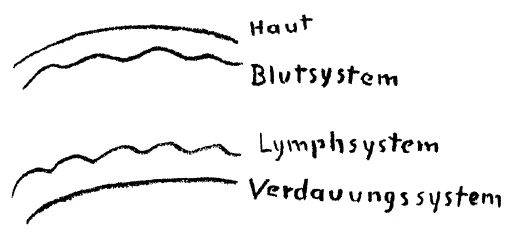
[ 34 ] So ist auf der einen Seite in der äußeren Umgrenzung des Menschen, im Hautsystem, ein Umgewandeltes zu sehen aus einem anderen System, dem Blutsystem, das ich hier so zeichnen will, und auch in dem Verdauungssystem haben wir die Umwandlung aus einem anderen System zu sehen, das heute in absteigender Entwickelung ist. Wir müssen nun festzustellen suchen, ob wir diese auf- und absteigende Natur von Organsystemen schon angedeutet finden in der Keimanlage. Und in der Tat zeigt sich, daß wir den Gesamtorganismus in der Keimanlage angedeutet finden - ich will es schematisch zeichnen - in den vier übereinanderliegenden Keimblättern, die man nennt: das äußere Keimblatt — Ektoderm -, das innere Keimblatt — Entoderm — und das Mesoderm - das äußere und das innere mittlere Keimblatt.
[ 34 ] Thus, on the one hand, in the outer boundary of the human being—the skin system—we see a transformation from another system, the blood system, which I will attempt to sketch here; and in the digestive system as well, we see a transformation from another system that is currently in a state of descending development. We must now try to determine whether we find this ascending and descending nature of organ systems already indicated in the embryonic structure. And indeed, it becomes apparent that we find the entire organism indicated in the embryonic structure—I will sketch it schematically—in the four superimposed germ layers, which are called: the outer germ layer—ectoderm—, the inner germ layer—endoderm—, and the mesoderm—the outer and inner middle germ layers.
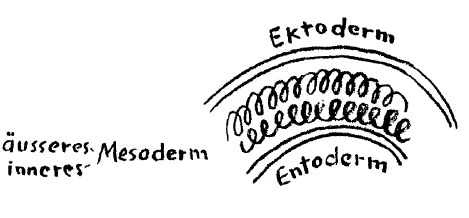
[ 35 ] Dabei haben wir im Sinne unserer Anschauung über die Entwickelung das äußere Keimblatt, das Ektoderm, das man in der heutigen Anatomie auch das Hautsinnesblatt nennt, anzusehen als ein Umwandlungsprodukt, das seine erste Anlage zeigt in dem äußeren Mittelblatt, dem äußeren Mesoderm. In diesem haben wir dasjenige als Keimanlage vor uns, was auf einer höheren Stufe in dem Hautsinnesblatt uns vor Augen tritt. Und in dem inneren Mittelblatt, dem inneren Mesoderm, haben wir die jüngere Bildung dessen vor uns, was sich später im Entoderm, im Darmdrüsenblatt, zeigt.
[ 35 ] In accordance with our view of development, we must regard the outer germ layer, the ectoderm—which in modern anatomy is also called the skin-sensory layer—as a product of transformation that first manifests itself in the outer middle layer, the outer mesoderm. In this, we have before us as an embryonic structure what appears to us at a higher stage in the skin-sensory layer. And in the inner mesoderm, we have the earlier formation of what later manifests itself in the endoderm, the intestinal-glandular layer.
[ 36 ] Wenn wir den menschlichen Keim in seiner Entwickelung betrachten, so haben wir die erste Anlage des Menschen in den beiden mittleren Keimblättern angedeutet, in den Mesodermen; die beiden anderen Keimblätter, Ektoderm und Entoderm, sind bereits umgewandelt. Die beiden Mittelblätter sind also die, welche den ursprünglichen Zustand darstellen, während Ektoderm und Entoderm die höhere Entwickelung zeigen.
[ 36 ] When we observe the development of the human embryo, we see the earliest signs of human form in the two middle germ layers, the mesoderm; the other two germ layers, the ectoderm and endoderm, have already undergone transformation. The two middle layers are thus those that represent the original state, while the ectoderm and endoderm show the higher stage of development.
[ 37 ] Nun wissen wir, daß die entwickelungsfähige Keimanlage des Menschen zusammenfließt aus zwei Anlagen, aus der weiblichen und der männlichen Keimanlage, und daß eine Neuentwickelung nur entstehen kann durch das lebendige Zusammenwirken dieser beiden Anlagen. In den beiden Keimanlagen müssen also getrennt enthalten sein alle die Prozesse, die nur vereint die Keimanlage für den menschlichen Organismus bilden.
[ 37 ] We now know that the human germ system capable of development arises from the union of two systems—the female and male germ systems—and that new life can only come into being through the living interaction of these two systems. Thus, all the processes that together form the germ system of the human organism must be contained separately within the two germ systems.
[ 38 ] Was zeigt uns nun der Okkultismus in bezug auf die hierbei obwaltenden Verhältnisse? Er zeigt uns, daß unter den heutigen physischen Bedingungen der weibliche Keim [Entoderm] nur imstande ist, eine solche menschliche Körperanlage zu produzieren, die, wenn sie sich einzeln entwickeln wollte, nicht das entwickeln könnte, was wir das Formprinzip nennen, das zuletzt zur Einlagerung des Knochensystems führt, das dem Menschen seine Festigkeit gibt; und auch das Hauptsinnessystem würde nicht durch den weiblichen Keim geliefert werden können. Es ist der weibliche Keim so angelegt, daß man fast sagen könnte, das, was da entsteht, würde zu gut sein für die Welt, so wie sie heute besteht, denn es sind nicht alle Prozesse in der äußeren physischen Welt vorhanden, welche einem solchen Organismus notwendig wären. Dieser weibliche Menschenorganismus könnte sozusagen nicht bis zu jener «Vererdigung» fortschreiten, wie sie in dem eingelagerten Knochensystem zum Ausdruck kommt, und er hätte nicht die Möglichkeit, verbunden zu sein mit der Außenwelt durch die Sinne. Er müßte in den äußeren Bedingungen eine Stütze finden, um sein weicheres inneres Material, das er anstelle des festen Knochengerüstes hätte, auszugleichen; er könnte sich nicht nach außen aufschließen, sondern würde in seinem inneren Leben abgeschlossen bleiben. Das ist der weibliche Anteil an der Keimanlage; er würde über das Ziel dessen hinausschießen, was heute in unserem irdischen Dasein möglich ist, einfach weil in den heutigen physischen Erdenverhältnissen nicht die Bedingungen gegeben sind, welche ein solcher verfeinerter Organismus nötig hätte, der so wenig zur Vererdigung und zum Aufschließen nach außen angelegt ist. Ein solcher Organismus wäre unter den heutigen irdischen Verhältnissen von vornherein zum Tode bestimmt. So ist wirklich der menschlichen Keimanlage, gerade durch die Tendenz, daß der Mensch in seiner Fortentwickelung zu weit kommen könnte, schon die Ursache dafür eingeprägt, daß der Mensch zum Tode bestimmt ist.
[ 38 ] What, then, does occultism reveal to us regarding the conditions prevailing here? It shows us that under today’s physical conditions, the female germ [endoderm] is only capable of producing a human physical constitution that, if it were to develop on its own, could not develop what we call the formative principle, which ultimately leads to the formation of the skeletal system that gives the human being its strength; nor could the main sensory system be provided by the female germ. The female germ is constituted in such a way that one could almost say that what arises there would be too good for the world as it exists today, for not all the processes in the external physical world are present that would be necessary for such an organism. This female human organism could not, so to speak, progress to that “mineralization” as expressed in the developed skeletal system, and it would not have the ability to be connected to the external world through the senses. It would have to find support in external conditions to compensate for its softer inner material, which it would have in place of the solid skeletal framework; it could not open itself outwardly, but would remain closed off in its inner life. This is the feminine aspect of the embryonic structure; it would overshoot the limits of what is possible in our present earthly existence, simply because the physical conditions on Earth today do not provide the environment required by such a refined organism, which is so ill-suited to earthification and opening up to the outside world. Such an organism would be doomed to death from the outset under present-day earthly conditions. Thus, precisely because of the tendency for human beings to go too far in their further development, the very cause of humanity’s doom is already imprinted upon the human germ.
[ 39 ] Der andere Anteil der Keimanlage, der männliche [Ektoderm], ist in der genau umgekehrten Lage. Wenn die männliche Keimanlage allein sich entwickeln würde, so würde dies zu mächtiger Entfaltung dessen führen, was sich kundgibt in dem Sichaufschließen nach außen im Hautsinnessystem, und dessen, was zur Verfestigung im Knochensystem führt, also nach der anderen Seite über das Ziel hinausschießen. Eine solche Einseitigkeit würde ebensowenig eine lebensfähige Keimanlage hervorbringen können wie der weibliche Keim für sich, denn der Organismus, den die männliche Keimanlage entwickeln würde, würde so starke Kräfte entfalten, daß er sich selbst zerstören und zugrunde gehen müßte unter den Verhältnissen, wie sie heute auf der Erde vorhanden sind, das heißt, er würde unter diesen heutigen Verhältnissen auf der Erde als Organismus nicht bestehen können. Der männliche Keim kann daher nur dann zu einem lebensfähigen Ausdruck kommen, wenn er mit der weiblichen Keimanlage zusammenwirkt. Nur dadurch, daß die beiden Keimanlagen sich ausgleichen, daß dasjenige, was in der weiblichen Keimanlage zum Tode bestimmt ist, sich ausgleicht mit dem der männlichen Keimanlage durch den Befruchtungsprozeß, ist eine lebendige Gesamtanlage des Menschen möglich. Was an Kräften zusammengedrängt vorhanden ist in der männlichen Keimanlage, das würde, wenn es für sich allein auswachsen würde, unendlich unter das Irdische hinunterführen, es würde zu einer viel größeren Verhärtung des Knochensystems führen, zu einem weit größeren Sichaufschließen und Aufgehen in der Außenwelt. Diese beiden organischen Keime müssen sich schon in ihrer allerersten Entstehung zu weiterer Entwickelung zusammenfinden, denn einzeln ist jede von ihnen zum Tode bestimmt. Nur die lebendige Wechselwirkung dessen, was nach beiden Seiten hin das Überhandnehmen des einen über das andere verhindert, ergibt die für das Erdendasein des Menschen mögliche Keimanlage.
[ 39 ] The other part of the germ layer, the male [ectoderm], is in the exact opposite position. If the male germ layer were to develop on its own, this would lead to a powerful unfolding of that which manifests itself in the outward opening of the skin-sense system, and of that which leads to solidification in the skeletal system—thus overshooting the mark in the opposite direction. Such one-sidedness would be just as incapable of producing a viable germ layer as the female germ alone, for the organism that the male germ would develop would unleash such powerful forces that it would have to destroy itself and perish under the conditions that exist on Earth today; that is, it would not be able to survive as an organism under these present-day conditions on Earth. The male germ can therefore only come to life if it interacts with the female germ. Only through the two germs balancing each other—through that which is destined for death in the female germ balancing out that of the male germ through the process of fertilization—is a living, complete human organism possible. The forces concentrated within the male germ would, if allowed to develop on their own, lead infinitely downward into the earthly realm; they would result in a much greater hardening of the skeletal system, in a far greater opening up and merging with the external world. These two organic germ cells must unite for further development already in their very earliest stages of formation, for individually, each of them is doomed to death. Only the living interplay of what, on both sides, prevents one from gaining the upper hand over the other, yields the germ cell necessary for human existence on Earth.
[ 40 ] So sehen wir, wenn es auch nur in skizzenhafter Art gezeigt werden konnte, daß wir die geistigen Tatsachen bis dahin zurückverfolgen können, wo der Mensch seinesgleichen hervorbringt. Wir würden dies natürlich noch viel ausführlicher darstellen können, aber in einem kurzen Zyklus läßt sich natürlich nicht alles sagen. Wenn wir noch tiefer hineinleuchten würden, so würden wir sehen, wie sich bewahrheitet, daß auch das Minuziöseste auf geistige Tatsachen zurückgeht, bis hin zu dem, was hier über die übersinnlichen Kraftsysteme gesagt worden ist, die ihren äußeren Ausdruck finden in den Organsystemen, die der Mensch entwickelt, damit sein Geschlecht über die Erde hin lebt.
[ 40 ] Thus we see, even if only in a sketchy way, that we can trace spiritual realities back to the point where human beings give rise to their own kind. We could, of course, present this in much greater detail, but it is naturally impossible to say everything in a short lecture series. If we were to delve even deeper, we would see how true it is that even the most minute details can be traced back to spiritual realities, all the way to what has been said here about the supersensible systems of forces that find their outward expression in the organ systems which human beings develop so that their species may live on the earth.
[ 41 ] Wir haben gesehen, daß die Erde als Ergebnis des dichtesten «Vererdigungsprozesses» in uns hervorgebracht hat das Knochensystem, und als das am wenigsten verdichtete, als das regsamste, das Blutsystem. Und es soll nur noch kurz hinzugefügt werden, daß alles, was vorgeht im irdisch-physischen Menschenorganismus, hinaufdringt bis zu den Vorgängen, die sich im Blute abspielen; das sind die Erwärmungsvorgänge. Wir haben in diesen Erwärmungsvorgängen des Blutes den unmittelbaren Ausdruck des Ich und damit das oberste Niveau zu sehen, und darunter sich abspielend die anderen Prozesse des menschlichen Organismus. Der Erwärmungsprozeß ist also das Höchste, in diesen greift unsere Ich-Seelentätigkeit unmittelbar ein. Deshalb fühlen wir auch etwas wie eine Verwandlung unserer Ich-Seelentätigkeit in ein inneres Warmwerden, das bis zum physischen Warmwerden im Blutprozeß gehen kann. Wir sehen also, wie das Geistig-Seelische von oben nach unten gehend durch den Erwärmungsprozeß eingreift in das Organische, das Physiologische, und wir könnten noch an vielen anderen Tatsachen zeigen, wie das Geistig-Seelische sich in Erwärmungsprozessen berührt mit dem Organischen. Erwärmungsprozesse haben wir auch durch die Vorgänge in den Ernährungsorganen. Durch die Tätigkeit der komplizierten Apparate des Ernährungssystems finden die mannigfaltigsten Verwandlungen statt, durch die es im physischen Organismus zu Erwärmungsprozessen kommt. Diese erstrecken sich von unten nach oben. Es reicht also im Erwärmungsprozeß der physische Organismus des Menschen bis hinauf ins Geistig-Seelische. Hören damit die Umwandlungen auf? Oder gehen sie weiter? Was dann folgt, kann nur angedeutet werden; es muß zunächst dem weiteren Nachdenken und namentlich Nachfühlen eines jeden Zuhörers überlassen werden. Wenn wir diese Umwandlungen mit Gefühlen wirklicher Ehrfurcht für den menschlichen Organismus betrachten können, so lernen wir einsehen, daß Physiologie nicht eine trockene Wissenschaft zu sein braucht, sondern eine Quelle höchster menschlicher Erkenntnis sein kann.
[ 41 ] We have seen that the Earth, as a result of the densest “process of earthification,” has produced within us the skeletal system, and as the least condensed, the most active, the circulatory system. And it should only be briefly added that everything that takes place in the earthly-physical human organism extends up to the processes that occur in the blood; these are the processes of warming. In these warming processes of the blood, we must see the direct expression of the ego and thus the highest level, with the other processes of the human organism taking place beneath it. The warming process is thus the highest; our ego-soul activity intervenes directly in these. That is why we also feel something like a transformation of our ego-soul activity into an inner warming that can extend to physical warming in the blood process. We thus see how the spiritual-soul aspect, moving from top to bottom through the warming process, intervenes in the organic and the physiological, and we could demonstrate through many other facts how the spiritual-soul aspect comes into contact with the organic in warming processes. We also have warming processes through the activities in the digestive organs. Through the activity of the complex apparatus of the digestive system, the most manifold transformations take place, through which heating processes occur in the physical organism. These extend from the bottom up. Thus, in the heating process, the human physical organism extends all the way up into the spiritual-soul realm. Do the transformations stop there? Or do they continue? What follows can only be hinted at; it must first be left to the further reflection and, above all, the inner feeling of each listener. If we can view these transformations with a sense of genuine reverence for the human organism, we come to realize that physiology need not be a dry science, but can be a source of the highest human insight.
[ 42 ] Was der Organismus produziert an innerer Wärme in unserem Blut, an Wärme, die er uns durch die gesamten inneren Prozesse zuleitet, das zeigt, daß wir in den Erwärmungsvorgängen etwas zu sehen haben wie eine Blüte aller anderen Prozesse im Organismus. Die innere Wärme des Organismus dringt bis hinauf in das GeistigSeelische und kann sich bis in Geistig-Seelisches hinein verwandeln. Das ist das Höchste, das Schönste, das durch die Kraft des Menschenleibes Physisches umgewandelt werden kann in Geistig-Seelisches. Wenn alles, was im menschlichen irdischen Organismus veranlagt ist, zu Wärme geworden ist und die Wärme vom Menschen in der rechten Weise umgewandelt wird, dann entsteht aus der inneren Wärme Mitgefühl und Interesse für andere Wesen. Wenn wir durch alle Prozesse des menschlichen Organismus hindurch aufsteigen bis zum obersten Niveau, den Erwärmungsprozessen, so schreiten wir gleichsam durch das Tor des menschlichen Organismus, das gebildet wird durch die Wärmeprozesse, hinauf bis dahin, wo die Wärme des Blutes verwertet wird durch das, was die Seele daraus macht. Durch lebendiges Interesse für alle Wesen, durch Mitgefühl für alles, was um uns herum ist, erweitern wir, indem unser physisches Leben uns bis zur Wärme hinaufführt, unser Geistig-Seelisches über das gesamte irdische Dasein, und wir machen uns eins mit dem gesamten Dasein. Es ist eine wunderbare Tatsache, daß die Weltwesenheit den Umweg gemacht hat durch unseren physischen Organismus, um uns zuletzt die innere Wärme zu geben, die wir Menschen in der Erdenmission berufen sind umzuwandeln durch unser Ich in lebendiges Mitfühlen mit allen Wesen.
[ 42 ] The inner warmth that the organism produces in our blood—the warmth it channels to us through all its internal processes—shows that in these warming processes we can see something like a blossoming of all the other processes in the organism. The organism’s inner warmth penetrates all the way up into the spiritual-soul realm and can be transformed into the spiritual-soul realm. This is the highest, the most beautiful thing that can be transformed from the physical into the spiritual-soul realm through the power of the human body. When everything inherent in the human earthly organism has become warmth and this warmth is transformed by the human being in the right way, then compassion and interest in other beings arise from this inner warmth. When we ascend through all the processes of the human organism to the highest level—the processes of warming—we pass, as it were, through the gateway of the human organism formed by these warming processes, up to the point where the warmth of the blood is utilized by what the soul makes of it. Through a living interest in all beings, through compassion for everything around us, we expand—as our physical life leads us up to the warmth—our spiritual-soul life over the entire earthly existence, and we become one with the whole of existence. It is a wonderful fact that the world spirit has taken the detour through our physical organism in order to ultimately give us the inner warmth that we humans, in our earthly mission, are called upon to transform through our ego into living compassion for all beings.
[ 43 ] Wärme wird in Mitgefühl umgewandelt in der Erdenmission!
[ 43 ] Heat is transformed into compassion during the Earth mission!
[ 44 ] Die Tätigkeit des menschlichen Organismus benützen wir sozusagen als Heizwärme für den Geist. Das ist der Sinn der Erdenmission, daß der Mensch als physischer Organismus dem Erdenorganismus so eingelagert ist, daß alle physischen Prozesse zuletzt ihre Vollendung, ihre Krone in der Blutwärme finden, und daß der Mensch als Mikrokosmos in Erfüllung seiner Bestimmung diese innere Wärme wiederum umwandelt, um sie auszuströmen als lebendiges Mitgefühl und Liebe für alles, was uns umgibt. Durch alles, was wir aus lebendigem Interesse in unsere Seele aufnehmen, wird unser Seelenleben erweitert. Und wenn wir dann durch viele Inkarnationen gegangen sind, in denen wir alle Wärme, die uns gegeben worden ist, verwertet haben, dann wird die Erde ihr Ziel, das innerhalb der Erdenmission zu erfüllen war, erreicht haben, dann wird sie als Erdenleichnam hinuntersinken und dem Verfall überliefert sein. Und aufsteigen wird die Gesamtheit aller jener Menschenseelen, die die physische Wärme umgewandelt haben in Herzenswärme. Wie die einzelne Seele, wenn der Mensch durch die Pforte des Todes gegangen ist, aufsteigt zu einer geistigen Welt, nachdem der physische Leichnam den Erdenkräften übergeben wurde, so wird einstmals der Erdenleichnam den Weltenkräften übergeben werden, und die einzelnen Menschenseelen werden zu neuen Daseinsstufen fortschreiten. Nichts in der Welt geht verloren. Was die Menschenseelen als Früchte auf der Erde errungen haben, das wird durch die Menschenseelen in Ewigkeiten hinübergetragen.
[ 44 ] We use the activity of the human organism, so to speak, as fuel for the spirit. This is the meaning of the earthly mission: that the human being, as a physical organism, is so integrated into the earthly organism that all physical processes ultimately find their fulfillment, their crowning glory, in the warmth of the blood; and that the human being, as a microcosm fulfilling its destiny, in turn transforms this inner warmth to radiate it outward as living compassion and love for all that surrounds us. Through everything we take into our soul out of living interest, our soul life is expanded. And when we have then passed through many incarnations in which we have utilized all the warmth that has been given to us, then the Earth will have reached the goal that was to be fulfilled within the Earth’s mission; then it will sink down as the Earth’s physical body and be left to decay. And the totality of all those human souls who have transformed physical warmth into warmth of the heart will ascend. Just as the individual soul, once the human being has passed through the gate of death, ascends to a spiritual world after the physical body has been surrendered to the forces of the Earth, so too will the Earth’s body one day be surrendered to the forces of the worlds, and the individual human souls will advance to new stages of existence. Nothing in the world is lost. What human souls have attained as fruits on Earth will be carried forward by them into eternity.
[ 45 ] So gestattet uns die Geisteswissenschaft, auch die physiologischen Prozesse im menschlichen Organismus anzuknüpfen an unsere Ewigkeitsbestimmung. Wenn uns die Geisteswissenschaft (Theosophie) nicht bloße Theorie, nicht bloß abstrakte Erkenntnis ist, sondern wenn wir sie so betrachten, daß sie uns zeigt: wir stehen als Menschen nicht nur auf der Erde, sondern wir gehören zum gesamten Weltensystem —, und wenn wir lernen, so über die Bestimmung des Menschen zu denken, daß er die Kräfte von der Erde nimmt, um in die Ewigkeit hineinzuwirken, dann nehmen wir durch Geisteswissenschaft (I'heosophie) das auf, was durch sie errungen werden muß. Und wenn die Menschen, die dieses hohe Ideal ahnen oder erkennen, sich brüderlich zusammenfinden und übereinstimmen in ihrem Streben, das heißt, wenn wir erkennen, daß in uns selbst die Keime zur Weiterentwickelung enthalten sind, die fruchtbar werden können für die weitere Erden- und Menschheitsentwickelung, dann können wir in aller Bescheidenheit das Gefühl haben, daß wir als Theosophen (Anthroposophen) durch die Entwickelung unserer eigenen Kräfte mitwirken können an der Erfüllung der Erdenmission.
[ 45 ] In this way, spiritual science allows us to connect even the physiological processes in the human organism to our eternal destiny. If spiritual science (theosophy) is not merely a theory, not merely abstract knowledge for us, but if we view it in such a way that it shows us: we as human beings do not merely stand upon the earth, but belong to the entire world system—and if we learn to think of the human destiny in such a way that we draw our powers from the earth in order to work into eternity, then through spiritual science (theosophy) we take in what must be attained through it. And when people who sense or recognize this high ideal come together in brotherhood and agree in their striving, that is, when we recognize that within ourselves lie the seeds of further development that can bear fruit for the continued evolution of the Earth and humanity, then we can, in all humility, feel that as Theosophists (Anthroposophists), through the development of our own powers, we can contribute to the fulfillment of the Earth’s mission.
[ 46 ] Wir sind hier zusammengekommen und werden nun wieder hinausgehen, um draußen zu leben und vielleicht manches von dem, was ja nur skizzenhaft hier als Anregung hat gegeben werden können, mit hinaus zu nehmen und weiter zur Entfaltung zu bringen. Aber auch wenn wir in der Welt zerstreut sind, so wollen wir in lebendigen Gedanken und Empfindungen und mit unserem ganzen Wollen miteinander harmonisch zusammenwirken. In diesem Geiste wollen wir voneinander scheiden, in diesem Geiste wollen wir uns auch wiederfinden, wenn dazu Gelegenheit sein wird.
[ 46 ] We have gathered here and will now go out again to live in the world, perhaps taking with us some of what could only be presented here in sketch form as a source of inspiration, and bringing it to further fruition. But even though we are scattered throughout the world, let us work together harmoniously through living thoughts and feelings and with all our will. In this spirit let us part from one another, and in this spirit let us also find one another again when the opportunity arises.