

An Occult Physiology
GA 128
21 March 1911, Prague
Translated by Steiner Online Library
Second Lecture
[ 1 ] In the course of these reflections, we will repeatedly be confronted with the challenge of examining the external human organism more closely in order to recognize, so to speak, the transitory and the fragile. But we will also see that it is precisely this path that will lead us to an understanding of the enduring, the imperishable, and the eternal in human nature. However, if our reflections are to achieve this goal, it is necessary that we strictly adhere to what was already noted yesterday in the introduction: the perspective of viewing the external physical organism with all reverence as a revelation from spiritual worlds.
[ 2 ] Once we have become reasonably familiar with concepts and sensations from the humanities, we can very easily come to see that the human organism, in its immense complexity, must be the most significant expression, the greatest and most significant revelation of the forces that, as spiritual forces, interweave and permeate the world. We will, however, have to ascend, so to speak, more and more from the external to the internal.
[ 3 ] Yesterday we saw how an external examination of the human being—whether by the layperson or by science—necessarily leads us to view the human being, so to speak, as a duality. We already briefly characterized this duality of the human being yesterday—we will have to go into this in more detail later—and we examined more closely that aspect of the human being which is enclosed within the protective bony shell of the skull and the vertebrae. In doing so, we saw how, if we start from the external structure and form of this part of the human being, we can already gain a preliminary insight into the connection between the life we call our waking daily life and that other life—which is, of course, initially fraught with doubts for us—that we call the dream life. We have seen that even the external forms of this particular aspect of human nature provide a kind of reflection, a kind of revelation: on the one hand, of the dream life, this chaotic life of images, and on the other hand, of waking daily life, endowed with sharply defined observation. Today we will first take a brief look at the other aspect of human duality, which lies, so to speak, outside the realm we considered yesterday. Even the most superficial glance at this second part of the human being can teach us that, in a certain respect, it presents the opposite picture of what we considered in the case of the brain and spinal cord. The brain and spinal cord are enclosed by bony structures as a protective shell. If we consider the other part of human nature, we must definitely say that here we find the bony structure more integrated into the organism. But that would be only a very superficial observation. We are already led deeper into the structure of this other part of human nature when we distinguish the most significant organ systems and first compare them externally with what we learned about yesterday.
[ 4 ] The organ systems—the functional systems of the human organism—that will be considered first are the digestive system and everything that lies between the digestive system and that marvelous structure which we can easily perceive as a kind of center of the entire human organism: the heart. Even a cursory glance shows us that the digestive system—as it is commonly called—is designed to take in the substances of our external earthly environment and prepare them for further processing within the human physical organism. We know that this digestive system extends in a tubular fashion from our mouth to the organ that everyone knows as the stomach. And even a superficial observation teaches us that, of those foods introduced into the stomach through this channel, unused portions are simply excreted, while other portions are transferred by the subsequent digestive organs into the human body. It is, after all, well known that what we call the lymphatic system—I will speak only schematically for now—is connected to the actual digestive system in the narrower sense, in order to receive the nutrients delivered by the digestive system in a transformed state. So that we can say that connected to the digestive system, insofar as it is linked to the stomach, is an organ system, the lymphatic system, as a network of channels running through the entire body, a system that takes over what has been processed by the digestive system and delivers the transformed substances to the blood. And then we have the third component of human nature, the circulatory system itself with its wider or narrower vessels, as it runs through the entire human organism and has the heart as the center of its entire activity. We know, of course, that the blood-filled vessels we call arteries originate from the heart, and that these carry the so-called red blood to all parts of our organism. The blood undergoes a certain process in the individual parts of the human organism, is then led back through other vessels, the veins, which, however, now return it to the heart in an altered, transformed state as so-called blue blood. We also know that this transformed, now unusable blood is directed from the heart to the lungs, that there it comes into contact with the oxygen from the air taken in from outside, that it is thereby renewed and then returned to the heart via the veins to begin its circulation through the entire human organism anew.
[ 5 ] To examine these complex systems, and so that we may immediately establish a foundation for the occult perspective within the external perspective, let us first focus on the system that must appear to everyone from the outset as the true central system of the entire human organism: the blood-heart system. Let us first consider how the blood, after being refreshed in the lungs as spent blood—that is, after being transformed from so-called blue blood back into red blood—returns to the heart and then flows out from the heart as red blood into the organism to be utilized there. (A diagram is drawn on the board.) Please note that everything I am drawing here is only very schematic. Let us briefly recall that the human heart is an organ that actually consists of four parts, four chambers, which are separated by internal walls in such a way that one can distinguish two larger chambers located below and two smaller ones located above; the two lower ones are the two ventricles, as they are commonly called, while the upper ones are called the atria. I do not wish to speak of the heart valves today, but rather to outline the course of the most important organ functions in a very schematic way. It is evident, first of all, that after the blood has flowed from the left atrium into the left ventricle, it flows out through a large artery and is carried from there throughout the entire organism. Now let us consider that this blood is first distributed to all the individual organs of the body, that it is then utilized by the body, whereby it is transformed into what is known as deoxygenated blood and, as such, returns to the heart into the right atrium, flows from there into the right ventricle, and from there goes back to the lungs to be renewed and to make the journey through the body once more.
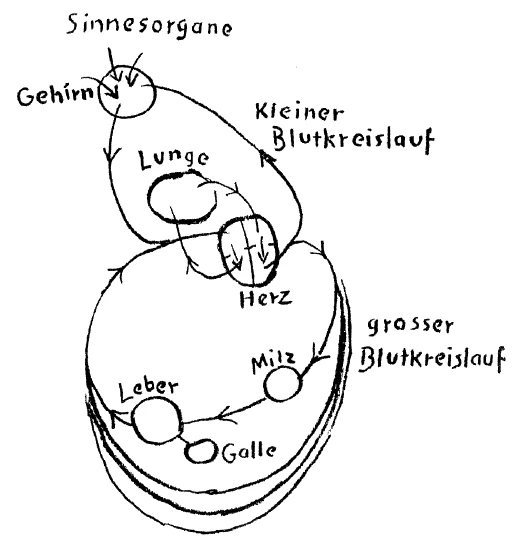
[ 6 ] When we consider this, it is important to bear in mind—as a basis for an occult perspective—that a collateral flow branches off from the aorta very early on, leading into the brain, supplying the upper organs of the human body, and flowing back from there as spent blood into the right atrium, and that this blood, having passed through the brain, is transformed in the same way as the blood coming from the rest of the organism. We thus have a smaller collateral circulation of the blood, in which the brain is involved as a sensory organ, separate from the other, larger circulation that supplies the rest of the organism. Now it is extremely important that we take precisely this fact into account. For we can only gain a true understanding—one that can provide a foundation for everything that will enable us to ascend into the occult realms—if we ask ourselves: Is there—in a manner similar to how the upper organs, namely the brain, are connected to the small circulatory system—something similar connected to the large circulatory system that supplies the rest of the organism? — Here we indeed arrive at the conclusion that even a superficial, external observation can provide: that the organ we call the spleen is initially connected to the systemic circulation, that the liver is also connected to it, and that the organ containing the bile prepared by the liver is likewise connected. All these organs are connected to the systemic circulation.
[ 7 ] If we now ask about the function of these organs, conventional science tells us that the liver produces bile, that the bile flows through the bile ducts into the digestive tract, and that it assists in the processing of food so that it can then be absorbed by the lymphatic system and transported into the blood. Conventional science says less precisely about the spleen. When we consider these organs, we must first focus on the fact that they are, so to speak, involved in the transformation of food for the human organism, but that, on the other hand, all three organs are integrated into the systemic circulation. They are not involved in this for no reason. For insofar as nutrients are absorbed into the blood to be carried by the blood to the human organism and to continuously replenish its building materials, these three organs participate in the necessary processing of the nutrients. The question now is: Can we already deduce from an external observation how these three organs participate in the overall activity of the human organism? — Let us first turn our gaze to an external aspect, namely that these organs are involved in the lower circulatory system just as the brain is involved in the upper circulatory system; and let us ask—if we initially stick to this external perspective, which will be explored in greater depth later—whether these organs might possibly have a similar, related task to that of the brain or, indeed, to the higher parts of the human organism. What might this task consist of?
[ 8 ] Let us consider these higher parts of the human organism; they are, after all, the organs that receive external sensory impressions and process the material of our sensory perception. Therefore, we can say: What happens in the human head, in the upper parts of the human organism, is the processing of the external world, the processing of those impressions that flow in from the outside through the sense organs. We must see the essential causes of what happens in the upper parts of the human being in the external impressions, in the external stimuli. As these external impressions send their effects into the upper organs of the human organism, they alter the blood—or at least contribute to this—and send this blood back to the heart in an altered state, just as blood is sent back to the heart from the rest of the organism in an altered state. Is it not reasonable, then, to consider that what enters the upper part of the human organism from the external world through the gateway of the sense organs corresponds in a certain way to what emanates from the internal organs—the spleen, liver, and gallbladder? The upper part of the human organism opens outward to receive the influences of the external world, and while the blood flows upward to take in these impressions from the external world, it flows downward to take in what comes from the lower organs. As we have said, influences from the environment are exerted on our upper organism through the senses. If we imagine this condensed, compressed into a single center, we can see in it something analogous to what is effected by the liver, gallbladder, and spleen: the transformation of substances taken from the external world. If we examine this more closely, you will see that this is not such a strange way of looking at things.
[ 9 ] Imagine the various sensory impressions flowing in from the external world as if condensed, so to speak, into organs, transferred into the inner being of the human being, and integrated into the blood; thus the upper part of the human organism presents itself to the blood just as the internal organs—the liver, gallbladder, and spleen—present themselves to the blood from within. So we have the external world, which surrounds our senses above, compressed, as it were, into organs and transferred into the inner being of the human being, so that we can say: On the one hand, the world touches us from the outside; it flows through the sense organs into our upper organism and acts upon our blood; and on the other hand, the world acts in a mysterious way from within, in organs into which what takes place outside in the macrocosm has first been condensed, and there it acts in opposition to our blood, which presents itself to it in the same way. If we were to draw this schematically, we could say: Let us imagine, on the one hand, the world, acting on the senses from all sides, and the blood, presenting itself like a tablet to the impressions of the external world; this is our upper organism. Now, if we imagine that we could condense this entire world, condense it into individual organs, form an extract of this world, and transfer it into the interior, so that, in a sense, the whole world acts upon the other side of the blood, then we would have formed a schematic picture of the exterior and interior of the human organism in a very peculiar way. Thus, in a certain sense, we could already say: The brain actually corresponds to our internal organization; insofar as it fills the chest and abdominal cavities, the external world is, as it were, transferred into our interior.
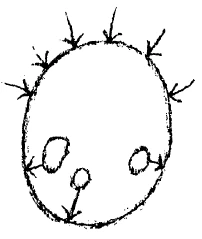
[ 10 ] Even in this system—which we recognize as a subordinate one, serving primarily to sustain the process of nutrition—we find something as mysterious as the integration of the entire external world into a system of internal organs, of internal instruments. And if we now take a closer look at these organs—the liver, gallbladder, and spleen—we can say: First of all, it is the spleen that presents itself to the flow of blood. The spleen is a peculiar organ; embedded within its blood-rich tissue is a whole collection of small granules that appear white in contrast to the rest of the tissue mass. When we consider the blood in relation to the spleen, the spleen appears to us like a sieve through which the blood passes to present itself to such an organ, which is in a certain sense a shrunken part of the macrocosm. At the next stage, we then see how the blood presents itself to the liver and how the liver, in turn, secretes bile, which is stored in a special organ, then passes into the nutrients, and from there enters the blood along with the transformed nutrients.
[ 11 ] We can only conceive of this internal presentation of the blood to the three organs in the following way: The first organ to which the blood is presented is the spleen, the second is the liver, and the third—which actually has a very complex relationship with the entire circulatory system—is the gallbladder. Because the gallbladder is presented with nutrients and is involved in their processing, it is counted as a special organ. For certain reasons, occultists of all ages have given these organs specific names. I would now ask you very much not to think of anything in particular when considering these names given to these organs, and to refrain from assuming that these names signify anything else in the wider world. We will see later why these particular names were chosen. Because the spleen is the first to present itself to the blood—so we can say, purely from an external perspective—it seemed to the ancient occultists best to designate it with the name given to the star that first appears in the solar system within the cosmos; therefore, they called the spleen Saturn or an inner Saturn within the human being. In a similar way, they called the liver an inner Jupiter and the gallbladder an inner Mars. Let us initially think of these names as nothing other than a choice we make because we have arrived at the view—at first hypothetically—that the outer worlds, which are otherwise accessible to our senses, are condensed within these organs and confront us, as it were, as inner worlds, just as the outer worlds confront us in the planets. But we could already say: Just as the outer worlds appear to our senses by penetrating from the outside and acting upon the blood, so do the inner worlds appear to us as acting upon the blood by likewise influencing it.
[ 12 ] We will now, however, find a significant difference between what we discussed yesterday as peculiarities of the human brain and what acts upon our blood like a kind of inner world system. This difference lies simply in the fact that human beings are initially unaware of what is taking place within their lower organism; that is, they know nothing of the impressions that the inner world—the inner planets, as it were—makes upon them, whereas it is precisely characteristic that the outer worlds make their impressions upon their consciousness. In a certain sense, therefore, we may describe this inner world as the world of the unconscious, in contrast to the conscious world we have come to know in the life of the brain.
[ 13 ] Now, precisely what lies within this conscious and unconscious will become clearer to us as we draw upon another source of information. You all know that conventional science speaks of the nervous system as the organ of consciousness, along with everything associated with it. Now, as a basis for our occult considerations, we must take into account a certain relationship that the nervous system has to the circulatory system—that is, to what we have schematically considered today. There we see that our nervous system enters into certain relationships with our circulatory system everywhere, that the blood reaches our nervous system everywhere. In doing so, we must first take into account what external science considers a given in this regard. It ‘considers it a given that the entire regulator of all conscious activity lies in the nervous system—everything we call conscious soul life. We cannot help but—at first only in a suggestive way, to be substantiated later—bring to our awareness that for the occultist, the nervous system stands merely as a kind of foundation of consciousness. For just as the nervous system is integrated into our organism and is connected to, or at least stands in a certain relationship to, the circulatory system, so too is that which we call the human astral body and the human ego integrated into the total being of the human being. And even a superficial observation can show us—and I have often spoken of this in my lectures—that the nervous system is, in a certain sense, a manifestation of the astral body, and the blood a manifestation of the ego. When we turn to inanimate nature, we see that we can attribute only a physical body to rocks, minerals, and so on, in the parts they present to us. When we then ascend from the inanimate, inorganic bodies of nature to the animate bodies of nature—to organisms—we must conceive that these organisms are permeated by the so-called etheric body or life body, which contains within itself the causes of life phenomena. We shall see later that spiritual science does not speak of this etheric or life body in the same way that external science has spoken of a speculative life force. When spiritual science speaks of the etheric body, it speaks of something that the spiritual eye truly sees—that is, of a reality that underlies the external, physical body. When we consider plants, we must attribute an etheric body to them. If we ascend from plants to sentient beings, the animals, it is the element of sensation, of inner experience, that distinguishes the animal from the plant. If we now ask ourselves what must be integrated into the animal organism so that it can be raised from mere life processes to sensations that plants do not yet possess, the answer is: If mere life activity, which cannot yet internalize itself, cannot yet ignite into sensation, is to be able to ignite into sensation, into inner experience, then the astral body must be incorporated into the animal organism. And in the nervous system, which plants do not yet possess, we must see the outward expression, the instrument of the astral body. The astral body is the spiritual archetype of the nervous system. Just as the archetype relates to its manifestation, to its image, so does the astral body relate to the nervous system.
[ 14 ] Now, if we begin our examination with human beings—and as I said yesterday, in occultism we are not as fortunate as the external scientific approach, in that we cannot, so to speak, mix everything together— then, when we examine the human organs, we must always be aware that these organs or organ systems can be used for purposes for which the analogous organ systems in the animal organism, even if they look similar, cannot be used. In humans, we must regard the blood as an external instrument of the ego, of everything we designate as our innermost soul center, the ego. Thus, in the nervous system we have an external instrument of the astral body, and in our blood an external instrument of the ego. Just as the nervous system enters into certain relationships with the blood within the organism, so do those inner soul formations that we experience as our ideas, perceptions, sensations, and so on, enter into a relationship with our ego. The nervous system is differentiated in the most manifold ways within the human organism. It appears to us as the inner nerve tracts, where it branches out, for example, into auditory nerves, facial nerves, and so on. The nervous system is thus something that extends through the organism in such a way that it is differentiated in the most manifold ways, containing inner diversities. When we observe the blood flowing through the organism, it appears to us—if we disregard the transformation of red blood into blue blood throughout the organism—as a unified blood. As such a unified entity, it stands opposite the differentiated nervous system, just as the ego stands opposite the life of the soul, which is structured into ideas, sensations, volitional impulses, feelings, and the like. The further you pursue this comparison—and this is, of course, meant only in a comparative sense—the more you will see that there is a striking similarity in the relationship between the two archetypes, the ego and the astral body, and their counterparts, their instruments: the blood system and the nervous system. Now, we can certainly say: blood is blood everywhere, but as it flows through the organism, it changes. We can draw a parallel between these changes in the blood and the changes the ego undergoes through various soul experiences. Our ego, too, is a unified entity. As far back as we can think in the life between birth and death, we can say of ourselves: I was there! In our fifth year as in our sixth year, yesterday as today, it is the same ego. — But if we now turn to the content, to what this “I” contains, we will find that this “I,” as it lives within me, is filled with a greater or lesser sum of ideas, sensations, feelings, and so on, which are attributable to the astral body and come into contact with the “I.” A year ago, our “I” was filled with a different content; yesterday it had a different content, and today yet another. The ego thus comes into contact with the entire content of the soul, flowing through this entire content of the soul. Just as the blood flows through the entire organism and comes into contact everywhere with the differentiated nervous system, so the ego comes into contact with the differentiated life of the soul, with ideas, feelings, impulses of will, and the like. Thus, even this merely comparative observation shows us that there is a certain justification for seeing in the blood system a reflection of the ego and in the nervous system a reflection of the astral body—these two higher, supersensory members of human nature—while the etheric body is more closely connected to the physical body.
[ 15 ] Now it is necessary to remember that the blood, which flows through the organism in the manner described, presents itself to the external world on the one hand—much as a tablet faces the impressions of the external world—and on the other hand stands in opposition to what we have called the inner world. Yes, it is the same with our ego. We first direct our ego toward the external world, taking in external impressions. This results in a manifold content within our ego; it becomes filled with the impressions coming from outside. Then there are also those moments when the ego, so to speak, remains within itself, when it is given over to its pain, its suffering, to pleasure and joy, to inner feelings and so on, when it even allows to rise from memory not what it now receives directly through contact with the external world, but what it carries within itself. Thus, in this respect as well, the ego can be likened to blood, in that it presents itself like a screen—at times to the external world and at times to the inner world; and we could represent this ego just as schematically as we have represented blood (see drawing on page 42). We can relate the external impressions that the ego receives—by grasping them as ideas, as mental formations—to the ego in the same way that we have related the real external processes coming to us through the senses to the blood; we can thus relate the mental events, just as in physical life, on the one hand to the blood and on the other hand to the ego.
[ 16 ] Let us consider, from this perspective, the interaction and counteraction between blood and nerves. When we turn our eyes toward the external world, for example, external impressions—colors, light, and so on—act upon the optic nerves. As long as we direct our eyes toward the external world, we can also speak of the impressions of the external world having an effect on our optic nerves, that is, the instrument of the astral body. At the moment when a relationship arises between nerves and blood, we can speak of the parallel soul process being that the manifold images of soul life enter into a relationship with the I. So, if we want to sketch this schematically, we must conceive of the relationship between nerves and blood as if what flows in from the outside through the nerves enters into a relationship with the blood vessels that come into the vicinity of the optic nerves.
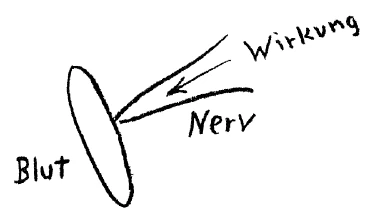
[ 17 ] This relationship is of extraordinary importance if one wishes to view the human organism in such a way that this perspective can serve as a foundation for the occult view of human nature. Then we must say to ourselves: In ordinary life, as it generally unfolds, the process occurs in such a way that an effect transmitted through the nerve is inscribed in the blood as if on a tablet and thereby inscribed in the instrument of the ego. But let us suppose we were to artificially interrupt the relationship between blood circulation and the nerve—that is, we would artificially place the human being in such a situation that, as it were, the nerve is removed from the blood circulation in its effectiveness, so that they can no longer interact with one another. This can be schematically illustrated by drawing the two components further apart, so that an interaction between the nerve and the blood can no longer take place. In this case, the situation may be such that no impression is initially made on the nerve. One can achieve this, for example, by severing the nerve. If, for whatever reason, a nerve is severed—meaning no impression is made on the nerve—then it is hardly surprising that the person cannot experience anything special through that nerve. But let us suppose that—despite the relationship between the nerve and the blood being interrupted—a certain impression is made. In an external experiment, this can be brought about, for example, by stimulating the nerve with an electric current. But this external influence on the nerve is not our concern here. There is, however, another influence on the nerve that leads to a state in which it cannot act on the bloodstream. This state can be brought about in the human organism—and indeed is brought about—by certain mental images, certain ideas, sensations, and feelings that a person has experienced and internalized; and for such an experiment to succeed, these should be higher moral or intellectual concepts. When a person forms such concepts—for example, of symbols—and exercises the soul in intense inner concentration, this causes them to, as it were, fully engage the nerve and thereby withdraw it from the blood circulation. When a person, in waking consciousness, surrenders to normal external impressions as they come, the natural connection between the nerve and the blood circulation is present. But when a person withdraws from the effects of external impressions through intense inner concentration, they have within their soul what first arises in consciousness; what is the content of consciousness primarily engages the nerve and thereby separates nervous activity from blood activity. The consequence of such inner concentration, which—if it is strong enough—truly interrupts the connection between the nervous system and the blood, is that the nervous system is, in a certain sense, freed from its connection with the blood system, and indeed freed from that for which the blood system is the external instrument; that is to say, it is freed from the ordinary experiences of the ego. And it is indeed the case—and this can be fully demonstrated experimentally—that through the experiences of spiritual training intended to lead upward into the higher worlds, through sustained, intense concentration, the entire nervous system is temporarily removed from its ordinary connection with the blood system and the tasks the latter performs for the ego. A certain consequence now sets in, namely that the nervous system, which previously inscribed its effect upon the tablet of the blood, now allows what it contains as an effect to flow back into itself, takes it back into itself, and does not allow this effect to reach the blood. It is thus possible, purely through processes of inner concentration, to separate one’s blood system from the nervous system, as it were, and thereby cause that which would otherwise have flowed into the ego—figuratively speaking—to flow back into the nervous system.
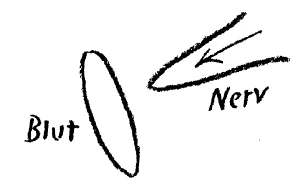
[ 18 ] Now, the peculiar thing is that when a person truly brings about such a thing through inner spiritual activity, they experience a completely different kind of inner experience and thus find themselves facing a completely transformed horizon of consciousness. We can say: When nerves and blood interact with one another in the usual way, as is the case in normal life, then the human being relates the impressions coming from the outside to his ego. But when, through inner concentration, through inner soul activity, he lifts his nervous system out of its interaction with his circulatory system, then he no longer lives in his previous, ordinary ego; he can no longer say “I” in the same sense to what he now has as his self. The human being then appears to himself as if he had quite consciously lifted a part of his being out of himself, separated from his blood system; it is as if something that is otherwise unseen, a supersensible force, were acting upon our nerves, which does not leave an imprint on our blood table and makes no impression on our ordinary “I.” The human being feels lifted away from the entire blood system, as it were, lifted out of the organism. It is a conscious lifting of the “I” out of the sphere of influence of the astral body. Whereas previously nervous activity was reflected in the blood system, it is now reflected back into itself; now the human being lives in something else, perceiving themselves in a different ego, in a [macrocosmic] ego that could previously only be sensed: they feel the intrusion of a supersensible world.
[ 19 ] If we wish to draw a more precise schematic diagram of the relationship between the nerve—or the entire nervous system—as it takes in impressions from the external world, and the blood, we can do so as follows:
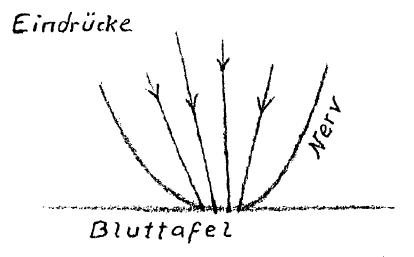
[ 20 ] If external impressions and experiences were to flow in, they would leave their mark on the circulatory system. But once we have separated the nervous system from the blood system, everything flows back within the nervous system; a world of which we previously had no inkling pours forth, as it were, to the very ends of our nervous system, and we feel this as a recoil. Whereas in ordinary consciousness one takes in a world that penetrates as far as the blood system, inscribing itself upon the blood system as if on a tablet, one now proceeds with the impressions only as far as where the nerves terminate and encounter resistance within themselves. At these nerve endings, one is, as it were, repelled and lives out into the supersensible world. When we have a color impression that we receive through the eye, it enters our optic nerve, imprints itself on the tablet of the blood, and we feel what we express with the words: I see red. - But let us suppose that we do not take our impressions all the way to the blood, but only as far as the end of the nerve, where we bounce back; then, in essence, we live only as far as our optic nerve. We recoil from the physical expression of our blood, living outside ourselves; we are actually within the rays of light that would otherwise evoke the impression of “red” within us. We have thus truly stepped outside of ourselves, precisely because we do not penetrate as deeply into our inner being as we otherwise do, but go only as far as the nerve endings. This, however, brings about a soul life that perceives the physical human being as something external and no longer identifies with it. Normal consciousness extends as far as the blood. But when we have developed the soul to the point where we, as it were, turn back at the nerve endings, then we have excluded the blood from what we call the higher human being, to whom we can come when we detach ourselves from our own selves.
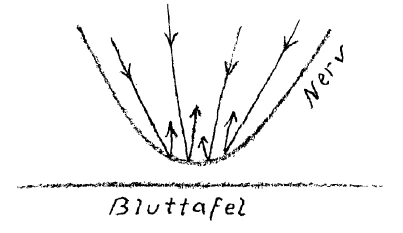
[ 21 ] Through these considerations, we have first gained an understanding of the processes that occur when we have separated the blood system—which we have regarded as a kind of tablet that presents itself on one side to external impressions and on the other to internal ones—from what we might call the higher human being, toward whom we can evolve if we detach ourselves from our own selves and become free from the influences of the ordinary ego. We will now be best able to study the entire inner nature of this blood system if we do not move in general phrases, but rather observe in the human being what is real—the supersensible, invisible human being toward whom we ourselves can aspire. If we observe this supersensible human being as he penetrates down to the blood, then we will be able to advance to the idea that the human being can live in the outer world, that he can pour himself out over the entire outer world, merge with this outer world, and that he can, as it were, take the opposite standpoint to his inner being. In short, we will come to know the functions of the blood and the organs involved in the circulatory system by answering the question: How must this higher world, to which the human being can ascend and which he can come to know precisely, be reflected in the realm of the blood? — The entire differentiated life of the blood will then reveal itself to us as the center of the human being when we directly observe the relationships of this marvelous system to a higher world. For that will indeed be our task: to be able to view the human being as a revelation of the supersensible, to be able to view the outer human being as an image of that human being who is rooted in the spiritual world. Through this, we will be able to recognize the human organism as a faithful image of the spirit.