

Wonders of the World,
Trials of the Soul,
and Revelations of the Spirit
GA 129
24 August 1909, Munich
Translated by Steiner Online Library
Seventh Lecture
[ 1 ] How can we characterize what has been the subject of our reflections in these lectures over the past few days? We can say that we have sought to rediscover, within the magnificent imagery of ancient Greek mythology, the ancient wisdom that we can receive in our own time through spiritual science or esoteric science. And we have indeed seen to what a great extent the things we now perceive in a different way can be found in this Greek mythology in an unforced and almost self-evident manner. The customary notions of this Greek mythology must, however, be greatly shaken by their superficiality when one becomes aware of such things; but especially when one discovers that even the deepest and most significant principles of knowledge—which have not yet been revealed even today—have already been expressed pictorially in this Greek mythology.
[ 2 ] Even deeper than everything associated with what we might call the upper circle of Greek gods—Zeus, Poseidon, Pluto, Apollo, Mars, and so on—and more significant than all of this, the Greeks regarded what they concealed in their mysteries through a certain connection to the figure of Dionysus. For while more or less everything associated with the upper gods was embedded in the exoteric conceptions of the outer world, that which was connected to the figure of Dionysus was concealed within the sanctity of the mysteries, and was handed down only to those who had undergone thorough preparation. What, then, was the contrast between what the Greeks perceived through their conceptions of the higher gods and what was placed within the sanctity of the mysteries? What was the underlying contrast here? Into the conceptions of the higher gods—Zeus, Pluto, Poseidon, Apollo, Mars, and so on—was placed everything that can be perceived through a deeper gaze into the wonders of the world, into what takes place around human beings, and through the laws governing these events. But into that which was associated with the figure of Dionysus, something quite different was also placed: that which signified the deepest destinies of the human soul striving for knowledge and entry into the supersensible worlds. The destinies of the human soul that knows and lives in the depths, with all the trials it must undergo on this path, were illuminated by the mysteries that, in a certain sense, are linked to the name of Dionysus. And if we are to gain any understanding at all of the figure of Dionysus and his relationship to the trials of the soul, we must already today go into a little of what, from the standpoint of modern spiritual science, can be said first of all about the knowing human soul,
[ 3 ] It might seem that people today have ample opportunity to learn about the question of what, in fact, constitutes knowledge of the world. For we do have—so they say—a widespread philosophy in every country, and this philosophy is expected to answer the question of how knowledge comes about. However, from the perspective of spiritual science, philosophy has not yet made much progress in answering this question of how knowledge comes about, and you can easily imagine why this must be so. As long as the philosophy of the outer, exoteric world refuses to acknowledge what the truth about the human being is—namely, the composition of the human being from physical body, etheric body, astral body, and I—as long as this is the case, this outer philosophy cannot arrive at any concept of knowledge of any significance. For knowledge is bound up with the entire being of the human being, and the question of knowledge can only ever elicit empty phrases as answers—such as those so common in our present-day philosophy—if no account is taken of the true, real nature of the human being, of his fourfold nature.
[ 4 ] Of course, given the constraints of this venue and the limited time available, I can only touch upon these matters; I can therefore speak to you only from a certain perspective about the nature and essence of human knowledge. But we will understand one another if we begin by asking: How does a human being acquire knowledge, regardless of what that knowledge may mean? How do we attain knowledge?—Well, surely you all know that a human being could never attain knowledge if he did not think, if he did not perform in his soul something like the work of imagination or thought. Knowledge does not come of its own accord. Human beings must work inwardly, must allow ideas to unfold in their souls if they wish to gain knowledge, and we, as adherents of spiritual science, must ask ourselves: Where in human nature do those processes take place that we call “imagination,” which leads to knowledge?
[ 5 ] The materialistic conception of knowledge in our time, the philosophical fantasy of our time, believes that knowledge arises through the workings of the brain. Certainly, mental activity takes place during cognition, but if we consider that the primary factor in cognition is the inner work of the soul in the life of the imagination, then we must ask the question: Does this life of the imagination, in its content—note that I say content—have anything to do with the work performed in the brain? - The brain is a part of the physical body, and everything that the life of imagination is in terms of its content—that is, the soul’s imaginative work that brings about knowledge—all of this does not extend to the physical body; all of this takes place in the three higher members of the human being, from the I down through the astral body to the etheric body. And you will find nothing in the content of any element of the life of imagination that takes place in any way in the external physical brain. So when we speak merely of the content of imagination, of the work of the imagination, we must locate these solely in the three higher supersensible members of the human being, and then we can ask ourselves: What, then, does the brain have to do with what takes place supersensibly within the human being? — There is, of course, the trivial truth to which today’s philosophers and psychologists refer, namely that while we think, processes take place in the brain. Certainly, this trivial truth is correct; it cannot and should not be denied. But nothing of the imagination itself lives in the brain. What significance does the brain—does the external physical organization, in fact—have for cognition, let us say for the life of the imagination alone?
[ 6 ] Since I must be brief, I can only illustrate this with an analogy. The brain’s role in what actually takes place in our soul when we imagine or think is exactly the same as that of a mirror to a person who sees themselves in it. When you walk through a room, you do not see yourself at first. When you walk toward a mirror, you see what you are, what you look like. Anyone who would now claim that the brain thinks, that the work of imagination takes place in the brain, is talking just as sensibly as someone who walks toward a mirror and says: I, I am not where I am walking; that is not me; I must reach in there—into the mirror—that’s where I am.”—He would soon convince himself that he is not actually inside the mirror at all, that the mirror is indeed the instigator, that what is outside the mirror sees itself. And so it is with the entire physical body organization. What appears there through the work of the brain is the inner supersensible activity of the three higher members of the human organism. For this to appear to the human being himself, the mirror of the brain is necessary, so that we perceive what we are in a supersensible sense through the mirror of the brain. And it is merely a consequence of the present human organism that this must be so. Human beings would indeed think their thoughts, but they could know nothing of them as present-day earthly human beings if they did not have the mirroring physical organism, first and foremost the brain. But everything that modern physiologists and, to some extent, psychologists do to understand thinking is just as sensible as if a person were to search for their reality in a mirror. Everything I have told you here in a few words can already be fully justified epistemologically today; it can be constructed strictly scientifically. Another question is whether, of course, such a matter can be understood in any way. Experience still speaks against this today. One can present these matters to philosophers today in the most rigorous manner imaginable, yet they will not understand a single word of it, because they simply do not wish to engage with these matters—I say explicitly: they do not wish to. For even today, in the outer exoteric world, there is absolutely no will to truly engage with the most serious questions of human cognitive capacity.
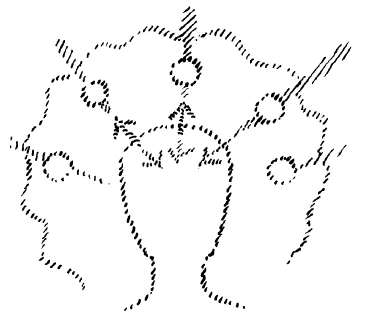
[ 7 ] If we are to form a proper schematic picture of the human cognitive process, we must say—taking this as the schema of the outer physical human bodily organization—: In all that constitutes the external physical body, nothing at all of what constitutes thinking or cognition takes place; rather, this occurs in the subsequent etheric body, astral body, and so on. It is there that the thoughts reside, which I have schematically indicated here with these circles. And these thoughts do not enter the brain — to think that would be utter nonsense — but they are reflected through the activity of the brain and in turn cast back into the etheric body, the astral body, and the I; and the mirror images that we ourselves first create and that become visible to us through the brain—we see these when, as earthly human beings, we become aware of what we are actually doing in our soul life. There is absolutely nothing of a thought inside the brain. There is as little of a thought in the brain as there is of you behind the mirror when you see yourself in it. But the brain is a very complicated mirror. The mirror in which we see ourselves out there is simple, but the brain is an immensely complicated mirror, and a complex process must take place so that the brain can become the instrument not to generate our thoughts, but to reflect them back. In other words, before a thought could even arise in an earthly human being, a preparation had to take place. And we know that this took place during the ancient Saturn, Sun, and Moon epochs, and that ultimately the present physical body—including the brain—is the result of the work of many spiritual hierarchies. So that we can say: With the beginning of Earth’s development, the human being on Earth was constituted in such a way that he could develop his physical brain, so that it could become the mirroring apparatus for what the human being actually is and what was previously present only in the environment of this physical bodily organization.
[ 8 ] That is what we say today, and under certain circumstances, an anthroposophical audience may already understand it. Basically, this process of insight is actually quite easy to understand. What we are able to understand in this way today is what the ancient Greeks sensed and felt, and for that reason they said to themselves: Here in this physical body, without the human being naturally having any direct awareness of it, something immensely significant is hidden. This physical body is indeed taken from the earth, since it consists of the earth’s substances and forces, but something is enshrined within it that can reflect the entire human soul life. - That which, coming from the earth—and thus, in turn, macrocosmic—is involved in the structure of the brain, the ancient Greeks called, when they applied their perception to the microcosm, to the human being, the Dionysian principle, so that within us Dionysus works to make our physical body the mirror of our spiritual life.
[ 9 ] Now, if we build on this—I would say—purely theoretical discussion, we can experience the faintest initial test of the soul; it is the faintest test of the soul, and since modern man is not exactly organized in the most refined way, he usually misses it. These tests must be more pronounced if modern people are to perceive them. Only then, when one is in a certain sense enthusiastic about knowledge, when one regards knowledge as a matter of life and death, does one feel what is to be said as, indeed, the first great test of the soul. It occurs when, arising from such knowledge, one must say something like the following: From ancient times, the great words of wisdom resound to us: ‘Know thyself!’—Self-knowledge, as the linchpin of all other true knowledge, shines before us as a lofty ideal; that is to say, in striving to attain knowledge at all, we first seek to know ourselves, to recognize what we are. Yet all our knowing takes place within the life of the imagination. The life of imagination that lies before us, which also reflects all external things to us—we experience this life of imagination as a mirror image. It does not penetrate at all into what we are, first and foremost, as a physical bodily organization; it is reflected back to us, and just as a person cannot see what lies behind the mirror, so too can a person not look into their own physical being. Nor does it penetrate because the soul life is entirely filled by the life of imagination. One must say to oneself: It is therefore impossible to know oneself at all; one can know nothing other than one’s life of imagination, which has made us into a mirroring apparatus in the first place. It is impossible for us to penetrate there, for we can only reach the boundary; there the entire life of the soul is reflected back, just as the image of a person is reflected back in the mirror. — If we are thus urged by an indefinable feeling to know ourselves, we must admit: We cannot know ourselves at all; it is impossible for us to know ourselves.
[ 10 ] What I have just said is an abstraction for most people today, because they simply lack an enthusiasm for knowledge, because they are unable to develop the passion that must arise when we see the soul confronted with the necessity of what it actually needs. But imagine this as a developed feeling, and you have placed the soul before a severe test, before the test: You must achieve something that you cannot possibly achieve! Expressed in spiritual scientific terms, this would mean: All external knowledge, everything that human beings can attain exoterically, leads to no self-knowledge at all. — From this would arise the striving to penetrate, by a path entirely different from that of ordinary knowledge, to what the work of Dionysus is within us, to our own being. And this was to take place in the Mysteries. In other words: in the Mysteries, something was handed down to people that has absolutely nothing to do with ordinary soul life, which is merely a reflection of our physical organization. The Mysteries were not allowed to limit people to exoteric knowledge, for then they could never have led them into their own inner selves. So anyone who wishes to acknowledge only the external exoteric knowledge would consequently have to say: The Mysteries must have been a complete sham, for they have meaning only if something entirely different from external knowledge is sought in order to reach Dionysus. — We must therefore seek in the Mysteries a certain kind of process that approaches human beings in a completely different way than anything that can approach them externally in exoteric life. We are then immediately faced with the question: Is there any means at all to descend into what is otherwise merely the mirroring apparatus?
[ 11 ] I would like to begin with the smallest things, my dear friends. Even when one takes the very first step in presenting the higher spiritual truths—which lead to reality and not to the outer Maya, to illusion—one is compelled to behave in a completely different way than one does when presenting the outer scientific or other aspects of external life. That is why one is so difficult to understand. People today strive to force everything into a straitjacket—Goethe would say, to lace it into Spanish boots—which are shaped and made for external science, and whatever does not fit this mold is not considered scientific. But with such knowledge, one cannot penetrate the essence of things. Hence you see that even in the lectures held here on spiritual science, a different approach, a different mode of presentation is followed than in ordinary external science; that things are characterized in such a way that they are illuminated from various angles; that, in a certain sense, language is once again taken seriously. And when one takes language seriously, one arrives at something that might be called the genius of language. On another occasion I have already said this here in these lectures, and it was not without reason that in the second Rosicrucian Mystery, in the “Trial of the Soul,” I used the word “poetize” for an original activity of the world-creators, or in the “Gateway of Initiation” for Ahriman the phrase “he creates in dense light.” Anyone who judges such words according to our present-day habits will believe that they are simply words, like any other words. No! These are words that go back to the original genius of language, words that draw out of language that which has not yet passed through the human conscious ego-imagination life. And language possesses much of this.
[ 12 ] In my latest work, which will be available here tomorrow or the day after, I have drawn attention to what a beautiful word existed in Old High German for what is abstractly referred to as “being born.” When a person comes into the world today, we say that they have been born. In the Old High German language, there was another descriptive word for this. For people were not consciously aware of what actually happens at birth, but the linguistic genius—in which Dionysus has a share and to which the imaginative life, which otherwise only reflects, extends—knew: when a person passes through the gate of death, the forces that they have carried over from their previous life—and which caused them to grow old in that previous life—are at work within them, initially during the early stages between death and a new birth. Before we die, we grow old, and the forces that cause us to grow old, we take with us into the next phase. In the early stages of our life between death and a new birth, these forces that cause us to grow old continue to work. But then, in the second half of that life between death and a new birth, a completely different kind of forces begins to operate. There, the forces intervene that in turn shape us so that we are born as a small child, that we are born young. Medieval language pointed to this mystery when it did not merely use the abstract word “to be born,” but when it was said in the Middle Ages, “the human being has become young!” An immensely telling, significant phrase: “the human being has become young!” In the second part of Goethe’s “Faust,” we encounter this phrase “become young in the Land of Mist.” The Land of Mist is an expression for medieval Germany. To have “become young in the Land of Mist” means nothing other than to have been born in Germany, but embedded in this phrase lies the awareness of the linguistic genius—that is, a higher being than the human being—who was co-creative in the organization of humanity. The fact that we speak of poetry in the German language is based on the awareness that the poet weaves together the meaning that otherwise lies scattered throughout the world, that he condenses what is otherwise spread out in the world. There will one day be a linguistics that is not as dry and sober as today’s, because it will engage with the living linguistic genius, which today still lies below what constitutes the conscious life of the imagination for the ego-people of the present. Much must be drawn from this linguistic genius if one wishes to characterize the things of the spiritual world, which, after all, lie beyond what ordinary consciousness encompasses.
[ 13 ] Thus, a different style of language, a different style of presentation, must emerge when spiritual matters are to be described. Hence the sense of strangeness that arises in certain descriptions of the higher worlds—a sensation that is, in fact, inevitable. So even when we merely begin to discuss the things of the spiritual world, we arrive at something that actually must go back beyond what a person has in their consciousness. It must be drawn up from the subconscious depths of the soul. In doing so, something is indeed necessary for the modern person who undertakes this task—something that may seem rather trivial, but which is nonetheless important. For if one wishes to characterize matters of spiritual science in the true sense, one must first renounce the ordinary, conventional means of linguistic expression. One may have to go so far as to say: If you renounce these means of ordinary expression in language use, then the professors and other clever people will call you a person who does not master language in the proper way at all. They will find all sorts of things to criticize; they will find your manner of expression unclear; they will find all sorts of fault with the way things are expressed in spiritual science. - But one must consciously accept this, for it must be so. One must boldly face the fact that one might be considered a fool because one refrains from making the so-called logically perfect—which, in a higher sense, is logically highly imperfect—the means of one’s expression in the ordinary external mode of expression.
[ 14 ] What I have hinted at to you in such minute detail—and not merely on a small scale—was necessary for the mystery student in ancient Greece and remains so for the mystery student today. Precisely in order to come to his full self, to penetrate down to his inner being—which otherwise is merely reflected in the outer physical organization—he must renounce the ordinary, outer, conscious mode of knowledge. Superficial people might of course say right away: But you do demand that a person always retain their common sense and judge everything—even in relation to the higher worlds—according to common sense; yet now you say: A person should renounce the ordinary, external, conscious mode of knowledge. — That is an apparent contradiction. In reality, it is possible—entirely possible—to examine the things of the higher spiritual worlds with all common sense and yet refrain from the external form of conscious knowledge that we are accustomed to from the external world. In doing so, however, we once again face a severe test of our soul. What does this test of our soul consist of?
[ 15 ] Given the nature of life today, the soul is accustomed to thinking in those forms and applying common sense that have been trained in the ordinary life of the imagination through the external world. The soul is accustomed to this. And now let us imagine some professor, some scholar of external science, who is exceptionally skilled at thinking within these forms of external knowledge. People might come along and say: You want to make something understandable to this professor, who can certainly think scientifically in today’s sense; if he doesn’t understand you, then you must have said something that is completely incomprehensible. — It is by no means to be denied that this professor possesses common sense regarding the things of the ordinary external world. But what is being described in our case are the things of the spiritual world, and he must not listen with that part of his soul that applies common sense to the ordinary things of the external world, but with a completely different part of his soul. And it is not certain that one must follow common sense if one wishes to comprehend things other than those belonging to the external world, for which one certainly possesses common sense; one may have it for the ordinary things of the external world, but one may be completely abandoned by it when it comes to things belonging to the spiritual world. What is required if one wishes to penetrate the spiritual worlds is not the critique of spiritual-scientific matters by means of common sense, but that we take our common sense with us, that we do not lose it on the path from external science to inner science, to spiritual science. It is important that the soul be strong enough not to suffer the fate that so many people experience today, which can be characterized as follows: When such people—who, as soon as external science is concerned, are true paragons of logic—hear about spiritual science, they must make the transition from what is told to them about external things to what belongs to the spiritual worlds. On this path, however, they usually lose their common sense and then imagine—because they possessed it at the starting point of the path—that they still have it later on. — It would be a grave delusion to believe that one could not therefore approach the things of the spiritual world with common sense. One must simply not lose this common sense along the way.
[ 16 ] In a much higher sense, what I have just presented to you in such minute detail was necessary for the mystics of Greece. It is also necessary for the mystics of the present day. They must cast off everything that ordinary consciousness possesses, yet still carry with them from this ordinary consciousness common sense, and then judge from an entirely different point of view using the tool of this common sense. Without renouncing ordinary consciousness, no mystic is possible. He must renounce that which is useful in the ordinary outer world. And the test of the soul, which already occurs here, consists in not losing common sense on this path from the ordinary outer world to the spiritual world, and then regarding as nonsense what emerges as something deeper when one has retained common sense. Thus it was also necessary for the Greek mystics to cast off everything they could experience in the outer exoteric world and to enter into a completely different state of soul, and this is still truly necessary for the mystic today. Therefore, when they enter the realm of mysticism, the things of the outer world sometimes take on entirely different names, and it has a deep significance when, in the Rosicrucian drama *The Trial of the Soul*, it is said of Benedictus that in his language some things change in name, changing so much that they can even take on the opposite designation. What Capesius calls misfortune, Benedictus must call happiness. Just as our life after death initially unfolds in a regressive manner, so that we relive past events, so must the names almost transform into their opposites when we speak in the true sense of the higher worlds. There you can appreciate what a completely different world it was that the ancient Greeks recognized as the content of their sacred mysteries.
[ 17 ] And what, in this mystical sense, was Dionysus himself within the mysteries? If you read the little book that will be published in the coming days, you will see that there have always been great teachers of humanity who remain invisible, revealing themselves only to the clairvoyant consciousness. You will see from it that it was true when the ancient Egyptians, when asked by the Greeks who their teachers were, replied that they, the ancient Egyptians, had been taught by the gods. This meant that the clairvoyant people were inspired by teachers who did not descend to Earth but appeared in the etheric realm and taught them. I am not telling you some kind of daydream or fantasy, but something that corresponds entirely to the truth. When the initiates of ancient Greece, who were initiated into the Mysteries, had undergone their proper preparation so that they did not perceive such things in a superficial, shallow manner—as is done today with abstract words—when they were led into the sacred Mysteries, they were indeed in a position to see something other than what ordinary consciousness perceives. Then they were able, within the Mysteries, to see the Teacher who cannot be seen with physical eyes, who could become visible only to the inspired consciousness. The physical leaders of the Mysteries, who could be seen with physical eyes, were not the important ones. The important ones were those who became visible to the clairvoyant consciousness within the Mysteries. And in the Mysteries that are of concern to us in these lectures, in the Dionysian Mysteries, the greatest teacher of the sufficiently prepared initiates of ancient Greece was in fact the young Dionysus himself, that figure of whom I have already said that he was a real figure who, followed by Silenus and fauns, made the journey from Europe to Asia and back again. This figure was also the true teacher of the initiates of the Dionysian Mysteries. Dionysus appeared as an etheric figure in these sacred Mysteries, and from him one could now perceive things that are not merely seen as mirror images in ordinary consciousness, but that sprang forth directly from the inner being of Dionysus.
[ 18 ] But because Dionysus is within us, man saw his own self in Dionysus and learned to recognize himself—not by brooding over his inner self, as is so often recommended today out of ignorance of the real facts, but for the Greek mystics, the path to self-knowledge was precisely to step outside of oneself. The path was not to brood inwardly and merely behold the mirror images of ordinary soul life, but to gaze upon that which they themselves were, yet into which they could not usually immerse themselves—namely, the great Teacher. This great Teacher, who was not yet visible when the disciple entered the Mysteries, the mystics beheld as their own being. Out in the world, where exoteric people knew him only as Dionysus, he also made the journey from Europe to Asia and back again as a physical human being incarnated in the flesh; there he was a real human being standing on the physical plane. In the Mysteries, he appeared in his spiritual form, which, however, was in a certain respect quite similar to real human physicality, as it stands before us today as the physicality of the I-human. This is the essential point we must bear in mind: that out in the world, in his human form, Dionysus walked about as a human being incarnated in the flesh. In the Mysteries, however, in order to educate the initiates toward a higher consciousness, Dionysus appeared in his spiritual form.
[ 19 ] In a certain sense, this is still true today. When today’s leaders of humanity walk about out there in the world in their human form, they are not recognized in the outer, exoteric world. And when we speak, from the perspective of spiritual science, of the Masters of Wisdom and the Harmony of Feelings, people would often be surprised at the simple, unassuming humanity with which these Masters of Wisdom and the Harmony of Feelings move through all countries. They are present on the physical plane. But they do not impart their most important teachings on the physical plane; rather, they impart them on the spiritual plane. And whoever wishes to hear them in order to receive their teachings must not only have access to their physical, corporeal body, but must also have access to their spiritual form. In a certain respect, this is still similar today to the ancient Dionysian mysticism.
[ 20 ] Thus, one of the trials of the soul is that we must obey the command “Know thyself” by, in a certain sense, stepping outside of ourselves. But there was another trial of the soul associated with the Dionysian Mysteries. I said that the mystics came to know Dionysus as a spiritual being; they were even instructed by him in the Mysteries; they came to recognize him as a spiritual being who was entirely dominated by the most essential and important aspect of human nature itself, which represents the human self firmly rooted on earth. When the Greek initiates directed their clairvoyant gaze toward this figure of Dionysus, then this Dionysus appeared to them, particularly in his spiritual form, as a beautiful, sublime figure who outwardly represented humanity in a magnificent way. Let us suppose that such a mystic had emerged from the mystery temples after having seen Dionysus there as a beautiful, sublime human figure. I expressly note that Dionysus was still a spiritual teacher even at that time, when the real human being Dionysus—of whom I have told that he made the journey from Europe to Asia and back again—had already died. In the Mysteries, the younger Dionysus remained a teacher for a long time. But if such a mystic had emerged from the Mystery sanctuaries and, out in the exoteric world, had seen the real, physically incarnated Dionysus—that human being to whom the higher human being belonged, whom he had seen in the Mysteries—then he would not have seen a beautiful human being. Just as today the person who stands within the Mysteries must not hope to see the same form that he beholds in the spiritual world in sublime beauty, in precisely such sublime beauty on the physical plane, just as he must be clear that the physical embodiment of the spiritual form that confronts him in the Mysteries is in many ways a Maya, an illusion, and veils the sublime beauty of the spiritual form by being, in a certain sense, ugly in the physical world: so it was also with regard to Dionysus. And what has been handed down to us as the outer image of Dionysus, who is portrayed to us as a divine figure not as perfect as Zeus, is in fact the image of the outer Dionysus embodied in the flesh. The Dionysus of the Mysteries was the beautiful human being; the outer Dionysus embodied in the flesh could not have been compared to him. Therefore, we need not seek the figure of Dionysus among the most beautiful human types of antiquity. Nor does the legend present him to us in this way; and we must imagine those who belong to Dionysus’s retinue as, in a certain sense, representing the outer human form in a grotesque manner, like satyrs or Silenus.
[ 21 ] Yes, we even find something highly peculiar in Greek mythology. We are told—and this is indeed true—that Dionysus’s teacher himself was a rather ugly man. The initiates of the Dionysian Mysteries also came to know this man, who was Dionysus’s teacher: Silenus! But Silenus is portrayed to us as a wise individual. We need only recall that a large number of sayings of wisdom are attributed to Silenus—sayings that often point to how worthless the ordinary life of human beings must be called when it is understood only in its outward appearance, in its Maya, in its illusion. We are told of a saying that made a great impression on Nietzsche: that King Midas asked Silenus, the teacher of Dionysus, what was best for humanity. Then the wise Silenus spoke these meaningful, difficult-to-understand words: “Oh, you people of a single day, it would be best for you not to have been born; or, since you have already been born, the next best thing for you would be to die soon!” — This saying must be understood correctly. It is meant to indicate the relationship between the spiritual reality of the supersensible world and the outer Maya, the great illusion or deception.
[ 22 ] Thus, when we consider them as physical human forms, we essentially find few beautiful human forms in these sublime beings before us, or at least human forms that can be called beautiful in a different sense than those that later Greek culture designated as ideal beauty. In a certain sense, we can still idealize Dionysus in contrast to how he appeared as an outward human being. If we wish to compare the form Dionysus had in the physical realm with the one through which he appeared in the noble radiance of the Mysteries themselves, even in spirit, we can still do so. We need not imagine him as ugly. But we would be making a mistake if we were to imagine the teacher and master of this Dionysus, the old Silenus, as anything other than having an ugly, upturned snub nose and pointed ears—and not at all beautiful. This Silenus, this teacher of Dionysus, who was thus ultimately to convey to humanity the ancient wisdom, adapted for human ego-consciousness—a wisdom that arose from the deeper self of the human being—was even more closely related to all that is natural, which humanity, with its present physical form, has essentially outgrown. The ancient Greeks imagined that human beings, in terms of their present beauty as regards their outer Maya, had emerged from an ancient, ugly human form, and that the type of individuality embodied in Silenus, the teacher of Dionysus, was not at all a beautiful human being.
[ 23 ] Now imagine—and this will not be difficult for you as a student of spiritual science—that both in the younger Dionysus himself and in his teacher, the wise Silenus, we have before us individualities who, according to everything I have explained so far, were of infinite importance for the development of present-day human ego-consciousness. So when we ask ourselves about the individualities which—if we understand ourselves correctly in the sense of spiritual science—were or are present in the spiritual environment for both our own consciousness and that of the Greeks, and which are important for everything that humanity has become—when we look for these individualities, we find these two: Dionysus and the wise Silenus. These individualities existed in ancient prehistoric times, to which no history or epic reaches back, but of which, however, the later history of the Greeks and the epics—namely the legends and myths—tell. In those times, both the wise Silenus and Dionysus lived embodied in physical bodies, performed outward physical deeds, and died when their bodies had to die. The individualities remained intact.
[ 24 ] Now we know that, in the course of human history, many things happen that are quite astonishing to those who rely solely on abstract concepts, especially with regard to the incarnations of human or other kinds of beings. Sometimes, to the outside observer, a later incarnation—even though it has advanced spiritually—may appear less perfect than an earlier one. I was able to give only a faint impression of spiritual realities in the second Rosicrucian drama through the incarnations of the “Monk” in the Middle Ages and “Mary” of more recent times. So it is also in history that the abstract thinker must sometimes be overcome with wonder when he considers two successive incarnations or at least incarnations that belong together. The younger Dionysus, who, as I told you, essentially allowed his soul to flow out into the outer culture, yet was able to gather it back together again at a certain time as a soul in a single human physical body, was reborn, incarnated among human beings, but in such a way that he did not retain his old form, but added to his outer physical form something of what constituted his spiritual form in the Dionysian Mysteries. The younger Dionysus was reborn in historical times in a human body, and his teacher, the wise Silenus, was also reborn. And the mysticism of ancient Greece had a clear awareness that these figures had been reborn. The artists of ancient Greece, who were stimulated and inspired by the mystics, also had a clear awareness of this. Little by little, in spiritual science—which does not wish to remain at the level of mere phrases but to move toward reality—such things must also be stated that are true for the successive development of humanity. The ancient wise teacher of Dionysus, Silenus, was reborn, and in his reincarnation, this wise Silenus was none other than Socrates. Socrates is the reincarnated Silenus, the reborn teacher of Dionysus. And the reincarnated Dionysus himself—that personality in whom the soul of Dionysus lived—was Plato. And one only perceives the deeper meaning of Greek history when one delves into what the transmitters of the external history of Greece do not know, but what the mystics knew and have handed down from generation to generation to the present day, and what can also be found in the Akashic Records. Spiritual science can proclaim once more that Greece in its ancient times contained the teachers of humanity, whom it sent over to Asia in the procession led by Dionysus, whose teacher was the wise Silenus, and that, in a manner appropriate to later times, all that Dionysus and the wise Silenus could become for Greece was renewed in Socrates and Plato. Precisely at the time when decay set in within the Mysteries themselves, when there were no longer any initiates who could still perceive the younger Dionysus clairvoyantly within the sacred Mysteries, this same younger Dionysus appeared as the disciple of the wise Silenus, Socrates, in the form of Plato as the second great teacher of Greece, as the true successor of Dionysus.
[ 25 ] Only then, in the spirit of ancient Greek mysticism, can one truly grasp the meaning of Greek intellectual culture—when one realizes that the ancient Dionysian culture found its rebirth in Plato. And we admire Platonism in an entirely different sense; we stand by it in its true form when we know that in Plato was the soul of the younger Dionysus.