

Wonders of the World,
Trials of the Soul,
and Revelations of the Spirit
GA 129
25 August 1909, Munich
Translated by Steiner Online Library
Eighth Lecture
[ 1 ] During yesterday’s lecture, we saw how manifold forces of the macrocosm interact with human nature, and we also saw how the Greek soul perceived these forces of the macrocosm and expressed them pictorially in its own way in what we today largely find in Greek mythology. The fact that I referred to Greek mythology on several occasions was not done for the sake of explaining it, but rather to shed light on primordial truths from a certain perspective in an appropriate manner; and for this purpose, it is better to turn to imagery and then to what is historically given than to resort to the abstract concepts of our lives, which, in their poverty, cannot give expression to the great wonders of the world. We have also seen how the figure of Dionysus already contains something connected to our most intimate soul forces, to what we might call trials of the soul.
[ 2 ] What, exactly, do we mean by “tests of the soul” in an esoteric sense? Tests of the soul occur when a person attempts to embark on those paths of the soul that can lead upward into the spiritual worlds. I already touched briefly on the mildest and most subtle of these tests of the soul yesterday. If we wish to speak in general terms, we can say that the trials of the soul consist in the fact that, on the path to the higher worlds, one has experiences that one is not immediately ready for, but only after a certain preparation. The trials then consist in the fact that one must make an effort to endure certain insights and to face these experiences calmly. Towards the end of the second Rosicrucian drama, *The Trial of the Soul*, a soul experience is suggested to you that is, in essence, not far removed from your own, and perhaps we can use precisely this soul experience to illustrate what a trial of the soul is in the true sense of the word. Let us imagine the figure described there as Capesius. From the two dramas we know what experiences Capesius goes through. We saw how he gradually approaches spiritual life, how he first receives only intuitions of it through his sound common sense, which drives him out of what he had previously been engaged in with regard to scholarship. Capesius begins to sense that the spiritual world nevertheless contains a higher reality; he then comes—namely by living out these intuitions within himself, so that they become fully alive in him—to have certain impressions that one must necessarily have of what one might call the external manifestations of occultism, spiritual science, or the secret science. These manifestations of spiritual science differ from other, let us say, scientific or literary communications in a fundamental way. While other communications simply affect our intellect and perhaps, indirectly through our intellect, our emotional faculties, only he has allowed something spiritual or esoteric to affect him in the right way who feels that the innermost life of his soul is shaken, that it is in a certain sense turned upside down by what flows forth—not abstract content, but living life—from all spiritual science. Capesius feels something like this after he has worked his way through his intuitions, and he then immerses himself in the first image of the “Examination of the Soul” in the writings, in the so-called Book of Life, which originates from Benedictus. But this does not merely have the consequence for him that he reflects, that he, as one usually does, racks his brains and seeks to fathom the meaning; rather, he feels the spiritual world breaking in upon him in a way that is incomprehensible to him. Indeed, there is yet another consequence! One could very easily compare the mood prevailing in the first scene of the second drama with the Faustian mood at the beginning of Goethe’s *Faust*; yet it is fundamentally different from that Faustian mood. The Faustian mood actually only implies that one can arrive at a certain kind of skepticism, of doubt regarding all knowledge, and that one then, out of one’s inner human impulse, seeks paths other than the usual paths of knowledge or insight. With Capesius, something else is at play. He is led into deep inner conflict at the very beginning precisely because he comes to recognize doubt—the persistence in ignorance—as humanity’s greatest sin. He comes to realize that in the depths of the human soul lies something that ordinary human consciousness does not initially know, of which it is unaware. A treasure lies there in the deep chambers of our soul. We harbor within us something that, in these deep chambers of the soul, is initially unrecognizable to normal consciousness, and we learn, when we delve into the latter in accordance with the spirit of and true meaning of spiritual science, that it is not merely a selfish longing, but that it is the deepest human duty toward the forces of the macrocosm not to let the treasure that lies within our soul go to waste.
[ 3 ] One learns, my dear friends, that within every human being in the world there lies, deep in the depths of the soul, something that the gods once placed within us from their own bodies, from their own substance. One learns to feel that the gods have renounced a part of their own existence, have, as it were, torn it from their own flesh, taken it away from themselves, and placed it within our souls. We can now, as human beings, do two things with this treasure of the soul, which is a divine inheritance. Out of a certain human complacency, we might say: “Oh, what do I need knowledge for? The gods will lead me to my goals themselves.”—But they do not do that, for they have placed such a treasure within us so that we might draw it out through our freedom. We can therefore allow this treasure of the soul to decay within us. That is one path the human soul can take. The second path is that we become aware of our highest duty toward the heavenly powers and say to ourselves: We must lift it up; we must bring it up from the hidden depths into our consciousness. - What do we do, then, when we bring this treasure of the soul up from the depths of our consciousness? Then we give this treasure of the soul a different form than it formerly had in the body of the gods, but in this form, which it has taken on through us, we in turn return it to the gods in a mysterious way. With our knowledge, we are not pursuing a personal matter; with our knowledge, we are not doing something that is meant merely to serve our egoism; we are doing nothing less than returning the good, the noble heritage that the gods have given us, back to them in the higher worlds in the transformed form it is to receive through us, so that they may have it again with us. But if we allow the treasure of the soul to decay within us, then we are, in the truest sense, indulging in selfishness, for then this treasure of the soul is irretrievably lost to the world process: we let the gods’ inheritance rot if we refuse to recognize it within ourselves.
[ 4 ] Capesius’s state of mind is evident from this. In the first scene of the second drama, he feels that it is his duty not to remain in doubt, not to dwell on the feeling that one can know nothing, but that, in a higher sense, it would be a dereliction of duty toward the cosmic powers to let the treasure of the soul go to waste. He feels, at first, incapable of using the tools of his body to raise this treasure of the soul. And that is the discrepancy in his soul; it is no longer anything Faustian. Rather, he tells himself: You must recognize; you must not remain in ignorance and, for example, give in to the feeling of how weak the powers are that we initially have at our disposal as a result of our ordinary life to lift the soul’s treasure alluded to. - There is then only one thing: to have trust in one’s own soul. If it patiently develops, little by little, what has been placed within it, then the powers that it now still feels to be weak must grow more and more, so that it can truly fulfill its duty toward the cosmic powers. This trust in the capacity and fruitfulness of the human soul must sustain us when we often stand helpless and fearful—because we bring with us only the strength acquired from the past—when it seems to us: You must, and you cannot at this moment!
[ 5 ] All trials of the soul essentially unfold in such a way that we shudder at this fear or this sense of powerlessness. And only when we find within ourselves that strength of soul which springs from self-confidence—from the confidence that gradually grows within us through our deepening engagement with spiritual science—only then can we pass such trials in the true sense of the word.
[ 6 ] You will have already seen from the spirit of these lectures that, deep down, two world currents are at work within the human being, within his entire nature and being. To truly harmonize these two world currents within the human being requires strength of soul; it requires the power to stand up to both currents with courage and boldness. You can see this expressed quite clearly at the end of the second drama, “The Trial of the Soul.” There we see how Capesius has gone through significant occult experiences, how he was allowed to glimpse his previous incarnation, how he was able to get to know himself as he was on our Earth centuries ago. And then you find a statement that one truly should not take lightly—the statement that the knowledge of one life imposes duties upon us for many lives, not merely for one. Just think for a moment, my dear friends, that when one looks back into a previous incarnation, one sees how one stood in relation to this or that person, what one owes to this or that person, so that one feels one’s life account heavily burdened after taking this look into the previous incarnation. Then something steps before our soul that could make us quite despondent. We realize: You cannot possibly make amends in your present incarnation for everything you have accumulated on your debt account. — However, a deep longing arises in many people to make amends as much as possible, but it arises from selfishness. For one thing is utterly unbearable for most people and their selfishness: that they must carry much, much of this debt through the gate of death, that they know: You must die and must take this or that from your debt into the next incarnation. — But this boldness to freely and honestly admit to oneself: You have wickedness on your soul—requires a high degree of selflessness, whereas in general, human beings are inclined to want to be as good as their conception of how a human being can be good allows. Anyone who has truly had occult experiences of this kind must be able to admit their wickedness unreservedly and even tell themselves that it is impossible to make amends for everything in this life alone.
[ 7 ] Romanus expresses this in a single phrase intended to be paradigmatic, stating that it is necessary to carry the guilt of our previous life through the gate of death, boldly facing the moment when the guardian stands before us, holding our account of guilt up to us. This is what Romanus says in the “Examination of the Soul,” and it is necessary that we take this into account. Here we face the other current, which one might describe as follows: If a person now practices not that trivial self-knowledge, but true self-knowledge, if they truly learn something about their innermost being, then they usually find something they would absolutely not want to have, something that is not only extremely uncomfortable for them, but, if it truly arises, shattering for them. — Compare this with that fundamental feeling of the human soul, which has something shattering about it, that prevails in so many souls, even if they are already somewhat acquainted with spiritual science. How often can one hear the words: “Oh, I do this out of pure selflessness; I want nothing for myself,” and so on. Perhaps it is precisely when one wants something most of all for oneself that one masks and conceals this by saying: “I do not want this for myself.” — This is an everyday experience. It is better, however, to admit to oneself how it really is—that, deep down, one wants even the most seemingly selfless actions for oneself. For in doing so, one lays a foundation for gradually learning to bear the image that the Keeper of the Threshold, the guardian facing the spiritual world, truly sets before one.
[ 8 ] And now let us pose the question in a broader sense: Why do we find so much disharmony within ourselves? What actually causes us to find so much disharmony within ourselves? Yes, you see, this is connected to the entire development of humanity. One really must be willing to examine this development of humanity a bit more thoroughly if one wants to understand why human beings find so much disharmony precisely when they delve deeper into their nature and being. So let us assume for a moment that there is a deep treasure of the soul hidden within us, one that is actually completely unconscious to today’s normal consciousness, and that when we discover it in our soul’s trials, we find an infinite amount of disharmony at the bottom of our soul, much that may make us shudder, recoil, or feel shattered. What is it that we carry within us? We all know that human evolution was a very complicated process before humanity reached its present stage. We know that in order to reach its present form, humanity had to pass through the ancient Saturn, Sun, and Moon phases of development, and only then did it enter the Earth phase of development. Once it becomes known to a wider circle just how complex the true facts of life actually are, and that one cannot understand anything about what a human being is and what surrounds them without looking back at these Saturn, Sun, and Moon phases, then one will see how infinitely naive the offerings of our modern abstract science are, how much this science actually remains stuck on the surface of things. Through the Saturn, Sun, and Moon phases, what we now have as the fourfold nature of the human being was slowly prepared and developed. And when the lunar evolution had run its course, the human being had reached a certain stage of development. The time between the lunar and the terrestrial evolution was then filled by the spiritual element that had been present in the human being on the Moon being processed into the new seed of terrestrial evolution.
[ 9 ] How, then, did humanity arrive on Earth as the result of the Saturn, Sun, and Moon evolutions? We have already addressed this question from a variety of perspectives. Today we wish to add a new perspective. For what are truly occult facts cannot be recognized by merely throwing around a few abstract terms, but rather by examining them from all sides and thus approaching what is truth. The paths to higher truth are convoluted, and only those who are willing to wander through labyrinths with patience can walk them. How did humanity, having brought its legacy from the Moon, arrive within the course of Earth’s development? Everything that constitutes the human physical body today—as we perceive it in the physical body today—was, when the Earth was in the early stages of its development, essentially not yet in existence at all. Even if the first rudiments of this physical body were already present on ancient Saturn, even if these rudiments developed further on the Sun and the Moon and had already reached a high stage on the ancient Moon, you must nevertheless imagine that in the interval between the Saturn and Sun stages of development, between the Sun and Moon stages of development, between the lunar and Earth developments, everything that had developed as the rudiments of the physical body and the other bodies had once again become spiritualized. It had passed back into supersensible substance when the Moon had completed its development. There, the physical that had developed on Saturn and taken further form was, of course, not a physical entity; rather, all of that had been taken back into the spirit, had been dissolved, as it were, and existed therein as forces capable of bringing about physical forms—but there was no physical substance present. When the Earth’s development began, what we call the physical body was not present as a physical body, but it existed spiritually, so that it could gradually condense into the physical body. It contained the forces that could then lead to the condensation of the physical body. We must take this into consideration. Yes, we can go even further.
[ 10 ] We know that we are now in the post-Atlantean epoch, and we know that this was preceded by the Atlantean and Lemurian epochs. And when we go back beyond the Lemurian epoch, we arrive at even earlier stages of Earth’s development. But when the Lemurian era approached, human beings still did not exist as physical bodies in their present form. What is now physical existed, in its densest regions, essentially as an etheric body; that is to say, the forces of our present physical body were, at that time, as it were, dissolved within the etheric body. This etheric body possessed precisely such forces that, when they condensed according to their own nature, they could then lead to our physical body; they were thus, in a certain sense, the forces of the physical body, but they did not exist as a physical body. Thus, even as humanity began its Lemurian development, its densest physical form was essentially an etheric one, and all densification into the physical body occurred only from the Lemurian period onward. And this densification into the physical body took place in a complex manner. Human beings thus initially existed for spiritual perception in an etheric body. Within this etheric body were those forces of the physical body that had been acquired through the Saturn, Sun, and Moon stages of development. They had a tendency to condense, so that the physical body could gradually come into being, but they were not yet the physical body. However, human beings would not have become what they are today if the forces of their physical body had simply condensed as they were predisposed to do at that time. If everything that was latent at the beginning of the Lemurian epoch had found expression in the human physical body, then human beings would also look quite different physically on the outside.
[ 11 ] We must bear in mind that human beings today do indeed look different from how they were constituted in that era, which we must place even further back than the ancient Lemurian period. For in the course of the Lemurian, Atlantean, and post-Atlantean periods, it was not only those forces in human nature that were present as predispositions in human beings at that time that were at work, but other forces were also at work. If we now wish to form a conception of how the forces of the etheric body have continued to act, we can best illustrate this by considering a specific organ system of the human physical body. Let us first examine how, since the ancient Lemurian era, a part of the human being has emerged from the etheric body.
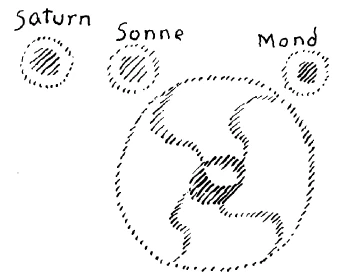
[ 12 ] Let us suppose that this drawing depicts the etheric body of the human being as it was when the Earth’s evolution began before the Lemurian epoch. Within this etheric body are the most diverse currents, the most diverse directions of force, which are the result of the ancient Saturn, Sun, and Moon evolutions. From these forces that are present there, from these currents, let us highlight one aspect. A certain sum of currents tended toward, directed their aims toward, bringing about within the human physical organism what we can call blood circulation with its centralization, with its center in the heart. Thus, these are forces that were acquired during the ancient Saturn, Sun, and Moon stages, but which were anchored in the etheric body prior to the Lemurian era; they condensed, as it were, in such a way that the blood system, with its center, the heart, could emerge as a physical entity. Thus, we have considered that organ system which, as a physical condensation, gradually emerged from a certain kind of forces in our etheric body, beginning in the ancient Lemurian era. Just as you can see that, when a solution of table salt in water is treated appropriately, the salt crystallizes out, taking on a crystalline form that stands out from the solution—so it is, in a higher sense, with what we call the blood system and the heart. It crystallizes out of forces of the human etheric body that have a tendency to condense into this physical organ system. Only in the course of Earth’s evolution were they able to develop into this physical heart.
[ 13 ] We will see later why this did not happen earlier in the course of the Moon’s evolution, but only in the course of Earth’s evolution. What, then, are the blood system and the heart system for us? They are the condensed etheric world, the condensed forces of the etheric world. For the development of the Earth, however, a kind of end, a kind of death, would have come for those forces that have condensed there into our heart and blood systems at the very moment they attained the density that our physical heart and physical blood—this entire system—exhibit today. This is the significant and mysterious aspect of Earth’s evolution: that not only did this condensation take place, that not only did the forces brought over from the ancient Saturn, the ancient Sun, and the ancient Moon condense into such an organ system—that is, not only did what was in the etheric body became the physical body, but that for each of our organ systems in Earth’s evolution an impulse arises through which that which was formerly ether and had condensed into the physical is dissolved again, transformed back into ether. Thus, one of the most important impulses in our Earth’s development is that the etheric forces, after having condensed into an organ system, are not left at this point of completion, but that other forces, other impulses, intervene, so to speak, to dissolve them once more. At the very moment when our human organs have attained their greatest density in the course of Earth’s development, certain forces of the macrocosm dissolve the substantialities of these organ systems once more, so that what had previously, as it were, slipped into the organ systems now emerges again and becomes visible once more.
[ 14 ] It is precisely in our heart and the blood flowing through it that we can most accurately observe, through occult means, how this dissolution takes place—that is, how earthly forces intervene in the substances of such an organ system. Something constantly flows out from our heart, perceptible to the clairvoyant eye. If you see the blood pulsating through the human body with clairvoyant vision, you will also see how this blood, as it were, becomes diluted again in the heart, how there the blood dissolves again into its finest parts—that is, not into its coarser parts, but into its finest physical parts—and returns to the etheric form. Just as the blood gradually formed in the ether, so too do we now have the reverse process taking place in the present human body. The blood becomes etheric, and streams of ether continually flow out from the heart, flowing toward the human head, so that we see the etheric body being re-formed through the circuit of the blood. So what crystallized out of the ether in the pre-Lemurian era to form the human blood system and the heart, we now see re-etherizing and flowing upward in the human etheric body toward the head. And if this part of the human etheric currents were not constantly flowing from the heart to the head, no matter how much we might try to think about the world and gain knowledge of it, we would be unable to think anything using the mere instrument of our brain. Our brain would be a completely useless organ for cognition if it were to function solely as a physical brain. One can form an idea from occultism of how the brain would function if it were left to its own devices today. Then a person would be able to think only of what relates to the inner needs of their body. They would be able to think, for example: I am hungry now, I am thirsty now, I want to satisfy this or that impulse now. - Human beings would be able to think only of what relates to their own physical needs; if they were to rely solely on their physical brain, they would be the most egotistical beings imaginable. But as it is, our brain is constantly permeated by those subtle, substantial etheric currents that flow upward from the heart. These etheric currents have a direct connection to a delicate, important organ of the brain, the so-called pineal gland. They constantly wash over and bathe the pineal gland. The pineal gland is enveloped by these subtle etheric currents, and its movements as a physical brain organ are in harmony with the etheric currents that I have described to you as emanating from the heart. Through this, however, these etheric movements are in turn connected to the physical brain, imprinting upon the physical brain—in addition to egoistic consciousness—that which enables us to perceive something of the external world, of that which we ourselves are not. Thus, via the detour through our pineal gland, our etherized blood system in turn acts back upon our brain. You will find a more precise elaboration of this fact in a certain direction when the lectures I gave in Prague as “Occult Physiology” are published; there I have discussed the function of the pineal gland from a different perspective.
[ 15 ] Thus we see that within the process of the Earth’s formation, we have not only a process leading to densification, but also, conversely, a process of rarefaction. When we consider this, we must say: Thus we carry within us forces that, in a sense, are regressing to the form they already had during the ancient Saturn, Sun, and Moon evolutions. The human being, as he carries it within himself today, knows nothing through his ordinary consciousness of this wondrous interplay of forces in his etheric body, which establishes a communication between his heart and his brain. Those who, in the course of occult development, become conscious of this, become aware of these etheric currents in a peculiar way. Here, self-knowledge reveals something most remarkable, something most significant. One learns to recognize how these forces flow upward from the heart to the brain, shaping this brain so that the human being can use it as an instrument of their soul life. But one immediately notices that these forces, one might say, have not passed through the human organism unscathed, that the human being does not release them as they entered his heart. Everything that the human being has developed in the meantime, developed from the unconscious in terms of base instincts, desires, and all that has entered into his nature—all of this is in turn carried into the etheric current that we form from the heart. Thus, in the old Lemurian era, we received it, as it were, in a certain sense as a pure etheric current that had no other greed, no other will, than to condense into the wondrous, wisdom-filled structure of our heart. Then we lived as physical human beings with this heart and circulatory system, undergoing various incarnations on Earth without knowing anything of this condensation of our old etheric body into the physical part of the heart and circulatory system. And we have been permeated by all that has passed through us in the form of desires, longings, sympathies and antipathies, emotions and passions, habits, and errors, and the etheric body, which is now emerging anew, which is now ascending to the brain, is clouded and permeated by all of this. We send this up from our heart, and we now become aware of it in true self-knowledge. We become aware that we cannot return to the gods in the same way that which we have received from the gods themselves in the depths of our bodily life, but rather return it defiled by our own being. We must now gradually approach what has just been described as a kind of impurity of our own being.
[ 16 ] If we want to understand this, we must bear the following in mind: When the Saturn evolution began—or rather, before it had even begun—the etheric current of all humanity and all earthly evolution, to which we have referred, was still a single entity; and in fact, at the very moment the Saturn evolution begins, a dichotomy, a duality, arises within the forces of the macrocosm. We will also point out later why this came about; for now, we will simply state the fact. It is only at the moment when the Saturn evolution begins that duality sets in within all macrocosmic activity. Greek mythology alludes to this duality by making the ancient Saturn, or Kronos, as the ancient Greeks called him, simultaneously the adversary of his father, Uranus; and this simultaneously indicates that it is aware that originally there was a unity of all macrocosmic forces. But when the ancient Saturn or Kronos begins to crystallize, something that is hidden within this Kronos immediately opposes universal development. A conflict arises, and if we wish to remain with what has been explained, we can say: The entire sum of the divine-spiritual beings who were active in the development at that time, when Saturn began its evolution, split within itself, so to speak, so that we now have a current of development that is directly involved in everything that occurs through Saturn, the Sun, and the Moon up to our Earth, and another current alongside this main current.
[ 17 ] If I were to use a rough comparison, you can imagine this secondary current by thinking of the relationship between the air—the atmosphere that surrounds the Earth—as a finer substance compared to the denser parts of the Earth, such as water and solid land. In this way, we could also imagine that a denser development extends over Saturn, the Sun, and the Moon, but that this denser development is always enveloped by a thinner development. We could, as it were, imagine that the ancient Saturn, the ancient Sun, and the ancient Moon have their divine-spiritual beings acting directly upon them within their own substance, but that there are always other divine-spiritual beings in the surrounding sphere who, in turn, surround the spiritual beings acting directly within Saturn, the Sun, and the Moon, just as the air surrounds the Earth. We have thus indicated two realms of gods or spirits, one of which participates directly in everything, entering into everything that successively occurs in Saturn, the Sun, and the Moon; the other generation of gods, the other series of gods, keeps itself somewhat at a distance, so to speak, intervening only from the outside, indirectly, and we must now form a conception of how one type of god relates to the other. And I ask you now to pay close attention to how the relationship stands between the actually more comprehensive gods, who participate directly in the development of Saturn, the Sun, and the Moon, and the other gods who, as it were, circle this globe in its succession.
[ 18 ] The best way to get an idea of what this is like is to first take a closer look at human beings themselves. Take the human soul; it thinks. What does that mean: it thinks? It means it produces thoughts. This is a process that takes place within us and which causes us, on the one hand, to be this real soul-being and, on the other hand, to have our thoughts continually rising up, as it were, continually enveloping this soul. Human beings, with their thinking, are still, even as soul beings, at a relatively lower level of the world’s organization. Those beings whom we have now designated as gods and distinguished into two streams stand at a far higher level. Just imagine if human beings were not only able to grasp their thoughts as mere thoughts, but if the human soul were so strong that whatever it thinks would immediately become a being, that we would give birth to our thoughts as beings, that when we conceived a thought, it would already truly exist. In a certain sense, it remains in the Akashic Records, but it does not solidify to the point where the human being has it before them as reality. Imagine that we would not merely think thoughts, but with every thought we would bring forth a being. Then we have grasped what takes place within the divine-spiritual world. The gods, living in the most beautiful harmony and unity, who existed before the ancient Saturn, conceived of themselves: they thought. — Only their thoughts were not like human thoughts, which one must call unreal, but they were beings, were other gods. Thus we have generations of gods who are originally real in their own right, and others who are simply the real representations of the gods directly associated with Saturn, the Sun, and the Moon. These are the deities who, as it were, hover around the developing world-sphere of Saturn, the Sun, and the Moon.
[ 19 ] So we have two kinds of generations of gods. One generation of gods is the imaginary world of the other; in fact, it relates to the other just as our thoughts relate to our real spiritual existence. What, then, have we called those gods up to now who are actually nothing more than the thoughts of others? These gods, who are merely the thoughts of the others, we have hitherto called the Luciferic entities because of certain characteristics, and we must include in this broader sense everything about the Luciferic entities of which we can say: The original gods had the need to imagine themselves in self-recognition. Therefore, they set the Luciferic entities before themselves as cosmic thoughts or thought-beings, just as human thoughts stand before human beings today. And just as human beings essentially come to know themselves only through their thoughts, so the original gods came to know themselves through Lucifer and his hosts. We could express this somewhat differently. We could say that these beings, who were actually only the images of the others, have always lagged behind in relation to the other development. The advancing gods have, as it were, left something of themselves behind, so that they could look back upon it and, just as in real life one can only recognize oneself in a mirror, see themselves in this mirror cast out of their own substance. Thus, the Luciferic beings are indeed beings that have been left behind, beings cast out from the original gods, who were there to provide a mirror of self-knowledge for the advancing divine figures.
[ 20 ] In a certain sense, what takes place within our soul—within ourselves—on a microcosmic level is indeed a reflection of this macrocosm. However, what is present within us is the reverse of what is, in a certain way, pre-formed in the macrocosm. We carry within our microcosm a reflection of this divine dichotomy, these generations of gods, one of which is primordial and the other a series of beings born from this primordial one, existing so that these other beings may come into being. You can infer from this that there must be a great difference between these two currents of the generations of gods; it also becomes quite clear to us. It reveals itself to us in that our entire comprehensive self, with all that is unconscious within us—from which our physical organism has also emerged—originates from the primordial generation of gods. However, what we experience with our consciousness, that which we can survey with our ordinary everyday consciousness, originates from the generation of gods that is merely the image of the primordial one. Our being enters us from two sides. Our entire organization, with all that is subconscious, comes from the original generation of gods. That of which we are conscious comes from the other side, from the generation of gods that merely orbited the ancient Saturn, the Sun, and the Moon. Therefore, when we delve into our imaginative life, we sense that, so to speak, in a higher sense, the imagination is merely the youngest daughter of a generation of gods; hence we perceive the unreal, the mere fleeting thought-like aspect of our conscious life. This was something that also dawned on the students of the Greek mysteries, as it was made clear to them: there are divine currents living within the whole of becoming that are all-encompassing, that flow into us unconsciously in their entire being, and there are those that only ordinary, normal consciousness can perceive. — Then it became clear to this Greek initiate that he had to turn away from this normal consciousness and turn to the ancient gods, who were also called the underworld gods, to those gods in whose nature Dionysus had his share. Only in this way could he come to the knowledge of the true nature of the human being.
[ 21 ] There is only one thing in the course of Earth's evolution through which something entirely new—a new element of clairvoyance, but also a new element of a mind and activity imbued with occult forces—can enter into us.
[ 22 ] It is indeed the case that, up to a certain point in human history, only what I have just described could flow into human life from the stream of gods hovering above the ancient Saturn, Sun, and Moon phases of development. This flowed into human consciousness from the outside, without the human being, so to speak, descending into their inner self, into the realm of the lower gods. Only that which could never have come into actual world reality could flow in. One could not reach true world reality through external cognition, for this would have required something to be mingled into what came from outside into our ordinary consciousness during the long period of the Saturn, Sun, and Moon eras—something that is not merely the imaginative life of the subterranean gods, but a reality. Something that works as if suddenly what is otherwise only our life of thought—which always stands before us as if it were sweated out of the soul as our unreal life of thought—were for a moment so gripped by a substantial reality that a particularly favored thought could stand still, be there beside us like our soul itself—as a reality. Something like this would have to occur if the gods hovering in the surrounding sphere were to act as the currents of the gods have acted throughout the ages, working through the wider self right into our physical organization. Something would have to flow toward us from outside, signifying, as it were, a renewal, a resurrection, a revival from the spiritual world of that which organized us and which then sank down into the depths of our consciousness.
[ 23 ] What was drawn into this outer generation of gods in a single moment was, in fact, the Christ who entered the body of Jesus of Nazareth at the baptism by John in the Jordan. With this Christ, a divine being enters physical life in the same way that those gods had to enter earthly life—gods who were previously merely beings conceived by the other gods. But now, for the first time, a real being enters, a being who is not merely a concept of the other gods in the same sense, but is independent, substantially independent. From the realm of the cosmos, where previously only the concepts of other gods had lived, comes such a divine thought that is real. How could this happen? This was made possible by the fact that this significant event—the baptism of John in the Jordan—had a long period of preparation within the entire process of our human evolution through Saturn, the Sun, and the Moon. What took place there at the Jordan and later through the Mystery of Golgotha is the echo of another important event that, however, occurred in a very, very distant past, which we must trace back to the ancient solar evolution.
[ 24 ] Thus, in the course of evolution as it has unfolded so far, we have the Saturn, Sun, Moon, and Earth stages. In the Earth evolution, we experience the Mystery of Golgotha and the baptism of John in the Jordan. During the ancient Sun evolution, another significant event can be gleaned from the Akashic Records, which can be characterized as follows. At that time, a process had progressed to the point where one could say: The higher gods are the conceptions of the lower gods; they are dependent on them. — And these higher gods find it, if I may put it in trivial terms, more appropriate to their own nature to live in the light elements of the higher worlds than in the denser elements from which the Earth was formed. This separation between two different generations of gods takes place during the development of the Sun, one of which sets out to continue living as the true ancient gods with the elements of earth, water, and air. The other generation of gods finds it too difficult to immerse themselves in these dense elements and simply continues to live with what we call the ethereal elements—first with warmth, then with the light ether, the chemical ether, and the life ether. We can also describe these two parallel currents of gods in such a way that one chooses the more difficult path of passing through the denser elements, while the other chooses the easier path, so to speak, fluttering around the other gods in the chemical and life-ether and forming their bodies from it. Accordingly, everything that lives in these finer etheric elements—and this occurs primarily during the early stages of the Sun’s development—develops forces that, in the long run, can only exist within these thinner elements.
[ 25 ] But roughly halfway through the ancient solar evolution, something great and powerful occurs: a being develops powers during this solar evolution that are in conflict with the finer, more ethereal elements. In contrast to what we call the Mystery of Golgotha, the great Earth sacrifice, we can speak of a solar sacrifice, which consisted in a being choosing to dwell among the gods who wished to live only in the finer elements, yet developing denser forces that were suited to the Earth elements. And so, since the Sun’s evolution in the series of beings who are actually armed with powers intended only for the ethereal, we have a being who has an intimate kinship within the world-ether with the earthly. Since the ancient Sun’s evolution, this being has been waiting for the right moment to channel the powers it had developed into the Earth itself. And it was Zarathustra’s great merit that he recognized: In what is out there as the Sun, something of the old Sun has remained. This being contains it for the time being. But the moment is approaching when this being will also bring down to Earth the form appropriate to the elements.
[ 26 ] Then came the moment when humanity was not yet ready to recognize this being, which had been placed in the etheric world, but when it first recognized its reflection. This was a preparation. And so, for reasons we will explain tomorrow, this being did not initially reveal itself to humanity in the course of evolution, but rather in a mirror image, which we can characterize by saying: this image relates to reality as moonlight—which is reflected sunlight—relates to direct sunlight itself. — That Being who had first prepared himself during the ancient Sun Age for his great deed on Golgotha was initially shown to humanity in his mirror image, and this mirror image was called Yahweh or Jehovah by the ancient Hebrew people. And Yahweh or Jehovah is the reflected Christ; is, in essence, the same as Christ, only as a reflection, foreshadowed, as it were, prophetically. Foreshadowed until the time came when the being could reveal itself in its own form, in its archetype, and not merely in its reflection.
[ 27 ] Thus we see the most important event for the Earth prefigured in the ancient Sun; we see humanity prepared for Christ through Hebrew antiquity. We see the being who once separated himself from the Earth, who went to the Sun, coming down again, but we also see how he is first shown to humanity in a mirror image, as it were, in a representation. Just as the higher gods relate to the lower ones, so Yahweh or Jehovah is the representation of the real Christ and, to those who see through things, is completely like him. Therefore, in a certain sense, we can speak of Jehovah-Christ and thereby also capture the true meaning of the Gospels, which tell us that Christ himself spoke of this: “If you wish to know me, then you must also know how Moses and the prophets spoke of me.”
[ 28 ] Christ knew full well that when people spoke of Yahweh or Jehovah in ancient times, they were speaking of him, and that everything said about Yahweh relates to him just as a reflection relates to its original image.