

Occult Reading and Occult Hearing
GA 156
4 October 1914, Dornach
Translated by Steiner Online Library
Second Lecture
[ 1 ] Let us once again clearly bring to mind what I said yesterday regarding the true situation of the human being in relation to the world. I said that it is actually a maya, an illusion, to assume that we, as soul-spiritual human beings, are inside our own skin, and that things are simply around us, and that we take in, as it were, the images of these things into ourselves. In truth, we live as soul-spiritual human beings within things, and we would not be able to perceive this living-within-things if we did not receive our experiences of things reflected from within our organism. And just as we live within the ordinary physical world, so are things reflected to us by our physical organism, by its entire sensory system, by its system of thought, and by its system of feeling and will.
[ 2 ] So this is actually the truth: that our organism is a mirroring apparatus, that what we experience is not generated within us by our physical organism—which is a mistaken mental image of materialism—but rather that it is reflected. Just as a mirror does not produce what one sees in it, so too does our organism not produce what we experience psychologically about things and in things. The materialist who claims that the brain or some other organ produces our spiritual experiences is, with regard to these higher things, asserting something quite similar to someone who might claim that the face they see of themselves in the mirror does not belong to them, but is produced by the mirror.
[ 3 ] So what the truth of the matter is, one must, so to speak, experience in the very moment one ascends to occult reading in the manner described yesterday. Let us recall once more what it is like when we come to occult reading. After preparing ourselves in the manner described yesterday, we experience the more fleeting—fleeting only in relation to the physical being, of course—fluctuating entities and events of the spiritual world. But we see them by experiencing them in our astral body, reflected from our etheric body, and we experience these reflections as images. I said yesterday that, in general, we can regard these images we experience in this way only as signs of spiritual reality. And I tried to make clear through a comparison what a mistake it would be for someone to regard what they experience so directly as dream images—only immensely more vivid than ordinary dream images—as reality. It would be just as if someone were to take the word “BUILDING,” written on the blackboard, not as a sign of the building, but as the reality itself. We must form the mental image that at the moment when we have reached the point of receiving, reflected from the outside through our etheric body, the fluctuating, easily fleeting images of the spiritual world as they relate to the physical, we stand, as it were, before an open book—a book that has been opened for us, but which we must first learn to read, to read correctly.
[ 4 ] That is generally true. But even more so than this applies to experiences on the physical plane, it applies to experiences in the higher worlds: everything that is true has its exceptions. And specifically, what I have just said is subject to exceptions. One must know this, otherwise one cannot find one’s way in the spiritual world: it applies in general, but it is subject to exceptions. To what extent it is subject to exceptions, I would like to discuss in a somewhat more concrete manner.
[ 5 ] I want to start with a very specific case. Let us assume that someone who has developed clairvoyant powers to a certain degree, as we understand them, endeavors—well, let’s say—since this is obvious to many people—to visit a deceased person in the spiritual world, that is, a person who has passed through the gate of death a short or long time ago and who lives in the spiritual world, in that life we have described as the life between death and new birth. Now, such a visit depends—as you can already see from yesterday’s lecture—on one being, so to speak, granted the grace from the spiritual world to actually see and behold the person in question. As a rule, mere curiosity is by no means satisfied in such endeavors. So anyone who approaches the matter from the outset with the sole intention of satisfying their curiosity by seeking out a deceased person in the spiritual world would either see nothing at all or be exposed to the most manifold errors. But let us assume that this is not the case, but rather that there is also a reason recognized by the beings of the spiritual world as justified for encountering this deceased person. Let us assume that everything is in order—to use the trivial phrase—and that one is, so to speak, permitted to encounter the deceased. Now—again, speaking in very general terms—this cannot simply come about by the clairvoyant in question entering the spiritual world through some form of meditation and then directing his desires, his wishes, or his thoughts toward the deceased in order, so to speak, to be graced with a vision of him. If one were to attempt this, or if one were to assume that such a result could occur, one would be mistaken. As a rule, something quite different will happen instead.
[ 6 ] You must realize, my dear friends, that one can only ever describe specific cases; one cannot rely on general, abstract theories when discussing a subject from the occult world, as I am doing at this very moment. I can only give an example.
[ 7 ] Let us suppose, then, that a seer had a valid reason to make contact with a particular deceased person, and that through meditation and concentration of his thoughts, he made efforts to make contact specifically with that person. Describing the nature of these efforts would go too far today, but let us assume that these efforts are correct. Then, once the state of the soul has truly been attained through meditation and concentration—a state in which the seer can perceive the deceased in question—the seer may at first see something that he—if he has no prior experience in this field—might very easily be inclined not to regard as the apparition of the deceased or as something connected with the deceased. He may see a world of images unfolding before him, a vivid world of images that is far more vivid than the images of ordinary dreams.
[ 8 ] I must emphasize this again and again, because it is usually misrepresented in the world. Ordinary dream images are chimeras, whereas these images are signs of the higher, spiritual world. One must first learn to understand the world of signs. One experiences moving images within oneself, all sorts of events connected with this or that personality. One experiences this; but at first one can hardly find any resemblance between what one has strived for and the images one experiences there. But one thing becomes apparent when this is truly the case, when it is not merely a wrong path one has taken: within this world of moving images, one will experience something that appears, I would say, to be the most important point in it. Regarding the other images, one will say to oneself: These images contain something that is familiar to you, that reminds you of all sorts of things that might also emerge from your memory; and although you could never have had precisely these events among your memories, they might nevertheless, because they draw on what you have experienced, be memories of such experiences interwoven with figments of the imagination.
[ 9 ] It is precisely here that the true clairvoyant must be vigilant. He must bear in mind that he is dealing with a world of images that could be composed of his own memories. But there is a certain point within it that contains no such memory. One must distinguish precisely between what might be composed of our imagination and what is the one element around which, as it were, everything else is grouped. Of that one must say: That would never have come from your memory; nor could it ever enter your field of vision from the world of dreams. — Of course, one must also have a certain amount of practice to distinguish dream images from reality and to see this difference clearly. But one then comes to say: There is something in there around which everything else is grouped. As a rule—I am trying to speak precisely—it is the case that this one thing that is in there can, in a certain sense, even appear paradoxical, absurd. It is the case that something strange appears in such a series of images—which might otherwise be so beautiful, so magnificent, so powerful—that something very peculiar appears within it. Now it will very often happen to the seer that such a thing ebbs away again, passes away again, that he actually can’t really make much of it. Then, of course, they must try again and again, and as a rule, if they have a certain practice of clairvoyance, they will succeed again. They will see such a series of images again and again, perhaps a new series of images of a completely different kind. But again, something will appear in the middle that is the same as what was previously seen as the center of a series of images. One must, however, have already reached a certain point in the art of seeing if one is to succeed, whether the first time or the next, in achieving the right result with these series of images. One must have reached the point where, while still holding the series of images, one becomes completely composed and self-assured, truly living within it with one’s self-awareness, so that the image does not slip away like a dream image. One must face it as one faces an object in the external world: one must be in control of oneself, one must know, “It is I who perceive this, and there is the image.” — One must be able to distinguish oneself from the image; one must not be carried away by the image.
[ 10 ] To achieve this, one would do well to first try—when the image is presented as it is—to arbitrarily change something within the image. Let’s assume, for example, that the image is there, that you have come to realize that you are distinct from the image, that you are present, and that there is a certain character in the world of images who looks at you with a sullen, unfriendly expression. Now try to grasp the feeling: What if I were quite kind to this figure, so that they might look at me more kindly, after having looked at me sullenly until now? — If you succeed in consciously changing something in the world of images, then it becomes easier to maintain your position in relation to that world.
[ 11 ] The next step, however, must be that one—yes, it is difficult to find the right expression here, for the things of the spiritual world are, after all, different from those of the physical world—that one must now actually identify with the image, with all the images one has there. One must immerse oneself in them, must become one with them. For by becoming one with them, one accomplishes, as we shall see in a moment, an important truth. I would like to say, if I may use the trivial expression: One must spiritually “eat” this entire series of images, swallow them, take them into oneself, identify with them, immerse oneself in the series of images. That is to say, one must now realize: I have now distinguished myself from this series of images; I have held my position outside of it, and now I deliberately immerse myself in this series of images, just as if I were jumping into water to swim in it.
[ 12 ] And now comes the most important part, because you are now experiencing within your own soul everything that is expressed in this series of images. For example, if one person attacks or hurts another, you now experience yourself both as the one doing the hurting and as the soul being hurt or attacked. I am everything in these images; I am completely within them. If you had an image before you depicting someone being beheaded, you would experience yourself simultaneously as the one being beheaded and as the one doing the beheading. In this way, you experience yourself as truly present within this entire fluctuating world of images. You yourself are every image and every movement within it.
[ 13 ] Then the image as such, as an imagination, becomes invisible; but the inner experiences become all the more meaningful. One now ceases to see the image, to look at it, but one is immersed in a rich experience within it. If one truly succeeds in being inside the images, then, I would say, the second act of the whole process begins. But this need not follow immediately.
[ 14 ] It may well be that, from this point on, a great deal of discouragement can take hold of the seer. It is quite possible that one reaches the moment when the decision is made to immerse oneself in the image, to swim within it, and—now it is gone like a dream, or like something one has forgotten. That can certainly happen. Only in the rarest of cases will it happen that one immediately afterward has the experience of which I now wish to speak. Most often, the image seems to have vanished entirely, like a dream that has faded away.
[ 15 ] Now, as a true clairvoyant, one must realize that it need not be true that the image has faded away. What rarely occurs immediately after the image fades may happen much later; it may emerge from the experiences of the day or night. For it is very often the case that what one has—forgive me for using the expression again—so to speak “consumed,” with which one has united, must first be digested by the soul. It can take some time. But when one has united sufficiently, when it has been sufficiently “digested,” then it happens that one knows: Now you are in relationship with the personality, with the individuality of the deceased, and they send thoughts into you that they themselves have. Now you think what the deceased is experiencing in their soul. You are in connection with them. They are now speaking to you, and you hear them.
[ 16 ] In truth, it is the image with which one unites, or the series of images one has absorbed and carries within oneself—which has now become one with oneself—that actually hears the truth and takes in the truth. And as a rule, this hearing—as spiritual hearing—is no longer connected to images, but is sustained by the awareness that the seer’s soul is connected to the deceased in question and allows itself to be told by him what is no longer heard with the ear, no longer perceived with the physical gaze, but is received directly through thought. One knows: This is not your thought; this is what the deceased speaks to you.
[ 17 ] As you can see, therefore, a certain amount of preparation is required to come into the presence of a deceased individual—a preparation that can be described, as I have just done. Once one has reached the point of hearing the dead after identifying with the image, then any deception is ruled out. For a deception could only occur in the same way as a deception on the physical plane, when I encounter a person and mistake them for another. I will generally not do that. One recognizes a person on the physical plane through oneself. I do not need to prove to myself, based on theoretical principles, that when I encounter Mr. Löw in the physical world, for example, that this is Mr. Löw. The being one encounters reveals this itself. In the spiritual world, too, one knows that one is facing a being, even though, of course, in the spiritual world it speaks to one in a spiritual manner and communicates in a spiritual way.
[ 18 ] What I have just described to you is the transition from a highly ambiguous sign—which one reads not by interpreting it with the intellect, but by taking it in, becoming one with it, and, as it were, consuming it—to spiritual hearing. Through the living process brought about by uniting with the image within one’s own soul, one prepares oneself to truly hear the objective essence spiritually.
[ 19 ] Reading is a living process—a truly living process. One really has to pour one’s soul into it. It demands something entirely different from us than what is required on the physical plane. This can at most be compared to a situation on the physical plane where someone gives us a book and demands that we devour it, that we eat it, in order to read and understand it. If we were organized in such a way that we could digest an “A” differently than an “I”—by having different internal processes when digesting the letters “A” and “I”—this would be comparable to the spiritual processes described. We cannot approach a spiritual process or a spiritual being until we have poured our whole soul into understanding the being or process in question. We must ourselves have become one with the signs or letters of the spiritual world. We must read them, and then, as we read them, hear them spiritually.
[ 20 ] I said that this is generally true. When one is working in the field of Spiritual Science, one must be very precise in one’s speech. Generally speaking; for there are also exceptions. For example, it is entirely possible that a seer, when in a state of spiritual vision, may not only experience a series of images, as I have just described, but may actually experience something as an image, as an imagination, that resembles the deceased person in question—just as they appeared in life as an external form. Then the seer can, of course, know that they are facing this deceased person. But he can never actually know for certain. It may be correct, but it need not be entirely correct. To explain this, I would like to use a comparison. You see, our ordinary writing—whether block letters or cursive—consists of symbols. And indeed, when I write down the word “building,” this word bears no resemblance to our building out there. But this was not always the case in the course of the development of writing. If we go back to earlier times, we find pictographic writing. Back then, people made pictures that still resembled what the pictures were supposed to represent; and it was only from pictographic writing that symbolic or alphabetic writing developed.
[ 21 ] The same is true of the relationship between the clairvoyance we strive for through our Rosicrucian method and the atavistic, more or less primitive clairvoyance that can occur in some people due to certain preconditions. Just as our symbolic and alphabetic writing is something developed, and pictographic writing is something more primitive, so too is clairvoyance in our sense something developed, and the vision that expresses what is seen directly in dream images is something more primitive. It is precisely the developed form of clairvoyance that will often be unable to perceive directly in the image what is to be perceived. In such cases, it will generally be as I have described. But there are certainly exceptions where a person without special development becomes clairvoyant purely on the basis of their organism’s predispositions. In such cases, this natural clairvoyant may perceive far more images resembling spiritual processes than the developed clairvoyant, who must first undergo all the procedures I have described. But he can never, through primitive clairvoyance, come to know anything with certainty; and even what can be known with certainty in this way consists only of events that relate to earthly life.
[ 22 ] Let us say, for example, that someone has died and, before his death, left a will without being able to tell anyone where it was located. He dies. Some primitive clairvoyant individual, possessing the necessary prerequisites, comes along, and it could even happen that such an untrained clairvoyant, in a sort of trance-like state of imagination, becomes connected with the deceased in question. And they can then perceive the deceased’s thoughts, which are directed toward the place where the deceased has placed the will. The person in question may perceive the image of the location—the cabinet, for example—where the will is kept. This can happen. But these cases are always connected to the outer physical plane. It concerns something that has taken place on the physical plane. There may also be more complicated matters; but they are still always somehow connected to the physical plane, to the earthly realm. One will not get much further in this realm of primitive clairvoyance. To go further and to truly communicate clearly and confidently with the spiritual world, the preparations I have spoken of are precisely what are needed. Now I must tell you more specifically about this, so that we can then go into the details of spiritual reading and hearing in the next lectures. I said that what lies behind the maya of outer experience, what is contained within things, becomes a truth the moment we enter the spiritual world. It becomes a truth as I have described it to you in the specific, concrete case. It is not enough that we perceive some image through clairvoyance and now have the image before us just as we can see beings of the physical world. That is not enough. We must come to the point of immersing ourselves in the images, of truly plunging into them. We must consciously do what we also do in ordinary life, only that we do not do it consciously there. We must truly enter into the image. So when I first perceive this series of images, at the center of which is what I have described, I must step out of myself; I must enter into this series of images; I must consume them, devour them; I must be within them.
[ 23 ] Now, what I have described may occur as a spiritual experience, but one does not yet truly understand this spiritual experience. To understand it, the following is necessary. One must be able to practice something like spiritual self-observation during the process of immersion. As one immerses oneself in such a series of images, certain things take place within one that one feels, as it were, within oneself. Consider for a moment what it is like when one has first established one’s position in relation to the imaginative images, and then proceeds to immerse oneself in this series of images. The feeling is quite different when one stands before them consciously than when one has immersed oneself in the images.
[ 24 ] I will try to describe to you how these two feelings differ. The fact is that the moment you have submerged yourself, you know: Now you have made this series of images disappear by identifying with them. At that moment, a feeling of inadequacy toward yourself takes hold of you. You become aware—things are hard to describe—that you are now, in fact, only a fragment of what you were when you stood at your former vantage point. You are only a fragment of it.
[ 25 ] Of course, one must make this observation many times in order to truly grasp the matter and acquire the ability to interpret it correctly. It feels as though—and such things are best characterized by comparisons—a twelve-kilogram weight, without anything else having happened to it, had suddenly become a one-kilogram weight. One feels as if one were only one-twelfth of oneself, and the other eleven-twelfths were out there in the world. — One can draw a symbolic picture of what has happened to you. You feel yourself to be somewhere out in the world, but you do not feel yourself to be there with your whole being; rather, you feel: Out there in the world are eleven-twelfths of your being; you are divided. — Symbolically, one can express this by saying: You are at one point on the circumference, and the other eleven twelfths are distributed across the rest of the circle. There (see drawing, a 1) is yourself, and there (see drawings 2, 3, 4, and so on) are the other eleven twelfths.
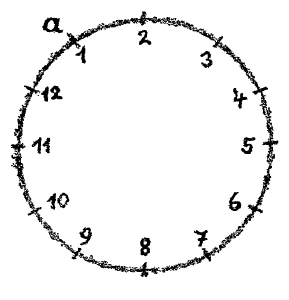
[ 26 ] Now it is all the more true that one is out there in the world: one has become one-twelfth of oneself, and one has, as it were, left the other eleven-twelfths behind in a circle. One can describe this using an occult term: one has transformed oneself into the zodiac; one has become the zodiac itself. — And now what one hears comes to one from within this zodiac. So—to stick with the earlier example—when the dead speak to one, they speak from within the zodiac.
[ 27 ] Consider the difference here compared to perception in the physical world. In the physical world, we are enclosed within our own skin, and things are outside of us; they seem to enter us as we look at them. In spiritual perception, we stand outside, at a point one-twelfth of the way along the horizon, and look inward from there. Now we have the world we are looking at within the zodiac. We look in from the outside. In ordinary life, we look out from the inside. And that which now meets us there inside as a spiritual voice, through which the dead speak to us, we perceive by accustoming ourselves to listening in various ways, to paying attention in various ways.
[ 28 ] We will discuss this in more detail later. For now, I would like to hint at it through the Symbolum. For example, we may feel that we can best perceive what the deceased is saying if, within the circle, we direct our spiritual ear in this direction, toward the spiritual Five (see drawing: line between point 1 and point 5).
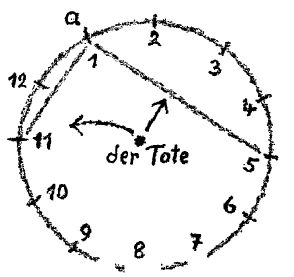
[ 29 ] Now he stops speaking there, but one can still hear him if one turns one’s spiritual ear toward another point (point 11). One gradually learns to recognize that within the circle there are seven voices to distinguish, which vary in such a way that one perceives them in the most diverse ways, depending on whether they are heard coming from one point or another. Everything one perceives speaks as if from seven voices within this circle. One can also put it this way: One has entered the circle of the world. That which one is to perceive lies within this circle. One must learn to feel oneself as a part of the circle and must, I would say, in cosmic humility, make no claim to being anything other than one-twelfth of the circle. But one must call upon the other eleven twelfths for help; one must presuppose them outside oneself. One must try to acquire the ability to discern what is speaking to one there. One must discern how, in the most varied ways, everything varies that a cosmic being can speak to one.
[ 30 ] Now, once again, we can use a comparison to understand what this is all about: What speaks to us within this circle can truly be called spiritual vowels. And everything that one is oneself within the circle, and everything that lies within the circle, are spiritual consonants. Consonants and vowels work together; consonants by standing still, by our having poured out our own being into the universe; and vowels by moving within and thereby bringing forth what is to be said.
[ 31 ] Now I would like to return once more to our example. I seek out a dead person, seeking to come together with them. I bring it to the point where a series of images appears to me, and in the midst of this series of images, something that seems paradoxical to me, something that seems absurd. I am clear about this: it is something I could not have drawn from the sources of my inner soul being on my own. I manage to submerge myself, to become one with the series of images. At this very moment, as I submerge myself in them, I stand at this specific single point (see drawing, point a), and all around it, eleven-twelfths of my being have detached themselves.
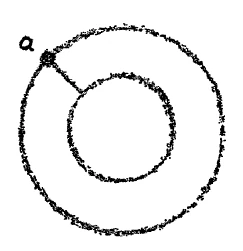
[ 32 ] That is why I said—you must remember that one must be precise when speaking of occult matters—: The series of images is listening to you. One has nothing within oneself but the “experienced” series of images; it stands there in that one-twelfth (see drawing). The other part, which cannot become one with this series of images, spreads out in the surrounding space. And there, sooner or later, one may succeed in truly receiving the spiritual voice, the message from the dead. There one hears the dead speaking from the surrounding space that one has formed around the very thing with which one wishes to enter into a relationship.
[ 33 ] So what has one actually done? One has stepped outside oneself, has become one with the world, but only with a part of the world. One has grasped with one’s whole being that which one wishes to perceive. One has, as it were, formed a spiritual aura around the dead person. But one cannot form it completely; one can only stand at a single point and must form the aura out of that which one is not.
[ 34 ] One might say: I perceive a series of images. At first I stand outside this series of images, but then I immerse myself in it. In this way, I form a world-sphere around what I wish to perceive, using what I have given up and sacrificed. This sphere of the world contains within itself—like seven planets—the vowelism through which the corresponding being can speak to us when we ourselves form the consonantism through the twelfthness of our being.
[ 35 ] One can only enter into a relationship with a being of the spiritual world by enveloping it—enveloping it in such a way that this envelopment forms the cosmic consonants, and that the being itself can reveal itself to us through the cosmic vowel sounds. And when the cosmic vowel sounds can interact with the cosmic consonant sounds that we have formed within ourselves, then reading and hearing work together, and we enter a specific realm of the spiritual world.
[ 36 ] I would ask you not to let what I have just said lead you into the error of thinking that what I have described has anything to do with the physical zodiac or the seven physical planets. That is not the case; that is not what is meant. Rather, it is the case that each time, one forms, as it were, a world sphere within the Twelvefold around the being in question that one wishes to perceive. One forms a world of its own everywhere.
[ 37 ] It is certainly true that if one wishes to fully understand something on the physical plane, one must view it from a wide variety of angles and perspectives; one must walk around it. In the spiritual world, we must realize that one does not have to walk around with one’s entire being, but rather one must divide one’s entire being in such a way as to create a circle around that which one wishes to perceive. Every time a true spiritual perception takes place, one has created such a spiritual sphere. And it is only because the divine beings we have come to know in the higher hierarchies have done this on a grand scale that what has come to pass—the result of which we see before us in the zodiac—has occurred.
[ 38 ] Imagine for a moment that what I have described were to occur—that communication with a dead person were to take place—and imagine that such communication could, at a certain moment—let’s say—be properly captured and solidified; this solidification would represent a human being, naturally a spiritual human being, divided into twelve parts, twelve fixed stars. If what has been perceived were to be frozen and fixed, it would represent a planetary system. Because the gods have done this as part of a special, grand plan, our solar system has come into being. While in the individual act of clairvoyance we create something transient, which naturally passes again once the act of clairvoyance is over, our entire universe is the fixed clairvoyance of the gods, of the higher hierarchies.
[ 39 ] That is why we can only understand this world if we understand its spiritual foundations. The physical realm is not real at all; it is just as unreal as was described yesterday in the analogy of the flowing waters of the Rhine. Only the spiritual is real. Thus, in the entire solar system, too, only the spiritual is real. One must also come to know the solar system in reality by deciphering, through spiritual reading and hearing, what lies behind it. In many respects, we have already done so. We will speak tomorrow and the day after about what else there is to say on this subject.