

The Connection Between Man
and the Elemental World
GA 158
22 November 1914, Dornach
Translated by Steiner Online Library
The World as the Result of Equilibrium Effects III
[ 1 ] As you may have gathered from yesterday’s discussion, even the form of our physical body is what it is because it is, as it were, the result of the interaction between the Luciferic and Ahrimanic forces.
[ 2 ] It is particularly important in our time to truly understand this interplay between the Luciferic and Ahrimanic forces, for only through this understanding can humanity gradually come to grasp the forces at work behind the outward phantasmagoria of existence. We know that we need neither to hate Ahriman nor to fear Lucifer, because these forces are, so to speak, hostile forces in the world only as long as they do not act within their own spheres. Much was said about this last year in Munich. Hints of this have also already been made here.
[ 3 ] Since we saw yesterday how the physical, spatial human body takes shape through the interplay of the Luciferic and Ahrimanic forces, we have pointed to the most external aspect of human life in which Lucifer and Ahriman play their roles. You know that we move somewhat deeper into the inner life of the human being when we proceed from the physical body to the etheric body. The etheric body is, so to speak, the formative principle of the physical body. It is embedded in the entire etheric world; it underlies our physical organism as a mobile, ever-moving etheric organism. Now, with regard to the etheric body, it must be said that just as we have seen with the physical body, Luciferic and Ahrimanic forces are at work within it as well, and that the human being, as an etheric being, is also placed—and this we must emphasize—within the interplay of the Luciferic and Ahrimanic forces. |
[ 4 ] To highlight what is truly important here, let us take a look at the three fundamental activities of the human being—namely, willing, feeling, and thinking—since human beings are not merely physical beings. Of course, we do not see this willing, feeling, and thinking when we look at a person in relation to their physical body. Only insofar as the physical body finds expression in a certain physiognomy, in gestures, and the like, can we glimpse through the physical body what lies within the human being. The etheric body, however, as an organism that is in motion within itself, is a constant expression of the human being’s thinking, feeling, and willing.
[ 5 ] When it comes to this thinking, feeling, and willing, purely empirical science once again faces some difficulties; and if one examines the various philosophical worldviews, one will see that sometimes one philosopher prioritizes willing, and at other times another prioritizes thinking. There are also those who regard feeling as the primary force. But these philosophical worldviews cannot form a proper conception of how this thinking, feeling, and willing actually form a unity within the human being. This inability to form a proper conception of the relationship between thinking, feeling, and willing in the life of the human soul is just as if a person were to find it difficult to come to terms with the concept of the human being in general. “I’m not quite sure,” say the philosophers, “is the human soul more of a volitional nature, more of an emotional nature, or more of a thinking nature? Is it more one or the other?”—This is just as if someone were to say: “Now I really don’t quite know anymore what a human being is.” Then someone just told me he wanted to bring me a human being, and he brought me a little creature, a five-year-old child, and said: This is a human being. — Then another person came and also said he wanted to show me a human being, and he brought me a creature much larger than the first, that is, a person in middle age. Finally, a third person came and also told me he wanted to show me a human being. He showed me a completely different being, one with a wrinkled face, gray hair, and so on. And now I really don’t know anymore what a human being is. Three different beings have been shown to me! — Yes, all three, aren’t they, are human beings. Only one is very young, the other is somewhat older, and the third has already grown quite old. They are very different in appearance. But as soon as you consider the three ages together, you know what a human being is.
[ 6 ] But the same is true of willing, feeling, and thinking. The only difference is that willing is essentially the same soul activity as thinking, only still very young, childlike. And as willing matures, it becomes feeling, and the fully matured willing is thinking. It is merely a difference in the stage of development of willing, feeling, and thinking; the fact that these stages coexist within our soul—the different stages of life for these soul activities—is what makes the matter difficult. But we have already discussed—you need only look it up in my book *The Threshold of the Spiritual World*—that as soon as we step out of the physical world, the law of transformation applies, not that of rigidity. There everything is transformed. The old suddenly becomes young, the young becomes old, and so on. So that the three soul activities can truly occur simultaneously within us: the will, which sometimes manifests as a young will, sometimes as an older will—that is, as feeling—and also as the oldest will, as a very old will, that is, as thinking. There the ages of life become intermingled; everything then becomes fluid. Such is the case in the human etheric body.
[ 7 ] But this transformation cannot simply come about on its own. What would constitute a unified activity of the soul does not come to our consciousness at all in ordinary life; we cannot bring it into our consciousness at all. If we—since the whole process must be observed in the etheric body, and the etheric body is something mobile and fluid—symbolically depict the etheric body as a continuous stream, then this stream of soul activity does not come to our consciousness at all in ordinary life; rather, into this stream, into this ceaseless movement of the etheric body that flows on with time, there is interwoven first Luciferic and then Ahrimanic activity.
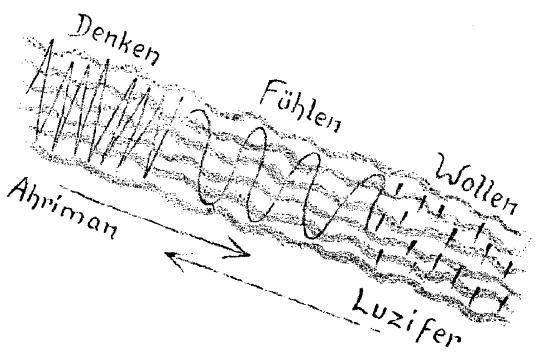
[ 8 ] Luciferic activity rejuvenates the will. Our soul activity, permeated by the Luciferic, is the will. When the Luciferic predominates in our soul activity, when only Lucifer exerts his powers in our soul, that is the will. Lucifer has a rejuvenating effect on the entire flow of our soul activity. When, on the other hand, Ahriman primarily exerts his influence in our soul activity, he hardens our soul activity; it grows old, and this is thinking. This thinking, this having of thoughts, is not at all possible in ordinary life unless Ahriman unfolds his forces in the etheric body. In the life of the soul, insofar as it manifests in the etheric body, one cannot do without Ahriman and Lucifer. If Lucifer were to withdraw completely from our etheric body, then we would have no Luciferic fire for willing. If Ahriman were to withdraw completely from our soul life, then we would never be able to develop the coolness of thinking. In the middle of the two lies a region where they struggle with one another. Here they interpenetrate, Lucifer and Ahriman; here their activities interplay. This is the region of feeling. In fact, the human etheric body appears in such a way that one can perceive within it the Luciferic light and the Ahrimanic hardness. When one surveys the human etheric body, it is of course not arranged as shown here (in the drawing) symbolically, but there is a jumble. There are inlays in which the etheric body appears opaque, as if it had, I might say, ice formations. Figures appear in the etheric body that can be compared to ice figures as they appear on window panes. These are the hardenings in the etheric body. In such places it becomes opaque. But these are the outgrowths of the life of thought in the etheric body. This freezing of the etheric body in certain places stems from Ahriman, who sends his forces into it through thinking.
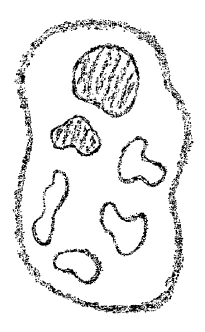
[ 9 ] In other parts of the etheric body, it is as if it contained vacuoles—very light areas within it that are transparent, shining, and sparkling with light. This is where Lucifer sends his rays and his forces; these are the centers of will within the etheric body. And in the space between them, where there is, as it were, constant activity within the etheric body, one sees that here is a dense area, but it is immediately embraced and dissolved by such a point of light. A constant solidifying and dissolving. This is the expression of emotional activity in the etheric body.
[ 10 ] Thus we can say: It is not only the form of the physical body that is brought about by the interplay of the Luciferic and Ahrimanic forces—which either disrupt or establish balance—but Luciferic and Ahrimanic forces are also at work throughout the entire etheric body. When the Ahrimanic forces prevail, this is an expression of thinking; when the Luciferic forces prevail, this is an expression of willing; and when they struggle against one another, one might say this is an expression of feeling.
[ 11 ] Here we see how Luciferic and Ahrimanic forces interact within the etheric body. In a sense, we are entirely the product of such forces, and are actually situated in the space between them.
[ 12 ] Now we must be clear about the fact that we are not always fully present in what is happening there with our whole self. Our ego, our earthly ego, which we have only acquired in the course of Earth’s evolution, can initially unfold its full activity and consciousness only within the physical body. In the etheric body, it will only be able to unfold fully during the Jupiter epoch, so that in all that takes place in the etheric body, the human being’s true ego is not directly active. If nothing from Ahrimanic and Luciferic forces had been added to the progressive evolution of the world, then the human being would be a completely different being; then the human being would be able to have perceptions in his physical body, but he would not actually be able to have thoughts. He has thoughts because Ahriman can exert influence on his etheric body. He has impulses of will because Luciferic forces can exert influence on his etheric body. These forces must therefore be present.
[ 13 ] We must therefore be clear that, with our earthly consciousness, we cannot fully descend into the etheric body. We can only fully experience our sense of self within the physical body. We cannot fully descend into the etheric body. With this etheric body, we therefore descend into a world in which we ourselves are not complete. And with Ahriman, who enters our etheric body as a shaper of thought, it is not only our thoughts that enter our etheric body. With Lucifer, who is a shaper of will in our etheric body, it is not only our impulses of will that enter our etheric body. And so it is also with the feelings, the realm where the two struggle. Insofar as Ahriman now lives in our etheric body, we descend with the etheric body into the sphere of the nature spirits, the elemental nature spirits, the earth, water, air, and fire spirits. We simply do not know this because we cannot descend fully into our etheric body with our ego. But it is always the case that in this etheric body, it is not only what we ourselves think that lives as a power of thought, but the influences of the nature spirits also penetrate there. In particular, whenever a person encounters these nature spirits, they can recount having experienced something they did not experience in their ordinary ego-consciousness; indeed, they encounter these nature spirits when something abnormal occurs within them, when the etheric body is, as it were, torn away from the physical body.
[ 14 ] How can something like this happen? You see, the human etheric body is connected to the entire surrounding etheric world, and thus also to the whole sphere of nature spirits around us. Let us suppose, for example, that a person is walking down the street during the day. When he walks down the street with his ordinary consciousness, his etheric body is properly situated within his physical body, and he perceives with his ego-consciousness whatever can be perceived by the ego-consciousness.
[ 15 ] But let us suppose for a moment that he is walking along a path at night. When one walks along a path at night, it is usually dark, which in itself is enough to put some people in a truly terrifying state. Now, because he enters such a terrifying state, these peculiar sensations—in which Lucifer particularly seizes him—cause the etheric body to detach from the physical body; and as a result, this liberated etheric body, having separated from the physical body, can now enter into a relationship with the surrounding etheric world. Let us now suppose that the person in question comes near a cemetery where etheric bodies still linger on the graves of the recently deceased. In this state, once his etheric body has detached itself, he may perhaps perceive something of the thoughts still residing in the etheric bodies of the deceased.
[ 16 ] Let us suppose that someone has recently passed away, leaving behind debts and having died with the thought of having incurred those debts. This thought may still linger within the deceased’s etheric body. Of course, one does not perceive these thoughts in another’s etheric body unless one’s own etheric body is relaxed, but in the state I have described, one can perceive them. One can enter into a relationship with the other person’s etheric body and can therefore perceive this thought: “I have incurred debts.” And now, because this strengthens the Luciferic power within him, the feeling stirs within him: “I must pay this debt.”
[ 17 ] Such a person thus experiences something in their etheric body that they would never experience in their physical body in ordinary life. One does not experience such things every day in ordinary human life; therefore, when one does experience it, it brings about something very significant in one’s consciousness. It brings about the realization that one knows: now you have experienced something that you did not experience in your body, that you cannot experience in your body. One feels that one is somewhere other than in one’s body, and one perceives this as an unfamiliar situation. One is somewhere other than in one’s body, and one then feels the urge to return to one’s body; one longs for help to return to one’s body.
[ 18 ] That feeling one has—the longing to return to one’s physical body—calls upon certain elemental spirits, nature spirits, for whom the human feeling is, as it were, food. They are drawn to us because they are, as it were, attracted by the feeling: “I want to enter my physical body.” — They help one find the way back into the physical body. When one sleeps in the ordinary way, one finds the way back easily; but when one experiences something like what I have described, one finds it difficult to return. However, one does not perceive it as one does in the physical body, but rather perceives it imaginatively, in images. Someone approaches—actually a nature spirit—who perhaps appears in the form of a shepherd and gives you the advice: Go to some castle. I will take you there in a carriage—and so on.
[ 19 ] Another mental image can be linked to such images. It can be linked to the idea that the body one has left behind—outside of which one had the experience—appears like an enchanted castle from which one must rescue someone upon entering. This is how one imagines this longing for the physical body and the help of the nature spirits. Then one returns to the physical body, that is, one wakes up.
[ 20 ] People who have experienced this in real life then recount such experiences because they feel that, in this way, they have, as it were, entered into a relationship with the thoughts of a deceased person. They tell themselves: That was a feeling of something that wasn’t merely within me, that wasn’t merely something I had dreamed; it was a feeling that conveyed to me an event taking place out in the world. — Of course, this is expressed in images, but it corresponds to an actual event. I would like to read you one such account, in which someone recounted what he experienced there—something similar to what I have just described. He describes it something like this: “As I was being bid farewell by the soldiers, I met three men on my way. They wanted to dig up a dead man because he owed them three marks. Then I was seized by compassion and settled the debt so that the deceased might rest in peace and no longer be disturbed in his grave. I continued on my way. Then a stranger with a pale face joined me and invited me to board a leaden vehicle, and he persuaded me to ride with him to a castle. A princess lived in the castle, who had declared that she would marry only the man who came to her in a leaden carriage. Then he went to the coachman and said, “Drive as fast as you can toward the side where the sun is rising.” Then a shepherd came and said, “I am the Count of Ravensburg!” He ordered the coachman to drive faster. We came to a gate, and a commotion could be heard. The gate was unlocked. The princess then asked the man where he was from, how he could have traveled with the old man, and I realized that the one who had led me there was a spirit. Then I entered the gate. I stepped inside and became the owner of the castle.” That is to say, he returned to his body. There you will find such an experience described, as I have cited it.
[ 21 ] And what is it, then, when it happens to someone else, and they go on to tell others about it? That’s a fairy tale.
[ 22 ] Fairy tales came into being in no other way than this. Anything else said about the origin of fairy tales is nothing more than wild fantasy. All true fairy tales are proof that there are experiences outside the human physical body when the etheric body is loosened in a certain way and the human being enters into a relationship with the outer etheric world. This is the one way in which the human being enters into a relationship with the outer world through his or her etheric body.
[ 23 ] But he relates to the external ethereal world in yet another way. He also relates to it where, one might say, there is a semi-conscious activity, one that is only partially permeated by the ego. This is the case with language. After all, we do not speak as fully consciously as we think. It is not at all true that we have speech—as something that belongs to us—under our control. Ethereal forces play out in language, and a good deal of unconsciousness is present in language. The ego does not extend all the way down into language. When we speak, we relate through our etheric body to the ethereal world surrounding us. We learn to think as individuals, but we do not learn to speak. We are taught to speak by karma, which places us within a certain context of life. While we come into contact with the nature spirits, as it were, in abnormal states when the etheric body is loosened, we simply come into contact with the folk spirits by speaking—by not merely thinking in silence. And the folk spirits take up residence in our etheric bodies—without reaching up to our consciousness. What lives in this way within the human being belongs, in essence, just as little to his fully conscious ego activity as that which the human being recounts to us here as fairy tales.
[ 24 ] We have thus described how Lucifer and Ahriman influence the human etheric body. But the Luciferic and Ahrimanic forces also influence the astral body. Now, when we study the human astral body, we must point out the most outstanding feature that characterizes the astral human being as he is on Earth. That is consciousness. In the physical body, form and strength are the essentials; in the etheric body, movement and life; in the astral body, consciousness. However, we do not have just one state of consciousness in the human body; we have two states of consciousness: the ordinary waking state and the sleeping state. But here is the curious thing: neither of these is actually fully natural to us. One could say that neither the waking state nor the sleeping state is fully natural to us. What would be natural for us is an intermediate state between the two, in which we never actually live with full consciousness.
[ 25 ] If we were constantly awake, we would hardly be able to develop properly as human beings through the various stages of life. It is only because there is, as it were, always something within us that is less awake than we are during the day that we are able to develop. Ask yourself how much you think about developing yourself through what you experience and take in during ordinary life? We use it more to satisfy our curiosity and our need for sensation. But how rarely do we seek to put what we experience in our waking daily life at the service of our development. We develop only because there is always something within us that sleeps along with us when we are awake during the day. I do not mean when a person falls asleep, but even when they are fully awake during the day, something is still sleeping. And this co-sleeping aspect ensures that they do not actually remain a child forever, but continue to develop.
[ 26 ] What we are aware of through our astral body is the ordinary waking state. But the ordinary waking state is such that we are too fully awake in it. We are too devoted to the outer world in the ordinary waking state; we become completely absorbed in the outer world. And where does this come from? It comes from the fact that waking consciousness lives under the strong influence, under the dominance of Ahriman. Waking consciousness = Ahriman.
[ 27 ] The situation is different with sleep consciousness. In sleep consciousness, we are once again not awake enough. There, we do everything too much for our own development, for ourselves. We are completely within ourselves and so deeply immersed in ourselves that all consciousness is extinguished. In sleep consciousness, Lucifer has the upper hand. Sleep consciousness = Lucifer.
[ 28 ] So, with regard to our astral body, the situation is this: when we are awake, Ahriman has the upper hand over Lucifer, and when we sleep, Lucifer has the upper hand over Ahriman. They maintain a balance only when we dream; then they struggle with one another, and thus they keep each other in check. There, the mental images evoked by Ahriman in our waking consciousness—which he allows to harden and crystallize—are dissolved by the influence of Lucifer and made to vanish again. Everything becomes images, for he does not allow them to solidify into fixed ideas; they are dissolved again and become fluid within themselves. Just as in a balance, equilibrium is achieved at a point or along a line when the balance is loaded equally on both sides, so that we are no longer dealing with a state of rest but with a state of equilibrium, so too in human life we are not dealing with a state of rest but with a state of equilibrium. And the two forces that hold the balance there, one of which or the other has the upper hand at times, are Lucifer and Ahriman. In waking consciousness, the scale of Ahriman sinks; in sleeping consciousness, the scale of Lucifer sinks. Only in the intermediate state in which we dream does the balance swing back and forth—not as if it were at rest, but it swings back and forth.
[ 29 ] But even as we move further up into human life, it becomes clear to us that the permeation of the world by Lucifer and Ahriman is at work there. Two concepts, after all, play a major role in life. One concept is that of duty; we could also say, if we approach the matter from a religious perspective, the concept of the commandment. We do, after all, speak of a “duty-commandment.” The other concept we wish to consider here is that of justice,
[ ] If you consider how the concepts of duty and right—the right that a person has to this or that—play a role in human life, you will soon realize that duty and right are polar concepts, polar opposites, and that, in a sense, people’s inclinations are such that they sometimes lean more toward duty and sometimes more toward right. We do, however, live in an era where people prefer to speak of their rights rather than their duties. All manner of groups assert their rights. We therefore have workers’ rights, women’s rights, and so on.
[ 30 ] Duty is the opposite concept of right. Our era will be succeeded by an era in which duties will be emphasized, particularly under the influence of the anthroposophical spiritual worldview. And only in the future—though more so in the distant future—will there be movements in which the emphasis will be placed less and less on the demand for rights and much more on the demand for duty. The question will then be asked more frequently: What duties does one have, as a woman or as a man, in this or that situation? Thus, the era of the demand for duty will replace the era of the demand for rights.
[ 31 ] Like polar opposites, like polarities, right and duty play a role in our lives. Now one might say: When a person looks toward duty with his soul, he is actually looking outward from himself. — Kant expressed this so magnificently by presenting duty as a noble goddess to whom man looks up: “Duty! You sublime, great name, which contains nothing beloved, nothing that carries flattery within you, but demands submission...” — Man sees duty, as it were, radiating down from regions of the spiritual world. Religiously, he perceives duty as an impulse imposed by the beings of the higher hierarchies. And as man submits to duty, he steps outside of himself in the sense of duty. And this stepping outside of oneself in the sense of duty is already something that takes man out of his ordinary self.
[ 32 ] But any such stepping outside of one’s ordinary self, any such striving for spiritualization, would place a person in a situation where he would, as it were, lose the ground beneath his feet if he were to give himself over solely to this one tendency—the striving to go beyond himself. Man would, as it were, lose his gravity if he were always striving to go beyond himself. Therefore, when man submits to duty, he must try to find within himself a support that gives him, as it were, gravity as he submits to duty. Schiller expressed this beautifully when he said that man has the most beautiful relationship to duty when he learns to love duty at the same time.
[ 33 ] This thought actually says a great deal. When a person speaks of learning to love duty, they are no longer merely submitting to duty; rather, they step outside of themselves and take with them the love with which they would otherwise love only themselves. They take the love that lives within their body—which was once selfishness—and direct it toward duty. As long as it is self-love, it is a Luciferic force. But when a person takes this self-love out of themselves and loves duty as they would otherwise love only themselves, they redeem Lucifer, take him out into the realm of duty, and, so to speak, make Lucifer a justified being in the working, in the impulse-feeling of duty.
[ 34 ] On the other hand, if a person is unable to do this—if he cannot draw love from within himself and offer it to duty—then he continues to love only himself. If they cannot love duty, then they can only submit to duty; then they become slaves to duty; then they wither away; then they harden into people of duty, becoming cold and sober, even though they are devoted to duty. They harden in an Ahrimanic way, even though they follow duty.

[ 35 ] You see how duty stands, as it were, right at the center of it all. If we submit to it, it destroys our freedom. We become slaves to duty because Ahriman approaches duty from one side with his impulses; but if we bring ourselves, if we offer the power of self-love as a sacrifice to duty, if we meet duty with Luciferic warmth as love, then the result is that, through the state of equilibrium between Lucifer and Ahriman, we find a proper relationship to duty. In the moral realm, we ourselves thus bring about a state of balance between Lucifer and Ahriman. Ahriman is out there in the spiritual realm and withers the duty to which we must submit, so that it takes away our freedom. But we meet him with love from our own organism; we offer ourselves to him. Through the struggle between Lucifer and Ahriman, we bring about the right relationship to duty. Thus, in a certain sense, we are also the redeemers of Lucifer. When we begin to be able to love our duties, then the moment has arrived when we contribute to the redemption of the Luciferic powers, when we lead the Luciferic forces—which are otherwise enchanted within us, enchanted into self-love—out of ourselves into the struggle with Ahriman. In this way, we redeem Lucifer, who is enchanted by self-love; we liberate him when we learn to love our duty.
[ 36 ] In his letters “On the Aesthetic Education of Man,” Schiller asked himself the same question: How does one move beyond the enslavement to duty to a love of duty? Only he did not use the terms “Lucifer” and “Ahriman,” because he did not conceive of the matter in cosmic terms. Yet Schiller’s wonderful letters on the aesthetic education of man can be directly applied to the Spiritual Science.
[ 37 ] When it comes to rights, the moment we assert them, they immediately reveal a connection to Lucifer. Human beings do not need to learn to love their rights; they love them, and it is entirely natural for them to do so. There is a natural connection between Lucifer and justice in feeling, in the sense of justice. And wherever rights are asserted, Lucifer has a say. Sometimes one can see quite clearly even outwardly how Lucifer’s power plays a strong role in the propagation of this or that right. Here the point is that we must bring about the opposite of justice, that we must, as it were, invoke Ahriman to provide a counterpole to Lucifer, who is already linked to justice. And we can do this, so to speak, through the counterpole of love. Love is an inner fire; its counterpole is serenity, the acceptance of whatever comes to us through world karma; the understanding of what happens in the world, the understanding serenity. As soon as we approach our rights with this understanding serenity, we call Ahriman in from outside. Here he is simply harder to recognize. We redeem him from his merely external existence, call him into ourselves, warm him through the love that is already linked to the right. Serenity possesses the coldness of Ahriman. In understanding what is in the world, we connect our understanding, warm love with what is coldness out there in the world. There we redeem Ahriman when we face what has come to be with understanding, when we do not merely demand justice out of self-love, but understand what has come to be in the world.
[ 38 ] This is the eternal struggle between Lucifer and Ahriman in the world. On the one hand, human beings learn to understand conditions in a conservative way; they learn to understand conditions as they have come to be out of cosmic, karmic necessity. That is one side. And the other side is that one feels within one’s breast the urge to constantly bring forth something new—the revolutionary current. Lucifer lives in the revolutionary current. Ahriman lives in the conservative current. And human beings live within these two polar opposites by standing within them in their legal life.
[ 39 ] Thus we see how right and duty also represent the balance between Lucifer and Ahriman. How such things as the human physical body, the etheric body, and the astral body manifest in life; how duty and right manifest in the realm of law and duty; and how these things exist in the world at all—we can only come to understand this when we learn about the interplay of the spiritual forces, above all those spiritual forces that bring about this state of equilibrium.
[ 40 ] Just as we can view what already exists as being under the influence of spiritual forces that bring about balance, so too does what we live out in our moral life fit into the world of polar opposites. Morality as a whole, ethics, and moral life—with its poles of duty and justice—become comprehensible only when we take into account the influences of Ahriman and Lucifer. The same applies to the historical life of humanity, which unfolds in such a way that revolutionary-warlike, that is, Luciferic movements alternate with conservative-peaceful, that is, Ahrimanic movements. It presents itself to us once again as a state of equilibrium between the Luciferic and the Ahrimanic. We cannot understand the world in any other way than by viewing it in this way, as a series of opposites. What confronts us out there in the world presents itself to us in opposites; it is truly dualistic. And in this respect, Manichaeism—Manichaeism properly understood, which is dualistic—is fully justified. We will have occasion to speak of this in various ways in the future, including how this Manichaeism is also fully justified within a spiritual monism.
[ 41 ] What I intend to do in these lectures is to show you how the world is the result of forces of equilibrium. And such a result of forces of equilibrium is expressed particularly in artistic life. Starting from this point, we will later examine the arts and their development in the world, as well as the role that the various spiritual forces play in the development of artistic life within humanity.