

The Connection Between Man
and the Elemental World
GA 158
31 December 1914, Berlin
Translated by Steiner Online Library
The Awakening of the Human Soul from the Spiritual Slumber of the Dark Age
[ 1 ] We begin this celebration marking the end of the year with Dr. Steiner recounting the beautiful Norwegian legend of Olaf Åsteson—the very same Olaf Åsteson who, as Christmas approached, fell into a kind of sleep that lasted thirteen days: the holy thirteen days that we have come to know through various of our reflections. During this sleep, he had significant experiences, which he was then able to recount when he awoke.
[ 2 ] We have made various observations that have drawn our attention to how, through the Spiritual Science worldview, we can recover in a different way ancient treasures of knowledge for human understanding—treasures that were once known to people as belonging to the spiritual worlds. Time and again we will encounter this pre-worldly knowledge of the spiritual worlds through one thing or another, and time and again we will be reminded that this ancient knowledge was based on the fact that, by virtue of his earlier constitution, the human being was able to stand in such a relationship to the entire universe and its events that, as we express it in our language, the human microcosm was immersed in the laws in the events of the macrocosm, and that through this immersion in the macrocosm, he could have experiences concerning things that intimately concern his soul life, but which must remain hidden from him as long as he walks on the physical plane as a microcosm and is endowed only with the knowledge given to the senses and the intellect bound to the senses.
[ 3 ] We know, of course, how materialistic a worldview it is to believe that only human beings within the cosmic order are endowed with the faculties of cognition, feeling, and will; whereas from the standpoint of a spiritual worldview, one must acknowledge that just as there are beings below the human level, there are also beings above the human level of thinking, feeling, and willing. Human beings can attune themselves to these beings when they immerse themselves as a microcosm within the macrocosm. We must then, however, speak of this macrocosm as if it were not merely a spatial macrocosm, but as if time, in its course, were significant in the life of the macrocosm. Just as a human being must withdraw from all the impressions that can be exerted on their senses from their surroundings, just as they must, so to speak, create darkness around themselves by shutting off their sensory perception in order to kindle the light of the spirit within when they wish to descend into the depths of their soul, so too must that spirit which we may call the Earth Spirit be shut off from the impressions of the rest of the cosmos. The least possible influence from the outer cosmos must be exerted upon the Earth Spirit so that the Earth Spirit itself may concentrate inwardly and gather its powers within. For then the mysteries are revealed that human beings must experience through this Earth Spirit, because the Earth, as Earth, has been separated from the cosmos.
[ 4 ] A time when the greatest influence from the outer macrocosm is exerted upon the Earth is the summer solstice, the time of St. John. We are therefore reminded by many accounts from ancient times, which relate to depictions of festivals and festival celebrations, of how such festivals took place in the midst of summer, and how, in the middle of summer, the soul—by divesting itself of the ego and merging into the life of the macrocosm—is intoxicatedly surrendered to the impressions of the macrocosm.
[ 5 ] Conversely, however, the legendary or other depictions of what could be experienced in ancient times—when the slightest impressions from the macrocosm reach the Earth—remind us that the Earth Spirit, concentrated within itself, experiences the mysteries of the Earth’s soul life in the infinite cosmos, and that when human beings enter into this experience at the time when the least light and warmth are sent from the macrocosm to the Earth, they then share in the most sacred mysteries. That is why these days around Christmas were always held in such high esteem, because when human beings still possessed the capacity within their organism to share in the Earth’s experience at the time when it is most concentrated, they could be united with the Earth Spirit.
[ 6 ] Olaf Åsteson, Olaf the Son of Earth, experiences various mysteries of the universe during these thirteen briefest days, while he is transported into the macrocosm. And the Norse legend, which has recently been unearthed from ancient sources, tells us of the experiences Olaf Åsteson had between Christmas and New Year’s until January 6. And we have good reason, my dear friends, to reflect more often on this ancient way of integrating the microcosm into the macrocosm; for our reflection will then be able to build upon such things. But for now, let us hear the legend of Olaf, the Son of the Earth, who, in the time in which we now live, experienced the mysteries of worldly existence by living together with the Earth Spirit. Let us therefore hear of these experiences.
[ 7 ] This was followed by the recitation.
[ 8 ] My dear friends, we have heard how Olaf Åsteson fell into that sleep which was to become for him a revelation of the mysteries of those worlds that lie beyond the realm of the senses, beyond ordinary life on the physical plane. In the legend, we have received the news of those ancient insights, of those ancient understandings of the spiritual worlds, which are to be regained through what we call the Spiritual Science worldview.
[ 9 ] The saying that runs through all the teachings concerning the human soul’s entry into the spiritual world has often been cited; it states that a person can only perceive the spiritual world when they reach the threshold of death through their own experience and then plunge into the elements. So that they no longer have the elements of earthly existence around them as they are in ordinary life on the physical plane—as earth, water, air, fire, but rather that they are lifted above this outer aspect, this sensory outer aspect of the elements, and immersed in what these elements are when one comes to know them according to their true nature, their next true nature, where beings are present within them that are connected to the experience of the human soul.
[ 10 ] That Olaf Åsteson experienced something of this immersion in the elements can still be sensed in the passage where it is first described how Olaf arrives at the Gjallar Bridge and how he walks across the bridge along the paths of the spiritual world, which stretch far and wide. How vividly the experience with the earth element is described to us, how he is depicted as immersing himself in the earth element. This is brought to such a degree of vividness that it tells us he feels earth in his mouth, just as the dead do when they lie in their graves. And it is then clearly indicated to us how he experiences the water element and all that can be experienced in the water element when one experiences this water element together with its moral content. Then again, it is indicated how the human being comes into contact with the fire element, with the air element.
[ 11 ] All of this is described in a wonderfully vivid way and brought together in the experience of the human soul’s communion with the mysteries of the spiritual world. The legend was discovered later; it was collected where it still lived on in the mouths of the people. And there are many things in this legend, as it is today, that are no longer as they originally were. Originally, there was undoubtedly first the vivid description of the experiences in the earth realm, then those in the water realm. And then the experiences in the air and fire realms were likely even more nuanced than is the case in the faint echo that was discovered centuries later and which we have before us today.
[ 12 ] Likewise, the ending was undoubtedly far more magnificent and less sentimental; in its current form, it no longer evokes the originally immense grandeur of the language or the superhuman poignancy inherent in such folk legends, whereas today’s ending is merely humanly moving; moving precisely because it is connected to such profound mysteries of the macrocosm and human experience.
[ 13 ] In times such as the one in which we now live, in seasons such as these—if we understand them correctly—there is ample cause to reflect on the fact that humanity, albeit with a different kind of knowledge, one that was more dull and dim, was in ancient times imbued with a wisdom that has been lost and must be regained. And so the question may once again arise in our souls: Since we can already recognize today how such knowledge must once again come to the benefit of humanity, must we not regard it as one of our most urgent tasks to do everything that can bring about such knowledge, that can permeate present-day human culture with such knowledge?
[ 14 ] Many things will be necessary for the shift I have just hinted at to take place in the right way within the entire human—I would now say—worldview. Above all, one thing will be necessary; I mention one, for it is one among many; but one can only ever take one at a time. It will be necessary for human souls, on the basis of our worldview based on Spiritual Science, to cultivate reverence and devotion toward what was known in ancient times, in the old way, about the great mysteries of existence. One will have to arrive at the realization of how, in materialistic times, this awe and this devotion have been neglected in the soul.
[ 15 ] One cannot help but feel how dry and sober this materialistic age is, and how arrogantly humanity in the first centuries of the fifth post-Atlantean cultural epoch stood before the revelations of ancient religious and knowledge traditions—traditions which, if approached with the necessary reverence, suggest that profound, profound wisdom lies within them. How irreverent, in essence, are we today even before the Bible! I do not wish to speak at all of that kind of modern, gruesome scholarship that tears the entire Bible to shreds and unravels it. I wish only to speak of the sober, dry manner in which we approach the Bible today, equipped, as it were, only with sensory perception and the ordinary powers of the intellect, and how we can no longer muster a sense of the immense grandeur of human insight that confronts us in many passages. I would like to point to a passage from Exodus, chapter 33, verse 18: And Moses said to God, “Show me, I pray, the form of your revelation.”
[ 16 ] Then Jehovah said, “I will cause all my goodness to pass before you, and I will proclaim the name of Jehovah before you; and I will be gracious to whom I will be gracious, and I will show mercy to whom I will show mercy.”
[ 17 ] But then Jehovah says: “You cannot see my face, for no one can see me and still live.”
[ 18 ] And the Lord said, “Here is a place by me; stand on the rock, and when my glory passes by, I will put you in a cleft of the rock and cover you with my hand until I have passed by. Then, when I take my hand away, you will see my back, but my face cannot be seen.”
[ 19 ] When we take stock of all that has found its way into our souls and hearts over the years of our Spiritual Science quest, and approach this passage, we may be moved to feel: Yes, what infinite wisdom speaks from this passage, and how deaf are the human ears of the materialistic age that they can hear nothing at all of the infinitely deep wisdom that speaks from this passage. I would also like to take this opportunity to draw your attention to a little book that has been published under the title: “Worte Mosis” by Bruns’ Verlag in Minden, Westphalia, because some passages in this little book from the Five Books of Moses are better translated than in other editions. Dr. Hugo Bergmann, the editor of “Worte Mosis,” has put a great deal of effort into the interpretation.
[ 20 ] We have often emphasized that, fundamentally, if a person wishes to enter the spiritual worlds, they must adopt a completely different way of relating to the world than the way they relate to the sensory world. The sensory world surrounds us. We look at the sensory world; we see it in its colors and forms, hear its sounds. The sensory world is there; we stand before it; it acts upon us; we take it in through perception, we reflect upon it. Such is our attitude toward the sensory world. We are passive; it works its way, as it were, into our soul. We reflect upon the sensory world; we create a mental image of the sensory world.
[ 21 ] Our behavior is quite different when we ascend into the spiritual world. This is one of the difficulties in forming accurate mental images about what a person experiences when entering the spiritual world. I have attempted to describe some of these difficulties in the little book *The Threshold of the Spiritual World*. We imagine the sensory world; we think about the sensory world. When we go through everything that one who wishes to walk the path of initiation must go through, then something occurs that can be described as follows: Just as the things around us relate to us, so do we ourselves relate to the beings of the higher hierarchies: they imagine us; they think of us. We think of the objects outside ourselves—the minerals, plants, and animals—and they become our thoughts. We, in turn, are the mental images, thoughts, and perceptions of the spirits of the higher hierarchies. We become the thoughts of the Angeloi, Archangeloi, Archai, and so on. We are taken in by them, just as we ourselves take in the plants, animals, and people. And we must feel secure by being able to say to ourselves: The beings of the higher hierarchies think of us; they conceive of us. These beings of the higher hierarchies embrace us with their souls. — Yes, we can quite imagine: by falling asleep before the church gate, that Olaf Åsteson became a mental image for the spirits of the higher hierarchies, and while he slept, the beings of the higher hierarchies experienced what the beings of the Earth Spirit experience—which for us is, after all, a plurality. And as Olaf Åsteson sinks back down into the physical world, he remembers what the spirits of the higher hierarchies experienced within him.
[ 22 ] Let us imagine for a moment: we are setting out on the path of initiation! How should we relate to the spiritual worlds into which we wish to enter as a collective of spiritual beings from the higher hierarchies? How can we relate to them? — We can address them and say to them: How do we enter into you, how do you reveal yourselves to us? — And then, once we have gained an understanding of the different way the human soul relates to the higher worlds, a response will, as it were, come back to us from the spiritual worlds: Yes, just as you perceive the sensory world—that it appears before your eyes, presents itself to your senses—so you cannot perceive the spiritual world. We must introduce you to it, and you must feel yourself within us. You must feel yourself as the thought you think in the sensory world would experience itself if it could experience itself within you. You must surrender yourself to the spiritual world; then all that can be revealed to you of the beings of the higher hierarchies will enter into you. Then it will flow into your soul, and you will think in the sensory world with grace. If the spiritual world wishes to bestow grace upon you, then it will permeate you with its love! If it wishes to have mercy on you and permeate you with its love.
[ 23 ] For you must not think that you can approach spiritual beings in the same way as you approach the physical world. Just as Moses had to enter the cave, so must you enter the depths of the spiritual world. You must place yourself there. Just as the thought lives within you, so must you live yourself into the spiritual beings. You must live there yourself as a world-thought within the macrocosm. What you experience in this way—to experience it of your own accord—you cannot do during your earthly life between birth and death; you can do that only after death, when you have died. No one can experience the spiritual world in this way before they have died, but the spiritual world can pass over you, bestow grace upon you, and flood you with its love. And then, when you subsequently—or while you are already within this spiritual world—develop your earthly consciousness, that which is the spiritual world will shine into your earthly consciousness.
[ 24 ] Just as an object exists outside and a person stands before it, just as the object penetrates into the person’s consciousness and then resides there, so too does the person, with his or her soul, dwell within the recesses of the spiritual world (Figures 1 and 2).
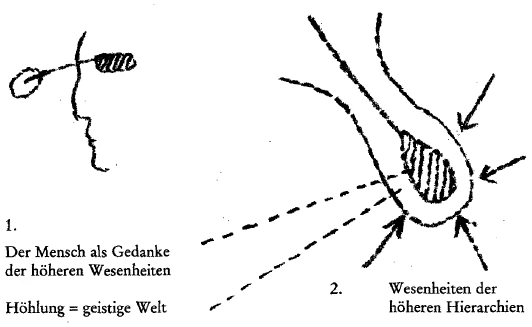
[ 25 ] The spiritual world flows through him. Here, the human being is before things. When the human being enters the spiritual world, the beings of the higher hierarchies are behind him. There he cannot see their faces, just as thoughts do not see our faces when they are within us. The face is in front; the thoughts are behind it; they do not see the face. The whole mystery of initiation lies in the words that Yahweh speaks to Moses.
[ 26 ] And Moses said to God, “Please show me the form of your revelation.”
[ 27 ] Then Jehovah said, “I will cause all my goodness to pass before you, and I will proclaim the name of Jehovah before you; and I will be gracious to whom I will be gracious, and I will show mercy to whom I will show mercy.”
[ 28 ] But then Jehovah says: “You cannot see my face, for no one can see me and still live.”
[ 29 ] One reaches the gates of death through initiation.
[ 30 ] And the Lord said, “Here is a place by me; stand on the rock, and when my glory passes by, I will put you in a cleft of the rock and cover you with my hand until I have passed by. Then, when I take my hand away, you will see my back, but my face cannot be seen.”
[ 31 ] It is the opposite way of perceiving the sensory world. One must draw upon much of what one has acquired over the years through endeavor in Spiritual Science in order to stand before such a revelation in the proper manner, with reverence and devotion. But then, little by little, this feeling of reverence toward these revelations enters the human soul, and among the many things we need so that the indicated transformation in humanity’s spiritual culture can come to the fore is this reverence, this devotion.
[ 32 ] The time when the least amount of impressions from the macrocosm reaches the Earth—the period from Christmas through New Year’s Day and on until about January 6—is well suited for recalling not only the concrete aspects of spiritual knowledge but also the feelings we must develop within ourselves through the absorption of Spiritual Science. Thus we truly live ourselves back into the Earth Spirit, with which we together form a whole, and with which the ancient, clairvoyant knowledge lived, as it is depicted for us, for example, in this legend of Olaf Åsteson. Humanity in the materialistic age has largely forgotten reverence and devotion toward spiritual life. Above all, it is necessary to ensure that this reverence and devotion return, for only through them will we be able to develop the attitude that will also bring us to the new Spiritual Science in the right way. For the time being, the prevailing attitude is still one that approaches the Spiritual Science in the same way one approaches other, conventional sciences. In this regard, however, a fundamental reversal must take place.
[ 33 ] Because humanity has lost its understanding of the spiritual world, it has also lost its proper relationship to the whole of human existence, to humanity. The materialistic worldview gives rise to chaotic feelings about existence in the world. These chaotic feelings about the existence of the world and humanity were bound to arise in the age of materialism. Let us take a period—and this period is our own: the first centuries of the fifth post-Atlantean cultural epoch—when people no longer had any real inkling that the human being is a threefold being: physical, soul, and spiritual. For truly, this is so. That which for us must already belong to the very first elements of Spiritual Science—the threefold division of the human being into body, soul, and spirit—was completely unknown from the first four centuries of the fifth post-Atlantean cultural epoch right up to our own time. Human beings were simply human beings, and any talk of a human division of the kind we have into body, soul, and spirit was regarded as foolish, fanciful prattle.
[ 34 ] One might think that these things are significant only for knowledge. But they are not. They are not significant merely for knowledge; they are also significant for the entire way in which human beings approach life. In the third century of modern development—or, as we say in our language, the development of the fifth post-Atlantean cultural epoch—three powerful words burst into this era, through which this age, in a sense, understood or at least attempted to understand the center of human will in earthly existence. Three words that are significant, but which acquired their distinctive character by bursting into humanity at a time when nothing was known about the threefold nature of the human being. Humanity heard of liberty, equality, and fraternity.
[ 35 ] That these words resonated within modern culture at a specific time was a profound necessity. One will truly understand these words only when one understands the threefold structure of human nature, for only then will one know what significance these words can have for human nature, in the truest sense of the word. As long as one fills these three words with those chaotic feelings that stem from the idea that ‘man is man,’ and that the threefold structure of the human being is a foolish delusion—as long as this is the case, one cannot find one’s way within the scope of the guidance offered by these three words. For just as these three words present themselves to us, they cannot be applied directly—one might say—on the same levels of human experience. They cannot do that. Simple considerations—which, perhaps because they are so simple, will not immediately appear before the eye of the soul in all the gravity they signify—can suggest to you how, on the same level of life, what these three words mean can lead to serious conflicts in life.
[ 36 ] Let us first consider the sphere in which brotherhood confronts us in the most natural way possible. Let us consider human kinship, the family, where we do not first need to establish brotherhood, where it is naturally innate to human beings, and let us reflect on how it speaks to our feelings when we can see that genuine, true brotherhood reigns in a family, that everything is bound together in brotherhood. But now—without needing to dampen in the slightest the wonderful feeling we can have of this brotherhood—let us look within to see what can arise within the brotherhood of the family, precisely because of the family’s brotherhood. There may be a member of the family who, precisely because of the brotherhood justified within the family, does not feel at ease, who longs to break free from the family’s brotherhood, because they feel they cannot unfold their soul within the family’s brotherhood, because they feel they must leave the family—in which they can live so fraternally—to allow for the free unfolding of the soul. We see: freedom, the free unfolding of the soul’s life, can come into conflict with the most well-intentioned brotherhood.
[ 37 ] Of course, a superficial person might say that this is not true brotherhood, which is incompatible with the freedom of a soul within the brotherhood. But one can say anything one can imagine. One can say that everything is compatible with everything else; there is no doubt about that. I recently came across a dissertation. Among the theses to be defended was the following: A triangle is a quadrilateral. Of course, one can defend that as well—indeed, one can even rigorously prove that a triangle is a quadrilateral! One can also fully prove that brotherhood and freedom are compatible. But that is not the point; rather, the point is that, for the sake of freedom, certain areas of brotherhood must be abandoned—and indeed are abandoned. We could cite many other examples.
[ 38 ] If one were to list the discrepancies between brotherhood and equality, one would have to talk about them at great length. Of course, in the abstract, one can have a mental image of everyone being equal, and one can show that brotherhood and equality are compatible. But we are not dealing with abstractions, but with the observation of reality, if we take life seriously and honestly. The moment we realize that the human being consists of the physical, which lives out its life on the physical plane; the soul, which actually lives out its life in the soul world; and the spiritual, which lives out its life in the spiritual world— At that moment, the correct perspective also opens up for the connection between the three powerful words we have cited. Brotherhood is the most important ideal for the physical world. Freedom for the soul world, and—insofar as the human being is situated within the soul world—one should speak of the freedom of the soul, that is, of a social condition that fully guarantees the freedom of the soul. And when we consider that each of us must strive, from our individual standpoint, for spiritual knowledge, for the development of our spirit, in order to be immersed in the spirit in the spiritual realm, it will very soon become clear to our spiritual eye where our conception of the spirit would lead us if everyone sought only on their own path and everyone arrived at a completely different spiritual content.
[ 39 ] As human beings, we can only come together in life if we—each on our own—seek the spirit and are ultimately able to arrive at the same spiritual content. One can speak of the equality of spiritual life. Of brotherhood on the physical plane and in relation to everything connected with the laws of the physical plane and which lives its way into the human soul from the physical plane. Freedom in relation to everything that lives into the human soul as laws of the soul world; equality in relation to everything that lives into the human soul from the laws of the spirit realm.
[ 40 ] You see, a new world year must dawn, in which a sun will grow in terms of its warming and radiant power: that sun which must provide radiant warmth for many things that, though alive during the time of darkness, remain misunderstood. This is precisely what is peculiar about our time: that many things are strived for, many things are spoken of, without being understood. |
[ 41 ] But this, too, can lead us to a sense of awe and devotion toward the spiritual world. For when we consider that many in the third century of the fifth post-Atlantean epoch strove for and uttered the words brotherhood, freedom, and equality without truly understanding them, we already have the opportunity to understand and find an answer to the question: Where, then, did these words come from? The divine-spiritual world order first instilled them in advance into the human soul, which did not yet understand, so that the soul might climb upward toward a true understanding of the world by clinging to such guiding principles. Even in such facts we can observe the wise guidance in the evolution of the world. In times more or less distant or close to us, we can observe this guidance everywhere; observe how we often only realize in hindsight that what we did before was actually wiser than we could have done with the wisdom we possessed at the time. I drew attention to this right at the beginning of my treatise on “The Spiritual Guidance of the Individual and of Humanity.”
[ 42 ] But if you consider, for example, the fact that the course of world history and human development is marked by guiding principles that can only be understood gradually, then you will likely notice an image that can be used to characterize this past period of the fifth post-Atlantean cultural epoch. For in certain respects it can truly be compared to the season of Advent, when the hours of daylight grow shorter and shorter. And now, in our present time, when we can once again gain some knowledge of the revelations of the spiritual world, development is entering a phase in which we can form a mental image that the light-filled hours are growing longer and longer, and we can speak of how this course of time truly seems analogous to the thirteen days and the return to the days that are growing longer again.
[ 43 ] But the issue runs even deeper. It is not right—not right at all—for us to have only harsh words for the materialistic era of the past four centuries. After all, this new era arose because of the great discoveries and inventions—the kind we call “great” in the materialistic age—such as circumnavigating the globe, discovering lands previously unknown, and beginning to colonize the Earth. That was the beginning of material culture. And then, little by little, the time came when people were almost suffocating in material culture. The time came when all one’s spiritual powers were applied to understanding and grasping material life. As we have seen, what remained of the insights, perceptions, and visions into the spiritual world derived from ancient knowledge was increasingly forgotten.
[ 44 ] But it is not right to have only harsh words for the materialistic age. What is right is something else; it is right to consider that, in its waking state, the human soul has thought and felt in a materialistic way, that it has established science and culture on a materialistic basis, but that this human soul is a whole. One could say: one part of the human soul established materialistic culture. In the past, this part was inactive; people knew nothing of external science, knew nothing of external, material life; the spiritual part was more awake then. (A diagram was drawn.) Over the last four centuries, it was precisely that part that was awake which founded materialistic culture; the other part, however, was asleep; this other part of the human soul was asleep. And truly, the forces we are now developing within humanity to work our way back up to spirituality were laid down during the era of materialistic culture in the soul members that lay dormant below. “Humanity” was truly, in terms of spiritual knowledge, in these times: Olaf Åsteson. That is truly what it was. Only, this humanity has not yet awakened! Spiritual Science must bring it to awakening.
[ 45 ] The time must come when both young and old people hear words spoken from that part of the human soul which has been asleep during the dark ages. This human soul has slept for a very long time, but the world spirits will approach it and call out to it: Awake now, O Olaf Åsteson! — We must simply prepare ourselves in the right way, so that we are not confronted with the call: Awake now, O Olaf Åsteson! — and yet have no ears to hear. To this end, we pursue Spiritual Science, so that we may have ears when the call for spiritual awakening in human evolution resounds.
[ 46 ] It is good for a person to sometimes remember that they are a microcosm and that they can experience many things when they merge with the macrocosm. And we have seen: the time, the season in which we now live, is favorable. Let us try, on this New Year’s Eve, to let it be a symbol of that New Year’s Eve necessary for humanity’s earthly evolution, in which the new epoch will dawn, in which the light—the light of the soul, the vision—will grow and grow ever more, the recognition of that which lives in the spiritual and which, from the spiritual, can surge through and flood the human soul. Let us connect the microcosm of our experience on this New Year’s Eve with the macrocosm of humanity’s experience across the Earth: then we will be able to experience what we are meant to feel, for we can sense the dawn of the new great world day in the fifth post-Atlantean period, at the dawn of which we stand, and whose midnight we wish to experience with dignity.