

Paths to Spiritual Insight and
the Renewal of an Artistic Worldview
GA 161
9 January 1915, Dornach
Translated by Steiner Online Library
First Lecture
[ 1 ] We have already gained an understanding of just how complex human beings actually are. We do not always take this into account because, out of a certain intellectual laziness, we strive for simplicity, for a simplification of understanding, for a certain schematism. Yet only a closer examination of the things we have observed over the years can show us just how complex the totality of human nature is.
[ 2 ] Let us now consider the fact that the human physical body, in terms of its original form, came into being in the distant past, during the ancient Saturn epoch. What emerged back then as the first rudiment of the human physical body, we still carry within us today, but in such a way that we must recognize it from the transformed product that we have gradually become. Since we have passed through the Sun, Moon, and Earth periods as physical human bodies, we can no longer perceive with ordinary perception what came into being during the ancient Saturn period. For this human body has, in fact, been transformed during the Sun, Moon, and Earth periods. During the Sun period, it underwent a transformation through the etheric body permeating it; during the Moon period, it underwent a transformation through the astral body permeating it; and during the Earth period, through the ego permeating it.
[ 3 ] If we consider, at first, only the physical human body—not yet the etheric body as such, nor the astral body, nor the I, but only the physical body—we must say that this physical body has undergone four main transformations.
[ 4 ] Once upon a time, it existed as a physical body, and the higher aspects of human nature were not yet present within it. Then it underwent transformation under the influence of the etheric body, then under the influence of the astral body, and finally under the influence of the ego. But all of this is the physical body; it is the product of the physical body’s transformation.
[ 5 ] Let’s take note of this: First, we have the initial structure of the physical body during the ancient Saturn era. Then, under the influence of the Sun era, we have what the etheric body makes of the physical body—that is, the original structure—and what the Sun’s development makes of it. Then, under the influence of the Lunar period, we have what the astral body makes of it, and during the Earth period, what the ego makes of it. These are four forms of transformation of the physical body (see diagram on page 13). We have now considered what is brought about in this physical body by the etheric and astral bodies and by the ego. But we have not considered the higher members of human nature in isolation, nor what changes have taken place over time with the etheric body, the astral body, and the ego. During the Solar Age, the etheric body is added; it undergoes its own development during the Solar Age and then undergoes changes during the Lunar Age through the influence of the astral body and during the Earth Age through the influence of the ego, so that this etheric body, in turn, has a threefold structure. Finally, during the Lunar Period, the astral body is added; it develops independently in its astral nature during the Lunar Period and during the Earth Period through the ego. But now, only during the Earth Period, the ego itself is added as a single entity.
[ 6 ] We can now also view the whole thing from a different perspective. When we consider the “I,” we actually have a fourfold “I” within us. We have within us that which the “I” makes of the physical body. Then we have that which the ego makes of the etheric body, then that which it makes of the astral body, and finally the ego itself within the ego.
[ 7 ] But let us now ask a different question. When we look at a human being as he is on the physical plane—we know, when we count the divisions of the schema, that a human being is a tenfold being—so when he stands before us like this on the physical plane, what, then, of his entire tenfold nature is actually present before us?
1. Physical body 2. Etheric body 3. Astral body 4. Ego
5. Etheric body 6. Astral body 7. Ego
8. Astral body 9. Ego
10. Ego
[ 8 ] Well, strictly speaking, very little of all this is actually before us on the physical plane; most of what I have written here regarding this Decad remains hidden. What stands before us, for the time being, is this “I.” Here (Schema p. 19: I 1). What is this “I”? This “I” is what the physical body is—that which the “I” has made of the physical body. Please pay close attention now to what I am about to say, for only then can one truly grasp the concept.
[ 9 ] When you stand before a person and look at them—the shape of their head, the features of their nose and mouth, when you see what they are like, what they are—even if you dissect them as an anatomist or physiologist—then you have what the ego has made of their physical body.
[ 10 ] What the lunar existence, the solar existence, and the Saturnian existence have made of the physical body escapes your view; it actually remains hidden. Only what the I makes of the physical body is before your physical eyes. So only by paying attention to this can one form a clear understanding of the matter.
[ 11 ] I will try to help you further by offering another perspective to explain the matter. When you look at an animal, for example a dog, a wolf, or a cat, you see a form created by the astral body. When you look at a human being, you see a form—extending all the way into the blood circulation—that is created by the ego. When you look at an animal, on the other hand, you see a form created by the astral body.
[ 12 ] What remains hidden is the configuration of the physical body, which is formed by the etheric, astral, and physical bodies themselves. What we experience externally is actually an embodiment of the I. Let us take this to heart. This is an embodiment of the I, and when we speak precisely about the human being, we should say: an I embodied on Earth is the human being in its entirety, right down to the blood circulation.
[ 13 ] So what the “I” makes of the physical body is what we perceive. But what do we not yet perceive? What we do not yet perceive is precisely this “I.” If you call this one “I 1” and this one “I 4” (see the diagram on page 19), then “I 1” is perceptible from the outside, while “I 4” is what you do not perceive from the outside, but rather experience only as a self-experience. When you experience yourself in your self-consciousness, when you experience what you perceive, what you feel, what you think—in short, when you experience yourself as the “I”—then you perceive this “I” as such: this is the “I” of which the philosophers speak. You thus perceive “I 4” as an inner experience.
[ 14 ] Now, you would not be able to perceive it as an inner experience if only the ego were truly present. I have already told you that we sleep not only at night but also during the day. We are not fully aware of the entire inner experience, and insofar as we sleep during the day, the beings of the higher hierarchies also live within us during the day.
[ 15 ] Living within this “I,” drawing in their impulses from the spiritual world, are the Angeloi, the Archangeloi, and the Archai. In that which lies most deeply dormant—in the resolute will—the power of the Archai lives first and foremost. The Angeloi and the Archangeloi also live in the will, but the deepest impulses of the will always come from the Archai. Yet, as I have already explained to you, human beings know very little about their own will. The power of the Archangels lives in human feeling, and the power of the Angels in human thinking. One might say: as an unconscious self-experience, within us are the Archai who give will, the Archangels who give feeling, and the Angels who give thought. And all of this strives and weaves its way into the ego and ultimately becomes what human beings call their inner soul life.
[ ] But what is actually known is only the I 1. Just as behind what we regard as the embodiment of the I lies what the astral body, the etheric body, and the physical body itself have made of the physical body, so behind what we experience inwardly lies that which the Angeloi, the Archangeloi, and the Archai bring about. So that we can say: Fundamentally, human beings know very little of what they actually are.
[ 16 ] When a person encounters another person, they perceive that person’s ego 1; when they look within themselves, they perceive their own ego 4. Thus, eight of the ten members remain hidden at first. But even if these members remain hidden in themselves, one can still say that their effects come to light in certain individual manifestations of human experience. What the ego makes of the etheric body remains hidden. How the ego here—which I would like to call the ego 2—behaves within the etheric body remains, at first, hidden—though only seemingly so. We shall see shortly that something does emerge.
[ 17 ] The appearance of the I 1 reveals itself to us when we encounter a person, in its form and shape. $o Just as the I 1 reveals itself to external perception in its physical form, so the I 2—that is, what the I makes of the etheric body—can naturally appear only to the clairvoyant. The etheric body is not a body of form, but a body of movement. Even without clairvoyance, you can sense how the I 2 sets the etheric body in motion with very specific rhythmic movements, just as the I 1 gives the physical body its form. But these rhythmic movements, these inner movements of the etheric body, come to light in the physical body as they press their way into it—or rather, they come to light in the physical world.
[ 18 ] We are trying to bring out—through eurythmic movements—what the “I” can generate in terms of movements within the etheric body, insofar as this is already possible today. If you have a mental image of a poem or a piece of music expressed through eurythmy, and if you could abstract from the physical body and look only at what the etheric body is doing, then you would see the “I” moving within the etheric body.
[ 19 ] We are trying to wrest this eurythmy from Ahriman; for because Ahriman has entered the world, the human etheric body has become so hardened that it could not develop eurythmy as a natural gift. People would practice eurythmy if Ahriman had not hardened the human etheric body to such an extent that the eurythmic element cannot find expression; for this eurythmic element must force its way through a single limb of the human physical body and is held in check by the other limbs of the physical body.
[ 20 ] The etheric body, which is actually prompted to live in eurythmic movements during musical activity, singing, and even speaking, is prevented by the heaviness of the physical body—that is, by Ahriman—from truly carrying out these movements and can express them through only a single limb: it can only place them in the lungs and larynx by forcing air through them. This is how speech and singing come about. We can therefore say that the I, in its desire to organize and eurythmize the etheric body, must content itself with a part of the human being in singing and speech, rather than taking hold of the whole person.
[ 21 ] When a person sings or speaks, a spectrum of the whole person is actually always revealed in the tone and the vocalization. What one hears is the sound, is the vowel. But what comes to light for the clairvoyant consciousness is, in essence, a whole person—the whole person in a certain form of movement.
[ 22 ] A, E, I, O, U—this always represents a whole human being, namely a spectrum, an ethereal phantom of the whole human being. However, the ethereal body is moved in a one-sided way, so that when you hear a person speak: A, E, I, O, U—it happens in such a way that you see five people in succession as spectral figures, but always in different forms of movement, so that the whole person is not always fully and evenly visible, but sometimes more the head, sometimes more the hands, sometimes more the legs. The other parts then recede, I would say, into darkness, into gloom.
[ 23 ] Now, however, connected to that very same “I 2”—which I just told you resounds in its effects through language and song—is another being from the order of the Angeloi. But this Angelos is precisely the one I have spoken of frequently in these lectures. This is something that, of course, cannot come to consciousness at all, for not even what I have just told you about the activity of the “I” in the etheric body when people sing or speak comes to consciousness. A being from the hierarchy of the Angeloi pours itself into all of this. This is precisely a servant of the national spirit, and in this way the linguistic coloring, the particular language, flows from the national spirit into human beings. Because the national spirit belongs to the hierarchy of the Archangeloi, this is again connected to the higher realms. This is a complex path through which the national, the folk-like, enters into human beings. But this is how it is integrated—in this way and at this point. For behind this Angelos stands the folk spirit, which is a being from the order of the Archangels.
[ 24 ] Let us now call this next “I,” which in turn remains hidden, “I 3.” Human beings do not experience this “I 3” directly either. For what one experiences directly is “I 4.” What one sees from the outside is “I 1.” And when we perceive the effects of “I 2” from the outside, it is when a person sings or speaks. Self 3 lives in very subconscious realms; it lives in everything of which a person is capable within the scope of their imaginative creation. Everything a person can produce within themselves in terms of imaginative images—images that are not representations of the physical external world—originates from Self 3, so that we can say: it lives as creative imagination in the broadest sense.
[ 25 ] Here, too, one should describe what you will find in my Philosophy of Freedom under the heading “Moral Imagination.” There it emerges as the imagination that creates moral principles. Everything creative, in good and in evil, belongs to this aspect of the human being. I said, “In good and in evil,” for you might well be of the opinion that there are many people who display a striking lack of imagination. To that one can only say: Oh, if only these people had more true imagination! For a little cultivation of true imagination is a good remedy for certain ills of life.
[ 26 ] I would just like to draw your attention to one thing. There are people who seem to have no imagination whatsoever in the very areas where one often looks for it. Indeed, when they occasionally have the chance to speak about imagination, they even display a pronounced hatred for all imaginative creations. But when you get up close to them—or, I would say, to their souls—they reveal that they actually have a great deal of imagination: for as soon as they hear a word here or there about their fellow man that is detrimental to him, they invent whole stories and tell the wildest things about their fellow man. Everything that is lied about in this way is, after all, a creation of the imagination, a product of the imagination’s transformation into evil. And if you consider this extension of the imagination into evil, you will realize that the imagination is, after all, quite widespread in the human world. If you consider all the creations of the imagination that people produce by saying this or that about their fellow human beings, or by otherwise spinning this or that tale, you will find a considerable amount of imagination even in those people who, in the ordinary, more noble sense, are lacking in imagination. Human faculties are sometimes devious, and mendacity and a penchant for slander are precisely forms of devious imagination.
[ 27 ] All in all, we can say: Down there in the current of the human being, there lies the I 3, for in everything that a human being can create from within themselves—everything that wells up from the depths of their soul life, whether good or evil—is that which comes from the I 3. But this I 3 is influenced by beings from the category of the Angeloi and beings from the category of the Archangeloi, in both good and evil, of a Luciferic and Ahrimanic nature.
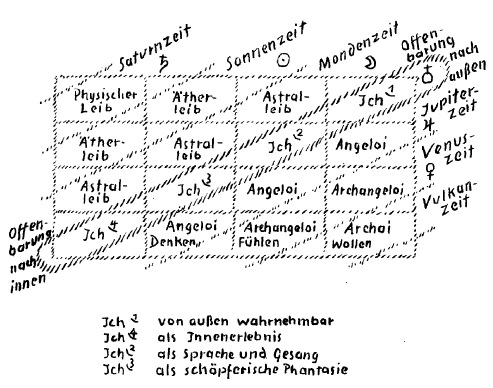
[ 28 ] You get a picture of human nature when you draw a line here. (See diagram: I 4, I 3, I 2, I 1.) If you draw a line here, you have, on the one hand, the outward manifestation of the human self; if you draw a line here, you have the inward manifestation of the human self. Between the two, you have ‘that which, I would say, is half external—the expression of the inner self outward; that is I 2. I 3 is that which is only half internal, namely, coming into the inner self from unknown depths. That which, on the other hand, lies above this slanted line here is something of the hidden human nature that lies in opposition to physical nature. What lies below this slanted line are the next spiritual hierarchies connected to the human being. Basically, when one speaks of the human being on Earth, one has hardly anything else in mind than what lies within this line. Above it, however, is everything that remains in the human being as a residue from the old Saturn, Sun, and Moon epochs.
[ 29 ] If you draw a line here (☾), you will reveal everything that lies hidden within a person from the Lunar era. If you draw a line here (○), you will reveal everything that lies hidden within a person from the Solar era. If you draw a line here (♄), you will reveal everything that lies hidden within the human being from the Saturn era.
[ 30 ] If you draw a line here (♃), you will see what will become apparent during the Age of Jupiter, when humanity will live among the angels. Draw a line here (♀), and you will see what will be revealed during the Age of Venus, and finally, here, you will see what will be revealed during the Age of Vulcan.
[ 31 ] In a certain sense, this framework gives you a rough idea of the complexity of human nature. It is good not only to view things as they present themselves in the course of our cycles, but we should also relate the individual elements to one another. Today I wanted to give you an example of how these things can be related to one another.
[ 32 ] One can, of course, arrive at such a schema in various ways. I would first like to tell you how a clairvoyant, for example, arrives at such a schema. The clairvoyant will say to himself: I stand before a person; from this person I first perceive, through physical perception, his or her outer form—everything that belongs to the exterior. But I can now deepen this form clairvoyantly; in doing so, I get to the very core of the outer form, so to speak. If I then look beyond the outer form, I perceive an etheric being, and language, singing, and indeed all sound expressions play a part in this etheric being. This deepens my understanding of the outer. In the same way, I can deepen my inner self. I can first develop my self-consciousness in the same way one develops it in ordinary physical life. But then one can also deepen it. One can pour one’s inner life into the world that otherwise manifests itself only as a product of fantasy. Then, however, something real arises. Then true imagination arises; then fantasy ceases to be mere fantasy. One enters into a feeling that tells one: fantasy is no longer mere fantasy, but plunges into something real. Something comes toward one, and one knows that this is the inner, and this is the outer (see drawing), and they meet each other.
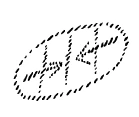
[ 33 ] This is how clairvoyant consciousness experiences it. Then what it can experience in its vision must be pieced together by placing itself in the lunar, solar, and Saturn periods. In this way, one can experience the necessity of such a schema within oneself in a clairvoyant, creative way. Those who have passed through the first stages of initiation can experience it in this way.
[ 34 ] But even if one has not yet reached this stage, one can help oneself to a certain extent so that, little by little, one comes to experience inwardly what approaches one from the outside. If you take everything that has been presented so far regarding Spiritual Science, then you can construct this schema for yourself, just as it is written here. You only need to make the effort not merely to read on sequentially, but to try to connect the things that have been presented. One can construct this schema from the available cycle material. And this is very useful, for by processing the material offered in the cycles in this way, one progresses from an external reception to an inner processing. This inner processing is of great value for real progress.
[ 35 ] Today I have given you an example of how one can construct such a schema from the cycles. I now hope that many of you will gradually construct such schemes for yourselves. Then, first of all, the empty speculation about the content of the cycles will diminish, and that is very good; and secondly, through such compilations, one will undergo genuine inner evolution. The individuals will make progress when such fruitful compilations are made. One cannot make just a few such compilations from the cycles. From what is now available as cycle material, if one makes it fruitful, one can make not only hundreds, but many, many thousands, perhaps even more, of such compilations. So you see, one has enough to do if one applies what is given in the cycles in a correspondingly fruitful way.
[ 36 ] If, on the other hand, one proceeds from such a schema to an extension of the schema, one can go even further. If you isolate what actually exists on the physical plane of the Earth—this fourfold configuration of the I—you can say: Beneath the diagonal strip lies all that is here, and above it lies all that is there. With these points, we simply need to reverse the arrangement. What has been inscribed down here, you must place up there. Then we have the six points up there; so we must make six points up there and would have to write what are here six members onto these six points. What is up here, we would have to write down here. We could make six points again, and we could write the six points there where the upper points are located.
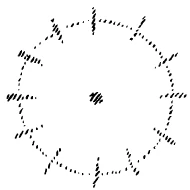
[ 37 ] But we don’t need to do that, because the cosmos has already done it for us. What is on Earth is there; and although what lives within us from the Saturn, Sun, and Moon eras is initially hidden, and what will one day come as the Jupiter, Venus, and Vulcan eras is also hidden, the traces of these are nevertheless ‘present in the universe, in the zodiac, in the circle of the zodiac.’
[ 38 ] So this framework can be expanded. Everything on Earth that is not human can also be found when we ascend or descend. This is merely a hint as to how you can connect our teachings on the elemental beings with what is contained in the cycles regarding the spiritual hierarchies and their connection to the celestial bodies.
[ 39 ] But you will also find all sorts of things regarding, say, pedagogy. Even pedagogy will become clear if we look at something like what we have just discussed in the right way.
[ 40 ] Consider that we have come to the conclusion that language and song are present in the “I.” Thus we can say: language and song have been forced out of the whole of human nature by Ahriman. Once this is properly understood, something extraordinarily important for real life will emerge. First, the principle will emerge for the pedagogy of singing that one must awaken in the student of singing an awareness of the part played by the etheric body in the process: as it were, of the continuous transmission of the tones to the etheric body. Only when this participation of the etheric body in singing is truly taken into account will that impulse for transformation also arise which, with regard to vocal pedagogy, must necessarily flow from our principles. In practical terms, this will be evident in the fact that singing teachers will increasingly guide the student to connect the sensation in the physical organs less with consciousness, but instead to develop greater consciousness in what, so to speak, lies close to these physical organs. The singer must have a feeling, not so much of the movement of the organs, but of what the air does within and around them as it moves. An emancipation of the conscious experience of the tone in the air from the experience of the tone in the organ is what will follow from the correct understanding of the principles of Spiritual Science in vocal pedagogy.
[ 41 ] Similarly, with regard to speech technique—specifically in terms of recitation—one will increasingly come to realize that this, too, involves a genuine awareness of the elemental interweaving that occurs while speaking artistically.
[ 42 ] This makes it possible for the sound to become a true artistic sound, for the speaker to gain a sense of the awareness that, by speaking artistically, one does not merely live confined within one’s own skin; rather, I would like to put it this way: the one who speaks artistically will feel the sound in the air, feel the sound in the air as a living being, and through this feeling of the sound as a living being, he will have something like an undertone, like a subtle nuance in his speech. Feeling the sound in living speech: this, in turn, will enrich the pedagogy of recitation.
[ 43 ] It is precisely by delving into the intimate aspects of Spiritual Science that something meaningful will emerge for teaching and learning in life. Much of what resonates when one touches upon such matters as those discussed today is actually still quite little known to humanity. For example, it would be good to develop an awareness of how a certain new form of vocal expression has been attempted in individual sections of my Mystery Dramas. This is easiest to follow in the seventh scene of the first Mystery Drama. But there are also such passages in the other Mystery Dramas where this can be observed.
[ 44 ] A certain inner shaping of sound—alongside everything else that lies within it—is the means by which a new element in poetic creation finds expression; an element of which there is scarcely a trace anywhere today, but which will take the place of what rhyme, end rhyme, or initial rhyme used to be in earlier times. A certain inner, I would say, ethereal-poetic experience of sound as opposed to the more external-physical experience of sound, as found in end rhyme or initial rhyme. The need is certainly there, even in our increasingly prosaic recitation, to shed the old forms. It is not easy today for anyone to embrace the use of initial rhyme or alliteration, as Jordan attempted; nor is it easy today for a reciter to emphasize end rhyme as it was originally emphasized. One prefers to emphasize according to meaning. But that is prose; that is not poetic language if one merely recites according to meaning. Poetic recitation would be: a recitation with exquisite emphasis on that which is not the prosaic element in the artistic form of expression. But this will only be possible again when, instead of focusing on the external aspects of sound configuration in rhyme or external rhythm, one attunes oneself to that inner rhythm. Thus one will have to immerse oneself in the sound in the manner I have discussed in another field: as I have discussed in recent lectures, where I spoke of immersing oneself in the individual tone in musical composition in the future.
[ 45 ] All these examples show that simply studying the theories of Spiritual Science is by no means enough; rather, what matters is an inner experience of what we take in and a permeation of the entire soul with what Spiritual Science aims to achieve, as I have already said on another occasion.
[ 46 ] This is precisely where we should begin with our building. To the extent that anything capable of providing inspiration can be placed in the physical environment, it should be placed in this building so that, through the contemplation of forms and colors, an effect may be felt throughout the entire soul and not merely in the eye. However, what has been suggested will only be fully achieved if we feel compelled to shape our entire lives in the same way—wherever it is already possible today—as was attempted in this building. But then we must also strive to truly bring Spiritual Science to life, to truly infuse it into what we undertake and wish to do. It is necessary to become aware that the spiritual-scientific worldview is intended to provide something that creates a kind of new human being within that old human being who has come to us as a legacy of earlier earthly evolution. At the same time as we take in Spiritual Science, we also take in the prerequisites that serve to help bring into being what is to be born for the future of the Earth.
[ 47 ] If one wishes to do so, one must, however, connect with Spiritual Science deeply, deeply, with one’s entire being. We have already witnessed beautiful examples of such a deep connection here and there. We have often spoken of one outstanding example. I would like to take this opportunity to mention a few words by our friend Christian Morgenstern in conclusion, which illustrate how Spiritual Science can penetrate our hearts and souls as a spiritual experience. Spiritual Science does not truly penetrate us to the extent that it is capable of doing so simply by our accepting it theoretically, but only when it becomes part of every fiber of our being.
[ 48 ] And this is an example—one among many—of how Spiritual Science has found such beautiful expression in a poem like Christian Morgenstern’s. On the surface, this poem could have been written from a different worldview, but in reality it breathes—not only in every line, but also in its vocalization—the spirit of our Spiritual Science:
I was born of God, as is all that exists,
I go to God with all that is mine to die,
I return home, O God, to live as Thine.First I was given from Your Self,
then it was necessary to acquire this gift,
to lift it to You, as a “You,” breast to breast.Then pride sought to spoil it all in the midst of it,
and it became Yours, and You were lost to it...
Until You summoned me with overwhelming power!Then I was born to You a second time:
for I understood how to die for the first time,
for I felt how to live for the first time.