

Paths to Spiritual Insight and
the Renewal of an Artistic Worldview
GA 161
27 March 1915, Dornach
Translated by Steiner Online Library
Eighth Lecture
[ 1 ] Since the last time we were able to gather here, we reflected on topics more closely tied to specific experiences; today, we would like to take a broader look at Spiritual Science in general. During these Easter reflections, we will have the opportunity to discuss a variety of topics, including more specific ones, as we will continue today’s reflections next week.
[ 2 ] Today I would like to start from the premise—which, deep down, you all have long known—that all insights in Spiritual Science are gained not by acquiring knowledge with the aid of the physical body’s instruments, but by freeing the soul-spiritual from the physical instrument, thereby allowing the soul-spiritual to enter into direct connection with the spiritual worlds. This direct connection with the spiritual worlds is interrupted in ordinary life and ordinary cognition by the fact that, in the waking state, we must always make use of the instruments of our physical body if we wish to enter into a relationship with the world. And in the sleeping state, all our will is concentrated on our connection with the body, so that the longing for the body spreads like a mist throughout our soul-spiritual being during sleep and prevents us, while in the sleeping state of ordinary life, from experiencing anything in the spiritual worlds in which we are, after all, present.
[ 3 ] The point is that those engaged in Spiritual Science must truly and clearly understand the value of Spiritual Science work as such, and the relationship between this work and the personal striving that, through meditation and the concentration of thoughts, feelings, and impulses of will—or by any other means—brings a person into the spiritual world. For we must be clear about this above all else, and it is a profound, significant truth that the unity which, so to speak, surrounds us in the ordinary world does not exist in the same way in the spiritual world. I have already pointed out that this unity is rooted in the entire structure of the spiritual-soul human being. How most people strive, time and again, to ask: What is the unity of the world? — How they are only satisfied when they can reduce everything to a single principle!
[ 4 ] In fact, the external physical world presents itself to us, in the highest sense, as a whole, as a unified entity, and those people who are, so to speak, completely dominated by the “devil of unity” arrive at all manner of intellectual abstractions as they seek the unifying principle of the world.
[ 5 ] Typical examples include personalities such as an elderly gentleman who once approached me one evening when I saw him again and told me, with the most intense sense of discovery, that he had finally found a unified principle by which he could explain all phenomena in the world. This unified principle, he said in his joy of discovery, could be expressed in ten to twelve words. And he was so happy about this that he said: “I can now explain the entire cosmos.”—He wanted to explain hell, earth, and heaven based on this unified principle.
[ 6 ] I was recently reminded of this episode, which took place many years ago, when someone wrote to me saying that he urgently needed to speak with me because he had met a person who was able to impart a worldview that completely satisfies the soul to another person in five minutes. I hardly need to mention that there can be no time for such conversations within a serious spiritual movement. But those people who are thus possessed by the devil of uniformity—who is always, at the same time, a kind of devil of convenience—are particularly numerous in our time.
[ 7 ] Above all, we must take to heart what is expressed in How to Attain Knowledge of the Higher Worlds: that as soon as we cross the threshold of the spiritual world, we are truly led into a threefold experience. I have emphasized this particularly in this book: that the soul is, as it were, divided into three; and as the soul crosses the threshold of the spiritual world, there is actually nothing left that makes it possible to believe in the “devil of unity,” in this convenient “devil of unity.”
[ 8 ] Yes, we ourselves feel that as soon as we cross the threshold into the spiritual world, we actually enter three worlds with our entire being—truly enter three worlds. And we must not lose sight of the fact that, once we have crossed the threshold into the spiritual world, we clearly experience these three worlds. Even with the entire formation of our physical body, we actually belong to three worlds. I would like to say: For this marvelous structure called “human being,” which confronts us in the physical world, the interaction of three worlds—which have a relatively strong independence from one another—is truly necessary. And when we consider the formation of our head, the formation of everything that belongs to the head, then we must, even if we speak only of the physical head, be clear that the formative power of our head—and also the beings who act and create within these formative powers—belong to a completely different world than, for example, the formative power of our chest, the formative power of everything that belongs to our heart, including the arms and hands. It is, as it were, as if the formative power of these material parts of the human being belonged to a completely different world than the formative powers of our head. And again, the abdominal organs and the legs belong to a completely different world than the other two limbs that have been mentioned.
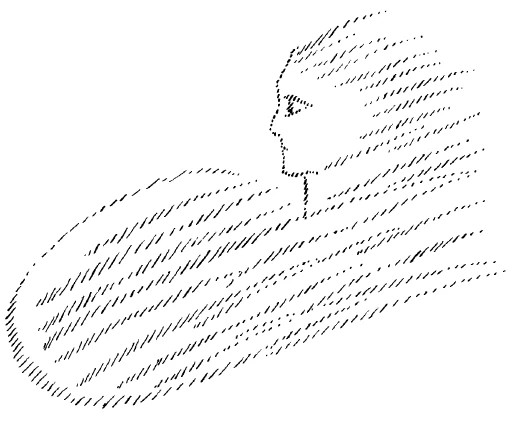
[ 9 ] Now you may ask: What is the significance of all this? It is of great significance because, fundamentally, the current human cycle is such that pure, genuine, truly authentic results of Spiritual Science can only be obtained by lifting our spiritual-soul aspect out of the head. So that, in a sense, this is the clairvoyant aspect of a human being who is to produce observations from Spiritual Science that can truly serve humanity today (see drawing). This clairvoyant aspect is to be understood in such a way that the spiritual-soul aspect is here brought to the fore, and that this spiritual-soul aspect is, as it were, connected—as through a spiritual-electrical connection—to the forces of the cosmos. Thus, everything—from the ego and the astral body up to the etheric body—must be drawn out. This drawing out is then, of course, linked to the development of the so-called lotus flowers. But the forces that set the lotus flowers in motion lie in this emphasized or to-be-emphasized part of the human spiritual-soul aspect.

[ 10 ] What is attained in this way—where clairvoyance is, so to speak, a form of mental clairvoyance—can be a result of Spiritual Science in our time; for this mental-clairvoyant result serves humanity. The clairvoyant result brought about by emphasizing the spiritual-soul aspect of the organs of the heart, arms, and hands is of a completely different nature. This emphasis also differs significantly in its inner nature from what comes about through what I would like to call head clairvoyance. The emphasis on the physical heart organ is brought about more through meditation that relates to the life of the will; it is brought about through humble surrender to the world process, whereas mental clairvoyance is brought about more through mental images, in the realm of imagination, but also through sensory perceptions.
[ 11 ] In general, with regard to these two types of clairvoyance, it is the case that, as heart clairvoyance—or chest clairvoyance—develops to the extent that it is meant to, head clairvoyance develops alongside it. Chest clairvoyance leads more to the development of the will, to a connection with the actions of spiritual beings of lower hierarchies, such as those incarnated in the various kingdoms of the Earth, while head clairvoyance leads more to the beholding, the recognition, and the perception of the higher worlds that are truly more important to human beings at first; worlds that are more important and higher in the sense that knowledge of these higher powers is necessary to satisfy certain needs for insight that must arise more and more in present-day humanity. The more we move toward the future of our development on Earth, the less people will be able to live—without their soul life becoming parched—if they cannot incorporate the results of this clairvoyance into their understanding.
[ 12 ] And yet another type of clairvoyance is that which arises when the spiritual-soul aspect—what might be called the spiritual-soul aspect—is separated from the rest of the human being. I would have to indicate this separation down there, toward the end, in the drawing ($. 158).
[ 13 ] Although the term isn't particularly elegant, I might perhaps call this type of clairvoyance “abdominal clairvoyance.” This way, one can truly distinguish between head clairvoyance, chest clairvoyance, and abdominal clairvoyance.
[ 14 ] While head clairvoyance leads, in the truest sense, to the attainment of results independent of the human being, abdominal clairvoyance leads primarily to the attainment of results related to what is taking place within the human being. What is going on within the human being must, of course, also be the subject of research, since even in the field of physical research there are anatomy and physiology, which deal with all of this. One must not get the impression that this abdominal clairvoyance could not have a certain value, in the highest sense of the word. Of course it has its value. But one must be clear that this abdominal clairvoyance can teach the human being very little about what takes place impersonally in cosmic processes; that it essentially teaches the human being about what is going on within the human being—I would say, within the human being’s skin.
[ 15 ] I will discuss other differences between head clairvoyance and gut clairvoyance later, but in terms of morality and ethics, these two types can essentially be quite clearly distinguished internally as well. Chest clairvoyance lies in between, between head clairvoyance and gut clairvoyance. In terms of ethics, head clairvoyance is relatively the most important. People who strive, in an impersonal way—in the sense indicated in “How Does One Attain Knowledge of the Higher Worlds?”— to attain a vision of the higher worlds—people who do not allow themselves to be deterred from walking this uncomfortable but sure path—will, with regard to their clairvoyance, also develop something impersonal within themselves, above all a higher interest in objective knowledge of the world, in what is taking place in the world of cosmic and historical becoming.
[ 16 ] This clairvoyance of the head will speak primarily of the human being in the sense that it draws attention to how the human being places themselves within the cosmic and historical course of life, draws attention to what the human being is within the totality of the world process, and whatever emerges from this clairvoyance of the head will always have an impersonal, I would say, a general-scientific character; it will contain messages of importance—I ask that everyone pay close attention to this word, not just one person or another.
[ 17 ] What is known as “intuitive insight” is likely to be permeated by all manner of human self-interest; indeed, it is very easy for the clairvoyant in question to become preoccupied with himself, with the occult underpinnings of his own destiny, and with the occult underpinnings of his personal worth and character. This arises as a natural inclination from what is called clairvoyance.
[ 18 ] Now, with regard to the perceptible world, a marked difference arises between the two types of clairvoyance. The person who strives, first of all in the sense described in How Does One Gain Knowledge of the Higher Worlds?, to free his soul-spiritual being from the head’s apparatus of perception—which, in a sense, detaches the spiritual-soul part of the head from the physical instrument—and to be able to enter into the spiritual world with this spiritual-soul part of the head, will find it extremely difficult to move beyond mere shadowy clairvoyant experiences. This stepping out of the head is initially associated with experiences that truly lack even the color and richness of vivid memories—that is, they appear, so to speak, very colorless within— and only when one presses on further and further in the efforts that lie along this path does it become apparent that the shadowy character of these experiences fades, and that, as it were, the colorless and shadowy experiences are tinged with color and sound.
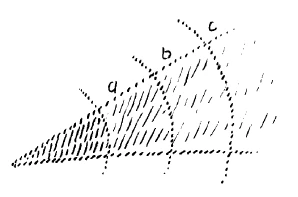
[ 19 ] For the process taking place here is that we first step out of our minds and find ourselves in a world within it that we have great difficulty perceiving. Then, as we gradually, slowly acquire the ability to live outside our heads, these inner life forces are strengthened, and the result is that the forces flowing in from the entire circumference of the world are drawn together. So imagine that the forces must be drawn in from the entire circumference of the world, and when we draw in all the forces from the circumference of the world, then we receive the coloring with color and sound. Imagine, to create a mental image of this, that you have here—a—a surface that is very strongly colored, a spherical surface. And now imagine this spherical surface extended over a large area—b, c—. There the color becomes much paler, and if we extend it even further, the color becomes paler and paler; if we were to bring it back in, we would, if this is a pale yellow, obtain a very intense, saturated yellow here, because the same number of color points is then concentrated more closely together.
[ 20 ] Now clairvoyance faces the entire cosmos, and spread across the entire cosmos is that which the human being must first concentrate with his life forces into what he himself is, clairvoyantly speaking, in terms of his essence; so that he truly only gradually tints the shadowy nature of his experiences through the laborious process of inner development. And then, when one has long, long striven to attain the general experience that gives one only the feeling of being outside one’s body, and when one has had this general experience for a long time and has increasingly gained the sense of having a more intense, though not yet colored or resonant, inner experience, then the realms of the cosmos gradually approach the clairvoyance of the head.
[ 21 ] This is a matter of slow, selfless development. In particular, it must be said that the study of Spiritual Science is indispensable to this development. It must be emphasized again and again that Spiritual Science, once it is presented, can truly be understood. It cannot be emphasized often enough that one does not need to be a clairvoyant to understand Spiritual Science. Of course, one must be a clairvoyant to arrive at the results; but once they are there, one need not be a clairvoyant.
[ 22 ] This understanding of Spiritual Science must precede the actual act of seeing. Here, too, one can say: the correct path is the reverse of the one that is correct in the physical-sensory world. In the physical-sensory world, we first have the correct perceptions, then we move on to intellectual contemplation; we form our scientific judgments afterward. When ascending into the spiritual world, it is the other way around. There we must first develop the concepts and mental images, must make an effort to objectively acclimate ourselves to Spiritual Science; otherwise we can never be sure that any observation in the spiritual world is interpreted by us in the right sense. There, science must indeed precede the act of seeing. And that is what is so infinitely uncomfortable for many: that they are supposed to study Spiritual Science. Many accept this as an incomprehensible imposition. For they strive to have visions in the spiritual world. Certainly, these can be obtained relatively easily; but to interpret them correctly requires that one truly engage with Spiritual Science objectively and selflessly, and allow it to permeate one’s being.
[ 23 ] Now, the exact opposite is true of what might be called “intuitive perception.” Here we start from the spiritual-soul aspect that initially worked on our physical-bodily aspect. For everything that exists in the world has a spiritual foundation. If you have, say, eaten a piece of kohlrabi—we are, after all, mostly vegetarians—and it is then processed in our organism, we are not merely dealing with the physical-chemical process carried out by the stomach with its forces and juices, but behind all of this, the etheric body, the astral body, and the ego are at work. All these processes are underpinned by spiritual processes. It would be entirely wrong to believe that there are material processes that do not have a spiritual process behind them.
[ 24 ] Now imagine that you lie down after a more or less sumptuous lunch and become clairvoyant—so clairvoyant, in fact, that the spiritual-psychic aspect of the digestive organs stands out from these organs above all else. Then, while your stomach and the other organs are digesting properly, you live with your spiritual-soul aspect within the spiritual-soul realm itself. And while the spiritual process taking place in your etheric body, astral body, and I would otherwise remain unconscious to you, it comes to your consciousness when you become clairvoyant, and you can then, by experiencing yourself within the spiritual-psychic realm, see all that working, forming, and creating of the spiritual-psychic realm on the limbs of the body during digestion; see it as it projects itself out into the world and appears to you, reflected pictorially, in the outer ether. Then, because you now do not have to draw the color so much from the cosmos, but because the entire process is playing out concentrated within your own skin, you receive the most beautiful clairvoyant images. So that a wondrous phenomenon unfolding around you in the most magnificent, lightest processes of color and form need be nothing other than the digestive process taking place in the human spiritual organs or some other process occurring within the body.
[ 25 ] This form of clairvoyance differs from the other in one particular respect: while the other form of clairvoyance begins with shadowy images that are only laboriously imbued with color and tone, this one begins with the most beautiful and magnificent things one can see. One can almost state it as a law: when clairvoyance begins with the most magnificent forms, especially with forms of color, then it is a form of clairvoyance that relates to processes taking place within the individual. I would, however, like to emphasize explicitly that it can be of great value for the exploration of the spiritual world. Just as the anatomist and the physiologist must investigate the digestive process and other processes, so too does it have the highest scientific value to explore in this way the spiritual, the spiritual realm, that lies behind human processes. But it would be disastrous to succumb to any delusions, to succumb to illusions, and to fail to interpret things correctly.
[ 26 ] If one were to believe that such clairvoyance, occurring without the proper preparation, could reveal more than what takes place within the human being and is projected out into the objective world; if one were to believe that, through such clairvoyance, one could, so to speak, draw closer to the ruling world powers, the dominant spiritual forces—one would be greatly mistaken. Just as one cannot solve the mysteries of the world by studying human digestion, so too can one not come closer to the world’s mysteries and secrets by developing this abdominal clairvoyance.
[ 27 ] So you can see how much is required to truly orient oneself correctly in the world we enter as our spiritual and soul forces are set free. No one should, for example, develop an aversion to abdominal clairvoyance because of the discussions that have been held on the subject. But everyone should be clear about how such clairvoyance relates to what can truly become spiritual clairvoyance, and how one must guard against any external overestimation of that which is gained through clairvoyance in such a way that it can have only a personal content. Only when one can, in regard to these things—which also have personal content—set aside the personal and view them as the anatomist or physiologist views what he experiences through dissection or obtains through his investigations; only when one transitions to a scientific perspective—only then do these things possess a special value. In any case, no religious feelings whatsoever may be attached to these things; they can only be attached to the results of intellectual clairvoyance. And one does justice to the other form of clairvoyance all the more the more one insists that its results be treated solely in a scientific-objective sense, just like the results of anatomy and physiology.
[ 28 ] Not everything discovered through clairvoyance is—and I want to state this radical proposition—worthy of worship; but everything is worth learning. That is what we must keep in mind. I said that for our series it is particularly important to incorporate the results of intellectual clairvoyance into the general spiritual culture of humanity; and that is truly important. Today, in regard to this importance, I would like to mention one aspect of the matter. We truly live in a time in which humanity must prepare to gradually move beyond mere philosophical idealism and enter into a genuine awareness of the spiritual worlds, of the general spiritual world in which we live, just as we live in the physical world.
[ 29 ] Now, let us take as our starting point an experience of mental vision, which we will easily understand once we have delved a little deeper into the ideas presented in the Munich lecture series held most recently, and which are also elaborated upon in my book The Threshold of the Spiritual World. I mentioned there in particular that our thinking undergoes a transformation at the moment when we free ourselves—especially with regard to our thoughts—from the physical instrument of the head. I expressed it grotesquely at the time by saying: When we become free in this way, our thoughts no longer have the character they have in ordinary, everyday life. In ordinary, everyday experience, we must have the feeling—unless we are insane—that we are masters of our world of thoughts, that when we have two thoughts, it is we who connect or separate them.
[ 30 ] When we remember, we realize that through our inner life we move from a present experience to a past one. We always have the feeling that we are the ones standing behind the fabric and ebb and flow of our thoughts. This ceases the moment we allow the spiritual-soul aspect in the head region to become free from the physical instrument, the moment we develop a mode of thinking that is liberated from the body. I once put it rather radically: It is as if we had stuck our head into an anthill, where everything begins to swarm. In the same way, thoughts also begin to develop a life of their own and to interplay chaotically. And when in ordinary life we have two thoughts and connect them—such as the two thoughts “rose” and “red”—we know that we are masters in our world of thought, connecting the concepts to form “the rose is red” and the mental image “the red rose.” This is not the case when we are outside the body. There, our thoughts come to life—the independent life of thoughts. Every thought becomes a being. One thought runs toward another, another runs away from the other.
[ 31 ] So the world of thought takes on a life of its own. Why does it take on a life of its own? Well, what we experience in our ordinary, everyday thinking are merely images, mere shadows of thoughts. You can read about this in my book Theosophy. As soon as we develop thinking independently of the body, every thought becomes like a shell, and an elemental being slips into that shell. The thought is no longer under our control: we let it go out into the world like a feeler, and an elemental being slips into it. Our thoughts are thus, as it were, filled with elemental beings, and this swirls and roars, weaves and stirs within us. So that we can say: When we insert the spiritual-soul part of our head into the spiritual world—we have it out there only because we are not inside it in the physical head—when we insert it into the spiritual world in this way, then we no longer experience thoughts as we experience them in the physical world, but we experience the life of beings. We insert our head, as I said back then, as it were, into an anthill. We experience the life of beings.
[ 32 ] This is essentially how it is all the way up to the beings of the highest hierarchies. And if we wish to experience an angel, an archangel, or a spirit of personality, we must extend our thoughts in the manner described. The being must envelop itself in our thoughts. We send out our thoughts, and the being slips into them and moves within them. When we perceive the beings on Venus or on Saturn, it is the case that we let our thoughts slip out, and the Venusian and Saturnian beings slip in. We must not fear no longer having earthly-human thoughts, but rather thoughts of the Hierarchy. We must accustom ourselves to living with our minds within the higher Hierarchies. We must tell ourselves: our thinking ceases, and our mind becomes the stage for the activity of the higher Hierarchies.
[ 33 ] The fact is that in the philosophy of Fichte, Schelling, and Hegel, thought was brought to its purest clarity at the beginning of the 19th century. What thought is capable of aspiring to is truly contained within this philosophy. The task of bringing thought to its highest point has been accomplished there. The next step, however, is for thought to step outside itself so that we can truly enter into the swirling and weaving life of thought. Thus we live in a time—one might say—when humanity is called upon to perceive the higher hierarchies. We are to be received by the world of the higher hierarchies, and we must cast off the fear of losing our thoughts to the life and weaving of the higher hierarchies.
[ 34 ] The 19th century was entirely filled with this fear, this dread of life in the higher hierarchies. That is where people had brought themselves; they did not know it, but deep down they were praying: “Oh, my dear Ahriman”—they did not know Ahriman, so the prayer had a different content—my dear Ahriman, protect me from having my thoughts claimed by the weaving and life of the higher hierarchies; for otherwise I might one day have in my thoughts, instead of the earthly things my mind has speculated out, some Uranus being, a Jupiter, Saturn, or Sun being, and this might swirl about within me! You will say: No one thought that way in the 19th century. — But I will nevertheless provide you with proof that people did think that way.
[ 35 ] Ludwig Feuerbach, a 19th-century philosopher who fought particularly hard against the idea of immortality and against any belief in a supernatural world—because he regarded such belief as that of a fanciful -mystical fantasy and regarded it as harmful to all of humanity. This Ludwig Feuerbach wrote the following sentences in his book Thoughts on Death and Immortality. I ask you to take these to heart:
“The active person, preoccupied with the affairs of human life, has no time to think about death, and consequently no need for immortality; and even if he does think of death, he sees in it only a reminder to invest the capital of life allotted to him wisely, not to waste precious time on unworthy things, but to devote it solely to the fulfillment of the life’s work he has set for himself.”
“If man were to find his fulfillment only beyond Earth, in heaven on Uranus or Saturn or wherever you will, then there would be no philosophy, no science at all. Instead of general, abstract truths and essences being the objects of our mind, instead of the thoughts, insights, and concepts—these purely spiritual beings and objects that now inhabit our minds—our heavenly brothers, the beings of Saturn and Uranus, would then be the inhabitants of our minds. Instead of mathematics, logic, and metaphysics, we would have the most precise portraits of the heavenly inhabitants. For those celestial beings would interpose themselves between us and the objects of knowledge and thought; they would block our view of those objects, causing an eternal, perfect solar eclipse in our minds.”
For Feuerbach, the “Sun” is: his thought.
[ 36 ] So he has the full picture of what ought to happen there. But he is so utterly terrified of it that he prays to the good Ahriman to spare him from the possibility that human beings here might attain this. He believes that then there would be no mathematics, no logic, but rather inhabitants of Saturn and Uranus in our minds.
“They would be closer to us and more akin to us than thoughts, ideas, and concepts, for they are not purely spiritual or abstract beings like these, but sensually spiritual beings—beings that express nothing but the essence of the imagination. Our entire mind would then be nothing but a dream, a vision of a more beautiful future. Therefore, whoever is prevented by the weight of reason from swimming on the surface of the boundless ocean of imagination will recognize that in the depths of our mind, as in an atmosphere they cannot breathe, the light of life of the angels and all other similar heavenly beings is extinguished... ."
[ 37 ] “If these beings were to enter into our thoughts,” writes Feuerbach, “then our spirit would be a dream.” He feels secure only within the realm of thought; and should the essence of angels and other heavenly beings enter into these thoughts, then he feels insecure. This is the prayer to Ahriman: that he may protect humanity from knowledge of the spiritual worlds. So wrote Ludwig Feuerbach, the opponent of any spiritual worldview, in the 1840s. What does this mean? It means nothing other than that the time is ripe to rise up to the spiritual worlds; for one need only take seriously what this man describes, and one has found the path into the spiritual worlds. One simply need not fight it through connection with Ahriman. So you see—if I may put it this way—: It is not in the heavens that Spiritual Science does not penetrate our contemporary culture, for it penetrates even the minds of its opponents. It wants to enter the world. It is not, then, a matter of fate; the gods bestow wisdom upon humanity: Spiritual Science is making its way in. Just as people have resisted under the leadership of Ahriman, so it is up to us to cease resisting and instead truly have the courage to take Spiritual Science with full, genuine seriousness.
[ 38 ] This is what one must say with regard to this development of the 19th century. One must say: It is as if it were predestined in the spiritual world that the spiritual age should follow the idealistic age, and it is up to human beings to open their minds and hearts to receive this spiritual world. That which was, in the most eminent sense, a materialistic worldview—as exemplified by Ludwig Feuerbach, its characteristic, spirited, and immensely philosophically gifted representative—is like an onslaught, a resistance against that which is meant to enter into humanity. The spiritual forces descend from above. The forces of understanding and the forces of cognition must truly rise up from below. One might say: it is a characteristic expression that Ludwig Feuerbach found for himself: A solar eclipse of the soul would have to begin if thoughts were to cease being thoughts, but instead the beings of Uranus, Venus, and Saturn and so on were to intervene—that is, the higher hierarchies. A solar eclipse of the spirit would then occur. People have had a hopeless fear of this. But this eclipse of the spirit is not caused by celestial beings; they, after all, want to bring their light into human beings. Human beings have brought about this darkness by uniting with Ahriman, and by spreading a cloud of fear around themselves aurically, they have sought to carry out their attacks against the spiritual world’s penetration. It is thus clear, however, that the eclipse originated with human beings, and it must also be said that this eclipse has gripped people more and more—this clouding of a free cognition that reaches out toward the brightness of the spirit.
[ 39 ] This is what people have brought upon themselves, and so one can see how, over the course of the 19th century, a certain fondness, a sympathy for all brief, inconsistent thoughts has emerged—for everything that does not need to be thought through to its conclusion. A preference, a sympathy has arisen for all that for which one does not wish to give a final account. An unbiased, unconditional recognition and thinking was loved less and less, and therefore it is not surprising that gradually this love of the nebulous, the unclear, the intellectually unfinished, has even taken on a morally questionable character in public life. But as this character is favored, sympathy for intellectual life becomes dulled, which then also spills over into general behavior. This particularly highlights a major counterforce against Spiritual Science, which strives for clarity on all sides.
[ 40 ] Spiritual Science must truly have sympathy and love for consistent, fully formed thoughts, not for half-formed ones; it must not wish to remain in obscurity and darkness, but must seek out wherever light is spread far and wide, not merely a dim glow in a confined space. And in this regard, we will still have much, much to fight through. One can have quite strange experiences in precisely such areas when karma brings one to these experiences at just the right moment. And indeed it does. You see, a few years ago you could read an article in a magazine called “Hochland” that was directed against our spiritual-scientific worldview, citing all sorts of foolish nonsense against our Spiritual Science. Now, this very article in the magazine “Hochland” stirred up quite a bit of dust. It was widely read, and the author was regarded as a particularly outstanding philosopher, especially since the magazine “Hochland” had also done everything in its power to point out to the world that in Dr. Lutoslawski, the writer of this article, it had gained a capable philosopher whom it could field against Spiritual Science.
[ 41 ] Recently, however, the following has come to light: That Dr. Lutoslawski has written letters to the editor of Hochland, Karl Muth, which the latter dislikes so much that he says: In our country—that is, in his country—only the inmates of insane asylums would write such crazy stuff as is contained in these letters. — And he is now publishing in the “Süddeutsche Monatshefte” the remarks made by the philosopher. We will not go into what these remarks refer to here; I merely wish to draw attention to the fact that the very man who says this must add: “In publishing this letter from Lutoslawski, it might be appropriate to learn about his personal connections.” — Now he provides curious biographical details about him and then publishes a letter from him, about which he says that such omissions can be expected at most from someone filled with inner hatred.
[ 42 ] So one is faced with the fact that the editor of the journal Hochland used the very man he is now casting aside as a battering ram against the worldview of Spiritual Science. For I believe that if someone may be called a fool once, then one has the right to regard him as a person who speaks like a fool in other respects as well. And it would be consistent of the editor of the journal if he were now to say: “Well, it follows from this that I had Dr. Steiner’s theosophy condemned back then by such a foolish fellow.” — He will be careful not to do that. People simply have no sympathy for true consistency where that consistency is supposed to extend into life.
[ 43 ] However, such things do give one a sense of where the origins of those forces that oppose theosophy and Spiritual Science—as we seek to cultivate them in a truly scientific sense—actually lie for the most part.
[ 44 ] I’ve highlighted this incident because karma has brought it to me, especially in the last few days. It’s strange, this karma. You walk past a bookstore. Someone walking with you, who probably doesn’t even think there’s anything special about it, points to a magazine in the window. I go into the bookstore, buy the magazine, and there it is. Even for ordinary everyday experiences, there is a good guidance of karma. From the table of contents printed on the outside of the magazine, it is not apparent that this article is inside, the one that casts the author in such a strange light.
[ 45 ] And one could now present many, many such examples to your minds. But you will understand that, in light of what I have just said, the responsibility placed upon each of us regarding such matters is truly growing ever greater, regardless of what one might otherwise think about them. No one needs to rely on any authority to have this or that thought, or to form this or that judgment. Of course, everyone could think differently about this article without their thinking necessarily taking a particular direction. What is necessary is that our sense of responsibility grows ever greater and that we increasingly realize that we must do everything possible to find ways to introduce Spiritual Science into today’s world culture. And some of the things that have happened in recent times in connection with the great world events make it urgently necessary that, in the near future, some of what has been left undone actually be published.
[ 46 ] These are the points I wanted to raise in our discussion to show how, over the course of the 19th century, Ahriman’s influence led people to deny the spiritual world, yet how he himself was at work even in the thoughts of those who denied it, because the time has come. “The time has come”: this phrase from Goethe’s fairy tale is fitting here.
[ 47 ] This needs to be confirmed in the near future.