

Artistic and Existential Questions
in the Light of Spiritual Science
GA 162
30 May 1915, Dornach
Translated by Steiner Online Library
Fourth Lecture
[ 1 ] If you consider the remarks I made here yesterday in conjunction with the other lectures I gave here a week ago, you will, in a sense, gain an important key to much of what is involved in Spiritual Science. I would simply like to outline the main ideas we need for our further considerations, so that we can orient ourselves. About eight days ago, I pointed out the significance of the processes that, from the perspective of the physical world, are called processes of destruction. I pointed out that, from the perspective of the physical world, one actually sees the real only in that which comes into being—that which, so to speak, emerges from nothing and comes into perceptible existence. So we speak of the real when a plant breaks free from its root, develops leaf by leaf until it blooms, and so on. But we do not speak of the real in the same way when we look at processes of destruction—at the gradual withering, the gradual fading away, the ultimate flowing away, one might say, into nothingness. For anyone who now wishes to understand the world, however, it is absolutely essential—in the most profound sense—that they also look toward so-called destruction, toward the processes of dissolution, toward that which ultimately appears to the physical world as a flowing into nothingness. For consciousness in the physical world can never develop where merely sprouting, budding processes take place; rather, consciousness begins only where what has sprouted in the physical world is in turn worn away and destroyed.
[ 2 ] I have pointed out how the processes that life evokes within us must be destroyed by the soul-spiritual if consciousness is to arise in the physical world. It is indeed the case that when we perceive anything external, our soul-spiritual nature must set destructive processes in motion within our nervous system, and these destructive processes then give rise to consciousness. Whenever we become aware of anything, the processes of consciousness must arise from processes of destruction. And I have pointed out how the most significant process of destruction—the one most significant for human life—the process of death, is precisely the creator of consciousness for the time we spend after death. Through the fact that our soul-spiritual nature experiences the complete dissolution and detachment of the physical and etheric bodies—the merging of the physical and etheric bodies into the general physical and etheric world— through this, our soul-spiritual nature draws the strength—from the process of death, our soul-spiritual nature draws the strength—to be able to have processes of perception between death and a new birth. The words of Jakob Böhme: “And so death is the root of all life”—gain their higher significance for the entire context of world phenomena through this.
[ 3 ] You have no doubt often asked yourselves this question: What actually happens during the time the human soul spends between death and a new birth? — It has often been pointed out that, for a normal human life, this period is a long one in comparison to the time we spend here in the physical body between birth and death. It is short only for those people who live their lives in a way that is contrary to the world—that is to say, who end up doing only what can truly and genuinely be called criminal. In such cases, there is a short interval between death and a new birth. But for people who are not merely given over to selfishness, but who live their lives in a normal way between birth and death, there is usually a relatively long interval between death and a new birth.
[ 4 ] But the question must, I would say, burn in our souls: What, after all, determines the return of a human soul to a new physical embodiment? The answer to this question is intimately connected with everything we can know about the significance of the processes of destruction that I have described. Just consider for a moment that when we enter physical existence with our souls, we are born into very specific circumstances. We are born into a specific era and drawn to specific people. So we are born into very specific circumstances. You must really take to heart the fact that our life between birth and death is, in essence, filled with everything into which we have been born. What we think, what we feel, what we experience—in short, the entire content of our life—depends on the time into which we have been born.
[ 5 ] But now you will also be able to easily understand that what surrounds us when we are born into physical existence depends on preceding causes—on what has happened before. Suppose—if I were to draw this schematically—that we are born at a specific point in time and go through life between birth and death. (A diagram was drawn.) If you consider what surrounds you, it does not exist in isolation, but is the effect of what came before. What I mean is: You are brought together with the past, with people. These people are the children of other people, who in turn are the children of still other people, and so on. — If we consider only these physical generational relationships, you might say: As I enter physical existence, I take on certain traits from the people around me; during my upbringing, I take on many traits from the people who surround me. — But these people, in turn, have also absorbed a great deal from their ancestors, from their ancestors’ acquaintances and relatives, and so on. One could say that, going further and further back, people must seek the causes of who they themselves are.
[ 6 ] If we let our thoughts go further, we can say that we can trace a certain current back beyond our birth. This current has, as it were, carried everything that surrounds us in the life between birth and death. And if we continue to trace this current upward, we would eventually arrive at a point in time corresponding to our previous incarnation. So, by tracing time back before our birth, we would find a long period during which we dwelt in the spiritual world. During this time, much took place on Earth. But what took place there shaped the conditions in which we live—the conditions into which we are born. And then, finally, in the spiritual world, we also arrive at the time when we were on Earth in a previous incarnation. When we speak of these circumstances, we are certainly speaking of average circumstances. Exceptions are, of course, very numerous, but they all fall, I would say, within the range I indicated earlier for souls who come to earthly incarnation more quickly.
[ 7 ] What, then, determines that—after a certain time has passed—we are reborn right here again? Well, if we look back at our previous incarnations, we see that during our time on Earth we were also surrounded by certain circumstances, and these circumstances had their effects. We were surrounded by people; these people had children and passed on to them their feelings and mental images, and the children in turn passed them on to the next generation, and so on. But if you follow the course of history, you will say to yourself: There comes a time in the course of evolution when one can no longer recognize anything truly identical or even similar in the descendants compared to the ancestors. Everything is passed on, but the fundamental character present at a certain time appears weakened in the children, even more weakened in the grandchildren, and so on, until a time comes when nothing of the fundamental character of the environment in which one lived in the previous incarnation remains. Thus, the flow of time works to destroy what was once the fundamental character of that environment. We witness this process of destruction in the time between death and a new birth. And when the character of the earlier age has been erased, when nothing of it remains, when that which, so to speak, was the focus of our earlier incarnations has been destroyed, then the moment arrives when we re-enter earthly existence. Just as in the second half of our life our existence is, in a sense, a kind of shedding of our physical being, so too must a kind of shedding of earthly conditions take place between death and a new birth—a annihilation, a destruction. And new conditions, a new environment into which we are born, must be in place. So we are reborn when everything for the sake of which we were previously born has been annihilated and destroyed. Thus, this idea of destruction is connected with the successive return of our incarnation on Earth. And what our consciousness creates at the moment of death—when we see the body falling away from our spiritual-soul nature—is strengthened at that moment of death, through this witnessing of destruction, in order to witness the process of annihilation that must take place within earthly conditions between our death and a new birth.
[ 8 ] Now you will also understand that the person who has absolutely no interest in what surrounds him on Earth—who, fundamentally, is not interested in any human being or any creature, but is concerned only with what benefits himself, and simply drifts from one day to the next—is not very strongly connected to the circumstances and things on Earth. Nor do they have any interest in observing their slow erosion; rather, they return very soon to set things right, to truly live with the circumstances they must live with, so that they may learn to understand their gradual destruction. Those who have never lived with earthly circumstances do not understand their destruction or their dissolution. Therefore, those who have lived very intensely within the fundamental character of a particular age—who have immersed themselves deeply in the fundamental character of a particular age—will, above all, have a tendency, unless something else intervenes, to bring about the destruction of the age into which they were born, and to reappear when something entirely new has emerged. Of course, I would say there are exceptions at the higher levels. And these exceptions are particularly important for us to consider.
[ 9 ] Let us suppose that one immerses oneself in a movement such as the Spiritual Science movement is today, at this moment in time, when it is out of step with everything in its surroundings, when it is something completely foreign to its surroundings. In that case, this Spiritual Science movement is not something into which we were born, but rather something we must work on—something we specifically want to see enter into the spiritual cultural development of the Earth. The task, then, is above all to live with the conditions that are hostile to Spiritual Science, and to reappear on Earth when the Earth has changed to such an extent that the conditions of Spiritual Science can truly take hold of cultural life. So here we have the exception on the upper end. There are exceptions both upward and downward. Certainly, it is precisely the most dedicated practitioners of Spiritual Science today who are preparing to reappear in an earthly existence as soon as possible, while at the same time working during the course of this earthly existence to ensure that the conditions into which they were born disappear. So you can see, if you take the last thought to heart, that you are, in a sense, helping the spiritual beings to guide the world by devoting yourselves to what lies in the intentions of the spiritual beings.
[ 10 ] When we consider the circumstances of our time today, we must say: On the one hand, we have, in a very striking way, what is leading into decadence and decline. — In a sense, those who are wholeheartedly devoted to Spiritual Science have been placed in this age to witness how ripe it is for decline. Here on Earth, they are introduced to that which can only be known on Earth, yet they carry this up into the spiritual worlds; they now witness the decline of the age and will return when this is to give rise to a new age—which lies precisely in the innermost impulses of Spiritual Science endeavor. In this way, the plans of the spiritual guides—the spiritual leaders of Earth’s evolution—are, so to speak, furthered by what such people, who engage with something that is, so to speak, not part of contemporary culture, take in within themselves.
[ 11 ] You may be familiar with the accusations frequently leveled by people today against adherents of Spiritual Science—that they concern themselves with something that often appears outwardly fruitless, something that outwardly has no bearing on contemporary circumstances. Yes, there is indeed a need for people in earthly life to engage with what is significant for future development, even if it is not immediately relevant to the present. If one objects to this, however, one should simply consider the following. Imagine these were consecutive years: 1915, 1914, 1913, 1912.
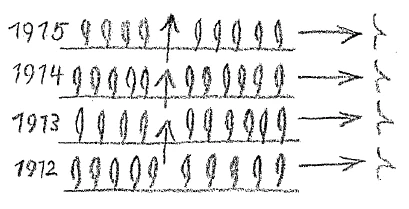
[ 12 ] We could then continue. Suppose these were successive years, and this here were the grain crops (center) of those successive years. And what I’m drawing here would always be the mouths (right) that consume these grains. Now someone might come along and say: Only the arrow pointing from the grains of grain into the mouths (→) is significant, because that sustains the people of the successive years. — And they might say: Anyone who thinks realistically looks only at these arrows that go from the grains of grain to the mouths. But the grains of grain care little about that—about this arrow. They don’t care about it at all; rather, they simply have the tendency to develop each grain of grain toward the next year. The grains of wheat care only about this arrow (&uarr); they have no interest whatsoever in being eaten—they do not care about that at all. That is a side effect; it is something that happens incidentally. Every grain of wheat has, if I may put it that way, the will, the impulse, to carry over into the next year in order to become a grain of wheat there once again. And it’s a good thing for the mouths that the grains of grain follow this direction of the arrow (→), because if all the grains of grain followed this direction of the arrow (↑), then the mouth here, in the next year, would have nothing left to eat! If the grains from the year 1913 had all followed this arrow (→), then the mouths of the year 1914 would have nothing left to eat. If someone wanted to apply materialistic thinking consistently, they would examine the grains to determine their chemical composition so that they could yield the best possible food products. But that would not be a sound approach; for this tendency does not lie in the grains of wheat at all—rather, the grains of wheat have a tendency to ensure their own further development and to evolve into next year’s grains of wheat.
[ 13 ] But this is also how it is with the course of the world. Those who truly follow the course of the world are those who ensure that evolution continues, while those who become materialists follow the voices that look only at this arrow here (→). But those who ensure that the course of the world continues need not allow themselves to be led astray in their endeavor to prepare for the times to come, any more than the grains of wheat allow themselves to be led astray in preparing for the coming year, even if the mouths here demand the arrows pointing in a completely different direction.
[ 14 ] In The Riddles of Philosophy, I pointed out this line of thought at the end, noting that what is called materialistic knowledge can be compared to eating a grain of wheat, and that what truly happens in the world can be compared to what occurs from one grain of wheat to the next year’s crop through reproduction. Therefore, what is called scientific knowledge is just as insignificant for the inner nature of things as eating is, without any inner significance, for the continued growth of the grain. And modern science, which is concerned only with the manner in which what can be known about things is brought into the human mind, does exactly the same thing as the man who uses the grain for food, for what the grains of grain are when eaten has nothing at all to do with the inner nature of the grains of grain, just as external knowledge has nothing to do with what develops within things.
[ 15 ] In this way, I attempted to introduce a thought into the philosophical discourse—one that will leave people wondering whether it will be understood, or whether even such a very plausible thought will be met time and again with the foolish retort: “But Kant has already proven that knowledge cannot reach the things themselves.” — He proved this only with regard to knowledge that can be compared to the consumption of grains of wheat, and not with regard to the knowledge that arises with the progressive development inherent in things. But we must come to terms with the fact that, in every possible way—just not in hasty ways, not in agitational ways, not in fanatical ways—we must repeat over and over again to our age and to the age to come what the principle and essence of Spiritual Science is, until it is thoroughly ingrained. For this is precisely what characterizes our age: that Ahriman has made people’s minds very hard and dense, and that they can only be softened again very slowly. So no one, I would say, should shy away from the necessity of emphasizing, again and again in every possible way, what constitutes the essence and impulse of Spiritual Science.
[ 16 ] But now let us turn to another demand that was raised here yesterday in connection with various premises: the demand that in our time there must be a growing reverence for truth, a reverence for knowledge—not for authoritative knowledge, but for knowledge that one acquires for oneself. There must be a growing conviction that one should not judge out of thin air, but rather on the basis of acquired knowledge about the workings of the world.
[ 17 ] Well, by being born into a particular era, we are dependent on our environment—entirely dependent on what is in our environment. But as we have seen, this is connected to the entire current of evolution, to the entire upward striving, such that we are born into circumstances that depend on the circumstances that preceded them. Just consider how we are placed within them. Certainly, we are placed there by our karma, but we are nonetheless placed into what surrounds us as something quite specific, as something that bears a certain character. And now consider how this makes us dependent in our judgment. This does not always become clear to us, but it is indeed the case. So we must ask ourselves, even though it is connected to our karma: What if we hadn’t been born at a specific time and place, but fifty years earlier in a different place—what would it be like then? — Then the different circumstances of our environment would have shaped the form and inner direction of our judgments just as they have been shaped by the place where we were born, wouldn’t they?
[ 18 ] So that, upon closer self-observation, we really come to realize that we are born into a certain milieu, a certain environment; that our judgments and our feelings depend on this milieu; and that, as it were, this milieu reappears when we make judgments. Now think how different it would be—I’m just saying—if Luther had been born in the 10th century and in a completely different place! So even in the case of a personality who has an immensely strong influence on their surroundings, we can see how they incorporate into their own judgments what is characteristic of the age, whereby the personality actually reflects the impulses of the age. And this is true for every human being, except that those in whom it is most pronounced are actually the least aware of it. Those who are most prone to merely reflecting the impulses of the environment into which they were born are, as a rule, the ones who speak the most about their freedom, their independent judgment, their lack of prejudice, and so on. When, on the other hand, we encounter people who are not as thoroughly dependent on their environment as most people are, we see that it is precisely such people who become most aware of what makes them dependent on their environment.
[ 19 ] And one of those who could never shake the feeling of dependence on his surroundings—the one whose life we have just seen unfold before our eyes once again—is Goethe. He knew, in the most profound sense, that he would not be who he was had he not been born in Frankfurt am Main in 1749, and so on. He knew that, in a sense, his era spoke through him. This animated and shaped his way of life in a truly extraordinary way. He knew that his judgment had been formed by the fact that he had observed certain inclinations and circumstances in his father’s household. His judgment was formed by the fact that he had spent his student years in Leipzig. His judgment was formed by the fact that he had come to Strasbourg. This was what drove him to want to break free from those circumstances and enter into entirely different ones—so that in the 1880s, one might say, he suddenly vanished into the night and fog and only told his friends about his disappearance once he was already far away, over hill and dale, after it had become impossible to bring him back under the circumstances of the time. He wanted to break free so that something else could speak through him. And if one examines many of Goethe’s statements, particularly from the period of his development, one will notice everywhere this feeling, this sense of dependence on his milieu.
[ 20 ] Yes, but what should Goethe have strived for then, if, at the very moment he truly became aware that one is actually entirely dependent on one’s surroundings, he had connected his feelings and sensibilities regarding this dependence with the thoughts we have expressed today? He would have had to say: Yes, my surroundings are dependent on the entire current of history all the way back to my ancestors. I will always remain dependent. I would have to transport myself in thought, in my inner experience, back to a time when today’s circumstances did not yet exist—when circumstances were entirely different—and then, if I could place myself within those circumstances, I would arrive at an independent judgment—not merely judging as my own time judges my own time, but judging as I would if I were to completely detach myself from my own time.
[ 21 ] Of course, it is not essential that such a person, who feels this is necessary, transport himself specifically to his own previous incarnation. But essentially, he must transport himself to a point in time connected with a previous incarnation, when he lived under entirely different circumstances. And when they now transport themselves back to that incarnation, they will not be dependent as they were before, for the circumstances have become entirely different; the earlier circumstances have since been destroyed, have come to an end. It is, of course, a different matter when I now transport myself back to a time whose entire environment, whose entire milieu, has disappeared. What, then, does one actually have? Yes, one must say: Before, one lived within that life, one enjoyed life; one was interwoven with life. One can no longer be interwoven with the life that has perished, with the life of an earlier time; one can only relive that life spiritually and soulfully.
[ 22 ] Then one might say: “Life lies in the colorful reflection.” Yes, what would have to happen if such a person, who felt this, wanted to depict this emergence from the circumstances of the present and the arrival at an objective judgment, from a standpoint that is no longer possible today? He would have to depict it in such a way that he is transported back into entirely different circumstances. Whether this is precisely the previous incarnation or not is irrelevant; what matters are circumstances that were entirely different on Earth. And they would have to strive to fill their soul with the impulses that existed back then. They would have to, so to speak, transport themselves into a kind of phantasmagoria, identify with this phantasmagoria, and live within it—live in a kind of phantasmagoria that represents an earlier time.
[ 23 ] But this is what Goethe strives for as he continues his Faust in the second part. Consider that he has first placed his Faust within the circumstances of the present; there he has him experience everything that one can experience in the present. But deep down, he feels: This cannot lead to any kind of true judgment, because I am always influenced by what is around me; I must break free, I must go back to a time whose circumstances have been completely transformed by our own era—a time that cannot, therefore, influence my judgment. That is why Goethe has Faust travel all the way back to classical Greek times and has him enter into and experience the classical Walpurgis Night.
[ 24 ] What he can experience in the present in the deepest sense, he has depicted in the Nordic Walpurgis Night. Now he must return to the classical Walpurgis Night, for from the classical Walpurgis Night to the Nordic Walpurgis Night, all circumstances have changed. What was essential to the classical Walpurgis Night has disappeared, and new conditions have arisen, symbolized by the Nordic Walpurgis Night. Therein lies the justification for Faust’s return to the Greek era. The entire second part of Faust is the realization of what one might call: “Life is but a colorful reflection.”
[ 25 ] First, a look at the present circumstances—but those circumstances that are already paving the way for destruction. We see what is unfolding at the imperial court, where the devil takes the place of the jester, and so on.
[ 26 ] We witness the creation of the homunculus, see how Faust strives to break free from the present, and observe how, in the third act, he now enters the classical era. Goethe had already written the opening section around the turn of the 18th century; the remaining scenes were not added until 1825, but the Helena scene had already been written in 1800, and Goethe calls it a “classical phantasmagoria,” using these words to suggest that he means a return to circumstances that are not the physical, real circumstances of the present.
[ 27 ] What is significant about Goethe’s Faust is that it is, I would say, a work of striving, a work of struggle. I have indeed emphasized clearly enough in recent times that it would be nonsense to regard Goethe’s Faust as a completed work of art. I have done enough to show that there can be no question of a finished work of art. But as a work of striving, as a work of struggle, this Faust is so significant. Only then can one understand what Goethe intuitively achieved, when one opens oneself to the light that our Spiritual Science can shed on such a composition, and sees how Faust looks into the classical era, into the milieu of Greek civilization, where conditions within the fourth post-Atlantean epoch were quite different from those in our fifth post-Atlantean epoch. One truly feels the deepest reverence for this struggle when one sees how Goethe began working on Faust in his early youth, how he immersed himself in everything that was accessible to him at the time, without actually understanding it very well. Truly, when approaching Faust, one must apply this perspective of Spiritual Science, for the judgments sometimes passed by the outside world are far too foolish when it comes to Faust.
[ 28 ] How could a scholar of Spiritual Science fail to notice when, time and again, people who consider themselves particularly clever come up and point out how magnificently this creed is expressed by Faust, saying: “Yes, in contrast to everything so many people say about any creed, one should remember more and more the conversation between Faust and Gretchen:
... Feeling is everything;
A name is mere smoke and mirrors,
Obscuring the heavenly blaze.
[ 29 ] Well, you know what Faust discusses with Gretchen there, and what is always cited whenever someone thinks they must particularly emphasize what should not be regarded as religious profundity and what should be regarded as religious sentiment. But what people fail to consider is that, in this case, Faust formulated his religious confession for the sixteen-year-old Gretchen, and that, in fact, all those clever professors then demand that people never go beyond Gretchen’s point of view in their religious understanding. The moment one presents Faust’s confession to Gretchen as something particularly sublime, at that very moment one demands that humanity never rise above the Gretchen perspective. This is actually convenient and easy to achieve. One can also very easily boast that everything is a matter of feeling and so on, but fails to notice that it is precisely the Gretchen perspective.
[ 30 ] Goethe, for his part, strove in a completely different way to make his Faust the embodiment of a ceaseless struggle, as I have just hinted at once again with reference to this very act of transporting oneself to a completely earlier age in order to attain the truth. Perhaps at precisely the same time—or slightly earlier—that Goethe wrote this “Classical-Romantic phantasmagoria”—this transposition of Faust into Greek antiquity—he wanted to clarify once more for himself how his Faust was actually supposed to unfold, and everything he intended to portray in it. And so Goethe jotted down an outline. What existed of his “Faust” at that time was: a foundation, a number of scenes from the first part, and probably also the Helena scene. There Goethe wrote down: “Ideal striving to influence and empathize with all of nature.”
[ 31 ] So, as the century drew to a close, Goethe—at Schiller’s suggestion, as he said—“took up again the old tragic verse, that barbaric composition.” That is indeed how he rightly described his Faust at the end of the century, for it had been written scene by scene. Now he asked himself: What have I actually done here? — And he created a mental image of this striving Faust, emerging from scholarship and moving closer to nature.
[ 32 ] So he wrote down: I wanted to write:
[ 33 ] 1. “The ideal pursuit of influencing and empathizing with all of nature.”
[ 34 ] 2. “The manifestation of the Spirit as the genius of the world and of action.”
[ 35 ] This is how he envisioned the manifestation of the Earth Spirit.
[ 36 ] Now I have shown you how, following the appearance of the Earth Spirit, the Wagner who appears is actually meant to be merely a means for Faust’s self-knowledge—he is meant to be nothing more than what is within Faust himself, a part of Faust. What, then, is the conflict within Faust? What does Faust do now that something is struggling within him? He realizes: Until now, you have lived only in your surroundings, in what the external world has offered you. — He can see this most clearly in the part that is within him, in Wagner, who is entirely content. Faust is in the very process of striving to achieve something in order to free himself from that into which one is born, but Wagner wants to remain entirely what he is; he wants to remain in what he is outwardly. What is it that plays itself out outwardly in the world from generation to generation, from epoch to epoch? It is the form into which human striving is imprinted. There, the spirits of form work externally on that into which we are to enter. But human beings must always, if they do not wish to perish within the form, if they truly wish to progress, strive beyond this form. “Conflict between form and the formless,” Goethe also writes.
[ 37 ] 3. “Conflict between form and the formless.”
[ 38 ] But now Faust is looking at the form: the Faust in that Wagner over there. He wants to free himself from this form. This is a quest for the substance of this form—a new substance that can spring from within.
[ 39 ] When we decided to erect a building here for the Spiritual Science, we could have examined all possible forms, studied all possible styles, and then built a new structure based on them—as many 19th-century architects did, and as we see everywhere else. In that case, we would not have created anything new from the form that has emerged in the course of world development: Wagnerian nature. But we preferred to take precisely the “formless content”; we sought, from what is at first formless—what is merely content—to take the living, experienced Spiritual Science and cast it into new forms.
[ 40 ] Faust does this by rejecting Wagner:
Let him not be a loud-mouthed fool!
He displays his intelligence and sound judgment
With little pretense.
[ 41 ] “Preference for formless content,” Goethe himself writes. And that is the $scene he wrote, in which Faust rejects Wagner:
[ 42 ] 4. “Give preference to substance over empty form.”
[ 43 ] But over time, the form becomes empty. If, a hundred years from now, someone were to construct exactly the same building as we are building today, it would once again be an empty form. That is what we must take into account. That is why Goethe writes:
[ 44 ] 5. “Content gives form its meaning.”
[ 45 ] That is what I would like us to experience, and that is what we aim to achieve with our architecture: form brings substance with it. And: “Form,” Goethe writes, “is never without content.” Certainly it is never without content, but those of a Wagnerian disposition do not see the content within it; therefore, they accept only the empty form. The form is as justified as it can possibly be. But progress consists precisely in the old form being overcome by the new content.
[ 46 ] 6. “Form is never without content.”
1. The ideal pursuit of influencing and empathizing with all of nature.
2. The manifestation of the spirit as a genius of the world and of action.
3. The conflict between form and the formless.
4. Preference for formless content over empty form.
5. Content brings form with it.
6. Form is never without content.
[ 47 ] And now a sentence that Goethe jots down to give his Faust the impetus, so to speak—a highly characteristic sentence. For the “Wagners” who ponder this: Yes, form, content—how can I blend these together, how can I bring them into harmony? — You can quite easily imagine a person today who wants to be an artist and who says to himself: Well, Spiritual Science—that’s all well and good. But it’s none of my business what those convoluted minds come up with as Spiritual Science. But they want to build a house that, I believe, incorporates Greek, Renaissance, and Gothic styles; and there I see what they’re envisioning inside that house they’re building—how the content corresponds to the form. — One might imagine that this is coming. It must come, after all, when people set out to eliminate contradictions, even though the world is precisely composed of contradictions, and what matters is that one can place these contradictions side by side. This is how Goethe writes:
[ 48 ] 7. “These contradictions, rather than being reconciled, should be made even more disparate.”
[ 49 ] In other words, he wants to portray them in his Faust in such a way that they stand out as strongly as possible: “These contradictions—instead of uniting them, to make them even more disparate.” And to do this, he once again sets two figures in opposition to one another: one who lives entirely within form and is content to cling to it, greedily digging for treasures of knowledge and rejoicing when he finds earthworms. In our time, we might say: He eagerly strives for the mystery of becoming human and is happy when he discovers, for example, that the human being originated from an animal species similar to our hedgehogs and rabbits. Edinger, one of the most prominent physiologists of our time, recently gave a lecture on how the human being originated from a primordial form similar to our hedgehogs and rabbits. Isn’t it true that the idea that the human race descends from apes, prosimians, and so on is something science has already moved beyond; we must go further back, to where the species branched off earlier. There were once ancestors resembling hedgehogs and rabbits, and on the other hand, we, as their descendants, are human beings. Isn’t it true that, since humans are now most similar to rabbits and hedgehogs in certain aspects of their brain structure, they must have descended from something similar? These animal species have survived; the others, of course, have all become extinct. So dig greedily for treasures and be glad when you find rabbits and hedgehogs. That is one kind of striving—striving in form alone. Goethe wanted to portray it in Wagner, and he knows full well that it is a sensible striving; people aren’t stupid—they’re sensible. Goethe calls it: “Bright, cold, scientific striving.” “Wagner,” he adds.
[ 50 ] 8. “Bright, cold, scientific pursuit: Wagner.”
[ 51 ] The other, the disparate—that is what one seeks to work out from within with every fiber of one’s soul, since one does not find it there in that form. Goethe calls it a “dull, warm, scientific striving”; he contrasts it with the other and adds: “student.” Now that Wagner has confronted him, Faust is also confronted by the student. Faust recalls how he used to be a student himself, what he studied—philosophy, law, medicine, and, unfortunately, theology as well—and what he used to say when he was still like that student: “All of this makes me feel so stupid, as if a millwheel were turning in my head.” But that is all in the past. He can no longer put himself back in that position. But all of that has had an effect on him. So:
[ 52 ] 9. “Dull, warm, scholarly pursuit: students.”
[ 53 ] And so it continues. From that point on, we actually see Faust truly become a student and then immerse himself once again in everything that allows one to engage with the present.
[ 54 ] Goethe now refers to the rest of the first part—insofar as it was already complete and was yet to be completed—as:
[ 55 ] 10. “A Person’s Enjoyment of Life as Seen from the Outside; in Dullness and Passion, Part One.”
[ 56 ] This is how clearly Goethe realizes what he has created. Now he wants to ask: How should things proceed from here? How is Faust to truly emerge from this personal enjoyment of life and enter into an objective worldview? — He must come to the Form, but now he must grasp the Form with his entire being. And we have seen how far back he must go, to a time when conditions were entirely different. There, the Form then meets him as a reflection of life. Form then meets him in such a way that he now takes it in by becoming one with the truth that was valid at that time, and sheds everything that had to happen at the same time in that era. In other words: he attempts to place himself within that time, insofar as it was not permeated by Lucifer. He attempts to return to the divine standpoint of ancient Greece.
[ 57 ] And when one becomes so attuned to the external world that one enters it with one’s whole being, yet takes nothing from the circumstances into which one has grown, then one arrives at what Goethe describes, in the highest sense, as beauty. That is why he says: “the joy of action.” Not anymore: the enjoyment of the self, the enjoyment of life. The enjoyment of action, stepping out, gradually distancing oneself from oneself. Immersing oneself in the world is the enjoyment of action directed outward and enjoyment with consciousness.
[ 58 ] 11. “The Enjoyment of Action Externally and Conscious Enjoyment; Part Two. Beauty.”
[ 59 ] What Goethe was unable to achieve in his struggle—because his time was not yet the time of Spiritual Science—he nevertheless outlined for himself at the turn of the 18th to the 19th century. For Goethe wrote some very significant words at the end of this sketch, which he jotted down there and which, in its first part, was a recapitulation of what he had done. He had already planned to write a sort of third part to his Faust; in the end, there were only two parts, which do not express everything Goethe wanted. For he would have needed Spiritual Science to do so.
[ 60 ] What Goethe sought to depict here is the experience of the entire creation out there, once one has stepped outside of one’s personal life. This entire experience of creation out there, in objectivity in the outside world—such that creation is experienced from within by having carried the truly inner out into the world—is what Goethe sketches, I would say, haltingly, with the words: “the enjoyment of creation from within”—that is, not from his own standpoint, having stepped out of himself.
[ 61 ] 12. “The Joy of Creation from Within.”
[ 62 ] With this “inner joy of creation,” Faust would now have entered not only the classical world, but also the spiritual world.
[ 63 ] Then there is something else at the end—a very curious sentence that alludes to the scene Goethe wanted to create but did not; a scene he would have created had he lived in our time, a scene that, however, had already dawned on him. He wrote: |
[ 64 ] 13. “Epilogue: Chaos on the Road to Hell.”
[ 65 ] I’ve heard very intelligent people discuss what this final sentence—“Epilogue in Chaos on the Way to Hell”—means. People have said: So did Goethe really still have the idea in 1800 that Faust would go to hell and deliver an epilogue amid chaos before entering hell? So it was only much, much later that he decided not to let Faust go to hell! — I’ve heard many, many highly scholarly discussions about this—and what discussions they were! It means that in 1800, Goethe was not yet free from the idea of letting Faust go to hell after all. But they didn’t consider that it is not Faust who delivers the epilogue, but of course Mephistopheles, after Faust has escaped to heaven!
[ 66 ] The epilogue is provided—as we would say today—by Lucifer and Ahriman on their way to hell; on their way to hell, they would discuss what they experienced with the aspiring Faust.
[ 67 ] I wanted to draw your attention once again to this summary and to Goethe’s exposition for the following reason: it truly shows us, in the most eminent sense, how Goethe, drawing on everything he was able to gain in his time, strove toward the path that leads straight upward into the realm of Spiritual Science.
[ 68 ] One can only truly appreciate Faust if one asks oneself: Why has Faust, at its very core, remained an imperfect work of poetry, even though it is the world’s greatest work of poetry about striving, and Faust is the representative of humanity precisely because he strives to break out of his milieu and is even transported back to an earlier age? Why, then, has this Faust nevertheless remained an unsatisfactory work of literature? For the very reason that it depicted only the striving toward that which Spiritual Science is meant to incorporate into the development of human culture.
[ 69 ] It is good to focus specifically on this fact and to consider that, at the turn of the 18th to the 19th century, a work of poetry emerged in which the central figure, Faust, was to be liberated from all the confining barriers that must surround human beings by living out his life through repeated earthly existences. What is significant about Faust is precisely this: that, as deeply as he is rooted in his folk heritage, he has nevertheless outgrown that heritage and matured into the universal human condition. Faust possesses none of the narrow confines of folk culture; rather, he strives upward toward the universal human condition in such a way that we find him not only as the Faust of modern times, but also, in the Second Part, as a Faust who stands among the Greeks as a Greek himself. This is a tremendous setback in our time, when, in the course of the 19th century, people have once again begun to place the greatest emphasis on the barriers to human development, and even see in the “national idea” a concept that could somehow still serve as a cultural foundation for our era. Humanity could wonderfully ascend to an understanding of what Spiritual Science is meant to be, if one were to grasp what is enshrined in Faust.
[ 70 ] It was not without reason that Goethe wrote to Zelter while composing the second part of his Faust, saying that he had hidden much within Faust that would only gradually come to light.
[ 71 ] Herman Grimm, whom I have often mentioned to you, pointed out that it will take a millennium before Goethe is fully understood. I must say: I believe that, too. — When people have delved even deeper than they do in our time, they will understand more and more of what lies within Goethe. Above all, however, they will understand what he strove for, what he struggled with, and what he was unable to express. For if you were to ask Goethe whether what he put into the second part of Faust was also expressed in his Faust, he would say: No! — But we can be convinced that if we were to ask him today: “Are we, with Spiritual Science, on the path you strove for back then, as it was possible at that time?”—he would say: “That which is Spiritual Science is moving along the paths I laid out.”
[ 72 ] And so, since Goethe had his Faust go all the way back to Greek antiquity in order to portray him as someone who understands the present, it is certainly permissible to say: Reverence for the truth, reverence for the knowledge that is wrested from the knowledge of one’s milieu, from the limitations of one’s surroundings—that is what we must acquire. And it is truly like a warning from current events, which show us precisely how humanity is heading toward the opposite extreme—toward judging things as short-sightedly as possible—and would prefer, today, to go back only as far as the events of 1914 in order to explain everything we are experiencing so terribly today.
[ 73 ] But anyone who wishes to understand the present must judge it from a higher vantage point than the present itself.
[ 74 ] This is what I, in turn, have sought to instill in your souls these days—a feeling that I have sought to show you how it arises from a truly inner, living understanding of Spiritual Science, and how it has been pursued by the greatest minds of the past, such as Goethe.
[ 75 ] Only when we take what arises in our souls through these reflections not merely as something theoretical, but process it within our souls and allow it to live in the meditations of our souls, does it truly become living Spiritual Science. May we hold fast to this—and to much, indeed to everything—that passes through our souls as Spiritual Science!