

Artistic and Existential Questions
in the Light of Spiritual Science
GA 162
29 May 1915, Dornach
Translated by Steiner Online Library
Third Lecture
[ 1 ] Today, as a first step toward preparing for further topics, we would like to discuss some peculiarities of the occult development of the human being. We are indeed permitted to speak of this occult development, because, fundamentally speaking, engagement with Spiritual Science is the beginning of true occult development. Even though most people do not recognize that simply engaging with Spiritual Science truly constitutes the first steps toward occult development, this is nevertheless the case. And it has been emphasized time and again—and must continue to be emphasized—that Spiritual Science is not merely intended to impart knowledge to us, a theoretical understanding, but rather to give us something that transforms our entire being, something that makes our whole being into something different from what the external culture of the present can achieve.
[ 2 ] We will now gain insight into the difficulty that Spiritual Science faces in making an impression not only on our memory but on the entire cultural life of the present when we familiarize ourselves with the distinctive features of research in Spiritual Science and with the way in which the results of such research relate to us as human beings. For they relate to us differently than other insights we acquire in life. We acquire insights through our experiences; for even when we acquire scientific insights, it is either through direct or indirect experience. No matter where we acquire insights, we first acquire them through experience and then store them in our memory. We retain these findings from life.
[ 3 ] We have often reflected on what it means—to put it more intimately—to preserve something in our memory, and especially recently we have discussed the nature of memory in greater detail. In any case, memory is an extraordinarily important aspect of life. Just think for a moment: if we did not have memory—if we could not recall what we experienced yesterday, the day before yesterday, a year ago, or ten years ago—how completely different our lives would have to be. It is simply inconceivable to us that the ordinary life of the soul, as it unfolds on the physical plane, could take place without memory.
[ 4 ] But compare this power, which enables you to retain memories of experiences on the physical plane, with the much lesser power that enables you to retain memories of dream experiences. Consider how much easier it is to forget a dream than experiences in the physical world. One might first ask: Why do we forget dream experiences more easily than experiences in the physical world? — Well, the answer to this question will also provide us with an important perspective for higher insights.
[ 5 ] How, then, are dream experiences acquired? — They are acquired because we are not fully present within the physical body. When we are fully present in the physical body, we do not dream. Then we experience the physical plane through the senses and through the mind, which is bound to the senses. When we dream, we must be at least partially outside the physical body. What does the physical body do when it works through the power of memory? Yes, as difficult as it may seem at first to the human mind, it is nevertheless true: every time a person has an experience and preserves that experience in memory through a thought, an imprint—a sort of template of the experience, as it were—is formed in our etheric body. But—as I have already explained—this imprint does not, for example, photographically reproduce the experience. Just as the written letter has nothing to do with the sound it represents, so too does what exists in our body as an imprint have nothing to do with the experience itself. The imprint is merely a sign. And this sign is, curiously enough, similar to the human form itself. Specifically, if you take the upper parts of the human form—the head and, at most, a little of the upper torso and the hands—you have what can be observed in the etheric body every time a person forms a memory of an experience.
[ 6 ] So, we can say: I experience something; that experience—whether small or large—remains with me as a memory. An imprint is formed, something like this (see drawing). Something like this arises in your etheric body every time a memory is formed, and if it were to be erased, you would no longer be able to remember the experience.
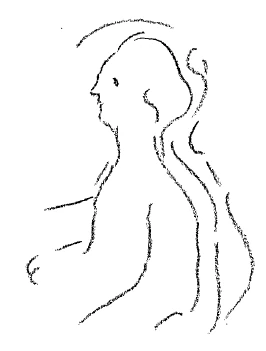
[ 7 ] Think of how many things you remember in life! You have just as many thousands and thousands upon thousands of such ethereal human images within you. Your etheric body—and your physical body as well—allow for so many different images to exist. If two were the same, you would not be able to distinguish between your experiences. When one observes a person from an occult perspective, one finds within them thousands upon thousands of such human images. But they do not arise solely in the etheric body; rather, each such human image also creates a subtle imprint in the physical body, and all these imprints are preserved as long as the person has memories. Thus, thousands upon thousands of such homunculi are present within the human being.
[ 8 ] Let’s say you are listening to today’s lecture. Just by listening to this lecture, hundreds upon hundreds of such homunculi will form in your soul. When you recall this later, they will also leave impressions on your physical body, and these impressions will remain there as well.
[ 9 ] But what about dreaming? Well, you see: in the case of dreaming, it is the case that the homunculus arises in the etheric body, that
[ 10 ] but it does not leave an imprint in the physical body. It leaves only a faint imprint—sometimes none at all. Then the person knows full well that he has been dreaming, but he cannot remember what he dreamed. Dreams leave only a faint impression—much fainter than any experience on the physical plane. That is why it is so difficult to retain a memory of them.
[ 11 ] The strength of a memory therefore depends entirely on how strong the impression is that the homunculus of the etheric body makes on the physical body. However, what the spiritual researcher finds—what he experiences in the spiritual world—is, at first, of such a nature that it cannot make any impression on the physical body at all. For if an experience can make an impression on the physical body, then it is no longer a purely spiritual experience; it has already been acquired in relation to the physical body. This must be the very characteristic of spiritual experience: that, at first, nothing at all happens in the physical body while the spiritual is being experienced.
[ 12 ] What follows from this? What follows is, in fact, what the spiritual researcher must regard as his next experience: that one has no memory of the results of spiritual research. The spiritual researcher’s experiences cannot be imprinted on the memory. The moment they arise, they also pass away.
[ 13 ] This is the difficulty in knowing anything about the spiritual world as long as one lives in the physical world and wishes to live solely through one’s physical body. For since human beings already have a poor memory for dreams—in which there is still a tenuous connection to the physical body—this will show you how understandable it must be that human beings cannot have any memory of what they actually experience in the occult realm.
[ 14 ] There are now people who are beginning to apply to themselves the rules from my book How Does One Gain Knowledge into the Higher Worlds?—the rules that are referred to as those of occult development. They may apply them for a very long time; but then, after years, they come and say: “I have practiced over and over again; I have done all kinds of exercises; I see nothing, I hear nothing from the spiritual world. My sense for the spiritual world refuses to open.” — Perhaps what these people say is completely wrong; it may be entirely wrong. The individuals in question may have long since found their way into the spiritual world and may be having perceptions there. But these perceptions vanish the moment they occur, because they cannot be incorporated into physical memory. The ability to know anything about one’s spiritual experiences depends, in fact, on something entirely different from memory. And I would now like to make clear to you what it depends on.
[ 15 ] Suppose you make a toy for a child. The child can enjoy this toy. You can make it today, and the child will enjoy it. You take the toy and put it in the closet. Tomorrow you give it back to the child, and the day after tomorrow, and so on and so forth. And the child can enjoy the toy you made today over and over again.
[ 16 ] But something else can happen as well. Let’s suppose you don’t capture the child’s interest by making a toy, but rather by putting something together for them out of various objects. Or you might even just demonstrate something to them by making gestures or the like. Let’s say you capture the child’s attention by demonstrating something to the child in a very specific way with your hands or fingers—say, by pre-rhythmizing something. You can’t put that in a closet, take it out again tomorrow and the day after, and give it to the child over and over like a toy. Whatever is meant to make an impression on the child in this way must be created anew each time. A doll that you’ve made can be stored away; the child can then play with it again and again. But if you use something you create yourself—through gestures or the like—to capture the child’s attention, you must recreate it anew each time.
[ 17 ] This can help us understand the difference between what we acquire on the physical plane—and what can become a memory—and what we experience on the mental plane—and what cannot immediately become a memory. When we have experiences on the physical plane, something like a homunculus forms in our etheric body, and an imprint of it is imprinted on the physical body. It remains, like a child’s doll. You can keep it and find it within yourself again and again. This then points you to the experience of the past. The experience you have in the spiritual world passes. But you had to do something to bring it about. You had to bring the soul into a state—through the rules you apply to the soul in the sense of “How does one gain insights into the higher worlds?”—in which the occult experience could occur. You can evoke this state within yourself again and again, so that you can have the experience repeatedly, but you cannot preserve it like a mental image. On the physical plane, experiences become memories through the retention of afterimages, in a mnemonic sense. The recurrence, the recollection—if we now use the word “memory” in a figurative sense—of occult experiences can only occur by recreating the very conditions under which we first experienced the event.
[ 18 ] Let us be clear: we really must be infinitely more active and engaged with experiences in the spiritual world than with those in the physical world. In response to experiences in the physical world, something truly takes shape within us that, I would say, gradually attains the utmost density. This is something internally diverse and multifaceted within us. These many people we carry within us—who accompany us through life—are something already formed. This makes life in the physical world easier, because it relieves us of the work we must do again and again during occult experiences in the spiritual world if we wish to have that experience once more. One can only remember the conditions through which one brought about the experience—never the occult experience itself, but only the way in which it was brought about. And you must recreate those conditions; then you can have the occult experience again.
[ 19 ] If we—and I say this not figuratively, but in the literal sense—if we walk along a path and at the end of that path there is a church or a house, and we turn back, then we can carry the memory of that image of the church or the house within us throughout the entire return journey. This is because this experience with the church or the house is an experience on the physical plane. If, instead, a spirit had been there—and that spirit manifested only at that location—it would be necessary to return to that same place each time in order to see that spirit. One must recreate the same conditions, for one can only remember the path and the circumstances through which one arrived at that experience.
[ 20 ] The strange thing about these matters is that a good memory is of no immediate use for retaining occult experiences; on the contrary, something that helps us in everyday life to consciously develop a good memory can actually hinder us in the occult realm. Certain people are born with a good memory right from the start. So they live their lives with a good memory. Others have a less good memory. This is based on very specific karmic conditions: A person has a good memory if they come into the world from their previous incarnations in such a way that their spiritual-soul aspect permeates the entire body as late as possible, so that certain parts of the physical body remain unaffected by the spiritual-soul aspect for as long as possible. Thus it is possible that, without any effort on our part, these impressions—these homunculi that I have described—are formed.
[ 21 ] But if a person enters life through physical birth and, for the sake of individual physical experience, is a personality so internally predisposed that impressions take complete possession of his physical body as quickly as possible, then he will not be able to develop a particularly good memory, because he fills his memory with himself; and then it is too full for so many impressions from such homunculi to enter it. We will therefore find a good memory primarily in those people who, I might say, have an otherwise vague, self-centered interest in the experiences of the physical plane.
[ 22 ] On the other hand, memory can also be developed, so to speak. But it can only be developed by stimulating attention and interest. Interest, attention, and memory go hand in hand. If you try to take a deep interest in a particular set of experiences or an area of life—to be fully present with your whole being—then your memory of those experiences will continue to improve. So if someone wants to improve their memory for something, the best way to do so is by trying as much as possible to sharpen their interest in that particular area. We don’t remember anything unless we develop an intense interest in it. Thus, attention and interest are what can compensate for a poor memory in the physical world.
[ 23 ] In order to properly engage with occult experiences—so that these experiences do not simply flit past us like dreams, leaving us unaware of them—loving attention and a loving interest in the spiritual realm in general are of the utmost importance. Without this spiritual interest, without this loving attention, we cannot repeatedly have the spiritual experiences we once had. It is quite possible to have an occult experience just once. It fleets by. Only in this way will one be able—not to create memories, but to establish the conditions—through which one can have the experience again and again anew, thereby deepening one’s interest in the events of the spiritual world.
[ 24 ] That is why it is so important that we not merely acquire as much knowledge as possible about the spiritual world by rote; in fact, that is the less important part. What is more important is that we never pursue these matters of the spiritual world without love, never without the most intense interest. If we absorb the knowledge of Spiritual Science indifferently—perhaps merely to boast about it or for some other reason—just as we so often absorb other knowledge of the world, then it has no significance at all. What matters is the degree of love and sympathy for the spiritual world that we cultivate within ourselves. That is what matters; that is what is significant. And this is also why we strive to present the events of the spiritual world from so many different perspectives, again and again from different angles; for in this way we are increasingly inspired to actively draw closer to the insights of the spiritual world, rather than succumbing to the desire to view this knowledge of the spiritual world in the same way as knowledge of physical things. — This is actually the most disastrous thing for the true occultist: when the longing arises in people to attain spiritual knowledge, but they do not wish to attain this knowledge in any other way than they do physical knowledge.
[ 25 ] Just as people have books about what can be known in the physical world, they would also like to have books about the spiritual world; just as they acquire knowledge of the physical world, they would also like to acquire knowledge of the spiritual world. But it is not at all possible to acquire knowledge of the spiritual world in this way; rather, books that deal with the spiritual world must each time anew stimulate our inner activity and set our inner forces in motion. Therefore, the way we acquire knowledge about the physical world—where we must repeat things over and over so as not to forget—is not the same as when we acquire knowledge about the spiritual world. When we read a cycle or a book on Spiritual Science again and again, this is not actually a repetition, but rather a process of immersing ourselves in the activity through which we arrive at that knowledge. And that is the most important thing; that is the essence. You see, if a person who is asked to pray when he goes to church were to tell you, “I don’t need to pray today; when I was seven years, three months, and two days old, I read that prayer once,” you would look at him quite strangely. I will always remember that I prayed it; I no longer need to pray it, for I know that I have prayed it; I just want to think about it now.” — You would look at this person strangely; you would make it clear to him that what matters is not remembering the prayer once performed, but evoking it again and again, because it is a living thing in every renewal. This is precisely how we should view our experience in occult science. We should not say, as we do in relation to ordinary science: “Yes, we have taken it in, we remember it”—but rather, we should accustom ourselves to delving into the matter again and again, to going through the process again and again. But people of modern times do not like this at all. People of the modern age much prefer to remain fixed on what they have once attained. Isn’t it true that one feels happiest when one has acquired some knowledge and then carries this knowledge through life, as it were, in one’s inner “knapsack,” and, when needed, takes it out and recalls it? This is something into which modern humanity is increasingly in danger of falling. Yet in modern times, I would say, there is an immediate need to transform this resting on one’s laurels so that… human work and human striving correspond to
Only those who must win it anew every day,
just as they must win life itself,
[ 26 ] this beautiful line from Faust.
[ 27 ] And it is truly the case that nothing more than the “Fist” mentality—which we have often discussed here—awakens and stirs within the human soul that which gradually leads into the occult, into the occultist mindset.
[ 28 ] Goethe wrote the first major monologue of Faust sometime in the 1770s, inspired by his state of mind at the time. For many today, it has become trivial, but when viewed in its original form, it is something that weighs heavily on the soul with all the tragedy of life:
Alas! I have now studied philosophy,
law, and medicine,
and, alas! theology as well,
thoroughly, with great effort.
And here I stand, poor fool that I am!
And I am just as wise as I was before.
[ 29 ] Goethe himself had written this from his very being, from the depths of his innermost self, as a young man in the 1770s. Then came the era in which human philosophical development reached its zenith in the works of Fichte, Schelling, and Hegel. But this pinnacle of philosophical development was linked to legal development. Hegel wrote a treatise on natural law; Fichte wrote a treatise on natural law; Schelling published a journal of medicine. Something immense and grand has swept through the human soul—precisely in regard to what led Goethe to say:
Alas, I have now studied philosophy,
law, and medicine,
and, alas!, theology as well,
thoroughly, with great effort.
[ 30 ] But do you believe that if Goethe had lived in 1840 and, instead of in 1772, had not begun his Faust until 1840—do you believe that, because something grand and mighty had arisen in the cultural development of humanity, something that sought in a truly philosophical way what passes through the human soul—do you believe that he would have said: “Thank God, I have now studied philosophy, law, and medicine—and, of course, theology under Fichte, Schelling, and Hegel. Here I stand, a clever, wise man, no longer as foolish as before, but having become completely wise—as wise as one can possibly be”? Do you believe that Goethe would have said that? Suppose much more had been written about the cultural development of the Earth; this opening monologue of Faust would have been written in 1840 exactly as it was back in 1772—exactly the same way. All these things are part of a true understanding of Faust. This great, gigantic idea cannot be understood unless one grasps it in its details. And if Faust were to be written today, it would have to begin once again with the very same words.
[ 31 ] And once the countless knowledge of the Spiritual Science has been brought to light: “I have now, thank God! thoroughly studied philosophy, law, and medicine, and, thank God! theology as well, and of course theosophy too, and I am as wise as can be.” That would never be the true Faustian spirit! The Faustian spirit would belong only to the one to whom the following applies: “Only he deserves freedom, as he does life, who must conquer it anew each day.” That is the spirit inherent in Faust, which at the same time shows us where the impulses lie that lead from the old, frozen culture to the new culture of humanity. Human beings must never rest in their efforts to acquire something different, something new, and I have also advocated this within the Spiritual Science movement to which we belong. It was truly dreadful to hear people in the old society say time and again: “Yes, we need diagrams, and when I present this or that, diagrams and tables should hang on the walls if possible, so that we have something to help us remember.” — And people were dissatisfied when one came along and, in essence, reversed what had once been there, what had been established; for that must always be acquired anew. For it is this ceaseless, unrelenting striving forward that matters.
[ 32 ] One can say quite plainly: By giving birth to a “Faust,” this newer culture has truly built a bridge from a merely outwardly materialistic culture to the new spiritual culture that must come to humanity.
[ 33 ] But much, very much, regarding the correct view of life is connected with all of this—with these peculiarities of the new knowledge, which must, after all, be drawn from occultism, and which therefore place demands on people’s active, dynamic impulses. Thus, it is connected to the principle of accepting everything as it is, as it is complete, when people strive to preserve that which cannot be preserved. For example, something that I have truly been striving to describe—I can say, for decades—cannot be preserved; that which is called human freedom cannot be preserved.
[ 34 ] Freedom, conceived as an external institution or an external condition within the human organization across the earth, is something impossible, something unthinkable. Freedom, preserved as it was once conceived for a specific moment in time, would already be a severe shackle for humanity in the next moment. Freedom is something that, as it continually comes into being, must also be unleashed, and human beings can only attain freedom in each moment by developing within themselves a trace of entering into a relationship with the entire spiritual world. Please refer to my book Philosophy of Freedom. There you will find that the entire tone of the work expresses this. There you can see that freedom is truly a key to what leads into the spiritual world.
[ 35 ] It stands to reason, however, that true freedom will only be understood by people who gradually develop the will to pursue Spiritual Science. Freedom cannot be understood by other people, for other people will always confuse certain characteristics of external institutions with freedom, whereas freedom can only ever exist in the state that a person can attain at any given moment.
[ 36 ] In fact, we already impair our freedom through something that we do not usually believe impairs our freedom: we impair our freedom through our memory. For suppose that, through the experiences you have gone through since your birth, you have acquired certain sympathies and antipathies; then what remains of these sympathies and antipathies already impairs your freedom. These acquired sympathies and antipathies—everything that is stored in memory—impair your freedom. And all the knowledge that humanity strives for—and which is geared toward becoming part of memory—also leads us further and further away from a true concept of freedom. In contrast, with every acquisition of occult knowledge, one draws closer to the true concept of freedom, genuine freedom.
[ 37 ] But all of this is connected to something else: Consider that with everything that becomes fixed as a memory, we are actually implanting a homunculus within ourselves. And everything that leaves an imprint within us as a homunculus—the reality is that when we set our inner life in motion, our activity gets us no further than these homunculi, no further than these imprints. We cannot go beyond that. If we could pierce through what has been stored there as memory—if we were truly to expel from ourselves everything we have experienced since the time of our childhood, as far back as we can remember—we would be piercing through something like a skin of life. But behind this “skin of life” lies the spiritual world. There it is, right behind it! And as a person begins in early childhood to construct an image of their own life—retaining from all their experiences those elements that make up the content of their memory—they weave a veil throughout their entire life, and this veil covers the spiritual world.
[ 38 ] We could not exist within the physical world if we did not weave this fabric, for, as far as we can remember, we are this fabric itself.
[ 39 ] But we come into being as human beings in the physical world only by forming ourselves out of the veil that we simultaneously hold up before the spiritual world. It is truly as if someone—well, I would say—wanted to direct their gaze toward a stage and said: “I want to look in there now.” — But they do so by hanging a curtain in front of it. In doing so, they actually cover up, bit by bit, what lies behind it. That is what human beings do in life. What human beings store up as memories is a curtain that is hung over spiritual reality, woven in front of the spiritual world. This is a contradiction we find ourselves caught up in during life, but one that must not be condemned or criticized, because it is the very condition that allows us to exist in physical life. It may only be described, but not condemned. If we did not weave this curtain spiritually before us, we would not be here in the physical world. And that is precisely what matters: that we know this, that we do not confuse ourselves with a reality when we are merely a curtain.
[ 40 ] We immediately see through all illusion—by recognizing that we are a curtain and not reality—the very moment we tell ourselves: You are, in fact, only that which stands before the true world, and your own form—that which you yourself are—lies behind the form you weave throughout your life. — If one keeps this fact in mind, one stands in the truth. Then one does not regard oneself as reality, but only as a curtain. Yet people are afraid to regard themselves as a mere curtain. They want to regard themselves as reality in what they are. Consequently, however, they cannot attain clarity even regarding the most important things in life.
[ 41 ] All people yearn for survival after death, for immortality; they all yearn to know that they will still be here after death. But they harbor a secret thought: If everything that is within me, everything I have on the physical plane, comes to an end, what will remain? That this must disappear precisely after death, that the veil is not merely torn asunder but must be dissolved so that the human being can emerge—this is self-evident to those who are advancing in spiritual knowledge.
[ 42 ] So we must also accept matters such as those discussed today in such a way that we truly find ourselves saying more and more: For Spiritual Science, we must inwardly embrace different human attitudes than those that have prevailed in culture up to now. There must arise a much greater striving among people for continuous engagement, for activity, for participation. The attitude of saying, “I have grasped it, I can retain it, and I can carry it through life”—that must disappear. — When that disappears, then all other things that are such obstacles to clear understanding will also disappear. I have often pointed out how people, even in the sciences, form the most confused notions of what is true. For example, you will still read time and again today in works on physiology that a person sleeps because, while awake, they go through this or that and become tired as a result. Sleep, then, would be a consequence of fatigue. I have pointed out that, if this were the case, the reindeer—which does not need to work very hard—would not need to sleep either. But if you ask a reindeer, you will learn: When you do absolutely nothing, you feel the most tired, and you fall asleep without having done the slightest thing. From this you can conclude: Fatigue has nothing to do with sleep, and sleep has nothing to do with fatigue—just as little as day has to do with night.
[ 43 ] At most, thinkers like Hume or Kant have difficulty with this because they confuse what follows one another. No one would regard the day as the cause of the night or the night as the cause of the day. Day and night follow one another. Day arises when the sun rises above the horizon, and night arises when the sun sets below the horizon. The sun’s position above the horizon is the cause of day, and the sun’s position below the horizon is the cause of night. Just as night is not the cause of day, nor day the cause of night, so too it is not essentially correct to say that waking is the cause of sleeping, or sleeping the cause of waking. Rather, it is rhythmic states that alternate, just as the positions of the sun above and below the horizon alternate—states that have nothing whatsoever to do with a causal relationship.
[ 44 ] But just as it is true that when the sun sinks below the horizon, it brings about twilight, and as it sinks further, it brings about darkness, so the truth is not that because we feel tired, we want to sleep, but rather that we feel tired because we want to sleep. We must long for sleep; only then do we feel tired.
[ 45 ] This seems to contradict everything that is thought today, but it is nevertheless true—just as true as the fact that day is not the cause of night, and night is not the cause of day. Thus, fatigue is not the cause of sleep. But just as night falls when the sun sets, so fatigue sets in because one wants to sleep. Here, the effect and consequence are completely confused and mixed up with the cause.
[ 46 ] Today I would like to draw your attention to something else. There is a tremendous difference between the relationship between day and night, the relationship between the sun and the Earth, and the relationship between sleeping and waking in human beings: You cannot possibly form a mental image of the same thing that can happen to human beings happening to the sun. Humans, I mean, eat a good meal and sleep at an inappropriate time, or they sleep at an inappropriate time for some other reason. The sun does not do that. For, just imagine what it would be like if the sun suddenly decided not to rise above the horizon at a certain time, and everything that turns day into night were to happen all of a sudden. — You cannot possibly have a mental image of a situation in the universe analogous to a human sleeping whenever they want, arbitrarily setting their own waking and sleeping hours. How far removed the sun is from that! It is impossible for the sun to overindulge and stop shining in the middle of the day, so that night falls. Just as far as that is from someone falling asleep during the day—it is easy; it only needs to be a little hot, and they think they must sleep because of the heat—just as far are natural necessity and the laws of nature from freedom; just as far is nature from the spirit. But just as far removed is the understanding that humanity possesses today, that our present age possesses, from the understanding that it will have to acquire through Spiritual Science.
[ 47 ] This is what we must always keep in mind: that it is not only a serious but also a great task to immerse ourselves in the endeavors through which Spiritual Science seeks to contribute to human culture. And many things that have not yet been overcome in general today will indeed have to be overcome if Spiritual Science and its findings are to become an integral part of humanity’s spiritual development.
[ 48 ] Today, to conclude, I would like to draw attention to two things—we will continue tomorrow—that must be embraced by anyone who wishes to enter the realm of Spiritual Science and make it fruitful for the spiritual life of the future: The first is a certain reverence, a certain awe of the truth. One need only open one’s eyes to see that, especially today, everything happening in the world appears to be a rebellion against this reverence, against this awe of the truth. Anyone who has awe of the truth will wait a long time before making a claim about something or passing judgment on it. Today, the tendency is toward the opposite—the tendency to feel as little respect for the truth as possible, and instead to shape the truth as one sees fit, as one deems appropriate to one’s own feelings and sensibilities. The ability to wait until the truth reveals itself as the chaste deity of the human soul—this is a sentiment of which one can say: It is truly necessary that it be embraced by humanity today. External culture, however, resists this embrace; it is a culture in which the aim is to fabricate reports and communicate all facts as quickly as possible, as today’s journalism does. There prevails a mood that is the opposite of the one Spiritual Science must cultivate within us. The way of relating to the world practiced today through the media and the press is the opposite of what Spiritual Science must strive for—and what must be strived for by those who have humanity’s best interests at heart. This must be acknowledged by those who wish to belong to the Spiritual Science movement. The first thing is reverence for the truth.
[ 49 ] The second is reverence for knowledge. This is what must weigh heavily on the hearts of those who recognize the impulses of the times and who strive to infuse new impulses into humanity’s development: that people do not take reverence for knowledge seriously enough. That is the sad thing: people everywhere show that they lack reverence for knowledge.
[ 50 ] Especially in our time, in light of the terrible events of the present, we see that people—most of all those who write and publish, but unfortunately others do so as well—judge as if the world had truly been created, say, in June or July 1914.
[ 51 ] Curiously enough, whenever present-day experiences are assessed, one hears time and again the opening words of the narrative, “In the year 1914,” and then the events are jumbled and tossed about, as if something meaningful might come of it. Nothing can come of it. One cannot understand why things are the way they are in the present unless one has reverence for the knowledge that leads back to the times of the distant past and recognizes that present-day events are the consequences of those distant pasts and are deeply and intrinsically connected to them.
[ 52 ] It breaks the heart of anyone who is serious about the development of humanity to see how thoughtlessly people today judge the way in which cause and being are connected here and there. And these judgments are made by people whose opinions clearly reveal that, deep down, they have no idea what really matters.
[ 53 ] Now one might object: You cannot expect everyone to be able to judge. — No, certainly not. But what one can expect is a respect for knowledge, an awareness that one must first know something before one can judge.
[ 54 ] That is something one would wish for people above all else today: that they not judge before they know. It is one of the most terrible evils of our time that people judge without knowing. This is what makes the products of contemporary culture so dreadful, because it is evident everywhere that they embody the exact opposite of reverence for true knowledge and reverence for the truth.
[ 55 ] Awe for the truth, awe for knowledge—that is what we should cultivate. I say: awe for knowledge; of course, I do not mean awe for scientific authority—so that things are not distorted—but rather awe for knowledge, above all for one’s own knowledge. One must first have acquired this; only then can one have reverence for one’s own knowledge. As long as one does not possess it, one cannot, of course, have reverence for what does not exist. Then one also lacks the necessary reverence in life.
[ 56 ] But above all, what matters is that impulses of a new sensibility and a new emotional life penetrate our souls, and that we do not simply try to continue in the same way—now along the paths of Spiritual Science—as has been attempted in material culture. Acquiring the ability to distinguish between these things must be our serious task.