

Artistic and Existential Questions
in the Light of Spiritual Science
GA 162
24 May 1915, Dornach
Translated by Steiner Online Library
Second Lecture
[ 1 ] Let us first try to bring to mind something that has often been considered in one context or another: the relationship between our thoughts and our mental images and the world. How can we conceive of the relationship between our thoughts and the world?
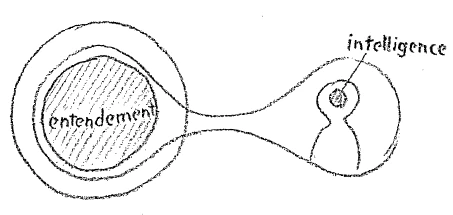
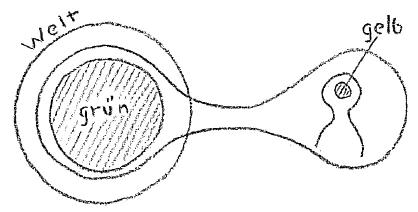
[ 2 ] Let us imagine, in a schematic picture, the world as an outer circle and ourselves opposite it (drawing on p. 30). Isn’t it true that, at first, it will be clear to all of us that we form a picture of the world in our thoughts? We spoke yesterday about how we arrive at conscious thoughts in the physical world. Let us use this circle (the smaller inner circle) to denote what exists within our physical being through our soul as our thoughts. And I would like to say: This circle is meant to represent what we perceive as the content of our soul—with the help of our body—as our thoughts about the world.
[ 3 ] Now we know from various considerations that what we call thoughts is actually based within us on a certain kind of reflection. I have often used the analogy that, even when we are awake, we are essentially outside our physical body, and that the physical body reflects back to us—like a mirror—what comes to our consciousness. So when we think of ourselves as soul-spiritual beings, we must not imagine ourselves to be inside—to put it plainly—where our thoughts emerge through our body, but rather we must conceive of ourselves as being outside our physical body, even while awake. This means that we must actually project our soul-spiritual nature out into the world. |
[ 4 ] And what, exactly, is being reflected? Well, when thoughts arise within us, something in the universe is being reflected. Let this circle (green) represent that which lives in the universe and is reflected within us. Just as I have the yellow circle here in the human organism as a reflection of something in the universe, so I want to use this green circle to denote something in the world itself that is reflected in our thoughts. And we can say: What is denoted here by this green circle is actually the real, the actual—of which our thoughts are merely the image, that image which is reflected back by our body. All of this is, of course, meant only schematically.
[ 5 ] If we understand in the proper sense what actually happens when we confront the world, then we must say that something is produced within us: the entire sum of our mental images is produced within us as a mere image of something that exists in the outside world. Everything that is within our intellect is an image of something that exists in the outside world.
[ 6 ] Those who have always been somewhat aware of the true nature of such things in the world have therefore spoken of how the truth of human thought content is, in reality, spread throughout the universe as the world’s thoughts, and that what we possess as thought content is merely the image of the world’s thoughts. The world-thoughts are reflected within us. If our true being were only within our thoughts, then this true being of ours would, of course, be merely an image. But from the entire context, it must be clear to us that our true being is not in our minds, but rather that our true being lies in the world itself, and that we merely reflect the world-thoughts within ourselves. And what we can find within ourselves through the mirroring mechanism of our body is an image of our true reality. All of this has, after all, already been emphasized in various contexts.
[ 7 ] When the physical body dissolves at death, the images that arise within us naturally dissolve as well. That which remains of us—our true reality—is, in essence, integrated into the cosmos throughout our entire life, and it projects a reflection of us from itself only during our lifetime through our body. Here, you see, lies the difficulty that philosophers continually encounter—and which they cannot overcome with their philosophy—the main difficulty. After all, these philosophers are initially given nothing other than the mental images they create. But consider that Being is precisely excluded from the mental image, from the content of consciousness. It cannot be found there, for what is in consciousness is only a reflection. Being cannot be found there. Now the philosophers seek Being through consciousness, through ordinary physical consciousness. They cannot find it that way. And it is only natural that philosophies such as Kant’s, for example—which seeks Being through consciousness—had to arise. But because consciousness, quite naturally, can contain only images of Being, one can come to no other conclusion than to acknowledge that one can never approach Being through consciousness.
[ 8 ] Anyone who looks more deeply will then realize that, of all that exists in consciousness, what is true and real is out there in the world, and that consciousness merely reflects it. But what actually happens there between the world and consciousness? As a scholar of the Spiritual Science, one must understand what happens there. Certainly, these are only images produced by the physical body. The physical body is created from the universe. In the course of life between birth and death, it develops to the point where it can create images—indeed, it creates an image of the whole human being that always confronts us when we reflect ourselves through our body. It is only an image, but it is an image nonetheless. And what is the purpose of this image within the entire cosmic context? Yes, this image must come into being. For, you see, at the very moment when we step out of the spiritual world into existence through birth, an epoch of our being has, in a certain sense, essentially come to a close. We have entered the spiritual world through a previous death, carrying certain forces into the spiritual world, and living out these forces up to what is called in the fourth Mystery Drama the “midnight hour of existence” between “death and a new birth.”
[ 9 ] In the second half of life, between death and a new birth, we gather strength. But where are these forces we gather headed? They seek to build the new physical body, and once the new physical body is in place, the forces we partake of during the second half—between death and a new birth—have fulfilled their task. For they seek to bring this new body into being. They seek to come together in the new body. Entire hierarchies are working—indeed, one might say, truly struggling—to ensure that this human being can step into existence from the spiritual universe through birth, as I hinted at in the second Mystery Drama through the words of Capesius. There we see what this evokes in the human soul when a person becomes aware of what it means that entire hierarchies of gods are engaged in bringing the human being into the world.
[ 10 ] But I would say that what these forces do in bringing human beings into being is very similar to what happens with the old seeds of a plant: Once the new plant has emerged, the old seed has fulfilled its purpose; it no longer claims to do anything other than bring forth a plant. This plant is called upon by the cosmos to produce a new seed. Otherwise, there would be no further development, and plant life would have had to come to an end with this plant. Similarly, if the image-consciousness were not to emerge here, human life would have to conclude with the renewal of life between birth and death. That which appears here as an image of the world is the new seed, which now passes through death and, through death once again, transitions into a new life. And this seed is now truly such that it carries nothing over from the old reality, but rather, in its existence as an image—in nothingness—it truly begins, in relation to reality, to external reality, in nothingness.
[ 11 ] Please take a moment to reflect on a thought of immense significance. Imagine for a moment that you are facing the world. Well then, the world is there, and you are there too. But you have emerged from the world; the world has created you; you are part of the world. Now life must go on. In what exists as reality within you—what the world has placed within you—this world that you behold within the physical plane—there is nothing there that can carry life forward. But something is added: You look at the world, form an image, and this image gains the power to carry your existence out into further, infinite distances. This image becomes the seed of the future.
[ 12 ] If one does not take this into account, one will never understand that, alongside the statement “Nothing comes from nothing,” the other statement is also entirely true: “In the deepest sense, existence is always brought into being from nothing.” Both statements are entirely true; one must simply apply them in the proper context. The continuity of existence does not end there. If, let us say, you were to wake up in the morning and find that nothing physical remained of you—as is indeed the case when one approaches a new birth—but you had only the full memory of what had happened, that is, merely an image, then you would indeed be quite content. Deeper minds have, of course, always sensed such things. For example, when Goethe placed the two poems side by side: “No being can disintegrate into nothing,” immediately preceded by the poem that conveys the meaning: “Everything must disintegrate into nothing if it is to persist in being.” These two poems stand side by side in Goethe’s work as an apparent contradiction, one immediately following the other.
[ 13 ] But for ordinary philosophy, this presents a stumbling block, because it must, in fact, ascend into the negation of being.
[ 14 ] Now one might raise the question again: What is actually being reflected there, if all that is reflected here are merely the thoughts about the world? How, then, can one actually be sure that there is a reality out there in the world? And this leads us to the necessity of acknowledging that reality cannot be guaranteed by ordinary human consciousness at all, but that reality can only be guaranteed by that consciousness which rises within us into the regions where the imaginations are, and which penetrates beyond the nature of the imaginations. Then one discovers that out there in the world, behind what I have indicated as “green,” there are not merely world-ideas, but that these world-ideas are the expressions of the world-beings. But they are veiled by the world-thoughts, just as the human inner life is veiled by the content of consciousness. So we look into the world; we imagine that we have the world in our consciousness: there we have nothing, a mere reflection. What is reflected are themselves merely world-thoughts. These world-thoughts, however, belong to real, actual beings—the beings we know as spiritual-soul beings, as group souls of the lower realms, as human souls, as the souls of the higher hierarchies, and so on.
[ 15 ] Now, as you know, the development of humanity on Earth can, in a sense, be divided into two halves. In earlier times, a kind of dreamlike clairvoyance existed. Through this dreamlike clairvoyance, people knew that behind this world—which is ultimately grasped by human thought—there exists a world of real spiritual beings. For in the old dreamlike clairvoyance, people did not merely perceive thoughts, as does the modern clairvoyant who, for example, through the methods described in How to Attain Knowledge of the Higher Worlds? re-establishes a connection with the spiritual world—does not merely perceive thoughts, but rather world beings. I have often tried to illustrate this, so much so that I even said in one of the Munich lectures: One sticks one’s head into these beings just as one would stick one’s head into an anthill: thoughts begin to take on a life of their own. — That was the case with the people of earlier times. In their perceptive consciousness, they lived not only in thoughts, but they lived within the beings of the worlds. But it was necessary—and we know from the various lectures that have been given why it was necessary—for this ancient clairvoyance to, so to speak, fade away and cease. For that through which human beings acquired their present consciousness—which they necessarily need in order to attain true inner freedom—required that the ancient clairvoyance slowly fade away and disappear. A time had to come when human beings would, so to speak, be left to rely on what they can perceive in the world without any clairvoyance at all. In that case, they were naturally cut off—completely cut off—from the spiritual world, to put it in extreme terms.
[ 16 ] Of course, there have always been individual spirits who were able to glimpse into the spiritual world. But while clairvoyance was once the norm, for a time being cut off from it became, in a sense, a defining feature of human culture. And we, in turn, are seeking through our endeavors in Spiritual Science to re-instill this consciously attained clairvoyance into human culture. So that we can say: There are two periods of development in human history on Earth, separated by an intermediate epoch. The first is a period in which dreamlike clairvoyance prevailed: people knew they were connected to a spiritual world; they knew that not only thoughts haunt the universe, but that behind these thoughts are world beings—beings, just as we ourselves are, who think these world thoughts. Then a time will come when people will know this again, but will know it through clairvoyance they have attained themselves. And in between lies the episode in which human beings are cut off. If we take a deep look at what has been said here, we must say: Actually, we must expect that at some point in human development, people came to realize: Yes, it makes no sense at all to simply think that there are thoughts inside this brain. For if there were only these thoughts, these images inside, and they did not represent anything, it would be best to cease all thinking! For why should one think about a world if that world contained no thoughts within itself?
[ 17 ] Certainly, in the 19th century, people were quite content with the idea that the world contained no thoughts, and yet they still reflected on the world. But the 19th century did, in fact, spread thoughtlessness over the most intimate matters of life. It was tasked with bringing about this thoughtlessness. But we may well suppose that at some point, perhaps, someone came to think in the following way, saying to himself: It only makes sense if one assumes that thoughts are not only found inside the brain, but that the entire world is full of thoughts. — If he had been able to advance directly to our Spiritual Science, then he would have said: Certainly, there are thoughts out there in the universe, but there are also beings who cherish these thoughts, just as we cherish our own thoughts. They are the beings of the higher hierarchies.
[ 18 ] But that time had to come first, so to speak, after humanity had fallen deeply into materialism—that is, into the belief that the world has no thoughts.
[ 19 ] One might now be tempted to look for Flegel in the person who formed these thoughts: since those thoughts can only be images of the great world-philosophy, one might be tempted to seek this person in Flegel. But that would not be entirely accurate; for Hegel lived in a period in which, thanks at least to what had preceded it—namely, Fichte’s opposition to Kant—it was possible to draw upon, I might say, newly sprouted seeds of spiritual consciousness. Hegel’s philosophy could not have been conceived without a spark of spiritual thought having already fallen into the materialistic age. Even if Hegel’s philosophy is still, in many respects, a rationalist straw from which the spirit has been squeezed out, these thoughts of the logic of the world could nevertheless only be conceived out of the awareness that spirit exists in the world. So this cannot be what is called Hegelian philosophy; it cannot be where the tragic moment would have come to say to oneself: In the world out there are thoughts, and these thoughts are the truly real, the true, actual reality... And where, then, would be the era that had progressed so far that it had, so to speak, drawn a veil over everything spiritual and at the same time said to itself: ‘Thoughts are the real in the world, and behind these thoughts there can be no more spiritual beings’? One did not need to say it aloud; one only needed to feel it, so to speak, unconsciously, and then one stood there in the world and said to oneself: ‘Yes, individual life is actually nothing! After all, individual life has, at the end of the day, value only between birth and death.’ For what truly lives are not human thoughts, but rather the thoughts of the world—a world intelligence, though a world intelligence without a distinct being. — And I believe one could not imagine a greater tragedy than if, for example, a Catholic priest had arrived at this inner realization! |
[ 20 ] What happens arises from the necessities of the world. Let us suppose that a Catholic priest had even come to this conclusion—he could very easily have done so, for scholasticism has, after all, wonderfully trained the mind, and only if one has thoughtless, untrained thinking can one believe that thoughts exist only in the mind and not out there in the world—then, in a sense, this Catholic priest would have pulled the rug out from under his own feet. For by recognizing only worldly thoughts as the eternal, he would have wiped out the entire world, which, through revelation, was, so to speak, prescribed for him to believe in as the spiritual world.
[ 21 ] One can truly say: What can be posited by Spiritual Science actually happens in the world. If we ever find it necessary to first assume something as necessary, and we must say: there must have been a moment in the world when something like this was felt—then that moment did indeed exist, quite certainly existed. And even if it passed by completely unnoticed, it still existed.
[ 22 ] I would like to draw attention to this moment—the moment when one can truly see how that which is not yet present enters into conflict, yet seeks to prepare itself, seeks recognition—recognition of the world’s ideas—but does not yet wish to know anything about what lies beyond these world ideas: the world of the higher hierarchies.
[ 23 ] In 1769, a pamphlet titled “Lettres sur l’esprit du siècle” was published in London. It contained allusions to the very spirit I have described. And in 1770, another pamphlet titled “Système de la nature. La voix de la raison du temps et particulièrement contre celle de l’autre système de la nature.” This “Autre système de la nature” was Baron Holbach’s, against which this pamphlet was specifically directed. The pamphlet stated that it intended to oppose what Baron Holbach, as a materialist, advocated in his System of Nature. But the two pamphlets were scarcely read and were completely forgotten.
[ 24 ] It turned out, however, that in 1865 a fine book was published in Poitiers by Professor Beaussire, titled Antécédents de Hégélianisme dans la philosophie Française. This book, published in 1865, was a two-volume work and had been written somewhat earlier than the two aforementioned pamphlets—that is, around the years 1760 –1770, and was authored by the Benedictine monk Leodegar Maria Deschamps, who was born in Rennes in 1733 and died in 1774 as prior of a Benedictine monastery in Poitou. The first volume contained what Deschamps referred to at the time as “Le vrai système.” It was not published—along with parts of the second volume—until 1865. For all that time, it lay as a manuscript in the library of Poitiers. No one paid any attention to it, except during the very period in which it was written. What Deschamps—for he was also the author of the two pamphlets I mentioned—sought to express in 1769 and 1770 is now set forth in a powerful first volume, published a century later by Professor Beaussire; that is what it contains. And the second volume contained a detailed collection of correspondence and an account of all the efforts Deschamps made at that time—let us put ourselves in the context of the era in which this took place: namely, before the outbreak of the French Revolution—it described all the efforts Deschamps made to somehow bring his “vrai système” to fruition. We learn there that the man truly—I would say—found himself caught between two fires: On the one hand, wherever people became acquainted with his “vrai système,” they warned him that, as a priest, he would inevitably face the harshest penalties if the Church were to learn of the “système” in any way. On the other hand, however, the so-called free thinkers also took very little interest in his work. They did take an interest, but none of them were even willing to do what he asked: find him a publisher. Rousseau, Robinet, Voltaire, the discerning Abbé Yvon, Barthélemy, and even Diderot—they all knew this “vrai système.” It was even read aloud to Diderot in his salon. He did not understand it right away and therefore wanted to keep it to read through; but the good priest Deschamps was so anxious that he took it back with him, because he did not want to let it fall into other hands. Thus, he was always torn between these two things: on the one hand, his “vrai système” was not supposed to become known; on the other hand, he wanted it to truly take hold of humanity.
[ 25 ] Now let’s take a look at what Deschamps presented as his “vrai système” in his first volume. He truly depicted what I just spoke of—that it was bound to occur at some point. He refers to what is inside the head (see drawing on p. 40), describing it as a force, “intelligence”; and he calls what is outside—what I have drawn here in green—“entendement.” And the significant point is that he recognized: Yes, when one now takes in this entire mass of world-thoughts with the mind’s eye, it is a fabric of world-thoughts. If one looks only at the individual object, it actually has meaning only insofar as it places itself within the entire fabric of world thoughts. It is, in essence, nothing in and of itself. What is something, what is there, is the entire fabric of world thoughts.
[ 26 ] And that is why Deschamps distinguishes between “le tout” and “tout.” He calls “le tout” the entire intellectual essence of the world, and he distinguishes “le tout” from “tout.” The former is the sum of all particulars. A subtle distinction, as you can see. “Le tout” is the whole, the all, the universe, the cosmos; “tout” is everything that is regarded as a detail. But what is regarded as details is, at the same time, as he says, “rien”; “tout” is “rien”; that is an equation. But “le tout,” in his sense, means: the universe of thought.
[ 27 ] The more materialistically minded individuals, such as Robinet and his ilk, could not grasp what he actually meant. And so it was impossible to understand him at all. That is how it came to pass—because the materialistic tendency was already there, so to speak—that the works of this Benedictine prior were left to gather dust. After all, isn’t it true that the fact that a professor finally published the work in 1865 is, in the end, nothing special? That was, in fact, the usual practice: to collect and publish such old manuscripts—whatever their content might be.
[ 28 ] So the time that was to dawn—the time of materialism—had passed, leaving behind what had taken root in the lonely soul, the lonely spirit of a Benedictine prior.
[ 29 ] It is probably difficult for humanity today to learn to delve more deeply into these expressions, which are truly wonderful—particularly because of the way one is juxtaposed with another here: He calls them both “tout, rien” as he goes on to describe the world as “être sensible”; and then he forms the terms “néantisme” and “rienisme,” and even “néanteté” and “rienité.” And now consider the relationship between néantisme, rienisme, néanteté, rienité, and what we call maya, and you will see how closely all these things are related to one another, and how, in the age of materialism, what I might call that which was still instinctively present from the earlier consciousness of looking into a spiritual world—of which the last remnant remains—is disappearing: “le tout,” the cosmic realm of thought.
[ 30 ] Of course, with a thinker like this, one must acknowledge his greatness even if he no longer appeals to us 150 or 160 years later. I am, in fact, convinced that if, for example, our dear female friends were to obtain these two volumes from some library, and worked their way through the dense philosophical section of the first half of the first volume, and then read the second half of the first volume, they would become quietly indignant at the views Deschamps now expounds on the status of women, for he holds desperately outdated views on the matter and, entirely in the spirit of Plato, regards women from the perspective of communism. So we must not simply accept everything found in Deschamps’s work wholesale. But we must take into account what makes him such an interesting figure, especially if we wish to consider the progress of human development. The important thing, however, is that we see, as it were, a spiritual perspective fading away in him. He is not even read—one might even say, not even printed—even though the most eminent minds of his time were familiar with him. Even a mind as great as Diderot never saw fit to recommend any of his works for publication. All of this has simply been swallowed up by the rising tide of materialism,
[ 31 ] You can see from this how vigorously and energetically we must work. For this is nothing less than giving a new impetus to the spiritual development of humanity in the face of what—I would say—has emerged so surely and so strongly that, from a certain point onward, it has stifled everything that still reminded us of anything other than a more or less materialistic worldview.
[ 32 ] And there was indeed a tragic element to Deschamps’s personality. For he was, after all, a Benedictine priest. And here is the curious thing: Baron Holbach stated in his System of Nature: Religion is the most harmful thing the human race can have; religion is the greatest deception and must be eradicated as quickly as possible—; in contrast, Deschamps said: No, “le vrai système” must be adopted, and when people adopt “le vrai système,” then religion will disappear. However, it must be preserved until people have adopted “le vrai systeme.” Then, so to speak, all the revelatory truths that underlie it will cease to exist, and the fabric of cosmic thought will take their place. — So this priest, who, moreover, had to teach his seminary students the catechism and everything else that religion entailed every day, waited until his “vrai système” became common human knowledge, and religion would thereby disappear! Therein lies something of the utmost tragedy.
[ 33 ] When we face the outside world today—which, in many ways, believes it has already moved beyond materialism, but is terribly mistaken in this regard—then, of course, the primary task is first and foremost to teach people once again that what we have within us as the world of perception is a reflection of the truth, and that with our true spiritual and soul nature we are actually always outside our body. I have already discussed this here once before in a different context. I also pointed out at that time that I had defended this position—from a purely philosophical, epistemological standpoint—at the last Philosophers’ Congress in Bologna. Unfortunately, however, none of the philosophers present at the time understood what was actually meant philosophically. Even the chairman of the congress, the famous philosopher Paul Deußen, was among them. After my speech, he simply said: “Yes, I’ve heard a little about theosophy.” “I have read a pamphlet that Franz Hartmann wrote against Theosophy.” — That was all Deußen had to say at the time in response to my lecture—Deußen, who, as you know, is one of the best-known and, in the field of Indology, even the most revered philosophers of our time.
[ 34 ] We must, however, be clear that this really must be the first step: to first make this peculiar relationship between the spiritual-soul and the physical plausible to humanity’s world consciousness. Then the Spirit at work in the course of human development will bring about a situation in which people will recognize more than was possible in the 18th century; in which people will see the hierarchies behind the “entendement” and know that the “entendement” is that which the hierarchies live out as the content of the world’s thought, just as we, through our being, live out intelligence.
[ 35 ] However, certain things will necessarily be connected with this transformation in humanity’s spiritual consciousness, which we have, after all, been discussing constantly—and even in recent days—in a certain context. For what matters most of all to us—and I must emphasize this again and again—is that we do not merely absorb knowledge, but that we connect with the findings of spiritual research with every fiber of our spiritual and soul being: so that we learn to think, to perceive, and to feel in the spirit of spiritual research. Then, no matter where we find ourselves in life—wherever karma has placed us, whether our occupation is more material or more spiritual—we will truly carry what is spiritually sensed, felt, and thought within us into every aspect of life.
[ 36 ] And this must be said: Anyone who expects cultural advancement—true progress—to come from anything other than such a spiritual deepening of humanity will wait in vain, if things were up to them. The only thing that will truly advance humanity is this spiritual deepening; for the events that otherwise take place can only be brought to a fruitful conclusion if there are as many souls as possible who are capable of feeling, sensing, and thinking spiritually. Spiritual thinking must converge with what else is happening in the world if there is to be progress in the future of culture.
[ 37 ] What must play out as the karma of materialism—that is what you are experiencing now when you look around at what is happening in the world. It is the karma of materialism playing out. And anyone who can look deeply into things will find, in every detail—even in every detail—the karma of materialism playing out.
[ 38 ] We will find the path to a prosperous future only if we find our way through what—I would say—under the guidance of Christ, in balance between Ahriman and Lucifer, arises for the soul’s perception, and if we orient this perception of the soul toward the findings of Spiritual Science. And we must not succumb to the illusion that this inner experience and feeling must truly be drawn solely from Spiritual Science, that everything else in the present world is opposed to it, and that we ourselves stand in opposition to Spiritual Science if we are not willing, so to speak, to immerse ourselves completely in its spirit. For it alone, in relation to present-day humanity, deals with the human being as such—truly with the human being as such. After all, everything in present-day humanity is moving toward the goal of denying this human being as such and presenting something other than the human being as that for which one should fight, for which one should work, and to which one should devote one’s thoughts.
[ 39 ] As you know, my dear friends, I am unable to go into detail about current events since Christmas for certain reasons. But in general, we must again and again appeal at least to the emotional world of those who wish to remain within the realm of Spiritual Science: The greatest achievement in recent developments is that it contains the seeds of what humanity must attain. The greatest achievement has been that, within certain currents of human culture, what can be called merely national culture—merely national aspiration—has receded. For the true inner trend is that the national is to be overcome by the spiritual in the course of human development. Everything that works toward the unification of world territories from a national perspective stands in opposition to the progress of humanity. It is precisely there—where a part of a nationality lives in isolation, separated from the main body of that nationality—that what leads us forward can sometimes develop to the highest degree. For example, truly significant achievements have been made precisely because, in addition to the Germans in the German Empire, there are also Germans in Austria and Germans in Switzerland—separated from the Germans in the German Empire. And it would run counter not only to the course of what one might otherwise think, but also to the very idea of progress, to believe that uniformity under a single national principle should unite these three components into a single nation, disregarding precisely that greatness which arises precisely from external political separation. And one cannot even begin to imagine how infinitely bitter and sad it is when, from certain quarters, the national perspective is today asserted as the sole criterion for the formation of political alliances, when, from a national standpoint, divisions and separations are actively sought. One may remain aloof from all politics, yet still be overcome with sorrow when this idea—which runs counter to all genuine forces of progress—comes to the fore.
[ 40 ] A sad Pentecost, on which such words well up from the soul, my dear friends!
[ 41 ] But let us focus on the other Pentecost, which was mentioned yesterday and the day before, the Pentecost to which the third part of our motto refers: “Per spiritum sanctum reviviscimus.”
[ 42 ] Let us hold fast to the awareness that the human soul can find its way into the spiritual worlds, and that in our present epoch the point of development has been reached where it is predestined in the spiritual world that a new revelation—a scientific revelation of spiritual knowledge—will flow into humanity, a revelation that can grasp human souls and give them what they need now and for the future.
[ 43 ] We may say this, my dear friends: once peaceful times have returned to replace the present ones, we will be able to speak in a way quite different from how we have spoken thus far on the subject of Spiritual Science—unless some particularly repulsive karma should prevent it. But all of this presupposes that Spiritual Science is not merely knowledge for us, but a true, world-transforming gift of Pentecost; that we truly unite Spiritual Science not merely with our intellect, but with our hearts. For then, through the union of Spiritual Science with the power of our hearts, that which seeks to descend from the spiritual world will coalesce into the fiery tongues that are the tongues of Pentecost.
[ 44 ] What descends from the spiritual world as the gift of Pentecost draws people into the human soul—not the intellect, but the heart, the warm heart that can feel with Spiritual Science, not merely know about Spiritual Science. And the more deeply your heart is warmed by the abstractions of Spiritual Science—which at times may seem to have a cooling effect, even though an effort is almost always made to present only the concrete—the better. And the more we can even unite a thought such as the one expressed just yesterday with our hearts, the better!
[ 45 ] As we have said, as materialists we usually perceive only one half of the physical world: that which grows, sprouts, and shoots forth. But we must also look at destruction; we must, however, see that destruction does not impose itself upon us in the same way as it does upon those who view the destructive as a descent into mere nothingness. In all that is akin to destruction, we must also see the rising, the unfolding of the spiritual; we must connect ourselves fully with what we can sense and experience inwardly through the findings of Spiritual Science as spiritual life, the spiritual. Then we will increasingly feel the truth of the saying: Per spiritum sanctum reviviscimus.
[ 46 ] We will have a scientific confidence that we will be awakened to the spiritual world through the power of the spirit. And we will perceive—not with pride, but with all humility—what Spiritual Science is meant to bring into the world; yet we will perceive it especially in our difficult times, in our era, which poses so many questions to our sensibilities—questions that can only be answered if Spiritual Science is truly able to establish itself. I do not wish to stir up anyone’s pride, but I would like to repeat a saying that was once spoken when, on a grand occasion, there was talk of what was to be accomplished by those who had taken something in and were to carry it forth. It was said to these people—not to arouse their pride, but appealing to their humility—“You are the salt of the earth.”
[ 47 ] Let us understand this saying in its true sense: “You are the salt of the earth.” And let us realize that precisely when the fruits—the fruits of the blood-soaked earth—appear in the future, these fruits will not thrive without spirituality: that the earth will need salt even more then.
[ 48 ] Take these words, steeped in passion, into your own heart and soul on this Pentecost day, when we wish to truly permeate our entire being with the truth in the sense indicated: Per spiritum sanctum reviviscimus.