

Artistic and Existential Questions
in the Light of Spiritual Science
GA 162
23 May 1915, Dornach
Translated by Steiner Online Library
First Lecture
[ 1 ] Human beings perceive, both within themselves and in nature, what is called “growth,” and what is called “destruction,” “ruin,” and “dissolution.” And human beings actually shape their mental images—based on self-evident instincts and drawn from the physical world—in such a way that they become imbued with a certain belief in reality whenever they perceive building up and growth in themselves and in nature. And regarding that which, so to speak, departs from reality—that which loses its reality—human beings form mental images by directing their gaze toward the destructive, toward destruction, and toward dissolution, so that it seems entirely natural to them to describe something as departing from reality when they perceive it dissolving, gradually passing into what is called the “nothingness” of the physical world.
[ 2 ] If one truly wishes to form mental images about the spiritual world—as has often been emphasized—one must modify in many ways the mental images one has gained in the physical world. One must form different mental images of many things than those initially gained in the physical world if one wishes to approach the spiritual world with one’s thinking at all. And it is particularly significant that we form a concept that, in essence, is already widespread throughout our considerations of Spiritual Science, but which, I would say, we cannot bring to mind often enough: it is the concept of a connection between our consciousness and corresponding processes in our physical organism during our life in the physical world. We will never understand the workings of consciousness in the physical world unless we can reconcile it with the concept of destruction, of dissolution. If, as physical beings, we were characterized solely by growth and development, we could never be conscious beings in the physical world. That which manifests itself in us through growth, through sprouting and budding, never leads to consciousness in the physical world. Consciousness can only begin where the processes of growth are interrupted by destruction, by processes of dissolution and decay. On this basis, we must also familiarize ourselves with the mental images that initiation provides regarding so-called human development.
[ 3 ] We know, of course, that at first a child grows into the world as if in a kind of dream life. This dream life of the child, however, is linked to growth, to processes of sprouting and budding; and the earlier in the child’s life we turn our gaze toward it, the more we encounter these sprouting and budding processes. And only when individuality within the human organism gains enough strength to rebel against this sprouting and budding—and to incorporate processes of destruction into them—does a fuller and ever fuller consciousness emerge. To the extent that we are able to break down what our inner nature builds up within us, to that extent do we become conscious.
[ 4 ] When the one who has undergone initiation observes how consciousness arises in human beings, he finds that every conscious thought that is formed, every conscious sensation that asserts itself, is connected to the fact that processes of destruction are wrested from the organism’s processes of construction. One perceives this destruction by observing conscious life. And one must accustom oneself not merely to having a positive sense of reality by observing processes of sprouting, budding, and growing, but one must also bring oneself to to develop a sense specifically for conscious spiritual life by observing the extent to which this conscious spiritual life unfolds in the physical world—by observing processes of decay and destruction. That is why we must, in a sense, exchange the conscious processes for the unconscious processes of sleep, so that what we have destroyed during our waking thought life can be rebuilt once again by the unconscious forces of nature within our organism. This is the pendulum swing of life: that the soul force, by awakening to consciousness, wears away and destroys what mere nature creates in the human organism; and that from the moment the soul leaves the body’s natural life during sleep, the processes—the activities of sprouting and budding—take place once more. Therefore, it is incorrect to believe that one can compare a person’s waking daytime life to life during the summer, when the earth sprouts and shoots forth. No, the earth itself, as a spiritual being, awakens at the moment when the processes of dying off begin toward the fall; and the earth’s fully awake life is during the winter. During the summer, however, while the processes of sprouting and budding are taking place, the Earth is in a state of sleep. The Earth spirit sleeps during the summer and awakens during the winter.
[ 5 ] I have already hinted that it arose from spiritual intuition that the moment when human beings are to connect with that which Earth’s evolution is meant to bring into the fullest waking life—the Christ impulse—has been shifted to the middle of winter, not to summer: the Christmas festival. In contrast, in that earlier time, when human knowledge arose from a deeper participation in the Earth’s state of sleep—when the human soul had to immerse itself in the sleeping Earth soul in order to attain the imagination, the dreamlike imagination of the ancient spiritual worldview—the corresponding festival rite was to be performed during the hot summer months: the Feast of St. John. The Feast of St. John signifies a union—I would say, a union in dream and ecstasy with the sleeping, dreaming Earth Spirit. The Christmas festival signifies a conscious union with the waking Earth Spirit. —It is precisely through such mental images that we once again enter into a sense of the connection between the human being and the cosmos. We enter into it in a concrete way. Not by generally raving about how the human being is a microcosm in relation to the macrocosm, but by truly gaining insight into how the great being that is the Earth sleeps and wakes—in contrast to the human being, who completes his sleeping and waking within twenty-four hours, while the Earth, the Earth Spirit, completes this sleeping and waking over the course of a full year.
[ 6 ] Now we must turn our attention once again more closely to that which manifests itself in the physical world as consciousness. Let us suppose that we were to schematically represent that which is the sprouting, budding life of our nervous system with a drawing such as this:
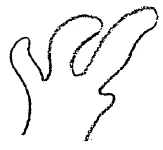
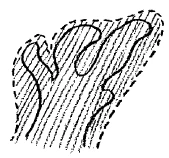
[ 7 ] In fact, clairvoyance perceives the sprouting, budding life—for example, that of the nervous system, particularly the brain—as such a fiery wave. Yet, in truth, the human soul life lies outside this sprouting, budding life. If I were to depict human soul life as it is during the night, during sleep, I would have to place it entirely outside this figure; but for waking life during the day, we must create a mental image of the soul life as intertwined with this sprouting, budding—I would say, fiery—life:
[ 8 ] If, then, the life of the soul were to permeate only physical-organic life, no consciousness would arise. How does consciousness arise? First, the soul must work upon the physical. In the physical realm, there are initially sprouting, budding growth processes—subtle growth processes—which, for my part, are scattered throughout the nervous system. These growth processes are broken down; they are destroyed. A process arises that is very similar to what occurs when a sprouting, budding plant gradually begins to wither and die, so that the soul life brings about processes of destruction within this sprouting, budding life, which I depict here through these notches or interruptions in the hatched lines.
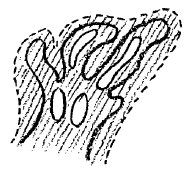
[ 9 ] So, when we live in a state of wakefulness, our inner life initially disrupts the physical growth processes, breaking them down. And as a rule, human beings are unaware of what is happening there—of this breakdown. Only clairvoyant observation gives us the opportunity to truly say to ourselves: By entering into a relationship with the spiritual world—I am now explicitly saying not with the physical world, but with the spiritual world—you must, if you wish to form mental images, destroy something within yourself.
[ 10 ] You see, this is what is so profoundly unsettling about the initiation process: that one witnesses this destruction; that one knows that in order to relate to any being—such as an angel, an archangel—of the spiritual world and to gain mental images of it, that is, to truly perceive it, one must destroy something within oneself. It is not the initiation itself that destroys anything; rather, it merely reveals what is destroyed in the everyday process of perception.
[ 11 ] We do this as well when we connect with a flower or an animal; it’s just that people aren’t aware of it in the ordinary course of life. We only begin to realize it when these processes of destruction reflect back into our inner life like mirrors. That is the transformation. So imagine this: You are looking at a red flower. What you experience with the red flower initially causes you to trigger a process of destruction within yourself. You simply aren’t aware of this. But what is destroyed there is reflected back into the soul, and this causes you to then have the red flower as a mental image, as a perception. So you must first create an image of the red flower within yourself by breaking down the sprouting, budding processes, and by breaking them down, you create what you then see. Conscious life consists of such processes of breakdown, which are in turn followed by processes of rebuilding. It is an inner working on one’s own organism, just as, fundamentally, all human cultural work is ultimately based on this. — When we engage in cultural work, we too initially destroy nature. We cannot build a house unless we take the wood from outside by destroying it, and then use what is the product of destruction—what we have torn from nature—to construct our works of art. This is essentially how we proceed with all artistic creation. Here we act exactly as the destructive, degrading forces do to the sprouting, budding processes: they suppress certain growth processes; and what is thereby embedded in the organism—as something dead that has been forced into the living—is the content of conscious being. We continually transfer the dead into the living as we develop consciousness; and the more conscious we become, the more we press a dead element into our living selves.
[ 12 ] Sleep then has the task of dissolving these dead inclusions, leaving only certain remnants that remain and that continue throughout our entire physical life in the same way as processes, forming the basis of memory and recollection. If everything were dissolved again by sleep, we would have no memory, no recollection. So you see, we must become acquainted with a true winter in our lives if we wish to attain consciousness. To wish to be conscious means to spread the destructive, withering life of winter over the sprouting, budding life of summer. We must create winter within ourselves if we want to be conscious. We must therefore, in a certain sense, learn to appreciate winter, because if it were always summer in life, the spirit could not experience the physical realm consciously but would always remain unconscious.
[ 13 ] However, something else may become clear to you from these reflections. The materialist observer of the world will readily say: “Yes, one cannot, after all, look into the way consciousness works within the physical body.” — Certainly, as long as one does not study Spiritual Science, one cannot look into it. But when one learns through Spiritual Science that a parallelism exists, as has been indicated—the parallelism between the individual life of the human being and the life of the Earth spirit—then one arrives at the following conclusion. Then one says to oneself, if one wants to form a concept of the sleeping human being, of what the sleeping human being actually is: Well, then one should simply stand there during the sprouting, budding summertime and observe how everything is sprouting and budding. Just as things unfold out there in the earth, so they unfold—only on a small scale, so that one cannot see it—within the physical nature of the human being. One would experience summer within the human being when observing the sleeping human, and one would experience winter within the human being when observing the waking human. If one wants to know how consciousness functions by making use of the physical body as an instrument, then one must observe how, in autumn, everything begins to wither and fade; everything begins to die off, as they say. And with the external image one can form of winter, one has a true mental image of what the waking consciousness accomplishes in the human physical organism by using the physical body as a tool.
[ 14 ] This is also why, when the soul is outside the body and this clairvoyant consciousness looks upon the body from which the soul has now emerged, this clairvoyant consciousness perceives the body as a sprouting, budding world. It is a childish mental image to believe that when the clairvoyant is outside the body with his soul, he sees the body the same way one sees another person in physical life. It is, in fact, a misconception for people to imagine that the person lies there while the soul hovers above, looking back down at the body and seeing the person lying there below. But that is not the case. The moment the soul leaves, the body becomes the world, the summer world; and when the soul remains clairvoyant and re-enters the body, it experiences the personal, individual winter within itself.
[ 15 ] In this way, we discover a deep connection between human life and the life of the Earth. When we now consider this life of the Earth and look first to the summertime, this summertime—set before us—reveals to us everything that is similarly at work and weaving within us as well, working and weaving. But within us, in the state of sleep. And if we now seek an expression that can briefly convey to us the sensation of this working and weaving in the state of sleep, then it is this: All of this is the world of being born, of coming into being. And when we feel ourselves to be in this world, we can say: We are born of the Divine. — For insofar as we belong to this world—this sprouting and budding world—through our own powers, we must say: “Ex Deo nascimur. We are born of the Divine.” People have been able to say this “Ex Deo nascimur” at every stage of Earth’s evolution, and will be able to say it at every stage of Earth’s evolution in the future as well. |
[ 16 ] In contrast, for our cycle of time—which follows the advent of the Mystery of Golgotha—it is essential that we understand that the forces of dying life, the forces of life that is melting away and dissolving, are at work within us, and that consciousness is connected to this melting away and dissolving of life. We find the consciousness of the Earth, the waking life of the Earth, during the winter season. In order to live with the Earth in the physical world during winter, we must immerse ourselves in what is first dying. But after the Mystery of Golgotha, we immerse ourselves by taking the Christ impulse with us into this dying process: “In Christo morimur.” And we make this our guiding motto through the other half of the year, as the Earth awakens, awakens within the life that is dying: “In Christ we die.”
[ 17 ] And so the earthly year is divided into two halves: the half that reaches its peak at St. John’s Day, for which the saying “Ex Deo nascimur” applies, and the other half, which reaches its peak around Christmas, for which the saying “In Christo morimur” applies.
[ 18 ] One should not believe that, properly understood, the view of human beings as a microcosm in relation to the macrocosm is merely an abstract one. Nor should one believe that one can accomplish much with abstract mental images of this view. Rather, one should be clear that one comes closer and closer to this view as one truly enters into the real life of the Earth Spirit.
[ 19 ] You see, when one looks at the Earth in winter like this, with its life withering away and freezing to death, this withering, freezing life is the expression of the thinking, feeling, and sensibility of the awakening Earth Spirit. But we must conceive of this Earth Spirit in connection with what initially surrounds us as our world. We must, as it were, imagine the world as a great spiritual being that has its physical instrument in the Earth. And this mental image of what the Earth thinks—what the Earth thinks, in particular, as it watches over us during the winter—is gained when one considers the entire way in which the Earth’s surroundings interact with the Earth itself. Imagine, on a winter night, gazing out at the stars—the moon, for example, amidst the stars—and one must say: The constellation of this starry world is an outward expression, an image of what is consciously thought upon the Earth, and we live within it as the universe enters into a relationship with the Earth. There you see us standing alive within Earth-thinking, within that which weaves around and washes over the Earth as Earth-thinking [in winter just as] we stand within Earth’s sleep in summer, alive with our own soul.
[ 20 ] And yet, in the summer, we must remain alert as we engage with earthly life. We must, I would say, draw upon all our astral forces so that we do not succumb to the Earth’s slumber. Many people, after all, fall asleep very easily in the summer heat because their astral forces are not strong enough to resist the general slumber of the Earth. When we ourselves sleep during the summer, our activity is in harmony with the Earth’s activity. In winter, on the other hand, we must develop within our subconscious such forces for sleep that resist the general earthly life, and for our waking life during the winter months we need those forces that align with the waking life of the Earth spirit. Thus, I would say, we resonate with our own life—with the small vibrations of our own life—in the annual vibrations of the Earth being, the conscious Earth being. And this conscious Earth being is entirely dependent on the constellation of the stars. And there you gain a vivid impression of how your own soul life is interwoven with the life of the stars through the indirect path of Earth’s sleep and wakefulness. There you gain a vivid mental image of what astrology should truly be, if it is to be taken seriously at all. That is why, as I have often said: Astrology is either the purest form of dilettantism, or it can only be attained as an integral part of a genuine deepening into studies and insights in Spiritual Science.
[ 21 ] I have often emphasized in recent times how necessary it is for those who are close to Spiritual Science to adopt mental images that lead from the purely intellectual to the living. Do you think that entirely new aspects of life open up when we now know that consciousness is rooted in decay and destruction, that destruction must exist so that consciousness can have tools within the physical realm? For truly, just as we cannot work in the physical world without destroying nature, so too can we not become conscious within ourselves without the processes of growth within us being destroyed. Clairvoyance must look upon these ongoing processes of destruction, look upon them unreservedly, as—one might say—a successive death unfolds throughout one’s entire life so that consciousness may exist. And initiation consists precisely in receiving, as it were, in a concentrated form within a single image, this process of destruction that is otherwise spread out over the entire period between birth and death. But in actual physical death, this process is thus concentrated; and if physical death were not to occur, we would never be able to develop consciousness in the spiritual world after death. Death—that is, the destruction of the physical and etheric bodies—is the fundamental condition for the development of consciousness in the period between death and a new birth. Just as a plant cannot exist without roots, so too consciousness could not exist between death and a new birth if it did not take root in the process of death. Just as we must, in the first years of our physical life, gain the ability to spiritually destroy the initial processes of growth and sprouting, and consciousness awakens only to the extent that we can embed processes of destruction within the processes of growth—just as consciousness forms at all only when this power of the destructive processes has reached a sufficient degree—so too must we destroy and cast off the entire body; and the act we perform in doing so—this shedding, first of the physical body and then of the etheric body—is the initial act for consciousness between death and a new birth. In this way we acquire the capacity for consciousness between death and a new birth, so that we—and one may well say this, for it is accurate—can, so to speak, kill ourselves, that is, undergo the processes that take place at the moment of death.
[ 22 ] Just as life here, between birth and death, has its starting point in the purely vegetative stage of childhood, so life between death and a new birth has its starting point in the process of death. Here, then, we are looking at processes of radical destruction. And this is precisely what is important: that we cultivate within ourselves the ability to live our way into the entire course of nature and the whole universe, including the spiritual realm.
[ 23 ] If you consider modern spiritual life, you will find that, essentially, more and more—as I have already pointed out—human development is turning away from the inner process of existence, and people want to view the world only from the outside. There is a growing aversion to viewing nature as a whole; and there is also a growing tendency to view, I might say, only half of nature—namely, the processes of growth, sprouting, and budding. Where destruction begins, people think, existence simply ceases. The materialist cannot help but think this way, for he can never gain any mental image of spiritual life in the physical world, since these mental images of spiritual life in the physical world begin precisely where the processes of destruction begin. But he wants only to examine the processes of sprouting, because for him, in fact, only those are real. When something begins to wither, he immediately begins again to examine that which then grows out of it, or he examines, within the dying process, that which then remains as a chemical residue—which is, in turn, that which develops from it as the emerging. The important thing is not to direct one’s gaze toward one half—toward decay. But [only] from decay alone can one gain an insight into the existence of conscious soul life. This is an immensely important mental image.
[ 24 ] By developing in the manner just described—by focusing its gaze solely on what is sprouting and budding—the modern worldview has also placed itself in a position where it is unable to perceive the spiritual, for the spiritual emerges from things precisely where they begin to dissolve. As long as they sprout and bud, the spiritual is at work within the beings; it does not appear as the spiritual there, but reveals itself outwardly through material processes. For the spiritual to appear in its own right, processes of destruction must take place. The spirits of the blossoms, the elemental spirits of the plants, must not remain when the blossoms awaken, when the blossoms unfold, when the sun conjures forth, through its resonant wave, the sprouting and budding life. “If this strikes you, you are deaf!” Read these words from the beginning of the second part of Goethe’s Faust with understanding: There they must go into hiding; they can emerge only when the sprouting, budding life recedes.
[ 25 ] You see, the poetic vision is so vivid in Goethe, for example, that he truly feels this: Just as the sprouting and budding of the sun’s revelation emerges, the elven beings must withdraw once more. We have, of course, depicted this for the delight of our little ones, who loved to crouch down when they heard it. But it will be evident to you that, in a sense, from the sight of the physically dying world, the realm of the spirit-mist and ultimately the spirit realm itself arise. It is not entirely without meaning when folk belief says that trees must first rot in order to become spiritual, and that they reveal the spirit to us only where they are rotting. When we go outside and find a rotting, withered tree trunk somewhere, it is actually only then that the spirit manifests itself. Destruction must first be present everywhere if the spiritual is to appear.
[ 26 ] However, the essence of modern spiritual life lies precisely in the fact that souls have, so to speak, withdrawn from such an intimate engagement with the external world that one can truly feel what is passing away—and thus the spiritual and living. And that is why, when one speaks to people today about the spiritual, they cannot form any mental image of it at all. For they regard the world only insofar as it sprouts and grows; when it ceases to do so, when it decays, then it simply disappears from reality. When one speaks to people about real, true life and about how the spiritual arises from transience, they feel they are hearing about something that gives them nothing at all, that means nothing to them. And so it can indeed happen today that when one speaks to an audience—one that has not yet been prepared by certain concepts of Spiritual Science—about what lives in the world as the spiritual, people do not know whether one is even speaking to them about anything at all. And so, for such people, the question of worldview has completely fallen into the realm of indifference. They have become completely indifferent to what one finds underlying things.
[ 27 ] You can have quite an experience there, as once happened during a lecture. As you know, our deepest desire is to keep away those who are usually the least [pre]educated in the audience: these are the ones who write for the newspapers; who, after all, usually understand the least of all about what’s being discussed. But sometimes it happens that such quite intelligent people of the present day simply cannot be kept away. After all, one can’t take such a radical approach everywhere, as was recently the case at a ‘place in Austria’ where, as soon as the journalist arrived, our chairman said: “You won’t understand anything anyway, so you’d better stay away.” — On top of that, the man had a ticket he’d bought [not even a free pass]. Things can’t go that way everywhere. And so it actually happened another time that the reporter wrote: “Well, what’s the point of all this Spiritual Science anyway? It’s clear enough: one person has a mental image of the world this way, another that way.” All of these views have equal validity.” — And so, in many places today, the most profound indifference—coupled with the most outrageous frivolity—toward anything related to worldviews is spreading. For example, a review of a lecture once read: “Well, one person simply views the world as a construction set, another concocts toad gall with tiger intestines, the third is a monist, the fourth stares into the thicket and thinks nothing of it, the fifth observes the powers of the soul through two pairs of glasses, and so on”—says the person in question—“one could go on and on.” So he is indifferent to it all.
[ 28 ] This lack of interest in grasping the world through the spirit is not waning; on the contrary, it is spreading and will continue to grow unless Spiritual Science penetrates our world. The greatest value of Spiritual Science will lie in the fact that it does not merely engage people’s capacity for concepts and ideas, but that it seizes and permeates the whole soul of human beings, so that a person truly feels themselves standing within it as the microcosm within the macrocosm, and truly experiences within it, in the particular, that which, I would say, is built upon the processes of destruction. It is only through this that we attain a true sharing in the experience of the dead—that, in the process of destruction that is death, we see the process by which the human being’s spiritual existence rises after death, which then continues to work until a new birth.
[ 29 ] Thus, Spiritual Science must at the same time become a living into the truth of things, a being seized by the truth of things. Modern spiritual life is a distancing from the truth, a growing indifference. One becomes indifferent to whether one looks into things clairvoyantly or whether one “brews toad bile with tiger intestines.” In cultural and ethical terms, modern spiritual life is on the path of the most frivolous, cynical indifference toward all existence that lies in the depths of beings. In contrast, Spiritual Science is developing, and it can develop naturally, since the human soul—simply by taking an interest in the results of spiritual research—is seized, carried into, and woven into the cosmic process. One need not be a clairvoyant, but only need to courageously experience the findings of clairvoyance and familiarize oneself with Spiritual Science; then one is seized by what one takes in as spiritual-scientific concepts and carried into a living experience and shared feeling of the cosmos. For this, however, it is necessary not merely to regard Spiritual Science as something through which one enjoys life, but to repeatedly bring to life in one’s soul what Spiritual Science offers, and to work through it more and more deeply in thought; one need not initially be clairvoyant, but one must accustom oneself to viewing the things of life from various angles in the spirit of Spiritual Science. That is why we characterize things from the most diverse perspectives. Then the experiences simply take hold of you and carry your soul—with its feelings, even if not yet with its understanding—into the life of the spiritual world and into the spiritual that manifests itself in the material world. |
[ 30 ] But this means that what Spiritual Science seeks to achieve—in knowledge, in art, in religious feeling, and in ethical will—enters our spiritual life as something of which we must be aware: it is emerging as something new in today’s education. And anyone who is a person of Spiritual Science must become aware of this novelty. I hinted at this yesterday in another context, namely in reference to the fact that we ourselves must reshape the Christ impulse and that our image of Christ is, in fact, very different from Michelangelo’s Christ. We must be able to courageously reshape our thinking and feeling toward the world in such a thoroughgoing way. Then humanity will once again gain a sense of what true life is—real, intense, living life. For this has ceased; wherever we look in our surroundings, it has ceased—that which Goethe still sensed when he said: “Art must be the expression, the true expression of the living laws of the world. It must be an interpretation of mysterious natural laws.” — This is no longer understood in our time. Hence we see how, in all fields, what appears as knowledge on the one hand and as art on the other is gradually becoming detached from the inner, true life of truth. In art today, people are so fond of speaking of “compositions,” of “arrangements” of individual elements. What art was in earlier times—and what it must become again—has already, I would say, vanished entirely: a creation drawn from the truth of things themselves. It is, in the most eminent sense—one might say—an Ahrimanic conspiracy against the truth that is currently sweeping through the world and manifesting itself in both the artistic and intellectual spheres.
[ 31 ] In the realm of knowledge, we see everywhere a clinging to what is merely perceived by the senses. We see something similar in art as well. We see how, little by little, the ability to feel and sense the inner truth of things is dying out in people. And so works of art can come into being and even—I would say—be admired far beyond the educated world, such as Romain Rolland’s novel Jean-Christophe.
[ 32 ] But when someone creates from true art—someone who senses inner truth, inner, prevailing truth—that person does not cobble together a so-called “work of art” like Jean-Christophe; that person knows that the individuality of Beethoven, Richard Wagner, Strauss, and Gustav Mahler each possesses its own inner truth. If one cobbles them together, one creates a repulsive chaos of decadent art, such as this repulsive Jean-Christophe; yet, to the chagrin of all those who have anything to do with true art—and this must also be said—it is admired throughout the entire cultured world, admired because, I would say there is currently a secret conspiracy against true, essential truth. Yes, one does not even realize that by admiring such a so-called work of art, one is sinning against the truth—against the real, essential truth—when, instead of living individualities formed out of a living unity, one accepts as valid a chaotic, foolish mess composed of all manner of things.
[ 33 ] One must look to the various sources of what is wrong, from which souls in our time so readily draw; one must calmly and courageously acknowledge this inversion in order to become aware of the profound significance of the impulse of Spiritual Science and its intervention in the living world of truth for humanity. Then, however, one will also understand that we live in an age in which what confronts us must become clear: on the one hand, summer life, sprouting, budding life: “Ex Deo nascimur”; [on the other hand, winter life,] the destruction of life, but the Spirit emerging from this destroyed life in our time according to the Mystery of Golgotha: “In Christo morimur.” But humanity must not remain standing in the future solely on this ground; rather, when this sprouting and budding summer life comes, when the sleep of the Earth spirit comes, then we must find the strength to develop, within the sleep of the Earth spirit, a higher life of the soul arising from the findings of clairvoyant science. Then we must say: As the world is, summer life is “Ex Deo nascimur”; winter life—as the world is and as the Mystery of Golgotha is set within it—“In Christo morimur.” But as we approach the sleep of the outer Earth organism—the summer life—let us be aware that we can carry into this time what we now feel through this genuine participation in the spiritual world—that which the Spirit carries into the time when the Earth sleeps: the spirit of Pentecost. If we have truly felt “In Christo morimur,” then we carry the spirit of Pentecost into this state of the Earth’s sleep by taking in the impulses that Spiritual Science can give us.
[ 34 ] We are born of the Divine; the sprouting, budding life of nature in summer bears witness to this. We live with Christ—we feel this; as we enter the winter season, when the earth lies dormant, we carry the Christ impulses with us into the life of nature as it withers: “In Christo morimur.”
[ 35 ] But as we once again approach summer with the Mystery of Golgotha, we bring the spirit of Pentecost into our lives, so that it may remain awake in the darkness of summer, amid all that is sprouting and budding, so that in the midst of the sleeping spirits of the earth, we ourselves may awaken in the Spirit: “Per spiritum sanctum reviviscimus.”