

Artistic and Existential Questions
in the Light of Spiritual Science
GA 162
31 July 1915, Dornach
Translated by Steiner Online Library
Tenth Lecture
[ 1 ] It is indeed difficult in our time to be truly understood when one speaks from the sources of what we call Spiritual Science in our context.
[ 2 ] Today, I am less concerned with the difficulty of being understood by the individuals we encounter in life than with the cultures and the various worldviews, schools of thought, and currents of feeling we face in the present day.
[ 3 ] When we consider European life, we find, first of all, that a great difficulty arises within it from the fact that, at the very moment when this European life advances from mere sensory perception to thinking about those perceptions — and this transition, after all, must be accomplished by each individual at every moment of waking life — that, I say, this European way of life, in the very content of its thoughts, fundamentally fails to sense how intimately that content is connected to what we are as human beings.
[ 4 ] One thinks, one imagines, and one is aware that through the thoughts one forms, through the mental images one experiences, one learns something about the world—that, in a sense, one comes to know something about the world—that these mental images, in fact, reflect something of the world. One has this awareness. Anyone walking down the street has the feeling that, by looking at the trees and so on, mental images come to life within them, and that these images are inner representations of what they perceive—that, in a sense, through these images they take in the world of external perceptions and then continue to live out these perceptions.
[ 5 ] Furthermore, the idea that thinking is still something essential within our inner self—within our inner self as human beings—that we are doing something when we think, that this thinking is an inner activity, an inner work—this is something that, within the European worldview, is rarely, if ever, truly brought to consciousness.
[ 6 ] I once pointed out here that every thought is, in fact, something fundamentally different from what it is commonly recognized as. It is recognized as a reflection of something perceptible externally. But it is not recognized as a shaper of form, as a creator. Every thought that arises within us, in a sense, takes hold of our inner life and, as long as we are growing, plays a part in our entire development as human beings. It was already involved in our development before we were even born, and it belongs to the formative forces of our nature. It continues to work, and it constantly recreates what dies within us. So it is not merely that we perceive our mental images from the outside; rather, as thinking beings, we are constantly working—through what we imagine—to continually reshape and form ourselves anew.
[ 7 ] From a perspective of Spiritual Science, every thought appears much like a head with something like an extension pointing downward, so that with every thought we actually enclose within ourselves something like a shadow image of ourselves; not entirely like us, but as similar as a shadow image. This shadow image of ourselves must be embedded within us, for something is constantly being lost from us, something is perishing; it is, in fact, crumbling away. And what the thought embeds within us in the form of a human figure is what sustains us at all until our death. Thus, the thought is at the same time a genuine inner activity, a process of building ourselves up.
[ 8 ] This latter insight is almost entirely absent from the Western worldview. One does not sense, one does not feel in one’s heart how a thought takes hold of one, how it truly spreads within us. A person who breathes still feels, from time to time—although for the most part they no longer pay attention to it—that the breath spreads within them, that the breath has something to do with their renewal, with their regeneration. So it is with thought as well. But the European hardly feels anymore that thought is actually striving to continually become human, or, to put it better, to take on human form.
[ 9 ] Without this sense of the forces that lie within us, however, we can hardly hope to gain a true understanding—an inner, emotional, and vital understanding—of what Spiritual Science seeks. For it does not actually work with what thought provides us—by representing an external reality—but rather it works with this life element of thought, with this continuous shaping of thought.
[ 10 ] For centuries now, precisely because European humanity has increasingly lost this consciousness—which I just described—it has been quite difficult to speak of Spiritual Science, or to be understood when speaking of it. In the Eastern worldview, this feeling I have just expressed toward thought is present to a high degree. It is indeed present to a high degree; at the very least, there is an awareness that one must seek this feeling through the inner experience of thought. Hence the tendency of people in the East toward meditation; for meditation is meant to be a kind of immersion into the formative powers of thought, a becoming aware of the living feeling of thought. One should become aware during meditation that thought is at work within us. This is why we find sayings in the East such as: “In meditation, become one with Brahma, with the Shaper of the world.” This awareness—that when one truly immerses oneself in thought, one does not merely have something within oneself, nor does one merely think for oneself, but rather immerses oneself in the formative forces of the world—is what is sought in the Eastern worldview. But it has become rigid—rigid because the Eastern worldview has failed to acquire an understanding of the Mystery of Golgotha.
[ 11 ] Although the Eastern worldview—and we will speak more about this later—is highly inclined to immerse itself in the creative forces of the life of thought, it nevertheless immerses itself in a dying element; it immerses itself in a web of abstract, lifeless mental images. So one could say: While true immersion consists in experiencing the life of the world of thought, the Eastern worldview immerses itself in a replica of the life of thought. One should immerse oneself in the world of thought as if one were placing oneself within a living being. But there is a difference between a living being and an imitation of a living being—let us say, an imitation made of papier-mâché. The Eastern worldview does not immerse itself in the living being—neither Brahmanism, nor Buddhism, nor Chinese culture, nor Japanese culture—but rather immerses itself in something that can be described as an imitation of the world of thought, as in something that relates to the living world of thought in the same way that a papier-mâché replica of an organism relates to a living organism.
[ 12 ] This, then, is the difficulty both in the West, on the one hand, and in the East, on the other. In the West, one is less understood because there is very little awareness of these living, creative forces of thought; in the East, one is not properly understood because there is not really an awareness of the liveliness of thoughts, but only of dead imitations, of the rigid, abstract weaving of thoughts.
[ 13 ] Now you just need to realize where what I have just explained actually comes from. You all probably remember the description of the Moon’s evolution that was given in my book Occult Science. In the course of his own evolution, humanity has indeed actively participated in everything that took place during the Saturn, Sun, and Moon phases, and is currently continuing to participate in what is unfolding as the Earth phase. If you recall the lunar evolution as described in my Occult Science, you will realize that during the lunar evolution, the separation of the Moon from the Sun took place. This occurred for the first time in a distinct manner—such that a genuine separation actually took place. We can therefore say: Whereas previously, in a certain sense, there was an interlocking of the planetary worlds, the separation of the Moon from the Sun in pre-Earth times marked a period of parallel development—a temporary coexistence of the Moon’s evolution and the Sun’s evolution. Such a state of separation existed.
[ 14 ] As you can see from Occult Science, this detachment is of great significance. Human beings, as they are today, could not have come into being if this detachment had not taken place. But on the other hand, every such process is intimately linked to the introduction of a one-sidedness into our evolution. It came to pass that certain beings from the hierarchy of the Angeloi—who were, in other words, human beings during the lunar evolution—refused, so to speak, to reunite with the Sun. The Moon thus separated, and during the later reunion with the Sun, they refused to take this step—to reunite with the Sun.
[ 15 ] All Luciferic backwardness is, after all, based on such a refusal to participate in later phases of development; and so part of the Luciferic nature stems from the fact that certain beings from the hierarchy of the Angeloi—who were human at that time—did not wish to participate in the reunion with the Sun during the final phase of the old Lunar Age. Certainly, they had to descend again, but in their hearts, in their innermost being, they retained a longing for lunar existence. They were then out of place; they no longer felt at home in the actual course of evolution; they actually felt themselves to be lunar beings. This was the nature of their backwardness. This kind of being naturally also belonged to the host of Luciferic beings who, in their further evolution, descended, so to speak, onto our Earth. They also live within us in the way I indicated in one of my recent lectures. And it is these beings who, so to speak, prevent the awareness from arising in our Western thinking that this thinking is an inwardly living one. They want to keep it lunar in nature, separated from the inner element of life connected to the solar; they want to preserve it in this state of separation. And they work to instill in our consciousness not a sense that thinking is connected to inner formation, but rather a sense as if thinking were connected only to the external—precisely to that which is separated. Thus they evoke a feeling regarding thinking: one can only represent the external world through thinking; one cannot grasp the inner, formative, living reality; one can only grasp the external. They therefore distort our thinking.
[ 16 ] It was precisely the karma of Western humanity to encounter these spirits, which in this form distort thought, alter it, and externalize it—spirits that strive to impose their stamp upon it, as if thought could serve only to reflect the external and not to grasp the inner life. It was the karma of the Eastern peoples to be spared from this kind of Luciferic element. Consequently, they retained a greater awareness of seeking, in their thinking, that which inwardly shapes and forms the human being—that which unites him inwardly with the living world of thought of the universe. It was incumbent upon the Greeks to form the transition between the one and the other.
[ 17 ] Because people in the East have had little contact with that Luciferic element I have just described, they have no real sense that one can also come into contact with the living aspect of thinking about the external world. For them, whatever they encounter there is always like papier-mâché; they have little understanding of how to apply thinking to the external world. Lucifer must be at work in the activity I have just described to you for a person to develop the inclination to think about the external world as well. But then it is just like the swing of a pendulum that goes to one side: they become fixated on this activity directed toward the external world. This is, in fact, the peculiarity of all life: that it swings first in one direction and then in the other. Such swings are inevitable, but one must find the way back from one to the other, from the Eastern to the Western. The Greeks were to find the transition from the Eastern to the Western. The Eastern way of thinking would have fallen entirely into rigid abstractions—as it indeed has to some extent—which are even cherished by some people, had Greek civilization not intervened in the world. If we build purely upon what we have just considered, we will find in Greek civilization the tendency to give inner form and life to thought.
[ 18 ] Well, if you study both Greek literature and Greek art, you will find everywhere how the Greeks strove to bring human forms to life from their inner experiences—in sculpture as well as in poetry, and indeed even in philosophy. If you familiarize yourself with the way in which even Plato sought not to establish an abstract philosophy, but rather to portray people who speak with one another, who exchange their views—so that what we find in Plato is not a worldview — after all, we have only dialogues in his works — but rather people who speak their minds, who express thoughts in which the thought itself appears human; you will find this confirmed. Thus, even in philosophy, we see that thought does not express itself abstractly, but rather, as it were, disguises itself in the human being who represents it.
[ 19 ] When one sees Socrates speaking in this way, one cannot speak of Socrates on the one hand and the Socratic worldview on the other. It is one and the same, a unity. In Greece, one could not imagine—as a modern philosopher might—that someone had appeared who had founded an abstract philosophy, who stood before the people and said: “This is now the true philosophy.”—That would be impossible; it would only be possible for a modern philosopher, for this lies, after all, hidden within every modern philosopher. The Greek Plato, however, presents Socrates as the embodiment of a worldview, and one must imagine that Socrates’ thoughts are not meant to be expressed as if one were merely recognizing the world, but rather that they move about in the form of Socrates and relate to people just as he does. And this element—of humanizing thoughts, of casting them, as it were, into an external, form-like, figurative shape—is the same in the Homeric and Sophoclean works, in all poetic figures, and is the same in all sculptural figures created by Greek civilization. That is why the sculpted gods of Greek sculpture are so human: because what I have just described has been poured into them.
[ 20 ] This is at the same time an indication of how the spiritual development of humanity strove to grasp, as it were, the living essence of the human being from the cosmic realm of thought and then to give it form. That is why these Greek works of art appear to us—as they indeed did to Goethe in an eminent sense—as something that, in its own way, can scarcely be surpassed or perfected, because they have synthesized all that remained from the ancient primordial revelation of living, active, and weaving thoughts, which were then poured into form. It was, as it were, the endeavor to draw together everything that could be found as thought from within and to shape it into the human form that, in Greek culture, became philosophy, art, and sculpture (Drawing a, page 198).
[ 21 ] The modern era, the present, has a different task—a completely different one. Now the task is, in a sense, to give back to the universe what is within the human being (Drawing b). All pre-Greek development led to the point of gathering together what could be discovered, as it were, from the world through the living essence of the human form, in order to synthesize it. This is the infinite greatness of Greek art: that the entire pre-Greek world is, in fact, synthesized and shaped within it. Now, conversely, we have the task of returning to the universe the human being who has been infinitely deepened by the Mystery of Golgotha, whose cosmic significance has been grasped inwardly.
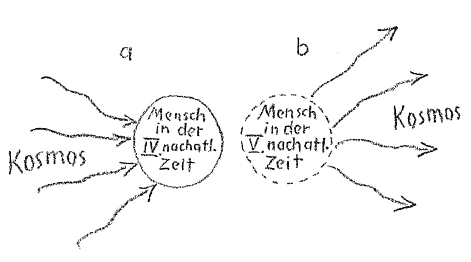
[ 22 ] You simply have to truly take to heart that these Greeks did not share the Christian view of the Mystery of Golgotha, that for them everything flowed together out of cosmic wisdom. And now imagine this immense, truly immeasurable progress in the development of humanity: the being that formerly acted from outside the cosmos—which one had to perceive as coming from the cosmos and could then express in form on the earthly stage—now enters the Earth from the cosmos, becomes human itself, and lives on in human development.
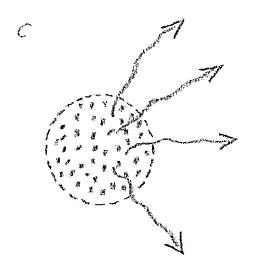
[ 23 ] What people sought in pre-Christian times out in the cosmos has now come into the Earth, and what could be poured into form is now contained within human development itself (drawing c). Of course—that is why I have indicated it with dots—it is not yet truly recognized, it is not yet truly felt; but it lives within human beings, and human beings have the task of gradually giving it back to the cosmos. We can create a mental image of this quite concretely: this giving back to the cosmos of what we have received through Christ. We simply must not resist this act of giving back.
[ 24 ] We can truly cling closely to Christ’s wonderful words: “I am with you always, even to the end of the age.” This means that what Christ has to reveal to us is not limited to what is written in the Gospels. He is not among us as a dead person who once poured out into the Gospels what he wanted to bring to Earth, but he is present as a living being within the course of Earth’s development. And we can work our way toward him with our souls. Then he reveals himself to us just as he revealed himself to the evangelists. The Gospel is then not something that once existed and then dried up; the Gospel is then a continuous revelation. In a sense, we are always facing Christ and, looking up to him, await the revelation anew.
[ 25 ] Certainly, whoever it was—whoever he may have been—who said: “I have much more to write, but all the books in the world could not contain it”—certainly he was infinitely right, for if he had wanted to write everything he could have written, he would have had to write what will only gradually emerge in the course of human development from the Christ event. He wanted to point out: Just wait, just wait! What all the books in the world cannot contain will surely come. We have heard the Christ, but future generations will continue to hear him as well, and thus we continually, unceasingly receive this revelation of the Christ. — To receive this revelation of the Christ means: to gain insight into the world from him. And what we have received, we must in turn give back to the cosmos from the center of our soul.
[ 26 ] Therefore, we may regard what we have received as Spiritual Science as a living revelation of Christ. It is He who tells us anew how the Earth came into being, what human nature is like, and what states the Earth went through before it became the Earth. All that we have as cosmology, all that we give back to the world—He reveals all of this to us. To feel oneself in this state of mind—to receive the condensed cosmos from Christ, as it were, inwardly and spiritually, and to assign it to the world with understanding, just as one receives it, so that one no longer looks up at the moon and stares at it as if it were a giant bowling ball, with which mechanical forces have knocked down pins in outer space and which has become wrinkled from these irregularities and the like, but rather recognizes what it signifies, how it is connected to the nature of Christ and Yahweh, and so on: this is the ongoing revelation of Christ. We must, in turn, impart to the external world what we receive from him. It is, first and foremost, a process of cognition. It begins with a process of cognition; later, other processes will follow. Mental processes and emotional processes will arise, emanating from us and pouring out into the cosmos; they will emerge from this.
[ 27 ] But you can see something else as well from what I have just explained. If you look at this sequence (drawing a, page 201), where the elements of the human being—which I would say were drawn together from the cosmos—then converged in the Greek worldview and in Greek art to form the whole human being, you will see: in Greek culture, human development strove toward sculptural form, toward pictorial form; and what Greek civilization achieved in pictorial form, we cannot, in fact, replicate. If we try to imitate it, nothing right comes of it. This is therefore a certain high point in human development. For one can say: In Greek sculpture, the current of human development strives toward a concentration drawn from the entirety of pre-Greek human development.
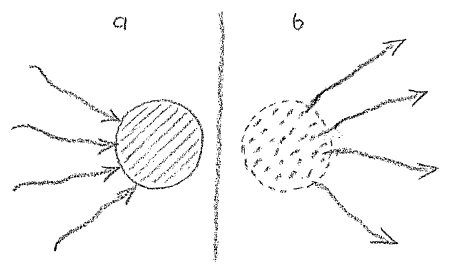
[ 28 ] If, on the other hand, we consider what is happening here (Drawing b)—what is now to take place—it is, I would say, a distribution of the constituent parts of the human being to the cosmos. You can follow this in detail. We assign our physical body to Saturn, the etheric body to the Sun, the astral body to the Moon, and our “I” to the Earth. So we truly divide; we divide the human being back into the world; and thus you can see: the entire structure of Spiritual Science is based on a division, a setting in motion once more of what is concentrated within the human being. The fundamental mood of this new worldview (drawing b) is a musical one; the fundamental mood of the old world (a) was a sculptural one. The fundamental mood of the modern era is truly musical, and the world will become increasingly musical. And knowing how to stand in the right way within what human development is striving toward means knowing that one must strive for a musical element, that one must not repeat the old plastic element, but rather that one must strive for a musical element.
[ 29 ] I have mentioned on several occasions that a figure of a primordial human being—who can also be referred to as Christ—will be placed in a prominent location in our building, with Lucifer on one side and Ahriman on the other. We take what is concentrated in the Christ and divide it again into Lucifer and Ahriman, insofar as it can be divided. We transform what has been sculpturally fused into a single figure into something musical, by turning it, as it were, into a melody: Christ-Lucifer-Ahriman.
[ 30 ] Our entire composition is truly shaped by this principle. Our entire composition embodies a distinctive fundamental characteristic: bringing sculptural forms into musical motion. That is its fundamental character. If you keep in mind that, in hinting at such things, one should never become arrogant but should remain quite humble, and if you consider that what has been done with this structure represents only the most imperfect first steps, then you will not misunderstand the meaning of all the remarks I make about the structure. Of course, this does not mean that any of what we envision as a distant ideal has even remotely been achieved; but one might say that the intention is to make a start. That is all that is meant by this—that a start should be made.
[ 31 ] But if you compare this beginning with what Greek civilization had achieved in terms of a certain degree of perfection—with the infinite refinement of the sculptural principle, that is to say, in the Greek figures of Athena and others, or as it finds expression in architecture in the Acropolis and the like—if you compare this perfection with the beginning, you will find, above all else, a polar, a radical difference. There, in Greek culture, everything strives toward being frozen in form, toward becoming fixed in form. Such an Acropolis or a Greek sculpture—they stand there to remain eternally frozen in this form, to preserve for humanity an image of what the beauty of form can be.
[ 32 ] A work such as our building—even when it is one day more fully realized—will always stand in such a way that one can truly say: it actually always inspires us to transcend this building as such, to move beyond its forms into the infinite. These columns—and especially the forms that adjoin them, and even what is painted and sculpted—are all there, so to speak, to break through the walls, to protest against the very existence of those walls, and to dissolve the forms; I would say, to dissolve them in an ethereal lye, so that they can lead one out into the vastness of the cosmic world of thought.
[ 33 ] One will truly appreciate this building when one feels that, upon looking at it, it dissolves, transcending its own boundaries; everything that forms its walls actually yearns to reach out into the vastness of the world. Then one has the right feeling. With a Greek temple, one feels a desire to become ever more one with what is firmly enclosed by the walls and with what can only enter through them. Here, with our building, one actually gets the feeling: If only these walls weren’t there to get in the way, for at every point they offer, they actually want to be broken through and lead further into the world of the cosmos. This is precisely how this building should be shaped by the challenges of our time—truly by the challenges of our time.
[ 34 ] Since we have spent years discussing not only the subjects of Spiritual Science but also conversing with one another in a way that reflects our shared understanding of what Spiritual Science seeks to express, it can be understood that when one says something disparaging about this or that in the world, one does not mean it in an absolutely disparaging or absolutely critical sense, but rather uses these seemingly critical words to characterize facts in their proper context.
[ 35 ] Therefore, when one—so to speak—levels accusations in connection with the words of a figure in world history, this is not meant in the same way as if one were simultaneously seeking to declare that, at least in one’s judgment of this figure, one wishes to be a sort of executioner who, in a spiritual sense, beheads them by passing judgment. Modern critics are like that; but those imbued with a Spiritual Science-oriented mindset are not. Please take what I am about to say in the sense implied by these words.
[ 36 ] At some point, a turning point had to be made, so to speak, in the development of humanity; it had to be said, so to speak: Now what has emerged from ancient times until now has come to an end; something new must begin. This turning point was not made all at once; in fact, it took place in several stages. But it stands out quite clearly in history. Take, for example, a historical figure such as the Roman Emperor Augustus—that is, the ruler of Rome whose reign coincided with the resurgence of the current that we trace back to the Mystery of Golgotha. Even today, it is difficult to make it entirely clear to people what the truly essential novelty was that Emperor Augustus introduced into Western development, as opposed to what had previously existed within Western culture under the influence of the Roman Republic. One must resort to concepts that are little known to people today if one wishes to explain such a thing.
[ 37 ] When reading history books that cover the period from the Roman Republic to the Imperial era, one gets the feeling that today’s historians write as if they imagined the role of Roman consuls and tribunes to be roughly equivalent to that of the president of a modern republic. There isn’t much difference, after all, when Niebuhr or Mommsen speak of the Roman Republic or of a modern republic, because today we view everything through the lens of what we immediately experience in our own surroundings. It is hard to form a mental image of what a person in times long past felt and thought—including their feelings toward public life—as being something entirely different from what people today feel. But it was something radically different, and one truly cannot understand the Roman Republican era unless one acquires a certain concept that was alive in the mindset of the ancient Roman republican—a concept he had carried over from the period known as the Roman Kingdom.
[ 38 ] The ancient kings, from Romulus to Tarquinius Superbus, were truly, for the ancient Romans, beings intimately connected with the divine, with the divine-spiritual government of the world. And the ancient Roman of the royal era could not understand the significance of his king in any other way than by creating a mental image of what happened with Numa Pompilius, the Roman king, who went to the nymph Fegeria to learn what he was to do. Inspiration for what one had to do on earth was received from the gods, or rather from the spirit realm. This was a living consciousness. The kings were the bridge between what happened on earth and what the gods, from the spiritual world, intended for the earth.
[ 39 ] Thus, what was essentially a feeling in the ancient worldview was extended to public life: what a human being brings about in the world is connected to what shapes him from within the cosmos, so that there is a constant inflow from the cosmos. This view did not stop at human government. Just as Plato would have said: What a human being can know does not exist because he carves it out in his soul as concepts, but because he receives it as an outflow from the divine beings. — In ancient Rome, too, people did not say that one human being governs other human beings, but rather: The gods govern humanity, and the one who governs outwardly in human form is merely the vessel into which the impulses of the gods flow. — But this had already been carried over into the times of the Roman Republic in the office of consul. In ancient times, the office of consul was not, so to speak, that “civic” element—as a modern government, for example, more or less takes shape—but rather the Romans truly held the idea, the feeling, the living sense that only one who still has an open mind to what the gods wish to infuse into the development of humanity can be a consul.
[ 40 ] The fact that this became increasingly difficult to believe as the Republic progressed and as major discrepancies and disputes arose within it was precisely what led to the Roman Republic’s inability to survive. It was something like this: People thought that if the Republic was to have any significance in the world, the consuls would, in a sense, have to be divinely inspired individuals; they would have to convey what came from the gods.
[ 41 ] But looking at the later consuls of the Republic, one might say to oneself: These guys are no longer the right instruments of the gods. — This is also connected to the fact that people could no longer feel—feel vividly—the legitimacy of the Republic. Now, of course, the development of such a feeling lay beyond people’s overt consciousness. It resided very strongly in the subconscious and was present in the conscious mind only among the so-called initiates. The initiates were fully aware of these matters. Therefore, even in the later Roman Republic, anyone who—for my sake—was still an ordinary, materialistically minded average citizen would say: “Well, I don’t like that consul; he’s certainly no divine instrument!” — The initiate would never have admitted that; he would have said: “He is nevertheless a divine instrument; it is only that, as development progresses, divine inspiration can penetrate humanity less and less. Human development is taking on such a form that the divine can enter it less and less.”
[ 42 ] And so it came to pass that when an initiate—a true initiate—appeared who saw through all of this, he had to say to himself: We can’t go on like this any longer! We must now appeal to another divine element that is more hidden from human beings. — Just as human beings had developed externally, morally, and so on, it was no longer possible to trust that, where human beings—through their own development—opposed the divine, the divine could still enter. Therefore, one came to, as it were, suppress the influx of the divine into a realm that was more hidden from human beings. Augustus, who was to a certain extent initiated into these mysteries, surely recognized this. Therefore, it was his aim to withdraw divine world governance from what humans had hitherto possessed and to return to a realm where the gods still act more unconsciously—that is, to work toward ensuring that the principle of heredity be taken into account in the conferral of the consular office. He sought to elect consuls no longer as they had been elected up to that point, but in such a way that the office would be passed down through the bloodline, thereby ensuring that the ability to express the will of the gods in public life would also be passed down. The progression of the divine within human beings was pushed down to a level lying below the threshold of consciousness, because it was seen that people had reached a stage where they could no longer receive the divine.
[ 43 ] You can only arrive at a true understanding of this extraordinarily remarkable figure of Augustus if you assume throughout that he was fully aware of these things and, acting out of full consciousness and under the influence of the Athenian initiates of that time who came to him, did all the things that are reported to us about him. His limitation lay solely in the fact that he could not gain an understanding of the Mystery of Golgotha; he saw only how human beings descend into matter, and therefore could only make sense of the immersion of the Divine in the materiality of blood. He had no understanding that something entirely new was now dawning in the Mystery of Golgotha. He was, in the highest sense, an initiate into the ancient mysteries, but he had no understanding of what was now developing as something new within the human race.
[ 44 ] The fact is, however, that what Augustus accomplished is, in a sense, impossible. In earthly evolution, the Divine cannot be immersed in the pure matter of the blood without earthly evolution degenerating into the Luciferic. Human beings would not be able to evolve if they were to develop solely as the blood dictates—that is, passing down from generation to generation only what was already there. Yet the fact that this actually took place is imbued with infinite significance. You must now consider that in ancient times, when the ancient mysteries were active, these mysteries did indeed contain an immensely powerful spiritual element—even if this can no longer be meaningful to us today in the same way. People were, after all, aware of the spiritual worlds. These spiritual worlds did, in fact, enter the human mind in a substantial way. And on the other hand, during the time of Augustus, people ceased to know anything about the spiritual element of the world; they ceased to know anything about it as a result of the necessary human evolution.
[ 45 ] The very essence of Augustus’s initiation lay in the fact that he knew: people would now become less and less capable of absorbing a spiritual element in the old way. There is something immensely tragic about what is unfolding around the person of Augustus. The ancient mysteries still existed at that time; but the feeling grew stronger and stronger that something was not quite right with these ancient mysteries. What was received in these ancient mysteries was something of infinite significance—a magnificent spiritual knowledge and insight. But people also sensed that something of infinite significance was approaching. — We know it is the current of the Mystery of Golgotha, which cannot be grasped with the ancient mystery knowledge—to which this ancient mystery knowledge was no longer suited. But what people were able to become aware of through the Mystery of Golgotha itself was still very little. After all, with our Spiritual Science today, we are, in essence, ourselves only just beginning to understand what has flowed into human evolution through the Mystery of Golgotha.
[ 46 ] So there was something that felt like a break with the old elements, from which one can understand that there were people who told themselves over and over again: We can’t make sense of what is coming to us from the Mystery of Golgotha. These were precisely people who stood at a certain spiritual height in the old sense—in the sense of the pre-Christian, pre-Golgotha era. It was precisely these people who said to themselves: “Yes, we are being told about a Christ who spread certain teachings.” — They did not yet sense the deeper meaning in these teachings; but what they heard about them seemed to them like rehashed old wisdom. They were told that someone had been condemned and had died on the cross, someone who had taught this and that. They could not understand any of this. It all seemed quite ordinary to them, or like lies and deceit. In contrast, the ancient wisdom that had been handed down to them seemed immensely magnificent and brilliant. Julian the Apostate must be understood in light of this mindset; his entire outlook must be understood in this way.
[ 47 ] But more and more, figures began to emerge who said to themselves: What the ancient wisdom offers—what it expounds about the cosmos—cannot be reconciled with what is blossoming, as if from a new center, through the Mystery of Golgotha. — One such figure who felt this way was the Eastern Roman Emperor Justinian in the 6th century, and Justinian’s deeds—he reigned from 527 to 565—must be understood precisely from this perspective. One must view him as having sensed, through the very way he had grown into his time, that something new was in the world. Alongside this, what had been handed down from ancient times entered this new world. Let us take just three things that had been handed down from ancient times.
[ 48 ] Rome had, after all, been ruled by emperors for a long time—five to six centuries. But the office of consul had actually always persisted in Rome as a shadow of the old days; the consuls were still being elected. If one were to view these consular elections through the eyes of Justinian, one would see in them something that no longer made sense—something that had certainly made sense during the time of the Roman Republic, but which was now completely meaningless. Therefore, he abolished the office of consul. That was the first step.
[ 49 ] The second was that the Athenian and Greek schools still existed. In these, the ancient wisdom of the mysteries was taught, which contained a much higher treasure of wisdom than that which had now been attained under the influence of the Mystery of Golgotha. But this ancient mystery wisdom contained nothing about the Mystery of Golgotha. Therefore, Justinian closed the ancient Greek philosophical schools.
[ 50 ] Origen, the Church Father, was just as well versed in matters related to the Mystery of Golgotha as he was in the ancient wisdom; though not a deeply initiated initiate, he was nonetheless highly knowledgeable in these matters. He had fused the Christ event with the worldview of ancient wisdom in his own worldview; he also sought to understand this Christ event through it. This is precisely what is so interesting about Origen’s worldview: that he was one of those who sought most earnestly to understand the Mystery of Golgotha in the spirit of the ancient mystery wisdom. And Justinian played a major role in ensuring that Origen, of all people, was condemned by the Catholic Church. That was the third act.
[ 51 ] Augustus represented the first stage (drawing on page 201, line drawing), and Justinian represented the second stage in this sense. Thus the modern era is distinguished from antiquity; an era which, as far as the West is concerned, no longer had any understanding of the wisdom of the mysteries, which had indeed continued to live on in the Greek philosophical schools. This modern era had to gradually work its way deeper and deeper into fostering the flourishing of that current of humanity that sprang from the Mystery of Golgotha. Thus it came to pass that, precisely with the condemnation of Origen and the closing of the Greek philosophical schools, modern humanity truly lost an infinite amount of the ancient spiritual heritage of wisdom. The subsequent centuries of the Middle Ages then worked for the most part with Aristotle, who attempted to recast the ancient heritage of wisdom from the perspective of human reason. Plato still drew upon the ancient mysteries. Aristotle—who is certainly infinitely deeper than today’s philosophers—did not regard his wisdom as a mystery tradition, but sought to comprehend it through human reason. It was thus a rejection of the ancient mystery wisdom that was particularly prevalent at that time.
[ 52 ] All of this is connected to the fact that, in recent times, precisely this situation has emerged—the one I described at the beginning of today’s lecture. If the Greek philosophical schools had not been closed—one might say this, but of course one nevertheless feels it was necessary that the Greek philosophical schools be closed; this is not a criticism, but is connected to the development I have described—if these Greek philosophical schools had not been closed, we would have had the living Plato, not that dead Platonism of modern times, which the Renaissance then brought about, and which is a dreadful misunderstanding of the real, living Plato. Although this misunderstood Plato is still something quite beautiful, something quite great, he is nonetheless a dreadful misunderstanding of the old, living Plato. And if people in the Renaissance believed they truly possessed something of Plato, they thereby proved only that they had absolutely no sense of what the ancient Plato possessed within himself, and that they were thus content with that scattered element that the Renaissance period had taken from Plato.
[ 53 ] Today, we make do with even less from Platonism. We see a certain shift in our world of thought and imagination away from our own inner selves; and this has given rise to the feeling I described at the beginning of this lecture: that when we think, we have the sense that our thoughts merely represent external objects and do not operate within us. In a certain sense, this stems from the fact that the ancient sense of the living vitality and weaving of thoughts within human beings was driven away with the closure of the philosophical schools by Justinian.
[ 54 ] That is one reason why it is difficult to be understood when speaking of Spiritual Science today: European humanity no longer has a proper relationship to its own thoughts.
[ 55 ] But the world of feeling and the world of will are something else entirely in the human soul. On the one hand, there is the realm of imagination and thought; on the other, the realm of feeling and will. It is even more difficult to speak about this realm of feeling and will. People regard thoughts as something that reflects the outside world. Modern people no longer have a true sense of how this is vividly connected to them. Today, people—especially Westerners—tend to view the world of feeling and the world of will as if they were active solely within their own souls, as if they were entirely contained within them. The world of feeling is the opposite of the world of thought: one becomes more aware of the world of thought as if it were meant to reflect an external reality; in the world of feeling, one no longer has the sense of standing within it—in the very place where one could truly stand if one grasped the reality, the actual existence, of the world of feeling. For the cosmos also lives within this world of feeling. And while we as people of the European world have forgotten that the world of thought operates within us, we have forgotten, in the case of the world of feeling, that what we feel and will also exists outside us. In the case of thought, we have lost the inner aspect; in the case of the world of feeling, we have lost the outer aspect. We no longer perceive any connection between our feelings and what unfolds in the cosmos.
[ 56 ] This came about because certain spirits—this time from the hierarchy of the Archangels—had previously refused to participate in the separation of the Moon; they remained with the ongoing evolution of the Sun. Certain archangelic beings, who had advanced to the human stage during the Sun’s evolution, now refused to participate in the separation of the Moon from the Sun during the Moon’s evolution: they remained with the Sun; they did not go out with the Moon. As a result, these spirits entered into Luciferic paths of evolution. They now live within our feelings and prevent us from wanting to step outside of ourselves; they want to remain within us; they do not want to leave our feelings.
[ 57 ] Let’s keep the point I’ve just touched on here in mind until tomorrow. What we’ve said today concerns the fact that we cannot find a proper stance toward the world of thought. Tomorrow we will show how we cannot find the right stance toward the world of feeling, and how the Mystery of Golgotha relates precisely to this world of feeling, and what, in turn, our tasks are with regard to this world of feeling as we experience it: that we must strive to make our worldview more musical through the proper grasp of what our life of thought is.