

Artistic and Existential Questions
in the Light of Spiritual Science
GA 162
7 August 1915, Dornach
Translated by Steiner Online Library
Twelfth Lecture
[ 1 ] Today I would like to compile a variety of points that will allow us to address some important issues tomorrow, which we intend to discuss in our current context.
[ 2 ] Let’s assume, for example, that this is the Earth’s surface—a patch of farmland or some kind of meadow, or whatever it may be (see drawing), and in this meadow there were plants taking root—any kind of plants—and here, let’s say, there was a worm or some other small animal that lives and burrows right there underground, and whose habitat is such that it never comes up above ground, so it always lives within the earth. This—let’s say—maggot, caterpillar, or whatever it is, crawls around in there and, as it crawls around, gets to know the roots of these plants. Of course, since this animal never emerges above the surface of the earth, it only ever gets to know the roots of the plants—nothing else—crawling around and getting to know only the roots of the plants. And what will happen—won’t it?—is the following:
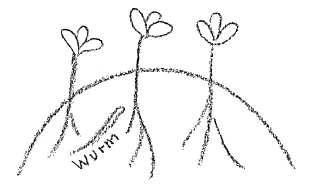
[ 3 ] When the time is just right for this caterpillar to be crawling around—up there in the plants, in all the plants in general—processes are taking place that depend on the sun shining and the sun radiating a certain amount of heat. These processes taking place in the plants will, of course, also cause changes to occur within the roots. When the plant begins to produce fresh shoots at the top and starts to bear flowers, changes naturally occur in the roots as well. All the processes in the roots are caused to proceed differently when something is happening up above. So we can say: When this worm crawls around down below, what happens in the meantime is that, through the effects of the sun, shoots, leaves, and fruits are brought forth above; and this, in turn, triggers processes in the roots. The caterpillar, however, merely crawls around in the soil; it crawls from root to root.
[ 4 ] Now let’s assume—hypothetically, we can certainly assume this—that this caterpillar or maggot is a worm or caterpillar philosopher and is forming a worldview. So it crawls around down there underground and forms a worldview. In the picture it constructs for itself as a worldview, what comes about through the influence of the sun and brings forth the shoots can, of course, never play a role; for the caterpillar can know nothing of that; it crawls around—this caterpillar, this worm—and studies the changes in the roots, and notices quite clearly that something is happening, that the roots are changing, and that something is also happening in the surrounding soil. And this worm now expresses everything it knows in its worldview. It expresses all of this, but the fact that the sun rises and the plants sprout never features in the worldview this worm constructs for itself. That is, after all, completely self-evident. In other words, a worldview emerges within this “worm philosopher” that will provide a corresponding picture of the interrelationship of facts—whether the earth down below is becoming moister, warmer, and so on. The worm does not know, of course, where this warmth comes from; but the fact that it is getting warmer, that all sorts of processes are taking place in the roots—he takes all of this in.
[ 5 ] And let’s now suppose that the worm were not just an ordinary worm-philosopher, but that he were actually inspired by some modern philosopher who holds the view—so prevalent today—that everything is interconnected through cause and effect, that everything is subject to causality, as one might put it in scientific, philosophical, and technical terms: This worm will crawl around down there and call one thing the cause and another the effect, and will thus say: Well, the earth is getting a little warmer from above; this causes the roots to change. — He will then describe the subsequent processes in the roots, and a coherent picture will emerge that organizes all the processes underground according to cause and effect. But there will be no mention of the fact that the sun shines and draws the plants out, thereby causing the processes in the roots to change. Yet this worm-philosopher’s worldview will be entirely coherent. It may well be a correct picture of causality; nothing in the chain of cause and effect will need to be missing.
[ 6 ] Now you see, I think it’s quite clear to you that this “worm philosophy” has a unified worldview that is entirely correct, but that it lacks precisely what we humans must regard as the most important thing—namely, that the sun, with its warmth and light, brings about what the worm observes down there. Its entire causal framework depends solely on the fact that it does not emerge above the Earth’s surface and therefore cannot know what is happening above ground.
[ 7 ] You see, such worms are, in essence, the very people who today construct philosophies based on the chain of causality—of causes and effects. The image is perfectly apt: people examine what their senses perceive; they move among things, operating within a realm that, while not spatially bounded above, is limited by sensory perception, and they simply fail to perceive the spiritual realm that surrounds them—a realm that, in reality, brings about the processes they attribute to the chain of cause and effect. It is, in fact, virtually the same thing.
[ 8 ] If the worm were suddenly pulled out, could see the sun, and realize that everything it had figured out down there is, in fact, not the cause but the effect of what the other beings up there see—and of what exists there as sun, light, warmth, air, and water—it would have to realize that its worldview simply does not hold true; it would have to recognize that what is above is the cause of what it itself has perceived below. It is exactly the same when one rises from the ordinary human perspective to spiritual perspectives; for one notices how that which cannot be perceived under ordinary circumstances enters the sensory world.
[ 9 ] You can also see from this that the much-vaunted internal coherence of a worldview means nothing in terms of its correctness. Anyone who is truly able to put themselves in this worm-like existence with their whole heart and soul can assure you that nothing in these “worm-like worldviews” necessarily rests on a logical error. Everything can be logically sound and coherent in itself; there need not be any logical error at all—it can be a worldview that is completely internally consistent. From this, however, you can see that it does not matter at all whether one can prove anything using the means of the world in which one lives or not. I have mentioned this before from other perspectives. The question cannot be whether one can prove something using the means of the world in which one finds oneself. No matter how compelling the evidence a worldview may have, it remains, so to speak, a “Wurman-view.”
[ 10 ] If one truly allows this to sink into one’s soul, one realizes what is truly significant behind it: one realizes how, if one merely senses that there are other worlds, a kind of universal obligation to engage with these other worlds arises. For even if one has a worldview that is as closed as can be, one need not know anything at all about the actual processes involved in that closed worldview. And that is, in fact, what one mostly finds in the philosophies of the present and the immediate past: they are worldviews. They are truly extraordinarily logically self-contained; they have an extraordinary amount to offer for the worlds in which one lives; but they are, after all, constructed using the means of the worlds in which one lives.
[ 11 ] You can see from this that you cannot rely on so-called evidence, but that you must first consider where this evidence comes from. For us today, the real issue is to develop a sense of allowing ourselves to be absorbed by other worlds, of allowing other worlds to reveal themselves. Admittedly, this is difficult. For, after all, the worm is accustomed to living underground; thus, it will not fare well above ground if forced to come up; it would first have to adapt to the new conditions. So, naturally, it is also difficult for a human being, when the soul separates from the physical body, to adapt to the new conditions.
[ 12 ] Now you may raise a question, my dear friends. You might say: All right, you have now compared for us the world in which human beings exist with their senses to what lies beneath the earth. Show us something that actually limits—truly limits—our ordinary sensory perceptions in some way. One can indeed point this out quite clearly. It was only through the succession of the becoming of Saturn, the Sun, and the Moon—specifically during the lunar phase—that time entered into the perceptions humans have, and it was only during the earthly phase that space truly came into being. When we speak of Saturn, the Sun, and the Moon, and in doing so draw on mental images, we are really speaking only figuratively, only in terms of imagination, and we must be fully aware that when we speak of these three worlds in terms of mental images, these mental images have as much to do with what took place earlier—so to speak—as the forms of our letters have to do with the meaning of the word. We must not take today’s mental images as they are, but must regard them as symbols, as images, for what follows from them. For space has meaning only for what develops within earthly existence, and time has actually had meaning only since the old Moon’s separation from the Sun. That is the precise point at which the Moon—the old Moon—separated from the Sun. Only then is it possible to speak of such processes unfolding over time as we speak of them today.
[ 13 ] But because we have our mental images in space and time—for isn’t it true that everything external that we conceive of is in space, and everything internal that we bring to consciousness, that we allow to come to life within us, unfolds in time— we are, so to speak, enclosed in space and time between birth and death—but only between birth and death—just as the worm down there dwells in the earth. Space and time confine us just as the earth’s substance confines that worm. We are worms of space and worms of time; we truly are so in a very high, in a very proper sense. For we move, just as we are as incarnated human beings, through space, looking at things in space; and that which looks is our soul, which itself lives in time. Time passes between birth and death; time passes from falling asleep to waking up. The comparison isn’t even that bad when one looks at reality itself. Insofar as our soul is enclosed within the body, it is—in its formation of a worldview—truly a worm that crawls through space and which, if it wants to reach realities, must emerge from space; then it must also get used to no longer viewing things merely under the conditions of time, but under conditions for which what unfolds in time is merely an external sign, as it were, a letter.
[ 14 ] Now that I have drawn attention to this, I would like to turn these reflections to the spiritual-soul realm. Just as the future plant is truly already contained within the seed, so too was that which has developed on Earth today in our perceptions of space and time—and which has developed for human beings—already contained in embryonic form in earlier states. I have already pointed this out here in a related context: that Saturn, the Sun, and the Moon already contain these seeds. So that when we here on Earth ascribe a certain meaning to what happens around us, we must, so to speak, already see this meaning embedded in the ancient processes of the Moon, the Sun, and Saturn. With the formation of time and the formation of space, the meaning of life on our Earth must have been prepared in some way. The formation of time and space must, as it were, have taken place in such a way that the meaning of earthly life then emerged as a kind of blossom.
[ 15 ] Now we can form the following picture of these processes on Saturn, the Sun, and the Moon. We can say: We have an ancient Saturnian existence (I), which is surrounded by the cosmos; we have an ancient Solar existence (II), which is in turn surrounded by the cosmos; we have an ancient lunar existence (III), but already developing out of this lunar existence is a kind of minor planet—you need only look this up in my Occult Science—; and we have come to understand the Earth existence (IV) in such a way that the Earth separates from the solar existence and, in turn, separates from the lunar existence.
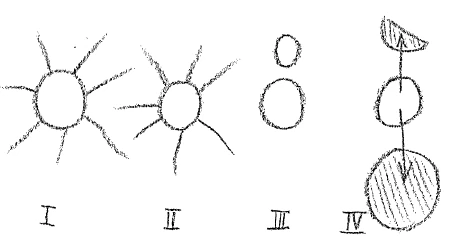
[ 16 ] If a person with a materialistic mindset—and I will assume the most favorable scenario for our Spiritual Science—could bring himself to believe in these processes, he would still have to take the next step, which consists of convincing himself that, fundamentally, all these processes —the formation of Saturn, the evolution of the Sun, then the development leading to the Moon, the separation of the Moon, and the separation of the Earth, Sun, and Moon—actually take place in order to make human beings possible, just as they are on Earth. Just as in a plant the processes take place in the roots and in the leaves to make the flower and the fruit possible, so all these processes—I would say, these macrocosmic processes—take place to make our life on Earth possible; they take place so that we can live on Earth exactly as we do. One could also say: These processes are the roots of our life on Earth; they exist so that we can develop in the way we do on Earth.
[ 17 ] Let us clearly bear in mind that we are dealing with the separation of the Sun on the one hand and the separation of the Moon on the other; that is to say, in order for our Earth to come into being as Earth, we are dealing with separations. This means that we are left behind on the Earth, and the Sun and Moon have separated from us and now act upon the Earth from the outside. This had to happen; otherwise, nothing within us could develop as it does on Earth. For everything to develop as it does on Earth, it is necessary that in primeval times the Sun and Moon were once connected to the Earth, and that they then separated and now allow their influences to shine in on the Earth from the outside. This is absolutely necessary.
[ 18 ] Now I would like to point out that our inner spiritual life has taken on very specific configurations as a result of this having happened. Among the manifold concepts we have—I could cite many examples—and which play a certain role in the overall context of our earthly existence, there is also the concept of “possessing something,” of “having something,” which is connected to the fact that our person unites with something that is just as much outside the person. We very rarely speak of “possessing” our arm or our nose, for isn’t it true that most people feel their arm or nose is so much a part of themselves that they do not speak of it as a possession? But that which could also be separate, and which nevertheless belongs to us, we designate—merely in the legal sense—as a possession, as a true possession.
[ 19 ] Now, what we call “imagination”—the ability to possess something of what exists out there—could not have developed within us at all if there had not been a separation of that which formerly belonged to the Earth, and the re-establishment of the connection between the Sun and the Moon and the Earth. Our life on the old Sun was entirely different. Back then, the Sun and Moon were connected to the Earth as the Sun itself; they were intimately connected to the whole of human existence. Back then, a human being could say: “The Sun’s influence within me,” or “I-Sun influence”—if he had already been able to say “I” at that time, though the archangels could— “I-Sun influence”; not: “The sun shines upon me; what is the sun’s influence comes to me.” — This had to take place: this planet or this fixed star, the sun, had to be separated so that we, as Earth humans, could develop precisely this particular configuration of the concept of possession.
[ 20 ] Now this is connected to something else as well. Imagine that, while still in its former existence as the Sun, the Archangel said: “I am the Sun.” — The fact that we see anything is based on the sun’s rays—or rays of light—shining on an object and being reflected back to us. If the sun were to shine from the center of the Earth, we would see nothing of the objects on Earth. We would then say, ‘I am the Sun, I am the Light,’ but we would not be able to distinguish individual objects; we would not see the objects. So, you see, there is even more to it. As the Earth evolves from Saturn, through the Sun and the Moon, to the Earth itself, it is only through the constellation in the macrocosm that the possibility arises to see and perceive objects as we do now. Such perceptions, of course, did not exist during the Sun stage; even though the first rudiments of our sense organs had already been prepared on ancient Saturn, they were only opened up on Earth—it was only there that they were transformed into organs of perception. These rudiments on ancient Saturn were, I would say, blind and non-perceiving sense organs. These sense organs were only awakened when the Sun departed and the Moon emerged from the Earth.
[ 21 ] This shows you that two processes occur in parallel: We form our sensory perceptions and see a world outside ourselves; and, running parallel to this, we develop the concept of ownership. For how do we arrive at the concept of ownership? During the old solar existence, you could not have imagined that any archangel would want to own anything. After all, he does not look upon anything; he is everything. If all objects and beings on Earth were like that, they would never feel the urge to want to possess anything. The concept of ownership develops only with the development of the senses; the concept of ownership is inseparable from the development of the senses; these two things proceed in parallel. The senses were on one side, and something like the concept of ownership on the other. Other mental images can also be considered.
[ 22 ] And if we consider, in a broader sense, what is written in the religious text, the Bible—for there is still much hidden behind such things as are written in religious texts—then we can say: What is written at the beginning of the Bible about Lucifer’s temptation is connected to the fact that Lucifer promised humanity the development of its senses: “Your eyes will be opened”—by this he means that all the senses will be opened. The opening of the eyes stands only for the senses in general. In this way, he directed the soul toward external things and, at the same time, gave rise to the concept of possession. If we were to explain in somewhat greater detail what Lucifer promised the woman, we would have to say: “You will be like God” means as much as: Your senses will be opened. You will distinguish between what pleases you and what does not, between what you call good and what you call evil, and you will want to possess everything that pleases you, everything you call good. — All of this must be connected to this Luciferian promise.
[ 23 ] Now, however, if we wish to truly grasp a mental image such as the one I have just developed, we must reflect on something. This is one of those points where it is necessary, in a lecture on Spiritual Science, to appeal to the self-reflection of each individual who wishes to take these ideas in. We must reflect on something: As I have explained to you the origin of the senses, the perception of things, and the development of the concept of possession, we have not needed to introduce any concept of space or time. Certainly, when a person wishes to visualize these things—as I have done by drawing them on the blackboard—one draws upon concepts of space and time. But to understand what it means for the senses to be awakened—and to understand what it means for the concept of ownership to develop—one does not need concepts of space and time. These things are independent of space and time. You do not need to think that I am spatially distant from a particular thing if I wish to possess it; nor do you need to appeal to temporal processes. As I said, here one must appeal to self-reflection. For anyone might object: “I can’t do it”—but if they pull themselves together sufficiently, they can imagine such mental images: that they do not rely on concepts of space and time. Yes, there is something else that is true: if you try to bring such mental images clearly into your consciousness—that is, to meditate on them, just as I have now, so to speak, meditated with you—you will gradually move beyond the concepts of space and time. You will enter a world where space and time truly no longer play the prominent role in your experiences that they do in everyday life.
[ 24 ] There is a peculiar longing inherent in human development. Wherever we encounter the human race in its innermost striving throughout history, we already find a certain longing; and that is the longing to have mental images that are independent of space and time, that have nothing to do with space and time. Historical events are transformed into myths, or the historical event is interpreted in terms of the spiritual, so that myths can be seen to take shape against the backdrop of historical events. And the further back we look in history, the more we find historical facts, as historical traditions, shrouded in myth. Just consider how, as in the case of ancient Greek history, everything is shrouded in myth; much of ancient Central European history, too, is shrouded in myth. The further back one goes, the more one moves away from the external, purely sensory perception of facts, and the representation emerges into a meaningful understanding. When you study myths, you will see quite clearly that in the formation of myths, there is a desire to transcend space and time. Not only do even—I would say—the most elementary myths, which fairy tales often depict, show how a human being—I need only mention Sleeping Beauty—steps out of time and into timelessness, but if you examine the myths, you will see: you cannot quite tell which historical facts are being referred to. Something that took place centuries earlier can be recounted as if it happened later. Sometimes, too, events that are centuries apart in historical development are forged together in myth. Myth seeks to rise above space and time. This means that there lives within human existence a longing to transcend this everyday reality—which compels us to think and create mental images in terms of space and time— and to immerse ourselves in such mental images that, being spaceless and timeless, represent those realities which, beyond the side-by-side and one-after-the-other nature of our existence in space and time, reign as eternal things—or, once they have come into being, remain as eternal things.
[ 25 ] If you take what I have just said and combine it with something I said last time, a beautiful connection will become clear to you. I said that we should consider: if there were no Luciferic influence at work within us, our world of imagination would actually be contained within the old Moon. — But this now shows that this old Moon is actually still there, has remained, and that it is only Lucifer who conjures up the illusion that our mental image is now within us. Thus, time becomes a means of deception and illusion for Lucifer. The old lunar existence is enduring, and so too are the things that arise from it. Our concepts of ownership are something enduring; that is to say, what the earthly human being develops through his concept of ownership as a social order on Earth remains and will continue to exist even when the Jupiter and Venus states are in place. And if no corresponding temptations—such as Luciferic and Ahrimanic temptations—arise, then one will see how social orders have formed on Earth through the concept of ownership. These will then represent something like physical orders. For this is part of the nature of maya, of the illusion that things are transient; in reality, they are enduring; in reality, they persist. And even when one understands existence correctly, one finds the enduring behind what has actually passed. You can grasp this, as it were, in what I have just described.
[ 26 ] But now, if we truly grasp what I have said, we are actually looking into the profoundly significant depths of our entire earthly existence. Do we not see how, beneath earthly existence in time and space, eternal earthly existence—or existence itself—literally unfolds? We have the temporal-spatial realm above us like a veil, and beneath it the conditions of duration, the conditions of permanence. And now our perception—as it unfolds in space and time—our perception that lives in space and time. Just think for a moment how one can, I would say, concretely create a mental image of this in detail. Just imagine—people today can’t even grasp this properly anymore—imagine “red” somewhere, somehow. To think of “red,” you need no space, you need no time; you can somehow create a mental image of “red”; it need not be in space or in time, because it is conceived merely as a quality (D. This is difficult for human beings because they want to define “red” strictly in spatial terms. It was not so difficult for the angels on the ancient Moon, for they had no desire to distribute “red” across individual objects. They already had a sense of time, but they did not conceive of it spatially. They conceived of it in terms of time; therefore, they perceived “red” or “green” or any color as a flowing stream. If you vividly imagine this—blue as a flowing stream, red as a flowing stream—and if you also imagine the other sensory perceptions as flowing, but only in terms of time, without a proper mental image of space interfering, then we can say: In the transition from lunar to earthly existence, one can perceive how the purely temporal is incorporated into the spatial. What, then, actually constitutes the essence of earthly existence? That a color like red is delineated and incorporated. On the Moon, it would have been impossible to see a delimited “red”; on Earth, we are able to see a delimited “red” (ID). But this is intimately connected with the separation of the Sun from the Earth and with the incidence of the sunbeam from outside. The very fact that I can say, in the true sense of the word, “the sunbeam falls in from the outside”—that alone points out to you that our present existence is inconceivable without the concept of space. Indeed, for our present perception and life, this fact that the sun stands outside means something real.
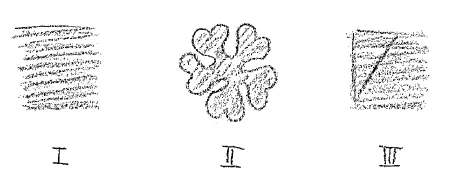
[ 27 ] Now, from what I have presented, you will easily be able to conclude that we could indeed say: colors are stretched across space, and so are the other sensory perceptions. In Theosophy, I have called that which lives on in the human being after death the “flowing stimulus,” because there the human being is not bound into space. That is why I have already referred to the first world that the human being experiences as the “world of flowing stimuli.” There, the sensory perceptions are not bound into space. On Earth, they are. Here, the sunbeam must come from outside; it must anchor the sensory perceptions within space (III). Connected to this—as I have explained—is the fact that human beings develop concepts of possession; for in a world of flowing stimulus, a human being can never think of possession; there is, at most, time, and even then they would recognize the futility of it if they were to think of possession. It would be roughly as if they were to think of owning a drop of water flowing away in a stream. This mental image therefore arises only when the sun, rising from the Earth, draws sensory perceptions into space.
[ 28 ] You see, something like what I have just explained must be transformed into a sensation, into a feeling. One cannot make sense of it if one remains at a purely theoretical level; one must transform it into a feeling, into a sensation; one must truly gain a vivid inner sense of how, as a human being—as a microcosm—one is placed within the macrocosm, and how even this longing to possess something is connected to the entire development of the macrocosm, to the process by which sensory perception has evolved. When one truly feels this, when one begins—I would say—to feel cosmically, when one begins to feel how something like the simple mental image—that one would like to possess what one sees and what pleases one in contemplation—is born out of the macrocosm: only then does one truly gain a vivid sense that the human soul is connected to the entire macrocosm; then an inner, living, and profoundly real feeling dawns within you of how you, in the individual mental images you create in everyday life, are connected to the macrocosm, and how, in fact, in everything we imagine and experience in our souls, the macrocosm lives within us. And within human beings there is a constant longing to sense such secret connections, which are truly rooted in the very foundation of life, and to express that sensation. This longing exists in human souls, in human hearts.
[ 29 ] And so let us imagine for a moment that a feeling, a true sense, were to arise in a human soul—I want to express the cosmic context of this individual soul experience: “My eye falls upon an external object; I want to possess it; I want to make it my own,” then, I would say, one will be able to sense the tragedy of natural existence from such a feeling. The tragedy of natural existence, I say. For, after all, we are essentially taking from an entire world that extends as far as the moon—and which still exists as the foundation of our own world—we are truly taking from it that which we wish to possess. What we strive to possess, we take away from this world, which rests upon the foundation of our natural world. We take that away from it. And that is what the human soul that truly feels with nature must constantly feel: that there is truly something contained within the very foundation of nature that must constantly endure; that human beings contradict this nature, which wants to give everything to everyone, and say: “This belongs to me.” — And now try to imagine this contradiction between nature, which wants to give everything to everyone, and the whole range of human feeling: “I want this for myself,” and the fact that I want it for myself is brought about by the fact that my senses can perceive it as good or less good for me, as sympathetic or unsympathetic. — There, one can immerse one’s own soul in the existence of nature, can empathize with nature as something is taken away from it; it is taken away simply by the fact that a person conceives the thought—under the impression of their senses—that they want what nature wants to give to everyone.
[ 30 ] There was a time—I would say—when I suddenly felt very deeply in my soul how one can truly grasp this entire relationship I have just tried to describe, how one can learn to empathize with nature, which says: No matter how much I resist, the course of world history has progressed to the point where human beings claim that my things are their things. I say that I felt this in my soul with such warmth and depth at a particular moment years ago, when—many years ago—a recitation was to take place in a gathering; there was a recitation program scheduled. And as sometimes happens, especially with recitation programs, when the scheduled performers are unable to attend and have to cancel—that’s exactly what happened here: a reciter had to cancel. So a replacement had to be found, and one was found. One may think what one will about the quality of the recitation that followed, about this substitute—I do not wish to go into that now—but the substitute was of a very special kind. For one of the purest, noblest Catholic priests I have ever met in the world agreed to recite the program that the actress in question was unable to perform due to her unavailability. And there was something particularly significant there; one could have a particularly meaningful experience, which for me crystallized into what I just expressed to you.
[ 31 ] For this priest—who truly took his Catholicism seriously, along with everything that Catholicism entails for a truly faithful and sincere priest—was to recite Goethe’s “Heidenröslein” as part of the program. And one could truly experience something in this recitation, because the man was not merely a priest in the ordinary sense, but was so learned and so purely devoted to spiritual contemplation that many said: the man in question—I will not mention his name now—knows the whole world and, besides that, three villages. That is how wise and experienced in the things one can know he was perceived to be. Now, the recitation itself was not particularly good; nevertheless, there was something so immensely significant in the way he presented “Heidenröslein,” because one could sense that his perception of the world stemmed from his—I would say—sensibility that was turned away from all that is sensual; one could sense how, precisely through this very act—that a priest took the stage instead of an actress—the entire cosmic power, the immense cosmic power of this unique poem, “Heidenröslein,” entered the recitation, along with the immense subtlety inherent in this poem.
[ 32 ] This poem, I would say, has a history. It is an old folk song. And as I have already said: people have always longed to sense that which lives as the cosmic foundation of existence. And in this very poem, “The Little Heathen Rose,” something of this truly magnificent cosmic foundation finds its way into infinitely simple mental images. That is why “The Little Heathen Rose” must be counted among the very most beautiful gems of poetry ever produced in the world. Years ago, I also heard of people who read into “Heidenröslein” something—I don’t know what—drawn from everyday, trivial human relationships, those all-too-human affairs; but that stems solely from the corrupt depths of their minds. If one is capable of interpreting into “Heidenröslein” anything that is not entirely pure, it requires a mind that, out of sensual haze, constantly seeks to revel in all manner of “holy” love. For one can indeed, out of one’s own sensual haze, constantly revel in “holy” love; but one can only perceive for oneself—with a pure, chaste heart—that which lies as the cosmic foundation underlying a poem such as “Heidenröslein,” and any misinterpretation would point to a genuine depravity of the mind. For consider the wondrous beauty of what—precisely because this folk poem has been transformed into the youthful, lyrical depth of Goethe’s art—this “Heidenröslein,” as presented to us by Goethe, has actually become. It has become something truly wondrous; in every line, there is always exactly what is meant to be there! Consider this: if one were to sense the effect of what, in the course of cosmic evolution, appears as a sensory perception to the eyes, and if one were to describe this—how could one do so better than by taking the color red, by, I might say, adding it to the object itself, without spatial limitation, letting it resonate in “Little rose, little rose, little rose,” by already letting the red resonate in “Little red rose!” Immediately the whole mystery stands before us, as it is set before us from the cosmos. The sensory world thus stands there:
Little rose, little rose, little red rose,
[ 33 ] in the ongoing
Little rose, little rose, little red rose.
[ 34 ] Right from the very first line, we are told that this is the mystery in question: that one can look out through one’s senses
A boy saw a little rose standing there,
A little rose on the heath.
[ 35 ] Then, on the very next line—in a marvelous escalation rarely seen in such beauty in poetry—a nuance is introduced that makes the little red rose begin to seem endearing:
She was so young and radiant in the morning,
[ 36 ] So something is presented that justifies our sympathy with what appears to the senses, and right in the next line, what goes along with it:
He ran quickly to get a closer look.
[ 37 ] Here you have the entire interplay between the senses and what presents itself to them: he was already running to get a closer look! And now the next line brings another intensification—this time within him. Outside, the intensification was: first of all
Little Rose on the Heath
[ 38 ] simply because of the object; then:
She was so young and beautiful in the morning
[ 39 ] the intensification outside. And in his case:
He ran quickly to get a closer look;
[ 40 ] as he ran to get a closer look:
I watched it with great pleasure.
[ 41 ] You can see how the exterior corresponds to the interior here. Now comes the refrain:
Little rose, little rose, little red rose,
Little rose on the heath,
[ 42 ] to draw our attention in particular to the correspondence between what is in the eye and what appears out there as the object “red.” And the mysterious connection to possession:
Knabe said: “I'll break you.”
[ 43 ] He wants to possess it, he wants to pick the little rose, he wants to take it home with him. There is nothing else to it; but what is there is wonderfully and cosmically profound:
The boy said: I’ll break you,
little rose on the heath!
The little rose said: I’ll prick you.
[ 44 ] In this sentence—“I’ll stab you”—we can now see the entire mystery of nature, which seeks to ward off what man hurls at her: “I want to carry your things home.” — She, Nature, just as she wants to leave the little rose there for everyone so that all who pass by may look at it, so she wants it to be just right with all her objects.
[ 45 ] Since in this
Röslein said: I'll stab you
[ 46 ] is already determined in and of itself—what I have called empathy for the tragedy of nature.
That you may think of me forever:
[ 47 ] He must pay a price to nature for wanting to tear apart what is united. He introduces into it what first arose in space and time: the desire to possess; for it was only because humans wanted to have the things of nature for themselves that relations of ownership arose. For this, man must pay the price for tearing something out of the enduring, so that he must at least think of it eternally. It must be immortalized; the untruth that it is not immortalized must not be allowed to persist. Then again, in the words
And I don't like it
[ 48 ] The little rose simply stands as a representative of all of nature—every natural object essentially conveys this message when one wishes to possess it. And then, to ensure that the feeling is truly anchored to the object in question:
Little rose, little rose, little red rose,
Little rose on the heath.
[ 49 ] The next stanza, in turn, is a wonderful climax. He won't be deterred:
And the wild boy plucked
the little rose on the heath.
[ 50 ] So he does want to own it after all!
Röslein fought back and stabbed.
[ 51 ] The little rose, in turn, represents all of nature.
Don't let him suffer any pain or sorrow:
[ 52 ] This is how nature works in general, and we sense that tragedy—which manifests itself as a mood in nature—when humans seek to possess it:
You'll just have to put up with it.
[ 53 ] This word is infinitely profound. This is what nature must say in response to everything that humans desire from her. To all of this, nature says: You’ll just have to put up with it.
[ 54 ] But this microcosmic mystery even has a macrocosmic counterpart, and if we now move from the microcosm out into the macrocosm, we may ask: Who, then, in the macrocosm is the wild boy who breaks the little rose on the heath? It is the sunbeam that has separated itself from the Earth along with the sun, and which now falls upon the Earth from outside; it is true that it brings forth—on the one hand, it brings forth—the little rose on the heath, but then, when it sees it, when it is there, it immediately breaks it again, causing it to wither.
[ 55 ] This is how it is everywhere in nature. Nature also reminds us of the idea that “one must simply endure it”: next to the rose are the thorns, the withered thorns, which serve as a symbol that nature does indeed take note of how the sun’s rays take away what it possesses. But it is also the thorn beside the rose. If we do not merely view it as a materialist would, but instead imbue it with the whole cosmic feeling, then the thorn on the rose is the expression of nature’s sorrow in the face of nature’s great joy, in the face of nature’s exultation that arises when the rose blossom opens, when the rosebush stands in nature adorned with roses. When then the wild boy—the sunbeam—comes and causes the roses to wither, this is the macrocosmic counterimage. And one can only say: If anything is capable of arousing esoteric feelings, it is such poems, in which one need not think of imbuing them with all sorts of straw-like allegories, but in which one need only remember one great truth: When the true poet goes beyond nature, he does so by attempting to express in words that which can be sensed beyond space and time, lying beneath the surface of facts. And when a poet captures something in such simple acts—such as a boy plucking a rose on the heath—that speaks so deeply to our hearts, it is because our hearts received this predisposition when we ourselves were not yet united with the earth, when we ourselves were still united with the ancient solar existence, and because we thereby retained within ourselves the capacity to feel in harmony with the entire world.
[ 56 ] Even though, as I have described, we now attribute our feelings to ourselves due to the Luciferic-Ahrimanic delusion, they nevertheless arose from the cosmos; and this is the reason why we can empathize so deeply with the true poet, even when he describes the simplest act of plucking a rose. For in what wells up from the human soul during even the simplest of actions, the entire cosmos stands before us. And one need not even put it into words, one need not think it through—but one feels it. When one allows a poem as wonderfully delicate as “Heidenröslein” to take effect upon oneself, one feels that the whole world is enshrined within it, that the world’s mysteries are embedded within it, so that indeed the mysteries of art, too, gradually reveal themselves to us as we ascend from the purely external perception and sensation of things to the inner, as we ascend from the microcosm to the macrocosm and attempt to gradually come to know the hidden mysteries that are at work within our souls. More on this tomorrow.