

Artistic and Existential Questions
in the Light of Spiritual Science
GA 162
7 August 1915, Dornach
Translate the original German text into any language:
Versions Available:
Artistic and Existential Questions, tr. SOL
Zwölfter Vortrag
Twelfth Lecture
[ 1 ] Heute möchte ich Verschiedenes zusammenstellen, das uns die Möglichkeit bieten wird, morgen auf einiges Bedeutungsvolle einzugehen, das wir in unserm jetzigen Zusammenhang besprechen wollen.
[ 1 ] Today I would like to compile a variety of points that will allow us to address some important issues tomorrow, which we intend to discuss in our current context.
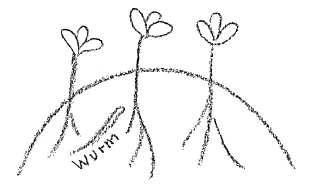
[ 2 ] Nehmen wir einmal an, hier wäre etwa die Oberfläche der Erde, ein Stück Acker oder irgendwie ein Stück Wiese, oder was es immer ist (siehe Zeichnung), und in dieser Wiese wurzelten Pflanzen, irgendwelche Pflanzen, und hier sei etwa ein Wurm oder irgendein kleines Tier, das eben da unter der Erde lebt und wühlt, und das seinen Aufenthalt so unter der Erde hat, daß es niemals über die Erde hinaufkommt, also immer innerhalb der Erde lebt. Diese, sagen wir, Made, Raupe, oder was es sonst ist, die kriecht also da drinnen herum und lernt bei ihrem Herumkriechen die Wurzeln dieser Pflanzen kennen. Selbstverständlich, da dieses Tier niemals über die Oberfläche der Erde herauskommt, lernt es immer nur kennen die Wurzeln der Pflanzen, nichts anderes, kriecht herum und lernt nur die Wurzeln der Pflanzen kennen. Und dasjenige, was geschehen wird, nicht wahr, das ist ja das Folgende.
[ 2 ] Let’s assume, for example, that this is the Earth’s surface—a patch of farmland or some kind of meadow, or whatever it may be (see drawing), and in this meadow there were plants taking root—any kind of plants—and here, let’s say, there was a worm or some other small animal that lives and burrows right there underground, and whose habitat is such that it never comes up above ground, so it always lives within the earth. This—let’s say—maggot, caterpillar, or whatever it is, crawls around in there and, as it crawls around, gets to know the roots of these plants. Of course, since this animal never emerges above the surface of the earth, it only ever gets to know the roots of the plants—nothing else—crawling around and getting to know only the roots of the plants. And what will happen—won’t it?—is the following:
[ 3 ] Es werden — wenn es gerade die richtige Zeit ist, in der diese Raupe da herumkriecht — da droben in den Pflanzen, überhaupt in den ganzen Pflanzen, Vorgänge vor sich gehen, die abhängig sind davon, daß die Sonne scheint, daß die Sonne eine gewisse Wärme ausbreitet. Diese Vorgänge, die da mit den Pflanzen vorgehen, die werden selbstverständlich auch bewirken, daß in den Wurzeln drinnen Veränderungen vor sich gehen. Wenn die Pflanze oben anfängt, frische Triebe zu bekommen, anfängt, Blüten zu tragen, so gehen unten in den Wurzeln auch Veränderungen vor sich, selbstverständlich. Es werden alle Vorgänge in den Wurzeln veranlaßt, anders vor sich zu gehen, wenn da oben irgendwie etwas vor sich geht. Wir können also sagen: Wenn da dieser Wurm unten herumkriecht, so geschieht mittlerweile das, daß da oben durch dasjenige, was dieSonne bewirkt, hervorgeholt werden Triebe, Blätter, Früchte; und dann werden dadurch auch Vorgänge bewirkt in den Wurzeln. Die Raupe kriecht aber nur herum in der Erde; sie kriecht von Wurzel zu Wurzel.
[ 3 ] When the time is just right for this caterpillar to be crawling around—up there in the plants, in all the plants in general—processes are taking place that depend on the sun shining and the sun radiating a certain amount of heat. These processes taking place in the plants will, of course, also cause changes to occur within the roots. When the plant begins to produce fresh shoots at the top and starts to bear flowers, changes naturally occur in the roots as well. All the processes in the roots are caused to proceed differently when something is happening up above. So we can say: When this worm crawls around down below, what happens in the meantime is that, through the effects of the sun, shoots, leaves, and fruits are brought forth above; and this, in turn, triggers processes in the roots. The caterpillar, however, merely crawls around in the soil; it crawls from root to root.
[ 4 ] Nun nehmen wir einmal an — hypothetisch können wir das ja annehmen —, diese Raupe oder Made sei ein Wurm- oder ein Raupenphilosoph und bilde sich eine Weltanschauung. Also sie kriecht herum da unten unter der Erde und bildet sich eine Weltanschauung. In dem Bilde, das sie sich da als Weltanschauung zurechtmacht, kann selbstverständlich niemals das eine Rolle spielen, was da durch den Einfluß der Sonne kommt und die Triebe hervorlockt; denn davon kann ja die Raupe nichts wissen; sie kriecht herum, diese Raupe, dieser Wurm, und studiert die Veränderungen an den Wurzeln, und merkt ganz gut, daß da etwas vor sich geht, daß die Wurzeln anders werden, und auch in dem umliegenden Erdreich etwas vor sich geht. Und dieser Wurm drückt jetzt alles aus in seiner Weltanschauung, was er weiß. Das drückt er alles aus, aber es kommt niemals in dem Weltbild, das sich dieser Wurm macht, davon etwas vor, daß die Sonne hervorkommt, die Pflanzen hervorkommen. Das ist ja ganz selbstverständlich. Das heißt, es entsteht in diesem Wurmphilosophen eine Weltanschauung, welche ein entsprechendes Bild geben wird über den Zusammenhang der Tatsachen, ob da unten die Erde feuchter wird, wärmer wird und so weiter. Er weiß zwar nicht, der Wurm, woher diese Wärme kommt; daß es wärmer wird, daß in den Wurzeln allerlei Vorgänge vor sich gehen, das alles faßt er zusammen.
[ 4 ] Now let’s assume—hypothetically, we can certainly assume this—that this caterpillar or maggot is a worm or caterpillar philosopher and is forming a worldview. So it crawls around down there underground and forms a worldview. In the picture it constructs for itself as a worldview, what comes about through the influence of the sun and brings forth the shoots can, of course, never play a role; for the caterpillar can know nothing of that; it crawls around—this caterpillar, this worm—and studies the changes in the roots, and notices quite clearly that something is happening, that the roots are changing, and that something is also happening in the surrounding soil. And this worm now expresses everything it knows in its worldview. It expresses all of this, but the fact that the sun rises and the plants sprout never features in the worldview this worm constructs for itself. That is, after all, completely self-evident. In other words, a worldview emerges within this “worm philosopher” that will provide a corresponding picture of the interrelationship of facts—whether the earth down below is becoming moister, warmer, and so on. The worm does not know, of course, where this warmth comes from; but the fact that it is getting warmer, that all sorts of processes are taking place in the roots—he takes all of this in.
[ 5 ] Und nehmen wir nun an, der Wurm wäre nicht ein gewöhnlicher Wurmphilosoph, sondern er wäre sogar inspiriert von irgendeinem modernen Philosophen mit der heute ja so gangbaren Anschauung, daß alles zusammenhängt nach Ursache und Wirkung, alles der Kausalität unterstellt ist, wie man das wissenschaftlich philosophisch-technisch ausdrückt: Da wird dieser Wurm da unten herumkriechen und wird das eine die Ursache nennen, das andere die Wirkung, und wird also sagen: Nun, die Erde wird von oben herunter etwas wärmer; das bewirkt, daß die Wurzeln sich verändern. — Er wird dann die weiteren Vorgänge in den Wurzeln darstellen, und es wird ein zusammenhängendes Bild entstehen, welches alle die Vorgänge unter der Erde nach Ursache und Wirkung gliedert. Aber nichts wird darin stehen davon, daß die Sonne scheint und die Pflanzen herauslockt, und damit die Vorgänge in den Wurzeln sich ändern. Aber das Weltbild dieses Wurmphilosophen wird ein ganz zusammenhängendes sein. Es wird ein richtiges Kausalitätsbild sein können; nirgends wird etwas in der Kette von Ursache und Wirkung zu fehlen brauchen.
[ 5 ] And let’s now suppose that the worm were not just an ordinary worm-philosopher, but that he were actually inspired by some modern philosopher who holds the view—so prevalent today—that everything is interconnected through cause and effect, that everything is subject to causality, as one might put it in scientific, philosophical, and technical terms: This worm will crawl around down there and call one thing the cause and another the effect, and will thus say: Well, the earth is getting a little warmer from above; this causes the roots to change. — He will then describe the subsequent processes in the roots, and a coherent picture will emerge that organizes all the processes underground according to cause and effect. But there will be no mention of the fact that the sun shines and draws the plants out, thereby causing the processes in the roots to change. Yet this worm-philosopher’s worldview will be entirely coherent. It may well be a correct picture of causality; nothing in the chain of cause and effect will need to be missing.
[ 6 ] Nun sehen Sie, es ist Ihnen ganz klar, glaube ich, daß diese Wurmphilosophie ein einheitliches Weltbild hat, das ganz richtig ist, aber daß ihm eben dasjenige fehlt, was wir Menschen als das Wichtigste anschauen müssen, nämlich daß die Sonne mit ihrer Wärme, ihrem Licht kommt, und das bewirkt, was der Wurm da unten beobachtet. Seine ganze Kausalität hängt eben nur davon ab, daß er nicht über die Oberfläche der Erde heraufkommt und daher nicht wissen kann, was über der Erde vor sich geht.
[ 6 ] Now you see, I think it’s quite clear to you that this “worm philosophy” has a unified worldview that is entirely correct, but that it lacks precisely what we humans must regard as the most important thing—namely, that the sun, with its warmth and light, brings about what the worm observes down there. Its entire causal framework depends solely on the fact that it does not emerge above the Earth’s surface and therefore cannot know what is happening above ground.
[ 7 ] Sehen Sie, solche Würmer sind im Grunde genommen doch die Menschen, welche an der Kette der Kausalität, der Ursachen und Wirkungen, heute Philosophien machen. Das Bild ist ein vollkommen zutreffendes: die Menschen untersuchen das, was ihre Sinne sehen; sie gehen herum unter den Dingen und bewegen sich eben in dem, was ja jetzt nicht räumlich nach oben abgeschlossen ist, aber was durch die Sinnesanschauung begrenzt ist, und nehmen einfach das Geistige nicht wahr, das sich um sie ausbreitet, und das in Wirklichkeit die Vorgänge bewirkt, die sie der Kette von Ursache und Wirkung zuschreiben. Es ist wirklich vergleichsweise genau dasselbe.
[ 7 ] You see, such worms are, in essence, the very people who today construct philosophies based on the chain of causality—of causes and effects. The image is perfectly apt: people examine what their senses perceive; they move among things, operating within a realm that, while not spatially bounded above, is limited by sensory perception, and they simply fail to perceive the spiritual realm that surrounds them—a realm that, in reality, brings about the processes they attribute to the chain of cause and effect. It is, in fact, virtually the same thing.
[ 8 ] Wenn der Wurm nun plötzlich herausgezogen würde, die Sonne sehen könnte, und merken könnte, daß alles, was er da unten ausgeklügelt hat, im Grunde genommen nicht die Ursache, sondern die Wirkung von dem ist, was die andern Wesen da oben sehen und was da als Sonne, Licht, Wärme, Luft, Wasser existiert: er müßte wahrnehmen, daß sein Weltbild einfach nicht gilt; er müßte erkennen, daß oben die Ursache für dasjenige ist, was er selber unten wahrgenommen hat. Gerade dasselbe ist es, wenn man sich erhebt von der gewöhnlichen Menschenanschauung zu Geistesanschauungen; denn man merkt, wie da dasjenige in die Sinnenwelt hereinkommt, was eben unter gewöhnlichen Umständen nicht wahrgenommen werden kann.
[ 8 ] If the worm were suddenly pulled out, could see the sun, and realize that everything it had figured out down there is, in fact, not the cause but the effect of what the other beings up there see—and of what exists there as sun, light, warmth, air, and water—it would have to realize that its worldview simply does not hold true; it would have to recognize that what is above is the cause of what it itself has perceived below. It is exactly the same when one rises from the ordinary human perspective to spiritual perspectives; for one notices how that which cannot be perceived under ordinary circumstances enters the sensory world.
[ 9 ] Sie sehen daraus auch, daß die viel gerühmte innere Geschlossenheit einer Weltanschauung nichts bedeutet für deren Richtigkeit. Derjenige, der sich so richtig mit ganzem Herzen und mit ganzer Seele in dieses Wurmdasein hinein zu versetzen vermag, der kann die Versicherung abgeben, daß nichts irgendwie in diesen Wurmanschauungen auf einem logischen Fehler beruhen muß. Da kann alles logisch in sich richtig und geschlossen sein, da braucht gar kein logischer Fehler drinnen zu sein, das kann eine vollständig innerlich haltbare Weltanschauung sein. Daraus aber ersehen Sie, daß es gar nicht darauf ankommt, ob man irgend etwas eben mit den Mitteln der Welt, in der man ist, beweisen kann oder nicht. Ich habe das öfter von anderen Gesichtspunkten aus erwähnt. Es kann sich da nicht darum handeln, ob man etwas mit den Mitteln der Welt, innerhalb welcher man sich aufhält, beweisen kann oder nicht. Weltanschauungen können noch so schöne Beweise für sich haben, sie bleiben eben doch, sagen wir, Wurmanschauungen.
[ 9 ] You can also see from this that the much-vaunted internal coherence of a worldview means nothing in terms of its correctness. Anyone who is truly able to put themselves in this worm-like existence with their whole heart and soul can assure you that nothing in these “worm-like worldviews” necessarily rests on a logical error. Everything can be logically sound and coherent in itself; there need not be any logical error at all—it can be a worldview that is completely internally consistent. From this, however, you can see that it does not matter at all whether one can prove anything using the means of the world in which one lives or not. I have mentioned this before from other perspectives. The question cannot be whether one can prove something using the means of the world in which one finds oneself. No matter how compelling the evidence a worldview may have, it remains, so to speak, a “Wurman-view.”
[ 10 ] Wenn man dies wirklich auf seine Seele wirken läßt, so merkt man, was dahinter sehr bedeutsam steht: man merkt, wie, wenn man nur einmal ahnt, daß es noch andere Welten gibt, eine Art allgemeiner Weltenverpflichtung entsteht, sich einzulassen auf diese anderen Welten. Denn man braucht ja eben, wenn man eine noch so geschlossene Weltanschauung hat, über die wirklichen Vorgänge mit dieser geschlossenen Weltanschauung gar nichts zu wissen. Und das ist esin der Tat, was man zumeist bei den Philosophien der Gegenwart und der unmittelbaren Vergangenheit hat: sie sind Wurmanschauungen. Sie sind wirklich außerordentlich logisch in sich geschlossen, sie haben für die Welten, in denen man sich aufhält, außerordentlich viel für sich; aber sie sind eben aufgebaut mit den Mitteln der Welten, in denen man sich aufhält.
[ 10 ] If one truly allows this to sink into one’s soul, one realizes what is truly significant behind it: one realizes how, if one merely senses that there are other worlds, a kind of universal obligation to engage with these other worlds arises. For even if one has a worldview that is as closed as can be, one need not know anything at all about the actual processes involved in that closed worldview. And that is, in fact, what one mostly finds in the philosophies of the present and the immediate past: they are worldviews. They are truly extraordinarily logically self-contained; they have an extraordinary amount to offer for the worlds in which one lives; but they are, after all, constructed using the means of the worlds in which one lives.
[ 11 ] Sie sehen daraus, daß Sie nichts geben können auf sogenannte Beweise, sondern daß Sie erst darauf sehen müssen, woher diese Beweise genommen sind. Für unsere Gegenwart handelt es sich wirklich darum, ein Gefühl zu bekommen für das Sich-Aufgehen-Lassen von anderen Welten, für das Offenbar-Werden-Lassen von anderen Welten. Gewiß, schwierig ist dieses. Denn, nicht wahr, des Wurmes Bedingungen sind, unter der Erde zu wohnen; so wird er es oben nicht gut aushalten, wenn er heraufgedrängt wird; er müßte sich erst an die neuen Bedingungen anpassen. So ist es natürlich auch schwierig für den Menschen, wenn er sich als Seele abtrennt von seinem Leiblichen, sich anzupassen an die neuen Bedingungen.
[ 11 ] You can see from this that you cannot rely on so-called evidence, but that you must first consider where this evidence comes from. For us today, the real issue is to develop a sense of allowing ourselves to be absorbed by other worlds, of allowing other worlds to reveal themselves. Admittedly, this is difficult. For, after all, the worm is accustomed to living underground; thus, it will not fare well above ground if forced to come up; it would first have to adapt to the new conditions. So, naturally, it is also difficult for a human being, when the soul separates from the physical body, to adapt to the new conditions.
[ 12 ] Nun können Sie eine Frage aufwerfen, meine lieben Freunde. Sie können sagen: Na schön, du hast uns jetzt die Welt, in der der Mensch mit seinen Sinnen ist, verglichen mit dem, was da unter der Erde ist. Zeige uns irgend etwas, was unsere gewöhnlichen Sinnesanschauungen eben in irgendeiner Weise begrenzt, richtig begrenzt. Darauf kann man auch strenge hinweisen. Dadurch daß die Aufeinanderfolge des Werdens von Saturn, Sonne, Mond vor sich gegangen ist, ist eigentlich erst eingetreten, und zwar während des Mondendaseins, die Zeit in die Anschauungen, die der Mensch hat, und während des Erdendaseins eigentlich erst der Raum. Wenn wir von Saturn, Sonne und Mond sprechen, und dabei räumliche Vorstellungen zu Hilfe nehmen, so reden wir wirklich nur bildlich, nur in Imaginationen, und wir müssen uns durchaus bewußt sein, daß, wenn wir von diesen drei Welten in Raumesvorstellungen sprechen, diese Raumesvorstellungen so viel zu tun haben mit dem, was da früher sich vollzogen hat, sagen wir, wie die Formen unserer Buchstaben mit dem Sinn des Wortes. Wir dürfen nicht die heutigen Vorstellungen als solche nehmen, sondern müssen sie als Zeichen, als Bilder nehmen für dasjenige, was daraus folgt. Denn der Raum hat nur eine Bedeutung für das, was sich innerhalb des Erdendaseins entwickelt, und die Zeit hat eigentlich erst eine Bedeutung seit der Loslösung des alten Mondes von der Sonne. Das ist der strikte Punkt, in welchem sich ablöst der Mond, der alte, von der Sonne. Da erst ist es möglich, von solchen in der Zeit verlaufenden Vorgängen zu sprechen, wie wir heute davon sprechen.
[ 12 ] Now you may raise a question, my dear friends. You might say: All right, you have now compared for us the world in which human beings exist with their senses to what lies beneath the earth. Show us something that actually limits—truly limits—our ordinary sensory perceptions in some way. One can indeed point this out quite clearly. It was only through the succession of the becoming of Saturn, the Sun, and the Moon—specifically during the lunar phase—that time entered into the perceptions humans have, and it was only during the earthly phase that space truly came into being. When we speak of Saturn, the Sun, and the Moon, and in doing so draw on mental images, we are really speaking only figuratively, only in terms of imagination, and we must be fully aware that when we speak of these three worlds in terms of mental images, these mental images have as much to do with what took place earlier—so to speak—as the forms of our letters have to do with the meaning of the word. We must not take today’s mental images as they are, but must regard them as symbols, as images, for what follows from them. For space has meaning only for what develops within earthly existence, and time has actually had meaning only since the old Moon’s separation from the Sun. That is the precise point at which the Moon—the old Moon—separated from the Sun. Only then is it possible to speak of such processes unfolding over time as we speak of them today.
[ 13 ] Damit aber, daß wir unsere geistigen Vorstellungen im Raum und in der Zeit haben — denn nicht wahr, alles Äußerliche, was wir vorstellen, ist im Raum, alles Innerliche, was wir zum Bewußtsein bringen, innerlich aufleben lassen, verläuft in der Zeit —, dadurch sind wir gewissermaßen zwischen Geburt und Tod, aber eben nur zwischen Geburt und Tod, in Raum und Zeit eingeschlossen, wie der Wurm da unten in seiner Erde wohnt. Raum und Zeit grenzen uns ebenso ein, wie diesen Wurm die Erdensubstanz eingrenzt. Wir sind Würmer des Raumes und Würmer der Zeit; wir sind es wirklich in einem ganz hohen, in einem ganz richtigen Sinne. Denn wir bewegen uns, so wie wir sind als inkarnierte Menschen, im Raume, schauen die Dinge im Raume an; und dasjenige, was anschaut, ist unsere Seele, die selber in der Zeit lebt. Zwischen Geburt und Tod geht Zeit vor sich, vom Einschlafen bis zum Aufwachen geht Zeit vor sich. Der Vergleich ist gar nicht einmal ein so schlechter, wenn man auf die Realität selbst schaut. Insofern unsere Seele im Leibe eingeschlossen ist, ist sie mit ihrem Bilden eines Weltbildes so richtig ein Wurm, der im Raume kriecht und der, wenn er zu den Realitäten kommen will, aus dem Raume heraus muß; dann sich auch daran gewöhnen muß, nicht mehr bloß unter den Bedingungen der Zeit die Dinge anzuschauen, sondern unter solchen Bedingungen, für die das, was in der Zeit verläuft, eben nur ein äußeres Zeichen ist, gleichsam ein Buchstabe.
[ 13 ] But because we have our mental images in space and time—for isn’t it true that everything external that we conceive of is in space, and everything internal that we bring to consciousness, that we allow to come to life within us, unfolds in time— we are, so to speak, enclosed in space and time between birth and death—but only between birth and death—just as the worm down there dwells in the earth. Space and time confine us just as the earth’s substance confines that worm. We are worms of space and worms of time; we truly are so in a very high, in a very proper sense. For we move, just as we are as incarnated human beings, through space, looking at things in space; and that which looks is our soul, which itself lives in time. Time passes between birth and death; time passes from falling asleep to waking up. The comparison isn’t even that bad when one looks at reality itself. Insofar as our soul is enclosed within the body, it is—in its formation of a worldview—truly a worm that crawls through space and which, if it wants to reach realities, must emerge from space; then it must also get used to no longer viewing things merely under the conditions of time, but under conditions for which what unfolds in time is merely an external sign, as it were, a letter.
[ 14 ] Nun will ich, nachdem ich auf dieses aufmerksam gemacht habe, diese Betrachtungen überleiten auf das geistig-seelische Gebiet. Wie wirklich in dem Keime schon die folgende Pflanze enthalten ist, so war natürlich dasjenige, was sich heute auf Erden in Raum- und Zeitwahrnehmungen entwickelt, für den Menschen entwickelt, im Keim schon enthalten in den früheren Zuständen. Ich habe darauf schon in einem Zusammenhange hier aufmerksam gemacht, daß in Saturn, Sonne und Mond eben schon Keime enthalten sind. So daß, wenn wir hier auf der Erde dem, was um uns herum geschieht, einen gewissen Sinn beilegen, wir diesen Sinn gewissermaßen in den alten Vorgängen des Mondes, der Sonne, des Saturns schon drinnen sehen müssen. Mit der Bildung der Zeit und der Bildung des Raumes muß sich in irgendeiner Weise der Sinn des Lebens auf unserer Erde zubereitet haben. Es muß gleichsam das Bilden von Zeit und Raum so geschehen sein, daß dann wie eine Art von Blüte dazu gekommen ist der Sinn des Erdenlebens.
[ 14 ] Now that I have drawn attention to this, I would like to turn these reflections to the spiritual-soul realm. Just as the future plant is truly already contained within the seed, so too was that which has developed on Earth today in our perceptions of space and time—and which has developed for human beings—already contained in embryonic form in earlier states. I have already pointed this out here in a related context: that Saturn, the Sun, and the Moon already contain these seeds. So that when we here on Earth ascribe a certain meaning to what happens around us, we must, so to speak, already see this meaning embedded in the ancient processes of the Moon, the Sun, and Saturn. With the formation of time and the formation of space, the meaning of life on our Earth must have been prepared in some way. The formation of time and space must, as it were, have taken place in such a way that the meaning of earthly life then emerged as a kind of blossom.
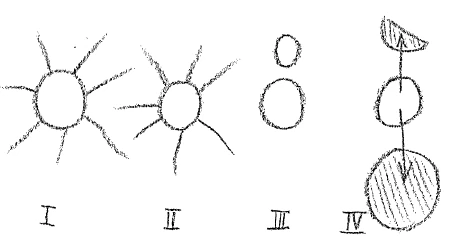
[ 15 ] Nun können wir uns ja von diesen Vorgängen auf Saturn, Sonne und Mond folgendes Bild machen. Wir können sagen: Wir haben ein altes Saturndasein (I), das ist umgeben von dem Kosmos; wir haben ein altes Sonnendasein (II), wiederum umgeben von dem Kosmos; wir haben ein altes Mondendasein (III), aber aus dem Mondendasein heraus sich schon entwickelnd eine Art Nebenplanet — das brauchen Sie ja nur in meiner «Geheimwissenschaft» nachzulesen —; und wir haben dann das Erdendasein (IV) so kennen gelernt, daß sich die Erde abtrennt vom Sonnendasein, und wiederum abtrennt vom Mondendasein.
[ 15 ] Now we can form the following picture of these processes on Saturn, the Sun, and the Moon. We can say: We have an ancient Saturnian existence (I), which is surrounded by the cosmos; we have an ancient Solar existence (II), which is in turn surrounded by the cosmos; we have an ancient lunar existence (III), but already developing out of this lunar existence is a kind of minor planet—you need only look this up in my Occult Science—; and we have come to understand the Earth existence (IV) in such a way that the Earth separates from the solar existence and, in turn, separates from the lunar existence.
[ 16 ] Wenn ein materialistisch denkender Mensch — ich will das Günstigste für unsere Geisteswissenschaft annehmen — selbst sich überwinden könnte, an diese Vorgänge zu glauben, so würde er aber noch immer den nächsten Schritt zu überwinden haben, der darin besteht, sich zu überzeugen, daß im Grunde genommen die ganzen Vorgänge — Saturnentstehung, Sonnenentwickelung, dann Heranentwickelung zum Mond, Abtrennung des Mondes, Abtrennung von Erde, Sonne und Mond —, daß alle diese Vorgänge eigentlich geschehen, um den Menschen möglich zu machen, so wie er auf der Erde ist. So wie bei einer Pflanze die Vorgänge in den Wurzeln, in den Blättern geschehen, um die Blüte, die Frucht möglich zu machen, so geschehen alle diese Vorgänge, ich möchte sagen, diese makrokosmischen Vorgänge, um unser Leben auf der Erde möglich zu machen; sie geschehen, damit wir auf Erden gerade so leben können, wie wir eben leben. Man könnte auch sagen: Diese Vorgänge sind die Wurzeln unseres Lebens auf Erden; das ist deshalb da, damit wir so, wie wir auf Erden uns entwickeln, uns entwickeln können.
[ 16 ] If a person with a materialistic mindset—and I will assume the most favorable scenario for our Spiritual Science—could bring himself to believe in these processes, he would still have to take the next step, which consists of convincing himself that, fundamentally, all these processes —the formation of Saturn, the evolution of the Sun, then the development leading to the Moon, the separation of the Moon, and the separation of the Earth, Sun, and Moon—actually take place in order to make human beings possible, just as they are on Earth. Just as in a plant the processes take place in the roots and in the leaves to make the flower and the fruit possible, so all these processes—I would say, these macrocosmic processes—take place to make our life on Earth possible; they take place so that we can live on Earth exactly as we do. One could also say: These processes are the roots of our life on Earth; they exist so that we can develop in the way we do on Earth.
[ 17 ] Fassen wir genau ins Auge, daß wir es zu tun haben mit der Abtrennung der Sonne auf der einen Seite, der Abtrennung des Mondes auf der andern Seite, daß wir es also zu tun haben — damit unsere Erde als Erde zustandekomme — mit Trennungen. Das heißt, wir werden zurückgelassen auf dem Erdenplaneten, und abgetrennt haben sich von uns Sonne und Mond, und wirken nun von außen auf die Erde herein. Das mußte sich so ereignen, sonst könnte sich nichts in uns so entwickeln, wie es sich auf Erden entwickelt. Daß alles sich so entwickelt, wie es sich auf Erden entwickelt, dazu ist nötig, daß einmal in Urzeiten Sonne und Mond mit der Erde verbunden waren, und daß sie sich dann getrennt haben und von außen nun ihre Wirkungen hereinscheinen lassen auf die Erde. Das ist durchaus notwendig.
[ 17 ] Let us clearly bear in mind that we are dealing with the separation of the Sun on the one hand and the separation of the Moon on the other; that is to say, in order for our Earth to come into being as Earth, we are dealing with separations. This means that we are left behind on the Earth, and the Sun and Moon have separated from us and now act upon the Earth from the outside. This had to happen; otherwise, nothing within us could develop as it does on Earth. For everything to develop as it does on Earth, it is necessary that in primeval times the Sun and Moon were once connected to the Earth, and that they then separated and now allow their influences to shine in on the Earth from the outside. This is absolutely necessary.
[ 18 ] Nun möchte ich darauf hinweisen, daß unser inneres seelisches Leben ganz bestimmte Konfigurationen angenommen hat dadurch, daß dies geschehen ist. Unter den mannigfaltigsten Begriffen, die wir haben — ich könnte ja viele Begriffe als Beispiel anführen — und die im ganzen Zusammenhang unseres Erdendaseins eine gewisse Rolle spielen, ist auch der Begriff des «Etwas-Besitzens», des «Etwas-Habens», was zusammenhängt damit, daß sich unsere Person mit etwas verbindet, was ebensogut außerhalb der Person ist. Wir sprechen in den seltensten Fällen davon, daß wir unsern Arm oder unsere Nase besitzen, denn nicht wahr, die meisten Menschen empfinden ihren Arm oder ihre Nase so sehr zu sich gehörig, daß sie da nicht von einem Besitz sprechen. Aber dasjenige, was auch getrennt sein könnte, und was dann zu uns gehört, bezeichnen wir lediglich im juristischen Sinne als einen Besitz, als einen richtigen Besitz.
[ 18 ] Now I would like to point out that our inner spiritual life has taken on very specific configurations as a result of this having happened. Among the manifold concepts we have—I could cite many examples—and which play a certain role in the overall context of our earthly existence, there is also the concept of “possessing something,” of “having something,” which is connected to the fact that our person unites with something that is just as much outside the person. We very rarely speak of “possessing” our arm or our nose, for isn’t it true that most people feel their arm or nose is so much a part of themselves that they do not speak of it as a possession? But that which could also be separate, and which nevertheless belongs to us, we designate—merely in the legal sense—as a possession, as a true possession.
[ 19 ] Nun könnte sich in uns das gar nicht bilden, was wir die VorstelJung nennen: etwas von dem besitzen, was da draußen ist —, wenn nicht eingetreten wäre die Trennung desjenigen, was früher zur Erde gehört hat, und das Wiederbezogenwerden von Sonne und Mond zur Erde. Unser Leben noch auf der alten Sonne war ganz anders. Da waren Sonne und Mond eben mit dem, was Vorgänge der Erde waren, als Sonne verbunden; da waren sie mit dem ganzen Menschendasein innig verbunden. Da konnte der Mensch sagen: «Sonnenwirkung in mir», oder «Ich-Sonnenwirkung» — wenn er dazumal schon hätte «Ich» sagen können, die Erzengel konnten es aber — «Ich Sonnenwirkung»; nicht: die Sonne bescheint mich, es kommt das an mich heran, was Sonnenwirkung ist. — Das mußte vor sich gehen, daß abgetrennt wurde dieser Planet oder dieser Fixstern Sonne, damit wir als Erdenmenschen eben diese besondere Konfiguration der Besitzesvorstellung entwickeln konnten.
[ 19 ] Now, what we call “imagination”—the ability to possess something of what exists out there—could not have developed within us at all if there had not been a separation of that which formerly belonged to the Earth, and the re-establishment of the connection between the Sun and the Moon and the Earth. Our life on the old Sun was entirely different. Back then, the Sun and Moon were connected to the Earth as the Sun itself; they were intimately connected to the whole of human existence. Back then, a human being could say: “The Sun’s influence within me,” or “I-Sun influence”—if he had already been able to say “I” at that time, though the archangels could— “I-Sun influence”; not: “The sun shines upon me; what is the sun’s influence comes to me.” — This had to take place: this planet or this fixed star, the sun, had to be separated so that we, as Earth humans, could develop precisely this particular configuration of the concept of possession.
[ 20 ] Nun hängt das noch mit etwas anderem zusammen. Stellen Sie sich vor, noch auf dem alten Sonnendasein sagte der Erzengel: Ich Sonne. — Daß wir etwas sehen, das beruht darauf, daß die Sonnenstrahlen oder Lichtstrahlen auf den Gegenstand scheinen und zu uns zurückgeworfen werden. Würde die Sonne mitten in der Erde scheinen, so würden wir nichts sehen von den Gegenständen, die auf der Erde sind. Wir würden dann zwar sagen: Ich Sonne, Ich Licht, aber wir würden nicht die einzelnen Gegenstände unterscheiden, wir würden nicht die Gegenstände sehen. Also, Sie sehen, noch weiteres hängt damit zusammen. Während die Erde sich entwickelt von Saturn, Sonne, Mond zur Erde herüber, entsteht erst durch die Konstellation im Makrokosmos die Möglichkeit, die Gegenstände so zu sehen und wahrzunehmen, wie wir sie jetzt wahrnehmen. Solche Wahrnehmungen, die gab es natürlich während des Sonnendaseins nicht; wenn auch die ersten Anlagen unserer Sinnesorgane auf dem alten Saturn schon vorbereitet worden sind, aufgeschlossen wurden sie erst auf der Erde, erst da wurden sie zu Wahrnehmungsorganen gemacht. Diese Anlagen auf dem alten Saturn, das waren, ich möchte sagen, blinde und unwahrnehmende Sinnesorgane. Aufgeschlossen wurden diese Sinnesorgane erst dadurch, daß die Sonne ausschied, und der Mond aus der Erde herausgegangen ist.
[ 20 ] Now this is connected to something else as well. Imagine that, while still in its former existence as the Sun, the Archangel said: “I am the Sun.” — The fact that we see anything is based on the sun’s rays—or rays of light—shining on an object and being reflected back to us. If the sun were to shine from the center of the Earth, we would see nothing of the objects on Earth. We would then say, ‘I am the Sun, I am the Light,’ but we would not be able to distinguish individual objects; we would not see the objects. So, you see, there is even more to it. As the Earth evolves from Saturn, through the Sun and the Moon, to the Earth itself, it is only through the constellation in the macrocosm that the possibility arises to see and perceive objects as we do now. Such perceptions, of course, did not exist during the Sun stage; even though the first rudiments of our sense organs had already been prepared on ancient Saturn, they were only opened up on Earth—it was only there that they were transformed into organs of perception. These rudiments on ancient Saturn were, I would say, blind and non-perceiving sense organs. These sense organs were only awakened when the Sun departed and the Moon emerged from the Earth.
[ 21 ] Damit sehen Sie, daß zwei Vorgänge parallel gehen: Wir bilden unsere Sinneswahrnehmungen und sehen draußen eine Welt; und damit parallel gehend entwickeln wir die Besitzesvorstellung. Denn wie kommen wir zu der Besitzesvorstellung? Sie könnten während des alten Sonnendaseins sich nicht denken, daß irgendein Erzengel etwas besitzen will. Er sieht ja auf nichts; er ist ja alles. Wären alle Gegenstände und Wesen der Erde so, würden sie niemals den Drang bekommen, etwas besitzen zu wollen. Mit der Entwickelung der Sinne entwickelt sich erst die Besitzesvorstellung; die Besitzesvorstellung ist nicht trennbar von der Entwickelung der Sinne; diese beiden Dinge gehen parallel. Die Sinne waren auf der einen Seite, und so etwas wie die Besitzesvorstellung auf der andern Seite. Es können auch andere Vorstellungen genommen werden.
[ 21 ] This shows you that two processes occur in parallel: We form our sensory perceptions and see a world outside ourselves; and, running parallel to this, we develop the concept of ownership. For how do we arrive at the concept of ownership? During the old solar existence, you could not have imagined that any archangel would want to own anything. After all, he does not look upon anything; he is everything. If all objects and beings on Earth were like that, they would never feel the urge to want to possess anything. The concept of ownership develops only with the development of the senses; the concept of ownership is inseparable from the development of the senses; these two things proceed in parallel. The senses were on one side, and something like the concept of ownership on the other. Other mental images can also be considered.
[ 22 ] Und wenn wir in umfassenderem Sinne bedenken dasjenige, was in der religiösen Urkunde, der Bibel, steht — denn hinter solchen Dingen, wie sie in den religiösen Urkunden stehen, liegt immer noch sehr vieles verborgen —, so können wir sagen: Das, was im Anfang der Bibel steht von der luziferischen Verführung, hängt damit zusammen, daß Luzifer dem Menschen verheißen hat seine Sinnesentwickelung: «Die Augen werden euch aufgeschlossen», — damit meint er, überhaupt alle Sinne werden aufgeschlossen. Das Aufschließen der Augen steht nur für die Sinne im allgemeinen. Damit hat er die Seele hingelenkt auf die äußeren Dinge und damit zu gleicher Zeit die Besitzesvorstellung hervorgerufen. Wollten wir das etwas ausführlicher sagen, was da Luzifer dem Weibe verheißen hart, so müßten wir sagen: «Ihr werdet Gott-gleich sein» heißt soviel wie: Eure Sinne werden aufgeschlossen sein. Ihr werdet unterscheiden zwischen demjenigen, was euch gefällt und was nicht gefällt, was ihr Gut, was ihr Böse nennt, und ihr werdet das alles besitzen wollen, was euch gefällt, was ihr gut nennt. — Das müßte man alles verbinden mit dieser luziferischen Verheißung.
[ 22 ] And if we consider, in a broader sense, what is written in the religious text, the Bible—for there is still much hidden behind such things as are written in religious texts—then we can say: What is written at the beginning of the Bible about Lucifer’s temptation is connected to the fact that Lucifer promised humanity the development of its senses: “Your eyes will be opened”—by this he means that all the senses will be opened. The opening of the eyes stands only for the senses in general. In this way, he directed the soul toward external things and, at the same time, gave rise to the concept of possession. If we were to explain in somewhat greater detail what Lucifer promised the woman, we would have to say: “You will be like God” means as much as: Your senses will be opened. You will distinguish between what pleases you and what does not, between what you call good and what you call evil, and you will want to possess everything that pleases you, everything you call good. — All of this must be connected to this Luciferian promise.
[ 23 ] Nun müssen wir allerdings, wenn wir solch eine Vorstellung, wie ich sie eben jetzt entwickelt habe, so recht erfassen wollen, uns auf etwas besinnen. Da ist einer der Punkte, wo es notwendig ist, daß man im geisteswissenschaftlichen Vortrag appelliert an die Selbstbesinnung jedes Einzelnen, der die Dinge aufnehmen will. Man muß sich auf etwas besinnen: Indem ich Ihnen dieses entwickelt habe von der Entstehung der Sinne, von dem Wahrnehmen der Dinge und von der Entwickelung der Besitzesvorstellung, haben wir nicht nötig gehabt, irgendwo eine Raumes- oder eine Zeitvorstellung einzufügen. Gewiß, wenn sich der Mensch diese Dinge versinnlichen will, wie ich es auch getan habe, indem ich sie auf die Tafel gezeichnet habe, so nimmt man Raum- und Zeitvorstellungen zu Hilfe. Aber um zu begreifen, was es heißt: die Sinne werden aufgeschlossen —, und um zu begreifen, was es heißt: die Besitzesvorstellung entwickelt sich —, dazu braucht man nicht Raum- und Zeitvorstellungen. Diese Dinge sind unabhängig von Raum und Zeit. Sie haben nicht nötig daran zu denken, daß ich raumgemäß von irgendeiner Sache entfernt bin, wenn ich sie besitzen will; auch an die Zeitvorgänge brauchen Sie nicht zu appellieren. Wie gesagt, hier muß man an die Selbstbesinnung appellieren. Denn es kann jeder einwenden: ich kann’s nicht —, aber wenn er sich genügend zusammennimmt, so kann er solche Dinge sich vorstellen: daß er keine Raum- und Zeitvorstellung zu Hilfe nimmt. Ja, noch etwas anderes ist richtig: wenn Sie versuchen, solche Vorstellungen sich klar zum Bewußtsein zu bringen, also darüber zu meditieren, wie ich jetzt gleichsam mit Ihnen meditiert habe, so kommen Sie allmählich hinaus über das Raumes- und Zeitvorstellen. Sie kommen hinaus in eine Welt, wo Raum und Zeit in Ihren Erlebnissen wirklich nicht mehr die eminente Rolle spielen, die sie im Alltagsleben spielen.
[ 23 ] Now, however, if we wish to truly grasp a mental image such as the one I have just developed, we must reflect on something. This is one of those points where it is necessary, in a lecture on Spiritual Science, to appeal to the self-reflection of each individual who wishes to take these ideas in. We must reflect on something: As I have explained to you the origin of the senses, the perception of things, and the development of the concept of possession, we have not needed to introduce any concept of space or time. Certainly, when a person wishes to visualize these things—as I have done by drawing them on the blackboard—one draws upon concepts of space and time. But to understand what it means for the senses to be awakened—and to understand what it means for the concept of ownership to develop—one does not need concepts of space and time. These things are independent of space and time. You do not need to think that I am spatially distant from a particular thing if I wish to possess it; nor do you need to appeal to temporal processes. As I said, here one must appeal to self-reflection. For anyone might object: “I can’t do it”—but if they pull themselves together sufficiently, they can imagine such mental images: that they do not rely on concepts of space and time. Yes, there is something else that is true: if you try to bring such mental images clearly into your consciousness—that is, to meditate on them, just as I have now, so to speak, meditated with you—you will gradually move beyond the concepts of space and time. You will enter a world where space and time truly no longer play the prominent role in your experiences that they do in everyday life.
[ 24 ] Nun besteht in der Menschheitsentwickelung eine eigentümliche Sehnsucht. Überall, wo wir das Menschengeschlecht in seinem innersten Streben in der Geschichte antreffen, treffen wir eine bestimmte Sehnsucht schon an; und das ist die Sehnsucht, auch Vorstellungen zu haben, die von Raum und Zeit unabhängig sind, die nichts zu tun haben mit Raum und Zeit. Geschichtliche Vorgänge werden in Mythen verwandelt, oder es wird in dem geschichtlichen Vorgang auf das hineingedeutet, was das Geistige ist, um möglich zu machen, daß man auf dem Hintergrunde von geschichtlichen Vorgängen Mythen sich gestalten sieht. Und je weiter wir in der Geschichte zurückblicken, desto mehr finden wir als geschichtliche Überlieferungen die geschichtlichen Tatsachen in den Mythus gehüllt. Denken Sie sich, wie schon in bezug auf die ältere griechische Geschichte alles in den Mythus gehüllt ist; auch viel von der älteren mitteleuropäischen Geschichte ist in den Mythus gehüllt. Je weiter man zurückgeht, desto mehr wird man entfernt von dem äußeren, rein sinnlichen Fühlen der Tatsachen, und es taucht ein die Darstellung in ein sinnvolles Erfassen. Wenn Sie Mythen studieren, da werden Sie ganz deutlich sehen, daé man bei der Entstehung der Mythen, sich aus Raum und Zeit herausarbeiten will. Nicht nur, daß schon, ich möchte sagen, die elementarsten Mythen, die Märchen oftmals darstellen, wie irgendein menschliches Wesen — ich erinnere nur an Dornröschen — aus der Zeit herausgeht und ins Zeitlose hineingeht, sondern wenn Sie bei den Mythen nachschauen, so werden Sie sehen: Sie wissen nicht recht, welche geschichtlichen Tatsachen gemeint sind. Es kann etwas, was Jahrhundertelang früher liegt, als etwas Späteres erzählt werden. Manchmal werden auch Tatsachen, die in der historischen Entwickelung Jahrhunderte auseinanderliegen, zusammengeschmiedet im Mythus. Der Mythus sucht über Raum und Zeit sich zu erheben. Das heißt, es lebt im Menschendasein die Sehnsucht, sich über diese Alltäglichkeit hinaus, die uns anweist, im Raum und in der Zeit zu denken und vorzustellen, auch sich hineinzuleben in solche Vorstellungen, welche raumlos und zeitlos diejenigen Realitäten darstellen, die jenseits des Nebeneinander und des Hintereinander unseres Raumes- und Zeitendaseins als die ewigen Dinge walten, oder wenn sie sich einmal gebildet haben, als die ewigen Dinge bleiben.
[ 24 ] There is a peculiar longing inherent in human development. Wherever we encounter the human race in its innermost striving throughout history, we already find a certain longing; and that is the longing to have mental images that are independent of space and time, that have nothing to do with space and time. Historical events are transformed into myths, or the historical event is interpreted in terms of the spiritual, so that myths can be seen to take shape against the backdrop of historical events. And the further back we look in history, the more we find historical facts, as historical traditions, shrouded in myth. Just consider how, as in the case of ancient Greek history, everything is shrouded in myth; much of ancient Central European history, too, is shrouded in myth. The further back one goes, the more one moves away from the external, purely sensory perception of facts, and the representation emerges into a meaningful understanding. When you study myths, you will see quite clearly that in the formation of myths, there is a desire to transcend space and time. Not only do even—I would say—the most elementary myths, which fairy tales often depict, show how a human being—I need only mention Sleeping Beauty—steps out of time and into timelessness, but if you examine the myths, you will see: you cannot quite tell which historical facts are being referred to. Something that took place centuries earlier can be recounted as if it happened later. Sometimes, too, events that are centuries apart in historical development are forged together in myth. Myth seeks to rise above space and time. This means that there lives within human existence a longing to transcend this everyday reality—which compels us to think and create mental images in terms of space and time— and to immerse ourselves in such mental images that, being spaceless and timeless, represent those realities which, beyond the side-by-side and one-after-the-other nature of our existence in space and time, reign as eternal things—or, once they have come into being, remain as eternal things.
[ 25 ] Wenn Sie das, was ich jetzt gesagt habe, zusammennehmen mit etwas, was ich das letzte Mal gesagt habe, so wird sich Ihnen eine schöne Verbindung ergeben. Ich habe gesagt, wir sollten sehen: wenn nicht ein Luziferisches in uns wirkte, wäre unsere Vorstellungswelt eigentlich im alten Monde drinnen. — Daraus geht aber nun hervor, daß eigentlich dieser alte Mond noch da ist, geblieben ist, und daß nur Luzifer uns vorzaubert, unsere Vorstellung sei jetzt in uns drinnen. Also die Zeit wird da zu einem Mittel des Truges, der Täuschung für Luzifer. Das alte Mondendasein ist dauernd, und so sind auch die Dinge dauernd, die entstehen. Unsere Besitzesvorstellungen sind etwas Dauerndes, das heißt, dasjenige, was der Erdenmensch durch seine Besitzesvorstellung als soziale Erdenordnung entwickelt, das bleibt, das wird auch noch bestehen, wenn der Jupiter- und der Venuszustand einmal da sind. Und wenn dann nicht entsprechende Verführungen als luziferische und ahrimanische Verführungen kommen, so wird man sehen, wie auf Erden durch den Besitzesbegriff soziale Ordnungen sich gebildet haben. Die werden dann etwas wie physische Ordnungen darstellen. Denn das gehört zum Maja-Sein, zu der Täuschung, daß die Dinge vorübergehen; in Wirklichkeit sind sie dauernd, in Wirklichkeit bestehen sie. Und schon, wenn man richtig das Dasein versteht, findet man hinter dem eigentlich Vergangenen das Dauernde. Sie können es gleichsam erfassen in dem, was ich jetzt erzählt habe.
[ 25 ] If you take what I have just said and combine it with something I said last time, a beautiful connection will become clear to you. I said that we should consider: if there were no Luciferic influence at work within us, our world of imagination would actually be contained within the old Moon. — But this now shows that this old Moon is actually still there, has remained, and that it is only Lucifer who conjures up the illusion that our mental image is now within us. Thus, time becomes a means of deception and illusion for Lucifer. The old lunar existence is enduring, and so too are the things that arise from it. Our concepts of ownership are something enduring; that is to say, what the earthly human being develops through his concept of ownership as a social order on Earth remains and will continue to exist even when the Jupiter and Venus states are in place. And if no corresponding temptations—such as Luciferic and Ahrimanic temptations—arise, then one will see how social orders have formed on Earth through the concept of ownership. These will then represent something like physical orders. For this is part of the nature of maya, of the illusion that things are transient; in reality, they are enduring; in reality, they persist. And even when one understands existence correctly, one finds the enduring behind what has actually passed. You can grasp this, as it were, in what I have just described.
[ 26 ] Nun aber blicken wir, wenn wir das so recht erfassen, was ich gesagt habe, eigentlich in tief bedeutsame Untergründe unseres ganzen Erdendaseins hinein. Sehen wir denn nicht, wie unter dem zeitlichräumlichen Erdendasein das ewig dauernde Erdendasein oder Dasein überhaupt sich förmlich ausbreitet? Wie einen Schleier haben wir das Zeitlich-Räumliche oben, und darunter die Dauerverhältnisse, die Verhältnisse der Dauer. Und nun kommt unsere Anschauung, wenn sie im Raum und der Zeit verläuft, unsere Anschauung, die in Raum und Zeit lebt. Denken Sie nur einmal, wie man das, ich möchte sagen, konkret im einzelnen sich vorstellen kann. Denken Sie einmal bloß — heute fassen das die Menschen gar nicht mehr ordentlich —, denken Sie sich irgendwo, irgendwie «rot». Um «rot» zu denken, brauchen Sie keinen Raum, brauchen Sie keine Zeit; Sie können sich «rot» irgendwie denken; es braucht nicht im Raum, nicht in der Zeit zu sein, weil es bloß als Eigenschaft gedacht ist (D. Es ist dies schwer für den Menschen, weil er das Rot durchaus räumlich begrenzen will. So schwer war es nicht auf dem alten Mond für die Engel, denn die hatten keine Sehnsucht, das Rot auf einzelne Gegenstände zu verteilen. Die Zeit hatten sie schon, aber räumlich stellten sie nicht vor. Zeitlich stellten sie vor; daher empfanden sie «rot» oder «grün» oder irgendeine Farbe als fließenden Strom. Wenn Sie sich das lebhaft vorstellen: Blau als fließenden Strom, Rot als fließenden Strom, wenn Sie auch die anderen Sinnesempfindungen strömend vorstellen, aber nur zeitlich, ohne daß eine richtige Raumesvorstellung sich hineinmengt, so können wir sagen: Da kann man empfinden beim Übergang vom Monden- zum Erdendasein, wie das bloß Zeitliche hereingespannt wird in das Räumliche. Was macht denn eigentlich das Wesentliche des Erdendaseins aus? Daß so ein Rot abgegrenzt wird und hereingespannt wird. Auf dem Monde wäre es unmöglich gewesen, ein abgegrenztes «Rot» zu sehen: auf der Erde ist es uns möglich, abgegrenztes «Rot» zu sehen (ID). Das aber hängt zusammen, innig zusammen mit der Abtrennung der Sonne von der Erde, und mit dem Hereinfallen des Sonnenstrahls von außen. Schon daß ich sagen kann im wirklichen Sinne: der Sonnenstrahl fällt von außen herein —, schon das weist Sie darauf hin, daß unser jetziges Dasein ohne die Raumesvorstellung nicht zu denken ist. Ja, für dieses unser jetziges Wahrnehmen und Leben bedeutet dieses Außerhalb-Stehen der Sonne etwas Reales.
[ 26 ] But now, if we truly grasp what I have said, we are actually looking into the profoundly significant depths of our entire earthly existence. Do we not see how, beneath earthly existence in time and space, eternal earthly existence—or existence itself—literally unfolds? We have the temporal-spatial realm above us like a veil, and beneath it the conditions of duration, the conditions of permanence. And now our perception—as it unfolds in space and time—our perception that lives in space and time. Just think for a moment how one can, I would say, concretely create a mental image of this in detail. Just imagine—people today can’t even grasp this properly anymore—imagine “red” somewhere, somehow. To think of “red,” you need no space, you need no time; you can somehow create a mental image of “red”; it need not be in space or in time, because it is conceived merely as a quality (D. This is difficult for human beings because they want to define “red” strictly in spatial terms. It was not so difficult for the angels on the ancient Moon, for they had no desire to distribute “red” across individual objects. They already had a sense of time, but they did not conceive of it spatially. They conceived of it in terms of time; therefore, they perceived “red” or “green” or any color as a flowing stream. If you vividly imagine this—blue as a flowing stream, red as a flowing stream—and if you also imagine the other sensory perceptions as flowing, but only in terms of time, without a proper mental image of space interfering, then we can say: In the transition from lunar to earthly existence, one can perceive how the purely temporal is incorporated into the spatial. What, then, actually constitutes the essence of earthly existence? That a color like red is delineated and incorporated. On the Moon, it would have been impossible to see a delimited “red”; on Earth, we are able to see a delimited “red” (ID). But this is intimately connected with the separation of the Sun from the Earth and with the incidence of the sunbeam from outside. The very fact that I can say, in the true sense of the word, “the sunbeam falls in from the outside”—that alone points out to you that our present existence is inconceivable without the concept of space. Indeed, for our present perception and life, this fact that the sun stands outside means something real.
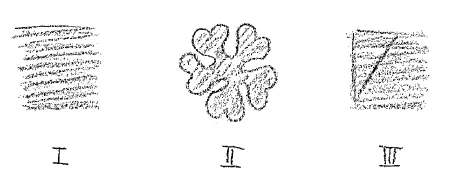
[ 27 ] Nun werden Sie leicht aus dem, was ich vorgebracht habe, entnehmen können, daß wir wirklich sagen könnten: die Farben sind in den Raum hereingespannt, und die anderen Sinneswahrnehmungen auch. «Fließenden Reiz» habe ich in der «Theosophie» dasjenige genannt, was nach dem Tode in dem Menschen lebt, weil er da nicht in den Raum eingespannt ist. Daher sprach ich schon von der ersten Welt, die er durchlebt, als «fließender Reizeswelt». Da sind die Sinneswahrnehmungen nicht in den Raum hereingespannt. Auf der Erde sind sie das. Hier muß der Sonnenstrahl von außen kommen, muß die Sinneswahrnehmungen in den Raum hereinspannen (III). Damit hängt zusammen — wie ich auseinandergesetzt habe —, daß der Mensch Besitzesvorstellungen entwickelt; denn niemals kann der Mensch in einer Welt des fließenden Reizes an Besitz denken; da ist höchstens Zeit vorhanden, und da würde er schon das Vergebliche einsehen, wenn er an Besitz denken wollte. Es wäre da ungefähr so, wie wenn er an den Besitz eines Stücks Wasser denken würde, das im Bach dahinfließt. Diese Vorstellung entsteht also erst, indem die aus der Erde herausgehende Sonne die Sinneswahrnehmungen in den Raum hineinspannt.
[ 27 ] Now, from what I have presented, you will easily be able to conclude that we could indeed say: colors are stretched across space, and so are the other sensory perceptions. In Theosophy, I have called that which lives on in the human being after death the “flowing stimulus,” because there the human being is not bound into space. That is why I have already referred to the first world that the human being experiences as the “world of flowing stimuli.” There, the sensory perceptions are not bound into space. On Earth, they are. Here, the sunbeam must come from outside; it must anchor the sensory perceptions within space (III). Connected to this—as I have explained—is the fact that human beings develop concepts of possession; for in a world of flowing stimulus, a human being can never think of possession; there is, at most, time, and even then they would recognize the futility of it if they were to think of possession. It would be roughly as if they were to think of owning a drop of water flowing away in a stream. This mental image therefore arises only when the sun, rising from the Earth, draws sensory perceptions into space.
[ 28 ] Sehen Sie, so etwas, wie ich jetzt auseinandergesetzt habe, muß man in eine Empfindung, in ein Gefühl verwandeln. Man kommt nicht zurecht, wenn man bei einer bloß theoretischen Vorstellung bleibt; man muß sie in ein Gefühl, in eine Empfindung verwandeln, man muß wirklich eine innerlich lebendige Empfindung davon bekommen, wie man als Mensch, als Mikrokosmos, in den Makrokosmos hineingestellt ist, und wie selbst dieses Sich-sehnen, etwas zu besitzen, zusammenhängt mit der ganzen Entwickelung des Makrokosmos, mit dem Hergange, wie sich die sinnliche Anschauung entwickelt hat. Wenn man das so recht fühlt, wenn man beginnt, ich möchte sagen, kosmisch zu fühlen, wenn man beginnt, zu fühlen, wie so etwas, wie die einfache Vorstellung: du möchtest dies besitzen, was du siehst und was dir im Anschauen gefällt —, wie das aus dem Makrokosmos herausgeboren ist: dann bekommt man wirklich erst die recht lebendige Vorstellung, daß zusammenhängt das menschlich Seelische mit dem ganzen Makrokosmos; dann geht einem ein innerlich lebendiges, ein ernst lebendiges Gefühl auf, wie man in dem einzelnen, was man im alltäglichen Leben vorstellt, mit dem Makrokosmos zusammenhängt, und wie eigentlich in allem, was wir so vorstellen, was wir in der Seele erleben, der Makrokosmos in uns lebt. Und in dem Menschen besteht eine fortwährende Sehnsucht, solche wirklich auf dem Grund des Lebens ruhende geheime Zusammenhänge zu empfinden, und die Empfindung auszudrücken. Diese Sehnsucht besteht in den Menschenseelen, in den Menschenherzen.
[ 28 ] You see, something like what I have just explained must be transformed into a sensation, into a feeling. One cannot make sense of it if one remains at a purely theoretical level; one must transform it into a feeling, into a sensation; one must truly gain a vivid inner sense of how, as a human being—as a microcosm—one is placed within the macrocosm, and how even this longing to possess something is connected to the entire development of the macrocosm, to the process by which sensory perception has evolved. When one truly feels this, when one begins—I would say—to feel cosmically, when one begins to feel how something like the simple mental image—that one would like to possess what one sees and what pleases one in contemplation—is born out of the macrocosm: only then does one truly gain a vivid sense that the human soul is connected to the entire macrocosm; then an inner, living, and profoundly real feeling dawns within you of how you, in the individual mental images you create in everyday life, are connected to the macrocosm, and how, in fact, in everything we imagine and experience in our souls, the macrocosm lives within us. And within human beings there is a constant longing to sense such secret connections, which are truly rooted in the very foundation of life, and to express that sensation. This longing exists in human souls, in human hearts.
[ 29 ] Und so denken wir uns einmal, es entstünde in einer Menschenseele so recht das Gefühl, so recht das Empfinden, ich will den kosmischen Zusammenhang dieses Einzelseelenerlebnisses ausdrücken: «Da fällt mein Auge auf einen äußeren Gegenstand; ich will ihn besitzen; ich will ihn mir aneignen», dann wird man, ich möchte sagen, die Tragik des Naturdaseins von einer solchen Empfindung aus erfühlen können. Die Tragik des Naturdaseins, sage ich. Wir nehmen ja im Grunde genommen einer ganzen Welt, die bis zum Monde geht, und die ja noch in unserer Welt als Grundlage vorhanden ist, wir nehmen ihr wirklich dasjenige, was wir besitzen wollen. Was wir zu besitzen streben, nehmen wir weg dieser Welt, die auf dem Grund unserer natürlichen Welt ruht. Das nehmen wir von ihr weg. Und das ist es, was die wirklich mit der Natur empfindende Menschenseele fortwährend fühlen muß: daß da auf dem Untergrund der Natur wirklich etwas enthalten ist, was fortwährend dulden muß; daß der Mensch dieser Natur, die allen Alles geben will, widerspricht und sagt: Dies gehört mir. — Und denken Sie sich jetzt hinein in diesen Widerspruch zwischen der Natur, die allen Alles geben will, und dem ganzen menschlichen Fühlen: Dies will ich für mich haben, und daß ich es für mich haben will, ist hervorgerufen dadurch, daß meine Sinne es als für mich gut oder weniger gut, sympathisch oder antipathisch empfinden können. — Da kann man seine eigene Seele hineinvertiefen in das Naturdasein, kann mit der Natur mitfühlen, wie ihr etwas weggenommen wird; schon dadurch weggenommen wird, daß der Mensch den Gedanken faßt, unter dem Eindruck seiner Sinne den Gedanken faßt: er will das haben, was die Natur allen geben will.
[ 29 ] And so let us imagine for a moment that a feeling, a true sense, were to arise in a human soul—I want to express the cosmic context of this individual soul experience: “My eye falls upon an external object; I want to possess it; I want to make it my own,” then, I would say, one will be able to sense the tragedy of natural existence from such a feeling. The tragedy of natural existence, I say. For, after all, we are essentially taking from an entire world that extends as far as the moon—and which still exists as the foundation of our own world—we are truly taking from it that which we wish to possess. What we strive to possess, we take away from this world, which rests upon the foundation of our natural world. We take that away from it. And that is what the human soul that truly feels with nature must constantly feel: that there is truly something contained within the very foundation of nature that must constantly endure; that human beings contradict this nature, which wants to give everything to everyone, and say: “This belongs to me.” — And now try to imagine this contradiction between nature, which wants to give everything to everyone, and the whole range of human feeling: “I want this for myself,” and the fact that I want it for myself is brought about by the fact that my senses can perceive it as good or less good for me, as sympathetic or unsympathetic. — There, one can immerse one’s own soul in the existence of nature, can empathize with nature as something is taken away from it; it is taken away simply by the fact that a person conceives the thought—under the impression of their senses—that they want what nature wants to give to everyone.
[ 30 ] Ich habe einmal, ich möchte sagen, ganz besonders gründlich plötzlich in meiner Seele gefühlt, wie man dieses ganze Verhältnis, das ich jetzt zu charakterisieren versuchte, durchempfinden kann, wie man lernen kann mitzufühlen mit der Natur, die da sagt: Ich mag mich wehren, wie ich will, die Weltentwickelung ist soweit gekommen, daß der Mensch erklärt, meine Dinge seien seine Dinge. Ich sage, ich habe das in einem besonderen Augenblicke in der Seele vor Jahren einmal so recht warm und innig auch fühlend empfunden, als einmal in einer Gesellschaft — es war vor vielen Jahren — eine Rezitation gepflegt werden sollte, ein Rezitationsprogramm war. Und wie es ja zuweilen vorkommt, besonders bei Rezitationsprogrammen, daß die betreffenden Persönlichkeiten verhindert sind, absagen lassen, so war es auch hier: eine Rezitatorin mußte absagen lassen. Es mußte also ein Ersatz gefunden werden und er hatte sich auch gefunden. Man mag nun über den Wert der Deklamation, die nun folgte, über diesen Ersatz denken wie man will — darauf will ich jetzt nicht eingehen —, aber der Ersatz war von ganz besonderer Art. Es fand sich nämlich einer der reinsten katholischen, edelsten katholischen Priester, die ich jemals in der Welt kennengelernt habe, bereit, das Programm zu rezitieren, welches die betreffende Schauspielerin wegen ihres Verhindertseins nicht rezitieren konnte. Und man hatte da ein ganz besonders Bedeutsames, man konnte ein besonders bedeutsames Erlebnis haben, das sich für mich verdichtete zu dem, was ich Ihnen eben aussprach.
[ 30 ] There was a time—I would say—when I suddenly felt very deeply in my soul how one can truly grasp this entire relationship I have just tried to describe, how one can learn to empathize with nature, which says: No matter how much I resist, the course of world history has progressed to the point where human beings claim that my things are their things. I say that I felt this in my soul with such warmth and depth at a particular moment years ago, when—many years ago—a recitation was to take place in a gathering; there was a recitation program scheduled. And as sometimes happens, especially with recitation programs, when the scheduled performers are unable to attend and have to cancel—that’s exactly what happened here: a reciter had to cancel. So a replacement had to be found, and one was found. One may think what one will about the quality of the recitation that followed, about this substitute—I do not wish to go into that now—but the substitute was of a very special kind. For one of the purest, noblest Catholic priests I have ever met in the world agreed to recite the program that the actress in question was unable to perform due to her unavailability. And there was something particularly significant there; one could have a particularly meaningful experience, which for me crystallized into what I just expressed to you.
[ 31 ] Denn dieser, wirklich seine Katholizität mit allem, was für den wirklich wahren und aufrichtigen Priester die Katholizität mit sich bringt, ernst nehmende Priester hatte dem Programm gemäß zu rezitieren das «Heidenröslein» von Goethe. Und man konnte an dieser Rezitation wirklich etwas erleben, weil der Mann nicht nur eben ein Priester im gewöhnlichen Sinne war, sondern so gelehrt war und so rein nur hingegeben geistigen Betrachtungen, daß viele sagten: der Betreffende — ich will jetzt seinen Namen nicht nennen — kennt die ganze Welt und außerdem noch drei Dörfer. So weise und erfahren in den Dingen, die man wissen kann, empfand man ihn. Nun war die Rezitation nicht besonders gut, trotzdem aber lag in der Art und Weise, wie er das «Heidenröslein» vorbrachte, etwas so ungeheuer Bedeutsames, weil man fühlen konnte, daß seine Empfindung der Welt aus seinem, ich möchte sagen, allem Sinnlichen abgekehrten Empfinden der Welt her kam; man konnte fühlen, wie gerade durch diesen Vorgang, daß eben ein Priester statt einer Schauspielerin eintrat, die ganze kosmische Gewalt, die ungeheure kosmische Gewalt: dieses einzigartigen Gedichtes das «Heidenröslein» in den Vortrag hereinkam, und die ungeheure Feinheit, die in diesem Gedichte liegt.
[ 31 ] For this priest—who truly took his Catholicism seriously, along with everything that Catholicism entails for a truly faithful and sincere priest—was to recite Goethe’s “Heidenröslein” as part of the program. And one could truly experience something in this recitation, because the man was not merely a priest in the ordinary sense, but was so learned and so purely devoted to spiritual contemplation that many said: the man in question—I will not mention his name now—knows the whole world and, besides that, three villages. That is how wise and experienced in the things one can know he was perceived to be. Now, the recitation itself was not particularly good; nevertheless, there was something so immensely significant in the way he presented “Heidenröslein,” because one could sense that his perception of the world stemmed from his—I would say—sensibility that was turned away from all that is sensual; one could sense how, precisely through this very act—that a priest took the stage instead of an actress—the entire cosmic power, the immense cosmic power of this unique poem, “Heidenröslein,” entered the recitation, along with the immense subtlety inherent in this poem.
[ 32 ] Dieses Gedicht hat ja, ich möchte sagen, eine Vorgeschichte. Esist ein altes Volkslied. Und ich sagte schon: die Menschen hatten immer die Sehnsucht, dasjenige zu empfinden, was als kosmisch auf dem Untergrund des Daseins lebt. Und gerade in diesem Gedichte das «Heidenröslein» kommt so etwas von diesem ganz grandiosen kosmischen Untergrunde in unendlich einfache Vorstellungen hinein. Daher muß man das «Heidenröslein» zu den allerschönsten Perlen der Poesie zählen, die überhaupt jemals in der Welt hervorgebracht worden sind. Ich habe dann vor Jahren auch von Leuten gehört, die irgend etwas, ich weiß nicht was, von alltäglichen, untergeordneten Menschheits-, menschlich-allzu-menschlichen Beziehungen in das «Heidenröslein» gelegt haben; allein das rührt ja bloß aus verdorbenen Untergründen der Gemüter her. Wenn man das kann, in das «Heidenröslein» irgend etwas herein zu interpretieren, was nicht ganz rein ist, so gehört dazu ein Gemüt, das aus sinnlichem Dunste heraus fortwährend schwelgen will in allerlei «heiliger» Liebe. Man kann nämlich aus seinem Sinnesdunst-Empfinden heraus fortwährend in «heiliger» Liebe schwelgen; aber man kann dasjenige, was als kosmischer Untergrund einem solchen Gedichte, wie das «Heidenröslein» zugrunde liegt, nur mit reinem, mit keuschem Herzen selbst empfinden, und jede Verkennung würde auf eine wirkliche Verdorbenheit des Gemüts hinweisen. Denn nehmen wir das Wunderschöne, was — gerade dadurch, daß dieses Volksgedicht übergegangen ist in die jugendlich lyrische Tiefe Goethescher Kunst —, was dieses «Heidenröslein», so wie es uns von Goethe vorliegt, eigentlich geworden ist. Etwas ganz Wunderbares ist es geworden; in jeder Zeile stets dasjenige, was da sein soll! Bedenken Sie einmal: fühlte man, wie dasjenige wirkt, was im Laufe der kosmischen Entwickelung als Sinneswahrnehmung für die Augen auftritt und wollte man dies beschreiben —, wie könnte man es besser tun, als indem man das Rot nimmt, indem man, ich möchte sagen, dem Objekt, dem Gegenstande es noch anfügt, ohne die räumliche Begrenzung, es anklingen läßt in «Röslein, Röslein, Röslein», indem man das Rot schon anklingen läßt in «Röslein rot!» Gleich steht vor uns das ganze Mysterium, wie es aus dem Kosmos heraus vor uns hingestellt wird. Die Sinneswelt steht also da:
[ 32 ] This poem, I would say, has a history. It is an old folk song. And as I have already said: people have always longed to sense that which lives as the cosmic foundation of existence. And in this very poem, “The Little Heathen Rose,” something of this truly magnificent cosmic foundation finds its way into infinitely simple mental images. That is why “The Little Heathen Rose” must be counted among the very most beautiful gems of poetry ever produced in the world. Years ago, I also heard of people who read into “Heidenröslein” something—I don’t know what—drawn from everyday, trivial human relationships, those all-too-human affairs; but that stems solely from the corrupt depths of their minds. If one is capable of interpreting into “Heidenröslein” anything that is not entirely pure, it requires a mind that, out of sensual haze, constantly seeks to revel in all manner of “holy” love. For one can indeed, out of one’s own sensual haze, constantly revel in “holy” love; but one can only perceive for oneself—with a pure, chaste heart—that which lies as the cosmic foundation underlying a poem such as “Heidenröslein,” and any misinterpretation would point to a genuine depravity of the mind. For consider the wondrous beauty of what—precisely because this folk poem has been transformed into the youthful, lyrical depth of Goethe’s art—this “Heidenröslein,” as presented to us by Goethe, has actually become. It has become something truly wondrous; in every line, there is always exactly what is meant to be there! Consider this: if one were to sense the effect of what, in the course of cosmic evolution, appears as a sensory perception to the eyes, and if one were to describe this—how could one do so better than by taking the color red, by, I might say, adding it to the object itself, without spatial limitation, letting it resonate in “Little rose, little rose, little rose,” by already letting the red resonate in “Little red rose!” Immediately the whole mystery stands before us, as it is set before us from the cosmos. The sensory world thus stands there:
Röslein, Röslein, Röslein rot,
Little rose, little rose, little red rose,
[ 33 ] in dem fortdauernden
[ 33 ] in the ongoing
Röslein, Röslein, Röslein rot.
Little rose, little rose, little red rose.
[ 34 ] Nun werden wir gleich in der ersten Zeile darauf hingewiesen, daß es sich um dieses Mysterium handelt: daß man hinausschauen kann durch seine Sinne
[ 34 ] Right from the very first line, we are told that this is the mystery in question: that one can look out through one’s senses
Sah ein Knab’ ein Röslein stehn,
Röslein auf der Heiden.
A boy saw a little rose standing there,
A little rose on the heath.
[ 35 ] Dann wird in der nächsten Zeile schon in einer wunderbaren Steigerung, die selten so schön in der Poesie da ist, eine Nuance heraufgeholt, daß nun das rote Röslein anfängt, sympathisch zu werden:
[ 35 ] Then, on the very next line—in a marvelous escalation rarely seen in such beauty in poetry—a nuance is introduced that makes the little red rose begin to seem endearing:
War so jung und morgenschön,
She was so young and radiant in the morning,
[ 36 ] Es wird also etwas hingestellt, was die Sympathie rechtfertigt mit dem, was aus den Sinnen erscheint, und gleich in der nächsten Zeile das, was dazu gehört:
[ 36 ] So something is presented that justifies our sympathy with what appears to the senses, and right in the next line, what goes along with it:
Lief er schnell, es nah zu sehn.
He ran quickly to get a closer look.
[ 37 ] Darin haben Sie die ganze Korrespondenz der Sinne mit dem, was sich den Sinnen darbietet: er lief schon, es nah zu sehn! Und nun die nächste Zeile wieder eine Steigerung, die Steigerung jetzt in ihm. Draußen war die Steigerung: zunächst
[ 37 ] Here you have the entire interplay between the senses and what presents itself to them: he was already running to get a closer look! And now the next line brings another intensification—this time within him. Outside, the intensification was: first of all
Röslein auf der Heiden
Little Rose on the Heath
[ 38 ] einfach da das Objekt; dann:
[ 38 ] simply because of the object; then:
War so jung und morgenschön
She was so young and beautiful in the morning
[ 39 ] die Steigerung draußen. Und bei ihm:
[ 39 ] the intensification outside. And in his case:
Lief er schnell, es nah zu sehn;
He ran quickly to get a closer look;
[ 40 ] indem er lief, es nah zu sehn:
[ 40 ] as he ran to get a closer look:
Sah’s mit vielen Freuden.
I watched it with great pleasure.
[ 41 ] Sie sehen, wie hier das Außere mit dem Inneren korrespondiiert. Nun kommt der Refrain:
[ 41 ] You can see how the exterior corresponds to the interior here. Now comes the refrain:
Röslein, Röslein, Röslein rot,
Röslein auf der Heiden,
Little rose, little rose, little red rose,
Little rose on the heath,
[ 42 ] um uns ganz besonders hinzuweisen darauf, wie dadie Korrespondenz istzwischen dem, was im Auge, und dem, was dadraußenalsdasObjekt «rot» erscheint. Und der mysteriöse Zusammenhang mit dem Besitz:
[ 42 ] to draw our attention in particular to the correspondence between what is in the eye and what appears out there as the object “red.” And the mysterious connection to possession:
Knabe sprach: Ich breche dich.
Knabe said: “I'll break you.”
[ 43 ] Er will’s besitzen, er will das Röschen pflücken, er will’s mit nach Hause nehmen. Nichts anderes ist drinnen; aber dies was drinnen ist, ist wunderbar kosmisch vertieft:
[ 43 ] He wants to possess it, he wants to pick the little rose, he wants to take it home with him. There is nothing else to it; but what is there is wonderfully and cosmically profound:
Knabe sprach: Ich breche dich,
Röslein auf der Heiden!
Röslein sprach: Ich steche dich.
The boy said: I’ll break you,
little rose on the heath!
The little rose said: I’ll prick you.
[ 44 ] Wir können in diesem Satz «Ich steche dich» nun das ganze Mysterium der Natur drinnen sehen, die abwehren will, daß der Mensch ihr entgegenschleudert: Ich will deine Dinge nach Hause tragen. — Sie, die Natur, will, wie sie das Röslein für alle lassen will, daß all die Vorübergehenden es anschauen, so will sie es mit all ihren Gegenständen gerade gemacht haben.
[ 44 ] In this sentence—“I’ll stab you”—we can now see the entire mystery of nature, which seeks to ward off what man hurls at her: “I want to carry your things home.” — She, Nature, just as she wants to leave the little rose there for everyone so that all who pass by may look at it, so she wants it to be just right with all her objects.
[ 45 ] Da in diesem
[ 45 ] Since in this
Röslein sprach: Ich steche dich
Röslein said: I'll stab you
[ 46 ] ist schon allein beschlossen, das, was ich als Mitempfinden der Tragik der Natur bezeichnet habe.
[ 46 ] is already determined in and of itself—what I have called empathy for the tragedy of nature.
Daß du ewig denkst an mich:
That you may think of me forever:
[ 47 ] er muß der Natur entgelten, daß er hinausreißen will, was vereinigt ist. Er bringt hinein das, was erst in Raum und Zeit entstanden ist, das Besitzen-Wollen; denn nur dadurch, daß der Mensch die Dinge der Natur für sich haben wollte, entstanden die Besitzesverhältnisse. Dafür muß der Mensch entgelten, daß er etwas herausreißt aus dem Dauernden, so daß er wenigstens ewig daran denken muß. Es muß verewigt werden; es darf nicht das Unwahre bestehen, daß es nicht verewigt wird. Dann wiederum in den Worten
[ 47 ] He must pay a price to nature for wanting to tear apart what is united. He introduces into it what first arose in space and time: the desire to possess; for it was only because humans wanted to have the things of nature for themselves that relations of ownership arose. For this, man must pay the price for tearing something out of the enduring, so that he must at least think of it eternally. It must be immortalized; the untruth that it is not immortalized must not be allowed to persist. Then again, in the words
Und ich will’s nicht leiden
And I don't like it
[ 48 ] steht einfach das Röslein als Repräsentant der ganzen Natur — jedes Naturobjekt sagt eigentlich das, wenn man es besitzen will. Und dann folgt wiederum, damit das Gefühl so recht geheftet wird an das, um was es sich handelt:
[ 48 ] The little rose simply stands as a representative of all of nature—every natural object essentially conveys this message when one wishes to possess it. And then, to ensure that the feeling is truly anchored to the object in question:
Rösleiin, Röslein, Röslein rot,
Röslein auf der Heiden.
Little rose, little rose, little red rose,
Little rose on the heath.
[ 49 ] Die nächste Strophe wiederum eine wunderbare Steigerung. Er läßt sich nicht abhalten:
[ 49 ] The next stanza, in turn, is a wonderful climax. He won't be deterred:
Und der wilde Knabe brach
’s Röslein auf der Heiden.
And the wild boy plucked
the little rose on the heath.
[ 50 ] Also er will es doch besitzen!
[ 50 ] So he does want to own it after all!
Röslein wehrte sich und stach.
Röslein fought back and stabbed.
[ 51 ] Das Röslein ist wiederum Repräsentant der ganzen Natur.
[ 51 ] The little rose, in turn, represents all of nature.
Half ihm doch kein Weh und Ach:
Don't let him suffer any pain or sorrow:
[ 52 ] So geht es überhaupt der Natur, und wir empfinden jene Tragik, die sich ausdrückt wie eine Stimmung in der Natur, wenn der Mensch sie besitzen will:
[ 52 ] This is how nature works in general, and we sense that tragedy—which manifests itself as a mood in nature—when humans seek to possess it:
Mußt’ es eben leiden.
You'll just have to put up with it.
[ 53 ] Unendlich tief ist dieses Wort. So muß die Natur sagen gegenüber alledem, was der Mensch aus ihr begehrt. Zu alledem sagt die Natur: Mußt’ es eben leiden.
[ 53 ] This word is infinitely profound. This is what nature must say in response to everything that humans desire from her. To all of this, nature says: You’ll just have to put up with it.
[ 54 ] Aber dieses mikrokosmische Mysterium hat sogar ein makrokosmisches Gegenbild, und wenn man jetzt aus dem Mikrokosmos in den Makrokosmos hinausgeht, so darf man sagen: Wer ist denn nun im Makrokosmos der wilde Knabe, der das Röslein auf der Heide bricht? Es ist der Sonnenstrahl, der sich mit der Sonne von der Erde abgetrennt hat, und der nun auf die Erde fällt von außen, der wirklich zwar hervorruft, auf der einen Seite hervorruft das Röslein auf der Heiden, aber dann, wenn er es sieht, wenn es da ist, auch gleich wieder bricht, es verdorren macht.
[ 54 ] But this microcosmic mystery even has a macrocosmic counterpart, and if we now move from the microcosm out into the macrocosm, we may ask: Who, then, in the macrocosm is the wild boy who breaks the little rose on the heath? It is the sunbeam that has separated itself from the Earth along with the sun, and which now falls upon the Earth from outside; it is true that it brings forth—on the one hand, it brings forth—the little rose on the heath, but then, when it sees it, when it is there, it immediately breaks it again, causing it to wither.
[ 55 ] So ist es überall in der Natur. Die Natur gibt uns noch eine Erinnerung an das «mußt’ es eben leiden»: neben der Rose die Dornen, die vertrockneten Dornen, die ein Wahrzeichen dafür sind, daß die Natur sich doch merkt, wie der Sonnenstrahl ihr dasjenige, was sie besitzt, nimmt. Aber es ist auch der Dorn neben der Rose. Wenn wir nicht bloß so betrachten, wie ein Materialist es tut, sondern wenn wir das ganze kosmische Fühlen hineinlegen, dann ist der Dorn an der Rose der Ausdruck der Trauer der Natur gegenüber der großen Freude der Natur, gegenüber dem Aufjauchzen der Natur, das dann entsteht, wenn sich die Rosenblüte öffnet, wenn der Rosenstrauch mit Rosen in der Natur dasteht. Wenn dann der wilde Knabe, der Sonnenstrahl kommt, und die Rosen zum Verdorren bringt, ist dies das makrokosmische Gegenbild. Und man kann nur sagen: Wenn irgend etwas geeignet ist, esoterische Empfindungen zu erregen, so sind es solche Gedichte, bei denen man nicht daran zu denken braucht, allerlei strroherne Allegorien in sie hineinzulegen, sondern bei denen man sich eben nur an eine große Wahrheit zu erinnern braucht: Wenn der wahre Dichter hinausgeht über die Natur, tut er es so, daß er dasjenige, was über Raum und Zeit hinaus erfühlt werden kann hinter der Oberfläche der Tatsachen, versucht, mit Worten zum Ausdruck zu bringen. Und wenn ein Dichter in solch einfachen Vorgängen, wie es das Abpflücken einer Rose auf der Heide durch einen Knaben ist, etwas anschlägt, was immerhin so tief zu unseren Herzen spricht, so ist es deshalb, weil dies unser Herz seine Anlage erhalten hat, als wir selber noch nicht mit der Erde vereint waren, als wir selber noch mit dem alten Sonnendasein vereinigt waren, und weil wir damit die Möglichkeit in uns erhalten haben, mit der ganzen Welt zu fühlen.
[ 55 ] This is how it is everywhere in nature. Nature also reminds us of the idea that “one must simply endure it”: next to the rose are the thorns, the withered thorns, which serve as a symbol that nature does indeed take note of how the sun’s rays take away what it possesses. But it is also the thorn beside the rose. If we do not merely view it as a materialist would, but instead imbue it with the whole cosmic feeling, then the thorn on the rose is the expression of nature’s sorrow in the face of nature’s great joy, in the face of nature’s exultation that arises when the rose blossom opens, when the rosebush stands in nature adorned with roses. When then the wild boy—the sunbeam—comes and causes the roses to wither, this is the macrocosmic counterimage. And one can only say: If anything is capable of arousing esoteric feelings, it is such poems, in which one need not think of imbuing them with all sorts of straw-like allegories, but in which one need only remember one great truth: When the true poet goes beyond nature, he does so by attempting to express in words that which can be sensed beyond space and time, lying beneath the surface of facts. And when a poet captures something in such simple acts—such as a boy plucking a rose on the heath—that speaks so deeply to our hearts, it is because our hearts received this predisposition when we ourselves were not yet united with the earth, when we ourselves were still united with the ancient solar existence, and because we thereby retained within ourselves the capacity to feel in harmony with the entire world.
[ 56 ] Wenn auch durch die luziferisch-ahrimanische Täuschung wir unsere Gefühle jetzt, wie ich geschildert habe, uns selber zuschreiben, so entstanden sie doch aus dem Kosmos; und darauf beruht es, daß wir so mitgehen können, so innig mitgehen können mit dem wahren Dichter, wenn er auch den einfachsten Vorgang des Abpflückens einer Rose schildert. Weil in dem, was aus der Menschenseele bei dem einfachsten Vorgange heraufkommt, der ganze Kosmos vor uns dasteht. Und man braucht es gar nicht auszusagen, man braucht es nicht auszudenken, aber man fühlt es. Wenn man ein so wundervoll feines Gedicht wie das «Heidenröslein» auf sich wirken läßt, dann fühlt man, daß da die ganze Welt hineingeheimnißt ist, Weltgeheimnisse da hineingelegt sind, so daß in der Tat auch die Geheimnisse der Kunst nach und nach dadurch sich uns enthüllen, daß wir aufsteigen von dem rein äußerlichen Wahrnehmen und Empfinden der Dinge zu dem innerlichen, daß wir aufsteigen vom Mikrokosmos zum Makrokosmos und versuchen, die verborgenen, aber in unserer Seele wirksamen Geheimnisse nach und nach kennen zu lernen. Davon morgen weiter.
[ 56 ] Even though, as I have described, we now attribute our feelings to ourselves due to the Luciferic-Ahrimanic delusion, they nevertheless arose from the cosmos; and this is the reason why we can empathize so deeply with the true poet, even when he describes the simplest act of plucking a rose. For in what wells up from the human soul during even the simplest of actions, the entire cosmos stands before us. And one need not even put it into words, one need not think it through—but one feels it. When one allows a poem as wonderfully delicate as “Heidenröslein” to take effect upon oneself, one feels that the whole world is enshrined within it, that the world’s mysteries are embedded within it, so that indeed the mysteries of art, too, gradually reveal themselves to us as we ascend from the purely external perception and sensation of things to the inner, as we ascend from the microcosm to the macrocosm and attempt to gradually come to know the hidden mysteries that are at work within our souls. More on this tomorrow.