

Chance, Necessity, and Providence
Imaginative Insight and Processes after Death
GA 163
28 August 1909, Berlin
Translated by Steiner Online Library
Third Lecture
[ 1 ] As I have already mentioned, I intend to compile over the next few days the material we need to shed the proper light on the mental images of providence, necessity, and chance. However, today in particular, I will need to introduce some preliminary concepts—as it were, as an abstract counterpoint to the beautiful, concrete images we have just seen. And if we wish to proceed thoroughly—as we must—we have no choice but to structure our discussion in such a way that we follow up with another lecture on Monday, so that I will speak today, then tomorrow after the eurythmy performance, and on Monday at seven o’clock. Tomorrow the eurythmy performance will take place at three o’clock, and we will follow it with another lecture.
[ 2 ] For the consciousness that has gradually developed up to our time—and which has emerged under the influence of materialistic mental images—the concepts of “necessity” and “chance” coincide in a certain way. What I mean is that many people whose mindset has developed under the influence of materialistic mental images are already unable to distinguish between the concept of necessity and the concept of chance today.
[ 3 ] There are, however, a number of facts in regard to which even those with a materialistically clouded mind still accept the concept of necessity, at least in a certain limited sense. Even people with a materialistic mindset still accept today that the sun will rise again tomorrow with a certain degree of necessity. The probability that the sun will rise tomorrow is, in the view of these people, so great that one can already describe this high probability as a necessity. Such facts, which take place out there in the wider natural world, in the relatively broader natural context of our earthly existence, are accepted as necessities by such minds. In contrast, they find themselves somewhat constrained by their concepts of necessity when they approach what has occurred in history, what has, as one says, played out historically. And very telling in this regard is a thinker like Fritz Mauthner, who has been mentioned to you several times now—a man who not only wrote his *Critique of Language* to “outdo” Kant, but who also wrote a philosophical dictionary. In this philosophical dictionary, he also has an entry on “History.” And the way he attempts to come to terms with what history is is quite interesting. He says to himself: When the sun rises, I see a fact. Let us assume, for example, that today, August 28, 1915, one could observe the fact that the sun has risen. This is a fact. That this rising of the sun is based on a law, a certain necessity, can only be understood, according to Fritz Mauthner, by the fact that the sun also rose yesterday, the day before yesterday, and in general, as long as people have observed this, the sun has risen. One is not dealing with a fact in and of itself, but one can move from that single fact to the same or similar facts in nature and thereby come to an understanding of the necessity. But now, with regard to history, Fritz Mauthner says to himself: Caesar, for example, was only there once; one cannot speak of a necessity here. For one could speak of a necessity—that Caesar had to come—only if such a fact were to repeat itself. But historical facts do not repeat themselves. So one cannot speak of necessity here. That means one must then view the whole of history as a kind of coincidence. — And Mauthner is an honest man — I have already told you that — he is truly an honest person. In contrast to others who are less honest, he is a person who simply draws the consequences from certain premises. And so, for example, with regard to historical necessity, he says: “That Napoleon overreached himself and even marched into Russia, that I smoked one more cigar than usual at this very moment, are two facts that actually happened, both necessary, both—as one rightly demands of the greatest and the ridiculously smallest facts of history—not without consequences.” Out of his honesty, he regards something called a historical fact—such as Napoleon’s march on Russia (it could just as well be something else)—and the fact that, as he says, he smoked one more cigar than usual at that moment, as both necessary facts, if one describes the historical at all as “necessary.”
[ 4 ] You will find it surprising that I am quoting this particular sentence from Fritz Mauthner’s article “History.” I quote it because in this sentence an honest man has honestly admitted to himself something that others, who are less honest, simply do not admit to themselves from the depths of today’s scientific mindset. He has admitted to himself: With the means we have, and which are accepted in science today, one cannot distinguish the fact that Caesar lived from the fact that I “smoked one more cigar than usual at this hour.” One finds no difference through the means that science accepts today! Now he takes a positive stance on not accepting any distinction, on not being so foolish as to establish history as a science, since history as a science cannot exist at all under the current premises of science. He is truly honest; for he says, for example—and with a certain justification—something like the following: Wundt established a schema for the “classification of the individual sciences.” History is naturally included in this as well. But one can actually find no more objective reason for Wundt having included history in his scheme of the sciences than that it has become customary—that is, that the fortuitous fact exists that universities have a full professorship for history. If one were to elevate the art of riding to the status of a full professorship—as Fritz Mauthner rightly argues from his standpoint—then professors like Wundt would also list the subject of horsemanship in a schema as a “science,” not out of any necessity of contemporary scientific understanding, but for an entirely different reason.
[ 5 ] It must be said: The present age has strayed far, far indeed from what confronts us in Goethe’s *Faust*, so that, if one takes the matter quite seriously, it can indeed shake one to the core. There is indeed much, much in Goethe’s *Faust* that points to the deepest mysteries within the human heart. People simply no longer take things seriously enough today. What does Faust say right at the beginning, after he has acknowledged the futility of what philosophy, law, medicine, and even theology could offer him at the time, after he has spoken out against these four disciplines? He says: What these sciences and life in general have brought to his soul has led him to the realization:
No dog would want to live like this any longer!
So I have surrendered to magic,
In the hope that through the power of my mind and my mouth<
Many a secret might be revealed to me,
So that I no longer need, with bitter sweat,
To say what I do not know,
So that I may recognize what the world<
Holds together at its very core.
Behold all creative power and seeds,
And no longer rummage through words.
[ 6 ] So, what does Faust seek to understand? “Active power and seed”! For this also points, from the depths of the human heart, to the question of “necessity” and “chance” in life.
[ 7 ] Necessity! Just imagine a human being like Faust confronted with the question of necessity in the historical life of humanity. Why am I here—he asks—at this point in human development? What has brought me into this world? What necessity, running through what we call history, has brought me into historical development at this very moment? — From the very depths of his soul, Faust poses this question. And he believes he can answer it only if he understands how “active force and seed” are—that is, how that which confronts us externally conceals within itself that by which one recognizes how the thread of necessary becoming runs through everything.
[ 8 ] Just imagine that a character like Faust were to emerge from some underground realm and make a confession similar to that of Fritz Mauthner. Fritz Mauthner is, of course, not Faustian enough to feel the same sense of inevitability that Faust would feel if he were one day forced to admit: I can see no difference between the fact that Caesar has been placed in his rightful place in history and the fact that I “smoked one more cigar in an hour than usual.” — Just imagine, for a moment, the question posed to the Faustian mind from the perspective that Fritz Mauthner has asserted here specifically regarding historical development. “I am just as necessary to the course of the world’s development,” Faust would have had to say to himself, “as it is necessary that Fritz Mauthner smoke one more cigar in an hour.” People simply do not take things seriously enough; otherwise, they would realize what significance it has for human life when someone who embodies the entire scientific conscience of the present says: With the means of contemporary science, one cannot today distinguish between the fact that Caesar lived and the fact that Mauthner smoked one more cigar than usual in an hour; one cannot distinguish the degree of necessity of one from the degree of necessity of the other.
[ 9 ] Once people have come to feel this with all their Faustian intensity, they will be ready to understand how necessary it is to grasp historical facts in their necessity, just as we have attempted to do for various historical facts through Spiritual Science.
[ 10 ] For this has shown us how, in a sense, the fact of successive epochs has been, so to speak, injected into the world of external reality through the great development of the spiritual. And what we might say about the necessity that this or that happen at some point differs quite considerably from the fact that Fritz Mauthner “smoked one more cigar in an hour.” We have mentioned the connection between the Old and New Testaments, or between the time before the Mystery of Golgotha and after the Mystery of Golgotha, and then again we have mentioned how, in the post-Atlantean era, the individual cultural periods follow one another, and how, within these cultural periods, individual events arise from spiritual foundations. This alone makes a historical perspective possible.
[ 11 ] How one views things matters immensely. What matters is that one recognizes where the premises—which are currently regarded as the only scientific ones—lead.
[ 12 ] I would like to say, that every day like yesterday or today—Hegel’s birthday, Goethe’s birthday—should serve as a festive reminder of how necessary it is to recall the great impulses of will from earlier times, to recall Goethe’s and Hegel’s impulses of will, in order to see how far humanity has been drawn into the materialistic current since that time. You see, shallow people—if I may coin the term—have always existed. And the difference between, say, Goethe’s time and our time does not lie in the fact that there were no shallow-minded people in Goethe’s time or Hegel’s time, but rather in the fact that back then, the shallow-minded could not present their outlook as the only authoritative one. Back then, things were still somewhat different.
[ 13 ] Yesterday was Hegel’s birthday; he was born on August 27, 1770, in Stuttgart. Since Hegel could not yet penetrate the true spiritual life in his time—as we attempt to do today through Spiritual Science—he sought, in his own way, to grasp the spiritual in the idea, in the concept; he sought to proceed from the idea, from the concept. Just as we seek, behind the appearances of external life, the spiritual life, the living life in the spirit, so Hegel—because he could only go so far—sought, behind all that is external, the invisible idea, a web of ideas: first the web of ideas of pure logic, then the web of ideas that lies behind nature, and then that which lies behind all events as the spiritual. Thus Hegel also sought behind history, so that he truly, albeit in the abstract form of the ideal, not in the concrete form of the spiritual, nevertheless accomplished much of significance with regard to historical considerations.
[ 14 ] What does a person do today who honestly holds the same view as Fritz Mauthner and who, let us say, describes the development of art from the ancient Egyptians through the Greeks up to our own time? He takes what the historical records have yielded, catalogs these things, and then believes that the fewer ideas this subject inspires in him, the more he adheres—in his own way—objectively to the purely external factual material, the more scientific he is. Hegel, however, attempted to write art history differently, and he already said, for example, what we can of course express much more spiritually today: If one conceives, behind the external development of art, the flowing, the emerging world of the ideal, then the idea will first, as it were, attempt—while still concealing itself—to emerge through the external material, to reveal itself mysteriously from the external material. That is to say, the idea will not yet have fully conquered the material; it will express itself symbolically through the material; it will still allow itself to be guessed at, sphinx-like, Hegel maintains. Then, as the idea progresses, it will increasingly conquer the material. A harmony will exist between the external expression in the material and the idea that conquers the material: the classical form of expression! Then, once the idea has worked its way through and conquered the material, a time will come when one sees, as it were, the overflow of the world of ideas dripping out of the material, where the idea then prevails. In the symbolic, the idea cannot yet fully penetrate the material. In the Classical, it breaks through, so that it unites with it. In the Romantic form of expression, it penetrates, drips out, as it were; there the idea is in superabundance. — And now Hegel says, let us now look in the external world to see where these concepts are realized: Symbolic, sphinx-like art in Egyptian civilization, Classical art in Greek civilization, Romantic art in modern times. Thus Hegel proceeds from the premise: We are, in the human spirit, with the spirit of the world. The spirit of the world must allow us to reflect on the course of artistic development. And then we must find in the external world what the spirit first inspired in us as thoughts.
[ 15 ] But Hegel “constructs”—as they say—external history in the same way. He first traces the development of ideas and then has it confirmed by what has happened externally. This is something the philistines—I mean the shallow-minded—could not grasp at all, and for which they reproached him terribly. For just as someone who is shallow-minded within a movement in Spiritual Science will want above all to know what his own incarnation is, so too were there, naturally, such shallow-minded people in their own way during the time Hegel lived. And that such a shallow-minded person existed can be seen, for example, from a remark Hegel made. So you see, Hegel’s underlying principle is first to soar into the world of ideas, and then to rediscover out there what has been recognized in the idea. — Well, naturally the critical shallow-minded people took issue with this, and Hegel had to remark the following: “Mr. Krug, in this and at the same time in another, quite naive sense, once challenged natural philosophy to perform the feat of deducing nothing but his quill pen.” “Deduction” was the term used to describe the process of rediscovering in the external world everything that had been found in the world of ideas. This remark refers specifically to Wilhelm Traugott Krug, who was teaching in Leipzig at the time. Curiously enough, however, Wilhelm Traugott Krug also wrote a “Philosophical Dictionary” like Fritz Mauthner, and was thus Fritz Mauthner’s predecessor. But Wilhelm Traugott Krug certainly could not become a leading figure at that time! Yet he said: If people like Hegel first want to find the real in the idea and then, out of the necessity of the idea, want to show how what is out there fits into the idea, then let someone like Hegel come along and show how he first has my quill pen in his idea. Hegel, with his idea—so Krug argues—does not convince me at all when he demonstrates how Egyptian art developed into Greek and then into modern art. But if he can deduce my quill from his idea, then he impresses me! — Now Hegel says the following in the aforementioned note: “One might have given him some hope of this achievement and the respective glorification of his pen, if science were one day so advanced and at peace with everything important in heaven and on earth, in the present and the past, that there were nothing more important left to doubt”—than Mr. Krug’s pen. — But really, in today’s mindset, what constitutes the mindset of the shallow-minded is the prevailing tone. And Fritz Mauthner would have to admit honestly: There is no way to distinguish between the necessity that Greek art arose at some point in time and the necessity of Mr. Krug’s quill, or the necessity that Fritz Mauthner “smoked one more cigar in an hour than usual.”
[ 16 ] I have already drawn your attention to the fact that, when it comes to these lofty concepts of human life, it is even more important first to find the right starting points and the right perspectives from which to examine these concepts. The task, therefore, will be to find the right perspectives regarding the concepts of necessity, chance, and providence.
[ 17 ] I told you to imagine Faust placed in the world in such a way that he would despair of ever finding a connection of necessity. But now imagine the opposite: Imagine that Faust must see himself placed in a world where there is only necessity, so that one day he would have to say to himself: I am placed in this world, and everything I do, down to the smallest detail, is necessity. Then Faust would say all the more—not because of his insight, but because of the order of the world: “No dog would want to live like this any longer, if there could be no chance at all, if nothing could be accidental, if nothing could come into being that is not necessary!” And what would this whole human being really be, if Spinoza’s assertion were true, that everything a human being does and experiences is as necessary as when one billiard ball strikes another, causing that other, second ball to fly on with a certain necessity according to certain laws. If that were the case, then a human being could never endure such a world order. Just how unbearable it would be, those natures who perceive “all active power and seeds” would feel most keenly!
[ 18 ] Necessity and chance are so embedded in the world that they simultaneously correspond to a certain human longing. Human beings feel that, in a sense, they cannot do without either necessity or chance. But one must understand them in the right way; one must adopt the correct perspective in order to judge them. Of course, when considering the concept of chance, one must now set aside all the prejudices we may have against it. We will have to examine the concept very closely so that, where we wish to live seriously, we may be able to substitute something better for this way of speaking—that this or that is a coincidence—which we are, after all, often compelled to say. But we will have to seek the right perspective. We will find it only if we continue the reflection we began just yesterday.
[ 19 ] You are familiar with the states of transition between sleep and wakefulness. But we have already said that, fundamentally speaking, waking consciousness itself is also nuanced, that we can, so to speak, distinguish between different degrees of wakefulness. But we can go even further in our study of waking consciousness. Basically, from the moment we wake up until we fall asleep, waking consciousness leads us to nothing other than observing the things of the world, sensing their effects, and forming mental images, concepts, and ideas. And then sleep consciousness—this sleep consciousness that still stands at the level of plant consciousness—leads us to look at ourselves in the way I described yesterday, and, because it is plant consciousness, to actually enjoy ourselves.
[ 20 ] If we examine the nature of human inner life quite thoroughly, we find that there is something we possess that fits neither into the nature of daytime consciousness nor into the nature of nighttime consciousness, namely: the very clear memory of something experienced in the past. Just think: you could have sleep consciousness without remembering anything. If you were to sleep continuously, you would not need to remember during sleep what you had previously experienced; at least, it would not be necessary. In a dream, one does remember something, but in deep sleep, a person in their plant-like consciousness does not remember the past. For sleep consciousness, it is clear in any case that memory plays no special role. But for waking consciousness we must also say: Through ordinary waking consciousness we experience what is around us, but the experience of what we have already experienced before is actually an intensification of ordinary waking consciousness. There we experience not only what is around us, but what was, yet reflected within ourselves. — So that you can say: if you have, so to speak, the level of human consciousness here (see diagram, horizontal line), then during sleep you look within yourself: “Looking within.” But we can call this looking within “subconscious.” We can then schematize daytime consciousness by saying: We look out into the world: “Consciously looking into the world.” A third type of inner experience, which does not coincide with “looking into the world,” is truly the conscious “looking within oneself” in memory. Thus, “Consciously looking within oneself” = memory. “Consciously looking out into the world” = waking consciousness. “Subconsciously looking within oneself” = sleep.
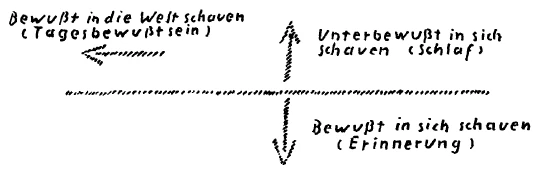
[ 21 ] So we actually have not just two distinct differences in consciousness, but three. Memory is truly a deepened, intensified form of everyday consciousness. For in memory, we do not merely recognize something; rather, we recognize something again, and that is the important point. Memory only makes sense if we recognize something. Just think about it: If I meet one of you today whom I have seen before, and I merely see him but do not know that he is the same person I have already met, then it is not a true memory. Memory is recognition. And Spiritual Science also shows us: While our ordinary daily consciousness—that is, this perception of the external world—is at the highest level of perfection, our memory is actually just at the beginning of its development. Memory must continue to develop further and further. Memory is, if we may speak comparatively, a still rather dormant faculty of human consciousness, and when the power of memory is further developed, then something else will be added to our present experience, namely the experience, the inner experience, of past incarnations. The experience of past incarnations is based on an enhancement of the power of memory, for this must under all circumstances be a process of recognition. This recognition must, under all circumstances, make its way through the inner self. Memory is a soul power that is only just beginning.
[ 22 ] Now let us ask: What is the nature of this power of the soul, specifically this power of memory? How does the process of remembering actually take place? — First you must answer this question: How do we arrive at a true concept in the present at all? — You will gain a mental image of what a true concept is if you do not form a mere superficial mental image of a true concept; for most people do not have concepts, but only have perceptions. Most people believe they know what a circle is. If someone asks: What is a circle? — one answers: A circle is just something like this. (A circle is drawn.) Certainly, that is the mental image of the circle; but that is not the point. One who merely knows that this is a circle, and to whom only what is on the blackboard comes to mind, has not yet formed a concept of the circle. Only the person who can say: “A circle is a curved line in which every point is equidistant from the center—” has a concept of the circle. — I do, of course, need an infinity of points, but I can find the circle internally as a concept. That is what Hegel meant. First, have the concept, even for the external fact, and then recognize the external fact again from the concept.
[ 23 ] Now try to discern the difference between the “half-asleep” state of a mere mental image, with which most people are content, and the active act of forming a concept. A concept is always an inner becoming, an inner activity. One does not have a concept of a table merely by having a mental image of it; rather, one has a concept of a table when one is able to say, for example: A table is something placed on a mere base that can support something else. The concept is an inner stirring and activity that one is able to translate into reality.
[ 24 ] One is tempted, when trying to explain something like this to our contemporaries, to—I would say—jump around. One would love to jump around so as to show how a true concept differs from the lethargic holding of a mental image. One would most like, in order to get people moving a little, to stir up this terribly sluggish mental image of today, to leap after the concepts everywhere, to devote oneself to the distinction between the ordinary mental image and that which truly requires one to circle around the center. Well, why would one want to do that? Because one knows from Spiritual Science that as soon as something rises to the level of a concept, the etheric body must actually make this movement. The etheric body is involved in this movement, so that one must not shy away from setting the etheric body in motion when one wants to construct concepts. One must not shy away from that.
[ 25 ] But what, then, is memory? What does it mean to remember? If I have learned that a circle is a curved line in which every point is equidistant from the center—and if I am to recall this concept—I must perform this movement again in the etheric body. Then, speaking from the standpoint of the etheric body, something has become a memory when the execution of the movement in question has become a habit in the etheric body. Memory is a habit of the etheric body. We remember a particular thing when our etheric body has become accustomed to performing the movement corresponding to that thing. You remember nothing other than what your etheric body has adopted as habits. Your etheric body must, if you move it frequently and cause it to recall again, develop from within the habit of performing the same movements—prompted by the first approach to the object—through the act of approaching the object. And because the habit becomes more and more ingrained, the memory becomes stronger and stronger the more often the event is repeated.
[ 26 ] But then I said: If we truly think, and not merely create mental images, the etheric body takes on all sorts of habits. But this etheric body is, after all, what underlies the physical body. You will find that people who want to clarify a concept sometimes try to imitate that concept in their outward gestures, even accompanying their speech with such a gesture. But human beings have gestures in general—gestures that are unique to them. This is what distinguishes people from one another: that they have their own unique gestures, if you take the term “gesture” broadly enough. — People have their own gestures — a gesture is, after all, the same thing. If one has a sense for gestures, then one can recognize a person even when walking behind them, by the way their gestures are, for example, the way they strike the ground with their heel. The way you think right now—that is actually, when this thinking becomes memory, a habit of the etheric body. This etheric body now trains the physical body throughout life. That is to say, or perhaps better put, it tries to train it, but it doesn’t quite succeed. So that we can say: Here is the physical body—well, for my part, the hand.
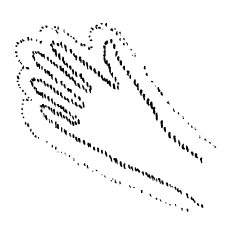
[ 27 ] When we think, we constantly try to send into the etheric body what will then become a habit. But the physical body sets a limit. Our etheric body cannot, in fact, send everything into the physical body. Therefore, it conserves these forces for which the physical body is an obstacle; and it carries them through the entire life between death and a new birth. Just as you think now, just as you imprint memories on the etheric body, so does this emerge in the next incarnation as your hidden gestural language, as your innate gesture. And if we now observe: Ah, this person has adopted this particular gesture since childhood, then the reason is that in the previous life, in the previous incarnation, they imprinted very specific patterns upon their etheric body through their thinking. That is to say, when I study a person’s gestures—to the extent that these gestures are revealed to me—they can serve as a marker for the way in which they came to terms with thinking in earlier lives. But consider what this means! It means: The thought, as it were, imprints itself upon the human being in such a way that it reappears as a gesture in the new incarnation. We are looking into this process of the thought becoming solid, becoming something that exists, becoming something that exists externally. What is first a thought within becomes a gesture without.
[ 28 ] Today, history is perceived as something random in academia, which knows nothing about necessity and how it differs from randomness. In a vocabulary from 1482—Mauthner himself notes this—it reads: “geschicht or geschehen ding, historia res gesta.” “Res gesta” is, in fact, what history used to be called! Now all that remains is the abstract word “regeste.” When one makes notes about events, one calls them a regeste! “Res gesta”! Why is that? It is the same word as “gesture.” The linguistic genius who coined the words “res gesta” still knew that even in what unfolds historically, one must see something that has remained. If one is to see in the gesture of the individual human being—which is born with him—the residue, the remnant of thoughts from previous incarnations, then it will no longer be a complete absurdity to assume that one also sees something like gestures in what confronts one in the facts of history. When I walk, these are a series of facts: these are the gestures for my thinking in my previous incarnation.
[ 29 ] Where, then, should we look for the thoughts behind the story? That is the question that now presents itself to us. For the individual human life, we must look for the thoughts behind the gesture in the previous incarnation. If we regard what happens in the story as a gesture, where should we look for the thoughts behind it?
[ 30 ] We will begin with these considerations tomorrow.