

The Value of Thinking for Satisfying Our Quest for Knowledge
The Relationship Between the Spiritual Science and the Natural SciencesGA 164
2 October 1915, Dornach
Translated by Steiner Online Library
The Relationship Between the Spiritual Science and the Natural Sciences III
[ 1 ] Today, we will continue our examination of F. von Wrangell’s pamphlet *Science and Theosophy*. Before we do so, I would like to briefly recapitulate a few thoughts that have emerged from the various chapters covered so far.
[ 2 ] First, I would like to explain why the perspectives presented in this brochure may be particularly relevant to our discussion. As I have already said, we are currently facing circumstances that may place those who stand on the ground of Spiritual Science in a position where they must defend Spiritual Science against the various attacks to which it is exposed. Now, in our time, such a defense will be particularly necessary when the attacks come from the side of science, and this is because science—which has developed in a certain form over the past three to four centuries—can, with some justification, lay claim to being the foundation of a worldview and actually does so. As a spiritual scientist, one might therefore hear it said: “Yes, if Spiritual Science has nothing to say in response to the objections raised by science, then it proves to be poorly founded; for anyone who wishes to advocate a worldview today must be able to defend it against the objections of science.” — That is why it is particularly important to take note when a scientist steps forward and explains what he or she has to say about the relationship between genuine scientific thinking and theosophical—and indeed, all spiritual—teachings.
[ 3 ] The considerations so far have shown you that it can be particularly important to advocate for spiritual teachings precisely from the standpoint shaped by a consciousness that has been shaped by astronomical and similar scientific research. I have, in fact, drawn attention to how a representative figure of the modern worldview, Du Bois-Reymond, specifically invokes the so-called “Laplacian mind”—the astronomical understanding of the world; I have shown what modern people imagine under the “Laplacian mind” and under the astronomical understanding of the world. It is therefore necessary to show to what extent a comprehensive worldview can be constructed on the basis of such astronomical concepts.
[ 4 ] I then said that it was important for this brochure to point out that practical materialism must necessarily follow, step by step, from theoretical materialism—from the theoretical, materialistic, and mechanical worldview. I then showed how Spiritual Science, too, must certainly take this standpoint, even though in our present time the objection is still frequently raised that theoretical adherents of the materialistic-mechanistic worldview by no means deny the validity of ideal, ethical motives, but on the contrary profess their commitment to them.
[ 5 ] We then saw, beautifully explained in the brochure, what worldview emerges for those who wish to adopt exclusively the perspective of a mechanistic-materialistic worldview. I have, so to speak, sketched out this worldview and particularly emphasized—as is also highlighted in the brochure—that anyone who regards the mechanistic-materialistic worldview as the all-encompassing worldview cannot view the inner experiences that take place in human consciousness as fundamentally different from other natural phenomena, that is, as side effects of mechanistic-materialistic processes; and that, if one constructs such a mechanistic-materialistic worldview, there can consequently be no longer any question of the survival of a spiritual core after death.
[ 6 ] The brochure then goes on to examine this basic assumption. In particular, it points out the relationship between freedom and morality on the one hand and the fundamental concepts of mechanical-materialism on the other; how the concept of freedom and responsibility can no longer be upheld if one fully commits to a materialistic-mechanistic worldview, and how this gives rise to the fundamental question or enigma of the world—namely, that it is necessary to arrive at a worldview within which the concepts of freedom and responsibility can find a place.
[ 7 ] It is then pointed out how the mental image of a general law—spanning all phenomena like a network, as it were—was arrived at only gradually, and also how it is impossible to ever refute the freedom of the will on the basis of experience, because, as we have seen, freedom of the will can never be conceived as being woven into this web of materialistic-mechanical processes in the way it would have to be if one were to adhere solely to this worldview.
[ 8 ] Then, in an epistemological discussion, it is shown how human beings relate to the external world through their senses; how one can conceptualize the formation of concepts, of mental images, and the formation of mental images of space and time. It is pointed out how the principle of causality ought to be a general principle of the worldview, yet how it has only gradually become part of the worldview, because it was originally assumed that real motives similar to those found in human beings themselves were present in things; so that, in other words, the course of development would show that humans did not originally assume a mechanical causality, but rather, fundamentally speaking, worked their way from a different conception of the interconnection of phenomena toward the mechanical-materialist conception.
[ 9 ] It then goes on to point out how, in more recent times, scientific inquiry has sought to achieve objectivity. The particularly important principle of materialistic-mechanistic science—the principle of measurement—is now examined in detail, and we will soon see how this principle of measurement has further implications even for the more complex areas of contemporary science.
[ 10 ] Now I would like to draw your attention very specifically to what is written in the booklet about measurement. Truly, I would ask you to use it as a starting point to truly grasp the nature of modern scientific thought precisely through this examination of measurement. We have seen, after all, how the principle of measurement is then applied to the principle underlying clocks. I would now like to make a few more remarks specifically about the principle of measurement to show you how you could use this chapter of Wrangell’s work *Science and Theosophy* as a kind of guiding thread to connect with what you can find in the various discussions about modern scientific thinking, particularly with regard to the character that is currently demanded of true scientific thinking.
[ 11 ] We have seen what the essence of measurement is, and we have also found evidence that, in a certain sense, measurement introduces a kind of uncertainty—despite all the objectivity in the observation that measurement encompasses. We can very easily draw attention to this uncertainty by saying the following: When we engage in simple measurement—the measurement of lengths or spaces—we use a standard of measurement as a basis. When we have to measure a length, we must proceed in such a way that we determine the ratio of the length to a standard of measurement. The length must exist in the sensory world, and our measuring stick must also be realized in the sensory world. Now you will find a remark in the text that draws attention to the fact that something comes into play that makes measurement uncertain. Measurement is based on comparing something to the measuring stick; one compares how many times the measuring stick is contained within the object being measured.
[ 12 ] However, a slight increase in temperature, for example, causes the heat to expand the ruler. So let us assume that the ruler has been heated and has thereby become a little longer. Of course—since we are measuring in a space with approximately uniform temperature, otherwise we would have to consider further complications—the object being measured would expand in the same proportion as the ruler. However, if the ruler and the object being measured are made of materials that do not expand at the same rate—so that the ruler expands less or more than the object being measured—then we are already dealing with inaccuracies in measurement.
[ 13 ] So we can highlight two things. The first is that the observation becomes independent of our subjectivity, of the observer. We compare what is to be measured with the standard of measurement—that is, we compare the objective with the objective. A good deal of modern scientific rigor is based on this, and, fundamentally, it also embodies a distinct ideal of modern scientific rigor. The other point is what would happen if we simply observed the things around us based solely on our subjectivity. For example, just create a mental image of the following. Imagine you have a container of water in front of you; now bring one hand close to the stove and hold the other hand in a pit of ice; then dip both hands into the water. You will feel something completely different in each hand, even though the water is the same temperature. To the warmed hand, the water will seem cold; to the cold hand, it will not seem cold at all. In this way, the subjective extends over everything objective. This is just a crude example, but it illustrates how the subjective always underlies all observation. Measurement detaches the content from the subject, from the observer. Therefore, there is an objective truth—a form of knowledge—detached from the subjective. This is important. And because, in recent times, people have increasingly strived to become independent of the subjective in their worldview, measurement has become a kind of ideal.
[ 14 ] You see, this measurement becomes so objective because the standard is independent of us; because we remove ourselves from the equation and substitute the standard in our place. Those who recall the lectures I gave in Berlin on the various perspectives one can adopt toward the world will see that something similar also underlies Spiritual Science itself. I said there: As long as one stands on the ground of external reality, one faces the world and forms a worldview. But as soon as one enters the spiritual world, one must essentially view what is to be observed from various perspectives—though here the perspective is meant in a spiritual sense. I listed twelve viewpoints, and only when one adopts these twelve viewpoints does one perspective always correct the other. In this way, one also becomes, in a certain sense, independent of subjectivity.
[ 15 ] From this you can see how the natural sciences and Spiritual Science converge, how objectivity—which is a necessary driving force in the development of the natural sciences—must also be sought by the Spiritual Science scholar, though not by asserting all twelve points of view. The twelve different points of view correct one another. Thus, measurement is the detachment from subjectivity. But on the other hand, it is pointed out that even in measurement, accuracy can only be achieved within certain limits, and Wrangell points this out in the next chapter:
Margin of Error in Measurement
When measuring time, just as when measuring length, one can specify the limit of accuracy—or, more precisely, the margin of error. Within these limits, the result obtained is objectively correct, but it never achieves flawless accuracy.
In this respect, all facts derived from sensory perception differ from the intuitive truths of thought, such as the formal laws of logic and all truths of mathematics.
[ 16 ] Thus, while measurement is rightly presented as the means that—taking the margin of error into account—provides a certain degree of accuracy with regard to a worldview, it is simultaneously pointed out that this accuracy, which can be achieved with respect to the external sensory world, can never be flawless correctness. It can never provide the same kind of truth found in the so-called intuitive truths of thought, in the formal laws of logic, and in the truths of mathematics.
[ 17 ] The next chapter is a further elaboration on what I have already said:
Absolute Validity of Logical and Mathematical Truths
Logical truth, for example: a part is smaller than the whole,
[ 18 ] — that is a mathematical truth. It cannot be stated with absolute certainty how many times a part is contained within this line [presumably, a line on the blackboard was being pointed to]
or: If two things are equal to a third, then they are also equal to each other; this is a universal principle;
[ 19 ] — these are absolute truths; however, they are not derived from external perception, but through thought
Anyone in their right mind recognizes its compelling necessity. The same is true in mathematics; once certain basic assumptions have been agreed upon, all other mathematical theorems follow with compelling necessity, without any restrictions. For example, if one agrees on what is meant by a straight line, what a right angle is, and what parallelism means, the theorems of geometry follow from these with absolute certainty.
[ 20 ] It is necessary to agree on these matters. We must agree on what a right angle is, what a straight line is, and what parallelism means. Once we have agreed that parallel lines are those that are equidistant from each other at all points that lie directly above one another, or once we have agreed that parallel lines are those that, no matter how far they are extended, never intersect, then we can use parallel lines to understand further mathematical theorems. I would now like to tie this in with something that seems quite far removed from the subject.
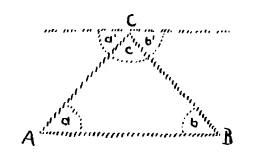
[ 21 ] Let’s assume we have a triangle here: We’ve discussed many times before that the three angles of a triangle add up to 180 degrees. Now, what is 180 degrees? It is 180 degrees when you imagine a point here and a straight line drawn through that point. The arc of a circle around that point—which is a semicircle—spans 180 degrees. Therefore, these three angles a, b, and c must be arranged in such a way that, when laid out in a fan shape, they form a straight line. This can be illustrated very easily by drawing a line parallel to line AB through point C. Then, once we’ve agreed on this parallel line, it follows that angle a’ must be equal to angle a, and angle b’ must be equal to angle b. Now the three angles lie next to one another in a fan shape and add up to 180 degrees. I would have to introduce intermediate steps, but you will see that the truth—that the three angles of a triangle add up to 180 degrees—is based on this. That is to say, there are certain fundamental truths of mathematics that arise from self-operating thought, on which we must agree, and from which the whole of mathematics then follows.
A person who has the ability to follow a line of reasoning is just as convinced of the eternal validity of the concluding statement as they are of their own existence.
[ 22 ] There can never be any doubt that the angles of a triangle add up to 180 degrees. For those of my esteemed friends who are familiar with this topic, I would like to emphasize that we are setting aside spatial geometry, which takes a different perspective; that would take us too far afield today.
Spatial science (geometry) identifies certain relationships between areas and their linear dimensions, as well as between spatial parts and the corresponding linear quantities.
[ 23 ] This is the simplest mental image. Because if you draw a rectangle, the area of that rectangle is the part I’ve shaded. Let’s call the length of the base line a, and this line b—then you get the area by multiplying a by b; that is, the area is composed of a linear quantity and a linear quantity.
These relationships were discovered by thinkers through intuition and logically linked to already known truths (this constitutes the mathematical proof). The correctness of the proof is not verified by experience, but is immediately recognized through intuition.
[ 24 ] It is very important that you engage with this issue: how, in this regard, mathematical reasoning and mathematical knowledge differ fundamentally from all other forms of knowledge that relate to external sensory objects. The latter can never be attained without approaching the external sensory object. One must therefore take into account all the imprecision involved in this process. However, when one wishes to construct a proof, there is no need to write down mathematical constructs; rather, they arise from spontaneous thought. Writing them down is merely an illustration for sluggish thinking that is unwilling to work on its own. But in principle, one could conceive of practicing mathematics without any illustration whatsoever, relying solely on inner mental images.
One must never overlook this profound, fundamental difference between facts derived from experience—which, due to the limitations of our senses, are always subject to error—and logical or mathematical truths, which hold absolute validity for us humans as soon as we have recognized the basic assumptions as correct.
If, however, a conclusion is drawn from any empirical fact through a chain of mathematical or logical propositions, this conclusion is correct only within the limitations under which that empirical fact was observed; only under these limitations can the final result obtained be accepted as a scientifically proven empirical fact; this is often overlooked.
Such empirical facts, when applied to phenomena of the sensory world, can lead to correct practical and even theoretical results, and they often attain such a high degree of probability that this probability seems to us equivalent to certainty; however, from an epistemological standpoint, it is not.
[ 25 ] The next chapter is titled:
All laws of nature are derived from experience and are therefore only valid under certain conditions
When we speak of laws of nature according to which, under certain conditions, certain phenomena necessarily occur—or, to put it another way, certain causes necessarily produce certain effects—these laws are derived from experience and can therefore only be proven to be correct within certain limits of accuracy.
Let us illustrate this with a few examples: The astronomer says that the Earth rotates around its axis at a constant speed; what does he mean by that?
[ 26 ] — So, while one can intuitively grasp certain mathematical truths, one cannot intuitively grasp the fact that the Earth rotates on its axis. What, then, does the astronomer mean by this?
First of all, this means: “We have compelling reasons to believe that the apparent daily rotation of the starry sky is an optical illusion caused by the Earth’s rotation on its axis; we call the duration of such a rotation a ‘sidereal day.’ To measure the duration of a sidereal day (that is, one rotation of the Earth around its axis), we must compare it to a duration of time that we assume to be constant. As such a unit of time, we choose the period of oscillation of a pendulum of a specific length attached to a clock. Experience shows us that the better the conditions are for ensuring the uniform operation of a clock, and the more precisely we conduct the stellar observations used to determine the duration of one Earth rotation, the more constant the ratio between the number of pendulum oscillations and the number of Earth rotations proves to be. Given the current state of technology, the Earth’s rotation has proven to be uniform within the possible margins of error, which can amount to only a small fraction of a second. We cannot claim absolute uniformity; indeed, we have reasons to doubt it.”
[ 27 ] — We need not go into the last sentence; it can be the subject of a later discussion.
[ 28 ] What, then, is actually evident from external observation? First, the phenomenon we experience as day and night on Earth; second, the comparison with the oscillations of a pendulum clock. And since we know from other premises that the pendulum swings uniformly, and that the uniform swing of the pendulum can be compared to what is observed with regard to the Earth, we must conclude that the Earth, too, rotates uniformly around its axis. Another explanation will be provided in the next chapter with regard to chemistry.
Chemical Laws
The same is true of chemistry. The entire foundation of this science rests on the principle that chemical reactions can only occur in very specific weight ratios of their indivisible components,
[ 29 ] — A footnote provides the following example: “For example, one unit of volume (let’s say one liter) of oxygen combines with only two units of volume of hydrogen to form water.” In other words, one oxygen atom combines with two hydrogen atoms to form a water molecule. I have spoken often about this combination of oxygen and hydrogen to form water. The footnote continues: “Since one atom of oxygen is 16 times heavier than one atom of hydrogen, one can also say: one unit of weight of hydrogen combines with 8 units of weight of oxygen to form 9 units of weight of water. If the mixture contains more oxygen than 8 times the weight of the hydrogen, the excess remains as ‘free (uncombined) oxygen’; if, on the other hand, there is less oxygen, the excess hydrogen remains uncombined.” Thus, oxygen combines with hydrogen to form water only in this very specific ratio; in water, they are present in this ratio. They cannot combine in any other way.
Or, to put it in technical terms: elements form chemical compounds only in multiples of their atomic weights.
[ 30 ] — This sentence encapsulates the entire atomic hypothesis. What is stated here holds true for all sensory perception, for the observation of masses and spatial relationships. But if one assumes that oxygen and hydrogen consist of the smallest particles—atoms that cannot be further divided—then one must assume that the same specific ratio also holds between the atoms. And since we cannot divide the atoms any further, when oxygen combines with hydrogen—that is, when one smallest particle of one combines with two smallest particles of the other—the same weight ratio must hold. If we take the atomic weight of oxygen and the atomic weight of hydrogen, a weight ratio emerges: that is, one atom of oxygen combines with two atoms of hydrogen, with the oxygen atom being eight times heavier. The entire multiple of the atomic weight is incorporated into the compound. What must one do to arrive at such a conclusion? One must perform a weighing—which is also a measurement. Thus, one approaches the sensory facts, and from the result of the weighing, one derives this law: that individual substances do not combine in any arbitrary way, but rather in a very specific ratio.
However, the empirical facts from which this law is derived are never entirely precise (because all weighing and measuring is subject to observational errors); if the law nevertheless expresses something absolute, then the following is meant: the more precisely the apparatus used for chemical analysis is constructed, and the more carefully the methods for breaking down compound substances into their irreducible elements are applied, the better the composition of the substance can be represented as a combination of multiples of the corresponding atomic weights of these elements.
Since the chemist is aware of the possible margins of error in his measurements, he knows whether the final result of his analysis agrees with the above law within these margins of error or not. If he finds a significant deviation, he remains convinced of the law’s correctness for the time being, to the extent that he assumes the presence of a yet-unknown element to explain the deviation or searches for an unnoticed source of error. Thus, in practice, he considers the law to be absolutely correct, even though he is theoretically aware of the conditional nature of this empirical law.
[ 31 ] In other words: If one were to find, based on other empirical facts, that two or three elements combine in a certain ratio, and if one were to observe yet another ratio in the substances containing them, one would have to assume that there is something else present as well.
[ 32 ] The next chapter is titled:
Laws of Physics
When physics states the law of conservation of energy, it means the following: if we convert a certain amount of kinetic energy into heat and compare the values expressing the amount of kinetic energy in its units and the amount of heat produced in calories (units of heat), we obtain a ratio known as the “mechanical heat equivalent”; the more precisely the measurements are made, and the better care is taken to ensure that all motion is converted into measurable heat, the more closely the ratios obtained in different experiments agree with one another. This is the actual result of experimentation.
[ 33 ] — Here, in a single sentence, we have an entire physical principle before us. What leads to this principle can be demonstrated by the very simple fact that when we run a finger across a surface, it becomes warm. You can test this for yourself. This energy—the energy from your own muscles that you’re expending—is not initially heat; but heat is generated, and energy is lost. What has happened here? Your energy has been converted into heat. For example, if you press here, a certain amount of heat is generated; if you apply a different form of energy, heat is also generated. One might think that this occurs irregularly; but that is not the case. The question of the relationship between the energy expended and the heat produced as a result has been the subject of important research. In 1842, Julius Robert Mayer—who was treated quite poorly by his peers at the time, even though he is now regarded as a scientific giant of the first order—was the first to point out that the ratio between energy and the heat produced from it is a constant. And he also attempted to specify the exact ratio. In his treatise, written in 1842, it is still stated imprecisely. Later scholars then determined and specified the exact value through their research. Helmholtz, who contended for priority of the discovery, ultimately succeeded in proving that such a ratio—a constant relationship between the energy expended and the heat produced—exists. An equal amount of energy produces an equal amount of heat, and the ratio between heat and the energy expended is as constant as the ratio to the constants is constant. This is called the “mechanical heat equivalent.” Thus, a physical law is established.
The physicist goes beyond this experiment when he replaces the observational results—which always differ from one another—with a simple, general formula. He is justified in doing so as long as he is aware of the conditions under which the formula is valid.
[ 34 ] — A formula arises simply from the fact that I say: When energy is converted into heat, there is a certain relationship between energy and heat. But no matter how many cases have been studied, the cases that will be studied the day after tomorrow have not yet been studied today. So when a physicist states a formula in such a context, he must be aware of the scope of validity such a formula can have.
Similarly, it can be shown that all laws of nature, in their simplified form, go beyond experience.
[ 35 ] — So, in essence, one goes beyond experience if one does not limit oneself to describing individual cases.
[ 36 ] Let us now consider the next chapter in terms of its overall trend; it is titled:
Knowledge progresses from the simple to the complex
The phenomena of the sensory world, as they present themselves to us, are so complex that, in order to fathom their interrelationships, human beings are compelled to first limit their attention to the simplest things and only then, step by step, expand the scope of their knowledge. The apparent, uniform, circular motion of the celestial bodies, in its simplicity, offered the possibility of applying the absolute truths of mathematics to empirical facts of observation and thereby predicting future events mathematically.
[ 37 ] — As for future lunar or solar eclipses—I mentioned this last time—this is based on observing the celestial bodies, expressing their movements in formulas, and then substituting certain values into those formulas. This makes it possible to specify the date on which, say, in the year 1950, a solar eclipse will occur.
This successful endeavor developed the ability to present large groups of phenomena in a clear, universally valid, mathematical form that facilitates vivid mental images. In the geocentric model of the universe, the concept of natural phenomena governed by laws found magnificent expression. Around the Earth, resting at the center of the world, the crystal-clear celestial sphere—with its countless stars attached to it—revolved with unchanging regularity. Only seven celestial bodies—the Sun, the Moon, and the five planets visible to the naked eye—have their own motion; to create a mental image of this motion, various combinations of circular movements were employed. This ultimately gave rise to the ingenious but complicated so-called Ptolemaic model of the universe, with its cycles and epicycles.
[ 38 ] — The earlier model of the universe was geocentric; it assumed that the Earth stood at the center of the world and that the other stars somehow revolved around it, and people observed how the workings of the universe unfolded. It was also possible to calculate these movements mathematically. It doesn’t matter that people had a worldview that astronomers no longer accept today. —
As the accuracy of observations increased and knowledge expanded, the difficulties in mathematically representing the observational data in this way grew, until finally the boldest and most far-reaching of all scientific hypotheses—the Copernican hypothesis—resolved these difficulties.
[ 39 ] — That is how it came to be; today, conditions are already quite different. It was assumed that the Earth stood at the center, that the starry sky revolved around it, and that the planets had their own motion. It was assumed that such a planet moved in a circle, which itself moved in a circle. One had to create a mental image of this in terms of epicycles. One had to have a very complicated understanding of space, which complicated the entire worldview. Then a principle entered human thought that contributed significantly to the establishment of the Copernican worldview. This was the principle that has never been cited more often than it was at that time: Nature does everything in the simplest way possible. — But, it was said, nature had not done this in the simplest way. And it was Copernicus who simply turned the matter on its head. He said: Let’s try placing the sun at the center and having the other celestial bodies move around it. And so a different astronomical worldview emerged—the Copernican one. I have already mentioned to you that it was not until 1822 that the Church permitted a Catholic to believe in this system. —
Degrading the Earth from its resting place at the center of the world to a satellite of the Sun, causing it—like the other wandering stars—to orbit at breakneck speed while spinning like a spindle on its axis, —this is a mental image that so thoroughly contradicted common sense and the teachings of the Church that their efforts to nip this heretical doctrine in the bud are understandable.
The reasons that led to the acceptance of this hypothesis could initially be fully appreciated only by those who were aware of how much more easily the results of observations were explained by this hypothesis than by assuming the Earth to be at rest. Admittedly, the distances separating us from the fixed stars had to be conceived as inconceivably vast.
[ 40 ] — Now we come to a discussion that is important, but one that we must examine in particular detail:
Incidentally, a fully valid proof of the correctness of the Copernican hypothesis was not provided until two and a half centuries later, through the discovery of what is known as the “aberration of light,” and even later through the measurement of several stellar parallaxes.
[ 41 ] — From an understanding of what stellar parallax and the aberration of light are, you will see that, prior to these discoveries, the Copernican worldview was indeed subject to a certain degree of uncertainty.
The mathematical method, which had been refined through the study of the movements of the celestial bodies, was gradually applied to the phenomena of earthly, inanimate nature—phenomena that are closer to us and therefore appear more complex. Statics—the study of the equilibrium of forces—had already emerged among the ancients; then, only with the revival of the exact sciences, did dynamics—the mathematical study of motion—emerge. Galileo investigated the laws of falling bodies; he intuitively recognized them, expressed them in formulas, and tested and proved them through ingenious experiments that enabled more precise measurements.
[ 42 ] — It points out that science essentially sets out to interweave mathematical mental images with external phenomena. The Ptolemaic worldview, too, aimed to extend mathematics like a net. When you see a star, you must already have grasped the mathematical mental image of the circle if you are to say: the star moves in a circle. So you connect mathematics with what you perceive empirically. This is also done in a large part of mechanical science, for example in statics, which deals with investigating the conditions under which equilibrium of forces is achieved, whereas dynamics investigates the conditions under which movements can be regulated, and so on. So we see how sciences are formed by interweaving what is empirically observed externally with mathematics.
Newton finally applies the laws of terrestrial gravitation to celestial phenomena. He proves mathematically that the same force that draws the apple to the Earth—the mutual attraction of two masses of matter—compels the Moon to orbit the Earth and the planets, along with the Earth, to follow their orbits around the Sun, whose elliptical shape, discovered by Kepler, corresponds to the requirements of mechanics.
[ 43 ] — This brings to mind the famous anecdote about Newton, who was once sitting under an apple tree and saw an apple fall. Now one might ask: Why does the apple fall? — For the naive person, this is not really a scientific question; it is precisely here that the scientific mind reveals itself—that what is not a question at all for the naive person becomes a question for the scientist. The layperson finds it perfectly natural that the apple falls. But it could also remain suspended, and it would do so if a force were not exerted by the Earth; the Earth pulls it toward itself. If you now create a mental image of the Earth with the Moon orbiting around it, you will realize that the Moon would have to fly away if another force were not counteracting it. Just think for a moment about what boys do—and perhaps girls do as well, though I don’t know that for sure. Suppose you have an object; tie it to a string, hold one end of the string, and move it in a circle. Try cutting the string, and the object will fly away. The Moon moves around in the same way. But why doesn’t it fly away? At every point, it has the tendency to do so. Suppose the Earth weren’t there; then it would certainly fly away; but since the Earth is there, it attracts the Moon, and it attracts it in such a way that it doesn’t move from here to A, but from here to B, after a certain amount of time.
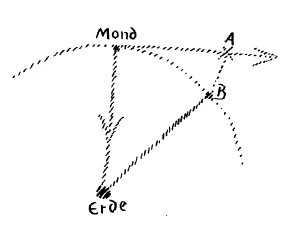
[ 45 ] The Earth must constantly attract it in order to keep it in its orbit. This is the same force, Newton told himself, as the one acting on the apple, which the Earth pulls down toward itself. It also uses this force to keep the Moon in its orbit. This is the same force by which celestial bodies attract one another and maintain their orbits. We see this force in the falling apple; the same force—the universal force of attraction, or gravity—is present in the celestial bodies. The rest—the calculations of how this gravity acts, how it decreases with distance, and so on—are details. It was precisely with this Newtonian theory of gravity that a very essential chapter in the scientific worldview was introduced—a chapter that, essentially, remained established right up to our time; only in our time is it being challenged. I have, after all, drawn your attention to how a so-called theory of relativity challenges it. But we will talk about that another time.
It was only with the discovery of the laws of gravity that our worldview became a unified one, encompassing the entire cosmos. The sublime idea of a cause (force) that acts everywhere and necessarily, measurable in its effects and therefore amenable to objective testing, accustoms the human mind to seek such testing everywhere and to strive constantly to reduce phenomena to as few basic assumptions as possible.
The progress of European science depends essentially on the application of this principle.
[ 46 ] In fact, much of this revolves around the application of this principle. I have already mentioned to you on several occasions how, as a twelve-year-old boy, I was surprised by a treatise in the school curriculum that attempted to explain these phenomena in a way other than through gravity. That gave me a great deal of trouble back then, because I was not yet very familiar with the formulas—the integral and differential equations—that were scattered throughout the treatise. But I can still tell you what it was about if I leave all that aside.
[ 47 ] Imagine the Earth here and the Moon there. (A drawing is provided. See p. 166.) This means that the Earth exerts a force on the Moon through empty space; it therefore has an effect at a distance. This gave rise to a great deal of speculation as to whether such an effect at a distance could really occur. Many were of the opinion that a body cannot exert an influence where it is not present, while others argued that a body is present where it exerts an influence. Schramm [the author of the aforementioned treatise] states: The entire theory of gravity is mysticism, for it assumes that a celestial body extends into the invisible realm in order to attract another. Whether it is a celestial body or a molecule makes no difference. So they are present at a certain distance. Now he asserts the following: The celestial bodies are not alone there. Space is filled with bodies. There are many other bodies there. But they, too, are not at rest; rather, they are in constant motion. If we now create a mental image of all these bodies in motion, then they are constantly colliding with this body we are considering here; bodies are also colliding here; but bodies are also colliding from within, so that the body is struck from all sides. And now he calculates the number and effect of these impacts. You can see very easily that there are smaller surfaces here to be struck, and larger surfaces there. But because fewer impacts can occur here than out there, the bodies are driven together. Here you have the result of the force of attraction, composed of various impacts, due to the fact that they occur in different numbers. So it’s rumbling here, it’s rumbling there; thus, fewer impacts must occur from the inside out than from the outside in. The bodies therefore tend to come together. They are driven together by the individual impacts.
[ 48 ] This man [Schramm] attempted to replace the force of gravity with a different kind of interaction. He sought to eliminate the mystical elements from the theory of gravity.
[ 49 ] Paul Du Bois-Reymond wrote a treatise in which he mathematically proved that collisions equivalent to the phenomenon of gravity are never possible.
[ 50 ] This is how science proceeds in its work; it attempts to derive principles from uncertain premises, then overturns them, only to return to the old principles. If Paul Du Bois-Reymond’s arguments are correct, one must return to the older ones. So one ends up returning to what should have been rejected. This is an interesting case that can illustrate how science works.
The progress of European science depends largely on the application of this principle. In this way, it has gradually become possible to unify more and more extensive areas of phenomena within inanimate nature—the phenomena of mechanics, heat, light, sound, electricity, magnetism, and chemical affinity—to transformations of a quantitatively indestructible entity that we call energy, whose measurable magnitude is expressed by the product of moving mass and the square of velocity.
[ 51 ] — In other words, attention is drawn here to the fact that if one forms a worldview in this way, one arrives at the assumption of an energy existing in space. I have already pointed out what the natural scientist Ostwald said: that it is not the slap itself that matters, but the energy applied in the process. And so, hypothetically speaking, you could have a material body here: (A diagram was apparently drawn.) How do you perceive it? Only by the fact that you can observe a different spatial extension here than in the surrounding area. But this, too, is merely a reaction—just as when you see a body, you can perceive nothing other than what acts upon your eyes with a certain force. Thus, matter can be replaced by energy. What we call matter can only ever be energy, and so observation and the mathematical law governing motion provide the basis for expressing the law of energy as the product of moving mass and the square of velocity. Discussing this, however, would take us too far afield; it can be done at a later time.
To date, no verified fact is known within the inanimate natural world that would contradict the basic assumption of the mechanical worldview; whereas countless conclusions logically or mathematically derived from it have been confirmed by empirical testing; indeed, the lawful sequence of events and the indestructibility of mass and energy are confirmed all the more reliably the more precisely the testing is conducted and the smaller the possible errors in the measurements are.
[ 52 ] It is pointed out here that a certain general physical law can be inferred from observation. The easiest way to arrive at this law is to say: We have a certain amount of energy. We convert this into heat. Heat, in turn—as we see with steam engines and so on—can undergo another transformation; it can be converted into a different form of energy. This transformation takes place in specific proportional ratios. This leads us to the so-called law of conservation of energy—that is, the law which states: There is a certain total amount of energy in the universe. This energy is transformed. When a certain amount of energy—let’s say heat—is transformed, energy disappears on one side, but on the other side, a different form of energy is present. Thus, a transformation of energy takes place. This is a law that plays an important role and which, in recent times, has been the subject of attempts to extend it to the entire worldview. And this brings us to the next chapter:
Extension of the Mechanical Mental Image to the Organic
However, this has only been demonstrable numerically within the inorganic world, insofar as we receive impressions of it through our five senses. It is understandable that this mental image of regularity is also applied to organic, animate nature.
But the question arises: to what extent are we justified in doing so?
[ 53 ] This means, then, that when we compare these energies and apply the law of energy—which can be applied to everything in inanimate, inorganic nature—we are now also attempting to apply the same law to organic nature. That is why the next chapter is titled:
Difference Between Inanimate and Animate Bodies
What is the difference between an animate and an inanimate body?
We call a body living when material changes occur within it not only according to physical and chemical laws, but also—in addition to these forces, which act alone in inanimate nature—other forces peculiar to each species and each individual, which determine the growth, reproduction, and death of every living being.
[ 54 ] — It is characteristic of living beings that they grow, reproduce, and die. We do not find this in the inorganic world. However, there is a tendency in the mechanistic-materialistic worldview to apply the same principles used for the inorganic world to living beings—that is, to the organic world.
Whether we attribute these laws to a “life force” or some other hypothetical cause—the fact remains that the gap between the organic and the inorganic has not yet been bridged, and that the more precise the observations, the more certain it becomes that life arises only from life.
[ 55 ] Here follows a sentence that has been quoted countless times; here it reads:
The opposite assumption—that living matter is merely a different arrangement of non-living matter—is, for the time being, a hypothesis not supported by any facts.
[ 56 ] — But I have also cited another point, and it is important to consider the other side of the issue in relation to this perspective. One might, in fact, believe that the validity of a spiritual worldview depends on the fact that it cannot be proven how life arises from inorganic substances. Yet there was a long period when people held a spiritual worldview and still believed that a homunculus could be created in a laboratory. Thus, the spiritual worldview was not always contingent upon the inability to bring forth life from the non-living. It is characteristic of our time to emphasize that life arises only from life, and that the spiritual worldview depends on this. I have often mentioned how Francesco Redi, only about 200 years ago, formulated the statement: “Life can come only from life,” and proved it incorrect to assume that life can arise from non-living matter. It is also important for science to point out that there is a gulf between the organic and the inorganic. Ferdinand Cohn emphasized at the naturalists’ conference in Berlin that the laws used to prove the inorganic are not sufficient to prove the organic. Bunge of Basel could be cited; and Julius Wiesner, the botanist, says: The further botany advances, the more evident it becomes that there is a gulf between the inorganic and the organic. Wrangell therefore says:
Therefore, if we wish to remain within the bounds of what has been scientifically established to date, we must distinguish between two fundamentally different groups of phenomena: the living and the non-living.
[ 57 ] The next chapter is titled:
Consciousness
We humans encounter yet another phenomenon through inner experience: consciousness, with its manifestations, which are sensation, thought, and volition.
We have no compelling reason to assume that plants also think and will, and—without straying from the ground of experience—we are justified in distinguishing, within the organic realm, between the unconscious plant world and the conscious animal world. 1The following footnote appears in the brochure: “Those who do not recognize a fundamental difference between plants and animals maintain this distinction solely for the sake of greater clarity.”
[ 58 ] — We have often spoken of the fact that there are people who want to blur the distinction between the plant and animal kingdoms, who claim that plants attract and devour living beings. You are familiar with a device that attracts creatures that come near it and then devours them: namely, a mousetrap. And yet one need not assume that a mousetrap possesses an animal-soul nature.
We call all phenomena related to consciousness “mental phenomena.”
[ 59 ] — To be more precise, we would have to say “all phenomena that we bring into consciousness,” for in Spiritual Science we must also call “spiritual” that which is neither the astral body nor the “I.” If you are only in the physical body and the etheric body, then we are not dealing with consciousness, but with spiritual activity. —
Thus, the world—as far as we perceive it through our five senses and our powers of thought—seems to contain three fundamentally distinct principles: matter, which is unchanging in its mass and properties; life, which obeys its own laws; and the spiritual.
[ 60 ] — I would also like to point out that even philosophers outside the realm of Spiritual Science, such as Eduard von Hartmann and others, have spoken of an unconscious spiritual realm, so that one...[gap in the postscript]
In the science that studies the inorganic world, as already mentioned, the assumption holds true that cause and effect are related in a numerically fixed ratio, and that all events within this inanimate world follow the strict law of necessity.
Biological science, which is dedicated to the study of life phenomena, proceeds from the same assumption, in accordance with the nature of all science. However, since measurement—and consequently the numerical examination of the regular course of changes (i.e., of events)—is not applicable to many phenomena of life, the prevalence of a necessary, immutable connection between cause and effect cannot be conclusively demonstrated in the field of biology. Yet there is nothing to contradict this assumption, and both its inherent probability and the analogy with what we know for certain support it. In any case, this assumption must underlie all scientific research, for its very purpose is to discover these laws.
[ 61 ] In various lectures, I have pointed out how, in recent times, efforts have been made to trace numerical constancy all the way up to animal and human phenomena. For example, Rudner attempted to determine how much thermal energy is contained in the food consumed by a particular animal; he then sought to determine how much heat the animal generates through its life processes. The resulting constant figure indicates that the heat absorbed through food is re-released during activity. This activity would be the transformed food.
[ 62 ] Another researcher has extended this to the psychological realm by testing a number of students. The principle of using numerical ratios is quite sound. It can be applied to all these phenomena. We will discuss tomorrow to what extent this is entirely correct. But logically, the matter is usually viewed in a very short-sighted way, for someone could, following the same logical laws that Rubner employs, examine how the monetary values—or their equivalents—that are brought into the bank correspond to all those that are taken out. They must, after all, correspond to one another. If one were to conclude from this that there are no people in the bank doing this, that would certainly be wrong. If one examines the food that is introduced into the organism and the energy that comes out again, and finds them to correspond to one another, one should not assume that nothing spiritual is involved.
[ 63 ] Then comes another chapter:
Mental Phenomena
If we consider mental phenomena, we see that, to ordinary sensory observation, they are tied to certain material conditions; and this gave rise to the materialist view that mental phenomena would not exist at all without the material basis of a living being—its brain, nerves, and so on.
[ 64 ] — This assumption has become so deeply entrenched that Du Bois-Reymond said in one of his speeches that if one wanted to speak of a world soul, one would have to prove where the world’s brain is. So he said: If you want to speak of a soul of the world, you must prove where the world’s brain is. — This has been reinterpreted in such a materialistic way because, when one observes human beings in the physical world, one sees that everything spiritual is bound to the brain.
Most people have always felt an innate aversion to this view, and the belief in the independent existence of spiritual beings—as well as in their interaction with the sensory world familiar to us—has found expression in a wide variety of religious and spiritualist mental images.
A great many facts that are supposed to serve as direct confirmation of such views are certainly based on deception and delusion.
[ 65 ] — We, too, have experienced quite a bit of this deception and delusion here in recent times. It is of great importance that those who stand on the foundation of the Spiritual Science worldview be free from deception and delusion.
However, well-documented factual evidence has been gathered recently that makes the assumption of a spiritual world appear to be the most likely hypothesis for explaining these phenomena; it would now be unscientific to simply dismiss this hypothesis—as was the case just a few decades ago.
[ 66 ] And this will be discussed further in the following chapter:
Human Occult Abilities
If numerous facts perceptible to the ordinary senses already suggest—if not even demand—a spiritualist interpretation, then there is the additional fact that many credible people claim to possess, in addition to the five senses, other organs of perception that are undeveloped in most people, which allow them to enter into direct communication with the spirit world.
That the five human senses do not exhaust all possibilities of perceptual abilities is, of course, to be assumed a priori and is confirmed by certain phenomena in the animal kingdom. There is therefore no justification for disputing this; rather, it is a scientific duty to examine the relevant facts carefully and without prejudice—which is indeed what many outstanding representatives of the exact sciences are doing at present.
For a great many people who have had occult experiences themselves or have heard of them from credible sources, the existence of spiritual worlds is a proven fact, and the possibility of gaining insight into the mysteries of the world by entering into them is beyond doubt.
Throughout history, such supposed or actual insights have given rise to teachings that have sometimes been disseminated as secret doctrines among the elect and sometimes manifested as openly taught religious systems. Of the major world religions, European culture is most closely interwoven with Christian doctrine.
[ 67 ] Now it is important that we use such a discussion as a starting point to explore how Spiritual Science approaches this issue. Taking into account everything that human development has gone through to date, Spiritual Science today takes the position of not emphasizing, at least initially, that there are already other organs of perception besides the five human senses — as you know, if you look back on much of what we have covered, there are other organs — but rather to emphasize that other organs of perception can be developed. In *How to Attain Knowledge of the Higher Worlds*, it is described what one must do so that such organs can be developed. It is important that modern Spiritual Science, albeit in a different sense, nevertheless claims the same universal validity as other sciences. Other sciences seek to gain knowledge that applies to all human beings. Spiritual Science seeks to develop organs of perception that can be developed by all human beings. Just as the scientist can verify what is claimed, so too can the person who develops the spiritual organs verify what Spiritual Science claims. Conventional science relies on abilities that already exist, while Spiritual Science relies on those that can be developed.
[ 68 ] Now let us consider the principle according to which these abilities are developed. You will find a detailed and concrete description of how these abilities are developed in “How Does One Attain Knowledge of the Higher Worlds?” For now, I will only briefly explain how such abilities should be understood.
[ 69 ] When a symphony is played, there is actually nothing in the room but air vibrations. These air vibrations can also be calculated mathematically. And if one were to perform a sufficient number of calculations, one could mathematically express all the motion occurring in the instrument and in the air as the sum of the facts of motion. One could completely abstract from the symphony one is listening to and say to oneself: I don’t care about Beethoven’s symphony; I want to be a mathematician and investigate what states of motion prevail there. — If one were to take that approach, one would eliminate the symphony and be left with only the states of motion. But you will have to admit that the symphony is still there as well. It cannot be denied, and it is something other than merely the image of states of motion. What has happened here? It is, after all, really only Beethoven who, in a certain way, brought about the emergence of such states of motion. But that alone does not yet constitute a real symphony.
[ 70 ] Now create a mental image of a person who applies all those faculties that are otherwise used to perceive the external physical world in order to arrive at laws such as the intuitive laws of mathematics and logic, that is, the laws that a person develops by virtue of being a thinking being—and if, with these laws, he were to treat himself in the same way that a composer treats the states of motion of the air—if he were not to accept the faculties of mathematics, logic, and other faculties as they are, but were to process them internally—then something arises within him that is distinct from the empirical faculties of logic, mathematics, and empirical research. Compare this—and the way the composer treats the air—with what one does internally, and consider what emerges from it; then you will be able to say: Here is a person who has the ability to conduct empirical research, the ability to form mathematical and logical judgments—this is just like a sum of states of motion present in the instruments and in the air. But when one processes these in a certain way, a symphony arises—a musical work of art. The laws by which one works on oneself are precisely those set forth in my book *How to Attain Knowledge of the Higher Worlds*. Then something emerges that is still developing, that is a consequence of human activity. And just as one who has a musical ear perceives more than merely the vibrations of the instruments and the air, so too does one who has developed the inner senses perceive not only the sensory, the mathematical, and not only the logical world, but also the spiritual world. This cultivation of something new on the basis of what already exists leads to one working one’s way into a spiritual world. Thus, the task of Spiritual Science is to recognize that the abilities a person already possesses can be further developed, just as the movements of instruments and the air can be further developed. It is on this capacity for further development that a person’s ability to evolve toward a conception of the world rests—one that gives them something they would not perceive without this further development. The essential point of Spiritual Science is that it points to the possibility of further developing certain abilities—not to the existence of abilities that are already present, but to their further development. And so Wrangell is correct when he says that the various religious systems point to the same thing as the secret teachings.
[ 71 ] The next chapter is titled:
The Essence of Jesus’ Teaching
If one regards what is common to all the countless interpretations of Jesus’ teaching as the essence of Christianity, it consists in the “good news” that the Creator and Ruler of the universe is a loving Father to humankind, whom He created in His own image; that love for God and one’s fellow human beings is the highest moral commandment; that the human soul is immortal; and that after death, a fate awaits it that corresponds to the person’s moral conduct during their lifetime.
[ 72 ] — Just as we have elucidated the essence of Christianity using the tools of Spiritual Science, it must be said that what is expressed here is indeed the content of Jesus’ teaching, but not the essence of Christianity. The essence of Christianity lies in the fact that a development took place in time through the union of the human being Jesus with the Godhead—that is, a being who had not previously been connected to the Earth became connected to it through the well-known event, thereby dividing time into a pre-Christian and a post-Christian era. This recognition of the appearance of the Christ-being on Earth is part of the essence of Christianity.
The glaring errors into which organized Christian communities—the historical churches—have fallen have brought their dogmas into conflict with certain well-established scientific achievements, thereby giving rise to the conflict between faith and knowledge, religion and science, which is eroding the intellectual life of European culture.
This situation explains the interest that has turned toward other religious systems, which claim not only to be in harmony with science but also to expand upon it. Among these teachings, Theosophy deserves special attention. Ever since H.P. Blavatsky drew the attention of the European cultural world to this teaching, which originated in India, it has been presented in various forms.
[ 73 ] Whenever the word “theosophy” is mentioned, it is important to draw attention to what Spiritual Science is and what the theosophical worldview is.
[ 74 ] I think I’ll be able to wrap this up tomorrow. However, I still need to discuss to what extent Blavatsky’s teachings originate from India and to what extent they do not, and in doing so, I must address some of the ways in which Spiritual Science differs from much of what is called theosophy. So, more on that tomorrow.