

The Riddle of Man
The Spiritual Background of Human History
GA 170
21 August 1916, Dornach
Translated by Steiner Online Library
Tenth Lecture
[ 1 ] What I would like to present today is to be a very unpretentious discussion of some philosophical schools of thought that have emerged in recent times. I will build upon very well-known schools of thought—those, so to speak, that lie at the surface of recent intellectual life. Later, in the near future or very soon, we can delve into the details and specific manifestations of contemporary thought. I would like to characterize a certain fundamental feature of some contemporary schools of thought, those of the most recent period. This fundamental feature consists in the fact that the entire direction of certain currents of thought reveals to us—one might say—a loss of a sense of orientation toward reality, toward truth, insofar as the harmony of our insights with an objective reality can be called “the truth.” One notices in certain recent currents of thought that thinkers find it so difficult to find their bearings when, for epistemological reasons—reasons they can accept as valid from a philosophical or scientific standpoint—they are called upon to decide whether a judgment about reality, this or that form of reality, is correct or incorrect. There is no principle—or, to put it in scientific terms, no criterion—to be found in thought that would provide the impetus to decide, in the case of certain judgments, whether they are true judgments, that is, judgments relating to reality. Certain older criteria have been lost. And it is clearly evident that, in recent times, nothing truly adequate has actually taken the place of these old criteria of truth.
[ 2 ] I would like to begin with a thinker who passed away very recently, who started out with studies in physics and then turned to a kind of inductive philosophy, and who attempted to replace the old concepts of truth—for which a sense of validity had gradually been lost—with something new. I am referring first and foremost to Ernst Mach. Ernst Mach—I can only outline the basic concepts today—is skeptical of all concepts produced by previous thought, that is, thought up through the last third of the nineteenth century. This line of thought, while relating to these concepts more or less critically and elaborating on them to varying degrees, spoke of the world and humanity in such a way that one assumed: Human beings perceive the world through their senses, process sensory impressions through concepts, and then arrive at certain representations, at ideas about the world. In doing so, one assumes—as I said, I cannot go into all sorts of further epistemological matters today—that what is perceived: colors, sounds, warmth, sensations of pressure, and so on—originates from some kind of objectivity, from something objective that is located out there in space or, more generally, outside our inner life, making an impression through the senses; this impression is then a sensory sensation, which in turn is further processed. And as the agent—the actual doer, the active force—in this entire process of cognition, which in turn underlies the entire process of life, people regarded the human “I,” about which much was speculated and theorized, but which was accepted in one form or another in such a way that it was said: There is simply such a thing that one is justified in regarding as a kind of “I,” which is active and which ultimately shapes the various sensory perceptions into concepts and ideas.
[ 3 ] Ernst Mach, in a sense, looks around at our given world and says: All these concepts—of the “I,” that is, of the subject of cognition, of subjectivity; of the object that underlies sensory perceptions—all these concepts are, in fact, unjustified. He says: What do we actually have that is given? What is actually present in the world? Only sensations are, in essence, present. We perceive colors, we perceive sounds, we perceive odors, and so on; but nothing outside of these sensations is actually given to us. If we take a proper look around the world, everything is, in a sense, sensation, and beyond sensations, one finds nothing objective anywhere. The entire world that lies before us actually dissolves into sensations. Everything is nothing but manifold sensations. And if we can say that nothing exists except sensations—then we cannot say either that there is a distinct “I,” an active agent, within us. For what is actually given to us in our soul? Again, only sensations. When we look within ourselves, we are presented only with a stream of sensations; these sensations are, as it were, wound onto a thread: yesterday we had sensations, today we have sensations, tomorrow we will have sensations. They are linked together like the links of a chain. But everywhere there is only sensation; nowhere is there an active “I.” There is only the appearance of an “I,” because a group of sensations is extracted from the general world of sensations and clustered together. And we call these clusters “I”; they belong to us; they belong to what we perceived yesterday, the day before yesterday, and half a year ago. Because we find such a group of related sensations, we designate it with the collective term “I.” — So the “I” also disappears, the object of cognition also disappears; all that a person can speak of is merely a multiplicity of sensations. So if we initially approach the world naively, if we observe reality, there truly exists an infinite variety of differently grouped colors, differently grouped tones, differently grouped sensations of temperature, differently grouped sensations of pressure, and so on; but that is all.
[ 4 ] But now science also comes into play. Science discovers laws. That is to say, it does not simply describe: “I perceive this sensation here, I perceive that sensation there,” and so on; rather, it discovers laws—natural laws. What compels humans to formulate natural laws, since they have only a multitude of sensations? Merely observing the multitude of sensations does not yield a judgment. Only by rising, to a greater or lesser extent, to the level of laws do we arrive at a judgment. What, then, do we actually want with judgment in the world of sensations, which is, after all, nothing but a chaotic multitude? By what standard do we guide ourselves when forming judgments? Indeed, if there is nothing there but sensations—one cannot, Mach argues, measure one sensation against another. So, what provides a criterion for forming judgments, establishing laws, and arriving at laws of nature?—Ernst Mach says: it is solely the economy of thought that leads to this. When we conceive of certain laws, we can, by means of these laws, trace certain sensations and hold them together, as it were, in thought. And when we feel that, by holding these sensations together in a certain way, we can measure them with the least amount of thought—that is, think in the most economical way—we call this a law of nature. We see a stone falling to the ground. It is a sum of sensations: a sensation here, a sensation there, and so on—nothing but sensations. We summarize this under the law of gravity. But the law of gravity is not a reality in itself, for only the sensations are real. So why, then, do we even conceive of the law of gravity? Because it is convenient; it is economically efficient to summarize a certain group of sensations with a brief expression. In a sense, this gives us a convenient overview of the world of sensations. And whatever we conceive that gives us the most convenient overview of any group of sensations—so that we can use this expression, knowing, as it were, that once we have the expression and certain conditions are met again—that is, once certain sensations recur—then others will follow in their wake—this serves as a law for us. If I summarize the sensations caused by a falling stone into the law of gravity, this is convenient for me, because I know: if I have this law, then one will fall to the ground just as another will. I can thus think from the past into the future. It is an economy of thought. The law of economy of thought, the law of the least expenditure of mental energy—that is, encompassing the greatest number of sensations with the smallest sum of thoughts—is what Ernst Mach takes as the foundation of the entire scientific enterprise.
[ 5 ] You can see from this: This does not lead to anything real. For by grouping sensations together in the most convenient way, one is merely serving one’s own convenience in life. But what one obtains as expressions through the principle of economic thinking says nothing about what underlies the sensations. It is merely for our own most convenient orientation in the world. It is only because, deep down, we find it so convenient; that is why we group sensations together in a certain way. So you see, this is a criterion of truth that quite deliberately refrains from seeking any kind of objectivity, that pursues no other goal than to “serve the human capacity for orientation through sensation.”
[ 6 ] One thinker who has based his ideas on similar considerations is Richard Wahle. Richard Wahle also says: People talk about one thing being the cause and another being the effect; they say that an “I” lives within, while objects exist outside. But that’s all nonsense—I’m using roughly the same terms he does—in truth, nothing in the world is present to us except this: here we see a color occurrence, there a sound occurrence; the world consists, as Wahle says, only of occurrences. If we call these occurrences “sensations,” as Mach does, we are actually already going too far; for the word “sensation” already contains a hidden implication that there is someone there who is sensing. But how can one know that what appears as an occurrence is a sensation? Events are there. Out there is a color event, a sound event, a pressure event, a heat event; in here is a pain event, a joy event, there is the event of satiety, the event of hunger, there is the event in which someone imagines that there is a God. But in reality, there is nothing there except that someone imagines: there is a God. Just as someone experiences pain, so they imagine: there is a God. Everything is merely an occurrence. Wahle does, however, maintain that one must distinguish between two kinds of occurrences: primary occurrences and so-called “miniatures.” Primary occurrences are those that arise with their original intensity: occurrences of color, sound, pressure, heat, pain, joy, hunger, satiety, and so on. Miniatures are images of the imagination, intentions—in short, everything that appears as if in a shadow, as if in silhouettes of the primary occurrences. But if one takes the sum of all primary occurrences and all secondary occurrences—the so-called miniatures—then one has everything the world has to offer. Everything else is, in essence, an added fabrication—a fabrication without justification. There, Wahle argues, people tell themselves: Three years ago, these events took place; then the other events followed; and because certain events follow one another in this way, it blinds people, and they summarize it all as an “I.” But where is such a “self”? There are only events strung together—sequences of events. But nowhere is there a “self.” And then people come along and say they have discovered laws that connect these events—laws of nature. But these laws represent nothing more than the stringing of events together. And to decide why they are strung together in this way is simply impossible. And when people call this “knowledge”—when they string the events together in a certain way—this “knowledge” is nothing but frivolity. This “knowledge,” Wahle argues, is neither valid nor particularly sublime; rather, it merely illustrates that humans cannot really find a way to relate to their events and so invent something. The “I” is the most curious invention of all. For nowhere in the totality of events can anything like an “I” truly be found. Given the way events follow one another, one must assume that unknown factors are at play; for it seems that events do not follow one another arbitrarily. But what kind of unknown factors—I use the same words that Wahle uses—are at play is completely beyond human judgment; one cannot say anything about it at all. All that a person can know is that events exist, and that these events are directed by entirely unknown factors. Physics, physiology, biology, and sociology are groping in the dark regarding this direction. But this is merely groping around, so that one can live with the events. It never leads to knowing anything about the unknown factors at play. Therefore, any belief that one could arrive at a philosophy that would explain the reasons why events occur in a particular way is a form of human madness to which humanity has succumbed for a time—and which it is high time to abandon. — One of Richard Wahle’s most important books is titled: “The Whole of Philosophy and Its End: Its Legacies to Theology, Physiology, Aesthetics, and Political Pedagogy.” To teach this end of philosophy—to teach that philosophy is madness—Richard Wahle became a professor of philosophy!
[ 7 ] We see that, above all, such considerations are based on a complete powerlessness in the face of criteria of truth. One no longer feels any impulse to reach a decision based on knowledge. What underlies this could be characterized, for example, in the following way. Imagine someone has a book and has been reading it for a long time; he reads it again and again and again, and lives under the impression that through this book he has received information about certain things—the very things the book contains information about. Now he pauses to reflect: Yes, here lies this book before me; I have always imagined that through this book I have received information about this or that; but when I really look at this book: there are always just letters, letters, letters on the pages. So I’ve actually been a fool to believe that messages about all sorts of things—things that aren’t even in the book—could flow to me from it, because after all, they’re just letters. I’ve always lived under the delusion that these letters would have an effect on me, in some kind of interaction, that they were meant to give me something; but letters are simply there, merely following one another—letters. So one must finally free oneself from the delusion that these letters describe anything, that they could somehow relate to one another, or group themselves into meaningful words or the like. — It really is an image that can be used to illustrate the kind of thinking that underlies Wahle’s “non-philosophy,” or “unphilosophy.” For his great discovery consists in saying: People have hitherto believed that they see events; but they interpret these events in their context—they read nature, as it were. But what foolish donkeys people have been! There are, after all, only disjointed events, and at most there are still unknown factors at play—just as there may be something unknown at play that groups the letters in such a strange way.
[ 8 ] So what is missing is the ability to immerse oneself in the impulse—the impulse to make a decision about the truth value of a judgment that is just being formed on the basis of the world. Human knowledge has become powerless with regard to a criterion of truth. In earlier times, it was believed that human beings possessed something like the ability to arrive at truths through the inner experience of what is contained in the judgment. This could not be substantiated. And so one philosophizes in this vein. — I wanted to use these two examples to illustrate this loss of the criterion of truth, this feeling of no longer being an active participant in the creation of truth.
[ 9 ] On a large scale, we see this loss of a criterion of truth—in the old sense of the term—in the contemporary school of thought known as pragmatism. And while perhaps not the most significant, William James is certainly the best-known representative of pragmatism. If we wish to briefly clarify the principle of pragmatism as it has emerged in recent times, we can characterize it roughly as follows:
[ 10 ] People make judgments through which they seek to say something about reality. Yet human beings have no way of finding within themselves anything that could lead them to make a true judgment about reality. There is nothing within a person that would decide, decide for itself, or decide in and of itself: this is true, that is false. — Thus, one feels powerless to find a fundamental, self-existent criterion for determining whether this is true or that is false. Nevertheless, by living in reality, a person feels compelled to make judgments. And the sciences are, after all, full of judgments. If one now considers the entire scope of the sciences with all their judgments—do they say anything about anything that is true or false in a higher sense, in the sense of the old philosophical schools of thought? No! In the sense of, for example, William James, this is an entirely impossible way of thinking—to ask whether anything can be true or false in and of itself. We make judgments. When we make certain judgments, we can live with them. They prove to be useful and applicable in life, and they promote life. If we were to make different judgments, we would soon find ourselves unable to cope with life; we would not make progress in life. They would be useless and harmful to life. This applies even to the crudest of judgments. One cannot even reasonably say that the sun will rise again tomorrow; for there is no criterion of truth at all. But we have formed the judgment: Every morning the sun rises. — If someone were to come along and say, “The sun rises only during the first two-thirds of the month and not during the last third,” — then with this judgment he would not make progress in life, for he would always run into trouble during the last third of the month. The judgment we form is useful. But we cannot speak of true or false in any other sense than that a judgment guides us through the world, that it promotes life, and that another judgment—one that is the opposite—harms life. There is no criterion for true and false that exists in and of itself; rather, we call that which promotes life “true,” and that which harms life “false.” — Thus, everything that is supposed to determine whether we make a judgment or not has been driven out into the practice of life. And all the impulses that people used to believe they possessed are no longer accepted.
[ 11 ] Such a school of thought is by no means the arbitrary creation of an individual or a school. Rather, the distinctive feature of precisely such schools of thought, as I have described them today, is that they are spread across virtually the entirety of, shall we say, the intellectual culture of the world; that they appear here and there as if independent of one another, because contemporary humanity is organized in such a way as to gravitate toward these schools of thought. For example, we see the following interesting phenomenon. While Peirce wrote the first book on “pragmatic philosophy” in America in the 1870s—a philosophy that was subsequently developed further by William James in the United States and by Schiller and others in England—that is, while Peirce published his first treatise on pragmatic philosophy in America, which falls within this school of thought, a thinker in Germany wrote his “Philosophy of the As If.” This is, therefore, a parallel development. The person in question, who wrote the “Philosophy of the As If” at that time, is named Vaihinger. What is the aim of this “Philosophy of the As If”? It proceeds from the idea that human beings are actually incapable of forming true or false ideas or concepts in the traditional sense, yet they do form ideas and concepts—for example, to take a well-known concept, that of the atom. The atom is, of course, a completely absurd concept. For in thought, the atom is endowed with all sorts of qualities that would have to be perceived by the senses if they actually existed. Nevertheless, sensory perceptions are understood as effects of atomic activity. Thus, it is a contradictory concept, a concept for something that is completely untraceable. As Vaihinger says, the atom is a fiction. We create many such fictions for ourselves, and fundamentally, all higher concepts we form about reality are such fictions. Since there is no criterion for what is true or false, a reasonable person of the present day must actually be clear about the fact that one is dealing with fictions. And one must create fictions with full awareness. One must be clear that the atom is a mere fiction, that the atom cannot exist. But one regards the phenomena of the world as if the world were governed by the movements or the life of atoms—as if—and for that reason it is useful to construct this fiction. One arrives at a certain coherence of phenomena when one constructs such fictions. An “I” is a fiction; but one must construct this fiction. For if one regards certain phenomena that occur together as if an “I” were active within them—an “I” that one knows with absolute certainty to be merely a fiction—then they are easier to understand than if one were to view them without the fiction of the “I.” And so, in fact, one lives entirely on fictions. There is no philosophy of reality, but rather a “philosophy of the As If.” The world deceives us into believing that what we regard as fictions is actually real.
[ 12 ] Overall, in its structure and also in its individual applications, the philosophy of pragmatism is very similar to the “Philosophy of As If.” I said: At the same time that Peirce was writing his treatise on pragmatic philosophy—in the 1870s—Vaihinger was writing down the “Philosophy of As If.” But given the mindset of people back then, in the 1870s—who still clung to so many vestiges of the old belief that there might still be an objective criterion of truth, and that the sciences could not consist solely of fictions—it would have been a risky move to publish this “Philosophy of As If” precisely in the 1870s if one wished to become a professor. It wasn’t possible back then. So Vaihinger looked for a way out. He initially left the Philosophy of the As-If in his desk, taught as is necessary today—isn’t that right?—and when the time came for him to retire, he retired and published the Philosophy of the As-If, which has now appeared in several editions. — I’m just telling the story; I’m not passing judgment, not making judgments, not criticizing—just telling the story.
[ 13 ] Thus we see that there is a certain tendency to dissolve the old criteria of truth and, in essence, not to place life in the service of truth—to make life an embodiment of truth, as was once believed—but rather to measure truth against life. Fictions—we know that they do not contain, in the old sense, what was called truth; but these fictions serve a purpose. Hence the peculiar definitions of the “philosophy of as-if”: Truth is the most convenient form of error, for there is nothing but error; but there are inconvenient errors and more convenient errors, and we call the more convenient errors “truths”; but one must simply be clear about this.
[ 14 ] There is, then, an evolutionary impulse in contemporary thought that truly leads to a situation where we no longer grasp the concept of truth in the old epistemological sense. One wonders: What is this connected to? Of course, I would have to tell you a great deal if I were to describe the full scope of what this is connected to. From the wealth of facts, let me highlight just one for now: in recent times, an infinite abundance of empirical knowledge has presented itself to humanity, and people have become increasingly powerless in their thinking—powerless because they could no longer master or hold together, through thought, the infinitely rich material of empirical perceptions and empirical knowledge.
[ 15 ] Another reason is that, over time, people have become far too accustomed to abstract thinking. In earlier times, people did not think as much. They tried to keep their thinking grounded in the external world and in experience. People had the feeling that, in a sense, they could not make progress with purely abstract thinking alone, that this kind of thinking had to be grounded in something. But through all the thinking they had practiced, they had learned abstract thinking and, in a sense, grown fond of it and become accustomed to it. Added to this were certain negative influences of the times, above all the notion that anyone who wants to become a private lecturer must actually think about or research something significant—and something truly monumental if they want to become a professor! And so, I would say, a certain hypertrophy of thought arose. People thought away and arrived at conceptual constructs that are internally logical as such. I would like to present to you one such conceptual construct that is entirely logical in itself.
[ 16 ] Imagine the following (see diagram): Here is a mountain; on this mountain (A), a single shot is fired first; after a certain amount of time—let’s say two minutes—two shots are fired; and again after a certain amount of time—another two minutes—three shots are fired.
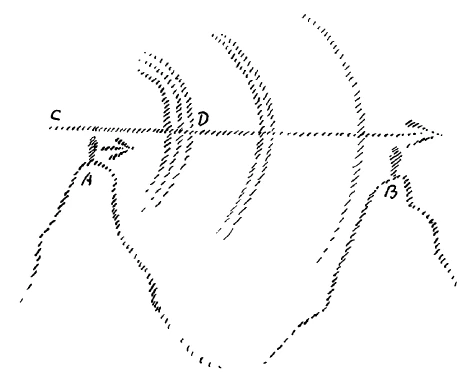
[ 17 ] Now there’s a man standing on the right (B) who’s listening. I’m not saying he’ll be shot, but he’s listening. This is what he’ll hear: one shot, then after a certain amount of time two shots, then after a certain amount of time three shots. But now let’s assume that the situation isn’t simply one where shots are fired here—one shot, two shots, three shots—and someone over there hears: one shot, two shots, three shots—but rather that a person (C) is moving at a certain speed from this mountain (on the left) to that mountain (on the right), dashing out from there, moving at a certain speed from one mountain to the other—his speed is very high. Now, as you know from elementary physics, sound takes a certain amount of time to travel from here to there. So if a shot is fired here (A), and (B) is listening here, he hears the sound; after a certain amount of time, the first shot arrives, after the next two minutes two shots, and after another two minutes three shots. But let’s assume that the person (C) is moving faster than the speed of sound. Now he’s standing there. He’s already moving from here toward the mountain faster than the speed of sound. The first shot is fired, the second two shots are fired, the third three shots are fired, and he arrives at the mountain just after the third three shots have been fired; he continues flying at the same speed, flying past the three shots—that is, he flies past the sound as he continues flying rapidly; he is moving faster. The sound of the three shots has reached this point (D) after a certain amount of time. He flies past the three shots and hears them as he passes; then he reaches the two shots that were fired earlier, and he hears those two; then he flies on, reaches the first shot, and hears it. So someone who flies faster than the speed of sound hears the sequence in reverse: three shots, two shots, one shot. Thus, if one relates to the speed of sound in the same way that an ordinary person on ordinary Earth relates to the usual conditions of life, one hears one shot here, two shots here, and three shots here. If one does not behave like an ordinary person on ordinary Earth, but is instead a being that flies faster than the speed of sound, then one hears the sequence in reverse: three shots, two shots, one shot. One need only practice the simple skill of flying after the sound and flying forward faster than the sound itself.
[ 18 ] Well, this matter is undoubtedly as logical as can be, for there is not the slightest objection to the logic of the matter. Certain developments in modern science have now led to the fact that what I have just explained to you here—about chasing after the sound and hearing in reverse—serves as the introduction to countless lectures. Time and again, lectures begin with this—well, let’s call it an example. For the purpose is to show that how we perceive things actually depends solely on our own situation in life. It is only because of our creeping nature in relation to sound that we do not hear things in reverse, but rather hear them as we do now. I cannot elaborate here on everything that follows from this, but I wanted to present this line of thought to you, for it forms, in a sense, the foundation for many of a theory that is widespread today and has profound implications—the so-called theory of relativity.
[ 19 ] I have shown you only the most rudimentary examples. But you can see that everything presented here is logical—everything is completely, completely logical. Today, there are countless judgments—philosophical literature is teeming with judgments that are made on the basis of the very same conceptual premises. Thinking is, so to speak, torn away from reality. One considers only certain individual conditions of reality and constructs one’s thinking based on them.
[ 20 ] It is, of course, difficult to respond to these things precisely because one naturally expects a logical response. But there can be no logical response. For this very reason, in my latest book, The Enigma of Man, based on earlier philosophical reflections, I introduced the concept that truth is grasped only by forming not merely a logical concept or a logical idea, but a concept and an idea that correspond to reality. Now, it would require a very lengthy explanation for me to show you that the entire theory of relativity is indeed logical—and wonderfully so—but it is not grounded in reality. So one can say: The concept developed here with regard to the one, two, three shots is entirely logical; but the person who thinks in a way grounded in reality does not form it. One cannot refute it; one can only refrain from using it! But anyone who has adopted the criterion of reality will also refrain from such concepts. The empirical phenomena that one seeks to grasp through this theory of relativity—Lorentz, Einstein, and so on—must be understood in an entirely different way than through the line of thought conceived by Einstein, Lorentz, and so on.
[ 21 ] What I have outlined here is, in turn, merely one current within the entire, ever-advancing stream of modern thought. Certainly, elements carried over from the past always find their way into this modern thought. But the ultimate consequences—the radical consequences—of what underlies almost all modern thought are precisely the things I have outlined. Now there is a certain peculiarity here. Because we have lost an original criterion—or, let us say, a sense of an original criterion of truth and falsehood—we end up, through emancipation into the abstract, forming concepts which, while indisputable in themselves because they are logical, and which are even, in a certain sense, true to reality, but which are unsuitable for making any genuine statement about reality; they remain merely formal concepts, so to speak, concepts that float on the surface of reality and do not dive into the actual impulses of reality.
[ 22 ] Here is an example of a theory that remains on the surface and refuses to delve into reality. Consider this: In human reality, we distinguish between the mineral kingdom, the plant kingdom, the animal kingdom, and the human kingdom. Human beings, in turn, live together within the social order—one might say the sociological order—and one might perhaps find even higher orders. That is not the point. When, in the mid-nineteenth century, a materialistic conception of reality prevailed, people imagined this layering of realms, so to speak, in very simple terms. Essentially, people assumed only the physical mineral kingdom and reasoned: Well, plants are simply things arranged in a slightly more complex way from the same basic components that make up the mineral kingdom; the basic components are arranged in an even more complex way in the animal kingdom; even more complex in the human kingdom, and so on up the hierarchy. However, as one moved further up into the social order, even complex atomic movements, for example, could no longer be found. Certain forms of atomic movement correspond to the mineral kingdom—as certain people imagined it—these become more complex in the plant kingdom, where one can disregard them, since the atom is not visible there; the animal kingdom corresponds to even more complex forms of movement, and the human kingdom to even more complex ones. This is how everything is structured. However, once one enters the social order, the atomic model doesn’t quite hold up; one cannot find any atomic movements there.
[ 23 ] A thinker from the last third of the nineteenth century did, however, manage the feat of reducing sociology to biological terms as well. He treated social structures—families, for example—like cells; then, of course, they group together into larger—what do I know—district communities; well, those are the beginnings of tissues. Then it goes on—states are already entire organs—well, and so on. Schäffle was the name of the man who conceived of these social organisms as ideas. Schäffle then wrote a book: The Hopelessness of Social Democracy and based it on this biological-sociological theory. The Viennese writer Hermann Bahr, who at the time was still a very young up-and-comer but a highly talented individual, wrote a counter-essay to Schäffle’s book The Hopelessness of Social Democracy and titled his counter-essay The Lack of Insight of Mr. Schäffle. It is an excellently written book, but one that has been forgotten.
[ 24 ] So, as I said, the old materialist concept of truth simply conceived of increasingly complex structures; of course, it also introduced certain concepts—let’s say: in crystals, atoms move in a certain rigid form, while in the plant kingdom they move in a more unstable form, seeking a point of equilibrium, and so on. In short, people devised all sorts of theories, but they always wanted one thing to emerge from another. Once materialism had been around long enough, people were able to reflect on just how unproductive this materialistic conception of reality is—and how little it actually stands up to closer scrutiny. And so the idea took shape: Certainly, the mineral kingdom exists, and then the plant kingdom emerges. Mineral matter is incorporated into the plant, even the mineral laws; the salts contained within it, along with the other substances, function according to their physiological and chemical laws. So the mineral kingdom is present within the plant kingdom. But the plant kingdom can never arise from the mineral kingdom alone. Something creative must be added. So as one ascends from the mineral kingdom to the plant kingdom, something creative is added, and this—the first creative force—is creative within the mineral kingdom. Then a second creative force emerges in the plant kingdom, which appropriates the mineral kingdom. Then a third creative force emerges, from which the animal kingdom arises. The animal kingdom, in turn, appropriates the lower kingdoms. Then comes a fourth creative force, which appropriates the lower kingdoms—in the human kingdom. Then, in the sociological order, a new creative force again appropriates the other kingdoms. A hierarchy of creative forces! — Of course, there is nothing to object to in the logic of this idea. The idea is also correct as an idea. You will, however, have to think differently about the matter if you recall certain concepts from spiritual science, which we do not wish to discuss today. But the entire consideration remains stuck in the abstract; it does not translate into a concrete mental image. Certainly, details are provided; but when one thinks in this way, one actually has only the abstract concept of the creative. The entire line of thought remains stuck in abstractions. Yet it is an attempt, in a sense, to overcome mere materialism through a formalism of clear thinking. One arrives at somewhat higher concepts, but they remain merely abstract.
[ 25 ] In Boutroux’s philosophy, we find an attempt to overcome mere materialism through formal thinking, which arises from an unbiased examination of the hierarchy of the natural kingdoms. This concept of the ascending creative force is sought, so to speak, from within the hierarchy of the sciences. In the process, interesting conclusions come to light. But everything remains stuck in the abstract. This could easily be proven if we delved into the details of Boutroux’s philosophy. For now, I merely wish to outline the lines of thought; the rest may come later. Here we have an attempt, so to speak, to grasp reality through a superficial observation of it using one-sided abstractions. But reality cannot be grasped in this way. Admittedly, one does not wish to establish a mere “philosophy of as if,” nor a mere pragmatism, nor to remain stuck at the insubstantial juxtaposition of events, but one does not arrive at a level of concretization where one could truly, as it were, “read” the external world in order to recognize what lies behind it—just as one recognizes what lies behind the letters of a book—but rather one arrives only at a few abstractions intended to indicate that something lives within the hierarchy of realms of reality. While the other philosophical schools of thought I have mentioned lost the criterion of truth in epistemological terms, here the power to grasp reality concretely is lost. One no longer has the ability to immerse oneself in the inner impulses of reality. One merely skims the surface.
[ 26 ] This brings us to another fundamental feature of modern life. This way of thinking, as I said, has in a certain sense emancipated itself from reality and proceeds, emancipated from reality, into abstractions. You can see how, in this way, the impulse to immerse oneself in reality has been lost in the most diverse schools of thought of recent times. People have become increasingly incapable of grasping the true nature of reality. A classic example emerges when one considers the development of thought from Maine de Biran to Bergson. While Biran, at the beginning of the nineteenth century, still represented a school of thought capable of delving into important psychological concepts—into the reality of human existence itself—Bergson strikes out on a unique path that is entirely characteristic of the particular tendency of modern thought. On the one hand, Bergson observes that with ordinary abstract thinking—and indeed with all scientific thinking as it is practiced and as it is reflected in scientific results—one cannot, in essence, penetrate into reality; one always remains, so to speak, on the surface of reality, without delving into the immediate life of reality. Therefore, he seeks to grasp this reality through a kind of intuition—which I can only characterize in very general terms at this point—and through an inner experience as opposed to the external conceptualization of reality. And this leads him to a distinctive perspective in epistemological and psychological terms. This culminates—I will omit the intermediate steps for now—in his assertion that, according to the materialist view, memory and higher structures of the soul’s life are believed to be bound to complex forms or movements, to structures of the brain. But the brain is not at all intended to form such complex structures; rather, what is psychological—and what is grasped not through abstract thinking but through inner experience and intuition—is what acts, and the relationships it enters into with reality are expressed in human sensations, in feelings, and in the practical shaping of life—in the movements we teach our bodies, for example. But everything is exhausted in the brain formations—in what has an effect on sensation and on the promotion and shaping of life. In contrast, memory, for example, does not come about because there are brain formations for it, but rather it operates with an intensity independent of the brain.
[ 27 ] It is an attempt to transcend the materialist conception of knowledge, an attempt that is peculiar in that it brings to light the opposite of reality. For it is precisely in order to develop memory that the physical body, the physical brain, and the entire physical system must exist. Memory could never take root in the soul unless the soul developed itself to the point of the physical body and, within the physical body, created the conditions for acquiring the faculty, the capacity for memory. Thus, a theory emerges here that, driven by the impulse to overcome materialism, arrives precisely at the opposite of what is correct. While it is true that one must say: Since memory is to be included among the faculties that the human soul acquires, and memory must then be integrated into the soul with the aid of the physical body—Bergson, on the other hand, conceives of the physical body as having no part in the development of memory. I am not elaborating on these points in order to make specific, so to speak, historical remarks about Bergson’s philosophy, but only to characterize this peculiar phenomenon: that a mode of thinking in modern times leads, in a completely logical way, to finding the opposite of what is correct.
[ 28 ] Thus, we can start with the more epistemologically oriented philosophies, which speak of powerlessness in the face of a criterion of truth and falsehood, and then move on to those philosophies that, while striving to find the truth, but because they seek it out of a sense of powerlessness in the face of the true, they end up precisely with the opposite—with what is false—so that in the present there is, in fact, a certain inner tendency in thought toward the incorrect, toward the false. This is indeed connected to the fact that, through the capacity for abstraction—the tendency toward abstraction—to which we have become accustomed, we have actually alienated ourselves from reality. We detach ourselves from reality and cannot find our way back to it. You can read more details in my The Riddles of Philosophy. One cannot find one’s way back to reality once one has separated oneself from it through abstraction. But on the other hand, a certain longing to grasp the spiritual is once again taking root in people. Yet there remains a powerlessness when it comes to reaching this spiritual realm. In such cases, it can often be downright significant—as one can even see in the present—how this search for the truth of the spirit arises out of absolute powerlessness. We have just examined an example where the truth is sought and the opposite is found through the emancipation of thought from reality.
[ 29 ] A characteristic example of the search for the spirit without even the slightest ability to grasp a single fragment of it can be found in Eucken’s philosophy. Eucken speaks only of the Spirit—that is, in words—but he never says anything about the Spirit. Because his words are utterly powerless to approach the true Spirit, Eucken therefore always speaks of the Spirit. He has already written countless books. It is a veritable ordeal to read through these books, for they all say the same thing. It always states that one must find this self-comprehension of thinking-in-itself—which, apart from external support and external resistance, comprehends itself within itself, beholds itself within itself, advances within itself, enters into itself through this advancement, and reshapes itself from within itself. One can attend a lecture by Eucken or read a book on Greek philosophy; one will find the development of Greek philosophy presented in such a way that this thinking first attempts, to some extent, to grasp itself, but is not yet able to do so. One can hear a lecture on Paracelsus and see how the inner world is gradually grasped; one can read a book on the origins of Christianity—everywhere the same, everywhere the same! And this philosophy is so infinitely significant for modern philistinism, which is so happy to hear talk of the spirit, to theorize about the spirit, when one need not know anything at all about the spirit, when one need not actually enter into the spirit. That is why many call Eucken’s philosophy the revival of idealism, the revival of spiritual life, a cultural catalyst capable of revitalizing the exhausted and stifling spiritual life of the present, and so on. And anyone who has a sense of what pulsates—and should pulsate—in a philosophy reads Eucken, listens to Eucken, and feels as vividly as if I were now pulling myself up by my own hair, higher and higher and higher! For that is, after all, the consistent logic of Eucken’s philosophy. In my Riddles of Philosophy, I sought to present things entirely objectively. What I have just said, everyone can tell themselves, because one need not rush to criticize, but must first become familiar with the concepts that exist.
[ 30 ] Thus we see how certain currents of thought in the present arise precisely out of a sense of powerlessness in the face of reality, and how philosophies are formed out of this very powerlessness. If one does not care about this life, well, then one thinks it isn’t really that bad. But it is bad. And sometimes one must also engage with what is alive and weaving its way through the intellectual life of the present, because perhaps through this one can gain a sense of how that which lives in the present can be overcome.
[ 31 ] I have presented to you only a few of the schools of thought that play a significant role in various fields of life—specifically, in those areas where thought is central and where philosophical worldviews are presented and taught. It is certainly the case today that a common structure of intellectual trends has gradually developed, even in recent years. I have hinted at this by showing you how pragmatism and the “philosophy of as if” emerged independently of one another.
[ 32 ] But the thinkers have also borrowed various ideas from one another. They were in a constant and lively exchange. Vaihinger is entirely independent of Peirce; they arrived at these philosophical orientations entirely independently of one another, over in America and here in Germany. But in other respects as well, we frequently find echoes between the character of one cultural community and that of another; and the only way to gain a picture of what truly exists in intellectual life is to really delve into the details of these matters and examine them. In this regard, too, there is indeed much speculation today—an immense amount of thinking, writing, and reflection—but even the simplest things are overlooked. Little attention is paid to certain connections that exist because people today have not retained a sense of reality. This sense of reality must be cultivated. Let me say this, as it were, as an appendix to today’s reflections: One can only acquire this sense of reality through one’s own efforts.
[ 33 ] If I may mention something personal here: It has always been my aim—even in all outwardly scientific matters—to cultivate a sense of reality, a kind of intuition for reality, so to speak. This consists not only in being able to judge reality, but also in finding ways to measure the real against the real and to compare it with the real. You may know that Nietzsche expounds the doctrine of so-called eternal recurrence, of the return of the same. This doctrine goes like this: Just as we are sitting here together now, so have we sat together countless times before and will sit together again. — It is not a doctrine of reincarnation, but a doctrine of the return of the same. I do not wish to criticize this doctrine of return at this time; that is not the point here. This doctrine of return stems from a very specific conception of an initial world order, from impossible ideas that Nietzsche formed regarding an initial world order.
[ 34 ] I was once at the Nietzsche Archive with other scholars, and the conversation turned to the doctrine of the return of the same. People were interested in how Nietzsche might have arrived at such an idea. Just think what wonderful opportunities these are! Anyone familiar with the situation knows what wonderful opportunities these present for writing as many dissertations and books as possible about how Nietzsche arrived at the original ideas behind the doctrine of the return of the same. Of course, one can put forward the boldest hypotheses, and one can find a great deal simply by looking. I said at the time, after the discussion had been going on for a while: Nietzsche very often—I was trying, that is, to grasp his idea in a realistic way—arrived at an idea by formulating the counter-idea to an idea he had found in someone else. To my knowledge, the counter-idea—namely, that because of a certain configuration of the Earth’s origins, there could be no return of the same—appears in Dühring’s work, in the work of another philosopher. And to my knowledge, I said, Nietzsche had read Dühring. Now, the simplest and most straightforward thing to do is to go to Nietzsche’s library, which has been preserved, take out those works by Dühring where this opposing idea appears, and take a look. — Well, we went into his library, looked it up, turned to the passage—I knew it exactly—and there we found a thick line drawn by Nietzsche’s hand at that spot, along with a few telling words. He used to write in places like this where he wanted to capture counter-ideas—I don’t remember exactly what he wrote there—something like “donkey,” “nonsense,” “rubbish.” Such a characteristic word was written there on the margin. And so he read it, made a note of it, formulated the counter-idea, and the counter-idea to the “doctrine of the return of the same” sprang from his mind! — The key is to look in the right place. For Nietzsche really did have a tendency to formulate counter-ideas in response to certain ideas.
[ 35 ] This, too, is a characteristic feature of the disempowerment of the modern criterion of truth—I have already described the other manifestations of this disempowerment to you—and it is yet another expression of that disempowerment: Because one cannot arrive at a criterion of truth on one’s own, one constructs counter-truths to truths that already existed, and counter-judgments to judgments that already existed. — But one must not generalize such things. If you were to draw the abstract conclusion from this that Nietzsche derived his entire philosophy solely in this way, that would of course be utter nonsense; for at times he was quite positive, that is, he simply developed certain ideas further, entirely in their spirit. For example, the entire doctrine of Beyond Good and Evil, as it appears to us in Nietzsche, can be traced in its entirety through all its individual parts. One need only go to Nietzsche’s library and pick up Guyau’s book on morality. One reads the passages that Nietzsche has underlined in the margins and finds them abstracted in Beyond Good and Evil! Beyond Good and Evil is already entirely contained within Guyau’s treatises on morality. Such connections must certainly be taken into account in modern times. If one fails to do so, one arrives at entirely false impressions of who this or that thinker actually was.
[ 36 ] So I wanted to present to you a few aspects of modern intellectual life today. I have limited myself to only the most well-known and most superficial examples. If circumstances permit, we can go into more detail on this very topic in the very near future.