

The Riddle of Man
The Spiritual Background of Human History
GA 170
15 August 1916, Dornach
Translated by Steiner Online Library
Ninth Lecture
[ 1 ] We have sought to understand human beings as they exist within the world through their sensory faculties and vital organs, and we have attempted to grasp some of the implications of the fact underlying these insights. Above all, we have, so to speak, freed ourselves from the trivial view—one that is particularly characteristic of some who wish to be spiritually minded—that everything they believe they should despise is labeled “the material” or “the sensory.” For we have seen that here in the physical world, precisely in human beings’ lower organs and lower activities, a reflection is given of higher activities and higher connections. We have had to regard the sense of touch and the sense of life, as they are now, as very much bound to the physical earthly world; the same applies to the sense of the “I,” the sense of thought, and the sense of language. But those senses that we find in the physical earthly sphere—which serve the physical organism only from within— the sense of movement, the sense of balance, the sense of smell, the sense of taste, and to a certain degree even the sense of sight—it is precisely these senses that we have had to regard as shadows of something that becomes great and significant in the spiritual world once we have passed through death. We have emphasized that, through the sense of movement in the spiritual world, we move among the beings of the various hierarchies according to the forces of attraction and repulsion they exert upon us, which manifest as spiritual sympathies and antipathies that we then experience after death. The sense of balance maintains not only our physical equilibrium—as it does here with the physical body—but also our moral equilibrium in relation to the beings and influences that exist in the spiritual world. And so it is with the other senses: the sense of taste, the sense of smell, and the sense of sight. And insofar as the hidden spiritual realm intervenes in the physical world, we cannot turn to the higher senses for explanations, but must instead turn to the so-called lower sensory realms. However, it is not possible at present to speak about certain very significant matters in this vein, because prejudices are so great today that one need only mention things that are significant and interesting in a higher spiritual sense to be misunderstood and accused of all sorts of things. And so, for the time being, I must refrain from pointing out the connection between certain interesting processes in the sensory realms and important facts of life.
[ 2 ] In this regard, conditions were indeed more favorable in ancient times. However, there were also no means of disseminating knowledge on the scale we have today. Aristotle was able to speak about certain truths much more freely than is possible today, when these truths are immediately taken personally in some sense and arouse personal sympathies or antipathies. In Aristotle’s works, for example, you will find truths that deeply affect people—truths that could hardly be articulated today before a large gathering—truths to which I alluded in my recent reflections when I said: The Greeks understood even more about the connection between the soul and spirit and the physical body, without thereby falling into materialism. In Aristotle’s writings, for example, you can find very beautiful descriptions of the outward appearance of brave people, cowards, hot-tempered people, and those who are prone to sleepiness. There, in a certain accurate way, it is described what kind of hair, what complexion, and what kind of wrinkles the brave and the cowards have, how those prone to sleepiness are physically constituted, and so on. Even depicting that would pose some difficulties today; other things even more so. Therefore, today—when people have become so focused on the personal and, in many respects, seek to cloud their perception of the truth through the personal—one must rely more on generalities when presenting the truth under certain circumstances. |
[ 3 ] Every human nature and activity can be understood from a certain perspective if we ask the necessary questions in the right way about what we have set before our souls in our recent reflections. For example, we have said: The sensory spheres, as they exist in human beings today, are, in a sense, separate and stationary spheres, just as the constellations out in outer space are stationary spheres—in contrast to what appears in the planets, which circle there, which move there, and which change their position relatively rapidly. Thus, the sensory spheres are, in a sense, clearly demarcated in their regions, while the life processes pulse through the entire organism and circulate through the individual sensory spheres—that is, they permeate them with their activity.
[ 4 ] But we have also said that during the ancient Lunar Age, our present-day sense organs were still life organs, that they were still functioning as life organs, and that our present-day life organs were, in essence, still more of a soul nature during the ancient Lunar Age. Now consider what has often been emphasized: that there is an atavism in human life, a kind of return to the habits and characteristics of what was once—in this case, during the Lunar Era—natural; a kind of regression. We know that there is an atavistic regression to the dreamlike, imaginative mode of perception characteristic of the Lunar Age. Today, we must describe this atavistic regression into Lunar visions as pathological.
[ 5 ] Now, please, take a good, hard look: It is not the visions themselves that are pathological, for otherwise everything that human beings experienced during the Lunar Age—when they lived solely in such visions—would have to be described as pathological, and one would be compelled to say that human beings underwent a pathological process during the Lunar Age, and moreover a psychological one; they were insane during the ancient Lunar Age. That would, of course, be complete nonsense; one cannot say that. What is pathological does not lie in the visions as such, but rather in the fact that, within humanity’s present earthly organization, they exist in such a way that they cannot be endured—that is, they are utilized by this earthly organization in a manner inappropriate to them as lunar visions. Consider this: when someone has a lunar vision, it is actually only suited to lead to a feeling, an activity, or an action that corresponds to the Moon. But if a person has a lunar vision here during their earthly life and acts in ways that are characteristic only of an earthly organism, that is where the pathological aspect lies. And they do this only because their earthly organism cannot tolerate the vision when, so to speak, the earthly organism becomes imbued with it.
[ 6 ] Take the most extreme case: Someone is prompted to have a vision. Instead of remaining calm with this vision and contemplating it inwardly, he somehow applies it—even though it is meant only for the spiritual world—to the physical world and acts accordingly with his body. That is to say, they begin to rage because the vision penetrates and overpowers their body—which it should not do. There you have the most extreme case. The vision should remain within the realm where it belongs, but it does not do so if, as an atavistic vision, it is not tolerated by the physical body. If the physical body is too weak to resist the vision, then a sense of powerlessness sets in. If the physical body is strong enough to resist it, then it weakens the vision. It then lacks the quality by which it deceives one into believing it is something akin to an object or process in the sensory world; for that is precisely what the vision deceives the person into believing, causing them to become ill as a result. If, therefore, the physical organism is strong enough to counteract the atavistic vision’s tendency to deceive, then the following will occur: the person will be strong enough to relate to the world in a manner similar to that of the ancient Lunar Age, while still adapting this behavior to the needs of the present-day organism.
[ 7 ] What does that mean? It means that human beings will undergo an inner transformation of their zodiac with its twelve sensory spheres. They will transform it in such a way that, within this zodiac and its twelve sensory spheres, more life processes than sensory processes will take place—or, to put it better, processes will take place that, while they do engage the sensory process, but transform them into life processes within the sensory sphere—that is, lift the sensory process out of the lifeless state it is in today and transform it into something living—so that a person sees, but at the same time something lives within that seeing; that they hear, and at the same time something lives within that hearing, just as it otherwise lives only in the stomach or on the tongue, so too in the eye and in the ear. The sensory processes are thus set in motion. Their life is stimulated. This can happen quite naturally. Then something of what is otherwise found only in the life organs today—to the same degree—is incorporated into these sensory organs. The life organs possess a strong inner permeation of sympathetic and antipathetic forces. Think how all of life depends on sympathy and antipathy! One thing is accepted, the other rejected. The sympathetic and antipathetic forces that the vital organs otherwise unfold are, as it were, instilled once more into the sense organs. The eye not only sees the color red, but also feels sympathy or antipathy toward it. This permeation with life flows back to the sense organs. Thus we can say: The sense organs, in a certain sense, become spheres of life in their own right.
[ 8 ] The life processes must then also be transformed. And this happens in such a way that the life processes become more imbued with spirit than they are during earthly life. This occurs in such a way that the three life processes—breathing, warmth, and nutrition—are, so to speak, brought together and imbued with spirit, taking on a more spiritual character. In ordinary breathing, one breathes in coarse, material air; in ordinary warmth, one takes in heat, and so on. Now, however, a kind of symbiosis takes place; that is, the life processes form a unity when they are imbued with spirit. They are not separate as in the present organism, but rather they form a kind of connection with one another. Breathing, warmth, and nutrition form an intimate communion within the human being—not coarse nutrition, but rather what constitutes the nutritional process; the process takes place, but one does not need to eat during it, nor does it occur on its own as it does during eating, but rather in conjunction with the other processes.
[ 9 ] Similarly, the four other life processes are united. Secretion, maintenance, growth, and reproduction are united and, in turn, form a more animate process—a life process that is thus more spiritual. And then the two parts can reunite, so that it is not the case that all life processes interact together, but rather that they interact in such a way that they are divided into three and four, with the three interacting with the four.
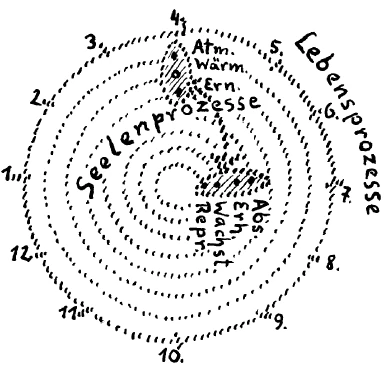
[ 10 ] This gives rise—in a way similar to, but not exactly the same as, what exists on Earth today—to soul forces that have the character of thinking, feeling, and willing: three in number. These are, however, different; they are not thinking, feeling, and willing as they are on Earth, but something else. They are more like life processes, though not such isolated life processes as those on Earth. The process taking place within the human being is a very intimate, subtle one—one that occurs when the person is able to endure this sort of “sinking back” into the Moon, where visions do not occur, and yet a similar kind—a faintly similar kind—of perception takes place, where the sensory realms become realms of life, and the life processes become soul processes. Nor can a human being remain in this state forever, for then he would be of no use to the Earth. After all, they are adapted to the Earth in that their senses and also their vital organs are as we have described them. But in certain cases, a person can indeed shape themselves in this way, and when they do so—if this shaping focuses more on the will, aesthetic creation arises; if it shifts more toward perception and observation, aesthetic enjoyment arises. The true aesthetic behavior of human beings consists in the sensory organs being enlivened in a certain way, and the life processes being imbued with spirit. This is a very important truth about human beings, for it helps us understand many things. We must seek that more intense life of the sensory organs and the different kind of life in the sensory realms—as opposed to what is the case in ordinary life—in art and in the enjoyment of art. And the same is true of the life processes, which are more imbued with spirit in the enjoyment of art than in ordinary life. Because these things are not viewed in accordance with reality in our materialistic age, the significance of the entire transformation that takes place within a person when they are immersed in the artistic realm cannot be fully grasped. Today, after all, human beings are viewed more or less as rigidly defined entities. Yet within certain limits, human beings are variable. And this is demonstrated by the very kind of variability we have just considered.
[ 11 ] If you have something like what has just been described, then vast, vast truths are contained within it. To mention just one such truth: it is precisely those senses that are most attuned to the physical plane that must undergo the greatest transformation when they are, so to speak, led back halfway into the lunar existence. The sense of the “I,” the sense of thought, and the coarse sense of touch—because they are, in a very robust sense, suited to the physical world of the Earth—must change completely if they are to serve that constitution of the human being which takes this path halfway back into the Lunar Age.
[ 12 ] Just as we encounter the “I” in life, just as we encounter the world of thought in life, we have no need for it in art, for example. At most, in certain minor art forms, a relationship to the “I” and to thought can exist that is similar to that in ordinary physical life on earth. No art form can depict or portray a human being directly in terms of their “I,” as they actually exist in reality. The artist must do something with the “I”—create a process through which they lift this “I” out of the specialization in which it currently lives within the earthly process; they must endow it with the most general significance, give it something typical. The artist does this entirely of their own accord. Likewise, the artist cannot express the world of thought directly in an artistic way, just as one expresses it for the ordinary earthly world; for otherwise he will not produce poetry or any work of art at all, but at most a didactic work, something instructive, which can never be artistic in the true sense of the word. The changes that the artist makes to what is there are a kind of return to the enlivening of the senses in the direction I have described here.
[ 13 ] But there is something else we must consider when contemplating this change in the senses. The processes of life are intertwined, as I said. Just as the planets eclipse one another and have significance in their mutual relationships, while the constellations remain static, so too do the sensory realms—when they, as it were, transition into the planetary life of the human being—become mobile and alive; they establish relationships with one another, and this is why artistic perception never focuses on specific sensory realms in the same way that ordinary earthly perception does. The individual senses also enter into certain relationships with one another. Let us take any case, for example, painting.
[ 14 ] From the perspective of genuine spiritual science, the following becomes apparent: In ordinary sensory observation—whether it be sight, the sense of warmth, the sense of taste, or the sense of smell—one is dealing with distinct sensory regions. These regions are thus separated. In painting, a remarkable symbiosis, a remarkable convergence of these sensory spheres takes place—not in the gross organs, but in the expansion of the organs, as I have indicated in previous lectures.
[ 15 ] The painter or the person who appreciates painting does not merely look at the color itself—the red, the blue, or the violet—but actually “tastes” the color, though not with a crude organ; otherwise, he would have to lick it with his tongue—which, of course, he does not do. But something takes place in connection with everything related to the sphere of the tongue that is, in a subtle way, similar to the process of tasting. So when you simply look at a green parrot through the sensory process of perception, you see the greenness of the color with your eyes. But when you appreciate a painting, a subtle imaginative process takes place in what lies behind your tongue—and still belongs to the tongue’s sense of taste—and participates in the process of seeing. These are processes as subtle as those that occur when you taste and consume food. It is not what happens on the tongue, but rather what follows the tongue—more subtle physiological processes that occur simultaneously with the visual process—so that the painter truly “tastes” the color in a deeper, spiritual sense. And he perceives the nuances of color—he “smells” them, not with his nose, but through what occurs more deeply within the organism during every act of smelling. Thus, such interconnections between the sensory realms take place as the sensory realms increasingly merge into life processes, into realms of life processes.
[ 16 ] When we read a description intended merely to inform us about what something looks like or what happens to it, we rely on our sense of language—the literal meaning of words—through which we are informed about this or that. When we listen to a poem—and listen to it in the same way we listen to something intended merely to inform us—we do not understand the poem. The poem does indeed unfold in such a way that we perceive it through our sense of language, but if only our sense of language is directed toward the poem, we do not understand it. In addition to the sense of language, the soul-infused sense of balance and the soul-infused sense of movement must also be directed toward the poem—but they must be soul-infused. Thus, once again, there arise interplay and interactions among the sense organs, as the entire realm of the senses passes into the realm of life. And all of this must be accompanied by animated life processes—transformed into spiritual processes—that simply do not function in the same way as the ordinary life processes of the physical world.
[ 17 ] If, while listening to a piece of music, someone takes the fourth life process so far that they break a sweat, that is going too far; it is no longer part of the aesthetic experience, since the secretion has been driven to the point of physical secretion. But first, it should not lead to physical secretion; rather, the process should unfold as a psychological process—yet it should be precisely the same process that underlies physical secretion. And second, the secretion should not occur on its own, but all four together—though all psychological—: secretion, growth, maintenance, and reproduction. Thus, the life processes become more spiritual processes.
[ 18 ] On the one hand, spiritual science must guide humanity toward the spiritual world; without this, as we have seen from various sources, humanity will perish in the future. But on the other hand, spiritual science must also restore the ability to grasp and comprehend the physical in conjunction with the spiritual. For materialism has not only made it difficult to approach the spiritual, but it has also led to an inability to understand the physical. For the spirit lives in all that is physical, and if one knows nothing of the spirit, one cannot understand the physical. Just think: those who know nothing of the spirit—what do they know of the fact that the entire sensory realms can be transformed into realms of life, that life processes can be transformed to the point where they manifest as soul processes? What do today’s physiologists know of these finer processes within the human being? Materialism has gradually led to a departure from all that is concrete and a turn toward abstractions—and these abstractions, too, are gradually being abandoned. At the beginning of the nineteenth century, people still spoke of vital force or life force. Of course, one cannot make sense of such an abstraction, for one only understands the matter when one delves into the concrete. When one fully grasps the seven life processes, then one has reality, and that is what it is all about—returning to the real. By reviving all sorts of abstractions like “élan vital” or similar ghastly abstractions—which mean nothing but are merely admissions of an inability to understand—one will, despite perhaps intending the opposite, only lead humanity further and further into the crudest materialism, indeed even into a mystical materialism. The next stage in humanity’s future development concerns true understanding—the understanding of facts that arise solely from the spiritual world. And we must truly advance in terms of our spiritual grasp of the world.
[ 19 ] Here, too, we must first turn our thoughts back to good old Aristotle, who was even closer to the ancient worldview than people are today. There is just one thing I would like to remind you of regarding this Aristotle: a peculiar fact. An entire library has been written about catharsis, through which he sought to explain the essence of tragedy. Aristotle says: Tragedy is a coherent representation of events in human life, the course of which arouses the emotions of fear and pity; but as these emotions are aroused, the soul is at the same time led, through the very nature of the unfolding of fear and pity, toward purification—toward catharsis—from these emotions. — Much has been written about this in the age of materialism, because people simply lacked the capacity to understand Aristotle. Only those are correct who have realized that Aristotle actually—in his own way, not in the sense of today’s materialists—means a medical, or semi-medical, term by “catharsis.” Because the processes of life become psychological processes, the events of the tragedy—for the aesthetic reception of the impressions it conveys—truly signify a stirring, penetrating even into the physical realm, of the processes that otherwise, as life processes, accompany fear and pity. And these life emotions are purified—that is, at the same time imbued with a spiritual dimension—through the tragedy. The entire psychological aspect of the life process is contained in this definition by Aristotle. And if you read further in Aristotle’s Poetics, you will see that there—not from our modern way of understanding, but from the ancient mystery tradition—lives something like a breath of this deeper understanding of the aesthetic human being. When reading Aristotle’s Poetics, one is far more deeply moved by immediate life than one can be today when reading any aesthetic treatise by ordinary aestheticians, who merely sniff around at things and engage in dialectical speculation but never truly get to the heart of them.
[ 20 ] Another significant high point in Schiller’s exploration of the aesthetic human being is found in his “Letters on the Aesthetic Education of Man.” That was a more abstract era. It is only now that we have come to add the intellectual-concrete and the spiritual to the idealistic. But when we look at this more abstract aspect of the Goethe-Schiller era, we do see in the abstractions found in Schiller’s aesthetic letters something of what has been said here, except that here the process seems to be carried down more into the material realm; but only because this material realm is to be permeated even more deeply by the power of the intensely grasped spiritual. What does Schiller say? He says: Human beings, as they live here on earth, have two fundamental drives: the drive of reason and the drive of nature. The drive of reason acts logically through natural necessity. One is compelled to think in a certain way; one has no freedom to think; for what good does it do to speak of freedom in this realm of rational necessity, when one is nevertheless compelled not to think that three times three is ten, but rather nine. Logic implies a strict necessity of reason. Thus Schiller says: When a person submits to the pure necessity of reason, he is under a spiritual compulsion.
[ 21 ] Schiller contrasts rational necessity with sensual necessity, which is present in everything that pertains to the drives and emotions. In this case, human beings do not follow their freedom, but rather natural necessity. Schiller then seeks a middle ground between rational necessity and natural necessity. And he finds this middle ground in the fact that rational necessity, as it were, bends toward what one loves and does not love—so that when one thinks, one no longer follows a rigid logical necessity but rather the inner impulse to combine or not combine ideas, as is the case in aesthetic creation. But then natural necessity also rises. Then it is no longer the sensual need that one follows as if under compulsion, but rather the need is spiritualized, elevated to a higher plane. Human beings no longer desire merely what their bodies desire; rather, sensual pleasure is spiritualized. And thus rational necessity and natural necessity draw closer together.
[ 22 ] Of course, you must read this for yourselves in Schiller’s Aesthetic Letters, which rank among the most significant philosophical works in the history of the world. What Schiller expounds there already embodies what we have just heard here, albeit in metaphysical abstraction. What Schiller calls the liberation of rational necessity from rigidity comes to life in the enlivening of the sensory realms, which in turn are traced back to the life process itself. And what Schiller calls the spiritualization—or, better yet, the “ensoulment”—of natural necessity comes to life here, as life processes function like soul processes. The life processes become more soulful; the sensory processes become more alive. This is the true process which—though expressed only in abstract concepts, in conceptual webs—is found in Schiller’s aesthetic letters, as was inevitable at that time, when people were not yet spiritually strong enough in their thinking to descend into the realm where the spirit lives as the seer intends: that spirit and matter are not set in opposition to one another, but rather it is recognized how the spirit permeates matter everywhere, so that one cannot encounter spiritless matter anywhere at all. Mere contemplation of thought is only mere contemplation of thought because human beings are not yet capable of making their thoughts so strong—that is, so spiritually dense, so spiritual—that the thought overcomes matter, thus penetrating into real matter. Schiller is not yet capable of realizing that life processes can truly function as soul processes. He is not yet able to go so far as to see how that which acts in the material realm as nutrition, warmth, and respiration can take shape, how it can sparkle and live spiritually, and cease to be material; so that the material particles disintegrate under the power of the concept with which one grasps the material processes. Nor is Schiller yet capable of looking up toward the logical realm in such a way that he truly allows it to work within him not merely as conceptual dialectic, but rather that, in that development which can be attained through initiation, he experiences the spiritual as his own process, so that it truly enters, alive, into what is otherwise merely knowledge. What lives in Schiller’s aesthetic letters is therefore a “I don’t quite dare to approach the concrete.” But what one grasps more precisely when one attempts to comprehend the living through the spiritual and the material through the living is already pulsating within them.
[ 23 ] Thus, in all fields, we see how the entire course of development is moving toward what spiritual science seeks. When, at the turn of the eighteenth to the nineteenth century, a philosophy that was more or less conceptually structured emerged, this philosophy embodied a longing for greater concreteness—a goal that could not yet be attained. And because the strength initially ran out, this striving—this yearning for greater concreteness—led to crude materialism in the mid-nineteenth century, continuing through the second half of that century and up to the present day. But it must be understood that spiritualism cannot consist merely in directing us toward the spiritual, but rather in overcoming the material and recognizing the spirit within matter. This is achieved through such insights. From them, you see entirely different consequences. You see that the aesthetic person is so deeply embedded in earthly evolution that, in a certain way, he rises above this earthly evolution into another world. And that is important. The aesthetically minded or aesthetically acting person does not do what is entirely adapted to the earth, but rather, in a certain way, elevates his sphere beyond the earthly sphere. And in this way, through the aesthetic, we penetrate many a deep mystery of existence.
[ 24 ] When you say something like that, it actually becomes something that, on the one hand, touches on the highest truths, but on the other hand can sound almost nonsensical, crazy, or twisted. But you don’t understand life if you cowardly shy away from the real truths. Take any work of art—the Sistine Madonna, the Venus de Milo—if it is truly a work of art, it is not entirely of this earth. It is lifted out of earthly events; that goes without saying. Yes, what kind of power lives within it? What lives in the Sistine Madonna, in the Venus de Milo? A force that is also within the human being, but one that is not entirely adapted to the Earth. If everything in the human being were adapted solely to the Earth, he would not be able to live on any other plane. He would never be able to reach Jupiter if everything in the human being were adapted to the Earth. Not everything is adapted to the Earth, and to the occult observer, not everything in the human being corresponds to what it means to be an earthly human being. These are mysterious forces that will one day give humanity the impetus to move beyond earthly existence. But art itself, too, can only be understood if one grasps its purpose: to point beyond the merely earthly, beyond mere adaptation to the Earth, to where that which is truly present in the Venus de Milo resides.
[ 25 ] One cannot come close to a true worldview unless one takes into account something that must absolutely be taken into account, especially as one moves toward the future and its intellectual demands. Today, people still often live under the prejudice that if someone says something that is logical and can be logically proven, then it also has the necessary significance for life. But logic and logical reasoning alone are not enough. And because people are always satisfied when they can prove something logically in some way, they also assert all manner of worldviews and philosophical systems that can, of course, be logically proven; no one familiar with logic doubts that they can be logically proven. But mere logical proofs do nothing for life; rather, what is thought, what is conceived inwardly, must not only be conceived logically but must also correspond to reality. What is merely logical does not count; only what corresponds to reality counts. I will illustrate this to you with just one example. Suppose a tree trunk is lying here before you, and you describe the tree trunk. You can describe it quite accurately, and you can prove to anyone that there is something real there, because you have described it in accordance with external reality. But in fact, you have described nothing but a lie. For what you are describing has no existence, because it cannot really be a tree trunk lying there in that state; rather, the roots have been cut off from the tree trunk, the branches and twigs have been cut off, and the piece lying there only comes into existence in such a way that branches, blossoms, and roots come into existence with it, and it is nonsense to think of the trunk as a real thing. As it appears, it is not a real thing. One must consider it together with its shoots, with what it contains internally, so that it can come into being. One must be convinced that what lies before one as a trunk is a lie, because only when one looks at a tree does one have a truth before one. Logically, it is not required that one regard a tree trunk as a lie, but in terms of reality, it is required that one regard a tree trunk as a lie and only a whole tree as a truth. A crystal is a truth; it can stand on its own in a certain sense—though always only in a certain sense, for everything is relative. But a rosebud is not a truth. A crystal is a truth; but a rosebud is a lie if one regards it merely as a rosebud.
[ 26 ] You see, because we lack these concepts of what corresponds to reality, all sorts of things like those we see today arise. Crystallography—and, if need be, even mineralogy—are sciences grounded in reality; geology is no longer one, for what the geologist describes is just as much an abstraction as a tree trunk is an abstraction. Even if it lies there, it is still an abstraction, not reality. What the Earth’s crust contains geologically also includes that which grows out of it and is inconceivable without it. And this is what matters: that philosophers emerge who do not allow themselves to think of abstractions in any other way than by being conscious of the power of abstraction—that is, by knowing that they are merely making abstractions. Thinking in accordance with reality, not merely thinking logically—this is something that must become increasingly prevalent. But under this mode of thinking in accordance with reality, our entire world development changes. For what, from the standpoint of thinking in accordance with reality, is the Venus de Milo, the Sistine Madonna, or anything else? Viewed from an earthly standpoint, they are a lie, not the truth. If one takes them as they are, one does not stand in the truth. One must be transported. Only the person who is transported out of the earthly sphere, who is taken away from it, who truly stands before the Venus de Milo in such a way that his soul is constituted differently than it is when facing earthly things, can view a true work of art correctly; for through this very process—precisely through that which is not truly here—one is thrust into the realm where it truly is, into the realm of the elemental world, where what is in the Venus de Milo is truly present. It is precisely through this that one stands before the Venus de Milo in a manner true to reality, for she possesses the power to tear one away from mere sensory perception.
[ 27 ] I do not wish to engage in teleology in the negative sense—far from it. Therefore, nothing should be said about the purpose of art, for that would, moreover, be pedantry and philistinism. We should not speak of the purpose of art. But what becomes of art—how it stands in life—that is a question one can answer. There isn’t time today to answer that fully; I’ll just touch on it briefly for now. One can answer many things by asking the counter-question: What would happen if there were no art at all in the world? — Then all the energies that are otherwise channeled into art and the enjoyment of art would be used to live in a way that is out of touch with reality. If you remove art from human development, you will find just as much falsehood in human development as there is otherwise in the development of art! Therein lies that peculiar and dangerous relationship with art that exists where the threshold to the spiritual world is present. Listen carefully wherever things have two sides! If a person has a sense of reality, then through an aesthetic perception of life they arrive at a higher truth. If a person lacks a sense of reality, they can fall into hypocrisy precisely through their aesthetic perception of the world. Things always have a fork in the road; it is very important to recognize this fork. For this is true not only in relation to occultism, but even in relation to art. A perception of the world in accordance with reality will arise as a concomitant of the spiritual life that spiritual science is meant to bring about. For materialism has brought about precisely this perception that is out of touch with reality.
[ 28 ] As seemingly contradictory as this may appear, it is contradictory only to those who judge the world according to what they imagine it to be, rather than according to what it actually is. We are truly living in a process of development that, precisely because of materialism, is increasingly distancing us from the ability to grasp even what is an ordinary sensory fact—a fact of the physical world. In this regard, interesting experiments have even been conducted that stem entirely from the materialistic way of thinking. But just as much of what arises from the materialistic way of thinking actually benefits precisely those human faculties needed for a spiritual worldview, so it is in this area as well. The following experiment was conducted. A very specific scenario was agreed upon: Someone was to give a lecture—I am choosing one example, though many such experiments have been conducted—and during the lecture, he was to say something that would offend or hurt someone sitting in the auditorium. This had been agreed upon. Every word of the lecture was delivered exactly as agreed. The person at whom the insult was directed, who was sitting in the auditorium, was supposed to jump to his feet, and a scuffle was supposed to ensue; during this, the person who jumped up was supposed to reach into his pocket, pull out a revolver, and that was how the situation was supposed to unfold; various details were discussed in precise terms regarding how events were to unfold. So imagine: a completely scripted scene was to unfold, complete with many details. Thirty listeners had been invited—and not just any listeners, but upperclassmen studying law and lawyers who had already graduated. The scuffle had taken place, and now the thirty were to describe what had happened. A record was taken accordingly by those who were privy to the entire process, attesting that the event really did unfold exactly as planned; the Thirty were questioned—all thirty of whom had witnessed the events, and all thirty were not fools, but educated individuals who were later to go out into the world and observe firsthand how scuffles and many other things actually play out. Of the thirty, twenty-six all gave false accounts of what they had seen, and only four were more or less correct—only four were more or less correct! For years, such experiments have been conducted to demonstrate the weight that witness testimony can carry in court with regard to the truth. The twenty-six were all sitting there; they could all say, “I saw it with my own eyes.”—People do not consider what is necessary to accurately describe a fact that unfolds right before their eyes!
[ 29 ] Art must be considered in order to gain a correct perspective on what unfolds before our eyes. For whoever lacks conscientiousness toward what is a sensory fact can never attain that responsible conscientiousness necessary to grasp spiritual facts. Now, look at our world today under the influence of materialism: is there much awareness or sensitivity to the fact that, out of thirty people who have seen the so-called “fact” with their own eyes, twenty-six may state something completely erroneous, and only four can describe the matter even roughly correctly? When you consider something like this, you will surely feel how infinitely significant it is what must be accomplished for everyday life through a spiritual worldview.
[ 30 ] You might ask: Were things different in the past? — People in the past did not have the same way of thinking that we have today. The Greeks did not yet possess this abstract way of thinking that we have today—and must have—in order to find our way in the world as it is today. But it is not the way of thinking that matters; what matters is the truth. Aristotle attempted, in his own way, to conceive of the aesthetic state of mind and the human way of life in much more concrete terms. But in an even more concrete, imaginative, and clairvoyant way, this constitution was grasped in ancient Greece through those imaginations that still stemmed from the Mysteries—when images replaced concepts, and when people said: “Once upon a time, Uranos lived.” In this, people saw everything that a human being takes in through the head, through the forces that—as sensory realms—still radiate out into the external world even now. Uranus—all twelve senses—was wounded, and the drops of blood fell into Maya, into the sea, and the foam spurted up. What the senses, as they become more alive, send down into the sea of life processes, and what foams up from what pulses down as the blood of the senses into the life processes—which have become soul processes—can be compared to what the Greek imagination caused to foam up when the drops of blood from the wounded Uranus dripped down into the sea, and from the foam Aphrodite, Aphrogenea, the goddess of beauty, was formed. In the older version of the Aphrodite myth, where Aphrodite is a daughter of Uranus and the sea, arising from the sea foam born of Uranus’s drops of blood, you have an imaginative expression of the aesthetic condition of the human being—indeed, the most significant imaginative expression and one of the most significant ideas in the spiritual development of humanity as a whole. All that was needed was for another idea to follow the great idea of Aphrodite in the older myth, where Aphrodite is not the child of Zeus and Dione, but of Uranus, the drops of Uranus’s blood and the sea—all that was needed was for another imagination, one that delves even deeper into reality—not merely into elemental reality, but into physical reality—an imagination that was at the same time conceived in physical-sensory terms, to follow in later times. That is to say: it had to stand alongside the myth of Aphrodite—of the origin of beauty in humanity—the great truth about the inworking of the Primordial Good into humanity, as the spirit dripped down into Maja-Maria, just as the drops of Uranus’s blood dripped down into the sea, which is also Maja, where then, initially in appearance, in beautiful radiance, that which is to be the dawn of the infinite reign of the Good and of the knowledge of the Good and the Good-True, the Spiritual. This is a truth that Schiller had in mind when he wrote the words:
Only through the dawn of beauty
Do you enter the realm of knowledge
[ 31 ] by which he mainly meant moral insight.
[ 32 ] You can see how many tasks—tasks that are not merely theoretical, but are life tasks—are falling to the humanities. No wonder that the humanities are still widely misunderstood today by those who do not want the truth. This must simply be accepted as an inevitable consequence.
[ 33 ] A peculiar attitude toward the truth has taken hold of many people, especially in our materialistic age. And if I were to tell you about letters, I could already add quite a few more to the collection today from that very circle where opposition to the truth is being fostered. I don’t even want to mention the utter nonsense that was written to me again yesterday in a letter. Yes, my dear friends, this is what we should not only reflect on a little, but also truly feel in our hearts: that it is not quite so simple after all; that there is a necessity in our time to bring spiritual science to humanity in a way that is appropriate to the present age; and that in doing so, one is always exposed to the danger of speaking to a number of people—a truly not insignificant number—those truths that touch upon what is most sacred and highest, but also what is deepest, most spiritual, and most heartfelt. One must speak these truths, even though there are dangers involved. Think of times past, when there were not a few people sitting in the auditorium who later became outright enemies and distorted the truth of what was said! This is, after all, something one should deeply feel if society as such is to be taken seriously at all: that one is compelled to speak to so many who supposedly listen as friends, just as you are listening today; for there have been some in the past who listened in this way, only to later distort everything that was true and even use what they had absorbed here to persecute the truth, to present themselves as enemies. If one must always reckon with the possibility—often even with one’s eyes wide open—that those who listen to these things might in the future turn against us, just as some have done, then it is precisely this that gives spiritual science its character today in terms of insights into the soul.
[ 34 ] Let us not take such things too lightly. Let us try, at least a little, to bring to mind the course of truth through the world order, through human evolution, and everything connected with this course of truth! — I do not wish to say more about this today. But today we have touched upon a subject that we could only illuminate from the realm of life—a realm that is closely, very closely connected to what brings the perception of the spiritual world directly into contact with life. And on such occasions, we must always also address the experiences associated with upholding the truth today. And I hope that there are still some who understand why I sometimes have bitter things to say about the way people relate to the truth, and that it is not entirely true when people blame me for it. For although it might even be called silly under other circumstances: the illogicality that is so widely embraced today—not in the service of truth, but in the service of lies—is perhaps best characterized by the following anecdote, which I would like to share in closing:
[ 35 ] Once upon a time, one person had taken a small piece of property from another, and after he had taken it, the one who had previously owned it no longer had it in the same way. He first had to work all over again to regain what he had previously earned. A court hearing was held. The person from whom the items had been taken was there, and the person who had taken them was also there. Both had their attorneys. Attorneys, after all, are not there to always represent the unconditional, absolute truth, but to say what is in the best interest of the person they are representing. First, the plaintiff’s attorney spoke; he was representing the person from whom something had been taken. At first, it even made some sense to the court. But then the attorney for the person who had taken the items spoke and said: “You have heard, Your Honors, that my client has admitted to having done everything he did. You asked my client: ‘Do you plead guilty or not guilty to having taken these things?’ My client replied: ‘I took everything, but I do not feel guilty.’ And my client is entirely correct. He is willing to admit this: he took everything; but he need not feel guilty, and you, Your Honors, cannot find him guilty. For if you wish to establish guilt, you must go back to the very source of the matter. Your Honors, consider this: this man has become a thief. He would never have become a thief if the man from whom he took the things had not possessed them in the first place! The owner is at fault! For if that man had not possessed those things, the other could never have become a thief! He is the one who is truly guilty! The fact that this man saw that the other had those things is what tempted him to take them. — And the lawyer spoke so eloquently that the court said: “Yes, until now it has always been believed that the thief is the guilty party; but everyone has been mistaken in thinking that the one who took the things is guilty, for if one goes back to the actual cause, the guilty party is the one who possessed the things to which they belonged.”
[ 36 ] What I am telling you is completely nonsensical, and everyone can see that. But when this logic is applied to life today, when what is presented to the world as spiritual science takes effect, and effects are brought about by distorting the facts, and one pretends that this happens because one sees the truth in spiritual science—then one is applying the very same logic as the person who says that the one from whom something has been taken is guilty, because he seduced the other, the one who took it. This logic is alive today, and if you will please observe life, you will find this logic.
[ 37 ] According to some others, just yesterday—as I said—I was once again blamed for everything that spiritual science is causing in the world—causing because this or that person out there is lying, because this or that person is doing this or that. It is the same logic as that which is developed when one says: It is not the one who takes, but the one from whom it is taken, who is truly to blame, for he has, after all, created the original cause for it.