

The Riddle of Man
The Spiritual Background of Human History
GA 170
13 August 1916, Dornach
Translated by Steiner Online Library
Eighth Lecture
[ 1 ] With a truth such as the one we brought before our souls yesterday, it is not merely a matter of absorbing it abstractly and theoretically within ourselves—and, in a sense, knowing that things are this way—but rather of truly allowing ourselves to be permeated by the consequences that these facts have for our entire human life. And these consequences are very significant. Today I want to outline just a few of what I would like to call these consequences. Of course, much more could be said along these lines, but one must start somewhere, or at least consider a current of thought and will that arises from such actual spiritual-scientific premises.
[ 2 ] Let’s review once again what we meant yesterday. We can view the twelve sensory regions as a kind of human zodiac. Flowing through all these sensory regions are the seven life currents: respiration, warmth, nutrition, excretion, maintenance, growth, and reproduction. (See the diagram on page 113.)
[ 3 ] To fully understand the matter, we must realize that the real truth regarding these things is quite different from what materialistic science claims. Materialistic science, for example, believes that the sense of taste and the related sense of smell are confined only to the narrow areas surrounding the tongue and the nasal mucosa. But that is not the case. The physical organs of the senses are, so to speak, merely the capitals of the realm of the senses. The respective realms of the senses extend much further. And I think that, for example, anyone who has even a little self-observation regarding the sense of hearing will know that we hear not only with the ear itself, but with a much broader region of the organism. Sound exists in a much broader region of the organism than just the ear; likewise, the other senses exist in a much broader region. The sense of taste and the related sense of smell, for example, are clearly perceptible in the liver and spleen; they thus extend further than is generally assumed in materialistic science. But if that is the case, then you will also realize that there are intimate relationships between the life organs—which constantly allow their life forces to flow through the entire organism—and the individual sensory spheres, so that one can say: A person’s inner constitution—their spiritual, psychological, and physical constitution—depends in many ways on how a particular life organ relates to the sensory spheres. And just as we speak in astronomy of Saturn being in Aries or the Sun in Leo, so too can we speak of the life impulse of secretion being situated, for my part, in the sphere of sight, having something to do with the sphere of sight, or of the growth region having something to do with the sphere of hearing. But each sphere may be related to one or another sphere of life; for the spheres of life stand in different relationships to the sensory spheres in different people. There are indeed similar relationships taking place within the human being as there are outside in the macrocosm, in the starry sky.
[ 4 ] If you now consider that the sensory spheres are relatively stable in human beings—they are stabilized by the fact that they tend toward the material organs, the sense of sight toward the eyes, even though it has a broader sphere of influence, the sense of hearing toward the ear, and so on—whereas, in contrast, all life processes are in motion and continually flow through and circulate throughout the entire body—then you will rightly suspect that there is something relatively calm in everything that takes place through the senses in human beings. In everything that takes place through the life processes and the organs that direct them, you will suspect something mobile, something that is mobile within the human being.
[ 5 ] If we now take into account what we said yesterday—that today’s sensory life consisted of more life processes during the Lunar period—we come to the conclusion that we must imagine human beings during the Lunar period as being, in their entire lives, more flexible than human beings during their present Earth period. The Lunar human was more flexible, more flexible inwardly. The Earth human, in relation to what he experiences as consciousness, behaves in fact just like the constellations of the zodiac, which are stationary in relation to one another. On the surface of the human being during the Earth era, things have become calm, just as they are calm in the zodiac. On the Moon, in what is today the sensory life, the human being was as mobile as is now the case out in the cosmos in the planetary sphere, where the planets always occupy different positions relative to one another. During the Lunar era, the human being was capable of transformation and metamorphosis. And I have often pointed out that when human beings today, through initiation, ascend once more to a form of knowledge that is, for example, imaginative, their life of consciousness becomes mobile again in relation to present-day earthly sensory life. Then everything is in motion again; only now human beings experience it within a supersensible consciousness. And so the insights from this sphere must also be received in this way. I have often explained how we must make our concepts and ideas more flexible when we immerse ourselves in what is perceived through supersensible consciousness. The concepts of the sensory world are enclosed as if in a little box, and everyone wants them arranged neatly side by side, whereas spiritual science requires concepts that transform into one another, that are flexible, that flow into one another. Here you can see some of the consequences of what we can cite as a fact.
[ 6 ] Another consequence is this: You will come to realize that this peaceful inner life, which is comparable to the images of the zodiac, can only take place when a human being lives in the earthly sphere. The twelve spheres of perception actually have meaning only for life in the earthly body—that is, between birth and death. Life between death and a new birth is fundamentally different, and the remarkable thing is this: those spheres of perception that we regard as the higher ones in earthly life lose this significance of the higher when we have passed into the spiritual sphere after death. Remember what I said in Occult Science about human relationships in the period between death and a new birth—how these relationships are mediated in a much more inner way than here on Earth. There we do not need the sense of the “I” as we have it on Earth; nor do we need the sense of thought or the sense of speech as we have them on Earth. What we do need, however, is the transformed sense of hearing; but this has been transformed into the spiritual realm—it is truly spiritualized. Through the spiritualized sense of hearing, we enter into the music of the spheres. But the spiritualization of the sense of hearing can already be recognized by the fact that everything which is heard here through a wholly earthly, sensory medium—namely, through physical air—is heard there without physical air. Moreover, we hear everything in reverse, running backward to forward. Precisely because the sense of hearing here on Earth is bound to the physical element of air, it is extremely difficult for the sense of hearing to conceive of things as if viewed in retrospect, moving backward. It presents some difficulty to truly imagine a melody moving backward. It presents no difficulty at all in spiritual perception. But the sense of hearing stands, so to speak, at the boundary; in the spiritual state, the sense of hearing is still most similar to that in the physical world.
[ 7 ] When we turn to the sense of heat, we find that it is already greatly altered in the spiritual world; the sense of sight is altered even more, and the senses of smell and taste are altered even more still, for they play a major role in the spiritual world. It is precisely what we here call the lower senses that play a major role in the spiritual world. It’s just that they are very, very spiritualized. And the senses of balance and movement also play a significant role in the spiritual world. The sense of life, on the other hand, plays a lesser role, and the sense of touch plays no special role at all.
[ 8 ] We can therefore say: When we enter the spiritual world through death, the sun sets, so to speak, in the sense of hearing. It stands at the edge of the spiritual horizon. The sense of hearing is, so to speak, cut off at the horizon, and on the other side the sun rises in the spiritual sense of hearing, and then passes through the spiritualized senses of warmth, sight, taste, and smell, which are particularly important for spiritual perception on the other side. And the sense of balance carries us through the vastness of the worlds, in that we not only perceive an inner balance but also feel ourselves in balance with the beings of the higher hierarchies, into whose realm we ascend. The sense of balance plays a major role there. It is hidden—a lower sense in our physical organism here—but there it plays a major role, for through it we recognize whether we are in balance between an Archangel and an Angel, or between a Spirit of Personality and an Archangel, or between a Spirit of Form and an Angel. The balance we maintain with the various beings of the spiritual world is conveyed to us precisely through the spiritualized lower senses. And the movements we make—for we are, after all, constantly in motion in the spiritual worlds—are conveyed to us by the spiritual sense of movement, which is now directed outward. We no longer need the sense of life, because we are, so to speak, swimming within all life; it is the very element in which we move as spirits, just as a swimmer moves in water.
[ 9 ] The lower senses, so to speak, lie below the horizon; here in physical earthly life, they serve only for the inner perceptions within the organism. But just as the sun, when it sets, moves toward the constellations below the horizon, so too does the sun of our life move toward the constellations below the horizon when we die. And when we are reborn, it rises toward the constellations we have here—the sense of touch, the sense of life, the sense of speech, the sense of thought, and the sense of the self—in order to perceive what exists in the physical world during our earthly life.
[ 10 ] And even more spiritual than these lower senses are the life organs. Many who wish to advocate a particularly elevated mystical perspective speak of the “lower” life processes. Certainly, they are low here, but what is low here is high in the spiritual world; for what lives in our organism is like a mirror image of what lives in the spiritual world. This statement is very remarkable. If you conceive of the human being, so to speak, as bounded by the zodiac of his senses, and imagine the stars of his life organs, then there are significant spiritual beings outside the human being in the spiritual world that are reflected in the human being. We can say: There is something in the spiritual world that is reflected in the four life processes—secretion, maintenance, growth, and reproduction—and there is something in the spiritual world that is reflected in respiration, warmth, and nutrition. That which is reflected in the fourfold process of excretion, maintenance, growth, and reproduction is, in the spiritual world, a higher reality; we are received into it, and in it we live and weave after death, so that our organism may be spiritually prepared for the next incarnation. Everything that is low in our physical organism corresponds to something High that can only be perceived through imagination. There is an entire world that can be perceived through imagination, through imaginative cognition—a world that is given to the imagination and that, so to speak, is reflected from beyond the zodiac of the senses into the human organism. It is as if you were to imagine that the Sun, Venus, Mercury, and the Moon were reflections of something that lies outside the zodiac; there are spiritual counterparts to the Sun, Venus, Mercury, and the Moon that exist outside the zodiac and are reflected within the zodiac only in these celestial bodies.
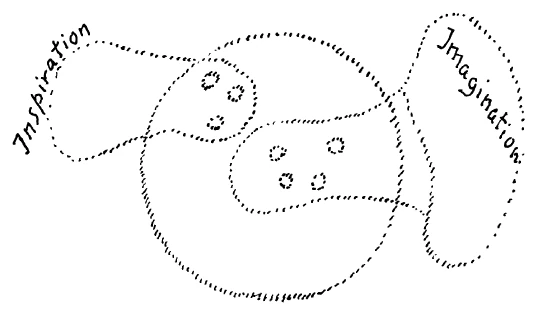
[ 11 ] Then, beyond the realm of the human senses, in the supersensible world, there is something that can only be perceived through inspiration—a world of inspiration. And this is reflected in breathing, warmth, and nutrition; just as if Saturn, Jupiter, and Mars were mirrored by spiritual counterparts from beyond the zodiac. And there is a deep kinship between what exists within the human being as lower nature and what exists out there in the universe. There are such counterparts to the physical life processes. In this way, we can distinguish between the human sensory realm and the realm of life.
[ 12 ] Let us now turn to what lies higher than life, to the realm of the soul proper, where we find the astral aspect of the human being and the “I”—the Self. There we emerge from the realm of the senses, and also from the realm of space and time; there we enter the spiritual realm. It is only because a certain connection exists between our “I” here on Earth and the twelve sensory spheres that the “I” lives within the consciousness supported by these sensory spheres. Beneath this consciousness, however, lies another kind of consciousness—an astral consciousness—which, as the human being is now, has a more intimate relationship with the human realm of life, with the sphere of life. The “I” has its intimate relationship with the sensory sphere; the astral consciousness has its intimate relationship with the realm of life. Just as we know about our zodiac through our “I,” or within our “I,” so do we know about our life processes through our astral consciousness, which is still subconscious in human beings today. Human beings cannot yet reveal this to themselves in their normal state; it still lies beyond the threshold. For this knowledge is, in physical life, an inner knowledge of life processes. Only in abnormal states does it sometimes happen that consciousness encompasses the realm of life, the sphere of life, so that this breaks through into ordinary consciousness. For people today, this is something pathological, and doctors and natural scientists stand in amazement before these pathological outbursts of human nature when the consciousness that lies below, which is still veiled today by the twelvefold consciousness, breaks through—when the planets can project their life into the zodiac by means of the subconscious, so to speak, breaking through. It must be developed—truly developed—as described in How Does One Attain Knowledge of the Higher Worlds?; then it is right. But if it surges upward without that, then it is indeed pathological.
[ 13 ] An interesting book has recently been published by a doctor who is now beginning to address such matters. The realm of spiritual science is still closed to him; he still thinks entirely in materialistic terms. But he is so open-minded in his research that he has turned his attention to these fields, especially in recent times. I am referring to the book The Mechanism of Thought by Carl Ludwig Schleich. In it, you will find very interesting accounts from medical practice. Let’s take the simplest account given there: A woman comes to see a doctor; she wants to consult him. He tells her to take a seat while she waits. At that very moment, a small fan—a device for letting air in—begins to move. “Oh, that’s a big fly,” she says, “it’s going to bite me.” Very soon after she says this, her eye begins to swell. After some time, a swelling forms on her eye that is as big as a chicken egg. The doctor reassures her that it’s not so bad and that the problem can be corrected soon.
[ 14 ] With the consciousness that is bound to the twelve sensory spheres in the human zodiac, a person cannot intervene so deeply in the sphere of life as to bring about a change in that sphere. When the subconscious surges up into ordinary daily consciousness, that is when human beings intervene in the sphere of life. Concepts and ideas, as we have them in ordinary consciousness, do not yet reach down to this depth of life processes in modern human beings. It merely surges up from time to time to a greater or lesser extent, sometimes even very strongly. But with what constitutes true, normal outer consciousness today, human beings—thank God—cannot yet intervene in their life processes; otherwise, they would do themselves a world of harm with many a thought. Human thoughts are not strong enough to intervene. But people are already harboring thoughts today that, if they were to interfere with the sphere of life—such as this thought of the lady’s, which welled up from the subconscious into the life processes—you would see people walking around with severely swollen faces, and suffering from many other, far worse conditions. So beneath the surface of the human being—which is bound to the zodiac—there is a subconscious that stands in a deeper connection with the life processes; this then has a far-reaching effect in abnormal states. Schleich, for example, recounts a very interesting case: A young girl goes to a doctor and says she has had sexual intercourse. According to the medical findings, this is ruled out, but she insists it is true. She does not want to reveal with whom she had intercourse. Over the next few months, she becomes visibly pregnant; all the symptoms appear, both the external, physically visible ones and the internal ones. During this time, when in later months one would normally hear the child’s heartbeat during an examination, the child’s heartbeat can be clearly distinguished alongside the pulse of the so-called expectant mother. Everything proceeds exactly as it should, except that no child is born in the ninth solar month! As the tenth month begins, it finally becomes clear that it must be something else. Surgery must be performed. There is nothing there—absolutely nothing; there was nothing at all! It was a hysterical pregnancy with all its associated physical symptoms. This is already being described by doctors today, and it is good that it is being described; for these things will force people to think differently about human relationships than they have done so far.
[ 15 ] Another case: A man comes to Schleich after pricking himself with a pen in his office earlier that day; he has cut himself slightly. Schleich examines the wound—it is not very serious. The man says, “Yes, but I know—I can already feel it in my arm. It’s blood poisoning; my arm has to be amputated, or else I’ll die of blood poisoning.” Schleich replies, “I can’t possibly amputate your arm when there’s nothing wrong with it. You certainly won’t die of blood poisoning.” Just to be on the safe side, he suctions the wound and discharges him. But the man was in such a state that Schleich, who is a very kind man, visited him again that evening. The patient is consumed by the thought that he must die. But even after the blood was later tested, there was not the slightest indication of blood poisoning. Schleich reassures him once more; but that night, the man in question dies. He really does die! Death, solely due to psychological causes! _
[ 16 ] Well, I can assure you that a person cannot die from the thoughts he forms under the influence of his zodiac sign—certainly not. These thoughts do not penetrate that deeply into the processes of life. And the other case I mentioned just a moment ago—I mean hysterical pregnancy—cannot arise from mere thoughts either, but one cannot die from the thought that something is blood poisoning either.
[ 17 ] With regard to this last case, in which an actual death apparently occurred as a result of delusion, contemporary science must, however, look to spiritual science for an explanation. And perhaps it is precisely this case that allows us to reflect a little on how things actually stand. We are dealing with a man who cuts himself with a pen he had been using to write, and “who apparently dies as a result of the delusion he derives from this.” But we are also dealing with something entirely different: The man who is dying here also has an etheric body, and death was already present within that etheric body before he cut himself. Death was living inside it. So at the very moment he entered his office that morning, death was already expressed in his etheric body—that is, the etheric body had taken on those inner processes that it assumes when one dies, only they had transferred very slowly into the physical body. And the blunder the man committed—he would not have committed it if death had not already been within him. Under the influence of this inner state, he ended up inflicting this stab wound on himself, which was completely meaningless. But as a result, the awareness “I am dying” forced its way out of his sphere of life and into his subconscious. The outward appearance was merely a facade, merely a sham. Because the sham was there, this thought surged up into his conscious awareness. Death has nothing—absolutely nothing—to do with the process of imagination present in ordinary daily consciousness; rather, it resides within him.
[ 18 ] These developments will gradually compel natural scientists to delve ever deeper into what spiritual science has to offer. We are already faced with a complex issue when we consider the relationship between the planetary sphere and the life process, and between the zodiacal sphere and the sensory realms. But the matter becomes even more complex when we ascend to the processes of consciousness—that is, when we enter those realms that have only a certain connection to these spheres: the “I” with the zodiac, the astral body with the human planetary sphere, with this mobile sphere of human life. But what is connected there to the human being’s mobile sphere of life, and what is connected from the “I” to the zodiac—we cannot approach this by imagining it as we do in the ordinary physical world, or as we do through the zodiac; rather, we can only approach it if we try to acquire a completely different capacity for imagination. In How Does One Attain Knowledge of the Higher Worlds?, it is advised to sometimes imagine things in reverse, to look back. Looking back means imagining the processes that take place in the world from one side to the other—that is, imagining them in reverse.
[ 19 ] Through this process of imagining things in reverse—among other things—one gradually enables the spiritual faculties to enter a world that is the opposite of the physical world. This is the spiritual world. It is the opposite of the physical world in many respects. I have already pointed out that one must not simply reverse what exists in the physical world in an abstract sense, but one must also, among the faculties one cultivates, develop those associated with this process of imagining in reverse. What follows from this? That people, if they do not wish to wither away completely in culture, if they wish to find their way into a spiritual view of the world, will be compelled to imagine an inverted world. For spiritual consciousness begins only where the process of life or the sensory process is truly reversed, where the process runs backward. People will therefore have to accustom themselves, as they look toward the future, to imagining things in reverse. Then, through this reverse imagination, they will be able to grasp the spiritual world, just as they now grasp the physical world through forward imagination. Our ability to imagine the physical world stems from the direction of our imagination.
[ 20 ] So, if I were to continue—I have just guided you through the human “zodiac,” the twelve spheres of the senses, and the sphere of the planet of life—I would have to direct you toward a completely different kind of imagination: one that looks backward.
[ 21 ] Now, as you know, people today are not particularly inclined to embrace spiritual science or to truly grasp it. They still reject it today because they are accustomed to materialistic thinking. For anyone who has crossed the threshold into the spiritual world even a little, the claim that the world only moves forward and never backward is just as foolish as if someone were to claim: “The sun always moves in one direction; it can’t possibly go backward!” — Yes, it does indeed go backward on the other side, by seemingly retracing this path (it is drawn).
[ 22 ] It is easy to imagine that such a person—truly frozen in the current way of thinking—might feel a genuine horror at the idea of imagining things in reverse, at imagining an upside-down world. But if this upside-down world did not exist, there would be no consciousness at all. But consciousness is, after all, already a spiritual science. The materialists deny this. Such a person of the present might therefore have a particular horror of imagining things in reverse, and one could imagine that he might one day raise the question: Is it really illogical to imagine the course of the world in reverse for once? — and that he might then come to the conclusion: It is not illogical at all. — It is truly not illogical to unravel a drama in reverse, from the fifth act backward, and it is just as little illogical to trace the course of the world in reverse. But for current ways of thinking, it is something dreadful. If a person who lives entirely within the present-day habits of thought were to raise such a question, he might, precisely from this question—for him it is a fact that one cannot imagine the world in reverse, that it is utterly unbelievable that the world could move backward—sense something extraordinary. One could thus imagine a solitary thinker who toiled away at the problem of imagining things in reverse, and who, based on the impossibility of such reverse imagination within today’s patterns of thought, drew particular philosophical conclusions.
[ 23 ] One can make yet another assumption. I have already pointed out to you that, particularly in the constellation where the sun sets, it becomes difficult for the sense of hearing to imagine things in reverse. The sense of hearing has, after all, undergone many changes over the course of time, especially with regard to music. Historians usually do not observe these more subtle changes, yet they are more important for people’s inner lives than the major changes recorded in history. For example, it is quite significant for the evolution of the sense of hearing—the spiritualized sense of hearing, already spiritualized in relation to the physical world—that during the Greco-Latin cultural period the octave was perceived as a particularly pleasant and harmonious combination of tones, and that in the eleventh, twelfth, and thirteenth centuries the fifth became especially popular. In those times, it was called the “sweet Ion.” The same feeling that people have today toward the third was still felt toward the fifth in the twelfth and thirteenth centuries. This is how constitutions change in a relatively short time.
[ 24 ] It could therefore be that someone with a particularly musical ear would take offense at the backward progression of these ideas—for music, after all, belongs to the very deepest realm we have here on the physical plane! — because a musical ear, precisely because it perceives deeply and with profound satisfaction in one direction on the physical plane, takes offense at this backward progression of ideas. Of course, this can only happen in an age when materialism is as prevalent as it is today. For someone who is not very musical, this conflict will not arise so easily. But a musical person who is thoroughly materialistic in their habits of thought may be led to say: “It is impossible to reconcile this with the human mind—the idea of imagining things in reverse.” — In this way, they resist the spiritual world. One might even assume that such a thinker could indeed exist somewhere.
[ 25 ] Curiously, a book has recently been published: Christian von Ehrenfels, Kosmogonie. The first chapter of this book is titled: “‘The Reversion,’ a Paradox of Our Knowledge.” Over many pages, Ehrenfels explores—just as a contemporary philosopher would—what it would be like to try to imagine the other side, so to speak, the asymmetrical side of the course of the world, and to think back to it. He actually does come to the point of thinking back—truly thinking back. There he attempts to grapple with this paradox and envisions specific cases of this backward thinking. I would like to cite one example of this backward thinking. He first assumes a course of events that moves forward rather than backward:
[ 26 ] “In the upright world, on a high mountain face, moisture and frost cause a chunk to break away from the compact rock mass, and as the thaw sets in, it loses its balance. It plunges down the overhanging face, strikes the rocky ground, and shatters into many pieces. We follow one of these pieces as it tumbles down the steeper slope, loses several more fragments upon colliding with stones, and finally comes to rest on a mound of earth. It has then expended all of its kinetic energy in the form of heat transferred to the earth and rock where it struck, and to the air that offered resistance to its motion. — How, then, would this—certainly not uncommon—process appear in a world turned upside down?”
[ 27 ] “A stone lies on a mound of earth. Suddenly, the seemingly chaotic heat waves from the ground below converge in such a strange way that they impart a powerful momentum to the stone, propelling it diagonally upward. The air offers it no resistance. On the contrary. As a result of peculiar heat transactions arising from its own composition, the air clears a path for it, automatically yielding to its diagonal upward motion, and even aids this movement through small but purposefully accumulating heat pulses. As it moves, the stone strikes a rocky outcrop. Yet it loses neither a fragment of its structure nor any part of its momentum. On the contrary. By chance, another small stone is also hurled toward the point of impact at the very same moment by the accumulated thermal pulses of the earth and the air, and—lo and behold!—this small stone is pressed so close to our stone—again by thermal pulses—and the—seemingly irregularly fractured — surfaces of these pieces fit together so meticulously that the forces of cohesion come into play, the small stone fuses with the larger one to form a compact mass, and the enlarged chunk—propelled by seemingly purposeful thermal shocks from the rock ledge against which it struck—can now continue its path diagonally upward at increased speed. »
[ 28 ] Just as the stone shattered into pieces earlier, so now the pieces come back together. The whole thing comes together again, settling back onto the rocky ledge. It balances out again, recedes once more, and so on. He describes this in great detail. In other words, he thinks through the process in reverse. He cites several more examples like this, in which he thinks the process through in reverse. You can see that he is struggling terribly; he is exerting himself tremendously.
[ 29 ] “On a sunny winter day, a hare runs through the snow, leaving a trail that is quickly blown away by the wind in many places; however, on some south-facing slopes, where the snow thaws under the sun’s rays and freezes again in the evening, the trail remains visible for weeks until it finally disappears completely with the onset of the general snowmelt. — In the “upside-down world,” the hare’s tracks would appear first, but not as a whole, rather in fragments, here and there, first as indistinct indentations in the frozen snow (or rather, the ice gradually loosening into snow), then, after weeks, as those indentations gradually deepen and their shape comes to resemble the imprint of a hare’s paws, in the spaces between them, as flakes are flung out of the loose snow by bursts of heat, — until finally the entire line of impressions is complete, and now the hare, with its head thrown back and its hindquarters leading, does not run along the line—but, against the pull of its muscles, is constantly propelled along by bursts of heat, so skillfully that one paw always lands within the already formed channel of the track. — As if that weren’t miraculous enough: — Whenever the paw steps out of this channel, the indentation is filled so accurately with loose snow by seemingly purposeful thermal pulses that it blends perfectly with the surroundings, and the snowfield immediately spreads out in flawless smoothness along the path the hare has traveled, as if it had never been otherwise.”
[ 30 ] You see, he’s trying hard. And now he tells himself: if he has to work this hard just to catch a single hare, how much harder, he thinks, would he have to work during an entire hunt.
[ 31 ] “It is easy to see: — these are essentially the same absurdities as in the examples from inorganic nature, only heightened to the grotesque and monstrous. — And this case is still a simple one involving tracks left by organic beings. Just consider, for example, the tracks left—not by a single hare, but by an entire winter hunt involving many hunters, beaters, dogs, many hares, and several roe deer, foxes, and deer—leaves behind in the snow—how these tracks crisscross and overlap, how one tramples over another’s tracks, leaving smoothed-out patches in places, and so on. Now let us reverse these processes—note how, through the seemingly similar causes of heat surges arising from chaos, different types of track lines form, and how every living being is now forced, pushed, and thrown precisely onto the line that corresponds to it—the roe deer onto this one, the stag onto that one, every hunter onto the trail corresponding to his footwear—always driven, pushed, and thrown by the strangely converging heat surges from the earth, from the air, and from within the organisms in question—and only then does one gain a faint notion of the scope of the concept of “track formation” in our “upright”—and not inverted—“world.”
[ 32 ] So he makes a great effort to gain the insights he needs. These insights bring certain things to the surface from the subconscious of modern human beings. You can see how natural it is for spiritual science to emerge, for as I have often shown using other examples, there is a natural urge in the human soul toward this. He struggles—one might even say, even if it is meant in a spiritual sense, he works up a sweat—to understand these retrograde processes at least to some extent. So here is such a thinker—for he is a thinker; that cannot be denied. Logically, it is entirely possible to imagine this, but he says it is implausible. For us, this means it contradicts his habitual way of thinking; in the final analysis, it means: He cannot conceive of the spiritual world at all. And now he concludes: “Yes, even more than that! — Let us imagine that a complex of realities akin to the ‘upside-down world’ is truly forced upon us as a fact by the inexorable compulsion of experience.”
[ 33 ] So, if the man were to put himself in the position of actually seeing his hare out there in the physical world, or his hunt—it could happen that, in the physical world, which is after all the only reality for him, he might see the opposite. Let’s suppose it were forced upon us that we actually stepped out into the physical world one day and found it to be a completely upside-down world:
[ 34 ] “How would we respond to it, how would we try to interpret it? — That — previously hinted at — conceptual project involving the form-absorbing principle of retroaction in the future, we would have to reject as absurd, even though the empirical evidence kept pushing us in that direction.”
[ 35 ] He says it would be terrible—we couldn’t imagine it, we shouldn’t be allowed to imagine it, and yet we would see it! That is what he imagines—the horror he would truly have to face if he were to enter the spiritual world. It would indeed be a terrible thing if it were forced upon him in the physical world, just as he imagines it!
[ 36 ] “We would have no other choice: — We would have to regard the seemingly spontaneous beginnings of form (here humans, there foxes, there roses, etc.) as merely seemingly spontaneous, but in fact brought about by teleological, purposefully precalculated collocations of material particles and their directions of motion, — and likewise the strange interplay of their convergence along gliding paths into ever fewer and simpler sequences of forms.”
[ 37 ] So he traces the whole thing back to the Darwinian uniform forms from the beginning of the Earth.
[ 38 ] “But what is the goal of this foresighted, anticipatory creative power? — Can the sudden emergence of form and its gradual transition into formlessness be the ultimate goal? — ‘No, and no again! — The goals of the whole must be of a contrary nature.”
[ 39 ] And now he asks himself: How would such a world appear to me if I could actually see it? And he answers his own question: “The world of experience is the grotesque joke of an incomprehensible world demon to whom everything about us is at the mercy—except for our knowledge.”
[ 40 ] He reserves those for himself, because, he says, he cannot enter there. These insights are his habitual ways of thinking; he cannot enter there—he reserves them for himself. But the world, which he would have to see upside down, would be the grotesque spectacle of a world demon, the devil; it would be the devilish world. He is afraid of what would have to appear to him as the devil. — There, for once, you have experienced in a soul what I have often said: it is fear of the spiritual world that holds one back. He says it outright: the moment he were to see a physical world similar to the spiritual world, he would regard it as the paradox of a diabolical being. That is why he fears it.
[ 41 ] “Beyond the limits of our world of experience, another, all-encompassing law of the universe must prevail!” — In other words: Even if the world were “upside down,” we would ultimately not be willing to interpret it according to upside-down principles.
[ 42 ] So what would the good Ehrenfels do if he were truly transported into such a world that would deign to be physical for him? He would say: No, I don’t believe in that; I want to imagine it from the other side; I won’t accept it. And that is exactly what people do with the spiritual world; they really do not want to accept it if they see things differently than they do in the present.
[ 43 ] “We would regard it (this world) as an exception, as an enclave, as a countercurrent within the grand sweep of world events, and to these overarching world events we would, after all, once again ascribe those distinctive characteristics that seem credible to us in and of themselves.”
[ 44 ] So one would stand up and say: No, this world—though a demon may be deceiving us with it—we do not believe in it; we imagine it to be the other way around; we imagine it the way we are accustomed to.
[ 45 ] Here you see the full extent of a philosopher’s resistance to what must come. It is good to grasp the course of human development in such respects. It is indeed true, my dear friends, that what must come to pass according to spiritual science does come to pass. And although it has often been shown here, through a wide variety of signs, that people even today still resist the Spirit in their conscious minds, they are beginning to turn toward it subconsciously. They are merely deluding themselves; they still deny it. It will not be long before they can no longer deny this spirit, for even now people’s thoughts are being directed toward it almost against their will, as can be seen in a case such as Christian von Ehrenfels’s “Cosmogony.”
[ 46 ] I also wanted to review this book here because, as a newly published work, it will certainly be the subject of much discussion in the near future. Even though it is written in philosophical language that is difficult to read, it will be discussed extensively—and likely in a very grotesque manner everywhere—because people will not grasp the connections. To ensure that what needs to be said about this book is said properly, I wanted to draw attention in this context specifically to Christian von Ehrenfels’s Kosmogonie. We are dealing with a philosopher who is a university professor and who has been teaching philosophy at the University of Prague for many years. This book was published in 1915. In the preface to this book, he discusses his intellectual development—which earlier philosophers he owes this or that to, and with whom he agrees to a greater or lesser extent as a philosopher. At the end of this preface, after noting that he owes this or that to Franz Brentano, Meinong, and other earlier philosophers, he says the following:
[ 47 ] “The bulk of my debt of gratitude, however, must be directed toward a field that, according to the general understanding of philosophy, lies far removed from it. — In my life, I have devoted a far greater amount of mental energy to the internal assimilation of German music than to the study of philosophical literature.” — He makes this confession as a professor of philosophy! — “And I do not regret this, now that I am in the second half of the sixth decade of my life”—meaning he is well over fifty years old—“but rather see it as one of the sources of my productivity”—and he is productive only in philosophy! — “For even if Schopenhauer’s interpretation of music as a special objectification of the world will in this form be subject to rejection, it nevertheless, as it seems to me, strikes at the heart of the matter in its intention. The truly productive musician, in his revelations, is closer to the world spirit than other mortals. — Whoever among these ‘others’ presumes to understand the metaphysical language of music feels it is their most solemn duty to translate the meaning they have perceived into the conceptual means of communication familiar to the rest of the world.
[ 48 ] If one understands religion to be a spiritual possession that grants its owner trust in the world, moral strength, and inner stability, then German music has been my religion throughout a generation of agnosticism, a time devoid of metaphysics and faith—from the day I finally broke away inwardly from Catholic dogma (in 1880), until those weeks (in the spring of 1911) when the outlines of the metaphysical doctrine presented here became clear to me.”
[ 49 ] And this metaphysical doctrine stems from the paradox of reversion, from the impossibility of reversing concepts.
[ 50 ] “Yes, German music is still a religion to me today in the sense that, even if all the arguments in this work were refuted, I would not fall into despair—but would remain convinced, with the trust in the world from which this work sprang, that I have been on the essentially correct path—convinced—because German music exists. For a world that has produced such things must, in its innermost essence, be good and trustworthy. i
[ 51 ] The music of the Mass in B minor, the music for Der steinerne Gast, the Third, Fifth, Seventh, and Ninth Symphonies, the music of Tristan, Der Ring, and Parsifal—this music cannot be refuted, for it is reality—life springing forth. — Thanks to their creators! — Hail to all who are called to quench their thirst for the eternal from this miraculous spring! — The best I have ever been allowed to create—and which I consider the best—is but a meager reward for the abundance I have received “from there”—from music.—
[ 52 ] And I am convinced, my dear friends, that this particular way of engaging with the spiritual world—as a philosopher does—can only be found in a mind that relates to music in this materialistic age in the same way that Ehrenfels relates to music. For what takes place in the human soul—even if it seems to pertain to the most diverse realms—is connected by a deep inner bond. Here I would like to give you an example of how differently a believer—not merely a listener, but a believer in the modern musical element—must allow his soul to be shaped by this element, as opposed to someone who, lacking such faith, approaches the musical element from a materialistic mindset. Only by examining the mysterious interconnections within the human soul—which bring so much harmony and disharmony into this inner life—can one gradually approach the mystery of life and humanity.