

The Riddle of Man
The Spiritual Background of Human History
GA 170
12 August 1916, Dornach
Translated by Steiner Online Library
Seventh Lecture
[ 1 ] When one speaks, as Goethe does, for example, in Faust, of the great and the small world—of the macrocosm and the microcosm—one is referring to the entire universe and to humankind: the entire universe as the great world and humankind as the small world. The relationships between the cosmos and humankind are, as we have already seen in many instances, very diverse and very complex. Today I would like to recall a few things we have already discussed over the years and link these recollections to a reflection on the relationship between human beings and the universe. You will recall that when we speak of our senses—of what it means for a human being to possess these senses—we say: These senses received their initial impetus, their first seeds, during the ancient Saturnic period. You will find this explained in detail in lecture cycles and mentioned time and again. Now, of course, one must not imagine that the senses, as they first emerged—in their initial form—during the Saturn era, were already as they are today. That would, of course, be sheer folly. It is, in fact, extraordinarily difficult to imagine the form of the senses that existed at the time of the ancient Saturn evolution. For it is already difficult to imagine what the human senses were like during the ancient Lunar period. At that time, they were still quite different from what they are today. And I would now like to shed some light on what these senses—which, during the ancient Lunar period, had already, so to speak, passed through their third stage of development—Saturn, Sun, Moon—were like during the ancient Lunar period.
[ 2 ] The form that the human senses take today is much more lifeless compared to the way they existed during the era of the ancient lunar evolution. Back then, the senses were much more vibrant, much more life-filled organs. However, they were not suited to form the foundation for the fully conscious life of the human being; they were suited only for the ancient, dreamlike clairvoyance of the lunar human, which this lunar human practiced to the exclusion of all freedom, all free impulses of action or desire. Freedom could only develop as an impulse within the human being during Earth evolution. Thus, the senses were not yet the foundation for the kind of consciousness we have during the Earth era; they were the foundation only for a consciousness that was more dull and also more imaginative than today’s Earth consciousness, and which, as we have often explained, resembled today’s dream consciousness. Human beings, as they are today, are said to possess five senses. We know, however, that this is incorrect, for in truth we must distinguish twelve human senses. All the other seven senses—which must be mentioned in addition to the five ordinary senses—are just as legitimate senses here for the Earth period as are the five senses that are always listed. You know, the list includes: the sense of sight, the sense of hearing, the sense of taste, the sense of smell, and the sense of touch. — The latter is often called the sense of touch, although even when it comes to touch, people do not really distinguish—as some in more recent times now seek to do—between the actual sense of touch and the sense of warmth. In earlier times, the sense of touch and the sense of warmth were still completely conflated. These two senses are, of course, entirely distinct from one another. Through the sense of touch, we perceive whether something is hard or soft; the sense of warmth is something entirely different. But if one truly has a sense—if I may use the word that way—for the relationship between human beings and the rest of the world, then one must distinguish between twelve senses. Let us list these twelve senses once again today.
[ 3 ] The sense of touch is, in a sense, the sense through which human beings enter into a relationship with the most material aspect of the external world. Through the sense of touch, human beings, so to speak, come into contact with the external world; through the sense of touch, human beings constantly interact with the external world in the most rudimentary way. Nevertheless, the process that takes place during touch occurs within the human skin. A person comes into contact with an object through their skin. What happens—that is, the perception of the object they are touching—naturally takes place within the skin, within the body. Thus, the process of touch occurs within the human being.
[ 4 ] Even more central to the human organism than the sense of touch is what we might call the sense of life. It is a sense within the organism that people today are hardly accustomed to thinking about, because this sense of life, I would say, operates in a subtle way within the organism. If something in the organism is disturbed, then one senses the disturbance. But that harmonious interplay of all the organs—which is expressed in the sense of life present in everyday life and always during the waking state, in this state of being—is usually overlooked, because people take it for granted as their right. It is this: knowing oneself to be imbued with a certain sense of well-being, with the sense of life. When this sense of life is subdued, one seeks to recover a little so that it becomes fresher again. One senses this refreshment and this subduing of the sense of life, but generally one is too accustomed to it to be constantly aware of it. But there is a distinct sense—the sense of life—through which we feel the living within us just as we see with our eyes whatever is around us. We perceive with the sense of life just as we see with our eyes. We would know nothing of the course of our lives if we did not have this inner sense of life.
[ 5 ] Even more internal—physically internal, bodily internal—than the sense of life is what one might call the sense of movement. The sense of life perceives, so to speak, the overall state of the organism as a feeling of well-being or, conversely, as a feeling of discomfort. But to have a sense of movement means that the parts of our organism move in relation to one another, and we can perceive this. Here I do not mean when the whole person moves—that is something else—but when you bend an arm, bend a leg; when you speak, the larynx moves; all of this—this perception of internal movements, of changes in the position of the individual parts of the organism—is perceived through the sense of movement.
[ 6 ] Furthermore, we must be aware of what we might call our sense of balance. We don’t really pay attention to it either. When we experience what is commonly called dizziness and fall over or faint, our sense of balance is disrupted—just as our sense of sight is disrupted when we close our eyes. Just as we perceive changes in our internal position, we perceive our balance when we simply orient ourselves in relation to up and down, left and right, and position ourselves in the world in such a way that we feel at home within it—that we feel we are now standing upright. So this sense of balance is perceived by us through the sense of balance. It is a true sense.
[ 7 ] These senses function in such a way that everything that happens actually remains within the organism. When you touch something, you do come into contact with the external object, but you do not enter into it. If you touch a needle, you say the needle is sharp; of course, you do not enter into the tip if you are merely touching it—otherwise you would prick yourself—but that is no longer touching. But all of this can only take place within your own organism. You may touch the object, but what you experience as a person who feels takes place within the boundaries of your skin. So what you experience through the sense of touch is physical and internal. Likewise, what you experience through the sense of life is physical and internal. You do not experience how things unfold here or there, outside of yourself, but rather what is within you. The same applies to the sense of movement: it does not refer to the movement of being able to walk back and forth, but rather to those movements that occur when I move my limbs or when I speak—that is, the inner movements—which are what the sense of movement refers to. When I move outside of myself, I am also moving internally. You must distinguish between these two things: my forward movement and the position of my limbs—the inner aspect. The sense of movement, then, is perceived internally, just like the sense of life and the sense of balance. You do not perceive anything externally here, but rather you perceive yourself in a state of balance.
[ 8 ] Now, first of all, step outside yourself through your sense of smell. That already brings you into a relationship with the outside world. But you will have the feeling that, through your sense of smell, you are still not reaching very far outward. You experience very little of the outside world through your sense of smell. People don’t even want to know what they could experience of the outside world through a more intimate sense of smell. Dogs, on the other hand, are more curious about it. The fact is that people initially only want to perceive the outside world through their sense of smell, but they have little contact with it. It is not a sense through which people wish to engage deeply with the outside world.
[ 9 ] Through the sense of taste, a person engages more deeply with the outside world. By tasting sugar or salt, one experiences their inherent properties in a very intimate way. The external becomes very internal—more so than with the sense of smell. Thus, there is a deeper relationship between the external and internal worlds.
[ 10 ] This is even more true of the sense of sight. You take in far more of the qualities of the external world through your sense of sight than through your sense of taste. And you take in even more through the sense of warmth. What you perceive through the sense of sight remains even more foreign to you than what you perceive through the sense of warmth. Through the sense of warmth, you actually enter into a very intimate relationship with the external world. Whether you perceive an object as warm or cold, you experience this intensely, and you experience it together with the object itself. The sweetness of sugar, for example, is experienced less in conjunction with the object itself. After all, with sugar, what matters to you is what it becomes through your sense of taste, rather than what is out there. With the sense of warmth, you can no longer make that distinction. There, you already experience the inner essence of what you perceive very intensely.
[ 11 ] Through the sense of hearing, you connect even more intimately with the inner nature of the external world. Sound reveals a great deal about the inner structure of the external world—much more than heat, and far more than the sense of sight. The sense of sight, so to speak, gives us only images of the surface. The sense of hearing reveals to us, when the metal begins to ring, what it is like inside. The sense of warmth also penetrates into the interior. When I touch something—for example, a piece of ice—I am convinced that it is not merely cold on the surface, but cold all the way through. When I look at something, I see only the color of the boundary, the surface; but when I cause something to sound, I perceive, so to speak, the inner nature of the sounding object in an intimate way.
[ 12 ] And we perceive even more intimately when the sound contains meaning. In other words, the meaning of sound: perhaps we should say, the meaning of language, the meaning of words. It is simply nonsensical to believe that the perception of a word is the same as the perception of a sound. They are as different from one another as taste and sight. Through sound, we do indeed perceive the inner essence of the external world, but this inner essence must be internalized even further if the sound is to become a meaningful word. Thus, we immerse ourselves even more intimately in the external world when we do not merely perceive sound through the sense of hearing, but when we perceive meaning through the sense of language. But then again, when I perceive the word, I do not immerse myself as intimately in the object, in the external being, as when I perceive the thought through the word. Most people no longer distinguish between these two. Yet there is a difference between perceiving the mere word—the meaningful sound—and the actual perception of the thought behind the word. After all, you also perceive the word when it is separated from the thinker by the phonograph, or even through the written word. But to place myself, in a living connection with the being that forms the word, directly into that being—into the thinking, imagining being—through the word itself requires a deeper sense than the ordinary literal meaning; it requires what I would like to call the “sense of thought.” And a sense that enables us to feel so closely connected to another being—to know ourselves as one with it, to perceive it as ourselves—gives us an even more intimate relationship to the external world than the sense of thought. This is when, through thinking—through the living thought that the being directs toward us—we perceive the “I” of that being: the sense of the “I.”
[ 13 ] You see, one really must distinguish between the sense of self that perceives the other’s self and the perception of one’s own self. This is not only different because in one case one perceives one’s own self and in the other the other’s self, but it is also different in terms of its origin. The seed, the capacity that enables everyone to perceive what another can know, was already implanted in us on ancient Saturn along with our sensory faculties. So the fact that you can perceive another as an “I” was already implanted in you along with your sensory faculties on ancient Saturn. However, you did not acquire your “I” until the course of Earth’s evolution; this “I” that animates you from within is not the same as the sense of the “I.” The two must be strictly distinguished from one another. When we speak of the sense of the “I,” we are referring to the human capacity to perceive another “I.” You know that I have always spoken with full recognition of the truth and greatness of materialistic science. I have given lectures here to fully acknowledge this materialistic science; but one must then truly immerse oneself so lovingly in this materialistic science that one also lovingly addresses its darker sides. How this materialistic science conceives of the senses is only now beginning to take on a certain order. Only today are physiologists beginning to distinguish, at the very least, between the sense of life, the sense of movement, and the sense of balance, and to separate the sense of warmth from the sense of touch. The other aspects mentioned here are not distinguished by external materialistic science. So, what you call the experience of your own “I,” I ask you most earnestly to distinguish from the ability to perceive another “I.” With regard to this perception of another “I” through the sense of self—and I say this out of a deep love for materialistic science, because this deep love for materialistic science enables one to truly see through the matter—materialistic science today is downright riddled with nonsense. It becomes nonsensical when it speaks of the way a person behaves when they set the sense of self in motion, for this materialistic science would have you believe that when a person encounters another person, they unconsciously infer the “I” from the other person’s gestures, facial expressions, and all sorts of other things—that it is an unconscious inference about the other person’s “I.” That is utter nonsense! Truly, just as directly as we perceive a color, we perceive the other person’s “I” when we encounter them. To believe that we infer the “I” only from physical perception is actually completely obtuse, because it dulls our awareness of the true fact that there is a deeper sense within human beings for perceiving the other “I.” Just as light, darkness, and colors are perceived through the eye, so too are other “I’s” perceived directly through the sense of the “I.” It is a sensory relationship with the other “I.” This must be experienced. And just as color affects me through the eye, so does the other “I” affect me through the sense of the “I.” When the time comes, we will also speak of the sensory organ for the sense of self in the same way that one can speak of the sensory organs for the sense of sight. It is simply easier to point to a material manifestation for the sense of sight than for the sense of self. But all of this exists.
[ 14 ] If you, so to speak, reflect on these senses, you can say: It is through these senses that your organism becomes specified or differentiated. It truly differentiates itself, for seeing is not the perception of sounds; the perception of sounds is not hearing; hearing, in turn, is not the perception of thought; and the perception of thought is not touching. These are distinct realms of the human being. We have twelve distinct realms of the human organism within these sensory realms. I ask you to pay particular attention to the distinction that each one is a separate realm in its own right; for because of this distinction, one can draw this entire set of twelve within a circle, and one can distinguish twelve separate realms within this circle. (See drawing)
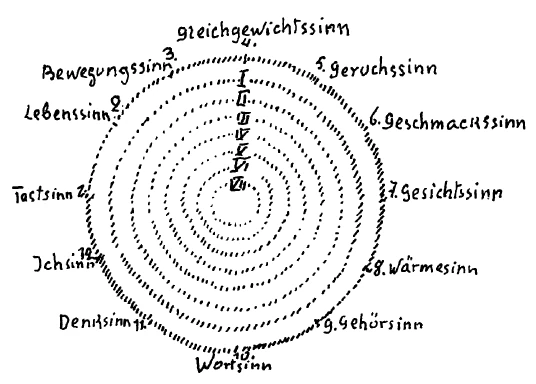
[ 15 ] This is different from the situation with the faculties that, in a sense, lie deeper within the human being than these sensory faculties. The sense of sight is bound to the eye; it is a specific region within the human organism. The sense of hearing is bound to the auditory system, at least for the most part; yet it does not rely on it alone; much more of the organism is involved, and hearing takes place in a much broader region than just the ear; but the ear is the most typical region of hearing. All these sensory regions are equally permeated by life. The eye lives, the ear lives, that which underlies the whole lives; that which underlies the sense of touch lives—everything lives. Life dwells in all the senses; it flows through all the sensory regions.
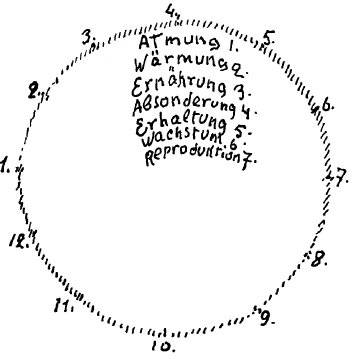
[ 16 ] If we continue to examine this life, it turns out to be differentiated once again. There is not just one life force. You must make a distinction: the meaning of life, through which we perceive life, is something different from what I am discussing now. I am now discussing life itself, as it flows through us; which in turn differentiates within us, specifically in the following way (see diagram). We must imagine the twelve sensory regions, as it were, at rest within the organism. Life, however, pulsates through the entire organism, and life itself is further differentiated. First, we have something that must be present in all living beings in a certain way: respiration. That relationship to the outside world, which is respiration, must, so to speak, be present in every living being. I cannot go into detail now about how it is differentiated in animals, plants, and humans; but in every living being, respiration is present in a certain way. Human respiration is constantly renewed by something the person takes in from the external world; this benefits all the senses. The sense of smell, the sense of sight, and the sense of hearing cannot function unless what life derives from respiration benefits all the senses. So I would have to add “breathing” to every sense. Isn’t that right? We do breathe; but what is accomplished through breathing as a life process benefits all the senses.
[ 17 ] Second, we can distinguish warmth. It occurs alongside breathing; but it is something different from breathing. Warmth—internal warmth—is a second way of sustaining life. A third way to sustain life is nutrition. So we have these three ways of engaging with life from the outside through vital processes: breathing, warmth, and nutrition. The external world is part of all of this. Breathing requires a substance—air for humans, and air for animals as well. Warmth requires a very specific ambient temperature with which we interact. Just imagine for a moment how it would be impossible for you to live internally with the proper warmth if the temperature in “your environment” were higher or lower! Imagine it a hundred degrees lower: your body heat would no longer be possible; your body heat would cease. Or a hundred degrees higher: you would do more than just sweat! Likewise, nutrition is necessary insofar as we regard the life process as an earthly process.
[ 18 ] Now we are moving deeper into the inner processes of life. Here we have the next process, which already belongs more to the inner realm—what one might call the reshaping, the internalization of what has been taken in from the outside, the transformation, the metamorphosis of what has been taken in from the outside. In keeping with the way we have referred to this in the past, I would like to describe this transformation once again using the same terms. There are no scientific terms for this yet; they must first be coined, because these distinctions have not yet been made. This inner transformation of what is taken in from the outside—which is thus subject to purely internal processes—can be conceptualized in four distinct ways. The first thing that occurs internally after eating is internal secretion. It is already a form of secretion when the ingested food is simply communicated to the body, when it becomes a part of the organism. It is not only secretion outward, but the communication within the body of what is taken in through the food substance. Secretion consists partly of discharge outward and partly of the absorption of food. This is a secretion carried out by the organs that serve the purpose of digestion: secretion into the organism. What is thus secreted into the organism must be sustained within the life process; this, in turn, is a distinct life process in itself, which we must refer to as maintenance. However, for life to persist, it must not only preserve what it takes in, but it must also increase it. Every living being undergoes an internal multiplication: a growth process in the broadest sense; the growth process is part of life, preservation, and growth.
[ 19 ] And then, part of life here on earth is the production of the whole; the process of growth merely requires that one part produce another. Reproduction is a process that is higher than mere growth, one that produces the same individual.
[ 20 ] Apart from these seven processes, there are no other internal life processes; life is divided into seven processes. But we cannot call these “districts”; rather, these seven benefit all twelve districts—these seven life processes animate everything. Therefore, when we consider the relationship of these seven to the twelve, we must say: We have 1. respiration, 2. warmth, 3. nutrition, 4. excretion, 5. maintenance, 6. growth, 7. reproduction—but in such a way that they are related to all the senses, that they flow through all the senses, so to speak, and that this constitutes movement. (See Figure 5.115.) We must, so to speak, depict the human being—insofar as he is a living human being—as having twelve distinct sensory regions, through which the sevenfold life pulses—the sevenfold life that is in motion within itself. — If you assign the signs of the zodiac to the twelve regions, you have the macrocosm; if you assign the sensory regions to them, you have the microcosm. If you assign the signs of the planets to the seven life processes, you have the macrocosm; if you assign the names of the seven life processes, you have the microcosm. And just as in the macrocosm the planets, in their movements, relate to the constellations through which they pass, so the living life process always passes through the dormant sensory spheres, flowing through them. You see, in many respects, the human being is a microcosm.
[ 21 ] If someone were to come along who is thoroughly versed in contemporary physiology and also, as it is understood today, in experimental psychology, he would say: This is just a cute little gimmick; after all, one can find connections between everything. And if one arranges it in such a way that one assumes there are twelve sensory regions, one ends up with the twelve signs of the zodiac; if one divides the life process into seven parts, one ends up with the seven planets. — In short, one might believe that this has been arranged through some kind of fantasy. But that is not the case; it truly is not. Rather, what exists in human beings today has slowly developed and taken shape. The senses were not as they are in human beings today during the ancient Lunar Age. I said they were much, much more alive. They were the foundation for the ancient, dreamlike clairvoyance of the Lunar Age. Today the senses are more dead than they were during the ancient Lunar Age; they are more separated from the unified, sevenfold—and in its sevenfoldness, unified—life process. During the ancient Lunar Age, the sensory processes were themselves even more like life processes. When we see or hear today, it is already a rather dead process, a very peripheral process. Perception during the ancient Lunar Age was not nearly as dead as that. Let us single out one sense, for example, the sense of taste. You all know, I think, what it is like on Earth. During the Lunar Age, it was something different. Back then, tasting was a process in which human beings did not separate themselves from the outside world as much as they do now. Now the sugar is out there; a person must first lick it and carry out an inner process. A very precise distinction must be made between the subjective and the objective. That was not the case during the Lunar Age. Back then, it was a much more living process, and the subjective and objective were not so sharply distinguished. The process of tasting was even more of a life process—similar, if you will, to the process of breathing. As we breathe, something real takes place within us. We inhale the air, but as we inhale the air, something takes place within us involving our entire blood formation; for all of this is part of breathing, insofar as breathing is one of the seven life processes—there, one cannot make such a distinction. So the external and internal belong together: air outside, air inside, and as the breathing process takes place, a real process takes place. That is much more real than when we taste. There, of course, we have a foundation for our present-day consciousness; but tasting on the Moon was much more of a dream-like process, just as the breathing process is for us today. We are not as conscious of the breathing process as we are of the tasting process today. But the tasting process on the Moon was what the breathing process is for us today. On the Moon, human beings did not experience more from tasting than we do today from breathing, nor did they want anything else. Humans were not yet gourmets and could not be, for they could only carry out the process of tasting to the extent that tasting brought about something within them that was connected to their survival, to their existence as lunar beings.
[ 22 ] And so it was, for example, with the process of seeing, with the process of perception during the Lunar Period. It was not the case that one looked at an object externally or perceived color externally; rather, the eye lived within the color, and life was sustained by the colors that entered through the eye. The eye was a kind of organ for breathing color. One’s state of being was connected to the relationship one entered into with the outside world through the eye in the eye’s process of perception. One expanded during the lunar phase, becoming broad when entering the blue; one contracted when venturing into the red: apart—together, apart—together. This was connected to the perception of colors. And so all the senses had an even more vivid relationship to the outer world and the inner world than the life processes do today.
[ 23 ] The sense of the “I”—what was it like on the Moon? The “I” did not enter human beings until they were on Earth; therefore, it could not have had any “sense” on the Moon at all; one could not perceive an “I,” and the sense of the “I” could not have existed there yet. — Thinking, too, as we perceive it today—as I described earlier—that is, living thinking—is connected to our earthly consciousness. The sense of thinking, as it exists today, did not yet exist on the Moon. Nor were there any speaking human beings. In the sense that we perceive another person’s speech today, this did not yet exist on the Moon, so the sense of the word did not exist either. The word first lived as Logos, resounding throughout the entire world, and also passed through the human beings of that time. It meant something to human beings, but they did not yet perceive it as a word spoken by another being. The sense of hearing was, however, already present, but much more alive than we have it now. Now, in a sense, it has come to a standstill on Earth as the sense of hearing. We remain completely still—at least as a rule—when we hear. Unless a sound causes the eardrum to burst, hearing does not bring about any substantial change in our organism. We, within our organism, remain still; we perceive the sound, the ringing. It was not like that during the Lunar Age. Back then, the sound came toward us. It was heard; but every act of hearing was connected with an inner trembling, with a vibration within—one brought the sound to life within oneself. What is called the “World Word,” one also brought to life within oneself; but one did not perceive it. One cannot, therefore, speak of a sense, but the Lunar human being brought this sound—which today underlies the sense of hearing—to life within oneself. If what we hear today as music had resounded on the Moon, not only would external dance have been possible, but also inner dance; then all the internal organs, with few exceptions, would have behaved in the same way that my larynx and its associated structures move internally today when I send the sound through them. The whole human being was vibrating internally, harmoniously or disharmoniously, and perceiving this vibration through the sound. So it was truly a process that one perceived, but in which one actively participated—a process of life.
[ 24 ] Similarly, the sense of warmth was a life process. Today, we are relatively unresponsive to our surroundings: things simply seem warm or cold to us. Although we experience this only faintly, on the Moon it was experienced in such a way that one’s entire state of being would change whenever the temperature rose or fell. It was, in other words, a much more intense experience; just as one vibrated with the sound, so one warmed and cooled internally and felt this warming and cooling.
[ 25 ] Sense of sight: I have already described what it was like on the Moon. We lived with colors. Certain colors caused one to expand one’s form, others to contract it. Today we perceive such things, at most, symbolically. We no longer shrink in the presence of red nor swell up in the presence of blue; but on the Moon, we did. I have already described the sense of taste. On the Moon, the sense of smell was intimately connected with the life processes. The sense of balance existed on the Moon; one certainly needed it. The sense of movement was even much more vivid. Today we vibrate only slightly, move our limbs—everything has more or less come to rest, become lifeless. But just imagine what this sense of movement had to perceive when all these movements took place, such as the tremor caused by sound. The sound was perceived, and we trembled along with it; but this inner tremor had to be perceived first through the sense of movement when a person evoked it themselves, and they imitated what the sense of hearing had awakened within them.
[ 26 ] The Meaning of Life: Well, from what I have described, you can see that the meaning of life, in the same sense as it exists on Earth, could not have existed on the Moon. Life must have been experienced in a much more universal way. People generally lived much more on the inside. Inner life was not so clearly demarcated by the skin. One swam within life itself. Since all organs—all the sensory organs we have today—were organs of life back then, there was no need for a specific “sense of life”; rather, all were organs of life, and they lived and, in a sense, perceived themselves. There was no need for a “sense of life” on the Moon. The sense of touch only arose with the mineral kingdom, but the mineral kingdom is a result of Earth’s evolution. In the same sense that we developed the sense of touch on Earth through the mineral kingdom, it did not exist on the Moon; it had just as little meaning there as the sense of life.
[ 27 ] Let us count how many senses we have left, which have now been transformed into organs of life: seven. Life is always divided into seven parts. The five that are added on Earth—making twelve, since they become tranquil spheres, like the zodiacal spheres—are absent on the Moon. Only seven remain on the Moon, where the senses are still in motion, where they themselves are still alive. Thus, on the Moon, life—into which the senses are still immersed—is divided into seven parts.
[ 28 ] This is only a small, elementary part of what must be said to show that there is no arbitrariness at the root of this, but rather a living observation of the supersensible world of facts, which, during earthly existence, does not initially come to people’s senses. The further one delves and the more one truly engages with the contemplation of the world’s mysteries, the more one sees that this ratio of twelve to seven is not merely a trifling matter, but rather that it truly permeates all of existence, and how the fact that it must be expressed externally through the ratio of the stationary constellations to the moving planets is also a result of a part of the great mystery of numbers in the existence of the world. And the ratio of the number twelve to the number seven expresses a profound mystery of existence; it expresses the mystery in which the human being, as a sensory being, stands in relation to living beings—and to oneself as a living being. The number twelve contains the mystery that we are able to take on an “I.” Because our senses have become twelve—twelve stationary spheres—they form the foundation of Earth’s “I”-consciousness. Since these senses were still life organs during the Lunar Age, human beings could possess only the astral body; at that time, these seven sense organs, which still formed life organs, were the foundation of the astral body. The number seven thus mysteriously underlies the astral body, just as the number twelve mysteriously underlies the nature of the “I,” the human “I.”