

The Riddle of Man
The Spiritual Background of Human History
GA 170
12 August 1916, Dornach
Translate the original German text into any language:
Versions Available:
The Riddle of Man, tr. SOL
Siebenter Vortrag
Seventh Lecture
[ 1 ] Wenn man, wie zum Beispiel auch Goethe im «Faust», von der großen und kleinen Welt spricht, vom Makrokosmos und Mikrokosmos, dann meint man ja das ganze Universum und den Menschen: das ganze Universum als die große Welt und den Menschen als die kleine Welt. Die Beziehungen zwischen dem Kosmos und dem Menschen sind ja, wie wir jetzt schon aus vielem gesehen haben, sehr mannigfaltig, sehr kompliziert. Ich möchte heute an einiges erinnern, das wir im Laufe der Zeiten schon besprochen haben, und dies Erinnerte anknüpfen an eine Betrachtung über das Verhältnis des Menschen zum Universum. Sie erinnern sich, daß, wenn wir von unseren Sinnen sprechen, von dem, was der Mensch als Besitzer seiner Sinne ist, wir sagen: Diese Sinne haben ihren ersten Anstoß, ihre ersten Keime während der alten Saturnentwickelung erhalten. Das finden Sie ja auch in Zyklen ausgeführt und immer wieder angegeben. Nun, selbstverständlich darf man sich nicht vorstellen, daß die Sinne, wie sie im ersten Anlauf, im ersten Keim während der Saturnzeit aufgetreten sind, schon so waren, wie sie heute sind. Das wäre natürlich eine Torheit. Es ist sogar außerordentlich schwierig, sich die Gestalt der Sinne vorzustellen, die zur Zeit der alten Saturnentwickelung vorhanden war. Denn es ist schon schwierig, sich vorzustellen, wie die Sinne des Menschen waren während der alten Mondenentwickelung. Da waren sie noch ganz anders als heute. Und darauf möchte ich jetzt einiges Licht werfen, wie diese Sinne, die ja während der alten Mondenentwickelung schon sozusagen ihr drittes Entwickelungsstadium durchmachten — Saturn, Sonne, Mond —, zur Zeit der alten Mondenentwickelung waren.
[ 1 ] When one speaks, as Goethe does, for example, in Faust, of the great and the small world—of the macrocosm and the microcosm—one is referring to the entire universe and to humankind: the entire universe as the great world and humankind as the small world. The relationships between the cosmos and humankind are, as we have already seen in many instances, very diverse and very complex. Today I would like to recall a few things we have already discussed over the years and link these recollections to a reflection on the relationship between human beings and the universe. You will recall that when we speak of our senses—of what it means for a human being to possess these senses—we say: These senses received their initial impetus, their first seeds, during the ancient Saturnic period. You will find this explained in detail in lecture cycles and mentioned time and again. Now, of course, one must not imagine that the senses, as they first emerged—in their initial form—during the Saturn era, were already as they are today. That would, of course, be sheer folly. It is, in fact, extraordinarily difficult to imagine the form of the senses that existed at the time of the ancient Saturn evolution. For it is already difficult to imagine what the human senses were like during the ancient Lunar period. At that time, they were still quite different from what they are today. And I would now like to shed some light on what these senses—which, during the ancient Lunar period, had already, so to speak, passed through their third stage of development—Saturn, Sun, Moon—were like during the ancient Lunar period.
[ 2 ] Die Gestalt, die die menschlichen Sinne heute haben, ist gegenüber der Art, wie sie zur Zeit der alten Mondenentwickelung vorhanden waren, eine viel totere. Die Sinne waren damals viel lebendigere, viel lebensvollere Organe. Dafür aber waren sie nicht geeignet, Grundlagen zu bilden für das vollbewußte Leben des Menschen; sie waren nur geeignet für das alte traumhafte Hellsehen des Mondenmenschen, das dieser Mondenmensch vollzogen hat mit Ausschluß jeder Freiheit, jedes freien Handlungs- oder Begehrungsimpulses. Die Freiheit konnte sich erst während der Erdenentwickelung im Menschen als ein Impuls entwickeln. Also die Sinne waren noch nicht Grundlage für ein solches Bewußtsein, wie wir es während der Erdenzeit haben; sie waren Grundlage nur für ein Bewußtsein, das dumpfer, auch imaginativer war als das heutige Erdenbewußtsein, und das, wie wir das öfter auseinandergesetzt haben, dem heutigen Traumesbewußtsein glich. Der Mensch, so wie er heute ist, nimmt fünf Sinne an. Wir wissen aber, daß das unberechtigt ist, denn in Wahrheit müssen wir zwölf menschliche Sinne unterscheiden. Alle anderen sieben Sinne, die außer den fünf gewöhnlichen Sinnen noch genannt werden müssen, sind genau ebenso berechtigte Sinne hier für die Erdenzeit, wie es die fünf Sinne sind, die immer aufgezählt werden. Sie wissen, man zählt auf: Gesichtssinn, Hörsinn, Geschmackssinn, Geruchssinn und Gefühlssinn. — Letzteren nennt man oft Tastsinn, wobei man schon beim Tasten nicht recht unterscheidet, was in der neueren Zeit einige nun doch schon unterscheiden wollen, den eigentlichen Tastsinn von dem Wärmesinn. Tastsinn und Wärmesinn hat eine ältere Zeit noch ganz durcheinandergeworfen. Diese beiden Sinne sind natürlich völlig voneinander verschieden. Durch den Tastsinn nehmen wir wahr, ob etwas hart oder weich ist; der Wärmesinn ist etwas ganz anderes. Aber wenn man wirklich einen Sinn hat, wenn ich das Wort so gebrauchen darf, für das Verhältnis des Menschen zur übrigen Welt, dann hat man zwölf Sinne zu unterscheiden. Wir wollen sie heute noch einmal aufzählen, diese zwölf Sinne.
[ 2 ] The form that the human senses take today is much more lifeless compared to the way they existed during the era of the ancient lunar evolution. Back then, the senses were much more vibrant, much more life-filled organs. However, they were not suited to form the foundation for the fully conscious life of the human being; they were suited only for the ancient, dreamlike clairvoyance of the lunar human, which this lunar human practiced to the exclusion of all freedom, all free impulses of action or desire. Freedom could only develop as an impulse within the human being during Earth evolution. Thus, the senses were not yet the foundation for the kind of consciousness we have during the Earth era; they were the foundation only for a consciousness that was more dull and also more imaginative than today’s Earth consciousness, and which, as we have often explained, resembled today’s dream consciousness. Human beings, as they are today, are said to possess five senses. We know, however, that this is incorrect, for in truth we must distinguish twelve human senses. All the other seven senses—which must be mentioned in addition to the five ordinary senses—are just as legitimate senses here for the Earth period as are the five senses that are always listed. You know, the list includes: the sense of sight, the sense of hearing, the sense of taste, the sense of smell, and the sense of touch. — The latter is often called the sense of touch, although even when it comes to touch, people do not really distinguish—as some in more recent times now seek to do—between the actual sense of touch and the sense of warmth. In earlier times, the sense of touch and the sense of warmth were still completely conflated. These two senses are, of course, entirely distinct from one another. Through the sense of touch, we perceive whether something is hard or soft; the sense of warmth is something entirely different. But if one truly has a sense—if I may use the word that way—for the relationship between human beings and the rest of the world, then one must distinguish between twelve senses. Let us list these twelve senses once again today.
[ 3 ] Tastsinn ist gewissermaßen derjenige Sinn, durch den der Mensch in ein Verhältnis zur materiellsten Art der Außenwelt tritt. Durch den Tastsinn stößt gewissermaßen der Mensch an die Außenwelt, fortwährend verkehrt der Mensch durch den Tastsinn in der gröbsten Weise mit der Außenwelt. Aber trotzdem spielt sich der Vorgang, der beim Tasten stattfindet, innerhalb der Haut des Menschen ab. Der Mensch stößt mit seiner Haut an den Gegenstand. Das, was sich abspielt, daß er eine Wahrnehmung hat von dem Gegenstand, an den er stößt, das geschieht selbstverständlich innerhalb der Haut, innerhalb des Leibes. Also der Prozeß, der Vorgang des Tastens geschieht innerhalb des Menschen.
[ 3 ] The sense of touch is, in a sense, the sense through which human beings enter into a relationship with the most material aspect of the external world. Through the sense of touch, human beings, so to speak, come into contact with the external world; through the sense of touch, human beings constantly interact with the external world in the most rudimentary way. Nevertheless, the process that takes place during touch occurs within the human skin. A person comes into contact with an object through their skin. What happens—that is, the perception of the object they are touching—naturally takes place within the skin, within the body. Thus, the process of touch occurs within the human being.
[ 4 ] Schon mehr innerhalb des menschlichen Organismus als der Vorgang des Tastsinns liegt dasjenige, was wir nennen können den Lebenssinn. Es ist ein Sinn innerhalb des Organismus, an den der Mensch sich heute kaum gewöhnt zu denken, weil dieser Lebenssinn, ich möchte sagen, dumpf im Organismus wirkt. Wenn irgend etwas im Organismus gestört ist, dann empfindet man die Störung. Aber jenes harmonische Zusammenwirken aller Organe, das sich in dem alltäglich und immer im Wachzustande vorhandenen Lebensgefühl, in dieser Lebensverfassung ausdrückt, das beachtet man gewöhnlich nicht, weil man es als sein gutes Recht fordert. Es ist dieses: sich mit einem gewissen Wohlgefühl durchdrungen wissen, mit dem Lebensgefühl. Man sucht, wenn das Lebensgefühl herabgedämpft ist, sich ein bißchen zu erholen, daß das Lebensgefühl wieder frischer wird. Diese Erfrischung und Herabdämpfung des Lebensgefühles, die spürt man, nur ist man im allgemeinen zu sehr an sein Lebensgefühl gewöhnt, als daß man es immer spüren würde. Aber es ist ein deutlicher Sinn vorhanden, der Lebenssinn, durch den wir das Lebende in uns geradeso fühlen, wie wir irgend etwas mit dem Auge sehen, was ringsherum ist. Wir fühlen uns mit dem Lebenssinn, wie wir mit dem Auge sehen. Wir wüßten nichts von unserem Lebensverlaufe, wenn wir nicht diesen inneren Lebenssinn hätten.
[ 4 ] Even more central to the human organism than the sense of touch is what we might call the sense of life. It is a sense within the organism that people today are hardly accustomed to thinking about, because this sense of life, I would say, operates in a subtle way within the organism. If something in the organism is disturbed, then one senses the disturbance. But that harmonious interplay of all the organs—which is expressed in the sense of life present in everyday life and always during the waking state, in this state of being—is usually overlooked, because people take it for granted as their right. It is this: knowing oneself to be imbued with a certain sense of well-being, with the sense of life. When this sense of life is subdued, one seeks to recover a little so that it becomes fresher again. One senses this refreshment and this subduing of the sense of life, but generally one is too accustomed to it to be constantly aware of it. But there is a distinct sense—the sense of life—through which we feel the living within us just as we see with our eyes whatever is around us. We perceive with the sense of life just as we see with our eyes. We would know nothing of the course of our lives if we did not have this inner sense of life.
[ 5 ] Schon noch mehr innerlich, körperlich-innerlich, leiblich-innerlich als der Lebenssinn ist das, was man nennen kann Bewegungssinn. Der Lebenssinn verspürt gewissermaßen den Gesamtzustand des Organismus als ein Wohlgefühl oder auch als ein Mißbehagen. Aber Bewegungssinn haben, heißt: Die Glieder unseres Organismus bewegen sich gegeneinander, und das können wir wahrnehmen. Hier meine ich nicht, wenn sich der ganze Mensch bewegt — das ist etwas anderes —, sondern wenn Sie einen Arm beugen, ein Bein beugen; wenn Sie sprechen, bewegt sich der Kehlkopf; das alles, dieses Wahrnehmen der innerlichen Bewegungen, der Lageveränderungen der einzelnen Glieder des Organismus, das nimmt man mit dem Bewegungssinn wahr.
[ 5 ] Even more internal—physically internal, bodily internal—than the sense of life is what one might call the sense of movement. The sense of life perceives, so to speak, the overall state of the organism as a feeling of well-being or, conversely, as a feeling of discomfort. But to have a sense of movement means that the parts of our organism move in relation to one another, and we can perceive this. Here I do not mean when the whole person moves—that is something else—but when you bend an arm, bend a leg; when you speak, the larynx moves; all of this—this perception of internal movements, of changes in the position of the individual parts of the organism—is perceived through the sense of movement.
[ 6 ] Weiter müssen wir wahrnehmen dasjenige, was wir nennen können unser Gleichgewicht. Wir achten auch darauf eigentlich nicht. Wenn wir sogenannten Schwindel bekommen und umfallen, ohnmächtig werden, dann ist der Gleichgewichtssinn unterbrochen, genau ebenso, wie der Sehsinn unterbrochen ist, wenn wir die Augen zumachen. Ebenso wie wir unsere innere Lageveränderung wahrnehmen, so nehmen wir unser Gleichgewicht wahr, wenn wir einfach uns in ein Verhältnis bringen zu oben und unten, links und rechts, und uns so einordnen in die Welt, daß wir uns drinnen fühlen; daß wir fühlen, wir stehen jetzt aufrecht. Also dieses Gleichgewichtsgefühl wird wahrgenommen von uns durch den Gleichgewichtssinn. Der ist ein wirklicher Sinn.
[ 6 ] Furthermore, we must be aware of what we might call our sense of balance. We don’t really pay attention to it either. When we experience what is commonly called dizziness and fall over or faint, our sense of balance is disrupted—just as our sense of sight is disrupted when we close our eyes. Just as we perceive changes in our internal position, we perceive our balance when we simply orient ourselves in relation to up and down, left and right, and position ourselves in the world in such a way that we feel at home within it—that we feel we are now standing upright. So this sense of balance is perceived by us through the sense of balance. It is a true sense.
[ 7 ] Diese Sinne verlaufen in ihren Prozessen so, daß eigentlich alles innerhalb des Organismus bleibt, was vorgeht. Wenn Sie tasten, stoßen Sie zwar an den äußeren Gegenstand, aber Sie kommen nicht hinein in den äußeren Gegenstand. Wenn Sie an einer Nadel sich stoßen, so sagen Sie, die Nadel ist spitz, Sie kommen selbstverständlich nicht hinein in die Spitze, wenn Sie bloß tasten, sonst stechen Sie sich, aber das ist ja nicht mehr Tasten. Aber alles das kann nur in Ihrem Organismus selbst vorgehen. Sie stoßen zwar an den Gegenstand, aber das, was Sie als Tastmensch erleben, vollzieht sich innerhalb der Grenzen Ihrer Haut. Also das ist leiblich-innerlich, was Sie da im Tastsinn erleben. Ebenso ist leiblich-innerlich, was Sie im Lebenssinn erleben. Sie erleben nicht, wie der Verlauf da oder dort ist, außer sich, sondern was in Ihnen ist. Ebenso im Bewegungssinn: nicht die Bewegung, daß man hin und her gehen kann, ist gemeint, sondern diejenigen Bewegungen, wenn ich an mir meine Glieder bewege, oder aber wenn ich spreche, also die innerlichen Bewegungen, die sind mit dem Bewegungssinn gemeint. Wenn ich außer mir mich bewege, bewege ich mich auch innerlich. Sie müssen da die zwei Dinge unterscheiden: meine Vorwärtsbewegung und die Lage der Glieder, das Innerliche. Der Bewegungssinn also wird innerlich wahrgenommen, wie der Lebenssinn und auch der Gleichgewichtssinn. Nichts nehmen Sie da äußerlich wahr, sondern Sie nehmen sich selbst in einem Gleichgewicht wahr.
[ 7 ] These senses function in such a way that everything that happens actually remains within the organism. When you touch something, you do come into contact with the external object, but you do not enter into it. If you touch a needle, you say the needle is sharp; of course, you do not enter into the tip if you are merely touching it—otherwise you would prick yourself—but that is no longer touching. But all of this can only take place within your own organism. You may touch the object, but what you experience as a person who feels takes place within the boundaries of your skin. So what you experience through the sense of touch is physical and internal. Likewise, what you experience through the sense of life is physical and internal. You do not experience how things unfold here or there, outside of yourself, but rather what is within you. The same applies to the sense of movement: it does not refer to the movement of being able to walk back and forth, but rather to those movements that occur when I move my limbs or when I speak—that is, the inner movements—which are what the sense of movement refers to. When I move outside of myself, I am also moving internally. You must distinguish between these two things: my forward movement and the position of my limbs—the inner aspect. The sense of movement, then, is perceived internally, just like the sense of life and the sense of balance. You do not perceive anything externally here, but rather you perceive yourself in a state of balance.
[ 8 ] Jetzt gehen Sie zunächst aus sich heraus im Geruchssinn. Da kommen Sie schon in das Verhältnis zur Außenwelt. Aber Sie werden das Gefühl haben, daß Sie da im Geruchssinn noch wenig nach außen kommen. Sie erfahren wenig durch den Geruchssinn von der Außenwelt. Der Mensch will das auch gar nicht wissen, was man durch einen intimeren Geruchssinn von der Außenwelt erfahren kann. Der Hund will es schon mehr wissen. Es ist so, daß der Mensch die Außenwelt durch den Geruchssinn nur zunächst wahrnehmen will, aber wenig mit der Außenwelt in Berührung kommt. Es ist kein Sinn, durch den sich der Mensch so sehr tief mit der Außenwelt einlassen will.
[ 8 ] Now, first of all, step outside yourself through your sense of smell. That already brings you into a relationship with the outside world. But you will have the feeling that, through your sense of smell, you are still not reaching very far outward. You experience very little of the outside world through your sense of smell. People don’t even want to know what they could experience of the outside world through a more intimate sense of smell. Dogs, on the other hand, are more curious about it. The fact is that people initially only want to perceive the outside world through their sense of smell, but they have little contact with it. It is not a sense through which people wish to engage deeply with the outside world.
[ 9 ] Schon mehr will sich der Mensch mit der Außenwelt einlassen im Geschmackssinn. Man erlebt das, was Eigenschaft ist des Zuckers, des Salzes, indem man es schmeckt, schon sehr innerlich. Das Äußere wird schon sehr innerlich, mehr als im Geruchssinn. Also es ist schon mehr Verhältnis zu Außenwelt und Innenwelt.
[ 9 ] Through the sense of taste, a person engages more deeply with the outside world. By tasting sugar or salt, one experiences their inherent properties in a very intimate way. The external becomes very internal—more so than with the sense of smell. Thus, there is a deeper relationship between the external and internal worlds.
[ 10 ] Noch mehr ist es im Sehsinn, im Gesichtssinn. Sie nehmen viel mehr von den Eigenschaften der Außenwelt im Gesichtssinn herein als im Geschmackssinn. Und noch mehr nehmen Sie im Wärmesinn herein. Das, was Sie durch den Sehsinn, durch den Gesichtssinn wahrnehmen, bleibt Ihnen doch noch fremder, als was Sie durch den Wärmesinn wahrnehmen. Durch den Wärmesinn treten Sie eigentlich schon in ein sehr intimes Verhältnis zu der Außenwelt. Ob man einen Gegenstand als warm oder kalt empfindet, das erlebt man stark mit, und man erlebt es mit dem Gegenstande mit. Die Süßigkeit des Zuckers zum Beispiel erlebt man weniger mit dem Gegenstande mit. Denn schließlich kommt es Ihnen beim Zucker auf das an,was er durch Ihren Geschmack erst wird, weniger auf das, was da draußen ist. Beim Wärmesinn können Sie das nicht mehr unterscheiden. Da erleben Sie schon das Innere dessen, was Sie wahrnehmen, stark mit.
[ 10 ] This is even more true of the sense of sight. You take in far more of the qualities of the external world through your sense of sight than through your sense of taste. And you take in even more through the sense of warmth. What you perceive through the sense of sight remains even more foreign to you than what you perceive through the sense of warmth. Through the sense of warmth, you actually enter into a very intimate relationship with the external world. Whether you perceive an object as warm or cold, you experience this intensely, and you experience it together with the object itself. The sweetness of sugar, for example, is experienced less in conjunction with the object itself. After all, with sugar, what matters to you is what it becomes through your sense of taste, rather than what is out there. With the sense of warmth, you can no longer make that distinction. There, you already experience the inner essence of what you perceive very intensely.
[ 11 ] Noch intimer setzen Sie sich mit dem Inneren der Außenwelt durch den Gehörsinn in Beziehung. Der Ton verrät uns schon sehr viel von dem inneren Gefüge des Äußeren, viel mehr noch als die Wärme, und sehr viel mehr als der Gesichtssinn. Der Gesichtssinn gibt uns sozusagen nur Bilder von der Oberfläche. Der Hörsinn verrät uns, indem das Metall anfängt zu tönen, wie es in seinem eigenen Innern ist. Der Wärmesinn geht schon auch in das Innere hinein. Wenn ich irgend etwas, zum Beispiel ein Stück Eis anfasse, so bin ich überzeugt: Nicht bloß die Oberfläche ist kalt, sondern es ist durch und durch kalt. Wenn ich etwas anschaue, sehe ich nur die Farbe der Grenze, der Oberfläche; aber wenn ich etwas zum Tönen bringe, dann nehme ich gewissermaßen von dem Tönenden das Innere intim wahr.
[ 11 ] Through the sense of hearing, you connect even more intimately with the inner nature of the external world. Sound reveals a great deal about the inner structure of the external world—much more than heat, and far more than the sense of sight. The sense of sight, so to speak, gives us only images of the surface. The sense of hearing reveals to us, when the metal begins to ring, what it is like inside. The sense of warmth also penetrates into the interior. When I touch something—for example, a piece of ice—I am convinced that it is not merely cold on the surface, but cold all the way through. When I look at something, I see only the color of the boundary, the surface; but when I cause something to sound, I perceive, so to speak, the inner nature of the sounding object in an intimate way.
[ 12 ] Und noch intimer nimmt man wahr, wenn das Tönende Sinn enthält. Also Tonsinn: Sprachsinn, Wortsinn könnten wir vielleicht besser sagen. Es ist einfach unsinnig, wenn man glaubt, daß die Wahrnehmung des Wortes dasselbe ist wie die Wahrnehmung des Tones. Sie sind ebenso voneinander verschieden wie Geschmack und Gesicht. Im Ton nehmen wir zwar sehr das Innere der Außenwelt wahr, aber dieses Innere der Außenwelt muß sich noch mehr verinnerlichen, wenn der Ton sinnvoll zum Worte werden soll. Also noch intimer in die Außenwelt leben wir uns ein, wenn wir nicht bloß Tönendes durch den Hörsinn wahrnehmen, sondern wenn wir Sinnvolles durch den Wortsinn wahrnehmen. Aber wiederum, wenn ich das Wort wahrnehme, so lebe ich mich nicht so intim in das Objekt, in das äußere Wesen hinein, als wenn ich durch das Wort den Gedanken wahrnehme. Da unterscheiden die meisten Menschen schon nicht mehr. Aber es ist ein Unterschied zwischen dem Wahrnehmen des bloßen Wortes, des sinnvoll Tönenden, und dem realen Wahrnehmen des Gedankens hinter dem Worte. Das Wort nehmen Sie schließlich auch wahr, wenn es gelöst wird von dem Denker durch den Phonographen, oder selbst durch das Geschriebene. Aber im lebendigen Zusammenhange mit dem Wesen, das das Wort bildet, unmittelbar durch das Wort in das Wesen, in das denkende, vorstellende Wesen mich hineinversetzen, das erfordert noch einen tieferen Sinn als den gewöhnlichen Wortsinn, das erfordert den Denksinn, wie ich es nennen möchte. Und ein noch intimeres Verhältnis zur Außenwelt als der Denksinn gibt uns derjenige Sinn, der es uns möglich macht, mit einem anderen Wesen so zu fühlen, sich eins zu wissen, daß man es wie sich selbst empfindet. Das ist, wenn man durch das Denken, durch das lebendige Denken, das einem das Wesen zuwendet, das Ich dieses Wesens wahrnimmt — der Ichsinn.
[ 12 ] And we perceive even more intimately when the sound contains meaning. In other words, the meaning of sound: perhaps we should say, the meaning of language, the meaning of words. It is simply nonsensical to believe that the perception of a word is the same as the perception of a sound. They are as different from one another as taste and sight. Through sound, we do indeed perceive the inner essence of the external world, but this inner essence must be internalized even further if the sound is to become a meaningful word. Thus, we immerse ourselves even more intimately in the external world when we do not merely perceive sound through the sense of hearing, but when we perceive meaning through the sense of language. But then again, when I perceive the word, I do not immerse myself as intimately in the object, in the external being, as when I perceive the thought through the word. Most people no longer distinguish between these two. Yet there is a difference between perceiving the mere word—the meaningful sound—and the actual perception of the thought behind the word. After all, you also perceive the word when it is separated from the thinker by the phonograph, or even through the written word. But to place myself, in a living connection with the being that forms the word, directly into that being—into the thinking, imagining being—through the word itself requires a deeper sense than the ordinary literal meaning; it requires what I would like to call the “sense of thought.” And a sense that enables us to feel so closely connected to another being—to know ourselves as one with it, to perceive it as ourselves—gives us an even more intimate relationship to the external world than the sense of thought. This is when, through thinking—through the living thought that the being directs toward us—we perceive the “I” of that being: the sense of the “I.”
[ 13 ] Sehen Sie, man muß wirklich unterscheiden zwischen dem Ichsinn, der das Ich des anderen wahrnimmt, und dem Wahrnehmen des eigenen Ich. Das ist nicht nur deshalb verschieden, weil man das eine Mal das eigene Ich wahrnimmt, und das andere Mal das Ich des anderen, sondern es ist auch verschieden hinsichtlich des Herkommens. Die Keimanlage, das, was jeder vom anderen wissen kann, wahrnehmen zu können, die wurde schon auf dem alten Saturn uns eingepflanzt mit den Sinnesanlagen. Also, daß Sie einen anderen als ein Ich wahrnehmen können, das wurde Ihnen schon mit den Sinnesanlagen auf dem alten Saturn eingepflanzt. Ihr Ich haben Sie aber überhaupt erst während der Erdenentwickelung erlangt; dieses innerlich Sie beseelende Ich ist nicht das gleiche wie der Ichsinn. Die beiden Dinge müssen streng voneinander unterschieden werden. Wenn wir vom Ichsinn reden, so reden wir von der Fähigkeit des Menschen, ein anderes Ich wahrzunehmen. Sie wissen, ich habe nie anders als voll anerkennend über das Wahre und Große der materialistischen Wissenschaft gesprochen. Ich habe hier Vorträge gehalten, um diese materialistische Wissenschaft voll anzuerkennen; aber man muß dann wirklich so liebevoll sich in diese materialistische Wissenschaft vertiefen, daß man sie auch in ihren Schattenseiten liebevoll anfaßt. Wie diese materialistische Wissenschaft von den Sinnen denkt, das kommt erst heute in eine gewisse Ordnung. Erst heute fangen die Physiologen an, wenigstens Lebenssinn, Bewegungssinn, Gleichgewichtssinn zu unterscheiden, und den Wärmesinn vom Tastsinn zu trennen. Das andere, was hier noch angeführt ist, das unterscheidet die äußere materialistische Wissenschaft nicht, Also, was Sie Erleben Ihres eigenen Ichs nennen, das bitte ich Sie sehr zu unterscheiden von der Fähigkeit, ein anderes Ich wahrzunehmen. Bezüglich dieser Wahrnehmung des anderen Ich durch den Ichsinn ist nun — das sage ich aus tiefer Liebe zur materialistischen Wissenschaft, weil diese tiefe Liebe zur materialistischen Wissenschaft einen befähigt, die Sache wirklich zu durchschauen — die materialistische Wissenschaft heute geradezu behaftet mit Blödsinnigkeit. Sie wird blödsinnig, wenn sie von der Art redet, wie sich der Mensch verhält, wenn er den Ichsinn in Bewegung setzt, denn sie redet Ihnen vor, diese materialistische Wissenschaft, daß eigentlich der Mensch, wenn er einem Menschen entgegentritt, aus den Gesten, die der andere Mensch macht, aus seinen Mienen und aus allerlei anderem unbewußt auf das Ich schließt, daß es ein unbewußter Schluß wäre auf das Ich des anderen, Das ist ein völliger Unsinn! Wahrhaftig, so unmittelbar wie wir eine Farbe wahrnehmen, nehmen wir das Ich des anderen wahr, indem wir ihm entgegentreten. Zu glauben, daß wir erst aus der körperlichen Wahrnehmung auf das Ich schließen, ist eigentlich vollständig stumpfsinnig, weil es abstumpft gegen die wahre Tatsache, daß im Menschen ein tiefer Sinn vorhanden ist, das andere Ich aufzufassen. So wie durch das Auge Hell und Dunkel und Farben wahrgenommen werden, so werden durch den Ichsinn die anderen Iche unmittelbar wahrgenommen. Es ist ein Sinnenverhältnis zu dem anderen Ich. Das muß man erleben. Und ebenso, wie die Farbe durch das Auge auf mich wirkt, so wirkt das andere Ich durch den Ichsinn. Wir werden, wenn die Zeit dazu gekommen sein sollte, auch ebenso von dem Sinnesorgan für den Ichsinn sprechen, wie man von den Sinnesorganen für den Sehsinn, für den Gesichtssinn sprechen kann. Es ist da nur leichter, eine materielle Manifestation anzugeben, als für den Ichsinn. Aber vorhanden ist das alles.
[ 13 ] You see, one really must distinguish between the sense of self that perceives the other’s self and the perception of one’s own self. This is not only different because in one case one perceives one’s own self and in the other the other’s self, but it is also different in terms of its origin. The seed, the capacity that enables everyone to perceive what another can know, was already implanted in us on ancient Saturn along with our sensory faculties. So the fact that you can perceive another as an “I” was already implanted in you along with your sensory faculties on ancient Saturn. However, you did not acquire your “I” until the course of Earth’s evolution; this “I” that animates you from within is not the same as the sense of the “I.” The two must be strictly distinguished from one another. When we speak of the sense of the “I,” we are referring to the human capacity to perceive another “I.” You know that I have always spoken with full recognition of the truth and greatness of materialistic science. I have given lectures here to fully acknowledge this materialistic science; but one must then truly immerse oneself so lovingly in this materialistic science that one also lovingly addresses its darker sides. How this materialistic science conceives of the senses is only now beginning to take on a certain order. Only today are physiologists beginning to distinguish, at the very least, between the sense of life, the sense of movement, and the sense of balance, and to separate the sense of warmth from the sense of touch. The other aspects mentioned here are not distinguished by external materialistic science. So, what you call the experience of your own “I,” I ask you most earnestly to distinguish from the ability to perceive another “I.” With regard to this perception of another “I” through the sense of self—and I say this out of a deep love for materialistic science, because this deep love for materialistic science enables one to truly see through the matter—materialistic science today is downright riddled with nonsense. It becomes nonsensical when it speaks of the way a person behaves when they set the sense of self in motion, for this materialistic science would have you believe that when a person encounters another person, they unconsciously infer the “I” from the other person’s gestures, facial expressions, and all sorts of other things—that it is an unconscious inference about the other person’s “I.” That is utter nonsense! Truly, just as directly as we perceive a color, we perceive the other person’s “I” when we encounter them. To believe that we infer the “I” only from physical perception is actually completely obtuse, because it dulls our awareness of the true fact that there is a deeper sense within human beings for perceiving the other “I.” Just as light, darkness, and colors are perceived through the eye, so too are other “I’s” perceived directly through the sense of the “I.” It is a sensory relationship with the other “I.” This must be experienced. And just as color affects me through the eye, so does the other “I” affect me through the sense of the “I.” When the time comes, we will also speak of the sensory organ for the sense of self in the same way that one can speak of the sensory organs for the sense of sight. It is simply easier to point to a material manifestation for the sense of sight than for the sense of self. But all of this exists.
[ 14 ] Wenn Sie gewissermaßen sich besinnen auf diese Sinne, so können Sie sagen: In diesen Sinnen spezifiziert sich oder differenziert sich Ihr Organismus. Er differenziert sich wirklich, denn Sehen ist nicht TöneWahrnehmen, Tonwahrnehmung ist nicht Hören, Hören ist wiederum nicht Denken-Wahrnehmen, Denken-Wahrnehmen ist nicht Tasten. Das sind gesonderte Gebiete des menschlichen Wesens. Zwölf gesonderte Gebiete des menschlichen Organismus haben wir in diesen Sinnesgebieten. Die Sonderung, daß jedes für sich ein Gebiet ist, das bitte ich Sie besonders festzuhalten; denn wegen dieser Sonderung kann man diese ganze Zwölfheit in einen Kreis einzeichnen, und man kann zwölf getrennte Gebiete in diesem Kreise unterscheiden. (Siehe Zeichnung)
[ 14 ] If you, so to speak, reflect on these senses, you can say: It is through these senses that your organism becomes specified or differentiated. It truly differentiates itself, for seeing is not the perception of sounds; the perception of sounds is not hearing; hearing, in turn, is not the perception of thought; and the perception of thought is not touching. These are distinct realms of the human being. We have twelve distinct realms of the human organism within these sensory realms. I ask you to pay particular attention to the distinction that each one is a separate realm in its own right; for because of this distinction, one can draw this entire set of twelve within a circle, and one can distinguish twelve separate realms within this circle. (See drawing)
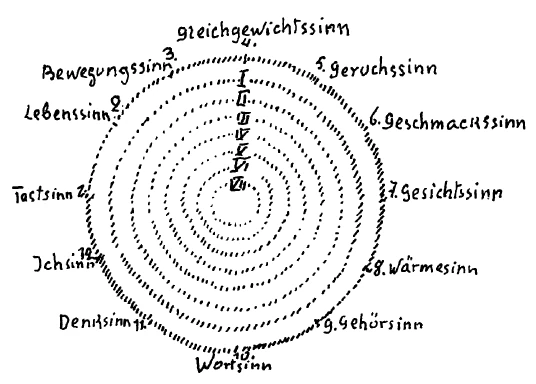
[ 15 ] Das ist anders, als es nun mit den Kräften steht, die gewissermaßen tiefer im Menschen liegen als diese Sinneskräfte. Der Sehsinn ist an das Auge gebunden, ist ein gewisser Bezirk im menschlichen Organismus. Der Hörsinn ist an den Hörorganismus gebunden, wenigstens in der Hauptsache; er braucht ihn aber nicht allein; es wird mit viel mehr im Organismus gearbeitet, es wird mit einem viel weiteren Bezirk gehört als durch das Ohr; aber das Ohr ist der normalste Hörbezirk. Alle diese Sinnesbezirke werden von dem Leben gleichmäßig durchflossen. Das Auge lebt, das Ohr lebt, das, was dem Ganzen zugrunde liegt, lebt; was dem Tastsinn zugrunde liegt, lebt — alles lebt. Das Leben wohnt in allen Sinnen, es geht durch alle Sinnesbezirke durch.
[ 15 ] This is different from the situation with the faculties that, in a sense, lie deeper within the human being than these sensory faculties. The sense of sight is bound to the eye; it is a specific region within the human organism. The sense of hearing is bound to the auditory system, at least for the most part; yet it does not rely on it alone; much more of the organism is involved, and hearing takes place in a much broader region than just the ear; but the ear is the most typical region of hearing. All these sensory regions are equally permeated by life. The eye lives, the ear lives, that which underlies the whole lives; that which underlies the sense of touch lives—everything lives. Life dwells in all the senses; it flows through all the sensory regions.
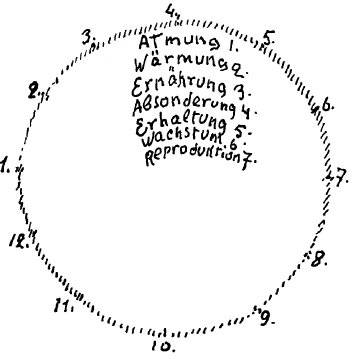
[ 16 ] Wenn wir dieses Leben weiter betrachten, so stellt es sich wiederum differenziert heraus. Es gibt nicht nur eine Kraft des Lebens. Sie müssen schon unterscheiden, es ist etwas anderes der Lebenssinn, durch den wir das Leben wahrnehmen, als das, was ich jetzt bespreche, Ich bespreche jetzt das Leben selber, wie es durch uns flutet; das differenziert sich in uns selber wiederum, und zwar in der folgenden Weise (siehe Zeichnung). Die zwölf Sinnesbezirke müssen wir uns gleichsam ruhend denken im Organismus. Das Leben aber pulsiert durch den ganzen Organismus, und das Leben ist wiederum differenziert. Da haben wir zunächst etwas, was in einer gewissen Weise in allem Lebendigen sein muß: die Atmung. Jenes Verhältnis zur Außenwelt, das die Atmung ist, muß gewissermaßen in jedem Lebendigen sein. Ich kann mich jetzt nicht im einzelnen darauf einlassen, wie es wiederum für die Tiere, Pflanzen und Menschen differenziert ist; aber in jedem Lebendigen ist in einer gewissen Weise die Atmung. Die Atmung des Menschen wird immer wieder erneuert durch etwas, was er von der Außenwelt aufnimmt; das kommt allen Sinnesbezirken zugute. Es kann nicht der Geruchssinn walten, der Sehsinn walten, der Tonsinn walten, wenn nicht das, was das Leben von der Atmung hat, allen Sinnen zugute kommt. Ich müßte also zu jedem Sinn «Atmung» dazuschreiben. Nicht wahr, es wird geatmet; aber was durch die Atmung als Lebensprozeß geleistet wird, das kommt allen Sinnen zugute.
[ 16 ] If we continue to examine this life, it turns out to be differentiated once again. There is not just one life force. You must make a distinction: the meaning of life, through which we perceive life, is something different from what I am discussing now. I am now discussing life itself, as it flows through us; which in turn differentiates within us, specifically in the following way (see diagram). We must imagine the twelve sensory regions, as it were, at rest within the organism. Life, however, pulsates through the entire organism, and life itself is further differentiated. First, we have something that must be present in all living beings in a certain way: respiration. That relationship to the outside world, which is respiration, must, so to speak, be present in every living being. I cannot go into detail now about how it is differentiated in animals, plants, and humans; but in every living being, respiration is present in a certain way. Human respiration is constantly renewed by something the person takes in from the external world; this benefits all the senses. The sense of smell, the sense of sight, and the sense of hearing cannot function unless what life derives from respiration benefits all the senses. So I would have to add “breathing” to every sense. Isn’t that right? We do breathe; but what is accomplished through breathing as a life process benefits all the senses.
[ 17 ] Als zweites können wir unterscheiden die Wärmung. Sie tritt ein mit der Atmung; aber sie ist etwas anderes als die Atmung. Die Wärmung, die innerliche Durchwärmung ist eine zweite Art, das Leben zu unterhalten. Eine dritte Art, das Leben zu unterhalten, ist die Ernährung. Da haben wir die drei Arten, dem Leben von außen mit Lebensprozessen entgegenzukommen: Atmung, Wärmung, Ernährung. Zu alledem gehört die Außenwelt. Atmung setzt voraus einen Stoff, beim Menschen die Luft, beim Tier auch die Luft. Wärmung setzt voraus eine ganz bestimmte Wärme der Umgebung, zu der wir uns in eine Beziehung setzen. Denken Sie sich nur einmal, wie Sie unmöglich innerlich mit der richtigen Wärme leben könnten, wenn die Temperatur in ‚Ihrer Umgebung höher oder tiefer wäre! Denken Sie sie sich um hundert Grad tiefer: Ihre Wärmung wäre nicht mehr möglich, Ihre Wärmung hörte auf; oder um hundert Grad höher: Sie würden nicht bloß schwitzen! Ebenso ist die Ernährung notwendig, insoweit wir den Lebensprozeß als Erdenprozeß betrachten.
[ 17 ] Second, we can distinguish warmth. It occurs alongside breathing; but it is something different from breathing. Warmth—internal warmth—is a second way of sustaining life. A third way to sustain life is nutrition. So we have these three ways of engaging with life from the outside through vital processes: breathing, warmth, and nutrition. The external world is part of all of this. Breathing requires a substance—air for humans, and air for animals as well. Warmth requires a very specific ambient temperature with which we interact. Just imagine for a moment how it would be impossible for you to live internally with the proper warmth if the temperature in “your environment” were higher or lower! Imagine it a hundred degrees lower: your body heat would no longer be possible; your body heat would cease. Or a hundred degrees higher: you would do more than just sweat! Likewise, nutrition is necessary insofar as we regard the life process as an earthly process.
[ 18 ] Jetzt kommen wir mit den Lebensprozessen mehr ins Innere. Da haben wir den nächsten Prozeß, der schon mehr dem Inneren angehört, das, was man nennen könnte die Umformung, die Verinnerlichung dessen, was aufgenommen worden ist von außen, die Umwandlung, die Verwandlung des von außen Aufgenommenen. Ich möchte, konform mit der Art, wie wir das einmal früher benannt haben, diese Umformung wiederum mit denselben Ausdrücken bezeichnen. Es gibt in der Wissenschaft noch keine Ausdrücke dafür; man muß sie erst prägen, weil man alle diese Dinge noch nicht unterscheidet. Diese innerliche Umformung dessen, was von außen aufgenommen wird, die also rein inneren Prozessen unterliegt, die können wir wiederum uns vierfach vorstellen. Das erste, was innerlich auftritt nach der Ernährung, ist die innere Absonderung. Absonderung ist es schon, wenn nur das aufgenommene Nahrungsmittel dem Körper mitgeteilt wird, wenn es ein Glied im Organismus wird. Es ist nicht nur die Absonderung nach außen, sondern die Mitteilung desjenigen, was durch die Nahrungsmittelsubstanz aufgenommen wird, im Inneren. Die Absonderung besteht zum Teil in Abgabe nach außen oder aber in der Aufnahme der Nahrungsmittel. Das ist eine Absonderung durch diejenigen Organe, die eben der Nahrung dienen: Absonderung in den Organismus hinein. Was so abgesondert ist in den Organismus hinein, das muß erhalten werden im Lebensprozeß, das ist wiederum ein besonderer Lebensvorgang für sich, den wir als Erhaltung bezeichnen müssen. Damit aber das Leben bestehen kann, muß es nicht nur das, was es aufnimmt, erhalten, sondern es muß es vergrößern. Jedes Lebendige unterliegt einer innerlichen Vermehrung: Wachstumsprozeß im weitesten Sinne; Wachstumsprozeß gehört zum Leben, Erhaltung und Wachstum.
[ 18 ] Now we are moving deeper into the inner processes of life. Here we have the next process, which already belongs more to the inner realm—what one might call the reshaping, the internalization of what has been taken in from the outside, the transformation, the metamorphosis of what has been taken in from the outside. In keeping with the way we have referred to this in the past, I would like to describe this transformation once again using the same terms. There are no scientific terms for this yet; they must first be coined, because these distinctions have not yet been made. This inner transformation of what is taken in from the outside—which is thus subject to purely internal processes—can be conceptualized in four distinct ways. The first thing that occurs internally after eating is internal secretion. It is already a form of secretion when the ingested food is simply communicated to the body, when it becomes a part of the organism. It is not only secretion outward, but the communication within the body of what is taken in through the food substance. Secretion consists partly of discharge outward and partly of the absorption of food. This is a secretion carried out by the organs that serve the purpose of digestion: secretion into the organism. What is thus secreted into the organism must be sustained within the life process; this, in turn, is a distinct life process in itself, which we must refer to as maintenance. However, for life to persist, it must not only preserve what it takes in, but it must also increase it. Every living being undergoes an internal multiplication: a growth process in the broadest sense; the growth process is part of life, preservation, and growth.
[ 19 ] Und dann gehört zum Leben hier auf Erden die Hervorbringung des Ganzen; der Wachstumsprozeß erfordert nur, daß ein Glied das andere hervorbringt. Reproduktion ist ein Prozeß, der höher ist als das bloße Wachstum, der das gleiche Individuum hervorbringt.
[ 19 ] And then, part of life here on earth is the production of the whole; the process of growth merely requires that one part produce another. Reproduction is a process that is higher than mere growth, one that produces the same individual.
[ 20 ] Außer diesen sieben Prozessen gibt es keinen weiteren Lebensprozeß mehr innerlich, In sieben Prozesse zerfällt das Leben. Aber wir können das nicht Bezirke nennen, sondern diese sieben kommen allen zwölf Bezirken zugute, diese sieben Lebensprozesse beleben alles. Wir müssen daher, wenn wir das Verhältnis dieser sieben zu den zwölf ins Auge fassen, sagen: Wir haben 1. Atmung, 2. Wärmung, 3. Ernährung, 4. Absonderung, 5. Erhaltung, 6. Wachstum, 7. Reproduktion, aber so, daß sie doch zu allen Sinnen in einem Verhältnis stehen, daß das durch alle Sinne gewissermaßen strömt, daß das Bewegung ist. (Siehe Zeichnung 5.115.) Wir müssen gewissermaßen den Menschen, insofern er ein lebender Mensch ist, so darstellen, daß er zwölf getrennte Sinnesbezirke hat, und daß durch diese das siebenfältige Leben pulst, das in sich bewegte siebenfältige Leben. — Schreiben Sie zu den zwölf Bezirken die Tierkreiszeichen dazu, dann haben Sie den Makrokosmos; schreiben Sie dazu die Sinnesbezirke, dann haben Sie den Mikrokosmos. Schreiben Sie zu den sieben Lebensprozessen die Zeichen der Planeten, so haben Sie den Makrokosmos; schreiben Sie die Namen für die sieben Lebensprozesse, so haben Sie den Mikrokosmos. Und wie sich im Makrokosmos die Planeten in ihren Bewegungen verhalten zu den Tierkreisbildern, durch die sie durchgehen, so geht der lebendige Lebensprozeß durch die ruhenden Sinnesbezirke immer hindurch, durchströmt sie. Sie sehen, noch in mancher Beziehung ist der Mensch ein Mikrokosmos.
[ 20 ] Apart from these seven processes, there are no other internal life processes; life is divided into seven processes. But we cannot call these “districts”; rather, these seven benefit all twelve districts—these seven life processes animate everything. Therefore, when we consider the relationship of these seven to the twelve, we must say: We have 1. respiration, 2. warmth, 3. nutrition, 4. excretion, 5. maintenance, 6. growth, 7. reproduction—but in such a way that they are related to all the senses, that they flow through all the senses, so to speak, and that this constitutes movement. (See Figure 5.115.) We must, so to speak, depict the human being—insofar as he is a living human being—as having twelve distinct sensory regions, through which the sevenfold life pulses—the sevenfold life that is in motion within itself. — If you assign the signs of the zodiac to the twelve regions, you have the macrocosm; if you assign the sensory regions to them, you have the microcosm. If you assign the signs of the planets to the seven life processes, you have the macrocosm; if you assign the names of the seven life processes, you have the microcosm. And just as in the macrocosm the planets, in their movements, relate to the constellations through which they pass, so the living life process always passes through the dormant sensory spheres, flowing through them. You see, in many respects, the human being is a microcosm.
[ 21 ] Wenn nun jemand kommen würde, der ein gründlicher Kenner der gegenwärtigen Physiologie und auch schon, wie man sie heute auffaßt, der experimentellen Psychologie ist, so wird er sagen: So etwas ist ja eine niedliche Spielerei; denn Beziehungen kann man zwischen allem finden. Und wenn man es gerade so einrichtet, daß man die Sinnesbezirke als zwölf annimmt, kriegt man die zwölf Tierkreiszeichen heraus; wenn man den Lebensprozeß in sieben Teile teilt, bekommt man die sieben Planeten heraus. — Kurz, man kann glauben, daß das durch irgendeine Phantastik so eingerichtet sei. Das ist es aber nicht, das ist es wahrhaftig nicht; sondern das, was heute am Menschen ist, das hat sich langsam heran- und herausgebildet. So, wie die Sinne heute im Menschen sind, waren sie nicht während der alten Mondenzeit. Ich sagte, sie waren viel, viel lebendiger. Sie waren die Grundlage für das alte traumhafte Hellsehen während der Mondenzeit. Heute sind die Sinne mehr tot als sie während der alten Mondenzeit waren, sie sind mehr getrennt von dem Einheitlichen, von dem siebengliedrigen und in seiner Siebengliedrigkeit einheitlichen Lebensprozeß. Die Sinnesprozesse waren während der alten Mondenzeit noch selbst mehr Lebensprozesse. Wenn wir heute sehen oder hören, so ist das schon ein ziemlich toter Prozeß, ein sehr peripherischer Prozeß. So tot war die Wahrnehmung während der alten Mondenzeit gar nicht. Greifen wir einen Sinn heraus, zum Beispiel den Geschmackssinn. Wie er auf der Erde ist, ich denke, Sie wissen es alle. Während der Mondenzeit war er etwas anderes. Da war das Schmecken ein Prozeß, in dem der Mensch sich nicht so von der Außenwelt abtrennte wie jetzt. Jetzt ist der Zucker draußen, der Mensch muß erst daran lecken und einen inneren Prozeß vollziehen. Da ist sehr genau zwischen Subjektivem und Objektivem zu unterscheiden. So lag es nicht während der Mondenzeit. Da war das ein viel lebendigerer Prozeß, und das Subjektive und Objektive unterschied sich nicht so stark. Der Schmeckprozeß war noch viel mehr ein Lebensprozeß, meinetwillen ähnlich dem Atmungsprozeß. Indem wir atmen, geht etwas Reales in uns vor. Wir atmen die Luft ein, aber indem wir die Luft einatmen, geht mit unserer ganzen Blutbildung etwas vor in uns; denn das gehört ja alles zur Atmung hinzu, insofern die Atmung einer der sieben Lebensprozesse ist, da kann man nicht so unterscheiden. Also da gehören Außen und Innen zusammen: Luft draußen, Luft drinnen, und indem der Atmungsprozeß sich vollzieht, vollzieht sich ein realer Prozeß. Das ist viel realer, als wenn wir schmecken. Da haben wir allerdings eine Grundlage für unser heutiges Bewußtsein; aber das Schmecken auf dem Mond war viel mehr ein Traumprozeß, so wie es heute für uns der Atmungsprozeß ist. Im Atmungsprozeß sind wir uns nicht so bewußt wie im heutigen Schmeckprozeß. Aber der Schmeckprozeß war auf dem Mond so, wie heute der Atmungsprozeß für uns ist. Der Mensch hatte auf dem Mond auch nicht mehr vom Schmecken als wir heute vom Atmen, er wollte auch nichts anderes haben. Ein Feinschmecker war der Mensch noch nicht und konnte es auch nicht sein, denn er konnte seinen Schmeckprozeß nur vollziehen, insoferne durch das Schmecken in ihm selber etwas bewirkt wurde, was mit seiner Erhaltung zusammenhing, mit seinem Bestehen als Mondes-Lebewesen.
[ 21 ] If someone were to come along who is thoroughly versed in contemporary physiology and also, as it is understood today, in experimental psychology, he would say: This is just a cute little gimmick; after all, one can find connections between everything. And if one arranges it in such a way that one assumes there are twelve sensory regions, one ends up with the twelve signs of the zodiac; if one divides the life process into seven parts, one ends up with the seven planets. — In short, one might believe that this has been arranged through some kind of fantasy. But that is not the case; it truly is not. Rather, what exists in human beings today has slowly developed and taken shape. The senses were not as they are in human beings today during the ancient Lunar Age. I said they were much, much more alive. They were the foundation for the ancient, dreamlike clairvoyance of the Lunar Age. Today the senses are more dead than they were during the ancient Lunar Age; they are more separated from the unified, sevenfold—and in its sevenfoldness, unified—life process. During the ancient Lunar Age, the sensory processes were themselves even more like life processes. When we see or hear today, it is already a rather dead process, a very peripheral process. Perception during the ancient Lunar Age was not nearly as dead as that. Let us single out one sense, for example, the sense of taste. You all know, I think, what it is like on Earth. During the Lunar Age, it was something different. Back then, tasting was a process in which human beings did not separate themselves from the outside world as much as they do now. Now the sugar is out there; a person must first lick it and carry out an inner process. A very precise distinction must be made between the subjective and the objective. That was not the case during the Lunar Age. Back then, it was a much more living process, and the subjective and objective were not so sharply distinguished. The process of tasting was even more of a life process—similar, if you will, to the process of breathing. As we breathe, something real takes place within us. We inhale the air, but as we inhale the air, something takes place within us involving our entire blood formation; for all of this is part of breathing, insofar as breathing is one of the seven life processes—there, one cannot make such a distinction. So the external and internal belong together: air outside, air inside, and as the breathing process takes place, a real process takes place. That is much more real than when we taste. There, of course, we have a foundation for our present-day consciousness; but tasting on the Moon was much more of a dream-like process, just as the breathing process is for us today. We are not as conscious of the breathing process as we are of the tasting process today. But the tasting process on the Moon was what the breathing process is for us today. On the Moon, human beings did not experience more from tasting than we do today from breathing, nor did they want anything else. Humans were not yet gourmets and could not be, for they could only carry out the process of tasting to the extent that tasting brought about something within them that was connected to their survival, to their existence as lunar beings.
[ 22 ] Und so war es zum Beispiel mit dem Sehprozeß, mit dem Gesichtsprozeß während der Mondenzeit. Da war das nicht so, daß man äußerlich einen Gegenstand anschaute, äußerlich Farbe wahrnahm, sondern da lebte das Auge in der Farbe drinnen, und das Leben wurde unterhalten durch die Farben, die durch das Auge kamen. Das Auge war eine Art Farbenatmungsorgan. Die Lebensverfassung hing zusammen mit der Beziehung, die man mit der Außenwelt durch das Auge in dem Wahrnehmungsprozeß des Auges einging. Man dehnte sich aus während des Mondes, wurde breit, wenn man ins Blaue hineinkam, man drückte sich zusammen, wenn man sich ins Rot hineinwagte: auseinander — zusammen, auseinander — zusammen. Das hing mit dem Wahrnehmen von Farben zusammen. Und so hatten alle Sinne noch ein lebendigeres Verhältnis zur Außenwelt und zur Innenwelt, wie es heute die Lebensprozesse haben.
[ 22 ] And so it was, for example, with the process of seeing, with the process of perception during the Lunar Period. It was not the case that one looked at an object externally or perceived color externally; rather, the eye lived within the color, and life was sustained by the colors that entered through the eye. The eye was a kind of organ for breathing color. One’s state of being was connected to the relationship one entered into with the outside world through the eye in the eye’s process of perception. One expanded during the lunar phase, becoming broad when entering the blue; one contracted when venturing into the red: apart—together, apart—together. This was connected to the perception of colors. And so all the senses had an even more vivid relationship to the outer world and the inner world than the life processes do today.
[ 23 ] Der Ichsinn — wie war er auf dem Monde? Das Ich kam in den Menschen erst auf der Erde hinein, konnte also auf dem Mond gar keinen «Sinn» haben; man konnte kein Ich wahrnehmen, der Ichsinn konnte überhaupt noch nicht da sein. — Auch das Denken, wie wir es heute wahrnehmen, wie ich es vorher geschildert habe, das lebendige Denken, das ist mit unserem Erdenbewußtsein in Zusammenhang. Der Denksinn, wie er heute ist, war auf dem Monde noch nicht da. Redende Menschen gab es auch nicht. In dem Sinne, wie wir heute die Sprache des andern wahrnehmen, gab es das auf dem Monde noch nicht, es gab also auch den Wortsinn nicht. Das Wort lebte erst als Logos, durchtönend die ganze Welt, und ging auch durch das damalige Menschenwesen hindurch. Es bedeutete etwas für den Menschen, aber der Mensch nahm es noch nicht als Wort wahr am anderen Wesen. Der Gehörsinn war allerdings schon da, aber viel lebendiger, als wir ihn jetzt haben. Jetzt ist er gewissermaßen als Gehörsinn zum Stehen gekommen auf der Erde. Wir bleiben ganz ruhig, in der Regel wenigstens, wenn wir hören. Wenn nicht gerade das Trommelfell platzt durch irgendeinen Ton, wird in unserem Organismus nicht etwas substantiell geändert durch das Hören. Wir in unserem Organismus bleiben stehen; wir nehmen den Ton wahr, das Tönen. So war es nicht während der Mondenzeit. Da kam der Ton heran. Gehört wurde er; aber es war jedes Hören mit einem innerlichen Durchbebtsein verbunden, mit einem Vibrieren im Innern, man machte den Ton lebendig mit. Das, was man das Weltenwort nennt, das machte man auch lebendig mit; aber man nahm es nicht wahr. Man kann also nicht von einem Sinn sprechen, aber der Mondenmensch machte dieses Tönen, das heute dem Hörsinn zugrunde liegt, lebendig mit. Wenn das, was wir heute als Musik hören, auf dem Monde erklungen wäre, so würde nicht nur äußerer Tanz möglich gewesen sein, sondern auch noch innerer Tanz; da hätten sich die inneren Organe alle mit wenigen Ausnahmen so verhalten, wie sich heute mein Kehlkopf und das, was mit ihm zusammenhängt, innerlich bewegend verhält, wenn ich den Ton hindurchsende. Der ganze Mensch war innerlich bebend, harmonisch oder disharmonisch, und wahrnehmend dieses Beben durch den Ton. Also wirklich ein Prozeß, den man wahrnahm, aber den man lebendig mitmachte, ein Lebensprozeß.
[ 23 ] The sense of the “I”—what was it like on the Moon? The “I” did not enter human beings until they were on Earth; therefore, it could not have had any “sense” on the Moon at all; one could not perceive an “I,” and the sense of the “I” could not have existed there yet. — Thinking, too, as we perceive it today—as I described earlier—that is, living thinking—is connected to our earthly consciousness. The sense of thinking, as it exists today, did not yet exist on the Moon. Nor were there any speaking human beings. In the sense that we perceive another person’s speech today, this did not yet exist on the Moon, so the sense of the word did not exist either. The word first lived as Logos, resounding throughout the entire world, and also passed through the human beings of that time. It meant something to human beings, but they did not yet perceive it as a word spoken by another being. The sense of hearing was, however, already present, but much more alive than we have it now. Now, in a sense, it has come to a standstill on Earth as the sense of hearing. We remain completely still—at least as a rule—when we hear. Unless a sound causes the eardrum to burst, hearing does not bring about any substantial change in our organism. We, within our organism, remain still; we perceive the sound, the ringing. It was not like that during the Lunar Age. Back then, the sound came toward us. It was heard; but every act of hearing was connected with an inner trembling, with a vibration within—one brought the sound to life within oneself. What is called the “World Word,” one also brought to life within oneself; but one did not perceive it. One cannot, therefore, speak of a sense, but the Lunar human being brought this sound—which today underlies the sense of hearing—to life within oneself. If what we hear today as music had resounded on the Moon, not only would external dance have been possible, but also inner dance; then all the internal organs, with few exceptions, would have behaved in the same way that my larynx and its associated structures move internally today when I send the sound through them. The whole human being was vibrating internally, harmoniously or disharmoniously, and perceiving this vibration through the sound. So it was truly a process that one perceived, but in which one actively participated—a process of life.
[ 24 ] Ebenso war der Wärmesinn ein Lebensprozeß. Heute sind wir verhältnismäßig ruhig gegenüber unserer Umgebung: es kommt uns warm oder kalt vor. Wir erleben das zwar leise mit, auf dem Monde aber wurde es so miterlebt, daß immer die ganze Lebensverfassung anders wurde, wenn die Wärme hinauf- oder herunterging. Also ein viel stärkeres Mitleben; wie man mit dem Ton mitbebte, so wärmte und kühlte man im Innern und empfand dieses Wärmen und Kühlen.
[ 24 ] Similarly, the sense of warmth was a life process. Today, we are relatively unresponsive to our surroundings: things simply seem warm or cold to us. Although we experience this only faintly, on the Moon it was experienced in such a way that one’s entire state of being would change whenever the temperature rose or fell. It was, in other words, a much more intense experience; just as one vibrated with the sound, so one warmed and cooled internally and felt this warming and cooling.
[ 25 ] Sehsinn, Gesichtssinn: Ich habe schon beschrieben, wie er auf dem Monde war. Man lebte mit den Farben. Gewisse Farben verursachten, daß man seine Gestalt vergrößerte, andere, daß man sie zusammenzog. Heute empfinden wir so etwas höchstens symbolisch. Wir schrumpfen nicht mehr zusammen gegenüber dem Rot und blasen uns nicht mehr auf gegenüber dem Blau; aber auf dem Mond taten wir es. Den Geschmackssinn habe ich schon beschrieben. Geruchssinn war auf dem Monde innig verbunden mit dem Lebensprozesse. Gleichgewichtssinn war auf dem Monde vorhanden, den brauchte man auch schon. Bewegungssinn war sogar viel lebendiger. Heute vibriert man nur wenig, bewegt seine Glieder, es ist alles mehr oder weniger zur Ruhe gekommen, tot geworden. Aber denken Sie, was dieser Bewegungssinn wahrzunehmen hatte, wenn alle diese Bewegungen stattfanden wie das Erbeben durch den Ton. Es wurde der Ton wahrgenommen, mitgebebt, aber dieses innere Beben, das mußte erst wiederum durch den Bewegungssinn wahrgenommen werden, wenn der Mensch es selber hervorrief, und er ahmte nach dasjenige, was der Hörsinn in ihm erweckte.
[ 25 ] Sense of sight: I have already described what it was like on the Moon. We lived with colors. Certain colors caused one to expand one’s form, others to contract it. Today we perceive such things, at most, symbolically. We no longer shrink in the presence of red nor swell up in the presence of blue; but on the Moon, we did. I have already described the sense of taste. On the Moon, the sense of smell was intimately connected with the life processes. The sense of balance existed on the Moon; one certainly needed it. The sense of movement was even much more vivid. Today we vibrate only slightly, move our limbs—everything has more or less come to rest, become lifeless. But just imagine what this sense of movement had to perceive when all these movements took place, such as the tremor caused by sound. The sound was perceived, and we trembled along with it; but this inner tremor had to be perceived first through the sense of movement when a person evoked it themselves, and they imitated what the sense of hearing had awakened within them.
[ 26 ] Lebenssinn: Nun, aus dem, was ich beschrieben habe, können Sie ersehen, daß der Lebenssinn in demselben Sinne, wie er auf der Erde ist, nicht vorhanden gewesen sein kann auf dem Monde. Das Leben muß man viel mehr als ein allgemeines mitgemacht haben. Man lebte viel mehr im Allgemeinen drinnen. Das innere Leben grenzte sich nicht so durch die Haut ab. Man schwamm im Leben drinnen. Indem alle Organe, alle heutigen Sinnesorgane dazumal Lebensorgane waren, brauchte man nicht einen besonderen Lebenssinn, sondern alle waren Lebensorgane und lebten und nahmen sich gewissermaßen selber wahr. Lebenssinn brauchte man nicht auf dem Monde. Der Tastsinn entstand erst mit dem Mineralreich, das Mineralreich ist aber ein Ergebnis der Erdenentwickelung. In demselben Sinne, wie wir auf der Erde den Tastsiinn durch das Mineralreich entwickelt haben, gab es ihn auf dem Monde nicht, der hatte dort ebensowenig einen Sinn wie der Lebenssinn.
[ 26 ] The Meaning of Life: Well, from what I have described, you can see that the meaning of life, in the same sense as it exists on Earth, could not have existed on the Moon. Life must have been experienced in a much more universal way. People generally lived much more on the inside. Inner life was not so clearly demarcated by the skin. One swam within life itself. Since all organs—all the sensory organs we have today—were organs of life back then, there was no need for a specific “sense of life”; rather, all were organs of life, and they lived and, in a sense, perceived themselves. There was no need for a “sense of life” on the Moon. The sense of touch only arose with the mineral kingdom, but the mineral kingdom is a result of Earth’s evolution. In the same sense that we developed the sense of touch on Earth through the mineral kingdom, it did not exist on the Moon; it had just as little meaning there as the sense of life.
[ 27 ] Zählen wir, wieviel Sinne uns übrigbleiben, die nun in Lebensorgane verwandelt sind: sieben. Das Leben ist immer siebengliedrig. Die fünf, die auf der Erde dazukommen und zwölf machen, weil sie ruhige Bezirke werden, wie die Tierkreisbezirke, die fallen beim Monde weg. Sieben bleiben nur übrig für den Mond, wo die Sinne noch in Bewegung sind, wo sie selber noch lebendig sind. Es gliedert sich also auf dem Mond das Leben, in das die Sinne noch hineingetaucht sind, in sieben Glieder.
[ 27 ] Let us count how many senses we have left, which have now been transformed into organs of life: seven. Life is always divided into seven parts. The five that are added on Earth—making twelve, since they become tranquil spheres, like the zodiacal spheres—are absent on the Moon. Only seven remain on the Moon, where the senses are still in motion, where they themselves are still alive. Thus, on the Moon, life—into which the senses are still immersed—is divided into seven parts.
[ 28 ] Das ist nur ein kleiner elementarer Teil dessen, was man sagen muß, um zu zeigen, daß da nicht Willkür zugrunde liegt, sondern lebendige Beobachtung der übersinnlichen Tatsachenwelt, die während des Erdenseins zunächst nicht in die Sinne der Menschen fällt. Je weiter man vordringt und je weiter man sich wirklich auf die Betrachtung der Weltengeheimnisse einläßt, desto mehr sieht man, wie so etwas nicht eine Spielerei ist, dieses Verhältnis von zwölf zu sieben, sondern wie es wirklich durch alles Sein durchgeht, und wie die Tatsache, daß es draußen ausgedrückt werden muß durch das Verhältnis der ruhenden Sternbilder zu den bewegten Planeten, auch ein Ergebnis ist eines Teiles des großen Zahlengeheimnisses im Weltendasein. Und das Verhältnis der Zwölfzahl zur Siebenzahl drückt ein tiefes Geheimnis des Daseins aus, drückt das Geheimnis aus, in dem der Mensch steht als Sinneswesen zum Lebewesen, zu sich als Lebewesen. Die Zwölfzahl enthält das Geheimnis, daß wir ein Ich aufnehmen können. Indem unsere Sinne zwölf geworden sind, zwölf ruhige Bezirke, sind sie die Grundlage des Ich-Bewußtseins der Erde. Indem diese Sinne noch Lebensorgane waren während der Mondenzeit, konnte der Mensch nur den astralischen Leib haben; da waren diese sieben noch Lebensorgane bildenden Sinnesorgane die Grundlage des astralischen Leibes. Die Siebenzahl wird so geheimnisvoll zugrunde gelegt dem astralischen Leib, wie die Zwölfzahl geheimnisvoll zugrunde liegt der Ich-Natur, dem Ich des Menschen.
[ 28 ] This is only a small, elementary part of what must be said to show that there is no arbitrariness at the root of this, but rather a living observation of the supersensible world of facts, which, during earthly existence, does not initially come to people’s senses. The further one delves and the more one truly engages with the contemplation of the world’s mysteries, the more one sees that this ratio of twelve to seven is not merely a trifling matter, but rather that it truly permeates all of existence, and how the fact that it must be expressed externally through the ratio of the stationary constellations to the moving planets is also a result of a part of the great mystery of numbers in the existence of the world. And the ratio of the number twelve to the number seven expresses a profound mystery of existence; it expresses the mystery in which the human being, as a sensory being, stands in relation to living beings—and to oneself as a living being. The number twelve contains the mystery that we are able to take on an “I.” Because our senses have become twelve—twelve stationary spheres—they form the foundation of Earth’s “I”-consciousness. Since these senses were still life organs during the Lunar Age, human beings could possess only the astral body; at that time, these seven sense organs, which still formed life organs, were the foundation of the astral body. The number seven thus mysteriously underlies the astral body, just as the number twelve mysteriously underlies the nature of the “I,” the human “I.”