

Humanity's Internal Impulses for Development
Goethe and the Crisis of the Nineteenth Century
GA 171
17 September 1916, Dornach
Translated by Steiner Online Library
Second Lecture
[ 1 ] Yesterday we attempted, so to speak, to characterize the forces that permeated Greek and Roman civilization in order to gain an understanding of what continued to exert an influence from the fourth post-Atlantean epoch into the fifth post-Atlantean epoch, and we hinted at how this carryover—this continued outpouring of the forces of the fourth post-Atlantean epoch into the fifth—manifested itself. I would now like you to turn your attention once more to the way in which we were able to characterize Greek and Roman civilization.
[ 2 ] Greek civilization, as it developed, was a great disappointment to those forces that might be called the Luciferic forces. It is, of course, only natural that one can speak of these things, so to speak, solely on the basis of imaginative insight, and that is how we shall proceed today as well. Greek civilization, as it developed, was thus a great disappointment, for the Luciferic powers had expected something entirely different from it. Let us just consider for a moment that Greek civilization, as the fourth post-Atlantean epoch, was supposed to have brought the Luciferic powers, so to speak, what they themselves, as Luciferic powers, had strived for during the Atlantean epoch. The Luciferic powers unfolded certain activities and exerted certain forces during the Atlantean epoch. They repeatedly expected to reap the fruits of these efforts for themselves in the fourth post-Atlantean cultural epoch. What, then, did they actually expect? When one discusses such matters, one gains insight into the inner nature of the Luciferic soul. One comes to know this Luciferic life, which consists of continuous efforts during certain periods, in the expectation that these efforts will succeed, and in ever-renewed disappointments. Certainly, a so-called human logician might ask: Why don’t the Luciferic forces give up their striving, since they can draw the conclusion that they are bound to be disappointed again and again? — Such a conclusion would, in fact, be human wisdom, not Luciferic wisdom. In any case, the Luciferic powers have not done this so far; rather, they repeatedly intensify their efforts after experiencing ever-new disappointments.
[ 3 ] What did the Luciferic forces expect, specifically from the fourth post-Atlantean epoch? They expected that during this epoch they would be able to take control of all the soul forces of the Greek people, which were directed toward incorporating the ancient imaginations of the Chaldean-Egyptian era into the realm of the imagination. The Luciferic forces sought to exert such a powerful influence on the people of Greek culture that these refined, I might say, imaginations distilled down to the level of fantasy—would have powerfully permeated the entire being of the Greeks, so that the Greeks would, as it were, have been completely absorbed into a soul world, into an everyday thinking, feeling, and willing that would have consisted entirely of subtle imaginations, refined precisely to the level of fantasy perception. If the Greeks had developed nothing else in their souls but these refined imaginative visions, if they had become completely filled with these refined emotional imaginations, then the Luciferic forces would have been able to lift these people—the Greeks—and, in their wake, a large part of humanity as a whole, out of earthly evolution and incorporate them into their Luciferic world. That was the intention of the Luciferic forces. It had also been the hope of the Luciferic forces since the ancient Atlantean era to achieve in this fourth post-Atlantean epoch what had not been accomplished during Atlantis itself: the incorporation of humanity into the cosmos at the level humanity had attained there. The Luciferic forces sought nothing less than to create a world for themselves—a distinct, separate world—in which human beings would dwell, free from earthly heaviness and with complete supersensible lightness, becoming wholly absorbed in this distinct Luciferic world through a life of fantasy.
[ 4 ] Thus, to create a planetary body populated by beings who, from within humanity, had attained the highest level of development in their imaginative life—that was the hope of the Luciferic beings. And the Luciferic beings made every effort to persuade the Greeks to lead them away from Earth as souls. Then the souls would have gradually left the Earth; the bodies that would still have been formed would have decayed. Individuals without a sense of self would have come into being. The Earth would have headed toward decadence, and a distinct Luciferic realm would have arisen. That did not happen. And why did it not happen? It did not happen because the genius and grandeur of Greek philosophy and Greek wisdom—to use this Platonic term—intermingled with the deifying madness of the Greek poets. Its philosophers—Heraclitus, Thales, Anaximander, Anaximenes, Parmenides, Socrates, Plato, Aristotle—saved Greek civilization from complete spiritualization in the realm of fantasy. They preserved Greek civilization on Earth. They are the very force that provided the strongest impetus for the preservation of Greek civilization within Earth’s evolution.
[ 5 ] Thus, one must consider in context the forces lying behind physical reality, which are the true causes of what happens. In this way, Greek culture has been preserved in the course of Earth’s evolution. With regard to this task, the Luciferic beings could not have achieved anything anyway if they had not been supported by the Ahrimanic beings. In pursuing this intention and harboring this hope, the Luciferic beings also counted on the support of the Ahrimanic beings. It must always be the case that two forces work together in these effects.
[ 6 ] Just as the Luciferic beings were disappointed by Greek civilization, so too were the Ahrimanic beings disappointed by Roman civilization as it developed. For just as the Luciferic beings, for their part, sought to achieve within Greek civilization what has been indicated—namely, leading human souls away from the earthly planet—so, too, did the Ahrimanic beings seek to carry out their work toward this same end. To this end, Roman culture was to take on a very specific form. The Ahrimanic powers deployed their strongest forces in Roman civilization, just as the Luciferic powers did in Greek civilization. For the Ahrimanic powers had reckoned that Roman civilization would bring about a certain rigidity on Earth, characterized by completely blind obedience and blind submission to Roman rule. What the Ahrimanic forces intended with Roman civilization was for a Roman Empire to extend across the entire known world of that time—a Roman Empire that was to encompass all human activity, one that was to be directed from Rome with the strictest centralism and the most extreme exercise of power: in a sense, a vast, far-reaching state apparatus emanating from Europe that would have absorbed all religious and artistic life and subjugated it. A vast state machine, a state mechanism in which the Ahrimanic forces intended to let all individuality wither away, so that every human being, every people, would have been merely a cog in this vast state mechanism.
[ 7 ] Just as Greek civilization could not be lulled into the Luciferic dream because of the brilliance of its philosophers, so too could Roman civilization not be brought to stagnation, as the Ahrimanic forces had intended. And what we cited yesterday as the Roman ideals worked directly against the Ahrimanic forces within Roman civilization; it was precisely this that initially counteracted them. But the legal, political, and military ideals that developed could not, on their own, have stood up to Ahriman; for it was precisely within this Roman world that the Ahrimanic forces developed something like a significant, grand attempt—a repetition of their attempt from the Atlantean era—to unleash infinitely powerful forces and powers. It was only because what the Ahrimanic powers intended to do with Roman civilization was thwarted from another direction that Ahriman’s onslaught was prevented; it was prevented at first by something that might just seem as though it should be looked down upon. But that is not the case. The Romans needed precisely what—as it was described yesterday—might have appeared as though it were meant to be portrayed with antipathy; the Romans needed precisely this ruthlessness, this rigid egoism, this ceaseless stirring up of emotionality, in order to be able to counter the onslaught of the Ahrimanic forces. And Roman history is by no means—I ask you to take special note of this—a manifestation of Ahrimanic forces! They are the ones behind it: Roman history is a struggle against the Ahrimanic forces. And if it is so convoluted, if it is so self-serving, if it is so focused on the politicization of the world, it is because only in this way could resistance be offered to Ahriman’s mechanization.
[ 8 ] But all of that would not have amounted to much, for the simple reason that Roman culture also absorbed Christianity, and as a result, Christianity would have taken on a form within Roman culture through which Ahriman could have achieved his goal all the more effectively—namely, by bringing about the mechanization of modern culture precisely through the spiritual decline of Roman culture, which had been transformed into the papacy. Thus, Ahriman—who, after all, works through much more external means than Lucifer—had to be countered by another power, also an external one. Ahriman has turned the forces of Christianity to his own ends, as we have just seen. Another power had to be set against him, and that consisted of the invading peoples of the Migration Period. The fact that Romanism was confronted by the invading peoples of the Migration Period prevented that rigid mechanization from taking hold under an all-encompassing Roman Empire. If you study the events of the Migration Period, you will see that you can only gain a true understanding of them if you view them as advances against mechanization within an all-encompassing Roman Empire. Everywhere, the forces emerging from the Migration Period are pushing their way into the Roman Empire—not to wipe Roman history from the face of the earth, but to drive back the Ahrimanic power operating behind Roman history, a power that Roman history itself fought against.
[ 9 ] In this way, Ahriman—that is, Lucifer—has been disappointed. This makes their desire to resume their mission for the fifth post-Atlantean epoch all the more significant. And this is the point at which one begins to understand the forces at work in the fifth post-Atlantean epoch, to the extent that such an understanding is possible today.
[ 10 ] This fourth post-Atlantean epoch extends both backward and forward in time. Its end is approximately the year 1413, its midpoint the year 333 A.D., and its beginning around 747 B.C. We have discussed this many times before. These are, of course, figures that are only approximate today. I said, then: What Lucifer and Ahriman were unable to achieve in the fourth post-Atlantean epoch—what was their disappointment—namely, the form that Greek and Roman civilization had taken—led them to redouble their efforts in the fifth post-Atlantean epoch, that is, from the 15th century onward. And these efforts are already present within the human forces that have been at work since the 15th century. Of course, it does not matter whether something occurs a few decades earlier or later; in outer physical reality, where one is, after all, dealing with the great illusion, things sometimes shift slightly. The fact that Roman civilization, as it has been preserved, could be preserved for the development of humanity is thus due to the events of the Migration Period. For if Roman civilization had developed in such a way that a large, all-encompassing, mechanized world empire had arisen, this world empire would have been habitable only by those ego-less human beings who were meant to remain on Earth after the Luciferic spirits had led the souls away along the path of Hellenism.
[ 11 ] So you can see how Ahriman and Lucifer work together. Lucifer wants to take the human souls and found his own planet with them; Ahriman now had to support him by doing this: while Lucifer, so to speak, sucks the juice out of the lemon, Ahriman squeezes it out by hardening what remains. And that is what he attempted to do in the Roman Empire. There you see a powerful, all-encompassing cosmic process that has unfolded, but one that was intended by the Ahrimanic and Luciferic forces. As I said, these forces were disappointed. They have continued their efforts, and the fifth post-Atlantean epoch will yet come to realize and understand how powerful these assaults are—assaults that have only just begun—and that, because at the beginning of every epoch the assaults emanating from the lagging-behind beings are at their weakest and then grow ever more powerful, the necessity of understanding these assaults also becomes ever greater and greater. Even before the end of the fourth post-Atlantean cultural epoch, the Luciferic and Ahrimanic forces had begun to exert their influence, even though the manifestation, the revelation of this influence, did not become apparent until later.
[ 12 ] If one wishes to understand how these forces are at work in the fifth post-Atlantean epoch, one must focus a little on what is intended for human beings themselves within the just and continuous development of humanity. The intention for human beings themselves is that they, as the human race, advance once more in the overall course of development. The cultural development of the Greeks and the political development of the Romans demonstrate how humanity as such progressed during the fourth post-Atlantean epoch. It is precisely through the struggle against Lucifer and Ahriman that what was meant to come about has come about; for the forces of these powers are always directed in such a way that they, so to speak, fit into the ongoing world plan, so that one can see they are part of it. They are needed as opposing forces. So, what abilities should the people of the fifth post-Atlantean epoch—our own epoch—develop in particular? We know, of course, that this concerns the development of the consciousness soul; yet this, in turn, must be composed of a series of forces—soul forces and physical forces. The first thing that must be developed if human beings are to remain properly grounded on Earth is a truly pure perception of the sensory world. Such a pure perception of the sensory world did not exist in earlier epochs, because the visionary and the imaginative—and, in the case of the Greeks, the phantasmal—always played a role in human soul life. But once the imagination had taken hold of humanity to the extent that it did in Greek life, it became necessary for people to develop the ability to perceive external natural reality unclouded by an underlying vision. We need not imagine that this refers to the materialistic worldview; this materialistic worldview is itself an Ahrimanically distorted perception of sensory reality. But, as I said, to observe sensory reality properly—that was one of the tasks of the fifth post-Atlantean epoch.
[ 13 ] The other task of the human soul is this: in addition to the pure contemplation of reality, to develop free imagination—in a sense, a kind of repetition of the Egyptian-Chaldean era. In this respect, the fifth post-Atlantean epoch has not yet progressed very far. Free imaginations must be developed, as sought by spiritual science—that is, not the bound imaginations of the third post-Atlantean epoch, nor imaginations distilled into fantasy, but free imaginations in which one moves as freely as a human being otherwise moves freely only in their intellect. The development of these two abilities will lead to the proper development of the consciousness soul of the fifth post-Atlantean epoch.
[ 14 ] Goethe beautifully described pure contemplation, which he contrasted with materialism by referring to it as his “primordial phenomenon.” You will find much discussion of this primordial phenomenon in Goethe’s writings and in my explanations of them. This primordial phenomenon is the pure contemplation of reality. But Goethe not only provided the initial impetus for vision-free sensory observation in the “Urphänomen,” but he also provided the initial impetus for free imagination; for precisely what we have found in his Faust—even if it does not yet go very far in terms of spiritual science, even if it is still, in a certain sense, merely instinctive in relation to spiritual science— it is nonetheless the first impetus of free imaginative life, for it is not merely a world of fantasy. We have seen how profoundly real this world of fantasy is, as it is developed through free imaginations in this marvelous Faust drama. Thus, however, we have, in relation to the primordial phenomenon, what Goethe calls “typical intellectual perception.” You can read more about this in my book The Riddle of Man. This must continue to develop further and further. On the one hand, the fifth post-Atlantean epoch must not only observe reality but also be able to live with it, so that—unlike the materialistic physicists—it can work, as Goethe did, in his physics laboratory, using the instruments in such a way that they reveal the primordial phenomena to him. Thus, one must conceive of a way of working—even in relation to practical life—that permeates this practical life with the primordial phenomenon; a way that is so at home in nature that nature is governed by the primordial phenomenon, and the intentions of the human race, arising from free imagination, must be encompassed within this primordial phenomenon of nature. On the one hand, directing one’s gaze toward the external world—in a sense selflessly—for the sake of knowledge and work; and on the other hand, bringing the whole into inner stirring and movement through the strongest possible engagement of the personality, in order to find the imaginations for external activity and external knowledge—this will gradually transform the conscious soul and the cultural life of the conscious soul into reality.
[ 15 ] One-sidednesses will, of course, develop within this cultural epoch. Knowledge will either strive solely toward the external world, as in Baconism, or it will strive solely toward the inner world, as in Berkeleyism. We have spoken of this. This imaginative life, which seeks to well up from within the human being, will develop amid all manner of disturbances. But we can already point to certain stages of development in which this or that person feels how this very imaginative life—this free imaginative life—is emerging from the soul. At first it is still very limited, very constrained; but let us note how a figure as significant in his own right as Jakob Böhme, shortly after the fifth post-Atlantean epoch began, already senses how the imaginative life is striving to develop within his soul. He expresses this clearly in his Aurora, describing how he feels the imaginative life at work within him. It must first become free; he still feels it to be somewhat unfree, but he senses that the divine-creative force is at work within him. And so, in a certain sense, he is the antithesis of Baconism, which strives, in a one-sided manner, to focus solely on the external world. Jakob Böhme is wholly absorbed in the inner world and describes it beautifully in the Aurora:
[ 16 ] “I say before God”—because he is speaking from his innermost being, he says this—“that I myself do not know what is happening to me”—as the imaginations arise within him—“; without having the driving will, I also know nothing of what I am to write.” This is how he speaks of the arising of the imaginations; this is the beginning of forces that must increasingly take hold of humanity in the fifth post-Atlantean epoch, which Jakob Böhme senses here. “I say before God that I myself do not know what is happening to me; without having the driving will, I also know nothing of what I should write. For as I write, the Spirit dictates to me in great and wondrous insight, so that I often do not know whether I am in this world according to my Spirit, and I rejoice greatly in this, since I am then granted constant and certain knowledge.”
[ 17 ] He describes the influx of the imaginative world. We see that he feels a harmonious calm within his soul and describes how, in the normal course of development, human souls should allow themselves to be taken hold of by these inner forces. These forces are to come upon the human soul in the fifth post-Atlantean epoch; but they are to be received in the pure spiritual inner being. They must not take any erroneous paths. One would have to speak of these forces in the 17th century in much the same way as Jakob Böhme does; then one would speak of these forces as a man wholly devoted to divine universal justice. That neither one kind of force—the pure contemplation of primordial phenomena—nor the other kind of force—the development of free imaginations, which do not consist of visions but are precisely free imaginations—may arise; that these forces in the human soul be disrupted as much as possible and be used as much as possible in turn to lead humanity as a soul out of the earthly plane and to establish a special plane with them—this is the mode of action of the Luciferic and Ahrimanic forces in the fifth post-Atlantean epoch.
[ 18 ] Many factors must indeed come together for the proper unfolding—the calm and slow unfolding—to be disrupted. Listen carefully: I am not merely speaking of a calm unfolding, but of a calm and slow unfolding, for the entire period from 1413 onward—spanning approximately 2,160 years—is to be devoted to gradually developing these forces I have mentioned: free imaginations and primordial phenomena, or rather, primordial phenomenal work. The Luciferic and Ahrimanic forces are now working against this in fits and starts, with all manner of opposing forces. If we simply consider that what is happening is always prepared long in advance by the extra-terrestrial world, then it will not be incomprehensible to us that preparations have been made to bring about very, very strong counterforces against the normal evolution of humanity. We have seen, after all, that even in Greek and Roman civilization the Luciferic and Ahrimanic forces poured in what they had developed during the Atlantean epoch. In a modified form, they now attempted to repeat these efforts even before the fifth post-Atlantean epoch, for the sake of this fifth post-Atlantean epoch. So you will not find it incomprehensible now when I say that a powerful impulse with aftereffects—Luciferic-Ahrimanic aftereffects from Atlantis—was necessary for this fifth post-Atlantean epoch as well. We know, after all, that the Atlantean influences radiated out from what Plato already knew as Atlantis. Let us illustrate this schematically by imagining Atlantis here (see drawing); then the European and Asian regions would be here, and the American region would be here. From there, the ancient Atlantean forces radiated out, including the ancient Atlantean Luciferic and Ahrimanic forces.
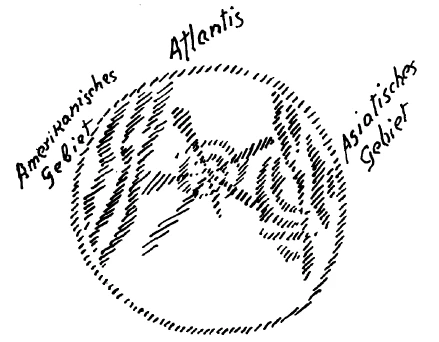
[ 19 ] Now, a portion of these forces was held back to act as Luciferic and Ahrimanic forces during the fifth post-Atlantean epoch; indeed, even some of the good forces—those that were legitimate during the Atlantean epoch—were held back, and these too are now Luciferic and Ahrimanic. However, the center was shifted to another point on Earth. Atlantis is, after all, gone. The center was shifted over to Asia, so that you might imagine, on the opposite side of what I have drawn schematically here, over in Asia, the aftereffects of the old Atlantean culture radiating out from there as a preparation for the fifth post-Atlantean epoch—to Luciferize and Ahrimanize it. They were essentially descendants of the ancient Atlantean teachers, who were now active from a point over in Asia. A priest had been trained to look back upon what had been seen in ancient Atlantis, to behold what the Atlanteans called the Great Spirit, and to receive instructions from this Great Spirit. And the priest, who had been initiated into these instructions, communicated them to a young, extraordinarily strong, energetic, and capable man, who, as a result of these instructions, came to be known within his community as “The Great Ruler of the Earth”—Genghis Khan. And the Great Spirit, through his successor—indirectly via this priest—had given Genghis Khan the task of using all the powers that could be mustered in Asia to spread that which could lead the fifth post-Atlantean epoch back into a Luciferic form. These powerful forces, which were even stronger than those that began to take effect in Greek culture, were deployed from this side. From this side, all free imaginations were to be transformed into ancient imaginations, into visionary imaginations. The aim was to work in the most powerful way possible to lull the human soul entirely into a twilight experience of the imagination, rather than into a free experience of the imagination imbued with reason. The intention was to use the special forces that had been preserved from Atlantis to influence the West in such a way that Western culture would have become a visionary culture. Then it would have been possible to separate the souls and form a special continent, a special planetary body, with them. All the upheavals that entered the development of modern humanity through the Mongol invasions and everything connected with them—and which continued to have an effect in the fifth post-Atlantean epoch, having already been prepared earlier—all these upheavals represent the great attempt, originating in Asia, to “transform European culture into a visionary one,” to sever it from the conditions of ongoing evolution, to lead it away from the Earth, so to speak. The East has indeed felt this “reimagining,” this desire to alienate itself from the Earth, time and again.

[ 20 ] A counterbalance had to be created to this. And this counterbalance was, at first, one that is part of the normal development of humanity. So, in contrast to what was to be brought about under the influence of the priest of Genghis Khan—the “relief” of the human race, intended to lead it away from the Earth—a counterweight to earthly gravity had to be created. And this was achieved by the discovery of the Western world—the discovery of America—with all that America held, thereby creating for humanity an earthly gravity and a desire to remain on Earth. The discovery of America and everything connected with it—indeed, the very immersion in the material realms of the Earth—meant, viewed from a broader perspective, the counterweight to the activity of Genghis Khan. America was to be discovered in order to lead people to become more deeply rooted in the Earth, to become more and more material, so that they might possess a sense of heaviness—a counterweight to the spiritualization sought by the descendants of the Great Spirit.
[ 21 ] But on the other hand, at the same time as this normal process of expanding humanity’s sphere of activity across America, the other, Ahrimanic forces of the Great Spirit also came into play. One current flowed from there to Europe, while another flowed from Asia to the other side and permeated America, so that the discovery of America not only led to the development of the normal forces but also brought with it powerful Ahrimanic onslaughts, which at first were still weak—they will continue to intensify, they merely need to be recognized—in such a way that the very evolution which Romanism had achieved in the Church and in the ecclesiastical state was overtaken by this Ahrimanic influence. While it is relatively easy to describe how the Luciferic influence worked through Genghis Khan—since we know quite precisely that a priest was initiated by the descendant of the Great Spirit—it is much more difficult to describe, because the details are so complex, how the Ahrimanic spirit worked from the other side. But you need only study how deeply Catholic—strictly Catholic—Spain was gripped by all the gold treasures found in America, and by everything associated with them. Study precisely that strange aftereffect that ancient Romanism has, like a specter, in a ruler such as Ferdinand the Catholic of Castile, or in Charles V, insofar as he is the ruler of an empire on which the sun never sets: time and again, new attempts at this expansion! Study Europe’s relations with the flourishing, gradually discovered Americas, and you will see how the temptations arise from there. It is, on the whole, a history of temptation, interwoven at the same time with a history that follows its normal course.
[ 22 ] I ask you only not to say that I portrayed the discovery of America today as an Ahrimanic act; on the contrary, I said the exact opposite. I said that America had to be discovered, had to be found, that all of this was necessary in the progressive course of world history—only that Ahrimanic forces have intervened, forces that are in opposition to what was meant to happen in the progressive course of world history. In reality, things are not so simple that one can say: Here is Lucifer, here is Ahriman, and this is how Lucifer and Ahriman behave, and this is how they divide up the world. That is not how things are.
[ 23 ] Thus we see the interplay of many forces that we attempted to eavesdrop on in their realm beyond the physical plane. All these forces, in turn, took control of others. They seek to take control of whatever human forces extend into the fourth post-Atlantean epoch, to distort them in their own way, and to put them at their service. You need only study a figure from the Renaissance such as Machiavelli, and you will find a human, personal symbol of this entire process that is beginning—the politicization of intellectual life. Machiavelli is, in fact, an expression, a revelation of this politicization of intellectual life—a great, powerful spirit, but one who, under the onslaught of the forces I have spoken of, completely revives the attitudes that stem from pagan ancient Rome. If we truly study history—recognizing that Machiavelli is not a single personality, a single individual, but merely the particularly significant expression of many who think in this way—then we see things as they really are. There we see what is rushing forward rapidly, what seeks to surge forward swiftly with the atavistic forces left behind—that is, Luciferic forces. Had things gone according to Machiavelli’s design, all of Europe would already have been politicized. Such forces, which act like a storm, are then countered by those that act in a normal manner. We can contrast such a purely political figure—one who reduces all human thought to the political, as Machiavelli does—with a personality who was almost his contemporary: Thomas à Kempis, who is wholly immersed in slow, gradual development and who is a spirit entirely devoid of politics, one who works slowly and gradually.
[ 24 ] And so we can trace these individual currents. We will find some that are ordinary; we will find others that flow in from earlier times and are utilized by the forces we have mentioned. Many forces interact in history. One must certainly focus one’s attention on these interrelationships. In a person such as Jakob Böhme, we see how he feels free imagination sprouting forth. One could say: Jakob Böhme is the kind of personality who, through the very nature of his inner life, has managed to avoid being disturbed by the Luciferic and Ahrimanic assaults and to follow the straight path of evolution.
[ 25 ] In contrast, in Eastern Europe and within Eastern culture, you can find numerous individuals who suffer greatly from the Luciferic disturbance—the disturbance that seeks, time and again, to tear the human being away from the earth, from the physical body, and to cause them to fall, time and again, into a state, into a situation that transforms the whole human being as if into a vision of themselves, thus completely spiritualizing them. This is the tendency that has been instilled in Eastern Europe. In Western Europe, by contrast, what has been instilled to a much greater extent is the sense of being drawn toward the other side, of the imaginative world being drawn toward bodily heaviness, toward physical heaviness, in order to transform what is meant to become free imagination into something that acts not merely in the soul but in the organism—something that the soul forces into the organism, thereby allowing the organism to participate in the imaginations. One can hardly express what I mean here more succinctly than Alfred de Musset did when characterizing his own state of mind. Musset is one of those personalities who felt an imaginative life within themselves, but who also sensed the onslaught against this imaginative life—that onslaught aimed at forcing this imaginative life into physicality. There, because it does not belong there—because it is meant to develop while floating freely in the soul—this imaginative life is seized by earthly heaviness and by all that is merely physical, whereas it is meant to unfold in the soul. Elle et lui, the book George Sand wrote about her relationship with Musset, contains a beautiful self-portrait of Musset’s inner life, and I would like to share a few passages from it, from which you will see how he himself feels caught up in such a besieged imaginative life. Musset says: “Creation confuses me and makes me tremble. The execution, which is always too slow for my desire, causes my heart to pound terribly, and weeping, barely holding back loud cries, I give birth to an idea—it intoxicates me in the moment, and the next morning it repulses me. If I reshape it, it becomes even worse; it slips away from me; better that I forget it and await another. But this other idea overwhelms me so confusingly and so immeasurably that my poor being cannot grasp it. It presses upon me and torments me until it has become realizable, and then the other sufferings—the labor pains—set in: truly physical pains that I cannot define. This is how my life passes when I allow myself to be dominated by this “giant artist who is within me”—consider the contrast to Jakob Böhme, who feels God within himself; he, a giant artist who is within him — “So it is better that I live as I have resolved to live, that I commit excesses of every kind in order to kill this gnawing worm, which others modestly call “inspiration,” but which I quite openly call “illness.”
[ 26 ] Almost every sentence contains a parallel to what I shared with you as a saying by Jakob Böhme, but it is also incredibly characteristic. Do you remember what I said earlier: “Let’s take it slowly—we’ll get back to this tomorrow”—following the normal course of development; here, however, there is a wild impetus, which is why it is not fast enough for him. And he describes it himself. It is a wonderful self-revelation that he offers here. He says: “Creation confuses me and makes me tremble,” because the desire to move faster, coming from the Ahrimanic side, constantly bursts into that which wants to proceed slowly. “The execution, which is always too slow for my desire, causes my heart to pound terribly”: there you have the entire psychology of the person who wants to live in free imaginations and is disturbed by surging Ahrimanic forces. “And weeping, barely managing to hold back loud cries”—consider how physically the imaginations affect him, so that he wants to scream when they manifest within him—“I give birth to an idea—it intoxicates me in the moment, and the next morning it repulses me.” Because it comes from the organism rather than from the soul! “If I reshape it, it becomes even worse; it slips away from me; better that I forget it and wait for another.” Because he wants to move ever faster—faster than normal development can keep pace with. “But this other idea overwhelms me so confusingly and so immeasurably that my poor being cannot grasp it. It presses down on me and torments me until it has become realizable, and then the other sufferings—the labor pains—set in: truly physical pains that I cannot define.” And that is why, he says, as he looks upon this giant artist at work within him, he would rather lead his life as he has resolved to do—namely, to have nothing to do with this entire imaginative world; for he calls it a “disease.”
[ 27 ] In contrast, consider Jakob Böhme’s statement: “I say before God that I myself do not know what will become of me.” That is bliss put into words. Confusion is expressed when it is said: “Creation confuses me and makes me tremble. The execution, which is always too slow for my desire, causes my heart to pound terribly.” With Jakob Böhme, everything is spiritual! And when he wants to write, it seems to him as if it is not a giant artist who makes him unhappy, but a spirit dictating to him, as he is transported into this world where the spirit dictates to him; he is in this world and is overjoyed by it, since he is then given constant and certain knowledge—constant, slowly unfolding. Jakob Böhme is inclined to accept this slowly unfolding knowledge; the process is not too slow for him, because he does not feel what I have described to you as the “rapidly surging” force to be dominant, but is instead protected from it.
[ 28 ] We could cite more and more examples—if we had the time—that would show us how human beings are embedded in this process of the world. The people I have mentioned have, of course, been singled out precisely because their names have been preserved by history. But in a certain sense, all of humanity—some in one way, others in another—is subject to this same reality. We select such examples only to bring to light what exists on a broad scale, so that we may characterize it through specific examples. And if you try to take in what we have presented here, you will be able to understand many things that have developed. One could, of course, also discuss some other aspects of life, but let us focus today once more on spiritual life—and more specifically, on the life of knowledge. In this particular realm, qualities may reveal themselves to us that characterize modern humanity and that can help us understand many things. Since it is not possible to say much about external life—due to the prevalence of today’s prejudices and everything connected with the soul’s bondage in present-day circumstances—it is, of course, only to a very limited extent that I can speak here and now about the forces that continue to influence the immediate present of our days. That is not possible, as I have already indicated on several occasions. But I would like, so to speak, to point out those phenomena that stir the emotions and passions to a lesser degree. Let me first describe a few phenomena—phenomena of the life of knowledge and feeling—that I have singled out, drawing a provisional line under the observations I have made by showing you which forces are at work in this fifth post-Atlantean epoch. In order to situate these individual phenomena within those forces, let us first examine them from a historical perspective.
[ 29 ] Let us single out a phenomenon that must, however, be of the deepest interest to us—a very significant phenomenon; let us take the phenomenon that manifests itself in the human understanding of the essence of Christ, and let us consider related manifestations of this understanding of the essence of Christ. Here we have a more recent example in Ernest Renan’s The Life of Jesus, which was published in the early 1860s, quickly went through many printings—I believe the twentieth edition was already published in 1900, after Ernest Renan’s death. Then there is The Life of Jesus—which, in reality, is not actually a life of Jesus—by David Friedrich Strauss. And then we have—we cannot exactly call it a “Life of Jesus,” but certain views of the utmost significance in Eastern Europe; not a “Life of Jesus,” but a discourse on Christ that culminates in what Soloviev wrote about Christ and his intervention in earthly evolution. What three significant expressions of 19th-century human spiritual life—this Life of Jesus by Ernest Renan, this Life of Jesus—which is not actually a Life of Jesus (we will hear why in a moment)—by David Friedrich Strauss, and this intervention of Christ in the evolution of the Earth, as Soloviev has expounded. At the very least, his remarks culminate in the idea of Christ.
[ 30 ] What is the crux of Renan’s discussion of the life of Jesus? If you wish to properly appreciate Renan’s book The Life of Jesus—that is, to understand it as a document of its time—then you must compare it with earlier accounts of the life of Jesus. You need not limit yourself to literary depictions of the life of Jesus; you can also examine all depictions—including pictorial ones—of the life of Jesus. For the same approach, so to speak, is evident everywhere in the way the life of Jesus is portrayed. In the early Christian era in Rome, not only was Christianity adopted from the East, but so was the depiction of Jesus. There were, of course, Greek depictions, Greek visual representations, and the East retained the ability to depict Christ. The Byzantine image of Jesus was, after all, repeatedly depicted in the West as well, stemming from Roman culture, until, starting around the 13th century, national ideas—which later manifested themselves in the manner I have already hinted at in recent days— emerged for the first time—impulses that gradually transformed the stereotypical, traditionally perpetuated image of Jesus, as the nations appropriated the Jesus archetype and depicted it in their own way.
[ 31 ] Here, once again, a wide variety of influences come into play in the depiction of the figure of Jesus. Observe how strangely the national perspective creeps in—I would say—into the depictions of Jesus’s head by Guido Reni, Murillo, and Lebrun. These are just three examples one could single out. Everywhere we see the desire to depict the figure of Jesus in a national style. It is evident everywhere: in Guido Reni, the Italian character flows into the face of Jesus far more than was the case with his predecessors; in Murillo, the Spanish character; and in Lebrun, the French. But in all three of these depictions, we see the principle of ecclesiastical tradition. You will not find paintings by them in which you do not see the powerful Church standing behind them. In contrast, you find a rebellion—one might say, a painterly rebellion—against the all-encompassing power of ecclesiastical authority, which is evident in the paintings of Murillo, Lebrun, and Guido Reni; a rebellion, a free exploration of humanity itself, in the works of Rubens, van Dyck, and Rembrandt. This is nothing short of painterly rebellion when viewed in relation to the depiction of Jesus’ face. In any case, however, we see from this development that the ideas associated with Jesus are not static, but that the forces at work in the world are themselves exerting their influence on this realm. Just as Romanism lies like a breath over Lebrun, Murillo, and Guido Reni as they rise to the national level, so too is the onslaught against Romanism so clearly expressed in the faces—not merely the face of Jesus, but the other faces of sacred history—in the works of Rubens, van Dyck, and especially Rembrandt. And so we see how, under the various impulses arising in human evolution, all spiritual developments gradually take shape.
[ 32 ] And likewise, you would find that in the periods since the 16th century, when the performing and visual arts have become increasingly detached from the word, as — for verbal representations have held the same significance for such matters since the 16th century as pictorial representations did in earlier times — the figure of Jesus, the figure of Christ, which is never fixed or rigid but is always conceived in accordance with how the various forces converge in the artists, once again comes into flux. And I would like to say: Renan’s Jesus, David Friedrich Strauss’s Jesus—who is not Jesus at all—and Soloviev’s Christ stand there as, for the time being, the latest products. And how vastly different they are from one another!
[ 33 ] Renan’s Jesus: A Jesus who lives as a human being in Palestine, just like a historical figure. Moreover, this Palestine itself is depicted in a wonderfully vivid way, drawing on all the resources of modern scholarship, I would say depicted in such a way that one has the entire Palestinian landscape with its people right before one’s eyes, and walking through this realistically and naturalistically depicted landscape with its people is the figure of Jesus, and the attempt to explain this figure of Jesus from the landscape and humanity of Palestine—how he grows up, how he becomes human, how such a person could have come to be in Palestine. One only realizes the excellence of Renan’s depiction when comparing it to earlier accounts. Earlier accounts take the inner progression of what is described in the Gospels and transpose it into a landscape that is nowhere in particular. In the past, the facts as described in the Gospels were simply recounted over and over again; the landscape was completely disregarded, and the narrative was presented in such a way that it could take place anywhere. Renan, however, sets out to depict the Holy Land realistically in every detail, so that Jesus, within this Holy Land, becomes a true Palestinian. Christ Jesus, who is supposed to belong to all of humanity, becomes a Jesus who lives and walks in Palestine as a historical figure—a Palestinian—understood in terms of the Palestine between the years 1 and 33, understood in terms of the local customs, the local views, and the local landscape. A realistic portrayal. The aim was to portray Jesus as a historical figure, just as any other historical figure is portrayed. To Renan’s mind, it would make no sense to portray an abstract Socrates who could be anywhere, who could ultimately exist at any time; but for Renan, it makes just as little sense to portray an abstract Jesus who could be anywhere. In keeping with 19th-century scholarship, he seeks to portray Jesus as a historical figure who lived between the years 1 and 33, as he can be understood in Palestine within the context of Palestinian conditions. This Jesus lived between the years 1 and 33, died in the year 33, just as any other person died in one year or another, and his lasting influence persists just as the lasting influence of any other historical figure who died in a certain year. Fully grounded in the modern perspective—Jesus as a historical figure, understood within the context of his milieu—this is what Ernest Renan’s The Life of Jesus offers us.
[ 34 ] Let us now consider David Friedrich Strauss’s The Life of Jesus, which is not actually a life of Jesus. I say it is not a life of Jesus; for although David Friedrich Strauss sets to work as a very learned man, examining what he wishes to examine with thoroughness—with the very same thoroughness that Ernest Renan displayed in his field—David Friedrich Strauss does not direct his attention to the historical Jesus; for him, the historical Jesus is initially merely the figure to whom he attaches something entirely different. David Friedrich Strauss examines what is said about Jesus insofar as Jesus was the Christ, insofar as Jesus miraculously enters the world, develops in a miraculous way, expresses great teachings of a certain kind, undergoes suffering and death, and moves toward the Resurrection. David Friedrich Strauss examines these accounts in the Gospels. Ernest Renan, of course, also drew on the Gospels, but he reduced them, so to speak, to what he—based on his precise knowledge of Palestine—could regard as credible for a worldview relating to the life of Jesus. This does not interest David Friedrich Strauss further; rather, Strauss tells himself: The Gospels recount this or that about Christ, who lived in the person of Jesus. — He then examines to what extent what is recounted there about Christ has also existed as a myth here or there; how the account of a miraculous birth is found in this or that myth of this or that people; how the account of his development is found here or there; and finally, how the mystery of Golgotha itself is already found in the myths and how it is applied in the legends, applied there to this god and here to that god. And so David Friedrich Strauss sees in the figure of the historical Jesus merely an opportunity for humanity’s myth-making to concentrate on a single personality. Jesus is of no concern to him; he is of value to him only insofar as the myths, which are otherwise scattered throughout the world, are concentrated on this one Jesus, to whom they are all attributed. But to him, all these myths stem from a common impulse; to David Friedrich Strauss, they all speak of the myth-forming power that lives within humanity. And where, for David Friedrich Strauss, does this myth-forming power come from? It comes from the fact that humanity, as it has developed on Earth from the very beginning of the Earth’s existence to its end, will always possess within itself a higher power than the merely external power that develops on the physical plane. A force runs through the entire human race, and this force will always be directed toward the supernatural; and this supernatural is expressed in the myths that are formed. We know that within him lives a supersensible reality that seeks to express itself in myths—a reality that cannot be expressed in external, physical science, but which finds expression in myths. Thus, David Friedrich Strauss sees the Christ not in the individual Jesus, but in all human beings; the Christ who, since the dawn of humanity, has lived through all people, through all of humanity, and has inspired the creation of myths about him. It is only through the personality of Jesus that this myth-forming power develops most strongly. That is where it concentrates. Strauss, therefore, does not speak of a Jesus; he speaks of a Jesus who is not actually Jesus, but to whom is merely attached that which, as the spiritual Christ-force, flows through all of humanity. For David Friedrich Strauss, humanity itself is the Christ, and the Christ is always at work—both before Jesus and after Jesus. And for David Friedrich Strauss, the true incarnation of the Christ is not the individual Jesus, but all of humanity, of which Jesus is merely the most outstanding representative in humanity’s embodiment of the Christ.
[ 35 ] So it is not Jesus as a historical figure who is the main point, but rather an abstract humanity. Christ has become an idea, and this idea is incarnated throughout all of humanity. It is the most distilled concept that people in the 19th century were initially able to grasp: the living essence of the idea becoming Christ, Christ understood entirely as an idea, and, in a sense, transcending Jesus! A “Life of Jesus” that is not the life of Jesus, but is intended to be a document proving that the idea—the divine—is incarnated in all of humanity, continually incarnating itself. Christ conceived in an idealized, abstract form—that is this second “Life of Jesus,” the “Life of Jesus” by David Friedrich Strauss. Thus, we have described Ernest Renan’s “Life of Jesus” as the historical figure of Jesus standing apart and alone, whereas in David Friedrich Strauss’s work, the idea of Christ pervades all of humanity, yet remains somewhat in a distilled, abstract form.
[ 36 ] And now, in Soloviev, we see nothing of Jesus at all, but only the Christ—yet the Christ sensed as a living presence, not acting as an idea that causes people to channel their power into myths, but acting as a living being who simply has no body, but who acts at all times, is always among people, and is meant to bring about the external organization, to establish the social order—the Christ who is always there, a living being who, I would say, would not have needed a Jesus at all to come among humanity as the Christ. Although, of course, all these things do not yet emerge so radically in reality in Soloviev’s work, that does not matter; it is the Christ as such who comes to the fore everywhere—namely, the Christ as the Living One, who can be grasped only through the imagination, but is grasped by the imagination in such a way that he acts on earth as a real being, as a supersensibly real being.
[ 37 ] There you have the three figures. We see how the same theme confronts us in three different ways in the 19th century: Ernest Renan’s The Life of Jesus, entirely realistic, the quintessential work of historical scholarship, Jesus as a historical figure, written with all the achievements of 19th-century scholarship. David Friedrich Strauss: the idea of humanity, active, impulsive, incarnating itself throughout all of humanity, yet remaining an idea, never coming to life. Soloviev’s Christ: living power, living wisdom, spiritual. Ernest Renan’s realistic life of Jesus, David Friedrich Strauss’s idealistic life of Jesus—which is at the same time an idealistic portrayal of the Christ impulse—and Soloviev’s spiritual portrayal of the Christ impulse.
[ 38 ] Today, I wanted to begin by presenting these three manifestations of modern life—as they appear side by side—in the light of the figure of Jesus Christ. Tomorrow, we will then place them within the context that emerges from the impulses we have come to know.