

Humanity's Internal Impulses for Development
Goethe and the Crisis of the Nineteenth Century
GA 171
25 September 1916, Dornach
Translated by Steiner Online Library
Sixth Lecture
[ 1 ] We have sought to show how, in the historical development of humanity, those spiritual forces come into play that we, in our own way, refer to as Luciferic and Ahrimanic forces or powers. We have seen how that which is to be carried over from one age to the next in the course of world history is carried over by such forces, and we have endeavored to show how what is present in human instincts, desires, the thirst for knowledge, and even in the impulses of social life can be grasped concretely only when one is familiar with these supersensible forces that underlie the development of world history. Just as this was to be articulated for our fifth post-Atlantean epoch, so, as we have seen, the groundwork has been laid since the 15th century. We have seen what new capacities have emerged in humanity since that 15th century, and what has developed within the entire cultural organism of Europe since that time.
[ 2 ] If we wish to look for a spirit who has expressed in the most concentrated and incisive way what the human impulses of our time should be, we can look to Goethe, and we have already mentioned that, through both his view of nature and his imaginative world, he has given expression to what can form the beginning of the fifth post-Atlantean epoch. And I must remind you today that I have often pointed out how Goethe, in that fairy tale about the green snake and the beautiful lily, intimately expressed what he regarded as cultural impulses, impulses of knowledge, and impulses of feeling— impulses of the will—what he must have regarded as necessary for human effectiveness in the future—in an intimate way in that fairy tale of the green serpent and the beautiful lily, into which he wove what he knew, one might say, from the spiritually hidden forces that have been at work in humanity since the 15th century and will remain active for about two millennia. You also know how, in our Mysteries, we have attempted in great detail to bring to life what Goethe perceived when he composed this fairy tale of the green snake and the beautiful lily. In these mysteries, what inspired Goethe—and what is to inspire the entire fifth post-Atlantean cultural humanity as its highest spiritual asset—was to be expressed in a way that is appropriate a hundred years after Goethe.
[ 3 ] Such depths of the human soul—as lie at the heart of such a great and powerful work of literature as the fairy tale of the Green Snake and the Beautiful Lily, even though it is a symbolic work—and such great impulses as underlie Goethe’s Faust as a work of universal significance, point us time and again to deep forces lying beneath the surface of consciousness. This is at work in such a soul, emerging from the depths of ancient cultural impulses. And today, in connection with what I discussed yesterday, I would like to speak a little about such cultural impulses, which, in Goethe’s case, I would say have undergone a certain spiritualization.
[ 4 ] We must go back once again to that time when, so to speak, the seeds of the impulses for the fifth post-Atlantean epoch were sown; we must go back to before the 15th century, because such things, which continue to have a spiritual effect, must be prepared long beforehand. How, in European spiritual and social life—in the striving for the true, the beautiful, and the good in European life—the normally active divine-spiritual forces become entangled with the Ahrimanic-Luciferic powers of our age can only be recognized by going back to the times when, so to speak, the first impulses were given. We learned about such early impulses from earlier times yesterday. Today we will examine another such impulse from the middle of the Middle Ages; we will explore how, in the middle of the Middle Ages, certain spiritual tendencies emerged from the process of human development. In doing so, I will only be able to touch upon the historical background. After all, anyone can look up the historical background today in any general encyclopedia.
[ 5 ] In order to describe the configuration of the cultural impulses—which then underwent a certain spiritualization in Goethe—I must refer back to that time when, out of the European will, and specifically out of the Christian impulses within that European will, the will to wage the Crusades arose. During this period, when the will to visit the holy sites arose within European cultural humanity, there were fierce clashes throughout European life between what are called Luciferic and Ahrimanic forces. That is to say, the continuing, positive, truly Christian impulses were, in a sense, counteracted from those sides that were characterized yesterday, in the manner permitted by the wise guidance of the world, so that what is happening in the wise guidance of the world today might be shaped accordingly by the other impulses working in from the past—impulses that constantly intersect with the present impulses, just as we have often discussed.
[ 6 ] Among the many events of this period, we see one that, upon reflection, I would say serves to gladden the human soul: among the many developments that arose shortly after the Crusades achieved their first successes, the Order of the Knights Templar was founded in 1119. Five French knights, led by Hugo de Payens, joined forces and founded an order at the sacred site where the Mystery of Golgotha took place; an order dedicated entirely to the service of the Mystery of Golgotha, with its first and most important monastery located directly adjacent to the site where the Temple of Solomon once stood, so that, in a sense, the ancient, sacred wisdom prepared for Christianity could interact at this site with the wisdom of Solomon, along with all the sentiments and feelings that arose to the highest degree from the most sacred enthusiasm for the Mystery of Golgotha and its bearer. In addition to the customary monastic vows of the time and the duty of obedience to their spiritual superiors, the first Knights Templar committed themselves to working in the most intensive way to incorporate into the sphere of European power the sites where the Mystery of Golgotha had taken place. They were to think of nothing else—as was laid down in the written and, above all, the unwritten rules of the Order—but how they might fill their hearts and souls entirely with the sacred mystery of Golgotha, and how they might serve, with every drop of their blood, to bring the sacred site into the sphere of influence of the European will. At every moment of their lives, they were to think and feel that they belonged entirely to this task, and that they would spare no effort to fulfill this task with all the strength available to each individual. Their blood was not to belong to them, but solely and exclusively to the task we have described. And if they face a threefold superior force—so they were commanded—they must not flee; every Templar must hold his ground, even if three infidels seek to dispute that position. And at every moment of their lives, they were to remember that the blood flowing through their veins did not belong to them, but to their great spiritual mission. Whatever wealth they might acquire was not to belong to any individual. No individual was to possess any property; it belonged solely to the Order as a whole. An individual who defeated an enemy was not to take any spoils other than the hemp cord tied around his waist—the symbol of the work he had voluntarily undertaken for what was then regarded as the salvation of the European spirit. A great and formidable task—one that called less for reflection than for deep feeling—had been set: a task aimed at strengthening the life of the soul as individual and personal, solely so that this individual life of the soul might be fully absorbed into the continuous stream of Christian development.
[ 7 ] In a sense, this was the star that was meant to guide the Knights Templar in everything they thought, felt, and undertook. This gave rise to an impulse in their souls which, as it continued to take effect with the further expansion of the Order of the Knights Templar from Jerusalem across the European countries, should have led to a certain spiritualization, a Christianization of European life. It may seem understandable, given the sheer immeasurable zeal that existed in the souls of these Knights Templar, that those powers whose purpose is to hold back development are compelled to steer them in such a way that human souls are diverted from the Earth, become alienated from it, and are, so to speak, led to a particular planet so that the Earth might be depopulated—that the forces desiring this would particularly set their sights on the souls who felt and sensed as the Knights Templar did. These souls, who wished to devote themselves entirely to the spiritual—it was easy for those forces to approach them that seek to remove the spiritual from the Earth, that do not want the spiritual to spread on Earth, that do not want the Spirit to permeate earthly existence. And there is always the danger that souls will become estranged from the Earth and weary of it, and that humanity on Earth will become mechanized.
[ 8 ] On the one hand, we have a spiritual life that is flourishing tremendously, and we may assume that the Luciferic temptation is close at hand, because there is a strong basis for such a temptation. But then, at the very same time that the Order of the Templars was rapidly spreading across the various Christian countries of Europe, there was, in Western Europe, the possibility of a sharp intervention by Ahrimanic forces. For in the period when the Order of the Templars, through its activities, had attained great prestige and also great wealth—as an order, not as individual Templars—and had spread throughout Western Europe as well, during this time at the end of the 13th and the beginning of the 14th century, we find a man ruling in the West, a human personality who, one might even say, felt a kind of enthusiasm in his soul inspired by the moral—or rather, immoral—power of gold; a personality who was able, in a one-sided way, to draw his inspiration from the materialization of wisdom through gold. Recall the fairy tale of the green snake and the beautiful lily, in which the golden king has become the representative of wisdom! It is indeed possible—because spiritual forces are also contained within individual substances (for matter is always only apparent; spiritual forces lie behind it, even if the materialist is unable to perceive them)—that gold itself can become a source of inspiration. A highly gifted personality, endowed with extraordinary, supreme intelligence, is susceptible to this inspiration through gold—an inspiration imbued with the very worst kind of Ahrimanic wisdom. This is King Philip the Fair, Philip IV, who reigned in France from 1285 to 1314. Philip IV the Fair can truly be called a brilliantly greedy man, a man who felt within himself the instinctive urge to recognize nothing in the world but what could be measured in gold, and Philip the Fair would grant no one but himself power over gold. He sought to force virtually all the power that gold could bring into the realm of his own will. This became his great, world-historical obsession.
[ 9 ] This led to the situation where, on an occasion that was in itself not very significant—namely, when Pope Boniface forbade French clergy from paying taxes to the French state—Philip IV the Fair enacted a law prohibiting the export of gold and silver from France. All gold and silver in France was to remain in France according to his will; but he was to have power over all the gold and silver. That was, one might say, his idiosyncrasy. Therefore, he tried to keep the gold and silver for himself and to give the rest of the people he ruled only token value; that is, he had the coins minted as poorly as possible in order to retain the gold in his gold and silver treasury and to add as little as possible to the coins. The unrest and outrage of the people over such measures could not deter him from continuing in this manner. So when he made a final attempt to mix as little gold and silver as possible into the coins, he was forced, by a popular uprising, to flee to the Templars’ sanctuary. There, driven by his own repressive measures, he had his treasure—his hoard of gold—hidden by the Templars. He was astonished at how quickly the Templars were able to quell the popular uprising. But at the same time, he was filled with fear, for he had seen how great the Templars’ moral power over the people was, and how little he—who was inspired solely by gold—could do in the face of the Templars’ moral power; for even back then, they already possessed rich treasures—treasures that were immensely vast— but who, according to their rule, were required to place all the wealth of their Order at the service of spiritual work and spiritual creation.
[ 10 ] When a passion becomes as strong as Philip the Fair’s greed for gold and silver, it unleashes powerful forces within the human soul—forces that exert a strong influence on the development of one’s will in relation to other people. Philip the Fair had little influence over the people; but all the more so over those who were his minions—and that was, after all, a vast army. And he knew how to use his power, this Philip the Fair. When Pope Boniface once refused to do his bidding—that is, to make the clergy in France pay as much as possible—Philip IV the Fair instigated a conspiracy against Pope Boniface, and Pope Boniface could only be rescued by his own followers. He died of grief very soon afterward. This was at the same time that Philip IV the Fair undertook to bring the Church entirely under the control of the monarchy, to make the Church leaders mere servants of the royal power governed by gold. Consequently, he arranged for the Pope to relocate to Avignon, and under Philip the Fair began the European “Babylonian Captivity” of the popes—often mentioned in history—which lasted from 1309 to 1377.
[ 11 ] Pope Clement V—who had previously been Bishop of Bordeaux and then took up residence in Avignon—was a complete puppet in the hands of Philip IV the Fair of France. Gradually, through Philip the Fair’s overwhelming will, he had been reduced to the point where he no longer had a will of his own, but truly used his ecclesiastical authority solely to serve Philip the Fair, whatever Philip the Fair desired. And Philip the Fair desired above all else—as if driven by a deep passion—to make himself the master of all the riches available at that time. No wonder that he—especially after he had seen what other significance gold could have in other hands—wanted above all else to destroy those other hands, the hands of the Templars, in order to seize their gold and take possession of it, to take possession of all their treasures. Now I said: Such a passion, which is stirred in such a material way and is so intense, generates at the same time powerful forces within the soul; but it also generates insights, even if they tend toward the Ahrimanic. And so it could be that certain insights dawned in the soul of Philip IV the Fair—I would say, of a subordinate nature, of that mode of cognition which we have seen flare up in the most bitter, abominable way in the Mexican mysteries. Philip IV the Fair came to realize what one can achieve by overcoming life in the world in the right way—albeit in a different manner than the Mexican initiates, and though not in such a direct but rather in a more indirect way. And as if driven by deep subconscious impulses, he found the means to incorporate subconscious impulses for human development through the killing of people. For this, he needed his victims. And in a most remarkable way, this diabolical instinct of Philip IV the Fair coincided with what was necessarily developing on the other side within the bosom of the Templars through their life devoted to the things characterized by it.
[ 12 ] Of course, when something as noble and grand as the Templars emerges, many inappropriate—and perhaps even immoral—elements inevitably attach themselves to that greatness and nobility; and there is no denying that there were certainly Templars who could be accused of all sorts of things. But that was not in keeping with the spirit of the Knights Templar’s founding. In keeping with the spirit of the Knights Templar’s founding was, first and foremost, what the Templars had accomplished for Jerusalem, and then what could be accomplished toward the Christianization of the entire European culture. For gradually the Templars spread into influential circles throughout England, France, Spain, and parts of Italy, throughout Central Europe—everywhere the Templars spread. And in individual Templars, this complete filling of the soul with a sense of the Mystery of Golgotha, with a sense of all that is connected with the Christian impulse, developed to the highest degree. The power of this connection with Christ grew strong and intense within the Templars. That was a true Templar—one who, in a sense, was no longer aware of himself, but who, when he felt, allowed Christ to feel within him; when he thought, allowed Christ to think within him; and when he was inspired, allowed Christ to be inspired within him. Perhaps there were only a few, but compared to the entire body of the Knights Templar, it was nonetheless a considerable number of men in whom this ideal brought about a complete transformation—a veritable metamorphosis of their inner life—that truly and repeatedly lifted the soul out of the body, allowing it to love in the spiritual world.
[ 13 ] As a result, something truly remarkable had taken place among the Templars; something truly magnificent and powerful had taken place among the Templars, even though these Templars knew the rules of Christian initiation through nothing other than the rite of sacrifice. First during the Crusades, then through their spiritual work in Europe, their souls were so inspired by their intense devotion to Christian impulses and to the Mystery of Golgotha that the result was the experience of Christian initiation among many Templars—a considerable number of them. And we have before us the world-historical event in which, against the backdrop of world history, Christian initiation arises from a group of men emerging from the depths, from the very womb of human becoming—that is, the beholding of those spiritual worlds that are to become accessible to human beings through Christian initiation.
[ 14 ] This always provokes opposition—opposition that was, after all, abundant at that time. So whatever comes into the world is not only loved; it is also fiercely hated. It was less hatred than a desire to wipe out such a society from the world and to seize its treasures—treasures that had flowed to it in abundance and that it was meant to use only in the service of the spirit—that drove Philip IV the Fair.
[ 15 ] Now, such an initiation—as was recently the case with a number of Knights Templar—always presents the opportunity not only to see the blissful, the divine, but also to perceive the Luciferic and Ahrimanic forces. Everything that works against the divine, everything that pulls human beings down into the Ahrimanic world and up into the Luciferic world—all of this appears, alongside the insight into the normal spiritual worlds, to the one who undergoes such an initiation. All the sufferings, all the temptations, and all the trials that come upon human beings through the forces opposed to the good—the initiated person faces these, and there are moments when, before his spiritual gaze, before the gaze of his soul, the good spiritual world fades away, and he finds himself as if trapped by that which seeks to gain power over him, and sees himself in the hands of the Ahrimanic-Luciferic forces that seek to seize him, that seek to take possession of his will, thought, feeling, and sensation. These are, after all, the spiritual trials well known from the descriptions of those who have looked into the spiritual world. And there were many within the circle of the Knights Templar who were able to gaze deeply into the mystery of Golgotha and its significance, who were able to gaze deeply into Christian symbolism as it had taken shape through the development of the Last Supper, and who could perceive the profound background of this symbolism. Many who, as a result of their Christian initiation, were able to look into the Christian impulses that flowed through the historical development of the European peoples—many who could look into these things—also saw something else. He experienced it, so to speak, in his own soul, because it came upon him as a trial that he repeatedly overcame; it revealed itself to him because he had to recognize what a human soul is capable of, even if it remains unaware of it. The initiate becomes aware of this and seeks to overcome what would otherwise remain in the unconscious. Thus, many such Knights Templar came to know that diabolical impulse which seizes hold of human will and feeling, seeking to debase the Mystery of Golgotha. And in the dream images that can haunt such an initiate, it appeared to many—which was entirely possible given the nature of how this initiation had come about, especially since the Luciferic forces were standing by, tempting them—as it were, the flip side of the veneration of the symbol of the crucifix. In the vision, he saw how the human soul could become capable of desecrating the symbol of the cross, of desecrating the sacred act of the consecration of the Host; he saw those human forces that urge a return to the old paganism, to worship what the pagans worshipped, and to despise Christian progress. These people knew how the human soul can succumb to such temptations, because they had to consciously overcome them. And you are looking into this inner life of the soul, about which external history tells us very little.
[ 16 ] Through his Ahrimanic Gold Initiation, Philip IV the Fair also possessed a true knowledge—albeit of a purely instinctive nature—of these facts of the inner life. He knew something of this, even to the extent that he could share it with his subjects. And now, after a cruel legal process had been set in motion—through which all manner of investigations had been conducted—something was staged that had been decided from the outset. Instigated by Philip IV the Fair, plots were hatched against the Templars using the individuals who had been called upon to participate in the investigation. They were accused of every possible vice, even though it was known that they were not guilty of any of them. One day in France, they were raided so that they could all be imprisoned, and after they had been imprisoned, all their treasures were seized as quickly as possible and confiscated.
[ 17 ] Legal proceedings were then initiated in which, entirely under the influence of Philip IV the Fair, torture was employed to the fullest extent. Every Knight Templar who could be tracked down was subjected to the most horrific forms of torture. Thus, torture was used here to break people’s will to live in ways similar to those you have come to understand in terms of their significance. Torturing as many people as possible was part of Philip the Fair’s intentions. And the torture was carried out in the most cruel manner, so that a large number—indeed, the vast majority—of the tortured Knights Templar were tortured to the point of unconsciousness. Philip IV the Fair knew what would emerge once consciousness was clouded, once these people lay on the rack enduring the most horrific torments; he knew: that is when the images of the trials would emerge! And now, at the instigation of Philip IV the Fair, an interrogation protocol was devised—a catechism of leading questions—so that the questions were phrased in such a way that the answer was always elicited by the question itself, and the answer was given from a mind clouded by torture. The question was asked: “Have you denied the Host and failed to recite the words of consecration during the consecration?”—And the Knights Templar confessed to this, because their consciousness was clouded by torture, because the forces opposed to the Good spoke through their visions. And they accused themselves—even though in their conscious lives they had shown the highest veneration for the symbol of the cross, the crucifix—of spitting on it during Communion; and they accused themselves of all the worst crimes that otherwise existed in their subconscious at that time as temptations. And so, based on what the Knights Templar confessed under torture, it was concluded that these Knights Templar had worshiped an idol instead of Christ, an idol in the form of a human head whose eyes glow, that during their initiation they were subjected to repulsive procedures of the worst sexual nature, that they did not perform the Eucharist in the proper manner, that they engaged in the worst sexual vices, and that during their initiation they renounced the Mystery of Golgotha; and the entire interrogation had been arranged in such a way that even the Grand Master of the Order of the Templars was forced under torture to make these admissions from his subconscious.
[ 18 ] It is one of the saddest chapters in human history, but one of those chapters in human history that can only be understood if one realizes that behind the veil of what history recounts there are active forces at work, and that human life is truly a struggle. It would be easy—I will now omit everything else that remains to be told due to time constraints—to show how all the spurious reasons pointed to the conviction of the Templars. Some stuck to their confessions, some fled; a large number were convicted, and as I said, even the Grand Master, Jacques Bernard de Molay, was forced under torture to testify in the manner described. And so it came to pass that Philip IV the Fair of France was able to persuade his puppet, Pope Clement V—it was not difficult!—that the Templars had committed the most shameful vices and were the most unchristian heretics. Pope Clement V gave his blessing to all of this, and the Order of the Templars was dissolved and destroyed by Clement V. Fifty-four Knights Templar, including Jakob Bernhard von Molay, were burned at the stake. Soon afterward, trials were held against them in the other European countries as well—in England, in Spain, and then as far as Central Europe and Italy.
[ 19 ] Thus we see how, right in the midst of European development, the Templar Order’s understanding of the Mystery of Golgotha and its effects made its way into the cultural fabric. In a deeper sense, these events must be viewed as having been brought about by a certain necessity. Humanity was not yet ripe in the time of the Templars to receive the impulses of wisdom, beauty, and strength in the way the Templars intended. Moreover, for reasons we will come to understand later—reasons rooted in the overall development of the European spirit—it was not destined for this spiritual world to be attained in the form in which the Templars sought to immerse themselves in it. It would have been attained too quickly, as is the Luciferic way. And we truly see one of the most significant clashes between Lucifer and Ahriman: Lucifer, as it were, pushing the Templars into their misfortune; Ahriman, active through the inspiration of Philip IV the Fair. We see a significant clash in world history.
[ 20 ] But what lived and worked within the Templars could not be eradicated. Spiritual life cannot be eradicated. Spiritual life continues to live and weave its way forward. With the Templars—especially those fifty-four who had been burned at the stake by Philip IV—many a soul had indeed ascended into the spiritual world, souls that would have accomplished much more on Earth in the spirit of the Templars and would also have drawn disciples who would have worked in the same spirit. But things were to turn out differently. Through the experiences those souls had endured amid the most terrible torments of torture, and under the influence of the visionary confession extorted under torture, these souls ascended into the spiritual world. And their impulses—which now, between their death and their next birth, their next incarnation, affect the souls that have descended since then, as well as the souls who are still above and have been waiting for their incarnation since that time—were to be transformed from the mode of activity in the physical earthly world into spiritual activity. And what now came from these Templar souls—who had been murdered in such a wretched manner and who, before their death, before being burned at the stake, had to endure the most terrible ordeal a human being can experience—was to become a source of inspiration for many. Powerful impulses were to flow down into human souls from these experiences. And in the case of many a human soul, we could demonstrate this.
[ 21 ] Today, too, we want to focus more on the realms of knowledge and spirituality, as I have done in the other examples I’ve given over the past few days. Inspiration—including that derived from the Templars’ cosmic knowledge—was always present. It is hardly surprising that the people eventually came to regard the Templars as heretics after they had been tortured and burned; nor is it surprising that the people also believed they had engaged in all manner of shameful acts. I do not know whether, if someone were to condemn the “Devil’s Play”—which was performed just a moment ago, featuring Mephisto, the Lemures, and the Fat and Skinny Devils—as particularly heretical, there would not be numerous people among the common folk who would also regard it as heretical! It’s just that in today’s somewhat more whiny times, people no longer use the same methods that Philip IV the Fair of France employed.
[ 22 ] The cosmic knowledge possessed by the Templars has found its way into many a soul. One could cite many examples of how the Templars’ inspiration has entered people’s souls. I would like to read just one passage to you from the poem “Ahasver” by Julius Mosen, published in 1838. I have often mentioned Mosen to you—you can read about this in the cycles—as a truly profound spirit: Julius Mosen, the profound poet of profound poetry, including “Ritter Wahn.” In the third part of Ahasver, right in the first canto, Mosen leads his Ahasver to that place on Earth—in Ceylon and the neighboring islands—which we in our spiritual science, in cosmology, designate as the region where the Lemurian evolution roughly took place. This region of the Earth is distinguished in a special way. You know that there is a certain point—not the geographic North Pole, but a certain point, the magnetic North Pole. Compass needles point everywhere toward the magnetic North Pole. Certain lines can be drawn as magnetic meridians; these coincide with the magnetic North Pole. Up in North America, where the magnetic North Pole is located, these lines form fairly circular patterns, but they are straight circles. Curiously, precisely in the region we refer to as Lemuria, this line becomes a winding, serpentine path. The magnetic forces intertwine there in a serpentine pattern. Such things are given far too little attention today. But anyone who looks at the living nature of our Earth knows that magnetism is a force that animates the Earth, that it runs straight in the north and winds its way precisely in the region where ancient Lemuria once lay. Consider how profoundly Julius Mosen, when he leads his Ahasver to this region in the first canto of the third period—he divides the work into periods—how he says there:
From the South Pole, in a perfectly straight line
The magnetic line stretches out,
But suddenly it curves like a snakeBefore India and its archipelagos —
There, before the dungeon where she sits bound
The eternal mother, sorrow in her deepest soul.The line would like to shorten itself into a circle
And, mysteriously, turn inward
Suddenly plunging into a whirlwind.The Great Spirit first held her there in his embrace
His poor wife—from her fiery passion
All the earth demons sprang forth.When the first creation had thus evaporated,
He, the Great, Unnameable Spirit
In his wrath, stamped the bridal bed into the sea.
[ 23 ] And so it continues. We see an inspiration emerge there, imbued with cosmic knowledge, wonderfully intuitive. The wisdom lives on—the wisdom that, amid pain, torment, persecution, and the most terrible sins, could only find its way into the world; but in a spiritualized form, it lives on.
[ 24 ] And if we seek one of the most beautiful spiritualizations of this wisdom—which, as described, has become part of the development of the European world—we find it precisely in all that seeks to act and live within Goethe’s mighty imaginings. Goethe knew the secret of the Templars. And it was not for nothing that he used gold in the way he did in his fairy tale of the Green Snake and the Beautiful Lily, demanding that the snake devour the gold and then sacrifice itself so that the gold might be wrested from the powers of which Goethe truly knew that it must not remain with them. Of course, “gold” here also refers to everything for which gold is a real symbol. And read Goethe’s fairy tale “The Green Snake and the Beautiful Lily” once more, and try to sense how Goethe knew the secret of gold and how, through the way he let gold flow through the fairy tale, he shows that he is looking back to ancient times. Perhaps I may insert a personal confession here: when I first asked myself the very question about gold in Goethe’s fairy tale in the 1880s, the meaning of Goethe’s fairy tale “The Green Snake and the Beautiful Lily” dawned on me through the further development of the gold within the story. Through the way Goethe allows gold to flow through this fairy tale, he shows how he looks back to the times when wisdom—for which gold also stands, hence the golden king of wisdom—was subjected to persecutions such as those described. In this way, he sought to reveal the past, the present, and the future. Goethe instinctively looked into the future of Eastern European culture. He saw the injustice in the way the problem of sin and death operated there. And if one were to describe—perhaps not entirely inappropriately—the nationality of the person who is then led to the temple and the beautiful lily, who at first appears as if without spirit, as if paralyzed: given what we have had to say in recent days about the culture of the East—namely, Russian culture—you will not find it incongruous to identify this person as Russian, and in doing so you will be quite in line with Goethe’s instinct. The secret of European development in the fifth post-Atlantean epoch lies just as much in this as Goethe was able to enshrine in his Faust in his own time, particularly—as we know from his own writings—as it is contained in the second part of his Faust. It is precisely in Goethe that it can be demonstrated—and we have already done so for various points, and it is to be demonstrated in the future for other points as well—that he begins to think and to view the world and empathize with it in the manner that is the fundamental requirement of the fifth post-Atlantean epoch.
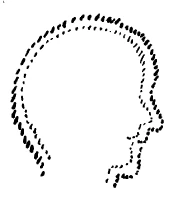
[ 25 ] Goethe is, after all, a true successor to the Templar way of life—but in a spiritualized form, just as I have characterized it. However, it is only slowly and gradually that this very Goetheanism will be able to find its way into human understanding. As I said, I have already shown how, in certain respects, Goetheanism provides the very impulse for all spiritual science. Everything in spiritual science can be developed from Goethe. And in a public lecture I gave a short time ago, I showed how Goethe’s theory of metamorphosis contains the first elementary scientific foundation for the doctrine of reincarnation—the doctrine of repeated earthly lives. For in the way Goethe begins his theory of metamorphosis and shows how the leaf transforms into the flower, how an organ appears in various forms—in this, if one follows it through to its logical conclusion, lies what I have already expounded here: that the human head is a transformed remnant of the body, and the rest of the body is a human head not yet transformed. Metamorphosis in the most extreme sense, which will directly lead science to the knowledge of reincarnation, to the knowledge of repeated earthly lives! But Goethe has been little understood so far; Goethe must first take root in human culture. And it will take not just centuries, but millennia, to fathom much of what lies within Goethe. For, fundamentally speaking, there is not even a foundation today for the study of Goethe through a monograph or biography written in Goethe’s own style.
[ 26 ] Let us see what has been accomplished within modern culture—in individual cases, since we can only cite a few examples—toward understanding Goethe’s personality as a whole. Herman Grimm, for example, rightly said: A certain Mr. Lewes wrote a book—for a time it was the most famous book about Goethe, even the very best, one might say—a book that deals with a certain person who is said to have been born in Frankfurt am Main in 1749, whose father is said to have been a Frankfurt councilman, and who then develops in such a way such that Goethe’s early life is attributed to him, all sorts of other things are attributed to him, Goethe’s works are attributed to him, he traveled to Italy in the same year that Goethe traveled to Italy, and he died in the same year that Goethe died—but it is not Goethe; rather, he is a figment of Mr. Lewes’s imagination!
[ 27 ] Then there is a book that is also relatively good, in which Goethe’s life and work are described with tremendous diligence—better than in much of what has been written about Goethe—but which is entirely filled, from the first page to the last, with hatred and aversion: the book by the Jesuit Baumgartner—an excellent book, but precisely a Jesuit book, a book hostile to Goethe, a book that is, in any case, better written than all the numerous books written about Goethe throughout the 19th century and well into the 20th century, a large number of which are unpleasant to read because one is constantly sneezing: one gets a whiff of library dust and the dust of pedantic scholars, which still clings to these books written by school foxes about Goethe—they call it Goethe—books that were sometimes written not without a particular school-fox-like arrogance, but they are a musty read, either because of the library dust or because of the air one must breathe in when one senses how often the person writing about Faust has opened a Grimm dictionary or some other dictionary at this or that passage in Goethe in order to decipher this or that word in Goethe, and so on. One might say: Oh, how dreadful, utterly dreadful, what has been written in this field!
[ 28 ] One book, however, stands out quite extraordinarily. It is the book containing Herman Grimm’s lectures on Goethe, which he delivered at the University of Berlin in the 1870s. Herman Grimm was, after all, a mind endowed with the best of intentions and the most wonderful traditions for immersing himself in Goethe. And so his book is a spirited, excellent work—a book that has grown out of the Goethean atmosphere. After all, Herman Grimm came of age in an era when Goethean traditions were still prevalent everywhere. But this book, in turn, reveals something significant. For in a certain sense, it is not at all a book that has grown entirely out of the Goethean traditions; it is both Goethean and, in a certain respect, also un-Goethean. For Herman Grimm does not write in a style like Goethe’s; rather, strangely enough, he writes in such a style that one might say: his book is as if written by an American, by a German-American. — And one could almost call Herman Grimm’s Lectures, based on their style alone, a book written in the American style, except that it is written in German; but the style is American. It is the style that Herman Grimm cultivated by studying, reading, digesting, and translating Emerson—one of his most enthusiastic followers—and by immersing himself completely in him. Now Herman Grimm has found his way into this American Emersonian style, so that he wields it and has become enthusiastic about it as well. And to see just how he is able to bring everything American to life within himself, one need only read Herman Grimm’s novel Unüberwindliche Mächte (Invincible Forces). Enthusiasm for all things American—and thus wonderfully international—also flows through his Goethe lectures and his book on Goethe.
[ 29 ] But despite all this, much, much more intellectual effort will have to be expended before Goethe and minds like his are truly understood. And once they are truly understood, they must still be understood differently than Herman Grimm understood Goethe. I keep thinking back to a time when I was once in conversation with Herman Grimm and wanted only to hint at some of the ways one might gradually enter the spiritual world: I will always remember Herman Grimm’s gesture with his right arm—a dismissive wave; he wanted to brush it aside. He created, one might say, a Goethe who is wonderfully magnificent to behold from the outside; one simply cannot see into his heart. But the way he moves through the course of history, the way he stands, the way he walks, the way he relates to people, the way human relationships flow into his works, the way the contemporary worldview flows into his works, this Goethe of Herman Grimm’s passes before our spiritual gaze like a ghost, like a ghost that flits through the world, ungrasped by the living. And only when Goetheanism has been deepened into spiritual science will Goethe be understood. Much will be discovered in Goethe that Goethe himself could not articulate. A properly understood Goethe already leads to spiritual science. Spiritual science is nothing other than Goetheanism brought to full maturity.
[ 30 ] And from the very earliest times, Goethe also understood how Christianity is a living force. How he longed for a possible expression of the “Christianization” of the modern worldview! In more recent times, spiritual science has already been working to discover this “Christianization.” That was not yet possible in his era. But let us take his poem “The Mysteries,” in which Brother Markus is led to the temple bearing the Rose Cross at its gate, and let us consider the whole: how there is a Christian atmosphere in this fragment, “The Mysteries”—that Christian atmosphere which stems from the fact that the symbol of the cross becomes an image of life through the roses that so vividly entwine it! And how does Goethe—he himself confided this to Eckermann in his old age—bring his Faust to a close with Christian ideas! A time will come when people will interpret this culmination of the Faustian idea and its harmonization with Christianity in a far more active and intense sense—even though Goethe himself was far from doing so of his own accord, for he was modest, inwardly modest in such matters. He was on the path—the one he has his brother Markus follow—toward the cross, entwined with roses. Ultimately, this is what should flow from such wisdom as was sought by the Knights Templar—though only at too rapid a pace and in a manner calculated more for physical development.
[ 31 ] But more and more, the longing for the full Christianization of the treasures of wisdom of the cosmos and of earthly existence also began to emerge, and for the full Christianization of earthly life—a Christianization of earthly life such that the Earth’s suffering, the Earth’s pain, and the Earth’s sorrow appear as the Cross of the Earth, which, however, finds its sole comfort, its exaltation, and its redemption in the rose symbol of the crucifix. And in people inspired time and again from this source—in whom lived on that which was meant to be destroyed with the burning of the Knights Templar, in people inspired by it—the lofty ideal lived on again and again: that in place of what brings strife and discord among people, there must come that which can bring goodness to the earth, as it can be conceived—this goodness, under the symbol of the cross in conjunction with the roses.
[ 32 ] Just today, one of our members presented me with the book Schutt by Anastasius Grün, and here I have once again the same verses that I read aloud some time ago to confirm that this mystery—which is also referred to here—was not merely brought up by us, but has been revived time and again. Anastasius Grün, the Austrian poet, wrote his collection Schutt, the eighth edition of which was published as early as 1847. In it, he wrote in his own style about the course of human history, and today I would like to read aloud once more the passage I read years ago to demonstrate the role that the concept of the Rose Cross plays in the development of humanity, particularly among those who have incarnated in a distinctive way in recent times. Anastasius Grün turns his gaze toward Palestine; he also turns his gaze toward other regions of the earth, after having described how much of the earth is drawn into desolate strife and conflict. After he has observed much of what causes strife and conflict and depicted it in the poem—after the in a certain sense magnificent seer Anastasius Grün has described this—he turns his gaze to a region of the Earth, which he then describes. I cannot read the entire passage aloud; it would take too long. His gaze is first directed toward a region of the Earth through which the plowshare is drawn:
Once upon a time, it happened that in the field, the children
Unearthed a shapeless, iron object;
To those who found it, it seemed too straight and heavy to be a sickle,
Almost too slender and too small to be a plowshare.They laboriously drag it home, as if it were a rare find,
Their parents see it—but they do not recognize it.
They call the neighbors from all around,
The neighbors see it—but they do not recognize it.There is an old man who, in this present world,
With a white beard and a pale face,
Stands out, himself like an ancient legend;
They show it to him—but he does not recognize it.Blessed are they all, that they shall never know it!
The folly of their ancestors, long since consumed by the grave,
Must still burn in their eyes as a tear.
For what they never knew—was a sword!From now on, it shall plow through clods like a plowshare,
Showing the seed only the way to the grave;
Sing of the sword’s new exploits
In the larks’ epic songs in the sunlit air! —Once again it came to pass that, as he plowed,
The farmer struck what seemed to be a piece of rock,
And, as his spade chipped away the surrounding earth,
A wondrous stone figure revealed itself.He calls the neighbors from all around,
They look at it—yet they do not recognize it!
Ancient, wise old man, can you shed some light on this?
The old man examines it—yet he does not recognize it.
[ 33 ] So something was unearthed while plowing, and even the old man doesn't know what it is.
Though they do not know it, it stands full of blessings
Upright in their hearts, in eternal charm,
And its seed blooms all around on every path;
For what they never knew—was a cross!They did not see the battle and its bloody mark,
They see only the victory and its wreath.
They did not see the storm with its fierce winds,
They see only the splendor of its rainbow!
[ 34 ] Anastasius Grün wants to say that the cross is recognized time and again, even in a region where it had already been lost and has been pulled from the ground as nothing more than a stone cross, where culture has already receded to such an extent that a non-Christian culture has developed. A cross is found there: one recognizes it in the innermost depths of one’s heart, even if, according to tradition, not even the oldest of the elderly knows it.
Though they do not know it, it stands full of blessing
Upright in their hearts, in eternal charm,
And its seed blooms all around on every path;
For what they never knew—was a cross!They did not see the struggle and its bloody sign,
They see only the victory and its wreath.
They did not see the storm with its fierce gusts,
They see only the splendor of its rainbow!The stone cross—they set it up in the garden,
A mysterious, venerable relic of antiquity,
Around it, roses and flowers of every kind
Climbing upward, winding round and round.So the cross stands amid splendor and abundance
On Golgotha, glorious, steeped in meaning;
It is completely hidden by its mantle of roses,
Long ago, the cross was obscured by roses.
[ 35 ] But there it is! There's the cross! There are the roses!
[ 36 ] One can only recognize the meaning of history by turning one’s gaze to what lives in the spiritual realm—that which permeates human development—but one must also direct one’s attention to what reveals to us under what auspices, under what signs, things enter world history. I believe one can sense the deeper connection between what we have characterized as defining later times and what has been characterized today in the ideal of the Templars and their fate in the world at the beginning of the 14th century.