

Humanity's Internal Impulses for Development
Goethe and the Crisis of the Nineteenth Century
GA 171
1 October 1916, Dornach
Translated by Steiner Online Library
Eighth Lecture
[ 1 ] Yesterday, my aim was to convey through my lecture that there is a meaning—a wise guidance—in the historical development of humanity, and that one can find this wise guidance, this meaning, in the historical development of humanity only by delving deeper into the spiritual foundations. That is what I tried to convey yesterday; I have been attempting to explore this for weeks now using specific, concrete examples. People in general live within their own era in such a way that they allow the events of that era to affect them directly; they experience happiness or unhappiness, pain or joy through these events; and thus they take with them their share of emotional impressions derived from the impulses of the era. In a certain sense, they also reflect on these things; yet in our age, reflecting on what is happening does not mean all that much, because the entire spiritual development of our age is not geared toward truly penetrating the causes that spiritually govern the phenomena.
[ 2 ] Yesterday I drew your attention to what anyone who delves more deeply into current events should constantly keep in mind: that, given the current state of thought and feeling among so-called “cultured” humanity, the social order can be sustained for only a few decades. Humanity needs a transformation of feeling and thinking—a change in many ideas, sensations, emotions, and impulses of the will. Spiritual science seeks to contribute its part to leading to an understanding of such a process of re-learning.
[ 3 ] Today, external history generally does very little to help a person understand why the things happening around them are the way they are. External history, which today largely refuses to look into the inner workings of events, records what happens on the surface and always regards past events as the cause of what follows—one might say, in the simplest, most convenient way. But when one traces things back to their causes in such a simple, convenient way—as history often does today—one arrives at outright absurdities. For ultimately, one would have to arrive at the view that most of what happens—perhaps even the most widespread phenomena—owes its existence not to meaning but to nonsense. One would have to admit that there is no meaning in history, but rather nonsense, if one were to draw the ultimate conclusions from the views to which many subscribe today. Let us take an example that anyone can grasp by reviewing external history.
[ 4 ] Let us, for example, consider the origins of the English religious community, the Anglican Church, to which many people belong, and examine its external historical origins. Well, we will find that Henry VIII reigned from 1509 to 1547, and that this Henry VIII had six wives. He was separated from the first by divorce, but this divorce, viewed purely from an external perspective, plays a major historical role. Catherine of Aragon—he divorced her. He had the second, Anne Boleyn, executed. The third, Jane Seymour, died. He divorced the fourth as well. The fifth, Catherine Howard, was also executed. Only the sixth survived him, and if one examines the story further, it was actually only by a kind of mistake, for a different fate had been intended for her as well. I would like to mention this somewhat complicated marital history of Henry VIII—who, as I said, reigned from 1509 to 1547—not so much for its historical content as to lead into a consideration of Henry VIII’s character. For one can gain some insight into his character simply by knowing that he had two wives executed, divorced a certain number of them, and so on.
[ 5 ] However, from a purely external, historical perspective, the divorce from his first wife, Catherine of Aragon, plays a certain significant role; for one need only consider two events to characterize this weighty role from an external standpoint. First, because the Pope refused to grant a divorce, the “Defensor fidei,” the Defender of the Faith, as he first called himself—that is, of the Catholic faith emanating from Rome—became an opponent of the Pope and of the Catholic Church led from Rome, and simply used his authority to separate the Church of England from the universal Catholic Church, so that a kind of Reformation took place; but a Reformation of a very unique kind, consisting in the preservation of the old customs, ceremonies, and rituals. It was therefore not at all like the situation with the Protestants, where a renewal was genuinely sought on the basis of spiritual principles and spiritual power; rather, everything religious was retained. It was only within England that the Church was to be separated from the universal Catholic Church, precisely because the Pope refused to grant Henry VIII a divorce. Thus, in order to marry another woman, this man established a new church for his people, which has existed ever since. So we have the external historical fact that millions upon millions of people have lived within a single religious framework throughout the ages, simply because a king’s divorce could only be effected by his creating that religious framework! This is an external historical context. Isn’t that an absurdity? And if one looks more closely at the matter, an inner absurdity is added to this—a true inner absurdity; for it cannot be denied that thousands upon thousands of people since Henry VIII’s divorce—that is, since the founding of the Church of England—have truly found a deep inner religious life within this context of faith, which came into being in such a questionable manner. In other words: something arises in history from a highly questionable cause, and the fruits that result can be—and indeed have been—the very things that bring the deepest inner salvation to thousands upon thousands of people. One need only draw the logical conclusions from these facts. One tends to skim over these developments; but if one draws the conclusions from such events, one will see that one arrives at the most diverse absurdities when viewing the facts from the perspective from which they are viewed today.
[ 6 ] I said that this one fact has come to pass; but there is another fact we must also note. That is the fact of the execution of Thomas More, that eminent, great, and brilliant disciple of Pico della Mirandola, who wrote Utopia, a marvelous work in which, drawing on a visionary insight—I cannot elaborate on this further today, but it can be discussed another time—he created the idea of a social bond among human beings; so that we see that this disciple of Pico della Mirandola, Thomas More, who, drawing on a certain atavistic clairvoyance that arose within him, forms a vision of a social order and sketches out this vision. Let those who are quite intelligent think what they will about the applicability of this image, but genius and genius-inspired impulses live within it. Even if such an image is not immediately applicable to external reality, what Johann Gottlieb Fichte said with regard to such social and other ideals set forth for humanity still applies to such an image. With regard to such ideals, Fichte once spoke out after he had observed how, time and again, people say: “Well, yes, here come these thinkers preaching all sorts of ideals, but they’re impractical people—you can’t apply that!” — In response to such objections, Fichte said: “We know just as well as those who raise such objections—perhaps even better—that ideals cannot be directly applied in real life; but we also know that, if life is truly to move forward, it must continually be shaped according to such ideals.” But those who want nothing to do with such ideals, says Johann Gottlieb Fichte, show nothing more than that they are not accounted for in the evolution of humanity. And so may the good Lord grant them rain and sunshine at the right time, and if possible also food and drink at the right time and good digestion, and if it is possible, good thoughts now and then. — Johann Gottlieb Fichte speaks rightly; for what is realized in the world are, after all, the ideals of humanity, even if other forces and other impulses interact with these ideals, and even if these ideals are not merely direct but also indirect.
[ 7 ] For various reasons, however, Thomas More was also executed, particularly under the influence of Henry VIII. And so, in an execution such as that of Thomas More—in this era and in the formation of the Church of England—we see two events that, if one wishes to understand their meaning and come to know their deeper significance, must also be considered more deeply. Only under certain conditions can one understand why the development described took place as it did. One can understand this development only by examining the outstanding figures within it, as it unfolded in the context of the era and the actions of Henry VIII.
[ 8 ] Let us first consider only the fact that a religious framework was created in order to bring about a divorce. As I said, for the individual—if he or she was religiously inclined—this need not have had any particular effect, for he or she could find salvation even within the church that had thus come into being. Many did find it. But in the broader historical context, in the historical development since that time, we can already see that this external establishment of a religious framework brought about something quite special. To understand this, we must consider the spiritual impulses that emanated specifically from the cultural community into which this religious framework was embedded. In an objective assessment, one must be clear that, as the influence of spiritual impulses from the southwest began to wane more and more in Europe, the influence of English culture grew ever stronger. The influence of English spiritual impulses grew ever stronger, first in the west of the European continent, then across the entire European continent; and if one wishes to speak of the strongest spiritual influences in Europe with regard to the 18th and 19th centuries, one must naturally take into account the impulses emanating from England.
[ 9 ] Now certain people emerge within English culture itself who are inspired by this cultural impulse; similarly, within France, for example, certain people emerge in whom these cultural impulses are alive. In England, philosophers—for example, the extraordinarily influential philosopher Locke. True, not many people today know much about Locke, but the influences of such figures flow through thousands upon thousands of cultural channels invisible to outward life, and Locke had an immense influence on Voltaire—and how Voltaire influenced European thought! But Voltaire’s influence can be traced back to Locke’s. How much has happened directly under the influence of Locke and Voltaire! How many ideas would never have spread across Europe had it not been for this Locke-Voltaire impulse. How differently would political and social life in Europe have unfolded if Locke and Voltaire had not nourished the European soul with their ideas. In France, for example, we see these same impulses coming to life once again in the immensely influential Montesquieu. When we then look at the further influence of these ideas on the continent, we see how human thought was revolutionized by Hume and, later, by Darwin. And once again, we see how an immense influence was exerted—first by Locke and Voltaire, and then by Hume and Darwin. And when Marx, the founder of modern socialism—whose influence cannot yet be fully assessed even today by those who call themselves educated, because this influence lives on in the broadest strata of society—when Marx began writing his seminal work Capital and conducting his research, he went to England! Certainly, Hegelianism lived within Marx, but it was a Hegelianism tinged with Darwinism. And anyone who studies the constitutional history of the individual European states in the 19th century, anyone who studies the constitutional struggles, will come to understand how profound the influence of the cultural impulses emanating from there was. All of this can, of course, only be hinted at here.
[ 10 ] But if we now consider specifically those outstanding figures who give Europe a certain character, we find in them everywhere] a particularly developed, abstract-rationalist mode of thinking—a mode of thinking that serves as a good, indeed an excellent, instrument for exploring, understanding, and dealing with the physical world, the material world, and so on. In Locke and Voltaire, in Montesquieu, as well as in Hume and Darwin—and in everything that stems from them—there lives a capacity, and this capacity is passed down into European thought—and even into the European emotional life; even those who know nothing of it are nevertheless deeply influenced by it—and creates a mode of thinking that is particularly suited to recognizing and dealing with the material interrelationships of the world, and to creating social orders based on those material interrelationships.
[ 11 ] Now we see a certain accompanying phenomenon—one that is not without significance, indeed by no means without significance—emerging among all these thinkers. These thinkers are sharp, at times brilliant thinkers, incisive thinkers with regard to the material interrelationships of the world; but they are all thinkers who take a peculiar stance toward the religious development of humanity—one in which they have no desire whatsoever to apply their thinking to the realms of religious life. Neither Locke, nor Hume, nor Darwin, nor Montesquieu wish to apply their thinking to what they regard as the subjects of religious life. Yet they do not contest this religious life either; rather, they accept it as it has historically come into being. They accept it as a fact. In these circles, a saying was quite common: One is Catholic, one is Protestant, just as one is French or English;—that is to say: one accepts it as something that simply is, one does not criticize it; one fits into it, one leaves it as it is. But one does not apply rational thought to these matters either! A thinker as energetic and incisive as Hume lives precisely in this sensibility, in this feeling; Montesquieu, too, lives in this feeling, in this sensibility: to leave religious life as it is, but to acknowledge it in outward life; certainly not to apply the acumen that one applies so readily to material things in any way to the affairs of the spiritual world.
[ 12 ] This historical sequence is, intellectually speaking, entirely determined by the indifferent establishment of the English religion by Henry VIII. That is the inner meaning of the matter. This mood, which is poured out over countless European impulses, depends on the fact that a certain religious context was created by the trivial event of a man wanting a divorce. This indifferent event—that a man wanted a divorce—stands at the starting point, and it gives rise to the mood of not caring about this matter at all, yet also allowing it to persist through generation after generation, century after century. And just as it was with regard to thinking about religious matters, this could only have come about because this historical event stood at the starting point. Only when one considers things from within does one find the corresponding connection.
[ 13 ] And the other event, the execution of Thomas More in 1535: A man is executed for various reasons—a man who looks into the spiritual world, who, albeit in a distorted, caricatured form, brings forth much from the spiritual world; he is executed, outwardly—and inwardly for other reasons I cannot discuss today—simply because he does not join those who are to swear the Oath of Supremacy, that is, who are to acknowledge the separation of the Church of England from the Roman Catholic Church. Such a man passes into the spiritual world in such a way that the soul has left the physical body, after this soul had already gained deep insights into the spiritual world while still in the physical body. This remains as a cause; it lives on as a cause in the world. What Thomas More beheld from the spiritual world while in his physical body remains so closely connected to him as he passes through the gate of death with his soul that he is able to exert a great influence precisely through this on his subsequent era...
[ 14 ] And so these two currents interact: an external one, which I have described previously, indifferent to religious life but full of seemingly devout acknowledgment of that religious life; and a soul that has become powerful precisely because it has experienced the supersensible within the physical body and allows this to radiate into its subsequent development. This radiated into the other spiritual atmosphere that I described to you here about eight days ago. For this spiritual atmosphere of the 14th, 15th, 16th, 17th, 18th, and 19th centuries is, as we know, also permeated by the impulses that arose from the persecution and execution of the Templars.
[ 15 ] The Knights Templar—founded in 1119, as we know—were initially active during the Crusades; they then spread throughout Europe, and due to specific circumstances, many people there fell victim to the greed and avarice of Philip the Fair. As I said, I have described this to you. But let us consider once more how these Templars became victims; let us turn our attention once more to how we have portrayed this based on the actual course of events: that numerous members of the Knights Templar were tortured after having, in the lives they had led, undergone a Christian initiation through the principles and impulses that lived within the Order of the Knights Templar. No matter how many shameful things the defamatory writings may say about the Templars, it can be historically proven that they are not true. Of course, there are excesses everywhere; but in essence, it is not true. What was cultivated within the Order of the Templars was this: every member was to know that his blood did not belong to him, but rather to the embodiment of the Mystery of Golgotha—in a spiritual sense—within Western humanity and, to some extent, within Eastern humanity as well. And what radiated from the Templars out of this spirit of self-sacrifice toward the Mystery of Golgotha gradually transformed into a kind of Christian initiation, so that a large number of Templars were truly able, to a certain degree, to glimpse into the spiritual world. As a result, however, they were also exposed to very special dangers when their consciousness was clouded by the torments of torture, which were carried out in hundreds and hundreds of cases. Their consciousness was clouded by the torture; as a result, their waking consciousness was paralyzed and a subconscious state came to the fore. All the trials faced by one who strives for such spiritual heights were revealed on the instrument of torture. And so it came to pass—and Philip the Fair knew that this would happen, for he was, in his own way, a man of genius, but he was a man of genius driven by greed and a lust for treasure; I have, after all, described this in greater detail— it came to pass that a large number of Templars, acting from their subconscious, both affirmed that strange accusation—which also claimed a denial of the Christian religion and the Mystery of Golgotha—which was understandable given their trials and temptations—and also accused themselves of other crimes. Some recanted once their consciousness had returned after being released from the instruments of torture; others were unable to recant. In short, fifty-four Knights Templar were subjected to a cruel execution, including the leader of the Knights Templar, Jacques-Bernard de Molay.
[ 16 ] There were souls who had passed through the gate of death, who had not only glimpsed the unfolding spiritual world in their waking consciousness—by having undergone a Christian initiation and having been able to behold the secrets of the Mystery of Golgotha— but who also knew something about the course of the world and were able to act within it because they had come to know the forces opposed to human instincts—forces that spoke through them on the rack, through which they had falsely accused themselves. These terrible, horrific experiences took on a corresponding form once these souls were in the spiritual world. And as I have already mentioned, after these souls had passed through the gate of death, much of what was to continue to work in the supersensible impulses of the 15th, 16th, 17th, 18th, and 19th centuries right up to our own time radiated forth from them. What lives on as inspiration in individual gifted personalities stems—when one considers its true cause—from the fact that souls who had experienced what Philip the Fair inflicted upon the Templars were drawn up into the spiritual world before they passed through the gate of death.
[ 17 ] All of this has paved the way for the age into which we have been placed. These and many, many other causes would still need to be described in detail if one were to fully understand the mindset into which a person born since then has been placed. For everything was imbued with what flowed from what has been described. One can point to something historically tangible here. I want only to point out—though one could point to many things—that in this era of which I speak, a widely influential educational book was created: Robinson. Now imagine how the concepts embodied in Robinson Crusoe take root in the most tender, earliest childhood; how this Robinson Crusoe has not only seen hundreds of editions in its original form, has not only been translated into every language, but has been reimagined in every conceivable language! For there are not only Bohemian, Hungarian, Spanish, French, German, Polish, Russian, and so on translations of Robinson; in all these languages there are also new creations in the spirit of Defoe. What lives there—how souls are shaped—is something people usually don’t even notice. All of this—what lives in Robinson—would have been unthinkable if the events I have spoken of had not preceded it.
[ 18 ] All these things are intrinsically connected. This is true right down to the smallest details. Today, someone walks from one street in the city to another, on their way to some business. When they think about it, they probably consider only the most immediate cause, at most. People do not consider that they would not be making this walk, that they would not have this errand, if all the things I have just mentioned had not preceded it; indeed, little attention is paid to these inner connections in general. I have often drawn attention to how little people are inclined to take these inner connections into account. Someone who views things purely from the outside might occasionally wonder: Who built the Gotthard Tunnel, or any tunnel for that matter? — Today, tunnels are not built without making certain calculations: differential calculus. It was not only those who laid stone upon stone who built the Gotthard Tunnel; rather, if differential calculus did not exist today, the Gotthard Tunnel would not have been built. The solitary thinker Leibniz invented differential calculus; he helped build it! It all plays a part. I only mention this to clarify, because the example in itself doesn’t mean much; I mention it merely to clarify.
[ 19 ] And beneath all these influences, which I have attempted to characterize, lies our age—the entire way of thinking, the entire configuration of our age. Now, one particular characteristic of this age must be emphasized: namely, that this age, according to its own belief, stands not only with both feet, but with its hands—indeed, with its whole body—deep within reality. This is the pride, not to say the arrogance, of our age: the belief that we stand deep within reality. People are immensely proud of this “standing deep within reality.” But even in its thoughts—as a later age will teach—our age does not stand within reality at all, much, much less so than an earlier age. For what will a future age teach? Well, it will, of course, not deny that our age has great ideas and great achievements. The Copernican worldview emerges; Galileo establishes modern physics, Kepler modern astronomy; galvanism, voltaism, the entire culture of electricity emerge; the culture of steam emerges, and so on. So the ideas created in this age are compelling; they are magnificent. And time and again, people repeat—even if they don’t express it in the exact same words—how aware they are that we have “come so wonderfully far” compared to the foolish superstitions of people in earlier ages. In short, people are fully convinced that, for example, Copernicus finally succeeded in realizing that the sun stands still, or has its own motion of its own accord—but in any case, that it does not revolve around the Earth in twenty-four hours, but rather that the Earth rotates on its own axis, and that the Earth then revolves around the sun over the course of a year, and so on. These things are well known. Today, they are understood as if humanity had finally come to abandon the old superstitions of the past—the Ptolemaic worldview—and replace the old error with the truth. People in earlier times believed all sorts of nonsense because they trusted their senses, but people in later times have finally come to realize: The Sun is at the center, with Mercury, Venus, Earth, Mars, Jupiter, Saturn, Uranus, and Neptune further out, orbiting it in ellipses. — At last we know that, for example, the Earth moves around the Sun over the course of the year, and—we’ve come so wonderfully far.
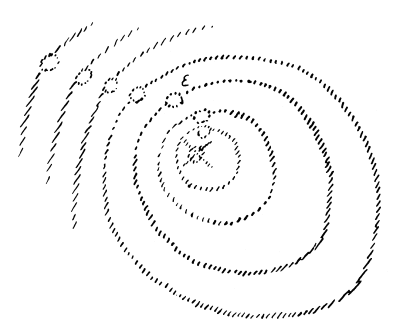
[ 20 ] We are not far at all from the age that will come to understand what this is all about. The spiritual powers on which Copernicus, Kepler, and Galileo depend are not concerned with true reality at all, but rather with instilling certain abilities into the human mind. What matters is the education of humanity through the education of the Earth, and humanity should think about the world in this way for a time, so that it may be educated in a certain way through its thoughts. This is what matters to the wise guidance of the world. For if one begins to view the matter spiritually—not merely as Copernicus, Kepler, and Galileo did, and especially their successors, in a purely external, mathematical, and physical way—but if one views it spiritually, one will come to other things, to very remarkable things. One might say: Well, now we have a physical world system; when one examines it, one must, of course, calculate and geometrize it, just as it is taught today in almost every elementary school. — But when viewed spiritually, things are different. You see, the spiritually educated observer, for example, is presented with the following. He observes a certain movement of the sun, and this movement of the sun proceeds like this—as seen from a certain point. Yes, that is correct; the movement proceeds like this, except that when I draw this here and trace the sun’s path back, the point does not coincide exactly with the earlier point, but lies slightly above it. This is a real movement of the sun that can be perceived spiritually.

[ 21 ] But the Earth, too, undergoes certain movements over the course of a year. And this is how the Earth traces this path, viewed spiritually (heavily hatched):
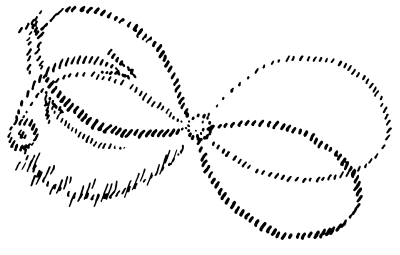
[ 22 ] You have to imagine this from a perspective. If you picture the Sun’s orbit lying in a plane, then the Earth’s orbit also lies in that plane, as seen from the side. If that were the Sun’s orbit, viewed as a line, the Earth’s orbit would look like this:
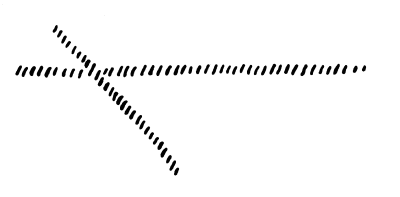
[ 23 ] But essentially, as you can see from this, there is a point in the universe where the Sun and the Earth are located—not at the same time, but approximately: while the Sun is at that point on its orbit, having moved a quarter of the way around, the Earth begins its movement at the point the Sun has just left. In fact, after a certain amount of time, we are actually in space at the spot where the Sun was; we follow the Sun’s orbit, so to speak, cross its path, and at a certain time of year arrive at the spot where the Sun was. Then the Sun moves on: ↷ the Earth moves on as well: ↶ and after some time, the Earth is once again roughly at the spot where the Sun was. We actually travel through space with the Earth, passing through the place where the Sun was. We sail through it; but we do not merely sail through it—the Sun leaves traces of its influence behind in the space it must traverse, so that the Earth enters the Sun’s traces—the traces the Sun has left behind—and crosses them, truly crosses them. For space has living content, has spiritual content, and the Earth enters into what the Sun brings about and crosses it, sailing through it.
[ 24 ] You see, this is how it looks from a spiritual perspective. Spiritually speaking, one must draw such lines when considering the orbits of the Earth and the Sun. A similar relationship exists with the other planets as well. At certain times, we are roughly in the same positions where Mercury was, and so on. The planets perform highly complex movements in space, in the cosmos, but they follow one another’s paths. Now we have the external picture, the purely geometric external picture; the other picture will be added, and only from the union of these two pictures will future humanity gain the understanding it must have.
[ 25 ] Look, I’m telling you this now. If you were to say this to an astronomer, he’d say: “Well, there’s just someone who’s gone mad, lost his mind, and is spouting such nonsense; that’s out of the question.” — But it wasn’t that long ago that even a famous Academy of Sciences said, when people were talking about meteorites—which, after all, fall from the sky to Earth—“That’s a crazy claim!” — That wasn’t that long ago at all. And there are many similar examples on record. Today, in classical physics, the law of so-called conservation of energy is recognized as a fundamental principle; the first person to articulate it, Julius Robert Mayer, was locked up in a madhouse! Of course, one could tell hundreds and hundreds of such stories. But the point is that you can see from this—I’m only citing it as an example—how the way of thinking regarding astronomical matters, this wonderful, successful way of thinking in the 16th, 17th, 18th, 19th centuries—was, in a sense, more suited to leading people away from reality: they do not, as they believe, stand with both feet, their hands, and their whole body firmly rooted in reality, but rather they give themselves over to highly fantastical notions and regard these as reality. This was precisely how humanity was to be educated during these centuries—so that, with regard to external nature, it would surrender to fantastical ideas—so that humanity would not, as in the old way, become completely absorbed in external events, but would thereby develop an even stronger sense of the inner self. It is precisely through these fantastical-materialistic ideas that the sense of the inner self has increased so tremendously among people in recent centuries. This had to happen at some point, for it had to be brought about in the course of human history. I have chosen an astronomical example here, but in every field it could be demonstrated how, in the centuries just past, human development proceeded in such a way that human beings were, so to speak, drawn away from true reality, from real reality.
[ 26 ] Now you will ask: Did people know about things like this—that we follow the sun’s path along with the Earth, and twice a year find ourselves in the very space where the sun has been active? Did people ever know anything about this at all? — Yes, they did know about it, and it can even be easily proven historically that they knew about it. Consider this: a person knows—knows for certain—that at a specific time during the course of the year, the Earth crosses the Sun’s path in its orbit in such a way that the Earth enters the Sun’s path, following in the Sun’s wake. The opposite occurs when the Earth returns to the other side. In one instance, it is as if the Sun were descending below the Earth’s orbit; in the other, as if the Sun were ascending, with the Earth’s orbit below it. At one time, so to speak, a person moves upward along the Sun’s path with the Earth, finding the Sun’s path as they ascend; at the other time, they move downward, descending below the Sun’s path. — What could a person say who knows this and also has the means to verify it, who has the means to know: Now, at the point where the Earth’s orbit crosses the Sun’s path, are we passing through the very spot where the Sun once stood? — What could such a person say? Such a person could say: This is a particularly important moment for us; we are at the place where the Sun has been! And this is expressed in the spiritual atmosphere, for one encounters the image that the Sun has left behind in the ether. That is when a festival is held! A festival is held at this precise moment. — And the ancient mysteries celebrated two such festivals each year, of which only—but please do not take this to mean that I am trying to specify the exact time—faint echoes remain in today’s festivals; yet the connections are no longer understood. But in the ancient Mysteries, people knew: Now we cross the sun’s path in such a way that we find in the ether the essence of the sun that has been left behind. The fact that people established major festivals at specific times of the year finds its guiding principle in such knowledge.
[ 27 ] With today’s knowledge, people are cut off from these connections. People today won’t show much respect for these things either; instead, they’ll say: “Well, what do I get out of it if I already know that I’m in the same place where the sun was?” — That’s roughly what people today would say. But that’s not what the ancient Egyptians said in their mysteries, for example. On the fifteenth of that month, knowing that: ‘Now the Earth is passing through the point that the Sun once left’—they asked the priestess who served Isis and had been thoroughly prepared at a hidden temple site, because they knew: through the special spiritual preparation that the Isis priestess was able to undergo, she brings to light what can be experienced when one passes through the Sun’s aura. — And the priests tried to glean from the words of the priestess of Isis what she had found in the sun’s aura, and they wrote down: a rainy year, sowing the seeds at a specific time—in short, all practical matters that were important for guiding life in the coming year. People likely acted accordingly, for they knew how the heavens influenced the earth. They tried to investigate this.
[ 28 ] It was already a time of decline when this science had been betrayed by opponents of the Osiris-Isis cult. The only way to save it—and this is the external event, which in turn is connected to the Osiris-Isis saga—was to share what had formerly been an ancient mystery confined to a single temple site in ancient Egypt at fourteen temple sites: this art of moving in step with the course of the year in this way and spiritually exploring the influences on Earth.
[ 29 ] The people of our age had to break away most of all from such a connection with heaven, because the people of our age were precisely meant to find the way to form the mere “I” out of the indeterminacy of drives and instincts. The “I” did not exert a very strong influence in the times when people made themselves entirely into instruments of celestial forces. The “I” did not exert a strong influence in the times when the priest announced to his immediate disciples: “There stand the Pleiades; when the Pleiades are there, we must begin the Isis Days; we must see what we can prophetically discern as the best way to conduct ourselves in the coming year.” — People placed themselves within the course of the world just as any cell places itself within our organism, within our entire organism. Humanity could become individual, become personal, only when, in a certain age, it was, so to speak, torn out of this context, when all those human mental faculties that mediated such connections fell dormant. And so the groundwork was laid for this spiritual slumber. And humanity has been in its deepest slumber with regard to spiritual matters since the 14th century. But now the time has come once again to awaken. It was a slumbering culture.
[ 30 ] Do not say: “I want to criticize creation and the Creator; why did He let people sleep?” — That is to place one’s own intellect above the wisdom of the worlds. Human evolution over the course of Earth’s history must undergo its period of slumber just as an individual human being must sleep over the course of twenty-four hours. The spiritual faculties lay dormant—that is, a worldview in accordance with these faculties, which lead to all of this. They lay dormant, deep in slumber, throughout the centuries mentioned. In contrast, humanity dreamed of geometric lines in space, dreamed and dreamed the dream of the Copernican, Galilean, and Darwinian worldviews, and used this dream—even resorted to deception—to experience a particular reality through it. For humanity needed this education. After all, it is the same with individual sleep. In the evening we are tired, so we fall asleep. Then we wake up refreshed with an inner sense of reality. In the evening we do not have that sense of reality. Had humanity continued to develop its ancient spiritual abilities—had they not fallen dormant—people would have grown weary and would never have arrived at reality at all. They arrived at reality precisely because they had strayed from it in their thinking, feeling, and social institutions. Because these abilities lay dormant, periods of renewal took place among humanity in earlier, bygone centuries. In a certain sense, humanity has indeed become freer than it was in earlier centuries, and will once again have to acquire spiritual knowledge—and later spiritual ability as well—in order to advance further and further along the path of freedom.
[ 31 ] Such things can be known. But then again, the true materialists of today will say: Well, so what if they can be known! — I have, after all, encountered materialists who say: Oh my goodness, am I really supposed to think about the life of the soul after death? I’ll see for myself when death comes; so why should I concern myself now, in my physical body, with this life after death?” — That seems to be a quite plausible thought—the idea that it might actually be unnecessary to concern oneself with the supersensible life here in physical life. But that is not the case; rather, it was only so in earlier times, when human beings were not yet destined for freedom. Now it is the case that certain thoughts can be grasped by the supersensible hierarchies only if they are grasped by human beings here in earthly existence. The gods think certain thoughts only when these thoughts live in human bodies. And these thoughts must be carried into the spiritual world through the gateway of death; only then can they take effect. It is truly so: The one who does not want to think about the supersensible is like a farmer who says to his neighbor: “You’re a stupid fellow; you set aside a certain portion of the seed every year! I may have only become a farmer this year, but I’m not as stupid as you; I’ll squander everything and eat it all up, and I’ll just wait calmly. It’ll grow all on its own!” — Such a farmer is like the person who refuses to acknowledge not only that what we experience here in the world must not be exhausted, but also that a certain seed must be sown in the soul to guide that soul along its path into the spiritual worlds. By engaging in spiritual science, one sows seeds appropriate for the present age. And this must be done!
[ 32 ] You can see from this that our age can become ever clearer and clearer to us precisely through spiritual comprehension of its fundamental structure and essence; for this internalization—which must be strived for in order to arrive at a true or truer astronomy—must also be striven for, for example, in relation to social thinking. For with regard to this kind of thinking, we have become just as asleep, just as dreamlike—at least most of us in our outer lives—as we are with regard to, say, astronomical matters, which I have chosen as an example. Over the past centuries and up to the present day, a great deal—indeed, a very great deal—has been veiled from humanity. Nor will what existed in the past ever happen again—such as, for example, conducting external research in this manner through an Isis priestess. But something similar was also done through the Druid priestess within the Celtic mysteries. It will no longer happen that people seek to recognize the influence of the spiritual in this way; much more inner paths will be found, paths far more suited to future humanity. But these will have to be found,
[ 33 ] Well, this ties in with something I alluded to yesterday. Do you think that the servant of Osiris prepared the priestess of Isis before the fifteenth of a certain month in order to obtain certain prophetic statements from her utterances as she passed through the solar space with her soul? What, then, was achieved through this service to Isis? What happened was that real time—not that abstract time of which people dream today, but real time—was explored. The season, the specific point in time, was, after all, a particularly important one; the point on the return journey was again an important point. How time works—but concrete, real time—was expressed through the content of what the priestess of Isis had to say. Could there not, then, be an inscription on the image of Isis that read: “I am the past, the present, and the future”? — This is the order of time. But only when such an exploration of wisdom is imbued with a noble spirit—one akin to the spirit of virginity—that is, when the approach of Isis is symbolized by her wearing the veil—only then could one truly bring forth what needed to be brought forth. The whole must have been steeped in holiness, in an atmosphere of sacrifice.
[ 34 ] In those ancient times, what was called wisdom was entirely connected to practice. Do not for a moment believe that wisdom was not connected to practice in those ancient times! Everything was organized in a practical way. In the Egyptian temples, people were already studying the voices of the gods; but they studied the voices of the gods in order to know precisely when the days or hours were in which to best tend the crops. Everything was connected to practical life. They studied the influence of the gods on practical life. People were aware of how the gods permeated practical life. It was indeed necessary that this temple service be kept sacred, for what mischief might have been committed if it had not been kept sacred! It is by no means to be claimed that these things—which must be spoken of in connection with ancient times—will reappear in the same way. They will reemerge in a completely, completely different form. But a kind of knowledge will be regained by humanity that is directly suited to intervening in practical life—a knowledge with which we will once again fully master the things around us, a spiritual knowledge, yet one that is practical precisely because it is spiritual—and this will arise once more. It will not be a cult of Isis that emerges, nor a cult of Osiris; but something else that will bear the traces of the fact that we have passed through the centuries that have elapsed since the cults of Isis and Osiris; that the new spiritual science must be sought with full consciousness and out of freedom. But to some extent, one will have to examine the events that have taken place to determine their reality. History will have to become something different from what it often is today, when it is researched solely on the basis of external records.
[ 35 ] This, however, leads to all sorts of rather strange interpretations, such as the one I mentioned yesterday in connection with Isis. When the inscription on the statue of Isis reads: “I am the past, the present, and the future”—those who were initiated knew how this related to the concrete reality, and that the veil merely expressed a certain state of mind. Today, people say of the veiled statue at Sais—the statue of Isis—that the veil expresses the fact that one cannot fathom the wisdom at all, that one will never know what Isis is. But if it says: “I am the past, the present, and the future; no mortal has yet lifted my veil”—and one does not interpret this to mean that the veil will never be lifted because one approaches the sanctity in question only in a veiled state, like that of a nun, but rather because, as so many say, there lies behind it something that cannot be known and that is not to be revealed to anyone—then this does not accord with what is written: “I am the past, the present, and the future; no mortal has yet lifted my veil.”—If that interpretation were a correctly developed one, as people believe, it would really amount to having to compare it with the trivial statement: “My name is Hans Müller, but you will never know my name.” — She does, after all, say who she is: “I am the past, the present, and the future”—and this refers precisely to the fact that she is meant to convey the mysteries of time, because what flows from time into space is, in turn, to be conveyed by the priest of Osiris. He is to carry the temporal into the spatial. He is to take in, in thought, that which comes from the soul, which is, so to speak, integrated into the universe and its course: the revelations of Isis.
[ 36 ] Today, spiritual science is still widely regarded as nonsense. But people will come to realize that, if one truly understands this spiritual science, it contains something far more real in terms of science than the scientific dreams of past centuries. And entirely, entirely different practical approaches—practical mastery of the external world—will emerge when the time is right. Today, the time is not yet right. Today, humanity must first come to recognize, so that, in the spirit of spiritual science, it may recognize beforehand, before it can act in the spirit of spiritual science.
[ 37 ] I wanted to explore this in order to point out, especially now, how only through a true understanding of what has happened can an understanding also be gained of what must happen, so that humanity may be led beyond and past certain things in the future—things whose karma it bears heavily in our present days of suffering and pain. Today, humanity bears the karma of the dream-life of past centuries. This mystery must first be grasped in its depth; only then will we better understand our suffering present, and also understand how, little by little, humanity will have to prepare a different karma for the future.