

Humanity's Internal Impulses for Development
Goethe and the Crisis of the Nineteenth Century
GA 171
14 October 1916, Dornach
Translated by Steiner Online Library
Eleventh Lecture
[ 1 ] If you reflect on what has been presented here in the preceding considerations, it will become clear to you that the evolution of modern humanity contains within itself two—one might say—opposing impulses toward its further development, two opposing impulses that, in a certain sense, must be averted by what spiritual science is meant to contribute to this evolution. We have, after all, contrasted these two impulses in a variety of ways. We have shown how one impulse, after a long period of preparation through various forces that we have identified—forces rooted in the supersensible and subsensible worlds—has coalesced for human thinking and striving into what might be called the physical kinship of beings and forces—that is, kinship, as we have said— and that which joins this sense and striving for the kinship of beings—namely, for the contemplation of human existence, if one uses the word as we have used it—is birth. As a kind of social ideal, so to speak, standing alongside this sense and striving for the physical kinship and physical origin of beings is what we have called happiness, which, particularly in the 19th century, has been elevated to the principle of mere utility. On the other hand, we have seen that this is countered by another impulse, one directed less toward how a person enters existence through birth than toward pondering the problem: How does a person pass through the gate of death? Thus, in place of birth, the contemplation and pursuit of an understanding of death takes center stage. The physical interconnection of forces and beings is replaced by a contemplation of evil, pain, and suffering in the world. And as a kind of social ideal, this is accompanied by what we might call redemption from or within existence, liberation, and so on.
[ 2 ] We have seen that Western culture tends more toward what is indicated on the left (see diagram on page 238), while Eastern culture tends toward what is indicated on the right here, insofar as these cultures do not feel enriched by universal human sensibilities and aspirations, by the universal human ideal, but rather leave themselves to whatever, so to speak, befalls them by virtue of their ethnic, climatic, and other local characteristics. We have seen how, under the influence of these general impulses, certain concepts and ideas also take on a specific hue or nuance, so to speak. We have seen how perfectly what might be called the “struggle for existence,” “survival of the fittest,” and so on, fits into the main impulses taking shape in Western culture, and how this has been countered in the East—in a manner no less scientific than the way the struggle for existence emerged in the West—by what might be called the “mutual aid of beings.” And I have explained to you how what the West sought to achieve through the one-sided principle of the struggle for existence—which rests on the foundations I outlined to you last time—was intended to lead to an understanding of the evolution of living beings. It was said that whatever fares best in the struggle for existence survives, while whatever fares worst perishes, so that, in a sense, the better-adapted—that is, the relatively perfect—emerges from the imperfect. What the struggle for existence means in this context is, for those Eastern sciences whose truly significant findings Kropotkin summarized in his book—which I quoted to you recently—mutual aid. It is believed that those animal species have the best chances of evolving toward perfection within whose ranks the principle of mutual aid is most widely established.
[ 3 ] And so we could cite many examples that would attest to how these two polar impulses have, in a sense, truly entered into human evolution today. This is what we must, I would say, observe with discerning eyes; for if spiritual science is to fulfill its task, it is essential that both one-sidednesses be avoided and that both polarities work together to form a whole. What I will outline in the course of today and tomorrow—today as a preparation, and tomorrow we will then proceed to the consequences— is not presented as if it were compelled to enter the world under all circumstances as though by a mechanical necessity; rather, it is meant to show that evolution tends toward these things, and that we must specifically avoid what the one-sided development of these two poles might bring about. If one does not recognize what, so to speak—without forcing the word—wants to come into being, then one cannot find the right path to bring into being the synthesis, the unification, that can be achieved solely through spiritual science.
[ 4 ] If we first consider everything that is, as it were, supported by these abstractions here (see diagram on page 238), we must say: That (on the left) is a spiritual cultural impulse that seeks to come to life, and which finds its full justification in the single tendency of the fifth post-Atlantean cultural epoch. I have shown you how this fifth post-Atlantean cultural epoch has developed human beings in such a way that, on the one hand, they must strive for what Goethe calls the “primordial phenomenon”—the pure, hypothesis-free, non-fantastical observation of what external natural phenomena present to the senses: the primordial phenomena. That is one aspect. The other (on the right) consists of imaginations rising more and more from the depths of the human soul, freely shaped by that soul. These imaginations will, one might say, arise with an inner necessity of the soul in certain people of our fifth post-Atlantean epoch. Just as the people of this fifth post-Atlantean epoch will be increasingly inclined, on the one hand, to observe nature and its phenomena with an open mind, seeking primordial phenomena rather than hypotheses, so, on the other hand, certain people will be particularly inclined to allow imaginations—which can lead deeper into the spiritual world—to rise from their souls.
[ 5 ] Even today, we have no idea where humanity is headed in this regard. One can resist the direction in which we are being steered, but this will not stop it or prevent its coming into being. More and more, people will cease to invent all sorts of hypotheses about natural phenomena; they will truly devote themselves purely to what constitutes a spiritual interpretation of the phenomena, as Goethe did in his physical observations. As Goethe so beautifully put it once: One should not formulate hypotheses about natural phenomena; the blue of the sky itself is the theory; one should simply seek nothing behind the phenomena when they are perceived purely. — All this speculation about all manner of atomic configurations and atomic structures will cease; the senses will be directed purely toward the phenomena and will arrange these phenomena in such a way that they explain themselves. Admittedly, this is still in its infancy today, but it will continue to develop further and further. Today it is in its infancy, and those who, for example, have studied chemistry in recent decades know full well what kinds of atomic structures—purely hypothetical—have been constructed. Such ideas are often peddled to the public by all sorts of monist and other lay associations long after they have been long since superseded by science. Precisely with regard to the hypothesis of atomic structures, there is, after all, a wide-ranging discussion, and it is not uninteresting to reflect on what has been discussed there. After all, most people still get a slight shiver down their spine at the achievements of science in this field when people talk about it: “The atom of this substance looks like this, the atom of that substance looks like that,” and so on. People don’t stop to think that these are mere hypotheses, mere figments of the imagination, that are being presented to them. In particular, van’t Hoff was recently one of those chemists who devised bold stereometric models in an attempt to understand the atom. And we know—at least most of us do—that even Theosophists of a certain school have gone along with this nonsense of constructing the atom to a great extent. A wild “science”—which can never truly be science—known as “occult chemistry” has been developed and has, in fact, found quite special recognition among those who wish to approach this supposed science from the perspective of theosophy or similar doctrines. But van’t Hoff has not remained unchallenged. It was precisely discerning chemists, such as Kolbe, who turned against what Kolbe calls van’t Hoff’s “hallucinations.”
[ 6 ] Incidentally, you can see from this that the term “hallucination” is not only applied to the spiritual realm, but that even natural scientists themselves sometimes use this term to describe their mutual findings. Indeed, Kolbe, who wishes to confine himself to pure phenomena in chemistry, even used that lovely phrase, saying: “Van’t Hoff rides the chemical Pegasus—which, as a natural scientist, he must have borrowed from the veterinary school affiliated with his laboratory—and in this ride on the chemical Pegasus, he discovers all manner of bold stereometric forms.” — One can only ever hint at this inner workings of science. It would require many, many lectures to show the premises on which this is based—what is today presented to the layperson as a certainty. All these things, these speculations with which the second half of the 19th century in particular dealt with regard to external nature—all of that will gradually have to fade away; for science itself will become increasingly convinced that these speculations are in no way justified by the sequence of phenomena, that one can always propose the most diverse hypotheses, and that just as much can be said in favor of each as against it. The pure observation of phenomena, on the one hand, will be a legitimate impulse.
[ 7 ] On the other hand, however, in this fifth post-Atlantean epoch—which, as we have heard, will last for many centuries to come—the human soul will be just as inclined to form imaginations. Many will regard these imaginations as mere fantasy, as mere figments of the imagination. But these imaginations will be generated by the human soul in order to gradually lead that human soul into the realm of the spiritual world. That this is the case in the fifth post-Atlantean epoch is based on a certain fact—a fact that can be discerned by spiritual science, a fact that is still far from being acknowledged by external physiology (though this will be the case later), but which can nevertheless already be taken into account by spiritual science. The entire human constitution of the organism has in fact become truly different from that of the Greco-Latin period, which began in the 8th century B.C. and ended in the 15th century A.D. This can, of course, only be recognized today through the contemplative consciousness; but it can indeed be recognized.
[ 8 ] Human beings essentially consist of the same earth-like, water-like, air-like, and heat-like elements as the external natural world. They are permeated just as much by the light-like, by chemical laws, and by the living as the external natural world is. Thus, human beings are permeated by both the grossly physical and the etheric; only subtle differences emerge in the human constitution across the successive periods of human evolution. As much as people today generally believe in evolution in nature, they are just as reluctant to delve into the finer nuances within that evolution. The human body, in its connection with soul and spirit, was, after all, quite different in the Greco-Latin period than it is during our present fifth post-Atlantean period. The main difference lies in the fact that during the Greco-Latin period, what can be described as the earth-like element—that is, the element which, in contrast to the watery element, possesses the earth-like constitution and solid cohesion—was, insofar as it is present in the human organism, closely bound to what can be called the life-ether. So one can say—if one retains the old terms “earth” and “life ether” (which are contested today, but what does that matter to us?)—that there was a close interaction between the life ether and the earth-like, that is, the solid element in human beings during the Greco-Latin period of development up through the 15th century. And the distinctive feature of modern human beings is that a loosening is taking place between the life ether and the earth-like element. So a loosening is taking place. The life ether in modern human beings is no longer as firmly connected to the earth-like element as it was during the Greco-Latin cultural epoch.
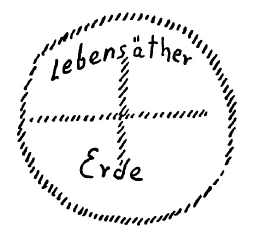
[ 9 ] These things can be established. But today I would like to direct your thoughts more toward another area and return to this very topic tomorrow, in order to offer you some supporting arguments for the fact I have just mentioned: that what a human being experiences throughout their entire organism due to the life ether within them is, in our time, much more distinct from what is experienced as a result of the earth-like element than was the case in the Greco-Roman era. This, however, brings about the situation where experiences arising from the earth-like element necessitate a pure observation of the external world. Precisely because the earth-like element is being loosened, it becomes possible to observe the primordial phenomena unclouded by hypothesis. And because the life ether is separating, it will be possible to experience within this separated life ether that which permeates the human being with imaginations rooted in the supersensible world. It is precisely through this loosening that this is the case.
[ 10 ] Now, in those cultures that are dominated by Western ideas (see diagram on page 252), human organization—because it always develops in a one-sided manner—tends more toward directing attention to what is experienced through the earth-like element in human beings. In cultures inclined toward evil, death, liberation, and mutual aid, nature, through its inherent tendencies, tends to direct attention more toward what can be experienced as a result of the life ether. These are the two one-sided tendencies: the one-sided tendency of the West, which is experienced more as a result of the earthly, earth-like element in human beings, and the one-sided tendency of the East, which is experienced more as a result of the one-sided experience in the life ether.
[ 11 ] It is precisely these reflections that lead us into the deepest mysteries of evolution in our time. And they must certainly be taken into account, for they threaten humanity, in a sense, with the one-sided assertion of polar, mutually opposing impulses. Today, this evolution—of both impulses—has not yet progressed very far, but for those who do not wish to bury their heads in the sand when it comes to life, who do not wish to numb themselves in the face of reality, it is already clearly perceptible—provided they possess the concepts necessary to grasp these matters. On the one hand, there is an ever-increasing urge to accept only the sensually real; on the other hand, there is an urge to accept only that which comes from the world of the imagination as legitimate—not only in knowledge (where this may be least evident), but in everything that permeates and shapes life, particularly in what one seeks to introduce into social life. This is where these things are developing. For one group—the one on the left (page 252)—this is already clearly visible; for the other group, we are only just at the very beginning of a different insight. One impulse is to combat the imaginative life, at least in the realm of knowledge, and to accept only the mere phenomenon. You can see this tendency expressed quite clearly when you consider everything that Darwin himself wrote. For it was Haeckelism that first introduced hypotheses and theories into Darwinism. With Darwin, we always find the desire to describe the phenomena. He merely draws the broad outlines from the premises to which I recently drew your attention, and he draws these broad outlines based on what life strives for within this cultural community—namely, to accept only the external physical reality and to focus more and more exclusively on the external physical, to combat the imaginative world, to eradicate the imaginative world, and to eradicate it from social life as well. And so, I would say, a very specific ideal of humanity emerges from this complex of concepts—an ideal that seeks to eat its way into everything and permeate everything, that seeks to make human beings, in a certain way, into knowers—knowers who survey the external physical world but adopt a dismissive attitude toward everything that leads into the spiritual world. Sometimes he deludes himself into thinking that he is not actually adopting a dismissive attitude, by coining all sorts of words for strange concepts that are supposed to be spiritual, often even mystical, but which in reality amount to nothing other than what I have just characterized.
[ 12 ] This is the case, for example, with Bergson’s philosophy. Certainly, many people today believe that Bergson’s philosophy is a kind of mysticism and that it intrudes into contemporary life as such. But what matters is not what one thinks about something, but what actually results in reality. And this supposed mysticism will nevertheless lead not to a refutation, but to a support of a purely positivist worldview.
[ 13 ] Certainly, this cultural impulse contains all the elements necessary to bring about the primordial phenomenal; but it also gives rise to the one-sided tendency to label everything imaginative as a product of the imagination and to eradicate it from what is called science—and this with regard to human beings as knowing beings.
[ 14 ] Even with regard to human beings as agents, as social beings, the groundwork was laid for the principle of the mere utility of experience and action—in what is externally perceptible, what is externally present, what has value for human beings between birth and death—to come increasingly to the fore, and everything else is, as it were, meant to exist solely so that what is present in the sensory world may be properly harnessed to a world that brings happiness or to a world of utility. Laws and ideals are created, as it were, to better enjoy the sensory-real. This tendency can be clearly perceived among both the utopians and the socialists of the West. It permeates everything—I would say from Mora to Comte, from Adam Smith to Karl Marx—it appears everywhere in theory. But it also appears in everyday habits; it permeates social feeling, social thought, and also action. And one can say: The ideal of humanity that takes shape under the influence of these impulses—which are here only roughly indicated by a few abstractions—is, one might say, the specter of the bourgeois, which haunts, like a kind of ideal, wherever this characterized, one-sided impulse seeks to drive itself one-sidedly into existence. It is nothing but a delusion about the most essential things when socialists today often believe they are no longer dominated by the bourgeois ideal. They often strive all the more toward the bourgeois ideal by gradually seeking for themselves what the bourgeoisie attained during the very period in which the bourgeoisie first rose to prominence. The bourgeois recognizes the sensory world and considers what is relevant to him. Concepts and ideas exist only to hold the sensory world together with brackets. The bourgeois experiences himself in what is essential for the period between birth and death, and regards everything else—whatever social institutions or social ideals may be conceived—only insofar as it can promote that which is enclosed between birth and death.
[ 15 ] Many who are today deeply entrenched in this ideal of bourgeoisie will, in their minds, fiercely resist it. But what Mephisto says applies to them as well—perhaps in a slightly different form: “The little people never sense the devil, even if he had them by the collar.” Thus, people often fail to notice the very thing that influences them the most.
[ 16 ] Well, last time I described to you how, had certain circles achieved what they wanted with Blavatsky—which was ultimately thwarted—the spiritual realm would have been placed in the service of the purest bourgeois ideal, just as the mental realm would have been: Information centers would have been set up in which mediums would have been used so that, in this way, “through the power and voice of the spirit,” one could have learned many a stock market secret and other mysteries of life. Incidentally, there is plenty of documentary evidence to show that this urge is not entirely without resonance in the hearts of people today; for it is not uncommon for me to receive letters from people who write again and again, claiming they have lost their fortunes and asking me to tell them, based on revelations from the spiritual world, which number will be drawn for this or that lottery, and similar things. You may laugh at this, but such occurrences are not entirely uncommon—and especially among certain social circles—so much so that you would often be astonished if you were told the names of the people who write such things and similar requests.
[ 17 ] So even the spiritual—the power to look into the spiritual world—is not conceived by this one-sided impulse as a means of entering the spiritual world, but rather, if such powers do exist, as a means of bringing them into the physical world in order to advance the physical world in accordance with the principle of utility. That is a one-sided view. I want to describe it abstractly today; tomorrow it will be more concrete.
[ 18 ] The other form of one-sidedness that threatens the evolution of the fifth post-Atlantean period is the one that is one-sidedly influenced by those concepts and ideas in which the great achievements of the phenomenal world are rejected, while the cultivation of the imagination is prioritized above all else. This is still in its very early stages, much more so than the other one-sidedness. But anyone familiar with the development of Russian intellectual life is also familiar with the manifold one-sidednesses in this area. For within many Eastern circles, the predisposition toward significant imaginings is emerging more and more. Anyone who reads—as I would recommend—the first volume of Soloviev’s translation can see for themselves the form such imaginings take; in the “Three Conversations,” at the end of the volume, you will find how truly significant, profound imaginations arise in this most important Russian philosopher. This penetration into the spiritual world—even if it is often one-sided, even if it is often skewed—that is not what matters now; what matters is that this is emerging as a certain predisposition. This is characteristic of the other one-sided impulse in our evolution during the fifth post-Atlantean period. A way of life will emerge that attaches little value to worldly phenomena, but instead places ever greater value on the imaginations that human beings bring forth from within themselves—imaginations that can often rise to the level of a visionary life. A particular preference will develop for such a visionary way of life, along with everything that accompanies it.
[ 19 ] That which is driven by Western impulses disregards spiritual connections and focuses on the physical and sensory; what is individual there must therefore incorporate spiritual connections—since they are meant to manifest only physically—into physical forces; that is, the spiritual must flow as much as possible into the power structure of social life. Consequently, this one-sided power structure strives for vast empires and powerful organizations that destroy individuality. Even if such developments are only in their infancy today—and thus cannot be seen by those who refuse to see them—this does nothing to advance the recognition of truth. In the East, by contrast, the spiritual is present directly within each individual human being. After all, it is only through their individuality that human beings can make the spiritual a reality here in the physical world. Therefore, everything under the influence of these impulses strives toward the dissolution of external power structures—toward the dissolution of everything that seeks to bind people together through treaties, laws, state organizations, and so on—and strives much more toward sectarianism, toward isolation, and toward the negation of external power structures. Such things are often concealed. But when large power structures and organizations emerge in the East today, this is initially merely a reaction against the very principle of the East—namely, to form numerous small communities of a sectarian nature, not only in the realm of religious life but also in the realm of social life and in views regarding the most ordinary, everyday coexistence. All of this strives toward the dissolution of the imperialist order. And the ideal of humanity that is taking shape there is that of the human being who wishes to go through life in order to free himself from life, to pass through death as strong as possible, to overcome the impulses of evil as strong as possible, and to seek liberation from that which has validity only between birth and death. This is what is sought within these cultural communities: to go through life in such a way that the human being can devote himself entirely to the imaginative world struggling within him—in a sense, forming a kind of cosmos, a spiritual cosmos within himself—unconcerned with external circumstances. While, on the one hand, external circumstances will become increasingly important, and while people will dream more and more of external circumstances and seek bliss in them more and more, on the other hand, the “desire to pass through” human life will always arise. While in the West the ideal of humanity is the bourgeois, in the East the ideal of humanity is—I can’t think of another word for it at the moment—the pilgrim, as they say in some German dialects: the “Bilcher,” who makes a pilgrimage through life, who regards life itself as a pilgrimage, and who, in essence, continues on this pilgrimage until he passes through the gate of death, so that there, with a strong soul that has borne all his experiences, he may enter into true liberation. If this impulse develops one-sidedly, it will deny a firm grounding in the other impulse.
[ 20 ] These are the two one-sidednesses: on the one hand, life confined to phenomena and appearances; on the other, life confined to imaginations that refuse to connect with external life. And what looms as a threat—because everything in the world must inevitably clash—is that these two one-sided impulses will enter into conflict with one another, engaging in ever-increasing conflict. This conflict will, in fact, be one of the defining characteristics of the fifth post-Atlantean epoch. On the one hand, there will be an ever-increasing drive to create coercive organizations; on the other, a drive to dissolve them. The issue simply isn’t yet so apparent, because people still hold the notion that what is unfolding today in the Russian East, for example, as a seemingly vast empire, is a reality. But with such matters, one encounters far more slogans and false notions than what is actually real. In reality, there are no greater contrasts than those between what is taking shape in the imperialism of the European and American West and what is taking shape in the East, extending even into East Asia. These are complete opposites. And even what animates the West in many respects—what is called there the “national principle”—is today regarded as something identical or similar to what is called “Pan-Slavism” in the East. There is no greater nonsense than this; for Pan-Slavism is anything but a national phenomenon. It is only seemingly branded as something national—even by the Pan-Slavists themselves—through the catchphrases of the West; in reality, it is precisely what will dissolve the national. As paradoxical as these things may still seem today—because what is completely different from one another is often described as the same thing—and as paradoxical as what I have to say may appear, it is deeply rooted in the truly driving forces. [Written on the blackboard: ]
| I | II |
|---|---|
| Kinship | Evil (Suffering, Pain) |
| Birth Bliss (Usefulness) |
Death Salvation (Destiny) |
| Struggle for Existence | Mutual Aid |
| Bourgeois | Individuality |
[ 21 ] Thus we see how two one-sided impulses threaten synthetic evolution and must be grasped with clear minds, because all concepts, ideas, and ideals—whether in the realm of knowledge or in the social sphere— can only be properly established for the future if one is truly aware of these impulses, if one knows that—whether one is now reflecting on law, morality, religion, or any natural phenomenon—these two concepts are always striving upward from the subconscious of the human soul and seek to shape one’s concepts. If one thus considers the development from the fourth post-Atlantean epoch—the Greco-Latin epoch—up to our fifth post-Atlantean epoch, one can see how what I intend to substantiate in more detail for you tomorrow as a fact must necessarily emerge as the dominant force in culture. If one considers characteristic phenomena, one can see this. Take, for example, a work such as a drama by Calderón, who died in 1681 but whose entire body of work reflects the lingering effects of the fourth post-Atlantean epoch—the Greco-Latin epoch. Let us consider, for example, the following work by Calderón: The hero of this play, Cyprianus, is a pagan magician thirsty for knowledge who has studied everything a pagan magician of his time could study. Thus, this drama, written at the beginning of the 17th century, presents Cyprianus—still entirely in the spirit of the fourth post-Atlantean culture—as a pagan magician who has studied everything “with fervent effort” and who now reflects deeply on religious matters and questions of natural knowledge, seeking to know “what holds the world together at its very core.” And as he strives for such knowledge, an evil demon appears to him—both spiritually and physically—promising to truly initiate him into the world he seeks, to let him discover “what holds the world together at its very core,” This evil demon, who appears to him in human form, causes love—which he had not known until then—to be kindled within Cyprianus: a longing for love. The evil demon also kindles this longing for love in a young girl in order to bring about a clash with Cyprianus’s longing for love. And so, in the drama, we are led to Justine, who is a true Christian. But the demon approaches her and wants to bring her together with Faust—or rather, Cyprianus. She resists, and the demon has no power over her. — This is in keeping with Calderón’s view, for she is a Christian. So the demon seizes upon a way out. He cannot bring Justine—Gretchen—herself to Cyprian; so he extracts a phantom from her. He separates it out, and this phantom in human form he now brings to Cyprian, who now believes he has Justine in his arms. But she very soon reveals herself to be a ghostly apparition. Now Cyprian addresses the evil demon in roughly these words: “Evil spirit, depart from me, or transform this ghostly apparition into a human being of flesh and blood!” — But the evil demon has no power over her, not only because Justine has just been to confession, but because she is a Christian in the first place. And when Cyprianus sees this, he decides to turn to Christianity—he has been a pagan magician until now—and the demon cannot prevent it. After undergoing long trials, having spent a year learning the mysteries of nature and the spiritual essence within nature, but also having internalized the Christian principle and the Christian impulse, he appears at precisely the same time that Justine’s father and Justine herself have been sentenced to death as Christians. And he now appears before them and demands to become a Christian. They die together as well. And the demon appears, riding a serpent, and proclaims once more how the one who can thus take in the Christ impulse within himself can be redeemed.
[ 22 ] Of course, I need not say—for I have already hinted at it many times, even if only by slip of the tongue—that we have in Calderón’s Cyprianus a true precursor of Faust. But there is a characteristic difference, and let us examine this characteristic difference. Let us not dwell on what certain aesthetes—who consider themselves particularly clever—have said about this drama: that it offends the modern aesthetic sensibility when Calderón, after the deaths of Justine and Cyprian, has the demon appear riding a snake, for it is enough to have seen him emerge through the ebb and flow of passion—all the way to tragedy, to the purely human. There is no need for the demon to appear and seal that outcome. — One can leave that to the very clever people of the present, who simply do not know that people back then—including Calderón—were interested in what the evil demon himself then experienced. But as I said, I do not wish to get into that; I want to draw attention to another difference that is truly worth considering. When one experiences Justine in this way—of course, with the differences that were bound to arise, since one is a 17th-century Spanish drama and the other is Goethe’s Faust—and when one takes a close look and sees certain similarities—along with differences—between Justine and Gretchen, for example, one will inevitably say: this figure of Gretchen is very similar to that of Justine in her artistic disposition, in every respect. But throughout the entire development of the drama, there is a considerable, significant difference. Cyprianus and Justine experience physical death together—a physical martyr’s death—and with that, Calderón’s drama comes to a close. Then there remains only the demon riding the serpent, who seals the outcome and articulates its meaning.
[ 23 ] With Goethe, we see something entirely different. If we consider the entire Faust—both the first and second parts—we see that, as the drama unfolds, Gretchen passes through the Gate of Death at the end of the first part, while Faust continues to develop. And at the end, we see how Faust and Gretchen are reunited. But Gretchen, who has long been in the spiritual world above as a soul, is brought back to Faust. This is what is bold, grand, and powerful: that even at the end of Faust, Goethe reunites Faust and Gretchen, but presents Gretchen as a soul who passed through the gate of death long ago. The man, the poet of the fifth post-Atlantean epoch in Goethe, is far more spiritual than the poet in Calderón, who still represents the echo of the fourth post-Atlantean epoch. Certainly, Calderón was better able than Goethe to look into the spiritual world. Hence, on the one hand, there are Justine and Cyprianus, both passing through the gate of death as physical human beings at the same time; on the other hand, there is the spiritual world: riding the serpent of the demon, and other spiritual events as well. But I would like to say that the two are clearly separated. And that is what is significant: in the fourth post-Atlantean epoch, where there is a close connection between the life ether and the earthly realm, the spiritual and physical worlds are strictly separated. Now the two perspectives diverge: that which is experienced between birth and death, and that which is experienced in the spiritual world. But the relationship between them must also be sought. This is expressed so wonderfully, magnificently, and powerfully in the fact that Faust and Gretchen do not die at the same time, and yet the conclusion of the second part of Faust brings Faust and Gretchen together: the spiritual and physical worlds are poetically interwoven; after they first drift apart, they are woven together. Here, in this creation of Faust, you have one of the first great attempts of the fifth post-Atlantean epoch to unite these two things: the physical world of phenomena and appearances, and the spiritual world of imaginations. And this was precisely the difficulty for Goethe — as can be seen from his conversations with Eckermann — to create the powerful final vision that reunites Gretchen, who has long since passed through the gates of death, with Faust, and thus to make the entire world that Faust experiences after Gretchen’s death—this world of physical experiences that Faust has lived through since her death—meaningful for Gretchen as well. Certainly, Faust is also dead when he meets Gretchen, but one sees that Gretchen’s influence is conceived in connection with Faust, whereas all of Faust’s experiences—from the beginning of the second part to the death he himself undergoes at the end—are conceived in connection with what lies above in the spiritual world, where Gretchen already resides.
[ 24 ] Goethe, for his part, initially depicted—in poetic form—a spirit that seeks to unite these two one-sidednesses and to fashion a synthesis. And it is precisely this that one can so clearly discern in Goethe. Just consider how Goethe, for his part, also strove to gain an understanding of the kinship among living beings—not by seeking a merely physical order, but by attempting to enrich, through his imagination, the kinships that had revealed themselves to him in contemplation. This comes across so beautifully in Faust, where we see how Goethe poetically has Faust express—in the beautiful words from “Forest and Cave” that I have often quoted—what Goethe himself had already grasped about the interconnectedness of living beings:
Sublime Spirit, you gave me, gave me everything,
That I asked for. You did not in vain
Turn your face toward me in the fire.
You gave me the magnificent natural world as my kingdom,
The power to feel it, to enjoy it. You do not
do you merely allow me to be a cold, marveling visitor,
but grant me to gaze into its deep bosom
as into the bosom of a friend.
You lead the procession of the living
past me, and teach me to know my brothers
in the quiet thicket, in the air and water.
And when the storm roars and creaks in the forest,
The giant spruce, crashing down, sweeps aside
Neighboring branches and trunks, crushing them as it falls,
And the hill thunders with a dull, hollow roar at its fall,
Then you lead me to the safe cave, show me
Myself, and within my own breast
Secret, profound wonders unfold.
[ 25 ] Here we see the world of phenomena viewed in its pure form, but as a gift from that sublime spirit to which Faust seeks to draw near. Humanity must become increasingly aware that external nature must not be speculated upon, for if it is speculated upon, senseless theories will gain more and more ground; rather, external nature must be purely contemplated, and the mysteries of this external nature will be revealed to the people of the fifth post-Atlantean epoch as imaginations rise from the soul to unveil the spirit of nature. From two directions, human beings will come to know what constitutes their cognition, their knowledge, and their social life: on the one hand, through an ever-expanding understanding of the external interrelationships of the immediate sensory world, and on the other hand, through the grasping of real imaginations originating in the spiritual world. We will then continue these reflections tomorrow. Today I wanted primarily to introduce preparatory concepts, and tomorrow we will then move more into the concrete aspects of spiritual life.